
Chapter 19 Who Gets What The Distribution of
Chapter 19: Who Gets What? The Distribution of Income Prepared by: Kevin Richter, Douglas College Charlene Richter, British Columbia Institute of Technology © 2006 Mc. Graw-Hill Ryerson Limited. All rights reserved. 1
Chapter Objectives n 1 a. Use theory of rational choice to explain how taxes affect the quantity of labour supplied. 1 b. List three factors that influence the elasticity of labour supply. n 2. Explain how the demand for labour is a derived demand. © 2006 Mc. Graw-Hill Ryerson Limited. All rights reserved. 2
Chapter Objectives n 3. List three factors that influence labour demand. n 4. Describe the impact of technology and globalization on the demand for labour. n 5. Explain what is meant by efficiency wages. © 2006 Mc. Graw-Hill Ryerson Limited. All rights reserved. 3
Chapter Objectives n 6. Define monopsonist and bilateral monopoly. n 7 a. Discuss real-world characteristics of labour markets. 7 b. List three types of discrimination. n 8. Describe how labour laws and labour unions have improved working conditions. © 2006 Mc. Graw-Hill Ryerson Limited. All rights reserved. 4
Distribution of Income n Income represents the amount of money a person earns a year; it is a “flow” concept. n The total amount of money a person has accumulated is one’s wealth; it is a “stock” concept. © 2006 Mc. Graw-Hill Ryerson Limited. All rights reserved. 5
Distribution of Income n Share distribution of income is the name given to this relative division of total income among income groups. © 2006 Mc. Graw-Hill Ryerson Limited. All rights reserved. 6
Distribution of Income n Socioeconomic distribution of income is the allocation of income among relevant socioeconomic groupings. © 2006 Mc. Graw-Hill Ryerson Limited. All rights reserved. 7
Lorenz Curve n A Lorenz curve is a geometric representation of the share distribution of income among families in a given country at a given time. © 2006 Mc. Graw-Hill Ryerson Limited. All rights reserved. 8
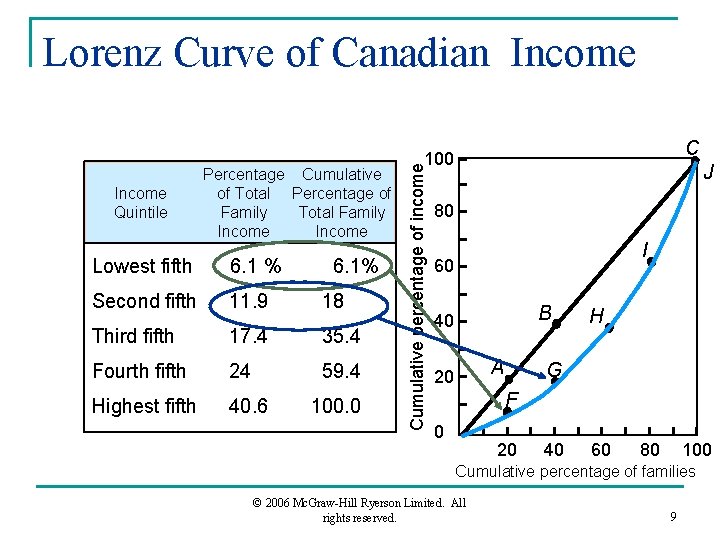
Lorenz Curve of Canadian Income Lowest fifth 6. 1 % 6. 1% Second fifth 11. 9 18 Third fifth 17. 4 35. 4 Fourth fifth 24 59. 4 Highest fifth 40. 6 100. 0 Cumulative percentage of income Income Quintile Percentage Cumulative of Total Percentage of Family Total Family Income C 100 J 80 I 60 B 40 A 20 H G F 0 20 40 60 80 100 Cumulative percentage of families © 2006 Mc. Graw-Hill Ryerson Limited. All rights reserved. 9
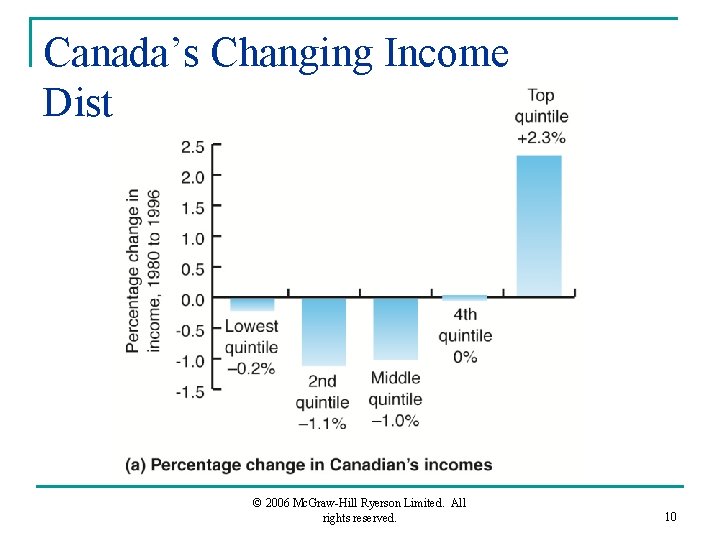
Canada’s Changing Income Distribution © 2006 Mc. Graw-Hill Ryerson Limited. All rights reserved. 10

Canada’s Changing Income Distribution Income Quintile 1980 1996 Lowest fifth 6. 3 % 6. 1% Second fifth 19. 3 18 Third fifth 37. 7 35. 4 Fourth fifth 61. 7 59. 4 Highest fifth 100. 0 Cumulative percentage of income 100 Line of equality 80 60 1980 40 1996 20 0 20 40 60 80 100 Cumulative percentage of families © 2006 Mc. Graw-Hill Ryerson Limited. All rights reserved. 11
Canadian Income Distribution n Some of the reasons for this income inequality are q q q Economic restructuring Household restructuring Restructuring of government benefits. © 2006 Mc. Graw-Hill Ryerson Limited. All rights reserved. 12
Canadian Income Distribution n During the ’ 80 s and ‘ 90 s technological changes and international competition caused a shift toward the “flexible work force” in Canada. n Nonstandard employment increased, such as part time, overtime, subcontracting, selfemployment and work at home – all nonpermanent positions. © 2006 Mc. Graw-Hill Ryerson Limited. All rights reserved. 13
Canadian Income Distribution n Household restructuring occurred partly because of the changing economy, and partly because social views and customs have also changed. n Dual income families became the norm. © 2006 Mc. Graw-Hill Ryerson Limited. All rights reserved. 14
Canadian Income Distribution n A single income household cannot compete with the earning power of a two income family. n In addition, reductions in employment insurance benefits and in social assistance means that a period of prolonged unemployment will have a devastating effect on a family. © 2006 Mc. Graw-Hill Ryerson Limited. All rights reserved. 15
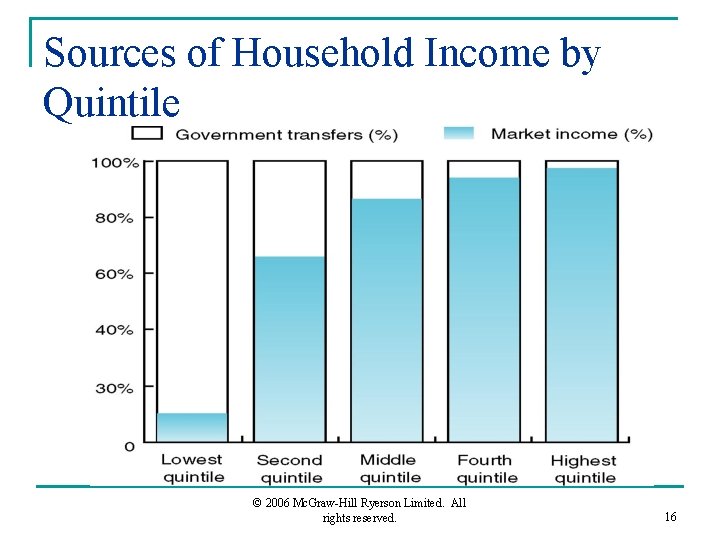
Sources of Household Income by Quintile © 2006 Mc. Graw-Hill Ryerson Limited. All rights reserved. 16
Defining Poverty n The LICO is set as the income at which families spend 20 percent more of their income on food, shelter and clothing than does the average Canadian family. © 2006 Mc. Graw-Hill Ryerson Limited. All rights reserved. 17
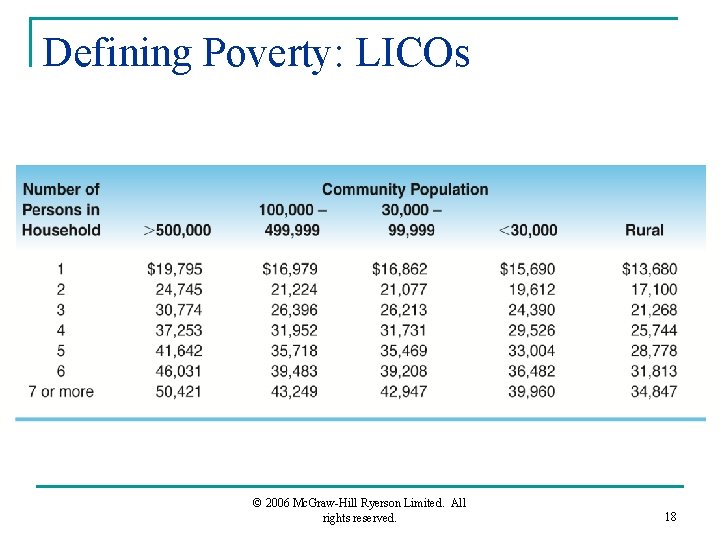
Defining Poverty: LICOs © 2006 Mc. Graw-Hill Ryerson Limited. All rights reserved. 18
Poverty Issues n n n Expectations Social distress Differential impacts Education Structural component © 2006 Mc. Graw-Hill Ryerson Limited. All rights reserved. 19
Poverty Issues n Expectations – by giving children a proper start in life, society can avoid higher social costs later, such as health care and prison. n People living below poverty line are less able to provide for their children; this will diminish their children’s expectations for their future, and their chances to succeed. © 2006 Mc. Graw-Hill Ryerson Limited. All rights reserved. 20
Poverty Issues n Reduced access to education is a significant factor in poverty. n There is a strong negative correlation between poverty and both education level and occupational skill level (human capital). © 2006 Mc. Graw-Hill Ryerson Limited. All rights reserved. 21
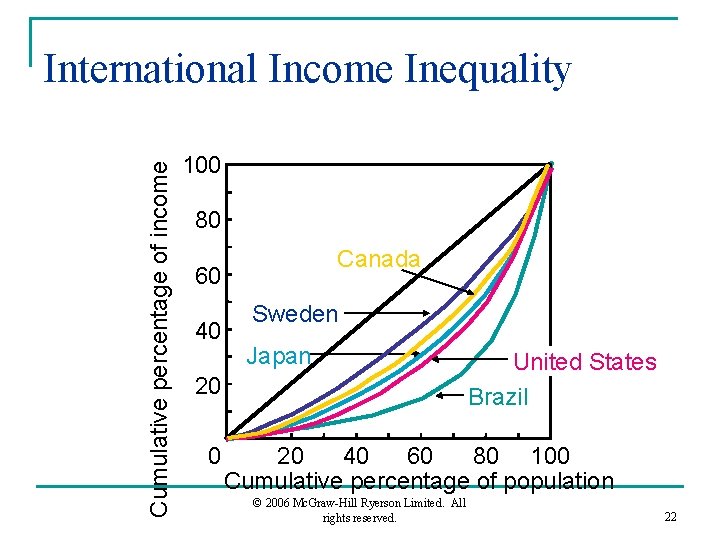
Cumulative percentage of income International Income Inequality 100 80 Canada 60 40 Sweden Japan 20 0 United States Brazil 20 40 60 80 100 Cumulative percentage of population © 2006 Mc. Graw-Hill Ryerson Limited. All rights reserved. 22
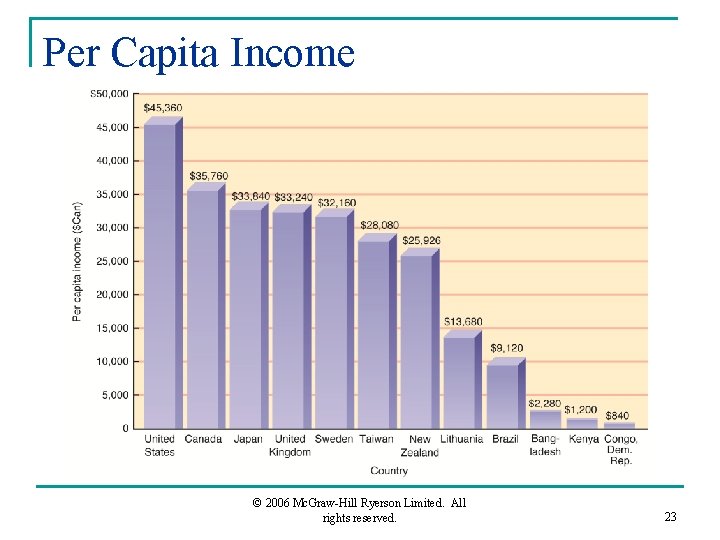
Per Capita Income © 2006 Mc. Graw-Hill Ryerson Limited. All rights reserved. 23
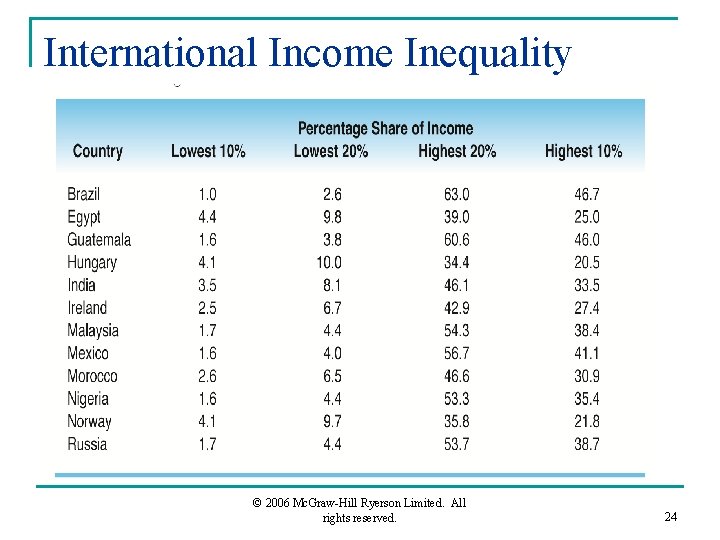
International Income Inequality © 2006 Mc. Graw-Hill Ryerson Limited. All rights reserved. 24
Distribution of Wealth n Wealth is the value of the things individuals own less the value of what they owe. n Wealth is a stock concept, representing the value of assets. n Wealth is much more unequally distributed than income in Canada. © 2006 Mc. Graw-Hill Ryerson Limited. All rights reserved. 25
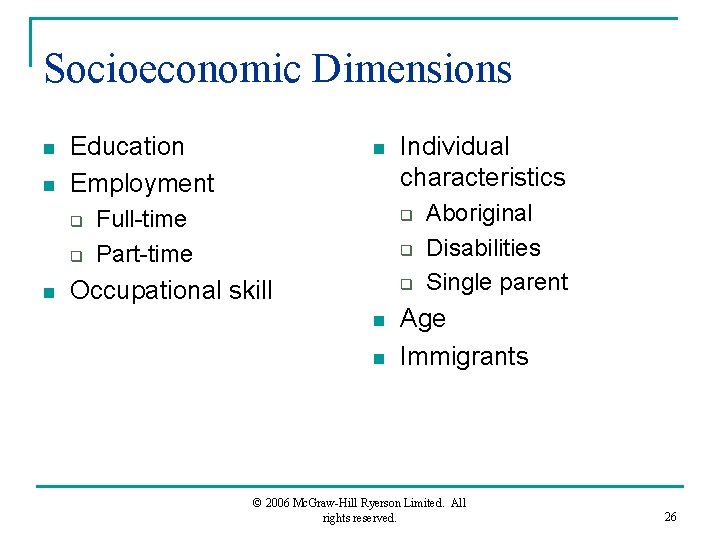
Socioeconomic Dimensions n n Education Employment q q n n Full-time Part-time Individual characteristics q q Occupational skill q n n Aboriginal Disabilities Single parent Age Immigrants © 2006 Mc. Graw-Hill Ryerson Limited. All rights reserved. 26
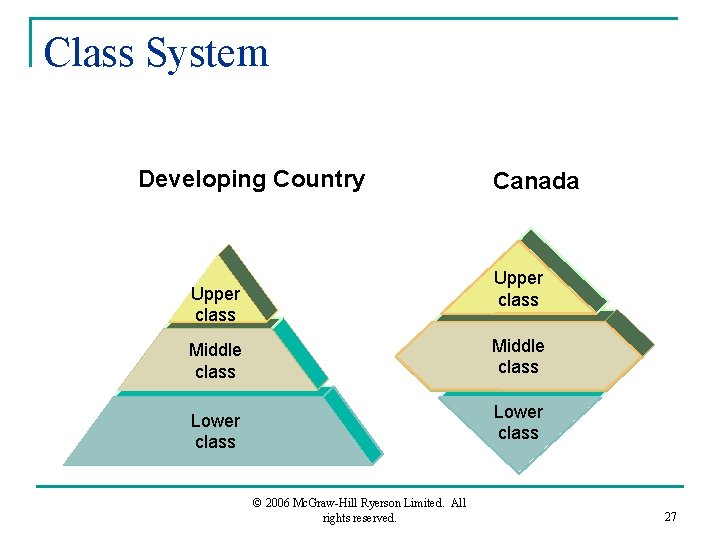
Class System Developing Country Canada Upper class Middle class Lower class © 2006 Mc. Graw-Hill Ryerson Limited. All rights reserved. 27
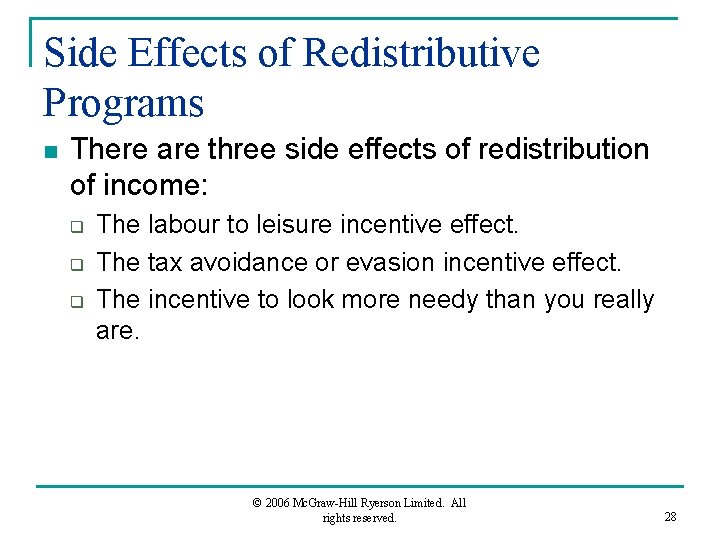
Side Effects of Redistributive Programs n There are three side effects of redistribution of income: q q q The labour to leisure incentive effect. The tax avoidance or evasion incentive effect. The incentive to look more needy than you really are. © 2006 Mc. Graw-Hill Ryerson Limited. All rights reserved. 28
Side Effects of Redistributive Programs n A tax may result in a switch from labour to leisure. n People may attempt to avoid or evade taxes, leading to a decrease in measured income. n Redistributing money may cause people to make themselves look as if they’re more needy than they really are. © 2006 Mc. Graw-Hill Ryerson Limited. All rights reserved. 29
Income Redistribution Policies n The direct methods include: n Taxation—policies that tax the rich more than the poor. n Expenditures—programs that help the poor more than the rich. © 2006 Mc. Graw-Hill Ryerson Limited. All rights reserved. 30
Income Redistribution Policies n The indirect method involves the establishment and protection of property rights. © 2006 Mc. Graw-Hill Ryerson Limited. All rights reserved. 31
Taxation to Redistribute Income n Taxes can be: n Progressive – the average tax rate increases with income. n Proportional – the average rate of tax is constant regardless of income. n Regressive – the average tax rate decreases with income. © 2006 Mc. Graw-Hill Ryerson Limited. All rights reserved. 32
Taxation n Government gets most of its income from: q q q Income taxes – which are somewhat progressive. Sales taxes – which tend to be proportional but are slightly regressive in their effect. Property taxes – which are roughly proportional. © 2006 Mc. Graw-Hill Ryerson Limited. All rights reserved. 33
Expenditure Programs n Welfare – a provincially administered program of income assistance to support individuals and families which have no other way of supporting themselves. n Old Age Security (OAS) – Canada’s largest pension plan, providing a modest pension income to those over 65 years of age. © 2006 Mc. Graw-Hill Ryerson Limited. All rights reserved. 34
Expenditure Programs n Guaranteed Income Supplement (GIS) – provides an additional monthly benefit for low -income pensioners. n Canada Pension Plan (CPP) – a retirement income plan and a death and disability insurance plan. © 2006 Mc. Graw-Hill Ryerson Limited. All rights reserved. 35
Expenditure Programs n Employment Insurance – short-term financial assistance, regardless of need, to eligible individuals who are temporarily out of work. © 2006 Mc. Graw-Hill Ryerson Limited. All rights reserved. 36
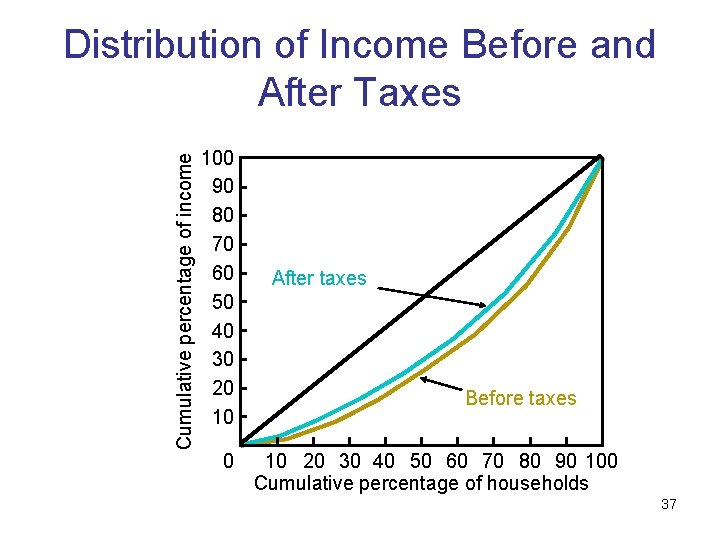
Cumulative percentage of income Distribution of Income Before and After Taxes 100 90 80 70 60 50 40 30 20 10 0 After taxes Before taxes 10 20 30 40 50 60 70 80 90 100 Cumulative percentage of households 37
Indirect Methods of Redistributing Income n The most important redistribution decisions that the government makes involve the indirect method, the establishment and protection of property rights. n Intellectual property rights, for example, provide a legally sanctioned barrier to entry. © 2006 Mc. Graw-Hill Ryerson Limited. All rights reserved. 38
Who Gets What? The Distribution of Income End of Chapter 19 © 2006 Mc. Graw-Hill Ryerson Limited. All rights reserved. 39
- Slides: 39