
Chapter 19 The Kinetic Theory of Gases Chapter19
- Slides: 33
Chapter 19 The Kinetic Theory of Gases
Chapter-19 The Kinetic Theory of Gases q Topics to be covered: q Avogadro number q Ideal gas law q Internal energy of an ideal gas q Distribution of speeds among the atoms in a gas q Specific heat under constant volume q Specific heat under constant pressure. q Adiabatic expansion of an ideal gas
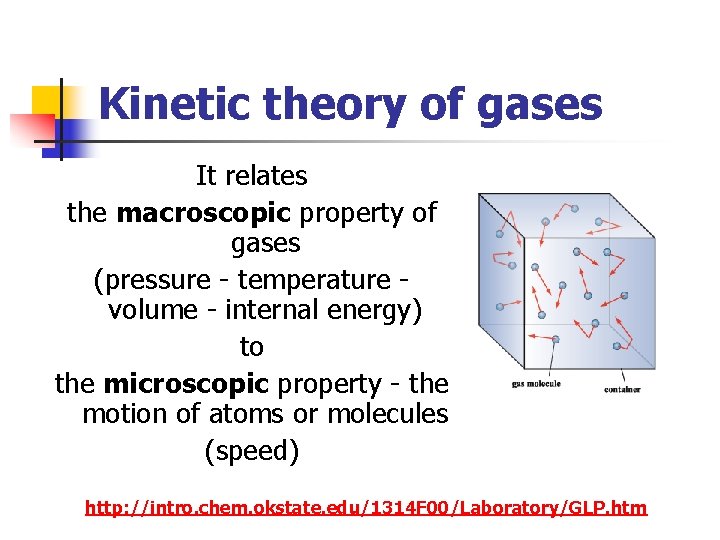
Kinetic theory of gases It relates the macroscopic property of gases (pressure - temperature volume - internal energy) to the microscopic property - the motion of atoms or molecules (speed) http: //intro. chem. okstate. edu/1314 F 00/Laboratory/GLP. htm
What is one mole? n n n n Avogadro’s Number NA = 6. 02 X 1023 One mole of any element contains Avogadro’s number of atoms of that element. One mole of iron contains 6. 02 X 1023 iron atoms. One mole of water contains 6. 02 X 1023 water molecules. From experiments: 12 g of carbon contains 6. 02 X 1023 carbon atoms. Thus, 1 mole carbon = 12 g of carbon. 4 g of helium contains 6. 02 X 1023 helium atoms. Thus, 1 mole helium = 4 g of helium. Avogadro’s Number NA = 6. 02 X 1023 per mole = 6. 02 X 1023 mol-1
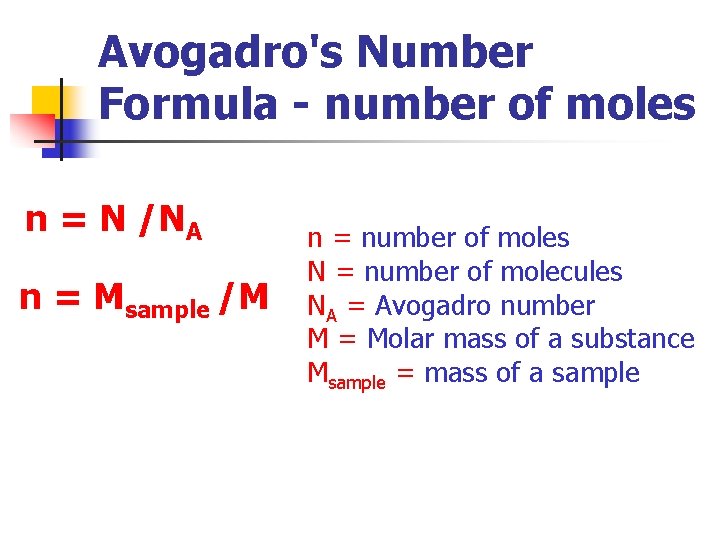
Avogadro's Number Formula - number of moles n = N /NA n = Msample /M n = number of moles N = number of molecules NA = Avogadro number M = Molar mass of a substance Msample = mass of a sample
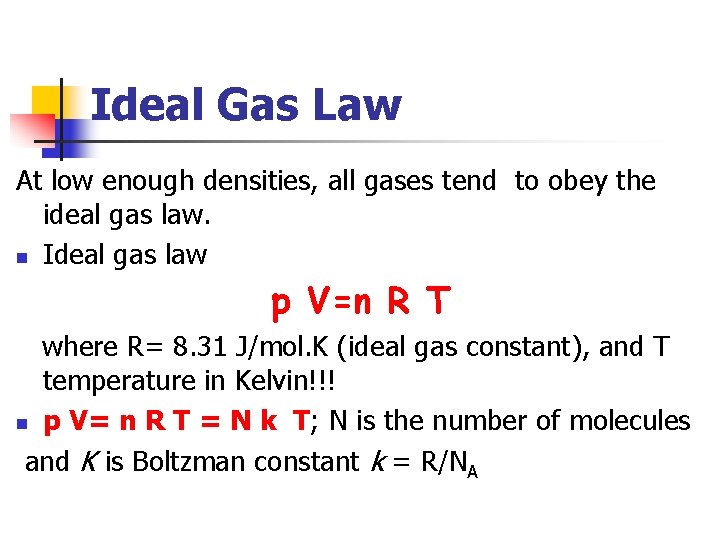
Ideal Gas Law At low enough densities, all gases tend to obey the ideal gas law. n Ideal gas law p V=n R T where R= 8. 31 J/mol. K (ideal gas constant), and T temperature in Kelvin!!! n p V= n R T = N k T; N is the number of molecules and K is Boltzman constant k = R/NA
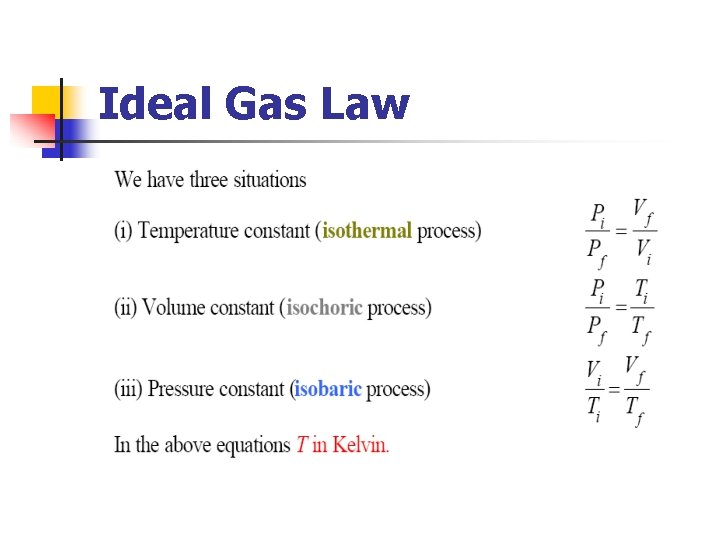
Ideal Gas Law
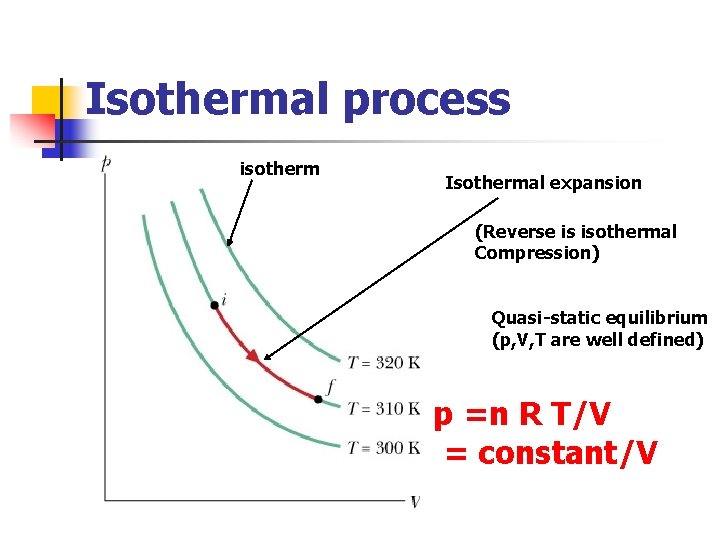
Isothermal process isotherm Isothermal expansion (Reverse is isothermal Compression) Quasi-static equilibrium (p, V, T are well defined) p =n R T/V = constant/V
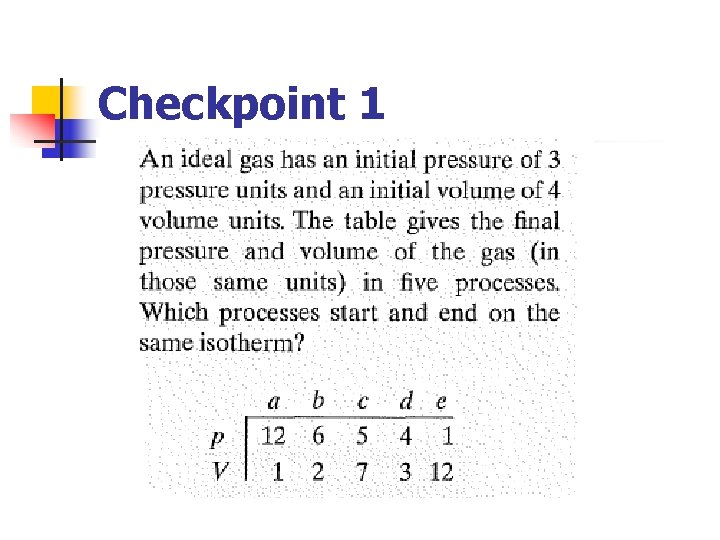
Checkpoint 1
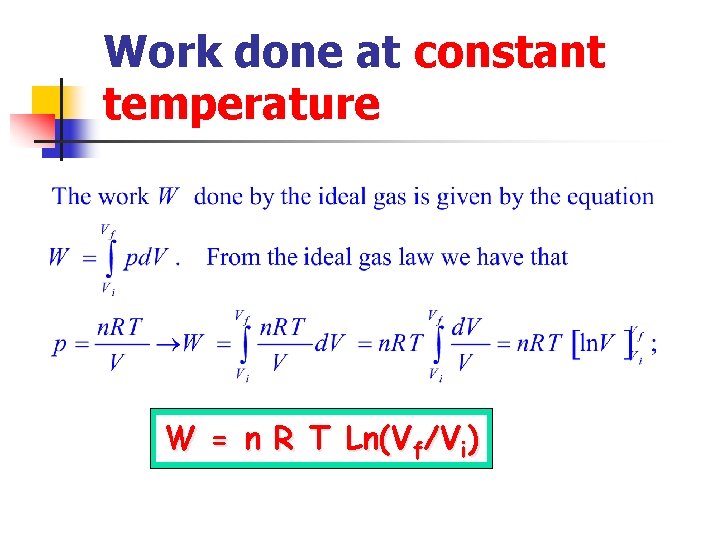
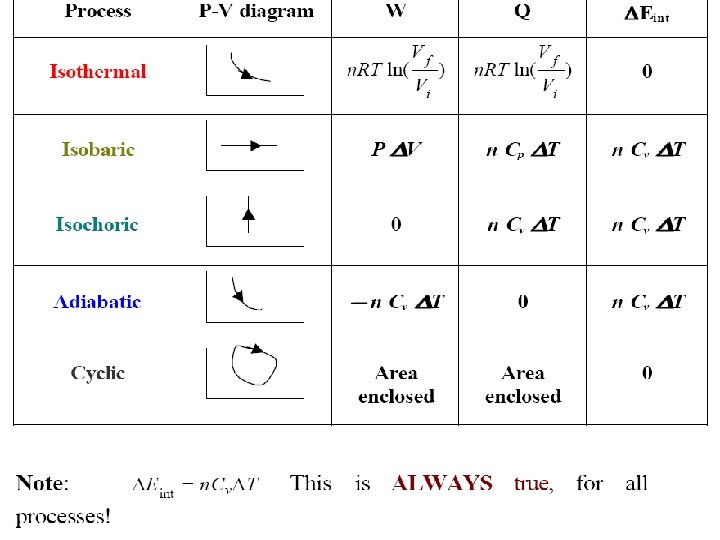
Work done at constant temperature W = n R T Ln(Vf/Vi)
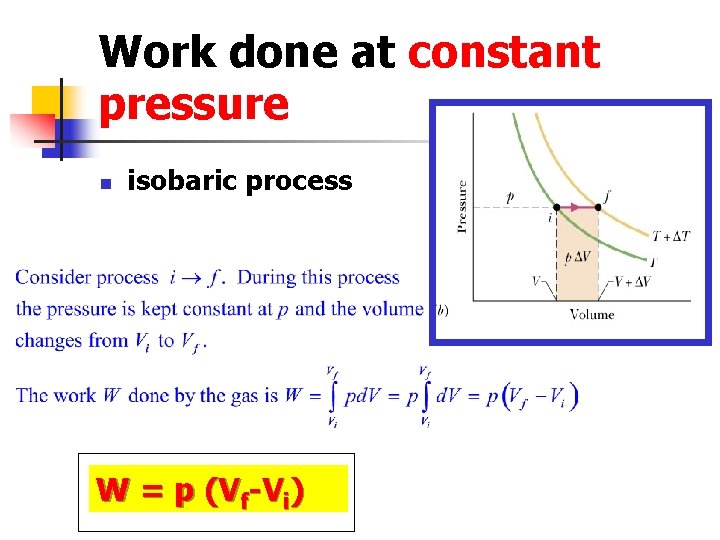
Work done at constant pressure n isobaric process W = p (Vf-Vi)
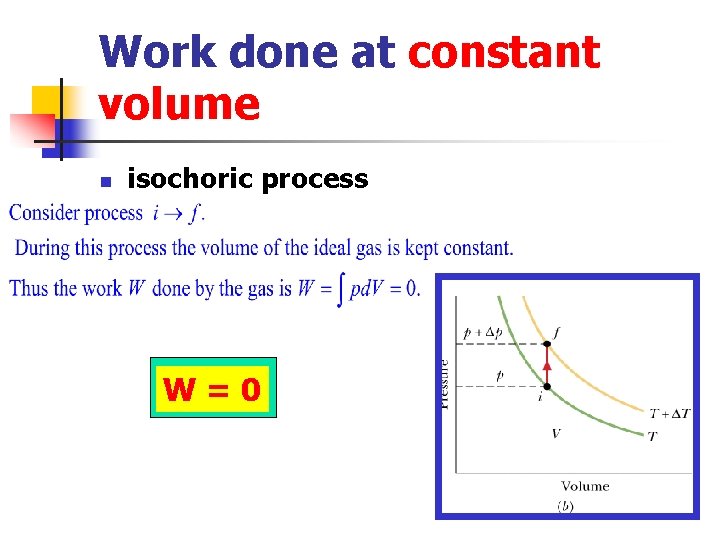
Work done at constant volume n isochoric process W = 0
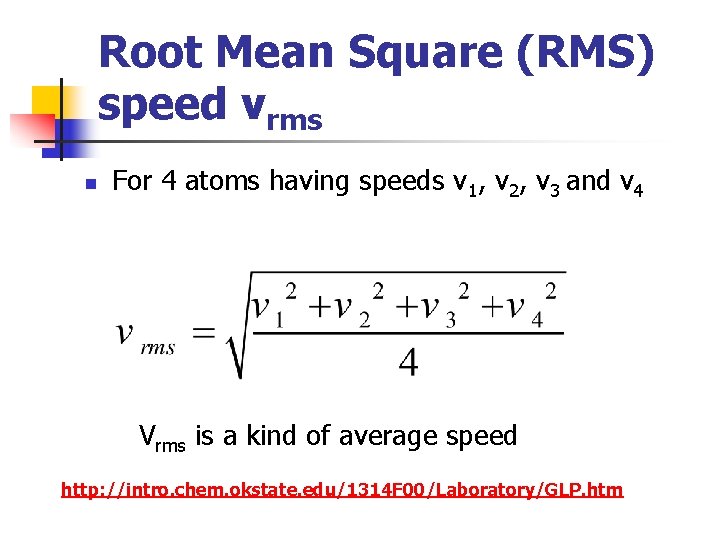
Root Mean Square (RMS) speed vrms n For 4 atoms having speeds v 1, v 2, v 3 and v 4 Vrms is a kind of average speed http: //intro. chem. okstate. edu/1314 F 00/Laboratory/GLP. htm
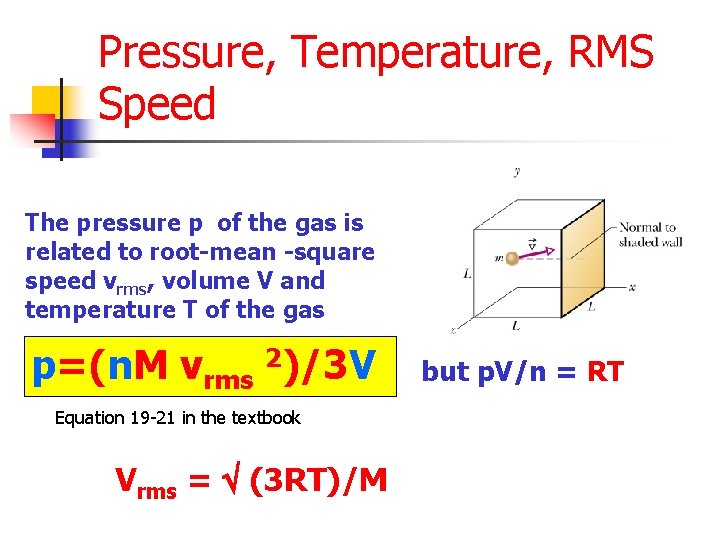
Pressure, Temperature, RMS Speed The pressure p of the gas is related to root-mean -square speed vrms, volume V and temperature T of the gas p=(n. M vrms 2)/3 V Equation 19 -21 in the textbook Vrms = (3 RT)/M but p. V/n = RT
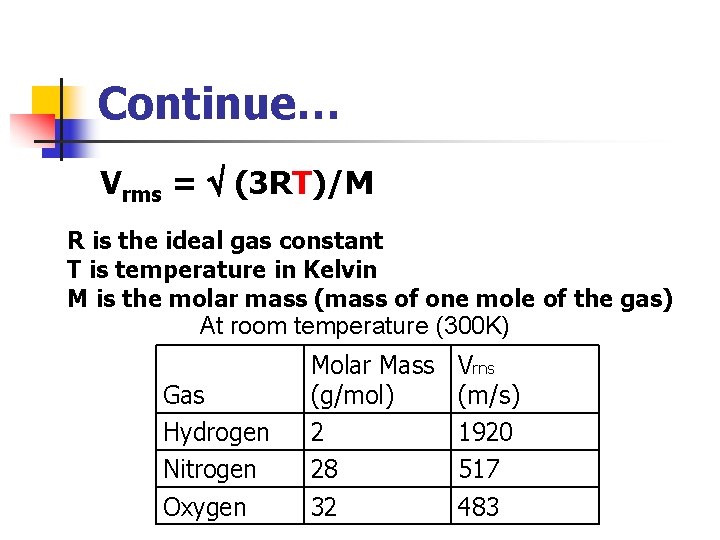
Continue… Vrms = (3 RT)/M R is the ideal gas constant T is temperature in Kelvin M is the molar mass (mass of one mole of the gas) At room temperature (300 K) Gas Hydrogen Nitrogen Oxygen Molar Mass (g/mol) 2 28 32 Vrns (m/s) 1920 517 483
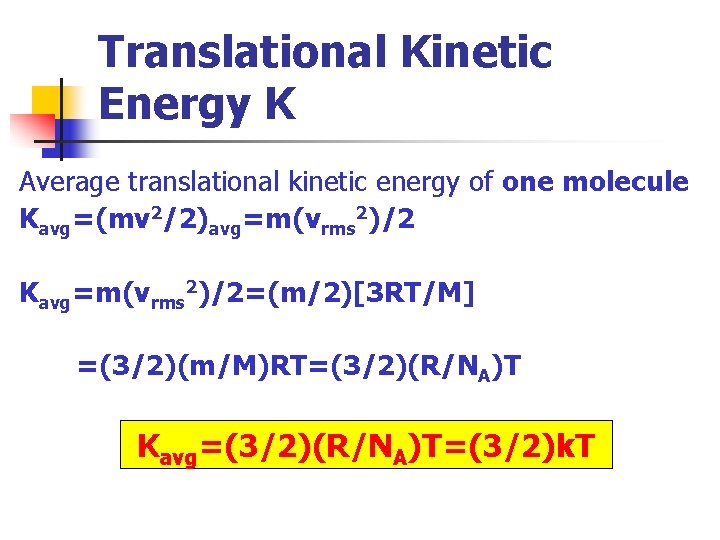
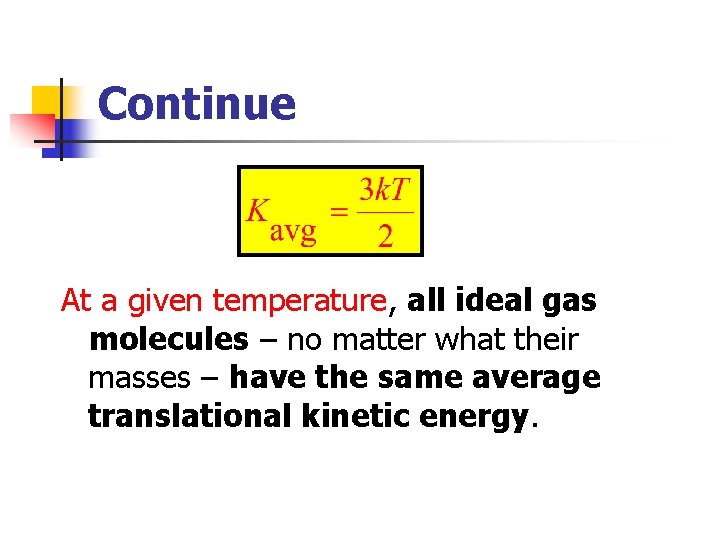
Translational Kinetic Energy K Average translational kinetic energy of one molecule Kavg=(mv 2/2)avg=m(vrms 2)/2 Kavg=m(vrms 2)/2=(m/2)[3 RT/M] =(3/2)(m/M)RT=(3/2)(R/NA)T Kavg=(3/2)(R/NA)T=(3/2)k. T
Continue At a given temperature, all ideal gas molecules – no matter what their masses – have the same average translational kinetic energy.
Checkpoint 2 A gas mixture consists of molecules of type 1, 2, and 3, with molecular masses m 1>m 2>m 3. Rank the three types according to average kinetic energy, and rms speed, greatest first.
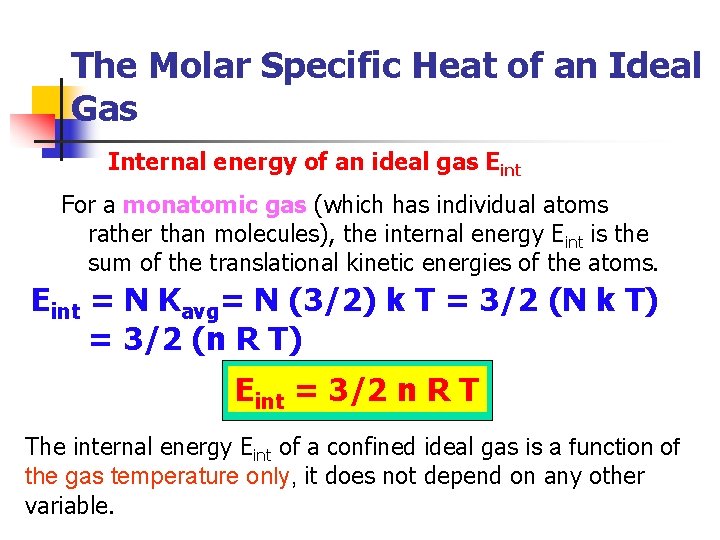
The Molar Specific Heat of an Ideal Gas Internal energy of an ideal gas Eint For a monatomic gas (which has individual atoms rather than molecules), the internal energy Eint is the sum of the translational kinetic energies of the atoms. Eint = N Kavg= N (3/2) k T = 3/2 (N k T) = 3/2 (n R T) Eint = 3/2 n R T The internal energy Eint of a confined ideal gas is a function of the gas temperature only, it does not depend on any other variable.
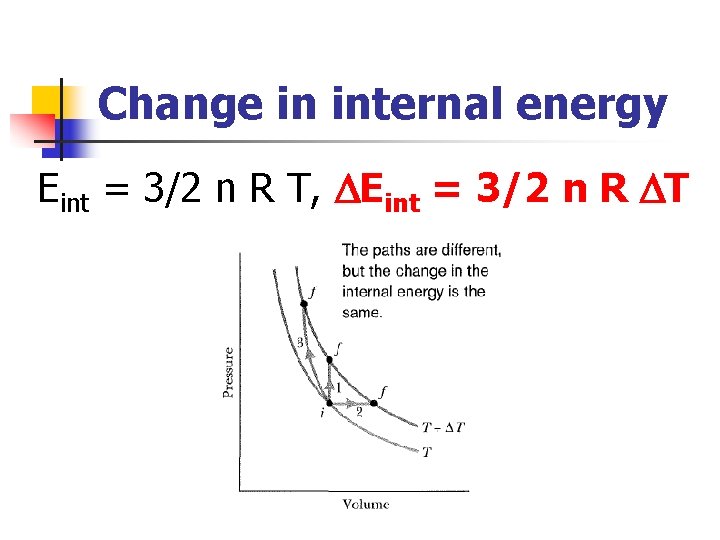
Change in internal energy Eint = 3/2 n R T, Eint = 3/2 n R T
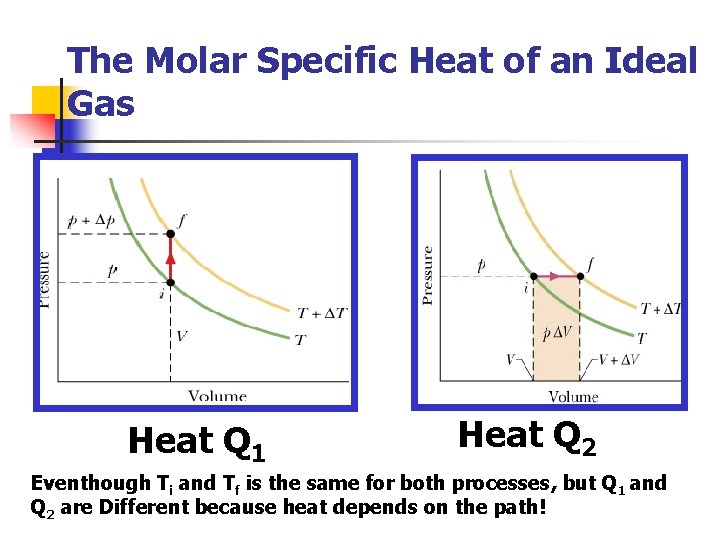
The Molar Specific Heat of an Ideal Gas Heat Q 1 Heat Q 2 Eventhough Ti and Tf is the same for both processes, but Q 1 and Q 2 are Different because heat depends on the path!
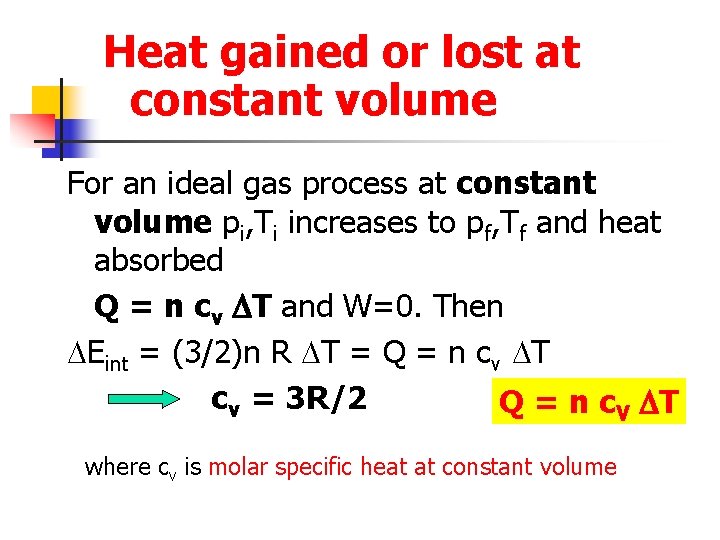
Heat gained or lost at constant volume For an ideal gas process at constant volume pi, Ti increases to pf, Tf and heat absorbed Q = n cv T and W=0. Then Eint = (3/2)n R T = Q = n cv T cv = 3 R/2 Q = n c. V T where cv is molar specific heat at constant volume
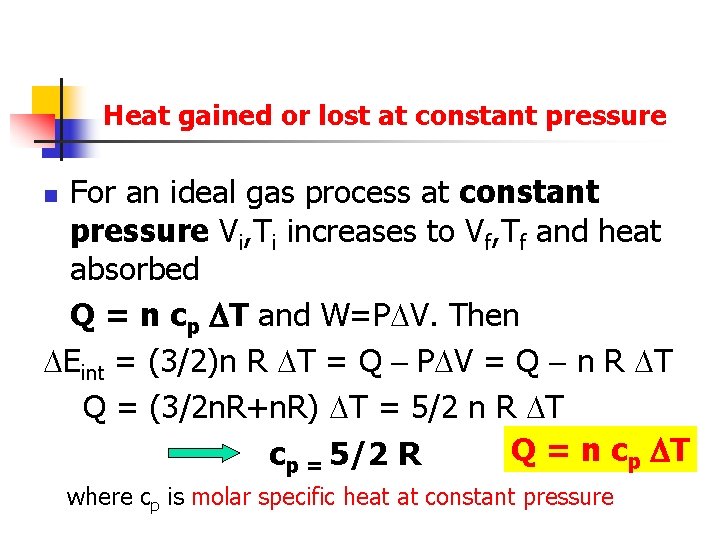
Heat gained or lost at constant pressure For an ideal gas process at constant pressure Vi, Ti increases to Vf, Tf and heat absorbed Q = n cp T and W=P V. Then Eint = (3/2)n R T = Q - P V = Q - n R T Q = (3/2 n. R+n. R) T = 5/2 n R T Q = n cp T cp = 5/2 R n where cp is molar specific heat at constant pressure
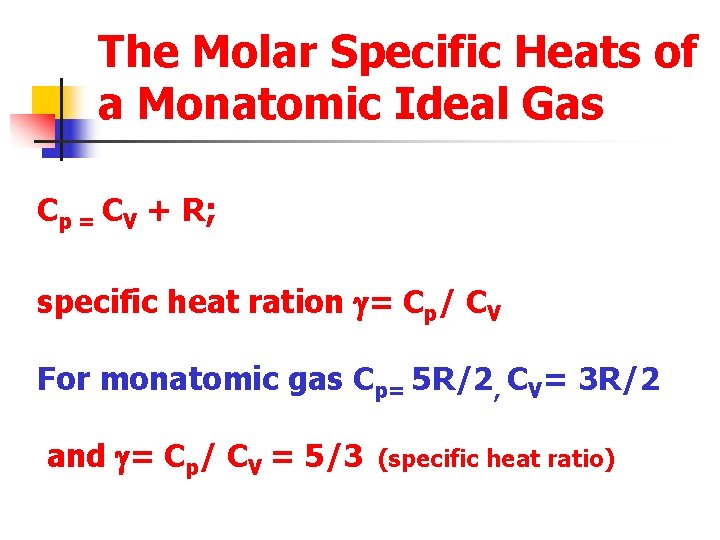
The Molar Specific Heats of a Monatomic Ideal Gas Cp = CV + R; specific heat ration = Cp/ CV For monatomic gas Cp= 5 R/2, CV= 3 R/2 and = Cp/ CV = 5/3 (specific heat ratio)
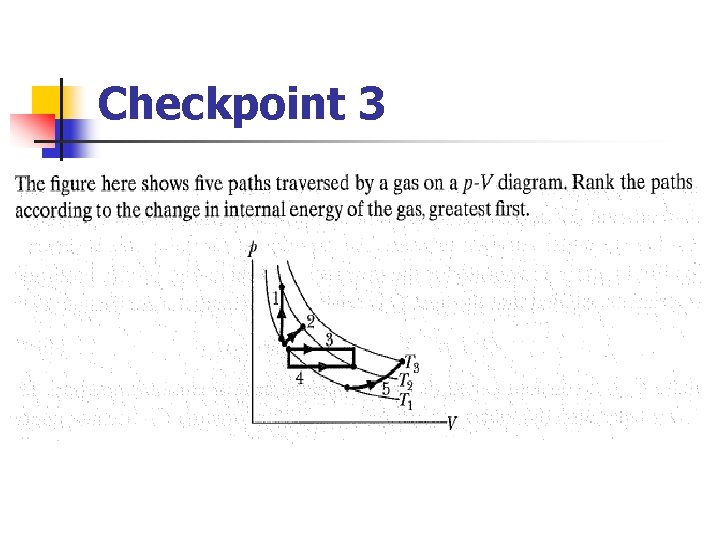
Checkpoint 3
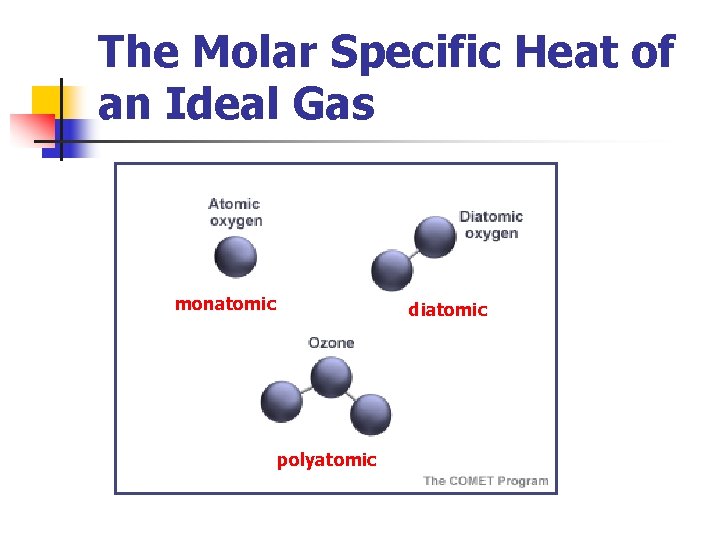
The Molar Specific Heat of an Ideal Gas monatomic diatomic polyatomic
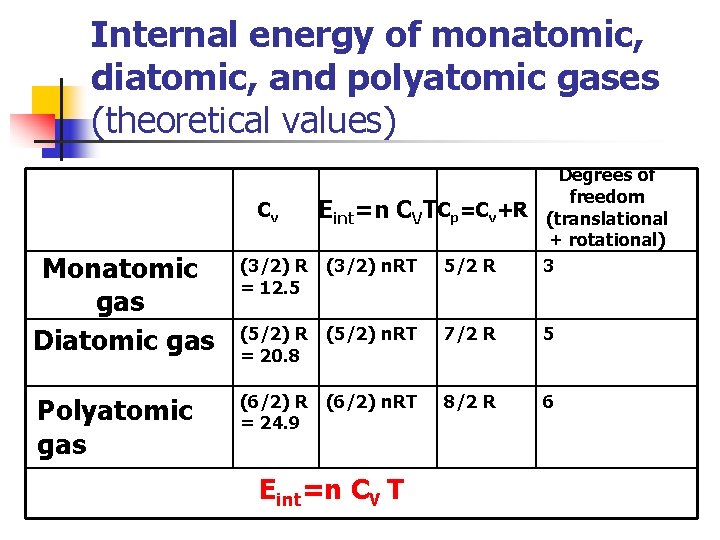
Internal energy of monatomic, diatomic, and polyatomic gases (theoretical values) Monatomic gas Diatomic gas Polyatomic gas Degrees of freedom Cv Eint=n CVT Cp=Cv+R (translational + rotational) (3/2) R (3/2) n. RT 5/2 R 3 = 12. 5 (5/2) R = 20. 8 (5/2) n. RT 7/2 R 5 (6/2) R = 24. 9 (6/2) n. RT 8/2 R 6 Eint=n CV T
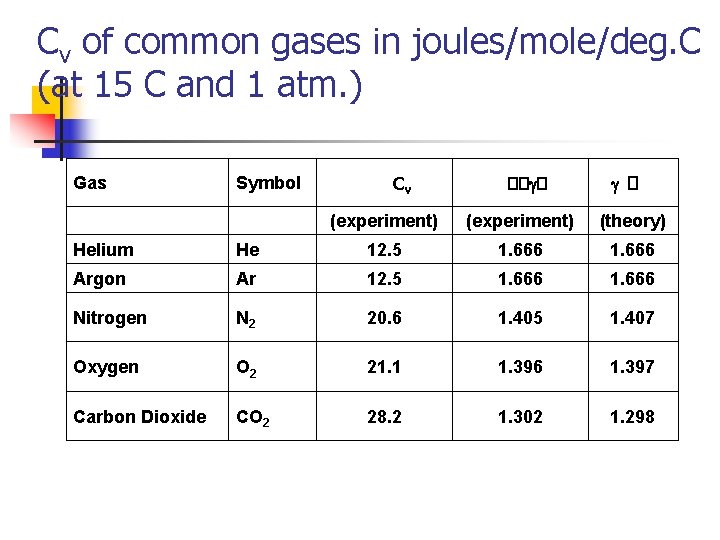
Cv of common gases in joules/mole/deg. C (at 15 C and 1 atm. ) Cv �� � � (experiment) (theory) He 12. 5 1. 666 Argon Ar 12. 5 1. 666 Nitrogen N 2 20. 6 1. 405 1. 407 Oxygen O 2 21. 1 1. 396 1. 397 Carbon Dioxide CO 2 28. 2 1. 302 1. 298 Gas Symbol Helium
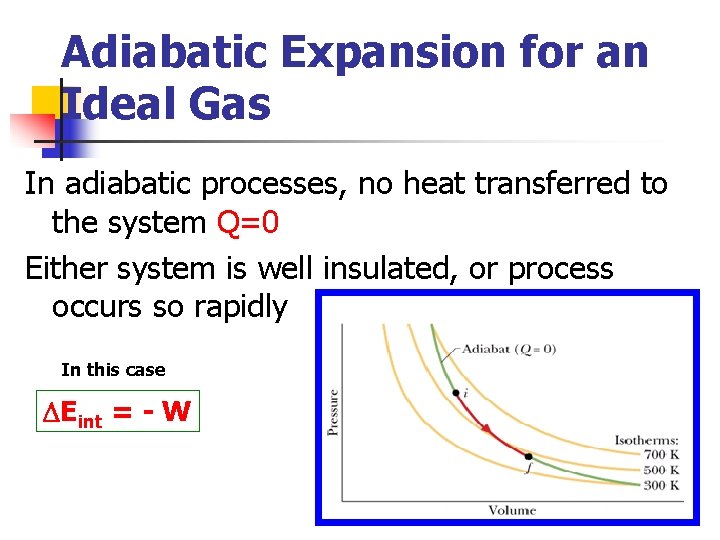
Adiabatic Expansion for an Ideal Gas In adiabatic processes, no heat transferred to the system Q=0 Either system is well insulated, or process occurs so rapidly In this case Eint = - W
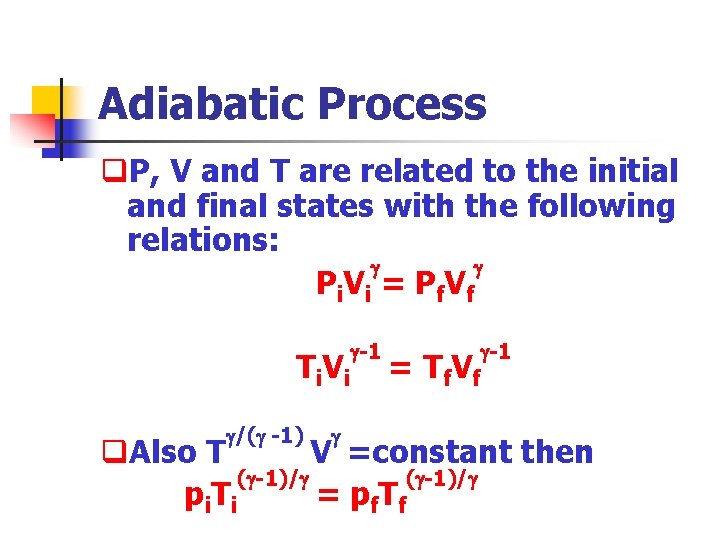
Adiabatic Process q. P, V and T are related to the initial and final states with the following relations: Pi. Vi = Pf. Vf Ti. Vi /( -1) -1 = Tf. Vf -1 q. Also T V =constant then ( -1)/ pi. Ti = pf. Tf
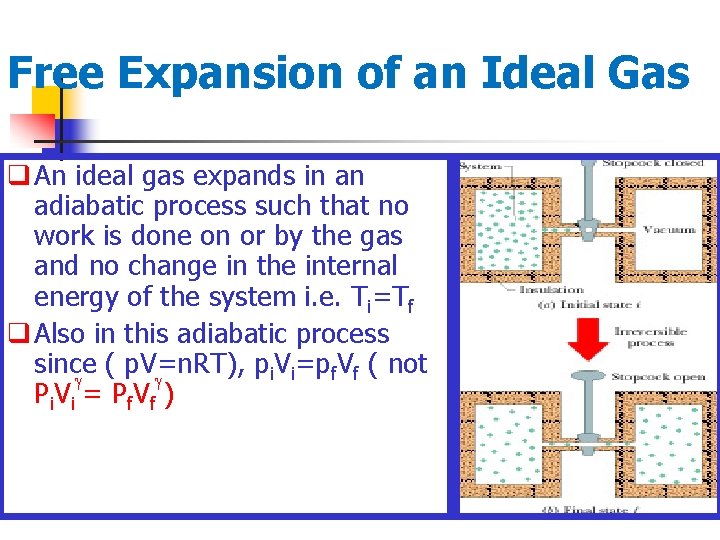
Free Expansion of an Ideal Gas q An ideal gas expands in an adiabatic process such that no work is done on or by the gas and no change in the internal energy of the system i. e. Ti=Tf q Also in this adiabatic process since ( p. V=n. RT), pi. Vi=pf. Vf ( not Pi V i = Pf. V f )
END