
Chapter 19 Population Genetics Chapter 19 Human Heredity
- Slides: 21
Chapter 19 Population Genetics Chapter 19 Human Heredity by Michael Cummings © 2006 Brooks/Cole-Thomson Learning
Populations as Genetic Reservoirs • Population – A group of interbreeding organisms belonging to a single species • Gene pool – Set of genetic information carried by the members of a sexually reproducing population • Allelic frequency – Frequency of an allele is present in the population Chapter 19 Human Heredity by Michael Cummings © 2006 Brooks/Cole-Thomson Learning
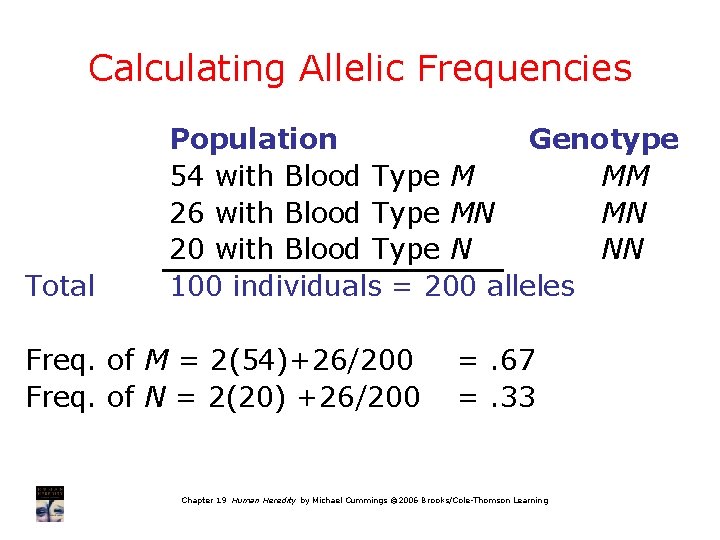
Calculating Allelic Frequencies Total Population Genotype 54 with Blood Type M MM 26 with Blood Type MN MN 20 with Blood Type N NN 100 individuals = 200 alleles Freq. of M = 2(54)+26/200 Freq. of N = 2(20) +26/200 =. 67 =. 33 Chapter 19 Human Heredity by Michael Cummings © 2006 Brooks/Cole-Thomson Learning
Allelic Frequencies • Dominant and codominant alleles can be measured directly • Recessive allelic frequencies cannot be measured directly • Mathematical formulas such as Hardy -Weinberg can be used to determine allelic frequencies Chapter 19 Human Heredity by Michael Cummings © 2006 Brooks/Cole-Thomson Learning
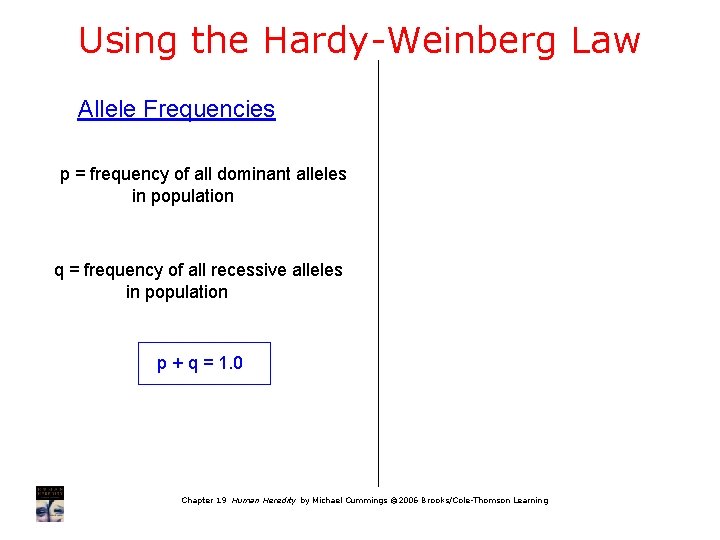
Using the Hardy-Weinberg Law Allele Frequencies p = frequency of all dominant alleles in population q = frequency of all recessive alleles in population p + q = 1. 0 Chapter 19 Human Heredity by Michael Cummings © 2006 Brooks/Cole-Thomson Learning
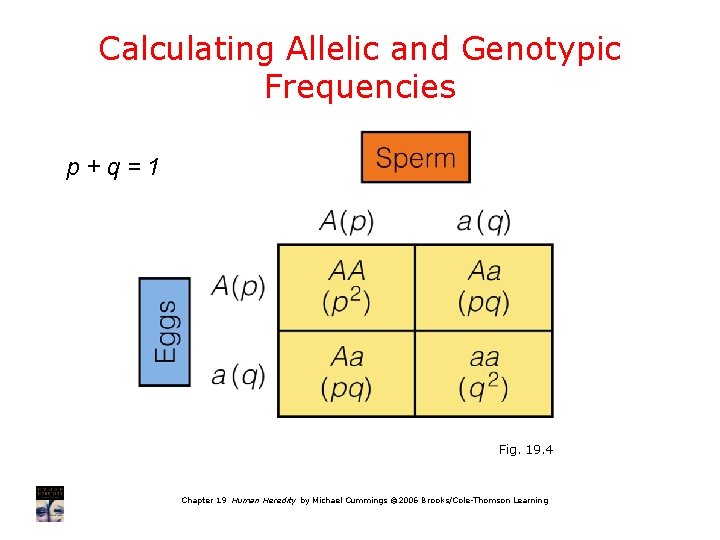
Calculating Allelic and Genotypic Frequencies p+q=1 Fig. 19. 4 Chapter 19 Human Heredity by Michael Cummings © 2006 Brooks/Cole-Thomson Learning
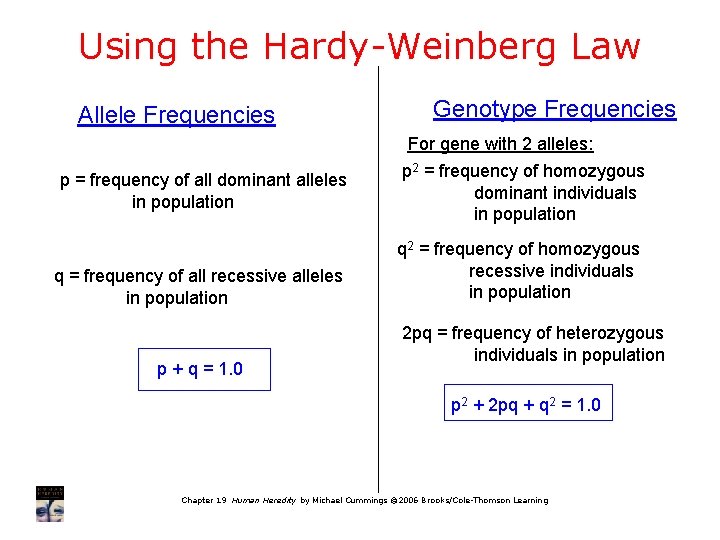
Using the Hardy-Weinberg Law Allele Frequencies p = frequency of all dominant alleles in population q = frequency of all recessive alleles in population p + q = 1. 0 Genotype Frequencies For gene with 2 alleles: p 2 = frequency of homozygous dominant individuals in population q 2 = frequency of homozygous recessive individuals in population 2 pq = frequency of heterozygous individuals in population p 2 + 2 pq + q 2 = 1. 0 Chapter 19 Human Heredity by Michael Cummings © 2006 Brooks/Cole-Thomson Learning
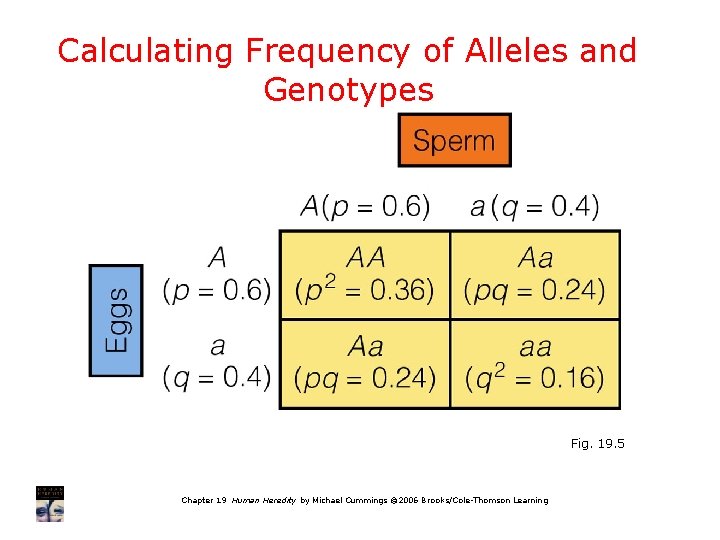
Calculating Frequency of Alleles and Genotypes Fig. 19. 5 Chapter 19 Human Heredity by Michael Cummings © 2006 Brooks/Cole-Thomson Learning
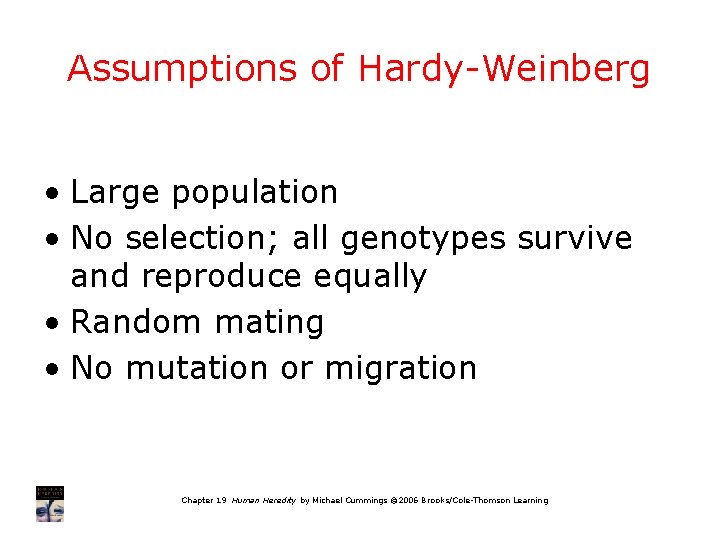
Assumptions of Hardy-Weinberg • Large population • No selection; all genotypes survive and reproduce equally • Random mating • No mutation or migration Chapter 19 Human Heredity by Michael Cummings © 2006 Brooks/Cole-Thomson Learning
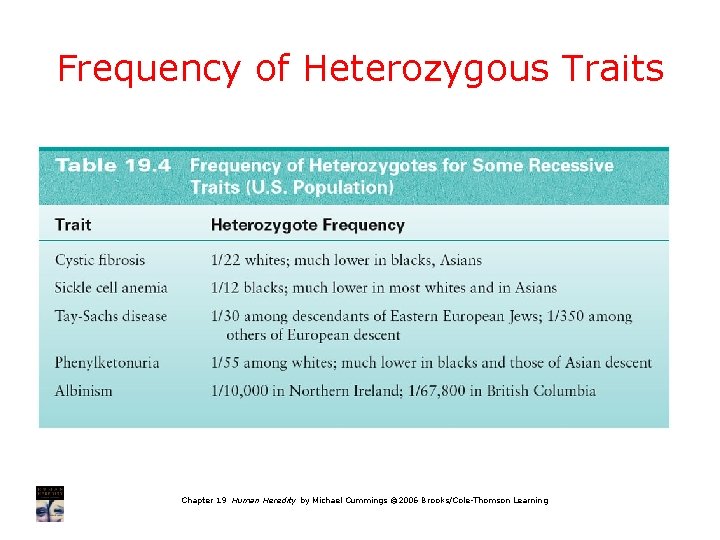
Frequency of Heterozygous Traits Chapter 19 Human Heredity by Michael Cummings © 2006 Brooks/Cole-Thomson Learning
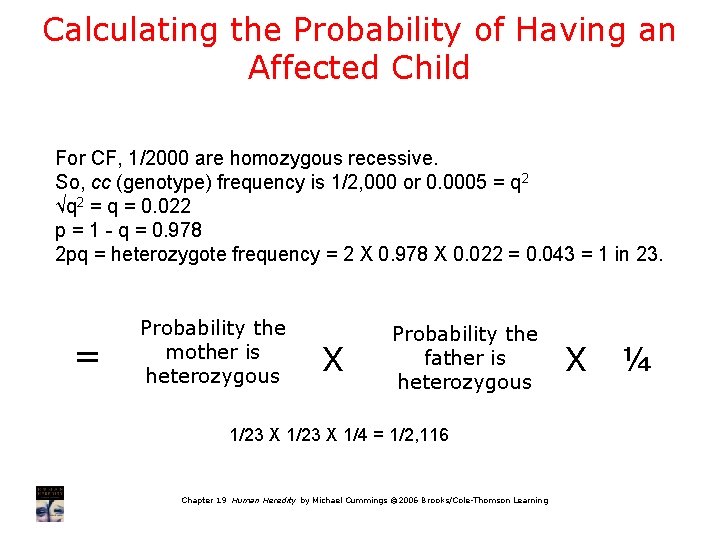
Calculating the Probability of Having an Affected Child For CF, 1/2000 are homozygous recessive. So, cc (genotype) frequency is 1/2, 000 or 0. 0005 = q 2 √q 2 = q = 0. 022 p = 1 - q = 0. 978 2 pq = heterozygote frequency = 2 X 0. 978 X 0. 022 = 0. 043 = 1 in 23. = Probability the mother is heterozygous X Probability the father is heterozygous 1/23 X 1/4 = 1/2, 116 Chapter 19 Human Heredity by Michael Cummings © 2006 Brooks/Cole-Thomson Learning X ¼
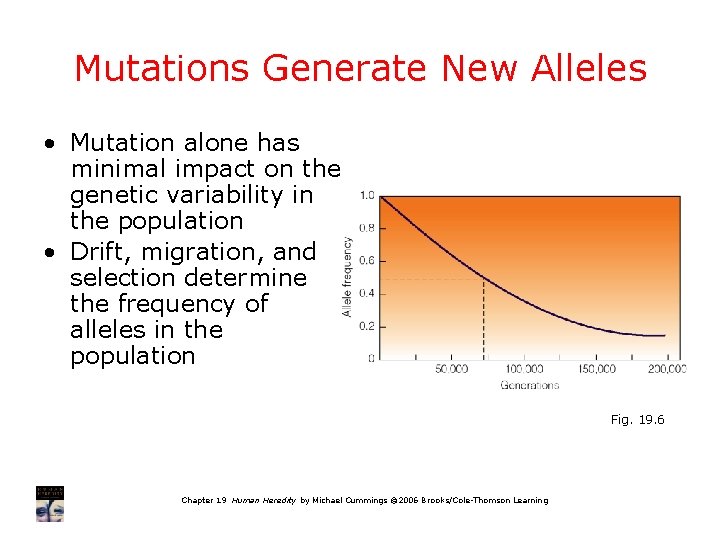
Mutations Generate New Alleles • Mutation alone has minimal impact on the genetic variability in the population • Drift, migration, and selection determine the frequency of alleles in the population Fig. 19. 6 Chapter 19 Human Heredity by Michael Cummings © 2006 Brooks/Cole-Thomson Learning
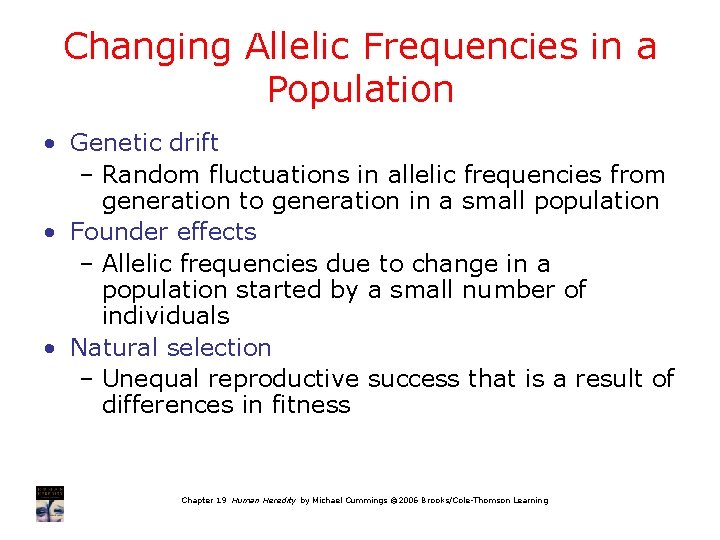
Changing Allelic Frequencies in a Population • Genetic drift – Random fluctuations in allelic frequencies from generation to generation in a small population • Founder effects – Allelic frequencies due to change in a population started by a small number of individuals • Natural selection – Unequal reproductive success that is a result of differences in fitness Chapter 19 Human Heredity by Michael Cummings © 2006 Brooks/Cole-Thomson Learning
Natural Selection and Frequency of Genetic Disorders Examples • Lactose intolerance • Duchenne muscular dystrophy • Sickle cell anemia • Tay-Sachs disease Chapter 19 Human Heredity by Michael Cummings © 2006 Brooks/Cole-Thomson Learning
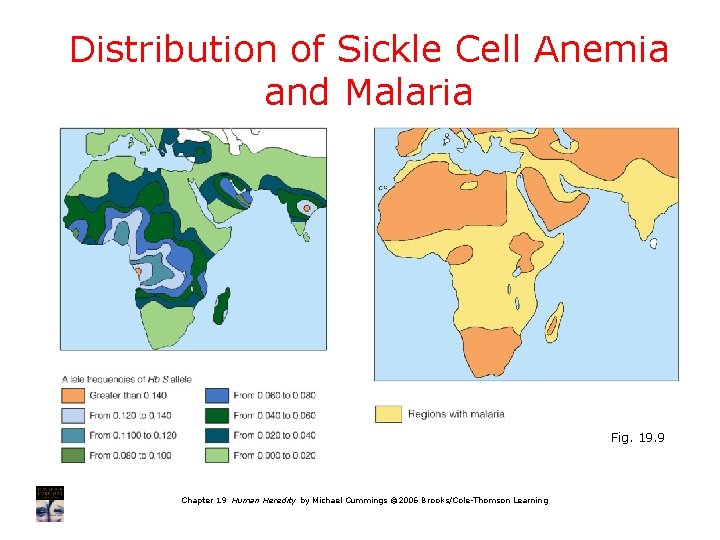
Distribution of Sickle Cell Anemia and Malaria Fig. 19. 9 Chapter 19 Human Heredity by Michael Cummings © 2006 Brooks/Cole-Thomson Learning
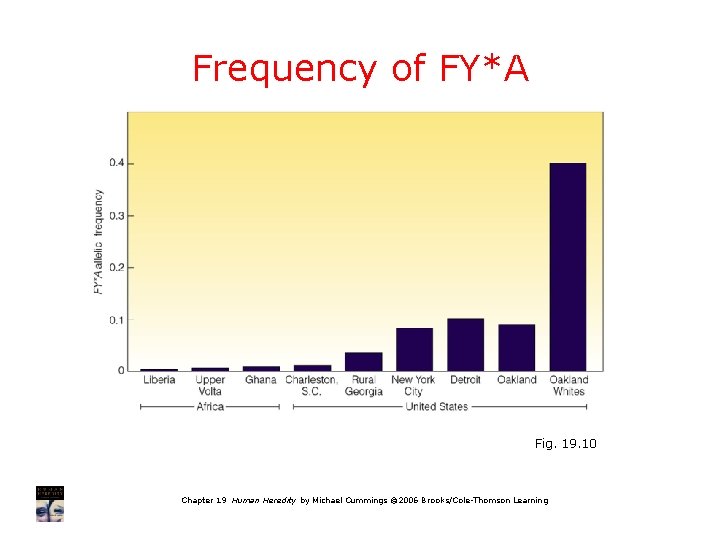
Measuring Genetic Diversity Duffy blood group alleles • FY*A, FY*B, and FY*O • Frequency of FY*O in West Africans close to 100% • Frequency of FY*O in Europeans close to 0% • Measure the frequency of FY*A and FY*B in U. S. black population to estimate genetic mixing between populations Chapter 19 Human Heredity by Michael Cummings © 2006 Brooks/Cole-Thomson Learning
Frequency of FY*A Fig. 19. 10 Chapter 19 Human Heredity by Michael Cummings © 2006 Brooks/Cole-Thomson Learning
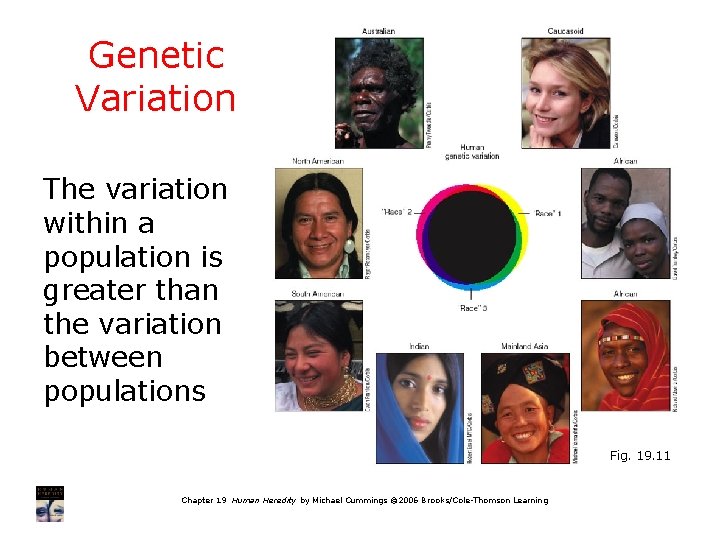
Are There Races? • Most genetic variation is present within populations • Minimal variation among populations, including those classified as different racial groups Chapter 19 Human Heredity by Michael Cummings © 2006 Brooks/Cole-Thomson Learning
Genetic Variation The variation within a population is greater than the variation between populations Fig. 19. 11 Chapter 19 Human Heredity by Michael Cummings © 2006 Brooks/Cole-Thomson Learning
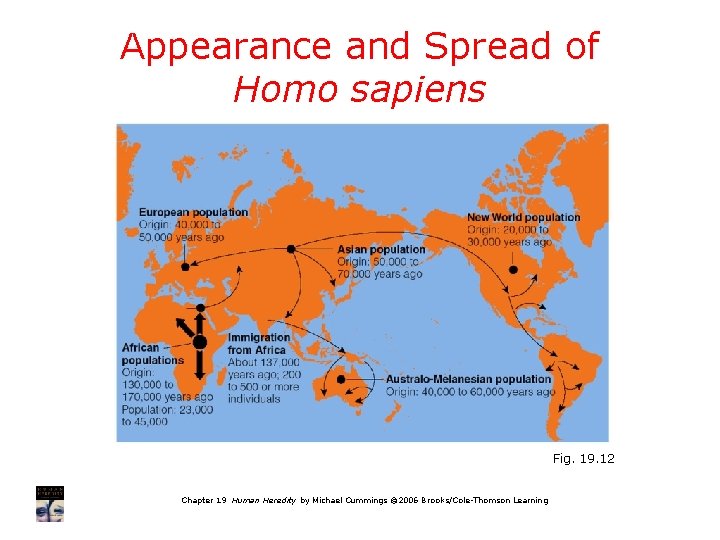
Homo sapiens • Combination of anthropology, paleontology, archaeology, and genetics used to study the dispersal of human populations • Evidence suggests North and South America were populated by migrations during the last 15, 000 or 30, 000 years Chapter 19 Human Heredity by Michael Cummings © 2006 Brooks/Cole-Thomson Learning
Appearance and Spread of Homo sapiens Fig. 19. 12 Chapter 19 Human Heredity by Michael Cummings © 2006 Brooks/Cole-Thomson Learning