
Chapter 19 OxidationReduction Reactions Redox Reactions West Valley
- Slides: 23
Chapter 19 Oxidation-Reduction Reactions (Redox Reactions) West Valley High School Chemistry Mr. Mata 1
Standard 3 G • Students will know how to identify reactions that involve oxidation and reduction and how to balance redox reactions. 2
Essential Question • How do electrons behave in a redox reaction? 3
Oxidation-Reduction Reactions (Redox): Ø Ø Ø Ø Chemical change. Involves the transfer of electrons. Principal source of energy on earth. Examples: Combustion of gasoline Burning of wood Burning of food in your body 4
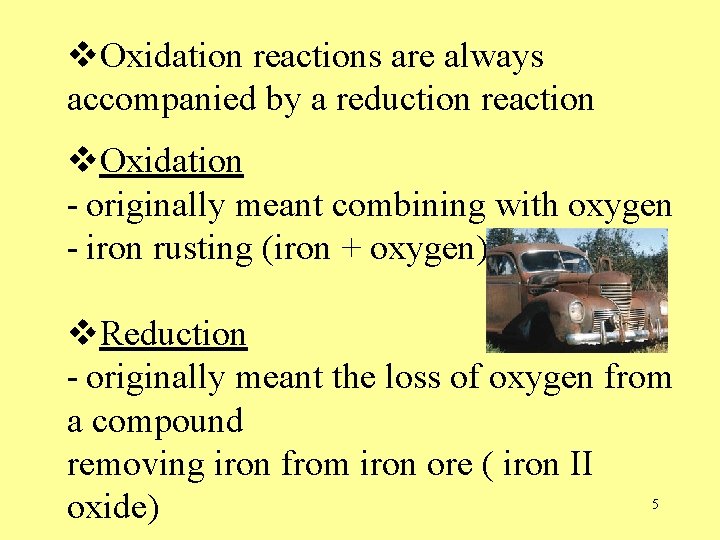
v. Oxidation reactions are always accompanied by a reduction reaction v. Oxidation - originally meant combining with oxygen - iron rusting (iron + oxygen) v. Reduction - originally meant the loss of oxygen from a compound removing iron from iron ore ( iron II oxide) 5
• Today • OXIDATION means: • complete or partial LOSS of ELECTRONS • • REDUCTION means: • complete or partial GAIN of ELECTRONS • • Memory Device : • LEO the lion says GER 6
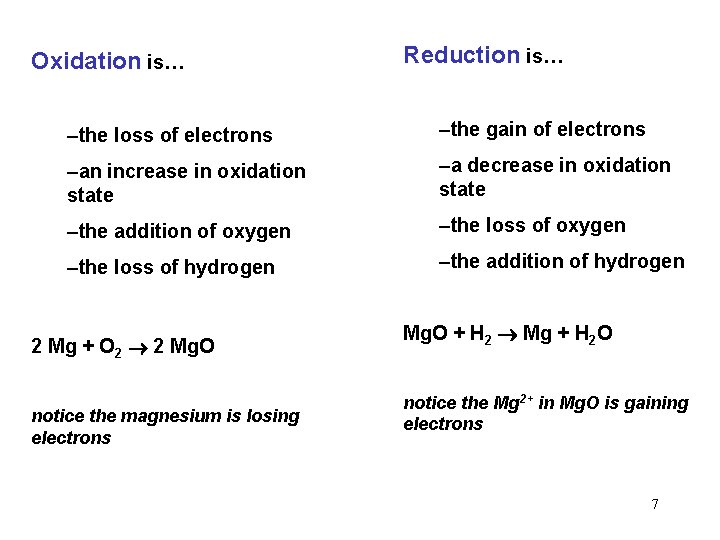
Oxidation is… Reduction is… –the loss of electrons –the gain of electrons –an increase in oxidation state –a decrease in oxidation state –the addition of oxygen –the loss of hydrogen –the addition of hydrogen 2 Mg + O 2 ® 2 Mg. O notice the magnesium is losing electrons Mg. O + H 2 ® Mg + H 2 O notice the Mg 2+ in Mg. O is gaining electrons 7
Oxidation States Ø Oxidation states are numbers assigned to atoms that reflect the net charge an atom. Ø They are assigned according to the following set of rules: Oxidation Number = ON 8
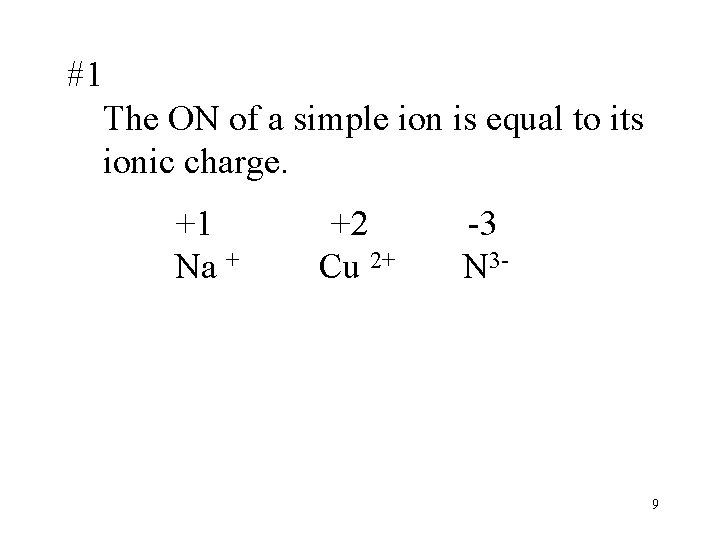
#1 The ON of a simple ion is equal to its ionic charge. +1 +2 -3 Na + Cu 2+ N 3 - 9
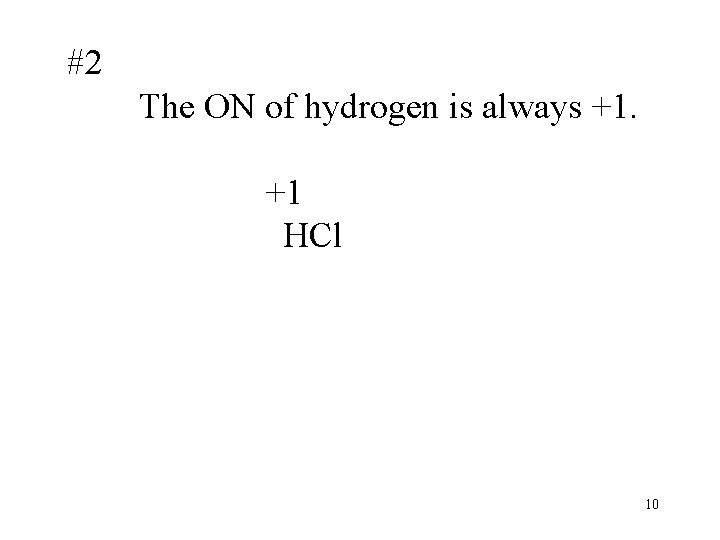
#2 The ON of hydrogen is always +1. +1 HCl 10
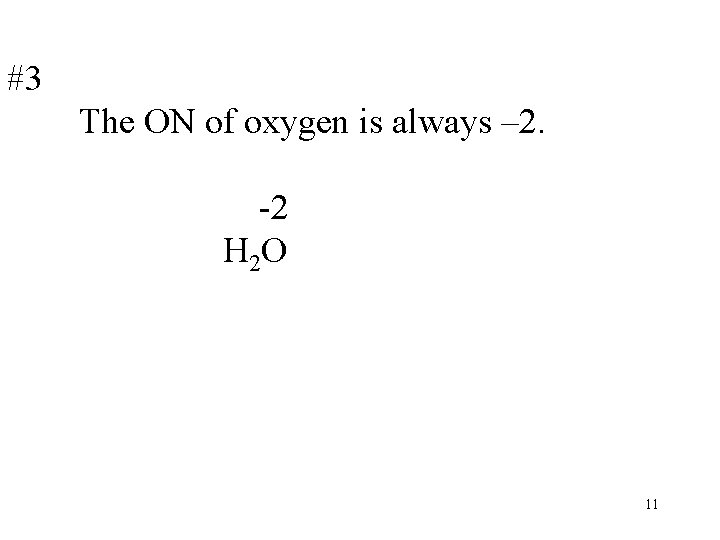
#3 The ON of oxygen is always – 2. -2 H 2 O 11
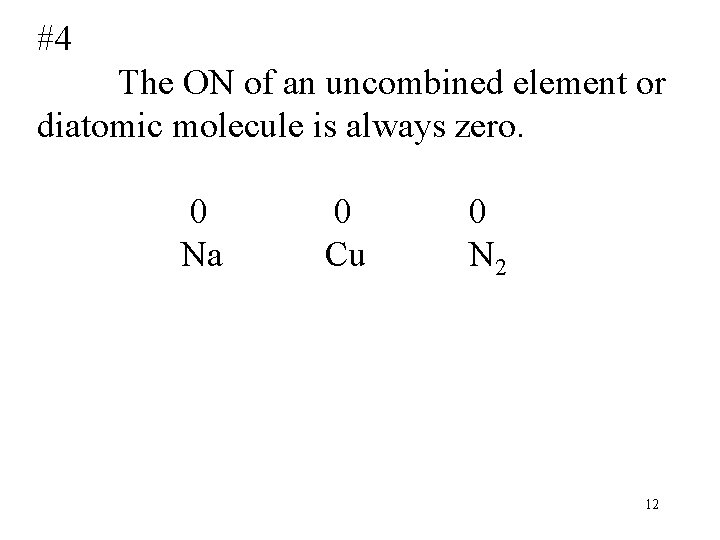
#4 The ON of an uncombined element or diatomic molecule is always zero. 0 0 Na Cu N 2 12
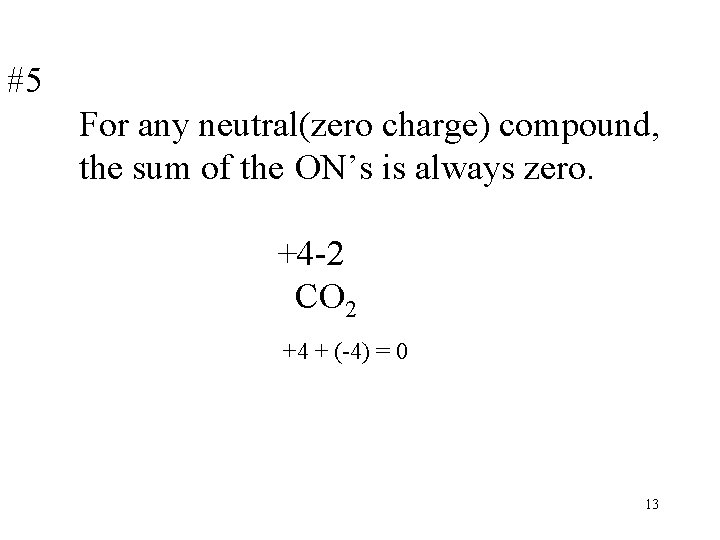
#5 For any neutral(zero charge) compound, the sum of the ON’s is always zero. +4 -2 CO 2 +4 + (-4) = 0 13
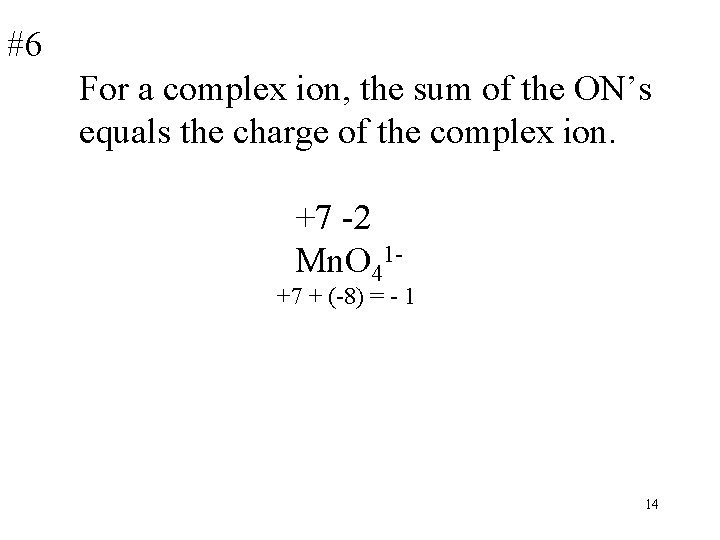
#6 For a complex ion, the sum of the ON’s equals the charge of the complex ion. +7 -2 Mn. O 41 - +7 + (-8) = - 1 14
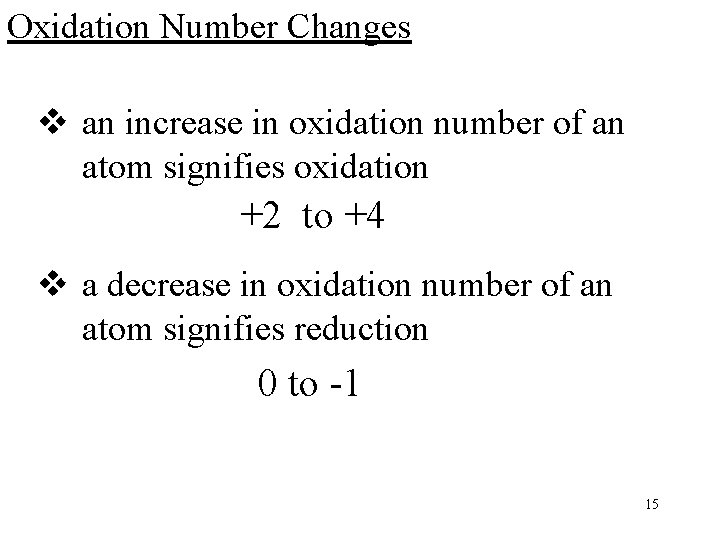
Oxidation Number Changes v an increase in oxidation number of an atom signifies oxidation +2 to +4 v a decrease in oxidation number of an atom signifies reduction 0 to -1 15
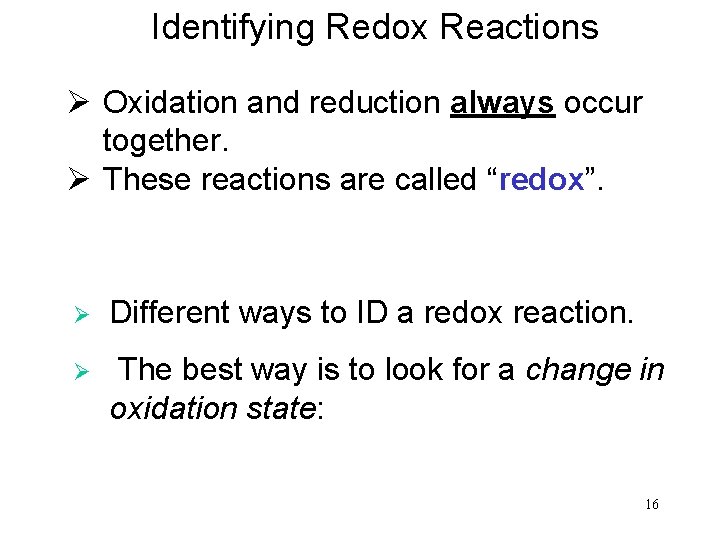
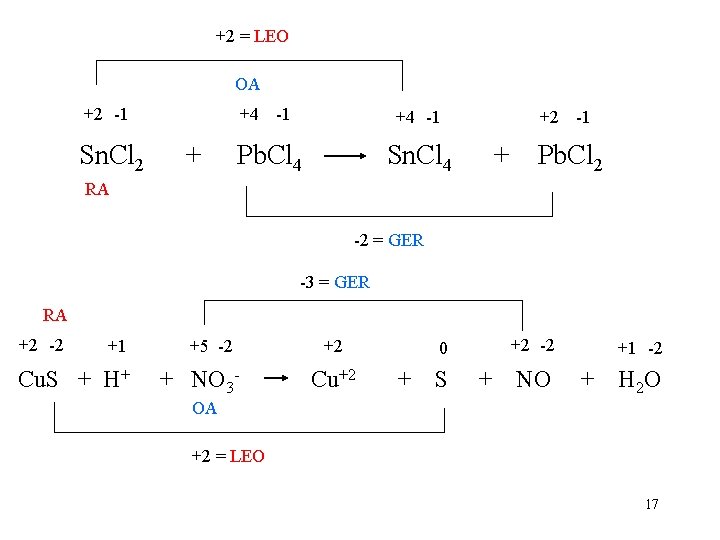
Identifying Redox Reactions Ø Oxidation and reduction always occur together. Ø These reactions are called “redox”. Ø Different ways to ID a redox reaction. Ø The best way is to look for a change in oxidation state: 16
+2 = LEO OA +2 -1 +4 -1 +2 -1 Sn. Cl 2 + Pb. Cl 4 Sn. Cl 4 + Pb. Cl 2 RA -2 = GER -3 = GER RA +2 -2 +1 +5 -2 +2 0 +2 -2 +1 -2 Cu. S + H+ + NO 3 - Cu+2 + S + NO + H 2 O OA +2 = LEO 17
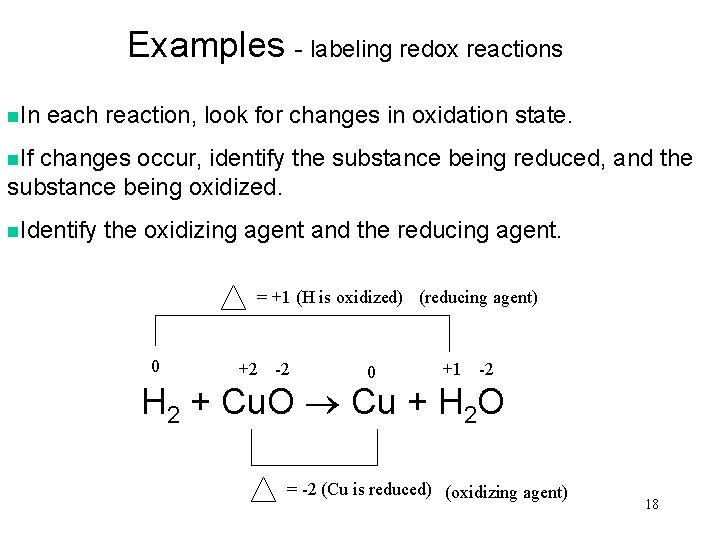
Examples - labeling redox reactions n. In each reaction, look for changes in oxidation state. n. If changes occur, identify the substance being reduced, and the substance being oxidized. n. Identify the oxidizing agent and the reducing agent. = +1 (H is oxidized) (reducing agent) 0 +2 -2 0 +1 -2 H 2 + Cu. O ® Cu + H 2 O = -2 (Cu is reduced) (oxidizing agent) 18
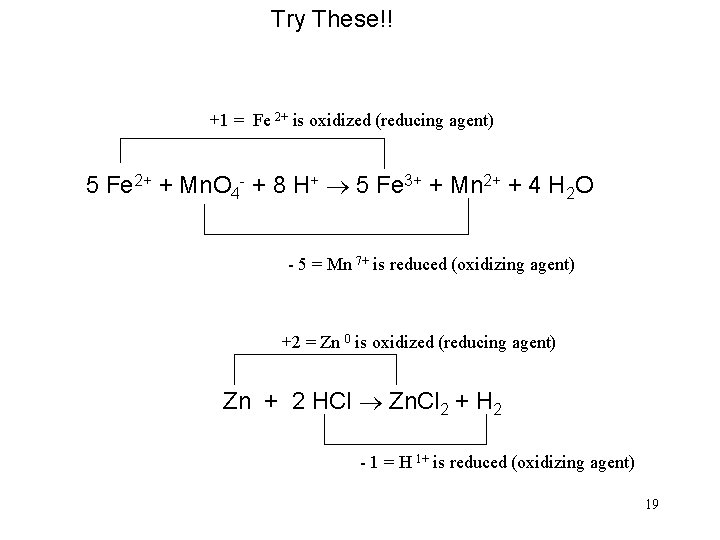
Try These!! +1 = Fe 2+ is oxidized (reducing agent) 5 Fe 2+ + Mn. O 4 - + 8 H+ ® 5 Fe 3+ + Mn 2+ + 4 H 2 O - 5 = Mn 7+ is reduced (oxidizing agent) +2 = Zn 0 is oxidized (reducing agent) Zn + 2 HCl ® Zn. Cl 2 + H 2 - 1 = H 1+ is reduced (oxidizing agent) 19
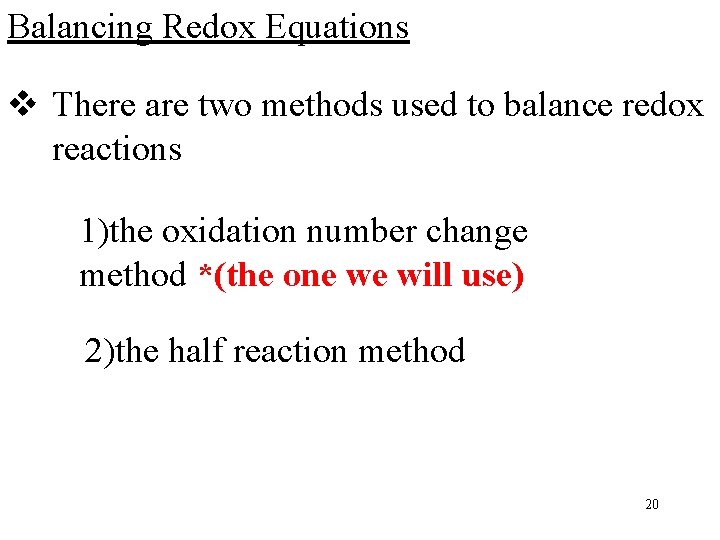
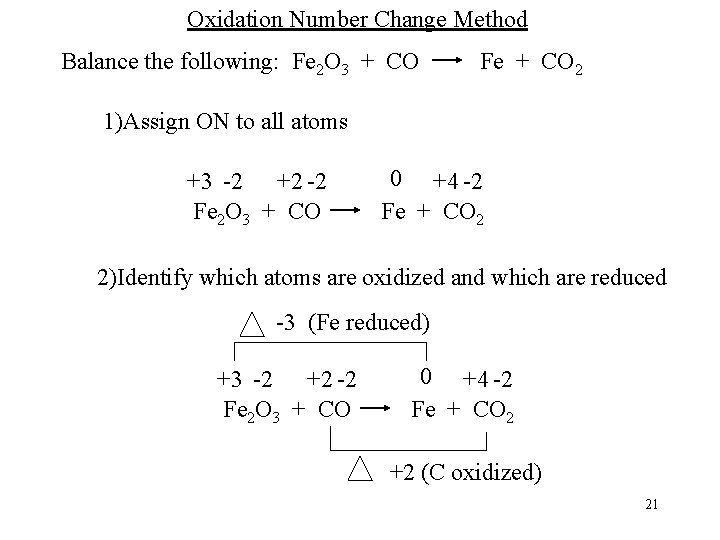
Balancing Redox Equations v There are two methods used to balance redox reactions 1)the oxidation number change method *(the one we will use) 2)the half reaction method 20
Oxidation Number Change Method Balance the following: Fe 2 O 3 + CO Fe + CO 2 1)Assign ON to all atoms 0 +4 -2 +3 -2 +2 -2 Fe 2 O 3 + CO Fe + CO 2 2)Identify which atoms are oxidized and which are reduced -3 (Fe reduced) 0 +4 -2 +3 -2 +2 -2 Fe 2 O 3 + CO Fe + CO 2 +2 (C oxidized) 21
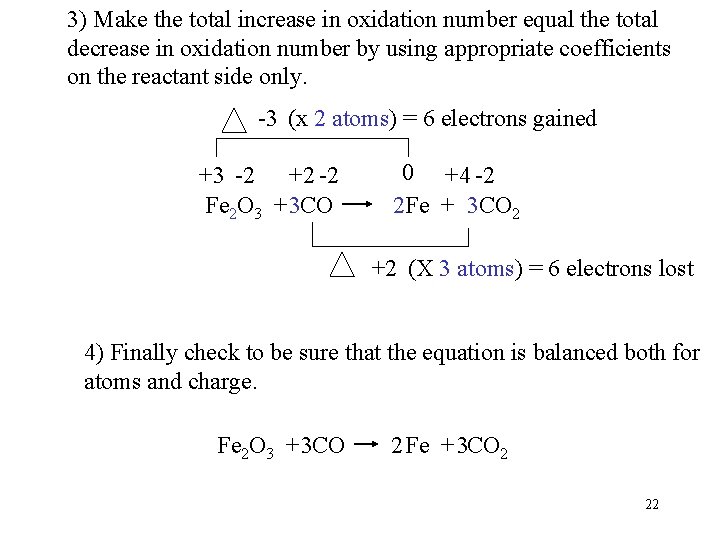
3) Make the total increase in oxidation number equal the total decrease in oxidation number by using appropriate coefficients on the reactant side only. -3 (x 2 atoms) = 6 electrons gained 0 +4 -2 +3 -2 +2 -2 Fe 2 O 3 + CO 2 Fe + 3 CO 3 2 +2 (X 3 atoms) = 6 electrons lost 4) Finally check to be sure that the equation is balanced both for atoms and charge. Fe 2 O 3 + CO Fe + CO 3 2 22
Chapter 19 SUTW Prompt • Describe the differences between oxidation and reduction in a redox chemical reaction. • Complete a 8 -10 sentence paragraph using the SUTW paragraph format. Hilight using green, yellow, and pink. • Due Date: Tomorrow (start of class). 23