
Chapter 19 Methods of AC Analysis Dependent Sources





- Slides: 28
Chapter 19 Methods of AC Analysis
Dependent Sources • Voltages and currents of independent sources – Not dependent upon any voltage or current elsewhere in the circuit • In some circuits – Operation of certain devices replaces device with an equivalent model 2
Dependent Sources • Models are dependent upon an internal voltage or current elsewhere in the circuit 3
Dependent Sources • Have a magnitude and phase angle determined by voltage or current at some other circuit element multiplied by a constant k • Magnitude of k is determined by parameters within particular model 4
Dependent Sources • Units of constant correspond to required quantities in the equation 5
Source Conversion • A voltage source E in series with an impedance Z – Equivalent to a current source I having the same impedance Z in parallel • I = E/Z • E = IZ 6
Source Conversion • Voltages and currents at terminals will be the same – Internal voltages and currents will differ 7
Source Conversion • A dependent source may be converted by the same method • Controlling element external to circuit • If controlling element is in the same circuit as the dependent source – Procedure cannot be used 8
Mesh Analysis • Method exactly the same as for dc – Convert all sinusoidal expressions into phasor notation – Convert current sources to voltage sources – Redraw circuit, simplifying the given impedances 9
Mesh Analysis • Assign clockwise loop currents to each interior closed loop • Show polarities of all impedances 10
Mesh Analysis • Apply KVL to each loop and write resulting equations • Voltages that are voltage rises in the direction of the assumed current are positive – Voltages that drop are negative 11
Mesh Analysis • Solve the resulting simultaneous linear equations or matrix equations 12
Nodal Analysis • Method is exactly the same as for dc • Nodal analysis will calculate all nodal voltages with respect to ground • Convert all sinusoidal expressions into equivalent phasor notation 13
Nodal Analysis • Convert all voltage sources to current sources • Redraw the circuit – Simplifying given impedances and expressing impedances as admittances 14
Nodal Analysis • Assign subscripted voltages to nodes – Select an appropriate reference node • Assign assumed current directions through all branches • Apply KCL to each node • Solve resulting equations for node voltages 15
Delta-to-Wye Conversion • Impedance in any arm of a Y circuit – Determined by taking the product of two adjacent impedances at this arm – Divide by the summation of the impedances 16
Delta-to-Wye Conversion 17
Wye-to-Delta Conversions • Any impedance in a – Determined by summing all possible twoimpedance product combinations of the Y – Divide by impedance found in opposite branch of the Y 18
Wye-to-Delta Conversions 19
Bridge Networks • Bridge circuits are used to measure the values of unknown components • Any bridge circuit is balanced when the current through branch between two arms is zero 20
Bridge Networks • The condition of a balanced bridge occurs when 21
Bridge Networks • When a balanced bridge occurs in a circuit – Equivalent impedance of bridge is found by removing central Z and replacing it by a short or open circuit • Resulting Z is then found by solving series -parallel circuit 22
Bridge Networks • For an unbalanced bridge – Z can be determined by -to-Y conversion or mesh analysis 23
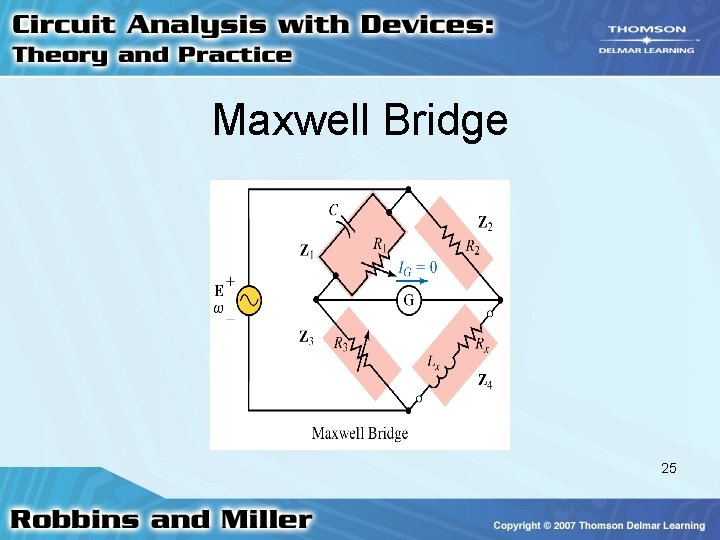
Maxwell Bridge • Used to determine the L and R of an inductor having a large series resistance • L = R 2 R 3 C R = R 2 R 3/R 1 24
Maxwell Bridge 25
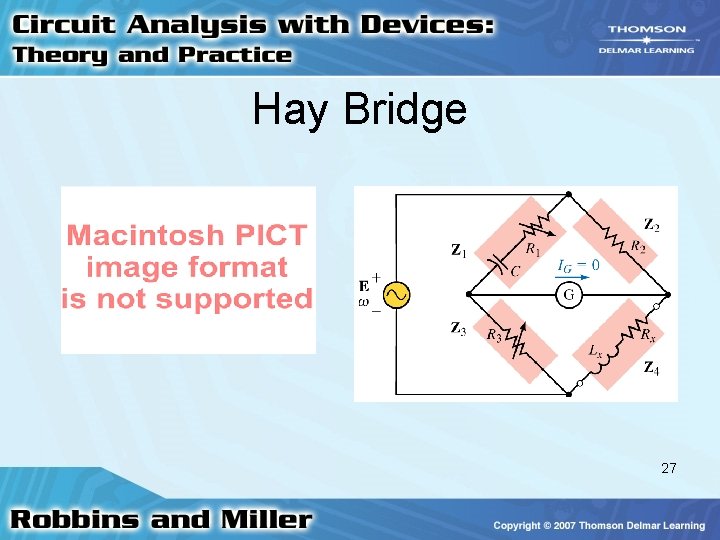
Hay Bridge • Used to measure the L and R of an inductor having a small series resistance 26
Hay Bridge 27
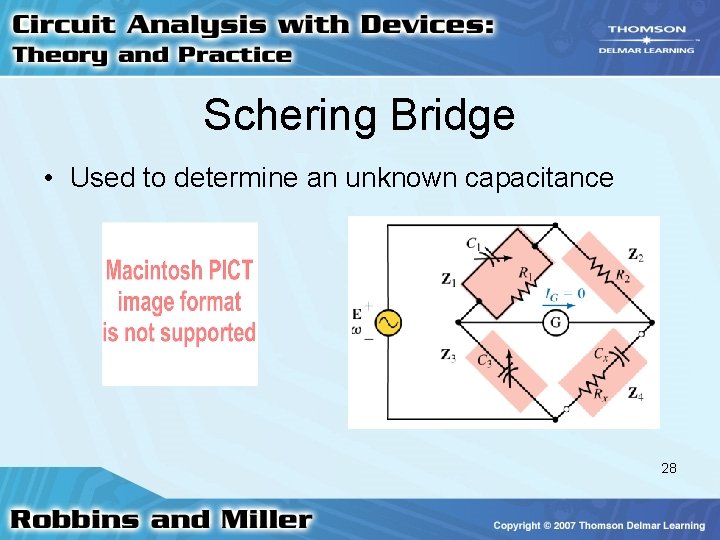
Schering Bridge • Used to determine an unknown capacitance 28