
Chapter 19 Manufacturing with Composites Composite Definition Structures


- Slides: 43
Chapter 19 Manufacturing with Composites
Composite - Definition • Structures made of two or more distinct materials • The materials maintain their identity during the process • The materials maintain their identity after the final component is fully formed.
Key Points • • Fabric Types Resin Types Manufacturing Techniques Curing Techniques Sandwiches and Honeycombs Joining of Composites Pros and Cons of Composites
Where are Composites Used? • • Recreational boats Cars Airplanes and other aircrafts Aerospace High performance sporting goods Appliances, tools, and machinery Tanks and pipes
What is a Composite? • First produced about 50 years ago • A “Judicious” combination of two or more materials that produces a “Synergistic” effect
Judicious • Implies that the components are carefully selected to provide the desired physical and chemical characteristics
Synergistic • The whole product is better than the sum of its individual components • Word coined by Buckminster Fuller • Illustrated concept by using a rope as an example
Composites are made up of a fiber and a matrix • Fiber can be short or long strands of material • Matrix is a the material that holds the fibers together • Natural composites – celery, corn stalks, and sugar cane • Manmade composite – reinforced concrete
Composite Classification • Matrix – Material that surrounds the other components • Fillers – Randomly oriented equally dispersed particles • Fiber Reinforcement – Usually the main component in differing forms
Simple and Advanced Composites • Simple Composite (Reinforced plastic) – Fiber laid in random directions or very short • Advance Composite – Long fibers are laid in a given direction, long, and continuous
Fiber orientation • Unidirectional • Biaxial (Cross-ply) – Random orientation • Laminates – Cross layering of unidirectional composites
Composite System Categories • • Fiber – Resin Fiber – Ceramic Carbon – Metal – Concrete Metal – Resin Metal – Elastomer Fiber – Elastomer Wood – Resin
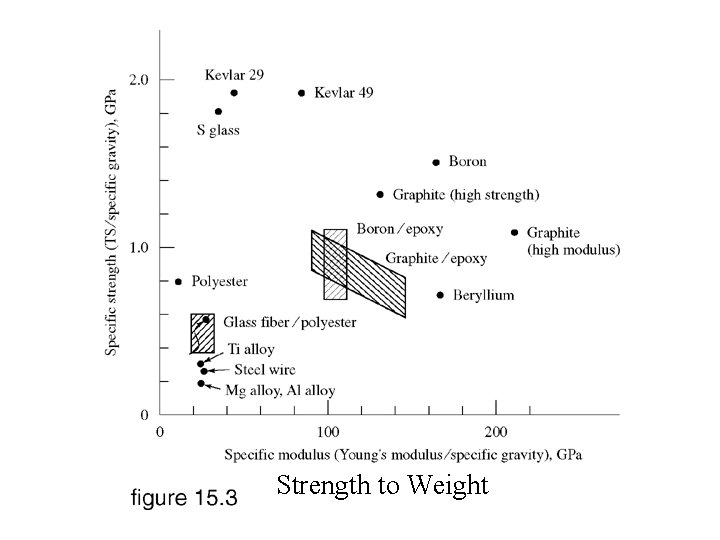
Typical Fabrics Used in Composites Glass • • • Can be long and continuous or short Can use many different types ex: Soda lime – easy and low cost Fiberglass white color can be dyed to any color Kelvar • • • Can be long and continuous Same family as nylon Distinctive yellow color Graphite (carbon) • • • Made by burning a material in the absence of oxygen, other elements burn off leaving carbon Should be called carbon fiber Always black
Strength to Weight
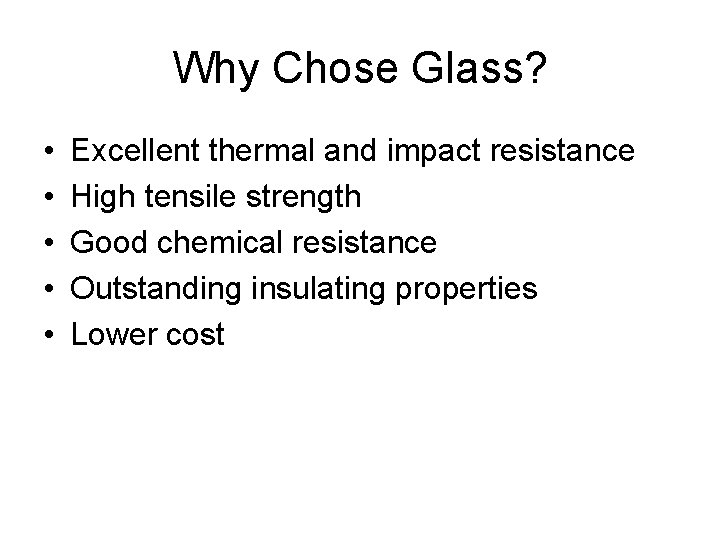
Why Chose Glass? • • • Excellent thermal and impact resistance High tensile strength Good chemical resistance Outstanding insulating properties Lower cost
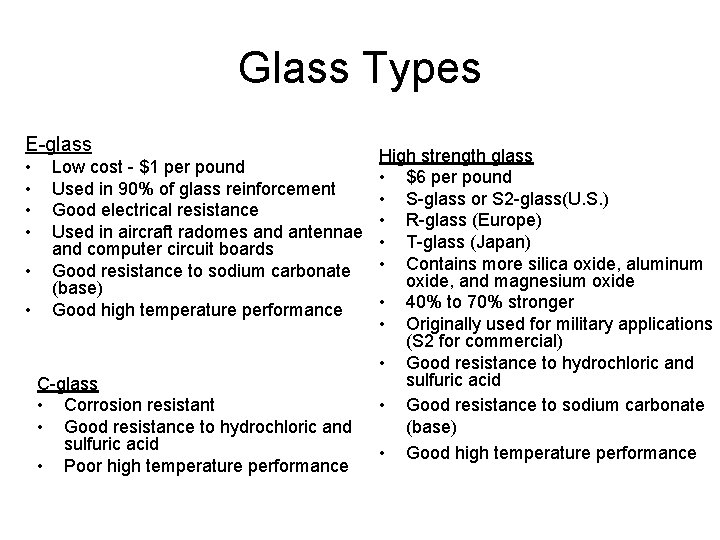
Glass Types E-glass • • • Low cost - $1 per pound Used in 90% of glass reinforcement Good electrical resistance Used in aircraft radomes and antennae and computer circuit boards Good resistance to sodium carbonate (base) Good high temperature performance C-glass • Corrosion resistant • Good resistance to hydrochloric and sulfuric acid • Poor high temperature performance High strength glass • $6 per pound • S-glass or S 2 -glass(U. S. ) • R-glass (Europe) • T-glass (Japan) • Contains more silica oxide, aluminum oxide, and magnesium oxide • 40% to 70% stronger • Originally used for military applications (S 2 for commercial) • Good resistance to hydrochloric and sulfuric acid • Good resistance to sodium carbonate (base) • Good high temperature performance
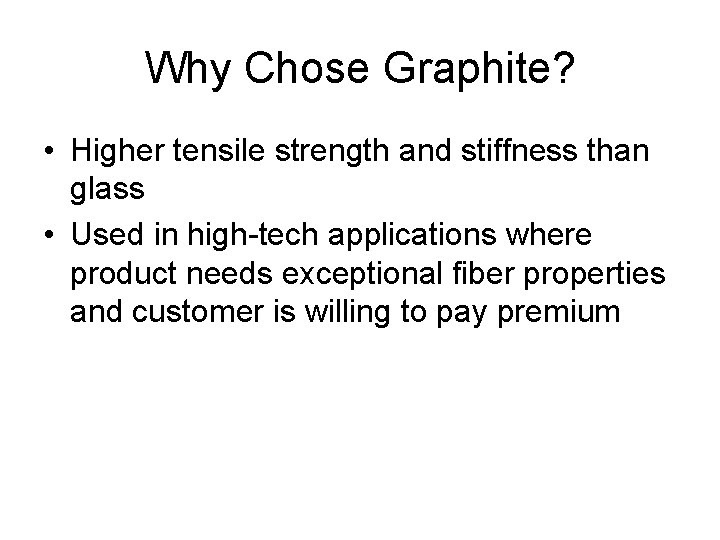
Why Chose Graphite? • Higher tensile strength and stiffness than glass • Used in high-tech applications where product needs exceptional fiber properties and customer is willing to pay premium
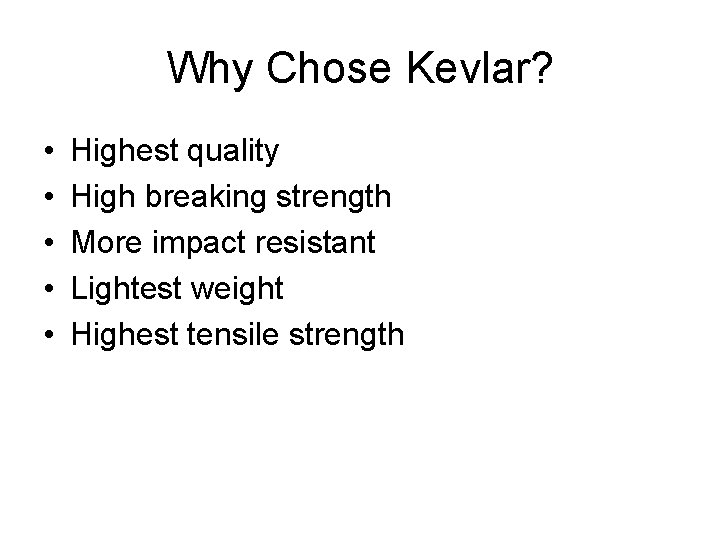
Why Chose Kevlar? • • • Highest quality High breaking strength More impact resistant Lightest weight Highest tensile strength
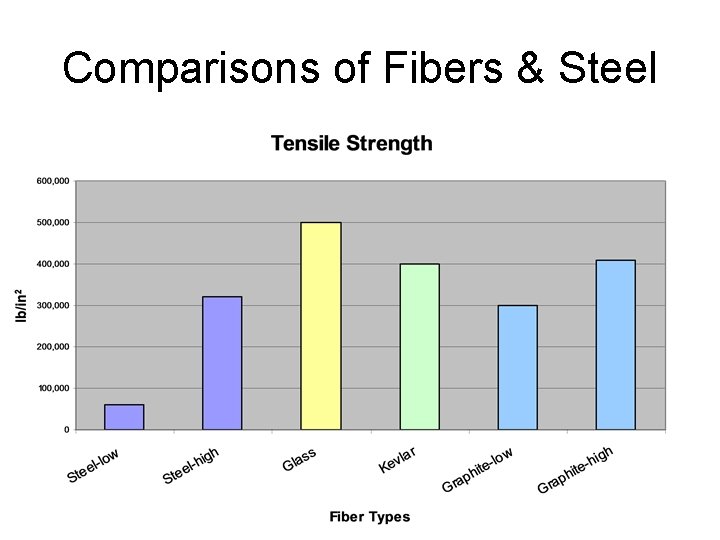
Comparisons of Fibers & Steel
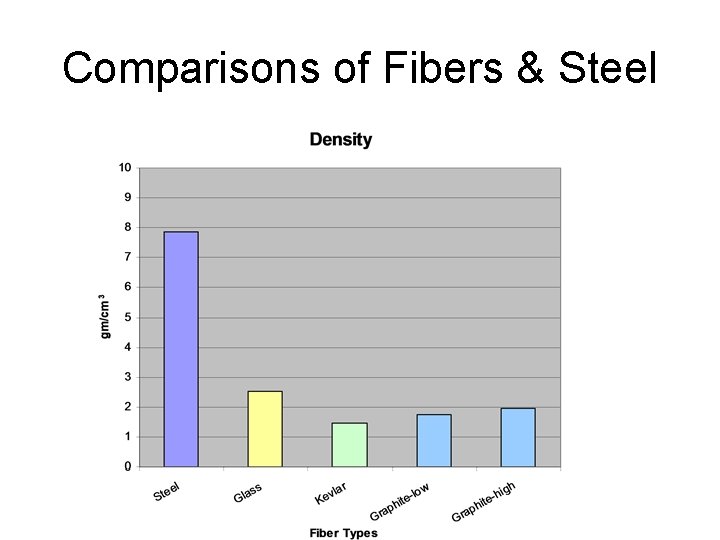
Comparisons of Fibers & Steel
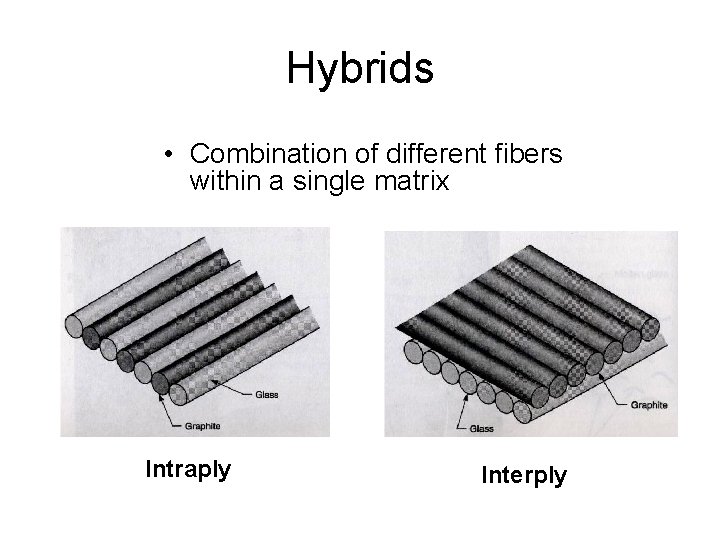
Hybrids • Combination of different fibers within a single matrix Intraply Interply
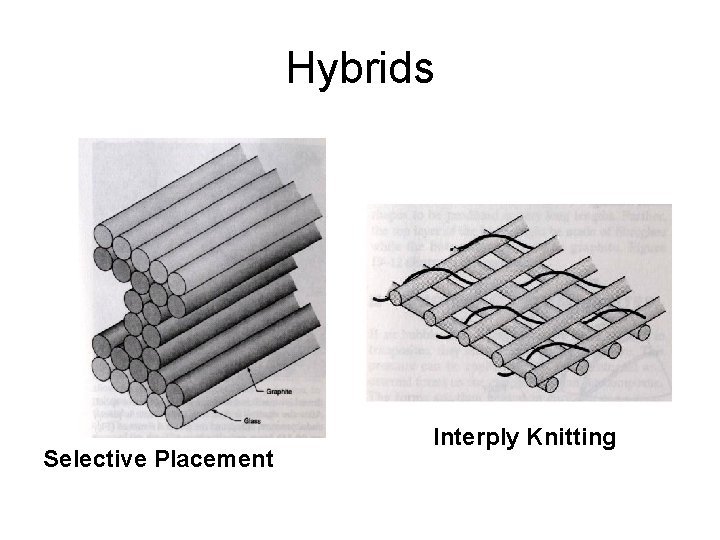
Hybrids Selective Placement Interply Knitting
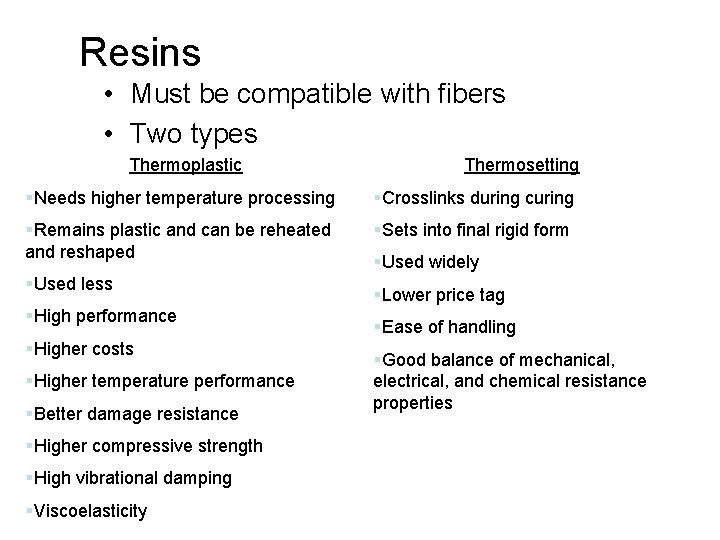
Resins • Must be compatible with fibers • Two types Thermoplastic Thermosetting §Needs higher temperature processing §Crosslinks during curing §Remains plastic and can be reheated and reshaped §Sets into final rigid form §Used less §High performance §Higher costs §Higher temperature performance §Better damage resistance §Higher compressive strength §High vibrational damping §Viscoelasticity §Used widely §Lower price tag §Ease of handling §Good balance of mechanical, electrical, and chemical resistance properties
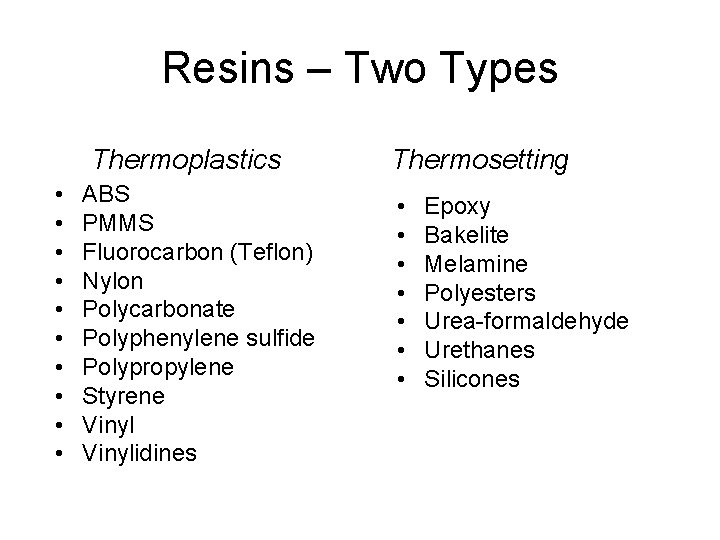
Resins – Two Types Thermoplastics • • • ABS PMMS Fluorocarbon (Teflon) Nylon Polycarbonate Polyphenylene sulfide Polypropylene Styrene Vinylidines Thermosetting • • Epoxy Bakelite Melamine Polyesters Urea-formaldehyde Urethanes Silicones
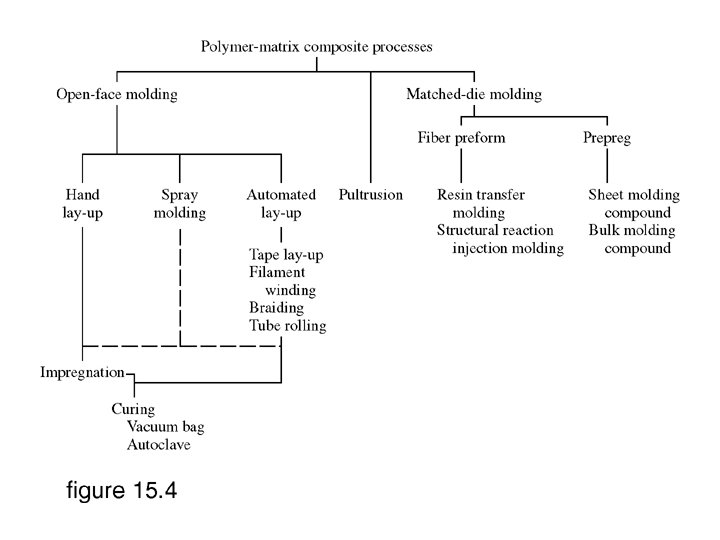
Manufacturing Techniques • • Hand layup or Hand-lay Pre-preg Filament winding Pultrusion
Open Mold Processes • • Hand Lay-up Spray-up Tape-laying Filament winding
Hand layup • Oldest, Inexpensive, Little equipment required • Repair technicians and backyard boat builders use this technique with fiberglass • Requires some skill to do • Wasteful use of resin • Product heavier compared to using other techniques • Good for one of a kind products or prototypes
Hand layup Method 1. A form is coated with resin using a paintbrush, roller, swab, spatula or any other method 2. Fabric is pressed into the resin 3. Another coat of resin is applied on top
Pre-preg Method 1. 2. 3. 4. Fabric saturated with resin Excess squeezed out by rollers Cured to B stage, material tacky Can be stored a week to 10 days if not used right away. Refrigeration lengthens shelf life 5. Can be wrapped around a mandrel, cut by computer controlled machines or laid up on forms by robots 6. Must be put under pressure to finish curing
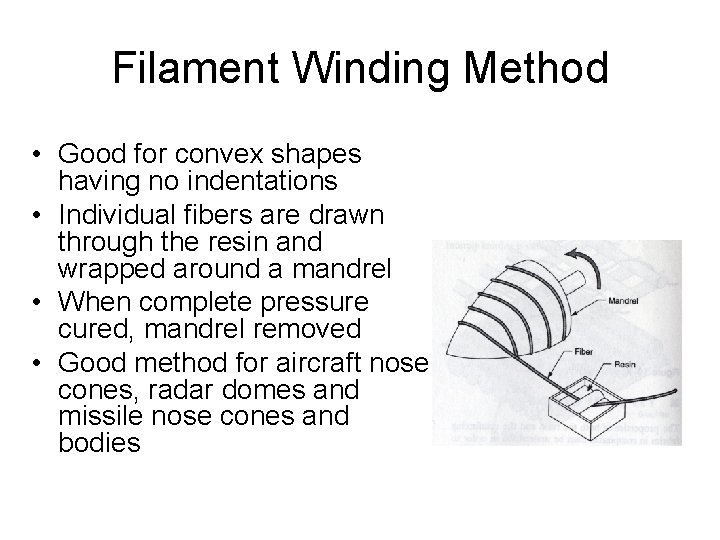
Filament Winding Method • Good for convex shapes having no indentations • Individual fibers are drawn through the resin and wrapped around a mandrel • When complete pressure cured, mandrel removed • Good method for aircraft nose cones, radar domes and missile nose cones and bodies
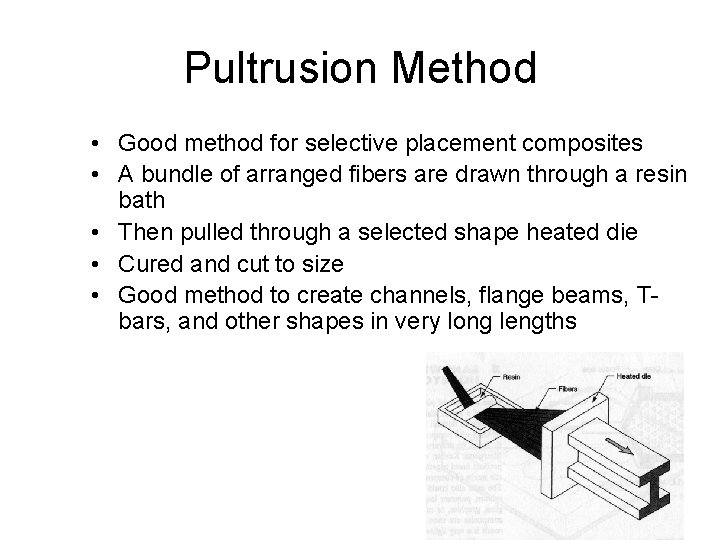
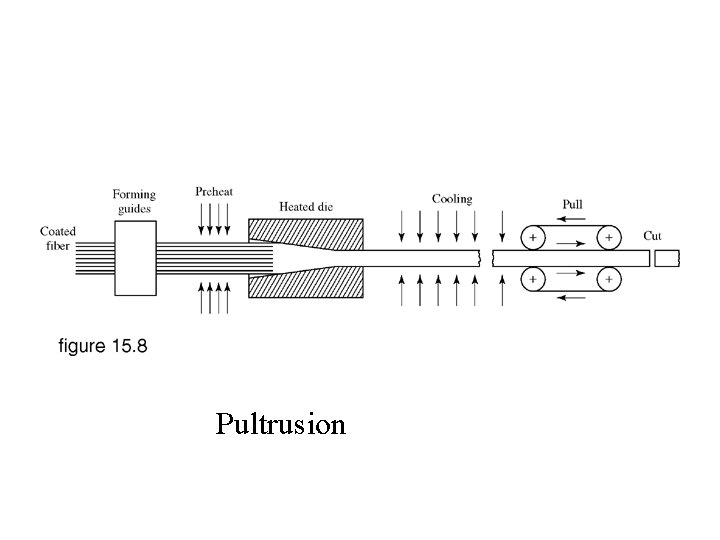
Pultrusion Method • Good method for selective placement composites • A bundle of arranged fibers are drawn through a resin bath • Then pulled through a selected shape heated die • Cured and cut to size • Good method to create channels, flange beams, Tbars, and other shapes in very long lengths
Pultrusion
Curing Techniques • Pressure forms • Vacuum bagging • Autoclaving
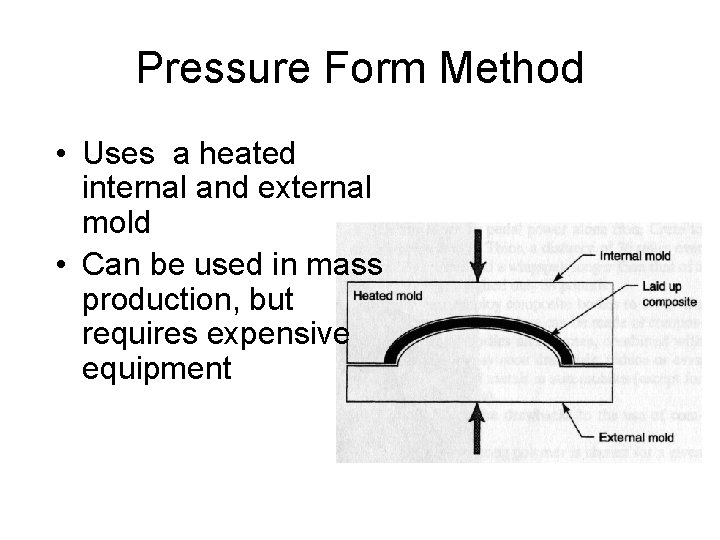
Pressure Form Method • Uses a heated internal and external mold • Can be used in mass production, but requires expensive equipment
Vacuum Bagging Method • Simple and cheapest method • Used after hand layup or pre-preg of material • Piece is placed in a polyethylene, rubber, or airtight flexible bag • Vacuum pull in the bag exerts equal pressure approximately 12 lb/in 2 • Part or entire bag is heated to cure
Autoclaving Method • Used when parts require more than one atmosphere of pressure • An oven that can be sealed and pressure is then applied by air or other gasses
Other Composite Forms Sandwiches • Styrofoam, syntactic foam, or polyurethane foam wrapped in fiberglass, Kevlar, or graphite fibers and fused together • Balsa wood could be used as a core to make sailboats • Recent developments using ceramic cores for heat resistance
Other Composite Forms Honeycombs • Honeycombed aluminum, Nomex, fiberglass, graphite, or other material wrapped and bonded to composite materials • Used in helicopter blades, truck and aircraft bodies, and some parts of aircraft wings and tail surfaces
Joining Composites • Joined in conventional methods by threads, pins, rivets, and other mechanical methods • Thermoplastic polymers joined by fusion welding • Chemical joining • Adhesives
Composites vs. Traditional Materials • • • Pros Lighter Stronger No fatigue failure No corroding Hard to break Complicated shapes • • Cons Delaminate Blisters Fabric cutting difficult Material and curing costs high
Environmental Concerns Reduction of styrene emissions • Exposure limited to 50 parts per million (OSHA) • Hard to meet standards and costly • Achieved by reducing styrene, better transferring to molds, curing in closed systems Development of biodegradable reinforced plastics • Filling up landfills with computer and car parts, packaging, etc. • Create matrices from soybean protein and use plant-based fibers such as ramie, pineapple leaves and banana stems • Could be used in car and train interiors, computers and as packaging materials • Low cost (when acceptance increases), biodegradable and renewable on a yearly basis
Websites • www. composites-one. com • www. msu. edu/~namaact/productinfo. htm