
Chapter 19 Light Mirrors and Lenses Section 1
- Slides: 39
Chapter 19 Light, Mirrors, and Lenses Section 1 Properties of Light Pages 550 - 554
What is Light? • Light is a type of wave that carries energy through matter or space • A source of energy such as the Sun or a light bulb gives off light waves that spread out in all directions from the light source. • A light ray is a narrow beam of light that travels in a straight line.
Light Travels Through Space • The material through which a wave travels is called the medium • Light is an electromagnetic wave and doesn’t need a medium in which to travel. • Electromagnetic waves can travel in a vacuum, as well as materials such as air, water, and glass.
Light and Matter • Most objects can only be seen if light waves from another source bounce off of them and into your eyes. • The process of light striking an object and bouncing off is called reflection • When light waves strike an object, some of the waves are absorbed by the object, some are reflected by it, and some might pass through it. it • What happens to light when it strikes an object depends on the material the object is made of.
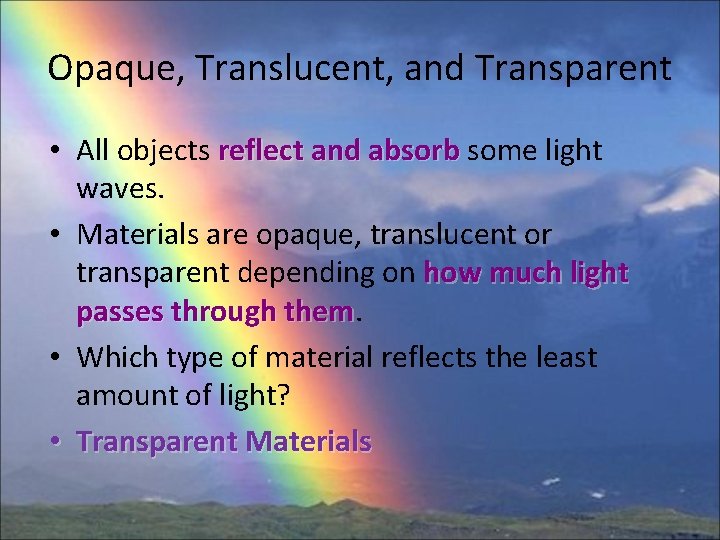
Opaque, Translucent, and Transparent • All objects reflect and absorb some light waves. • Materials are opaque, translucent or transparent depending on how much light passes through them • Which type of material reflects the least amount of light? • Transparent Materials
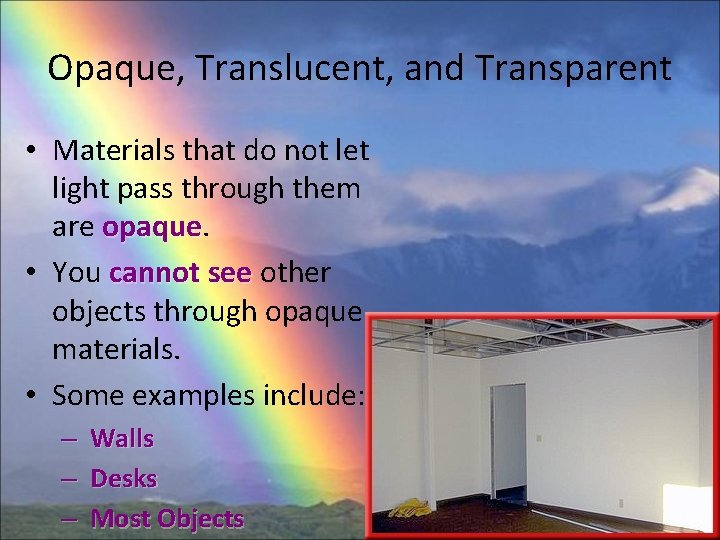
Opaque, Translucent, and Transparent • Materials that do not let light pass through them are opaque • You cannot see other objects through opaque materials. • Some examples include: – – – Walls Desks Most Objects
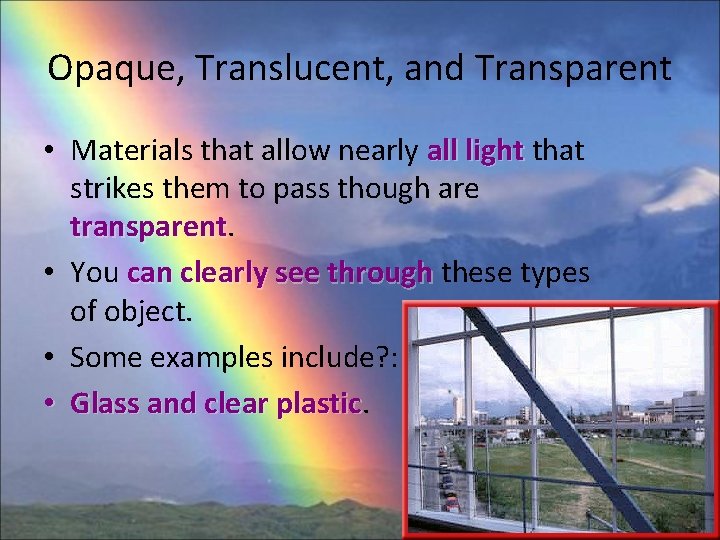
Opaque, Translucent, and Transparent • Materials that allow nearly all light that strikes them to pass though are transparent • You can clearly see through these types of object. • Some examples include? : • Glass and clear plastic
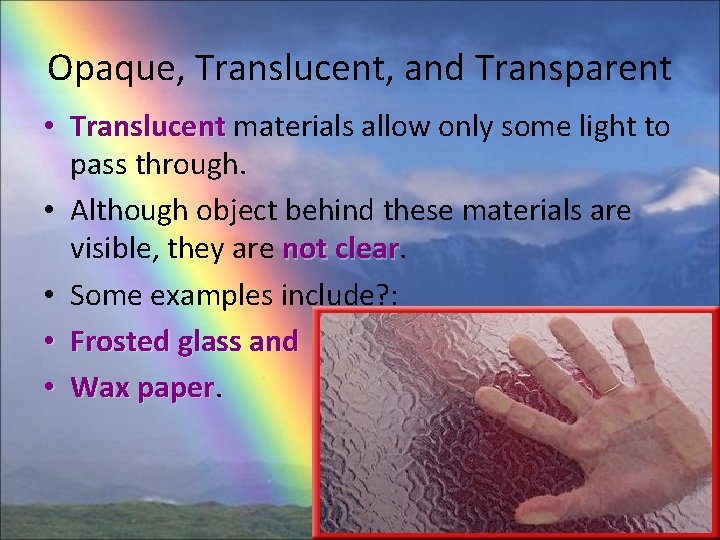
Opaque, Translucent, and Transparent • Translucent materials allow only some light to pass through. • Although object behind these materials are visible, they are not clear • Some examples include? : • Frosted glass and • Wax paper
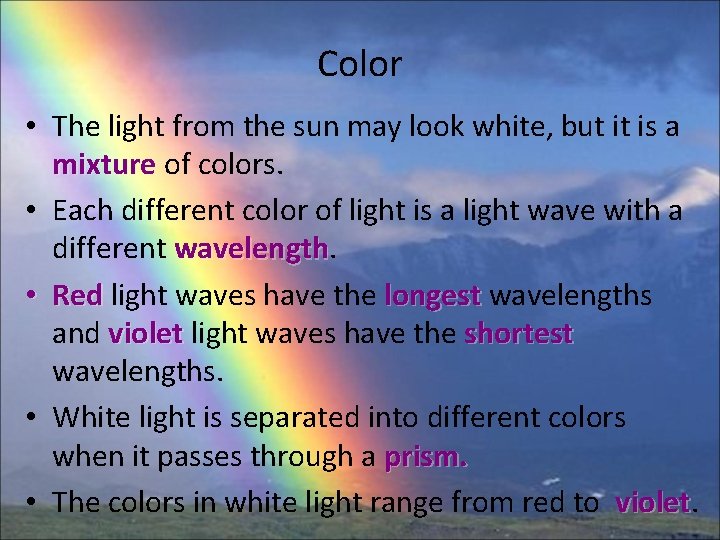
Color • The light from the sun may look white, but it is a mixture of colors. • Each different color of light is a light wave with a different wavelength • Red light waves have the longest wavelengths and violet light waves have the shortest wavelengths. • White light is separated into different colors when it passes through a prism. • The colors in white light range from red to violet
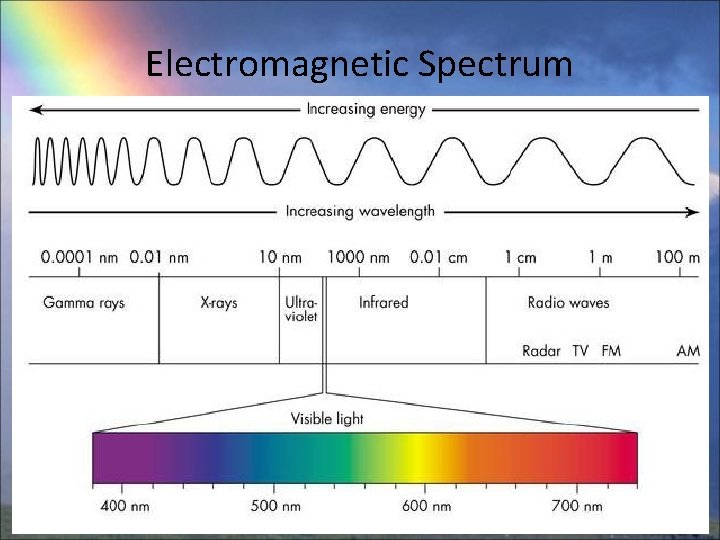
Electromagnetic Spectrum
Why Do Objects Have Color? • When light waves strike an object, some waves are absorbed and some are reflected. • If an object reflects red waves and absorbs all the others waves, it looks red • An object that reflects all the light waves that strike it looks white, while one that absorbs all the light waves looks black.
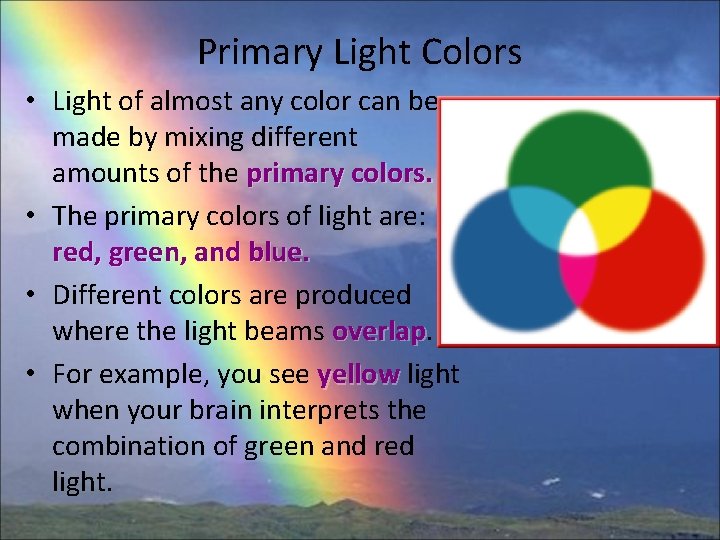
Primary Light Colors • Light of almost any color can be made by mixing different amounts of the primary colors. • The primary colors of light are: red, green, and blue. • Different colors are produced where the light beams overlap • For example, you see yellow light when your brain interprets the combination of green and red light.
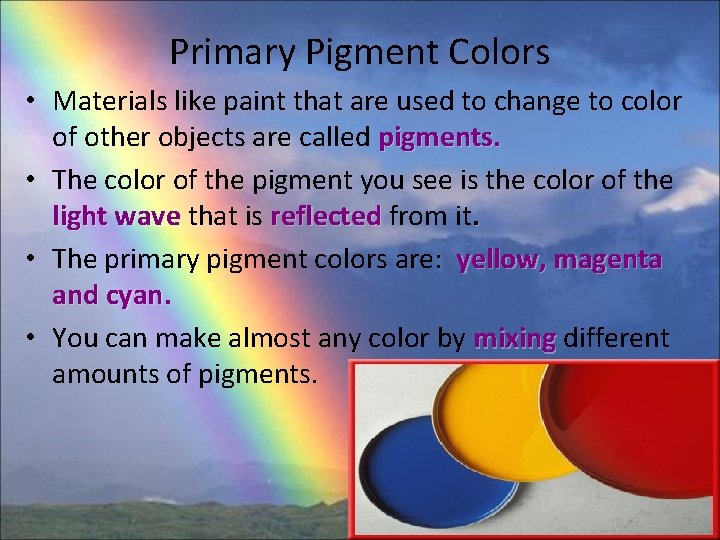
Primary Pigment Colors • Materials like paint that are used to change to color of other objects are called pigments. • The color of the pigment you see is the color of the light wave that is reflected from it. • The primary pigment colors are: yellow, magenta and cyan. • You can make almost any color by mixing different amounts of pigments.
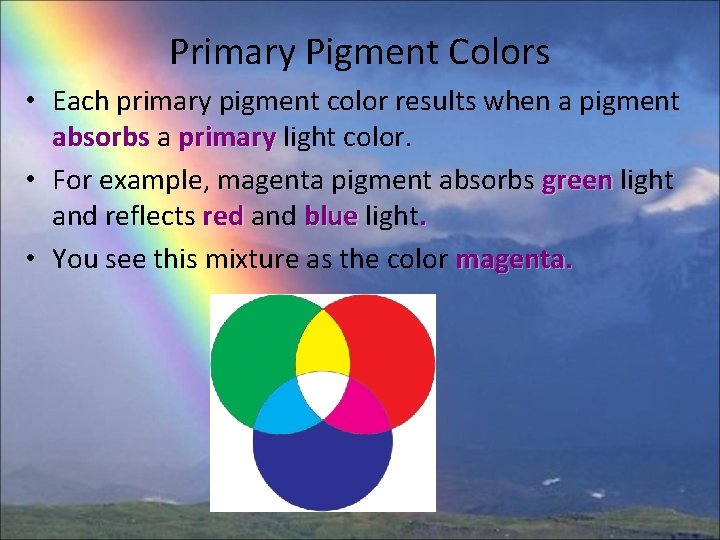
Primary Pigment Colors • Each primary pigment color results when a pigment absorbs a primary light color. • For example, magenta pigment absorbs green light and reflects red and blue light. • You see this mixture as the color magenta.
Chapter 19 Light, Mirrors, and Lenses Section 2 Reflection and Mirrors Pages 555 - 560
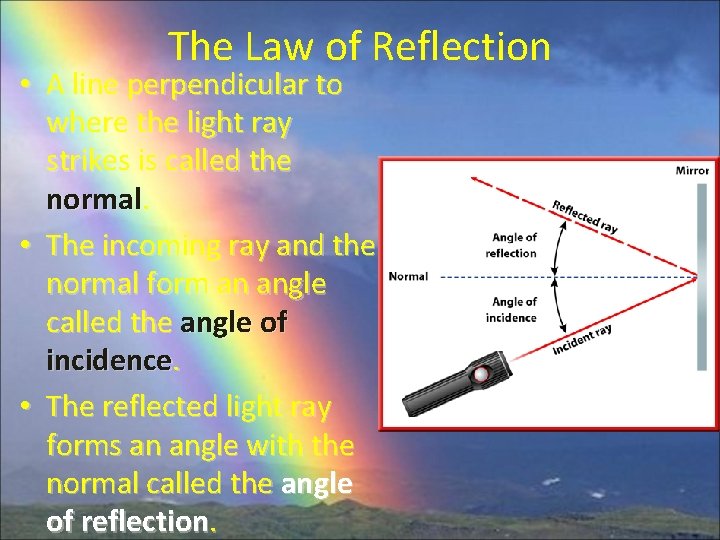
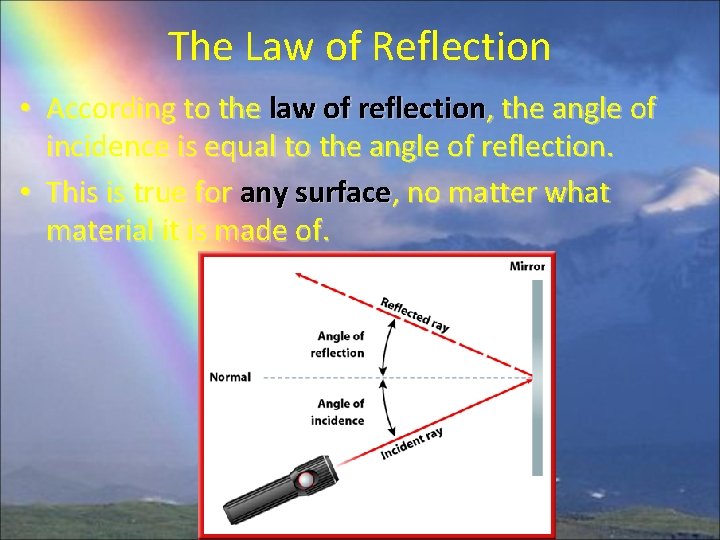
The Law of Reflection • A line perpendicular to where the light ray strikes is called the normal. • The incoming ray and the normal form an angle called the angle of incidence. • The reflected light ray forms an angle with the normal called the angle of reflection.
The Law of Reflection • According to the law of reflection, the angle of incidence is equal to the angle of reflection. • This is true for any surface, no matter what material it is made of.
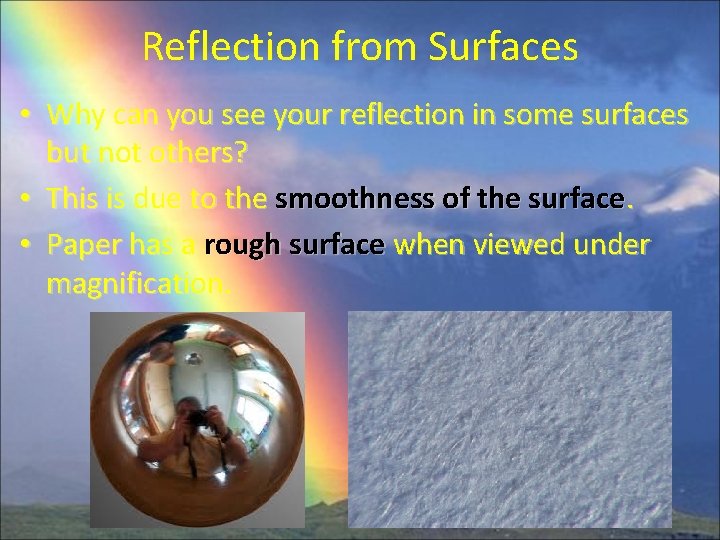
Reflection from Surfaces • Why can you see your reflection in some surfaces but not others? • This is due to the smoothness of the surface. • Paper has a rough surface when viewed under magnification.
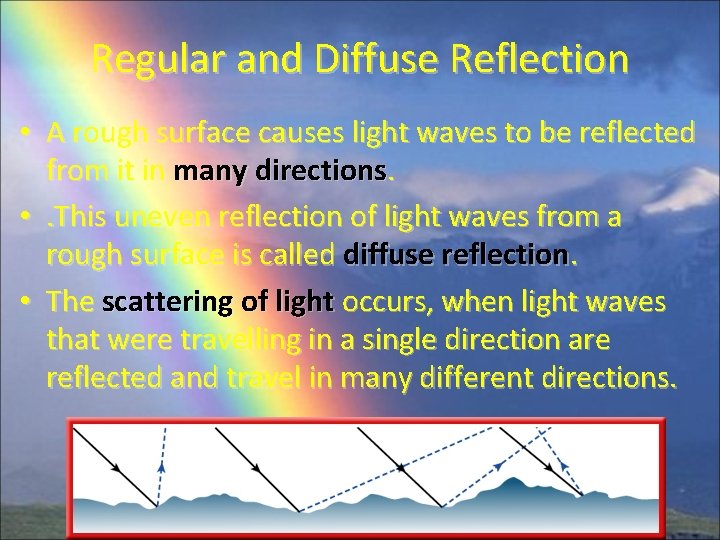
Regular and Diffuse Reflection • A rough surface causes light waves to be reflected from it in many directions. • . This uneven reflection of light waves from a rough surface is called diffuse reflection. • The scattering of light occurs, when light waves that were travelling in a single direction are reflected and travel in many different directions.
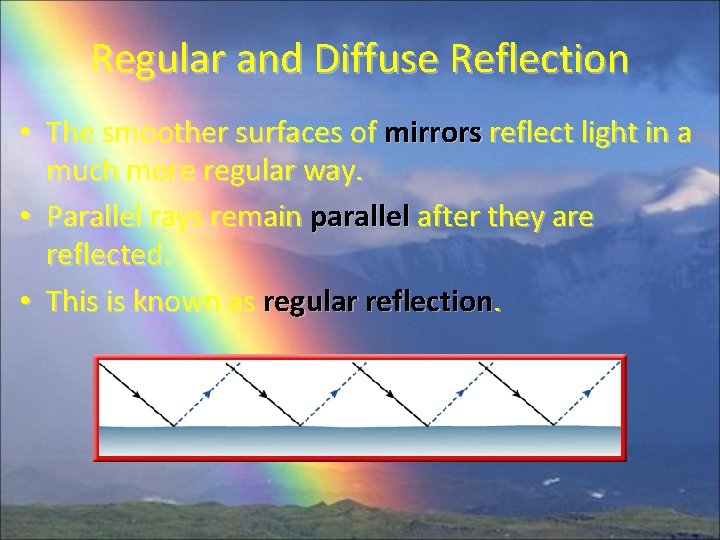
Regular and Diffuse Reflection • The smoother surfaces of mirrors reflect light in a much more regular way. • Parallel rays remain parallel after they are reflected. • This is known as regular reflection.
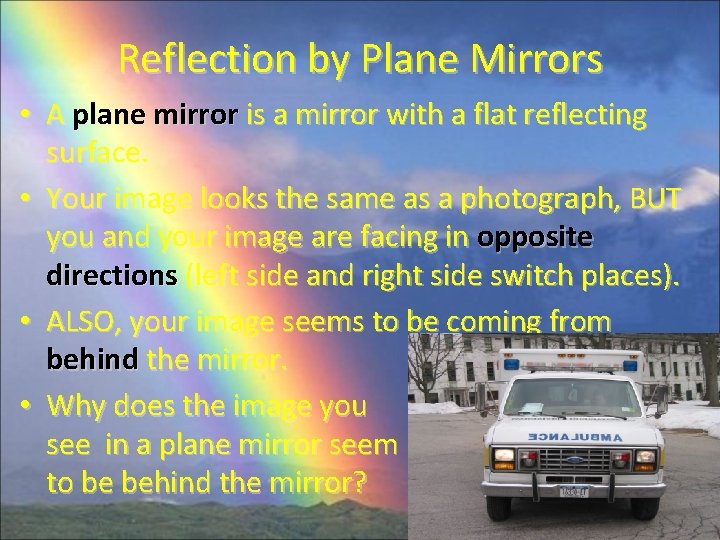
Reflection by Plane Mirrors • A plane mirror is a mirror with a flat reflecting surface. • Your image looks the same as a photograph, BUT you and your image are facing in opposite directions (left side and right side switch places). • ALSO, your image seems to be coming from behind the mirror. • Why does the image you see in a plane mirror seem to be behind the mirror?
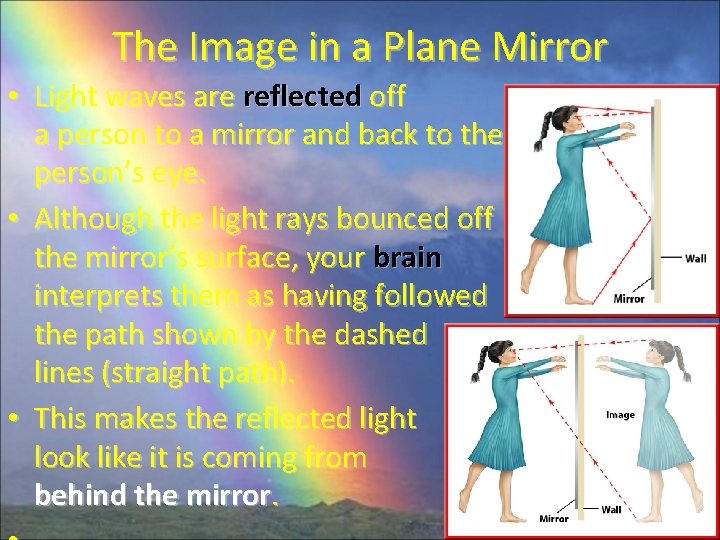
The Image in a Plane Mirror • Light waves are reflected off a person to a mirror and back to the person’s eye. • Although the light rays bounced off the mirror’s surface, your brain interprets them as having followed the path shown by the dashed lines (straight path). • This makes the reflected light look like it is coming from behind the mirror.
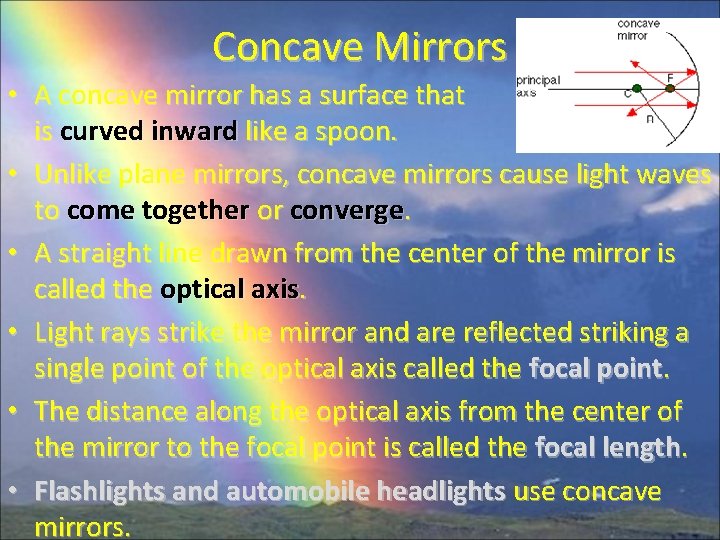
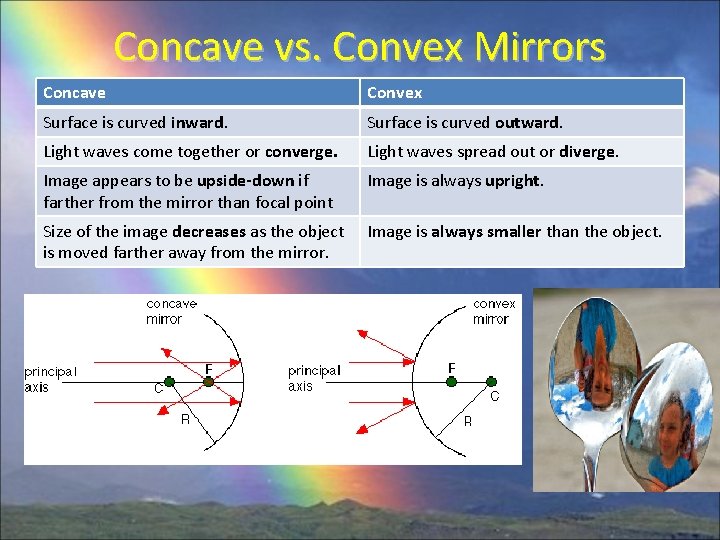
Concave Mirrors • A concave mirror has a surface that is curved inward like a spoon. • Unlike plane mirrors, concave mirrors cause light waves to come together or converge. • A straight line drawn from the center of the mirror is called the optical axis. • Light rays strike the mirror and are reflected striking a single point of the optical axis called the focal point. • The distance along the optical axis from the center of the mirror to the focal point is called the focal length. • Flashlights and automobile headlights use concave mirrors.
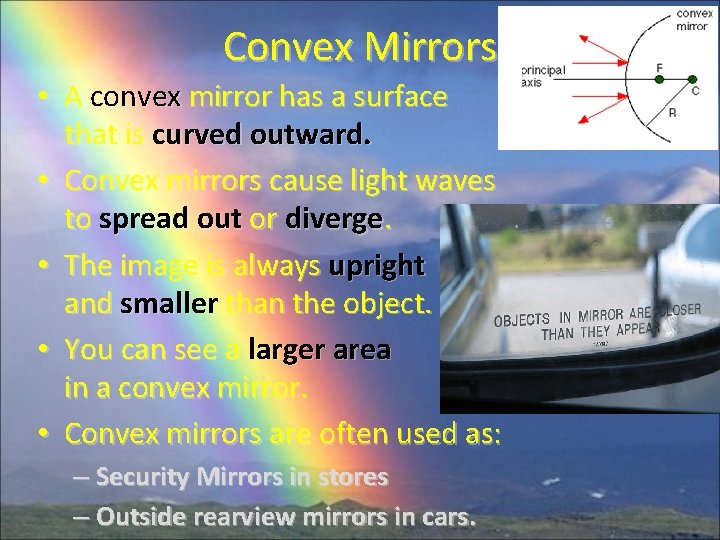
Convex Mirrors • A convex mirror has a surface that is curved outward. • Convex mirrors cause light waves to spread out or diverge. • The image is always upright and smaller than the object. • You can see a larger area in a convex mirror. • Convex mirrors are often used as: – Security Mirrors in stores – Outside rearview mirrors in cars.
Concave vs. Convex Mirrors Concave Convex Surface is curved inward. Surface is curved outward. Light waves come together or converge. Light waves spread out or diverge. Image appears to be upside-down if farther from the mirror than focal point Image is always upright. Size of the image decreases as the object is moved farther away from the mirror. Image is always smaller than the object.
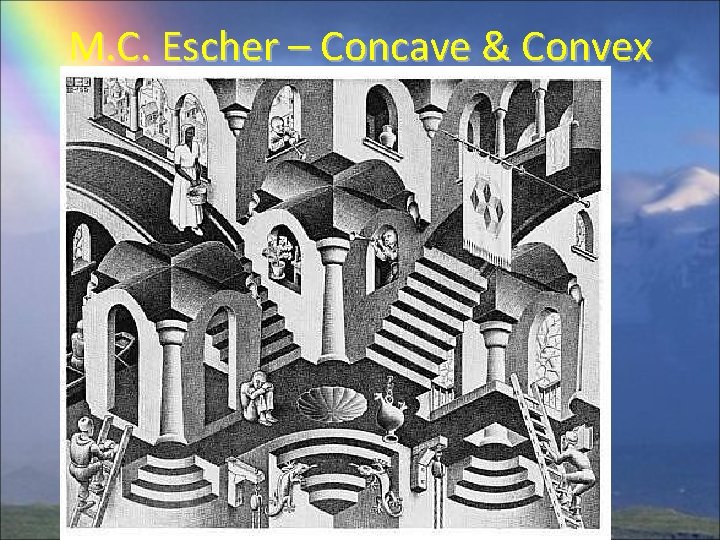
M. C. Escher – Concave & Convex
Chapter 19 Light, Mirrors, and Lenses Section 3 Refraction and Lenses Pages 562 - 566
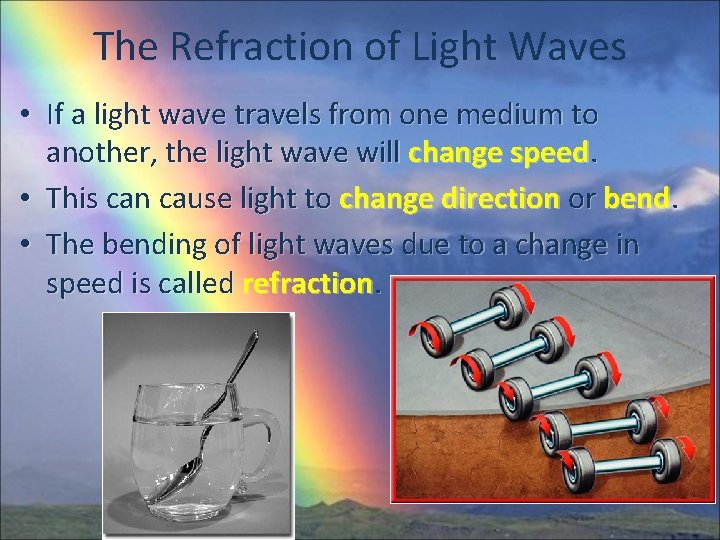
Bending of Light Rays • Objects in water can sometimes look strange. • A pencil in a glass of water sometimes looks as if it bent or shifted. • Illusions such as these are due to the bending of light rays as they pass from one material to another.
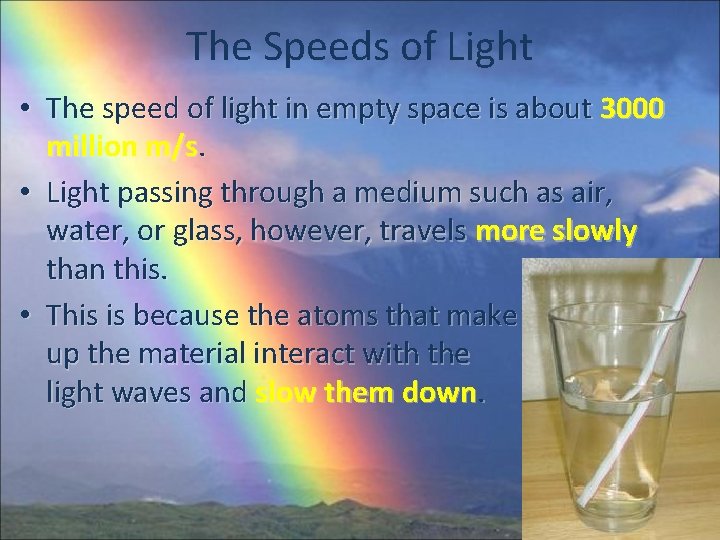
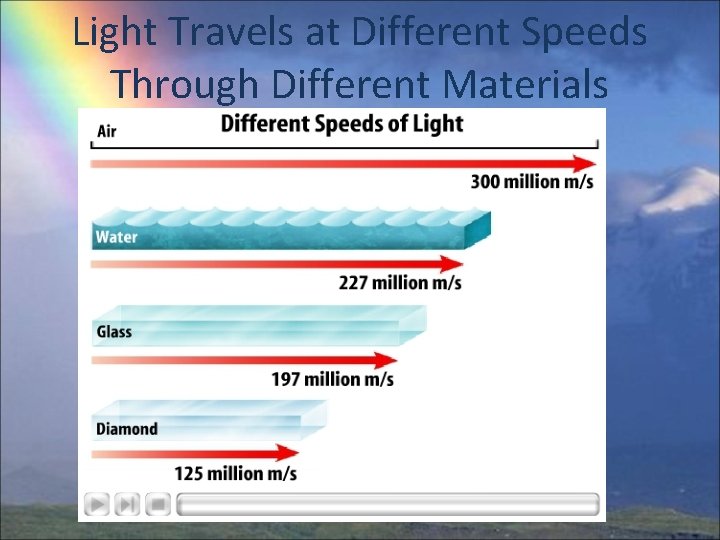
The Speeds of Light • The speed of light in empty space is about 3000 million m/s. • Light passing through a medium such as air, water, or glass, however, travels more slowly than this. • This is because the atoms that make up the material interact with the light waves and slow them down.
Light Travels at Different Speeds Through Different Materials
The Refraction of Light Waves • If a light wave travels from one medium to another, the light wave will change speed. • This can cause light to change direction or bend. • The bending of light waves due to a change in speed is called refraction.
Convex and Concave Lenses • Taking photographs of friends or looking through a magnifying glass involves the use of a lens. • A lens is a transparent object with at least one curved side that causes light to bend. • The more curved the sides of the lens are, the more light will be bent after it enters the lens.
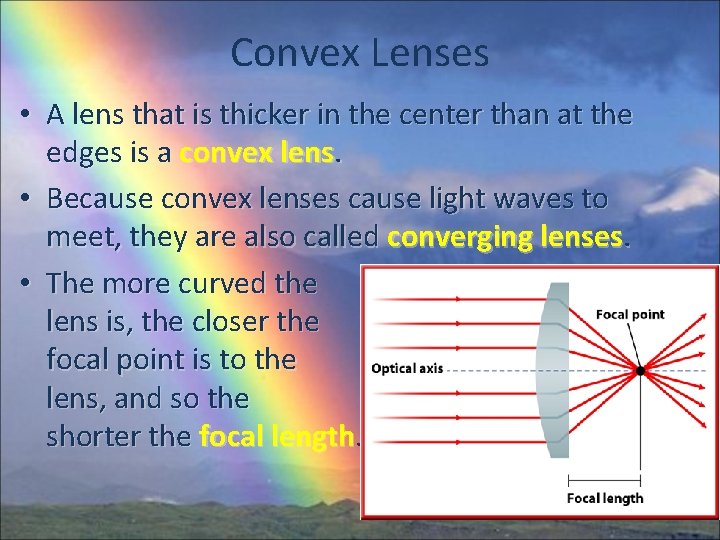
Convex Lenses • A lens that is thicker in the center than at the edges is a convex lens. • Because convex lenses cause light waves to meet, they are also called converging lenses. • The more curved the lens is, the closer the focal point is to the lens, and so the shorter the focal length.
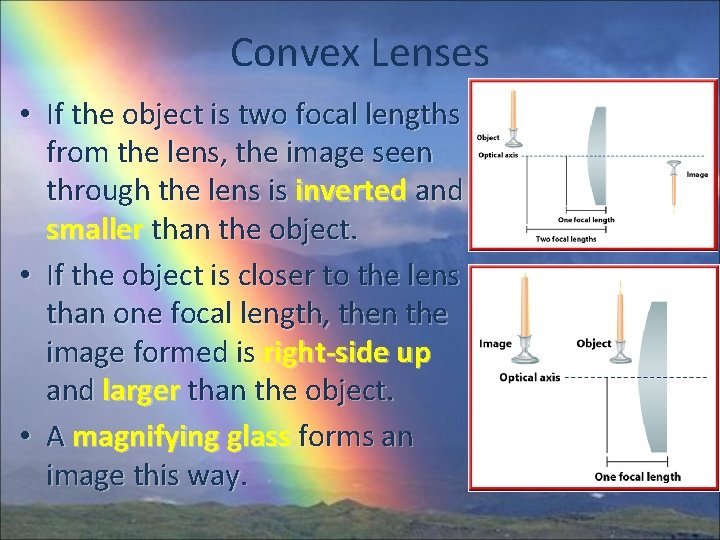
Convex Lenses • If the object is two focal lengths from the lens, the image seen through the lens is inverted and smaller than the object. • If the object is closer to the lens than one focal length, then the image formed is right-side up and larger than the object. • A magnifying glass forms an image this way.
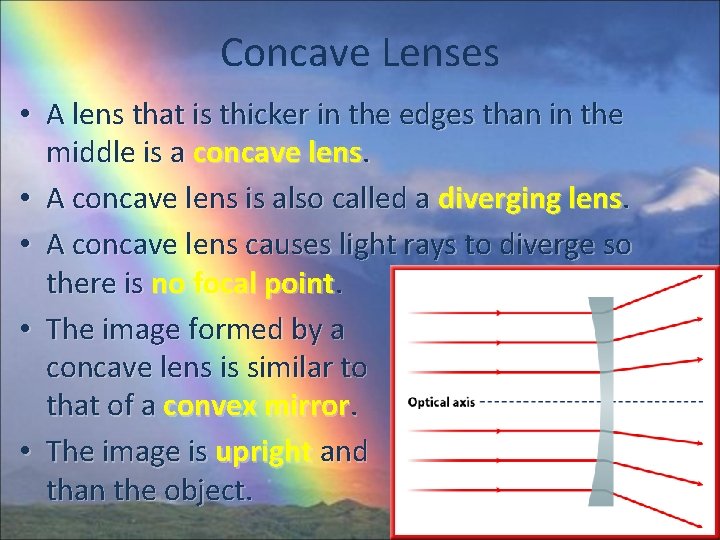
Concave Lenses • A lens that is thicker in the edges than in the middle is a concave lens. • A concave lens is also called a diverging lens. • A concave lens causes light rays to diverge so there is no focal point. • The image formed by a concave lens is similar to that of a convex mirror. • The image is upright and smaller than the object.
Total Internal Reflection • When you look at a glass window, you can sometimes see your reflection. . this is an example of partial reflection. • However, sometimes all the light waves that strike a boundary between two transparent materials can be reflected…this process is called total reflection.
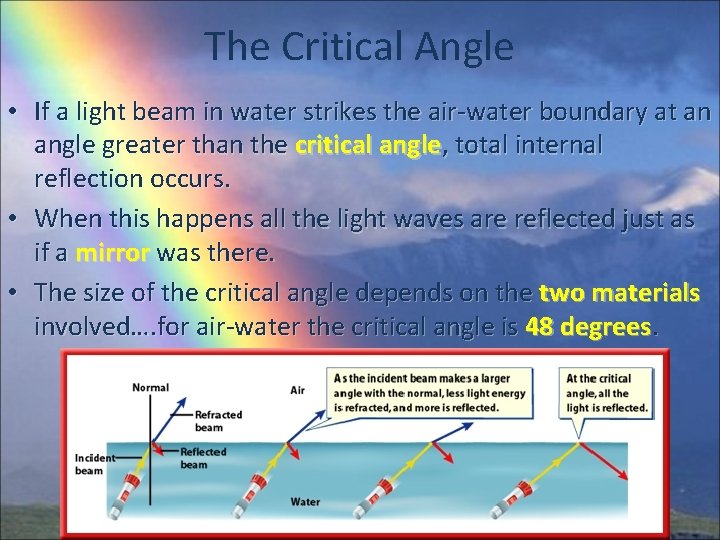
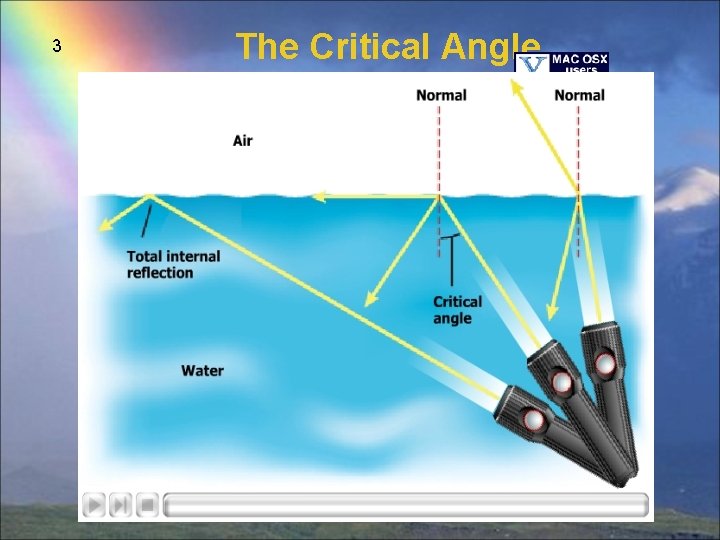
The Critical Angle • If a light beam in water strikes the air-water boundary at an angle greater than the critical angle, total internal reflection occurs. • When this happens all the light waves are reflected just as if a mirror was there. • The size of the critical angle depends on the two materials involved…. for air-water the critical angle is 48 degrees.
3 The Critical Angle
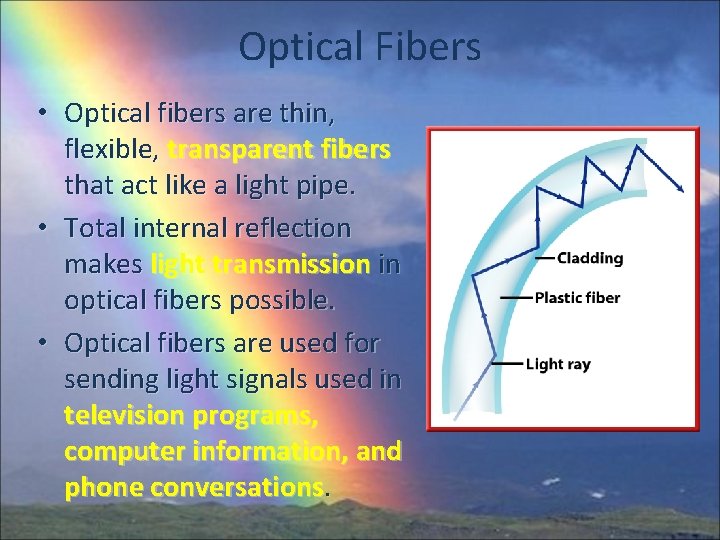
Optical Fibers • Optical fibers are thin, flexible, transparent fibers that act like a light pipe. • Total internal reflection makes light transmission in optical fibers possible. • Optical fibers are used for sending light signals used in television programs, computer information, and phone conversations.