
Chapter 19 Investment value NPV and IRR Outline
- Slides: 18
Chapter 19: Investment value: NPV and IRR
Outline n n DCF framework Discounting NOI
Investment value n n Investment value (to a particular investor) is different from market (appraisal) value. Commercial real estate decisions are made with an investment motive: expecting cash flows from the investment. The discounted cash flow (DCF) analysis addresses this motive. Decision rule: if NPV > 0, accept the project.
Inputs for DCF n n n The holding (investment) horizon. Applicable required return. Expected cash flows. ¡ ¡ In traditional finance, we’d like to use after (corporate) tax cash flows, e. g. , dividends or FCFs to the firms. In RE, there a variety of cash flow choices, both before taxes and after taxes. Thus, be clear about the types of cash flows and then use the appropriate discount rate. Do not compare apples with oranges.
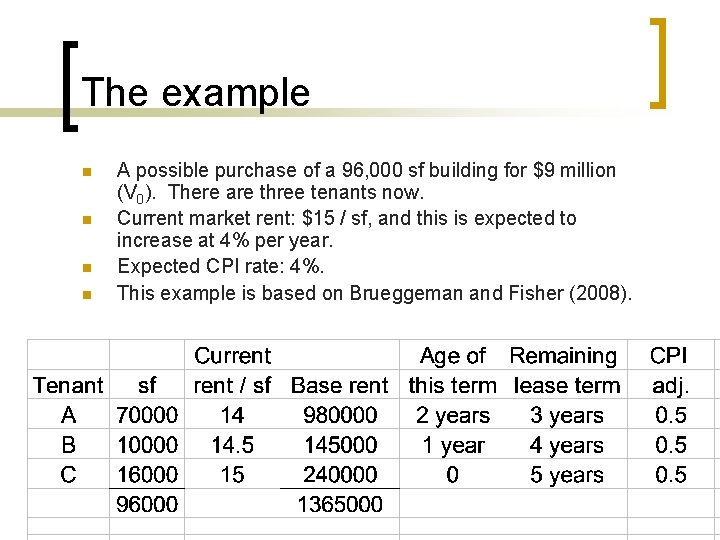
The example n n A possible purchase of a 96, 000 sf building for $9 million (V 0). There are three tenants now. Current market rent: $15 / sf, and this is expected to increase at 4% per year. Expected CPI rate: 4%. This example is based on Brueggeman and Fisher (2008).
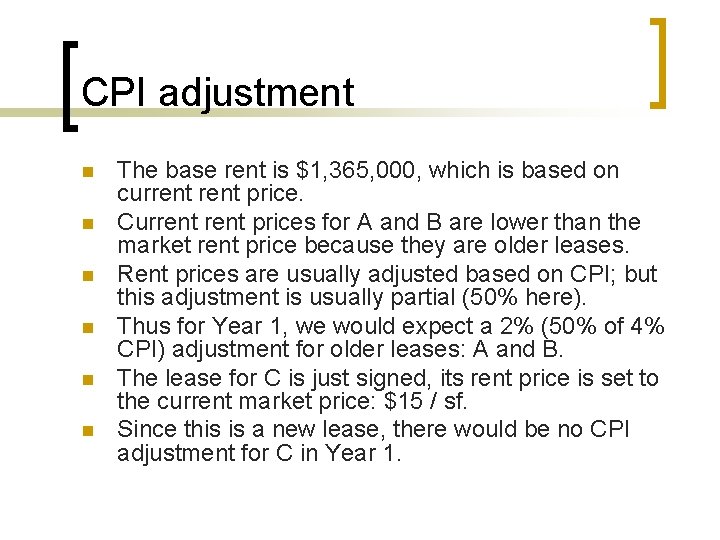
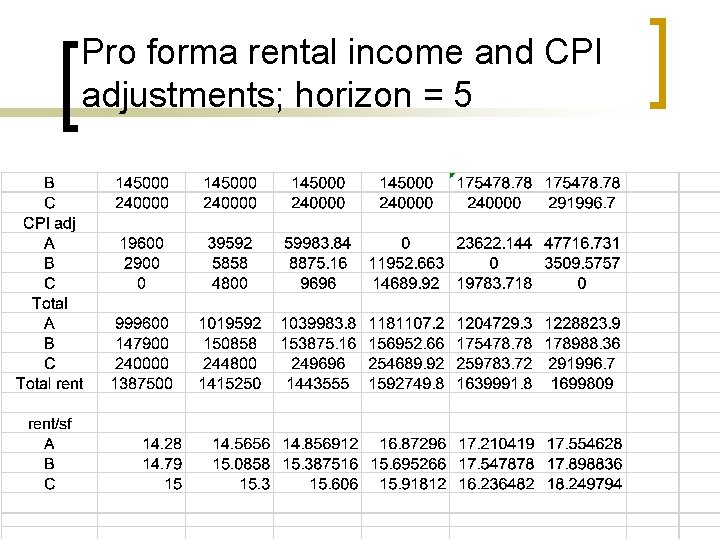
CPI adjustment n n n The base rent is $1, 365, 000, which is based on current price. Current prices for A and B are lower than the market rent price because they are older leases. Rent prices are usually adjusted based on CPI; but this adjustment is usually partial (50% here). Thus for Year 1, we would expect a 2% (50% of 4% CPI) adjustment for older leases: A and B. The lease for C is just signed, its rent price is set to the current market price: $15 / sf. Since this is a new lease, there would be no CPI adjustment for C in Year 1.
Pro forma rental income and CPI adjustments; horizon = 5
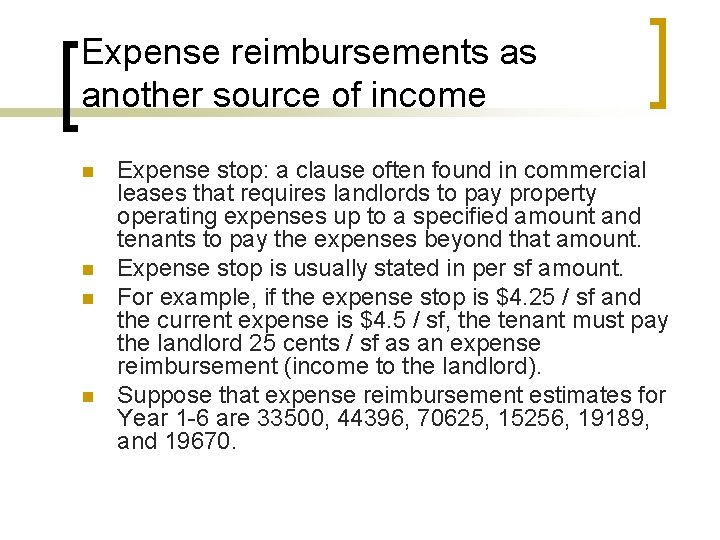
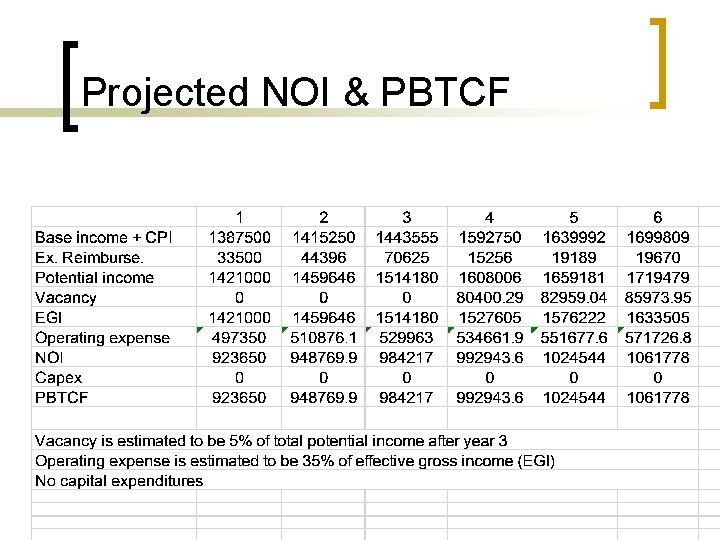
Expense reimbursements as another source of income n n Expense stop: a clause often found in commercial leases that requires landlords to pay property operating expenses up to a specified amount and tenants to pay the expenses beyond that amount. Expense stop is usually stated in per sf amount. For example, if the expense stop is $4. 25 / sf and the current expense is $4. 5 / sf, the tenant must pay the landlord 25 cents / sf as an expense reimbursement (income to the landlord). Suppose that expense reimbursement estimates for Year 1 -6 are 33500, 44396, 70625, 15256, 19189, and 19670.
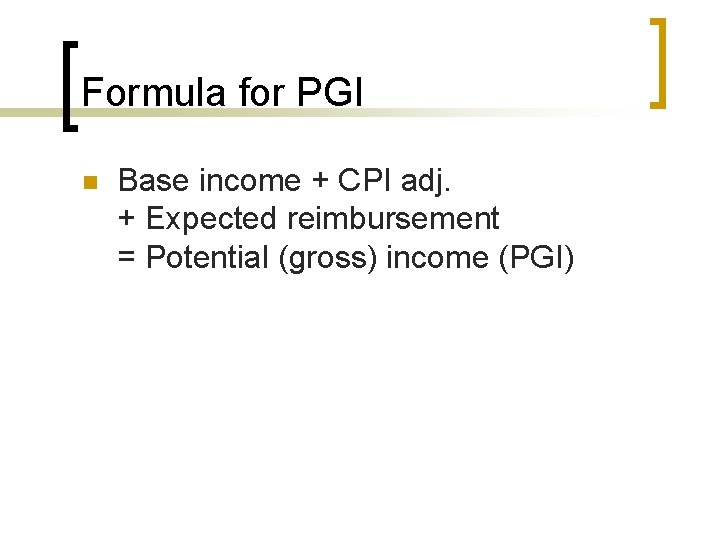
Formula for PGI n Base income + CPI adj. + Expected reimbursement = Potential (gross) income (PGI)
Projected NOI & PBTCF
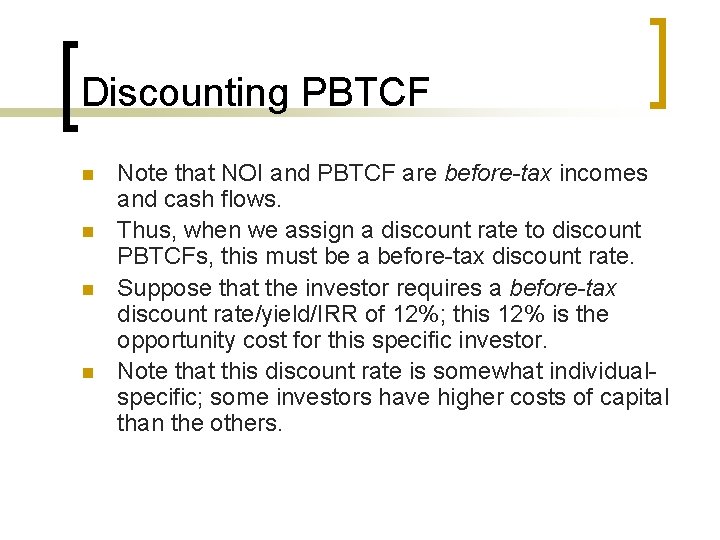
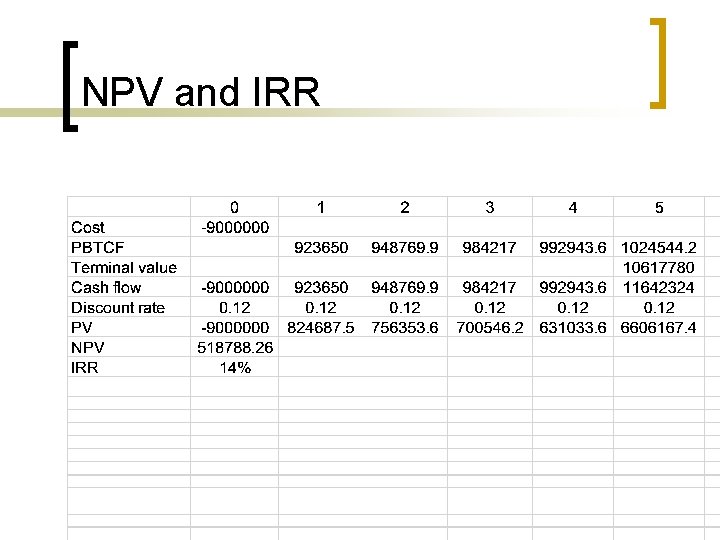
Discounting PBTCF n n Note that NOI and PBTCF are before-tax incomes and cash flows. Thus, when we assign a discount rate to discount PBTCFs, this must be a before-tax discount rate. Suppose that the investor requires a before-tax discount rate/yield/IRR of 12%; this 12% is the opportunity cost for this specific investor. Note that this discount rate is somewhat individualspecific; some investors have higher costs of capital than the others.
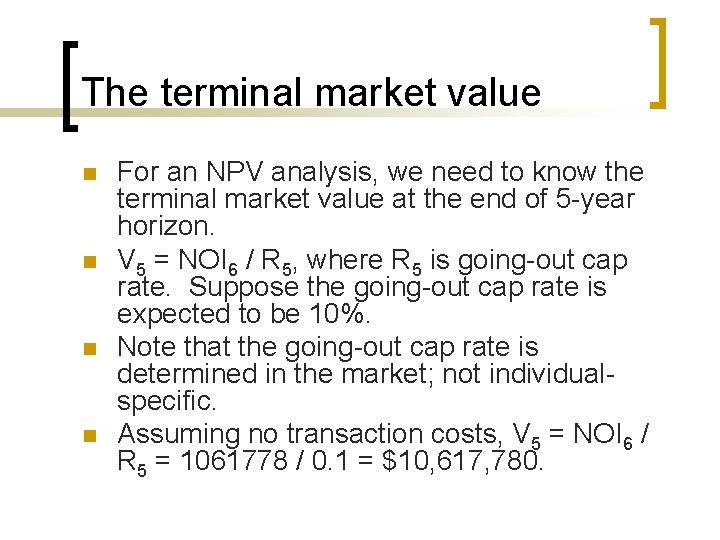
The terminal market value n n For an NPV analysis, we need to know the terminal market value at the end of 5 -year horizon. V 5 = NOI 6 / R 5, where R 5 is going-out cap rate. Suppose the going-out cap rate is expected to be 10%. Note that the going-out cap rate is determined in the market; not individualspecific. Assuming no transaction costs, V 5 = NOI 6 / R 5 = 1061778 / 0. 1 = $10, 617, 780.
NPV and IRR
Decision n Would you purchase the building?
Other cash flows/discount rates n n The previous example does not take taxes into consideration. One of course can use after-tax cash flows for the basis for DCF. If so, the discount rate needs to be a after-tax one. For this, see Chapter 11, Brueggeman and Fisher (2008).
Profitability ratios n n n Going-in capitalization rate R 0 = NOI 1 / V 0 = 923650 / 9000000 = 10. 26%. Net income multiplier (NIM) = V 0 / NOI 1 = 9000000 / 923650 = 9. 74. Gross income multiplier (GIM) = V 0 / EGI 1 = 9000000 / 1421000 = 6. 33.
Risk ratios n n n These ratios try to measure the income -producing ability to meet operating and financial obligations. Operating expense ratio (OER) = operating expenses / EGI; for year 1, OER = 497350 / 1421000 = 35. 00%. Loan-to-value (LTV) ratio = mortgage balance / acquisition price (V 0).
Pros and cons of financial ratios n n n Easy to calculate and communicate. Their calculations are usually based on a single year’s numbers; they tend not to consider future cash flows. They do not have a formal decision rule.