
Chapter 19 Investment Decisions NPV and IRR REAL

- Slides: 16
Chapter 19 Investment Decisions: NPV and IRR REAL ESTATE FIN 331
Overview A. Major theme: most RE decisions are made with an investment motive 1. magnitude of expected CFs--and the values they create —are at the center of investment decision making B. Chapter 18 focuses on widely used, singleyear, return measures, ratios, & income multipliers C. These criteria are relatively easy to calculate & understand—an advantage in the eyes of many industry professionals
Overview D. Limitation of these single-year return measures & ratios? 1. They do not explicitly incorporate income producing ability of property beyond 1 st year of rental operations 2. May lead to suboptimal investment decisions
Overview E. Many investors also perform multi-year analyses of potential acquisitions F. When using multi-year Discounted Cash Flow (DCF) decision making methods, investor must 1. Estimate how long she expects to hold property 2. Make explicit forecasts of: a. property’s net CF for each year, b. net CF produced by expected sale of property 3. Select rate of return at which to discount all future CFs
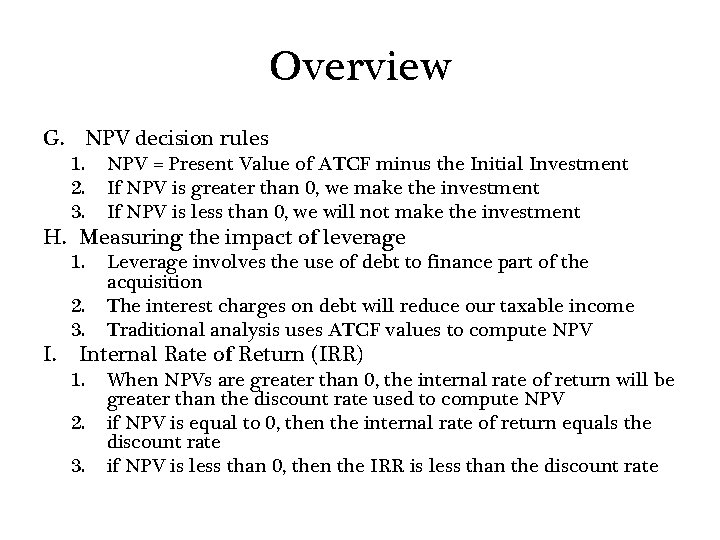
Overview G. NPV decision rules 1. 2. 3. NPV = Present Value of ATCF minus the Initial Investment If NPV is greater than 0, we make the investment If NPV is less than 0, we will not make the investment 1. Leverage involves the use of debt to finance part of the acquisition The interest charges on debt will reduce our taxable income Traditional analysis uses ATCF values to compute NPV H. Measuring the impact of leverage I. 2. 3. Internal Rate of Return (IRR) 1. 2. 3. When NPVs are greater than 0, the internal rate of return will be greater than the discount rate used to compute NPV if NPV is equal to 0, then the internal rate of return equals the discount rate if NPV is less than 0, then the IRR is less than the discount rate
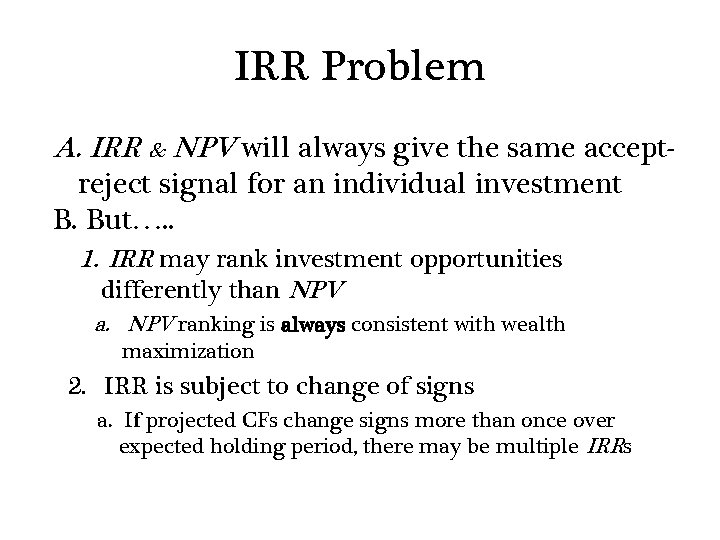
IRR Problem A. IRR & NPV will always give the same acceptreject signal for an individual investment B. But…. . 1. IRR may rank investment opportunities differently than NPV a. NPV ranking is always consistent with wealth maximization 2. IRR is subject to change of signs a. If projected CFs change signs more than once over expected holding period, there may be multiple IRRs
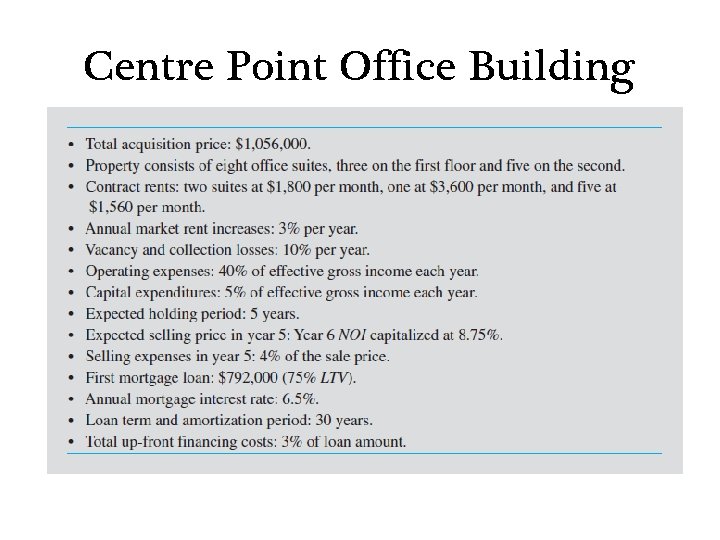
Centre Point Office Building
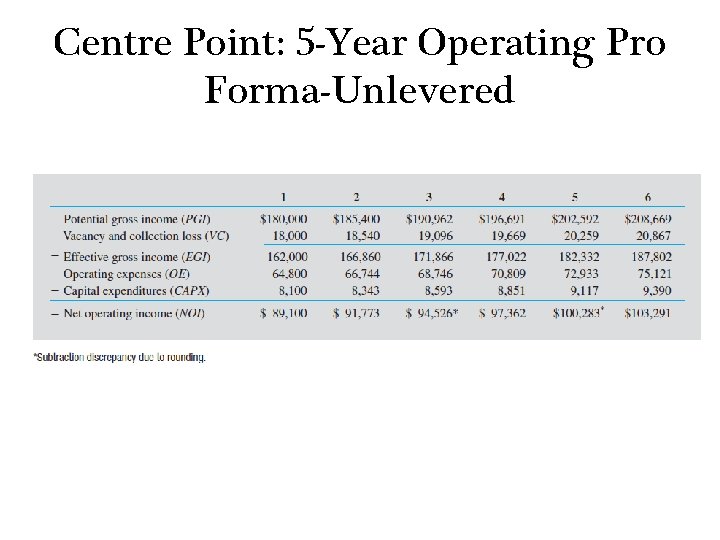
Centre Point: 5 -Year Operating Pro Forma-Unlevered
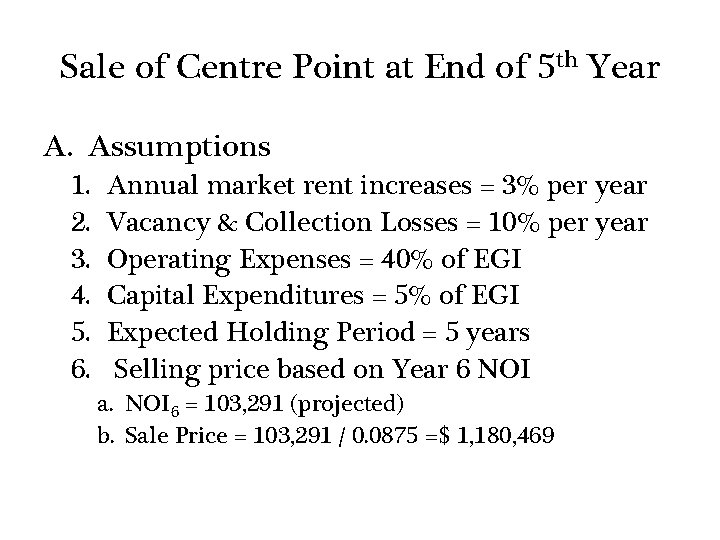
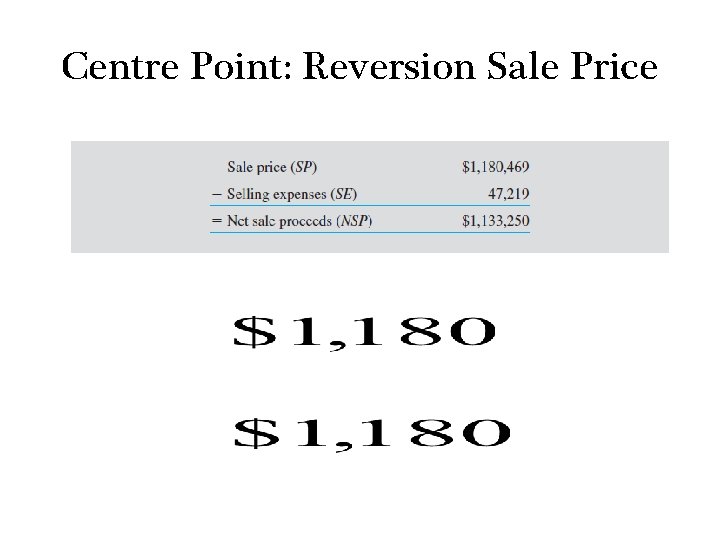
Sale of Centre Point at End of 5 th Year A. Assumptions 1. 2. 3. 4. 5. 6. Annual market rent increases = 3% per year Vacancy & Collection Losses = 10% per year Operating Expenses = 40% of EGI Capital Expenditures = 5% of EGI Expected Holding Period = 5 years Selling price based on Year 6 NOI a. NOI 6 = 103, 291 (projected) b. Sale Price = 103, 291 / 0. 0875 =$ 1, 180, 469
Centre Point: Reversion Sale Price
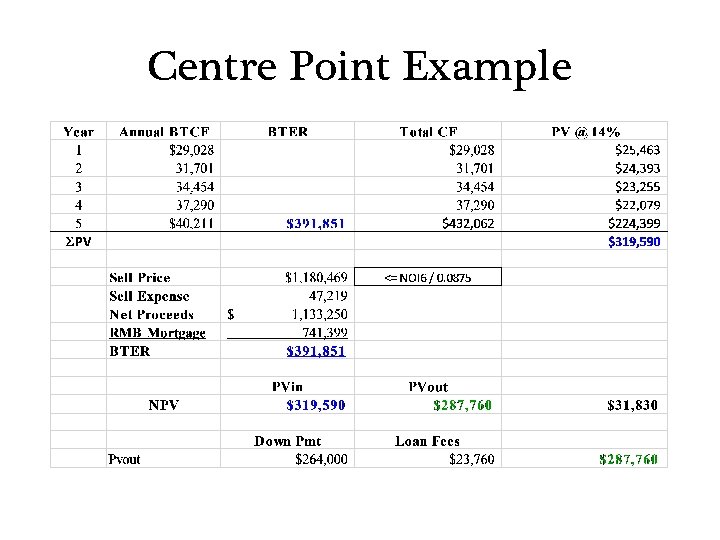
Centre Point Example
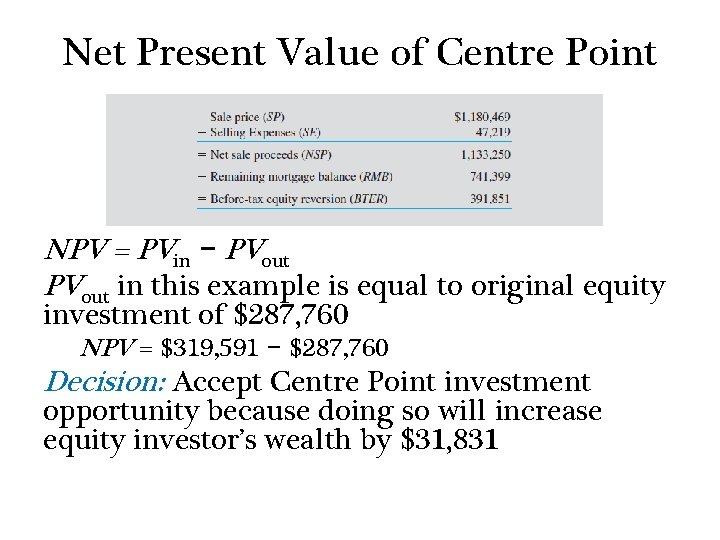
Net Present Value of Centre Point NPV = PVin − PVout in this example is equal to original equity investment of $287, 760 NPV = $319, 591 − $287, 760 Decision: Accept Centre Point investment opportunity because doing so will increase equity investor’s wealth by $31, 831
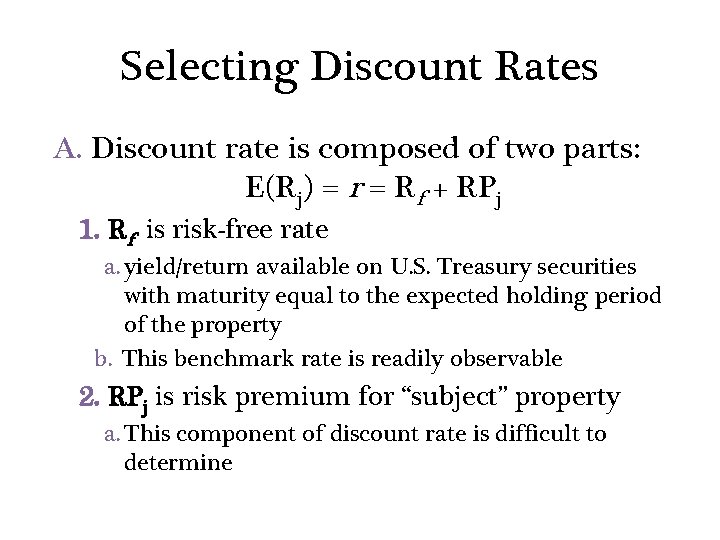
Selecting Discount Rates A. Discount rate is composed of two parts: E(Rj) = r = Rf + RPj 1. Rf is risk-free rate a. yield/return available on U. S. Treasury securities with maturity equal to the expected holding period of the property b. This benchmark rate is readily observable 2. RPj is risk premium for “subject” property a. This component of discount rate is difficult to determine
Measuring the Impact of Risk on NPV A. Sensitivity analysis 1. Most likely scenario 2. Worst-case scenario 3. Best-case scenario B. Value of computer 1. Excel spreadsheets 2. Specialized software such as ARGUS C. Monte Carlo simulation (using random probabilities to develop outcome distributions)
Selecting Discount Rates A. Since risk premiums vary, so do required yields 1. High quality, relatively safe RE investments: currently 6 -8% required returns 2. Development: 15%-30% or more B. So…how do investors determine required risk premiums (RPjs)? 1. Market comparables 2. Cost of capital: Debt, Equity (Oppt’y Cost)
HOMEWORK ASSIGNMENT A. Key terms: before tax cash flows, after-tax cash flows, leverage cash flow, unleveraged cash flow B. Study questions: 2, 3, 5, 9, 11