
Chapter 19 Interference and Diffraction Diffraction is the













- Slides: 26
Chapter 19 • Interference and Diffraction
Diffraction is… • the bending of waves, esp. sound and light waves, around obstacles in their path.
Interference is… • electromagnetic waves of the same frequency combine to reinforce or cancel each other • the amplitude of the resulting wave being equal to the sum of the amplitudes of the combining waves
Diffraction
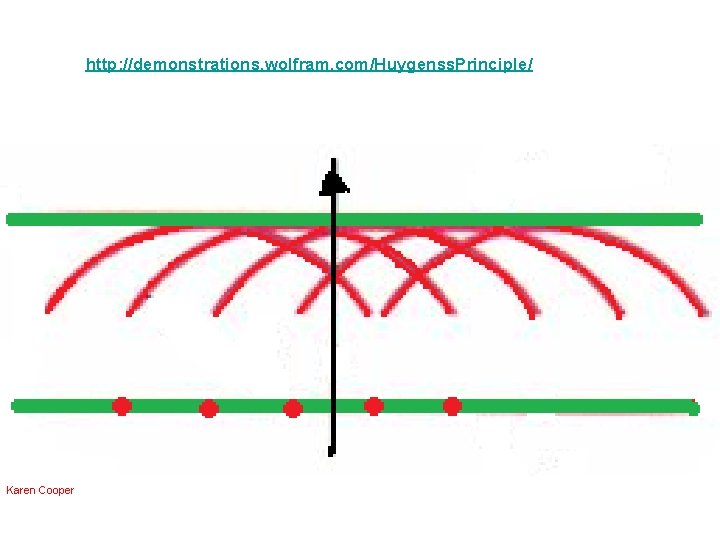
• The Dutch scientist Christian Huygens (1629 -1695) proposed a wave model to explain diffraction. These wavelets expand in every direction and are in step with one another. Light sources consist of an infinite number of points, which generate a plane wave front.
http: //demonstrations. wolfram. com/Huygenss. Principle/ Karen Cooper
Young’s two-slit experiment • Young could measure light's wavelengths and provided additional evidence of the waves nature of light. By directing the beam of light at two narrow, closely spaced slits in barrier, light diffracted and the two rays overlapped. This created light and dark bands.
Cheng, Poon S. , Mrs. "Chapter 4: Young’s Double Slit Experiment. " Singapore A Level Physics Syllabus. N. p. , n. d. Web. 6 Feb. 2011. <http: //h 2 physics. org/>.
Diffraction of white light • Constructive interference produces a bright central band other bands on either side. Dark areas are where destructive interference occurs between bright bands. • White light in double slit diffraction causes colors instead of light/dark bands. Positions of constructive/destructive bands depends on light's wavelength.
Constructive: positive growth. Destructive: negative growth. Constructive Interference. Tipler, Paul A. Physics for Scientists and Engineers. 4 th Ed. New York: W. H. Freeman and Company, 1999. Destructive Interference. Tipler, Paul A. Physics for Scientists and Engineers. 4 th Ed. New York: W. H. Freeman and Company, 1999.
Red Light Blue Light White Light Karen Cooper White Light. N. d. Multiple-beam interference. N. p. , 2009. Web. 7 Feb. 2011. <http: //www. itp. uniannover. de/~zawischa/ITP/multibeam. html>. Red Light. N. d. Multiple-beam interference. N. p. , 2009. Web. 7 Feb. 2011. <http: //www. itp. uniannover. de/~zawischa/ITP/multibeam. html>.
Karen Cooper
Equation: Wavelength Using Double Slit Interference • Distance between P 0 and P 1: x • Distance between screen and slits: L • Separation of two slits: d • Equation: x/L = λ/d • Wavelength Using Double-Slit Interference: λ = xd/L
Single-Slit Diffraction
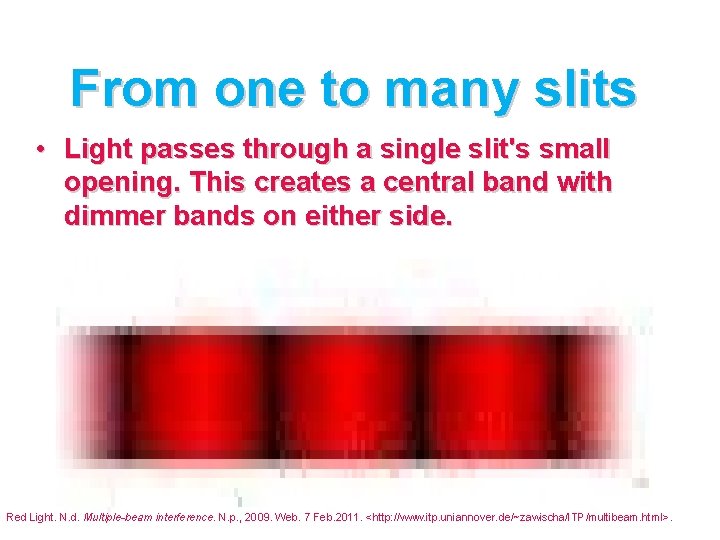
From one to many slits • Light passes through a single slit's small opening. This creates a central band with dimmer bands on either side. Red Light. N. d. Multiple-beam interference. N. p. , 2009. Web. 7 Feb. 2011. <http: //www. itp. uniannover. de/~zawischa/ITP/multibeam. html>.
Karen Cooper
Measuring a wavelength of light
• The slit is illuminated, so a central bright band appears at Po on screen. • The dark band from the central light band create a situation similar to the double-slit interference. • Paths differ by λ/2 and separation between slits is w/2 instead.
Red Light. N. d. Multiple-beam interference. N. p. , 2009. Web. 7 Feb. 2011. <http: //www. itp. uniannover. de/~zawischa/ITP/multibeam. html>. Karen Cooper White Light. N. d. Multiple-beam interference. N. p. , 2009. Web. 7 Feb. 2011. <http: //www. itp. uniannover. de/~zawischa/ITP/multibeam. html>.
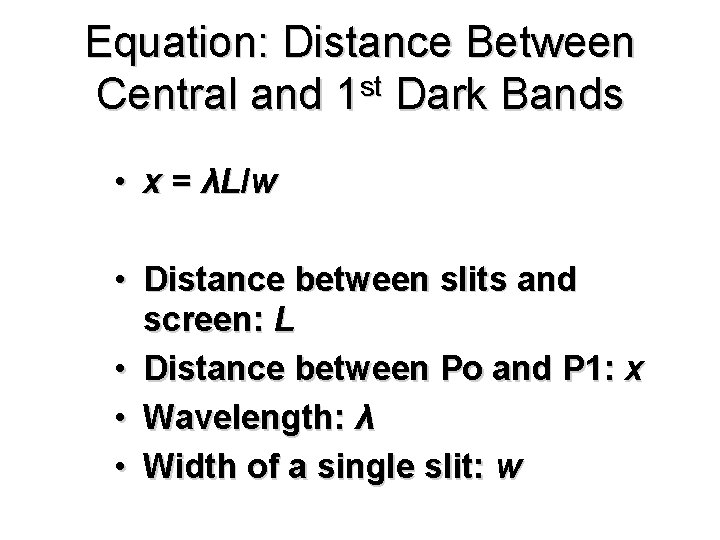
Equation: Distance Between Central and 1 st Dark Bands • x = λL/w • Distance between slits and screen: L • Distance between Po and P 1: x • Wavelength: λ • Width of a single slit: w
Diffraction Gratings
• Diffraction gratings are used to measure the wavelength of light. Diffraction gratings are made by scratching very fine lines on glass using the point of a diamond. The spaces between the scratches are like slits. • EX: jewelry creates spectrum like that on the surface of a CD.
Diamond. N. d. Colour Museum. N. p. , 2009. Web. 7 Feb. 2011. <http: //www. coloure. experience. org/index. htm>. CD. N. d. Multiple-beam interference. N. p. , 2009. Web. 7 Feb. 2011. <http: //www. itp. uniannover. de/~zawischa/I TP/multibeam. html>.
• The interference pattern produced by diffraction grating has bright bands cause by a double-slit. Individual colors can be distinguished more easily with this and wavelengths can be measured more precisely in diffraction grating then double -slits.
Equation: Wavelength Using a Diffraction Grating • λ = xd/L = d sin θ • • • Distance between P 0 and P 1: x Distance between screen and slits: L Separation of two slits: d Wavelength: λ Phase separation: θ
Ng. , H. K. , Dr. Diffraction Grating Spectrometer. N. d. N. p. , 30 Dec. 1996. Web. 8 Feb. 2011. <http: //www. physics. fsu. edu/users/ng/courses/phy 2054 c/ labs/expt 09/expt-09. htm>.