
Chapter 19 Hominid Evolution Classification Hierarchy Linnaeus Kingdom
- Slides: 57
Chapter 19 Hominid Evolution
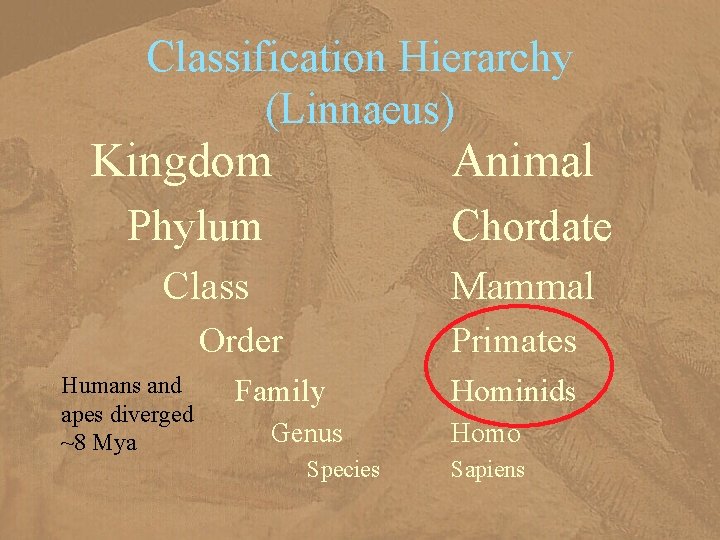
Classification Hierarchy (Linnaeus) Kingdom Animal Phylum Chordate Class Mammal Order Humans and apes diverged ~8 Mya Primates Family Genus Species Hominids Homo Sapiens
Humans and Apes • Diverged ~8 million years ago • >12 different forms of hominids since then
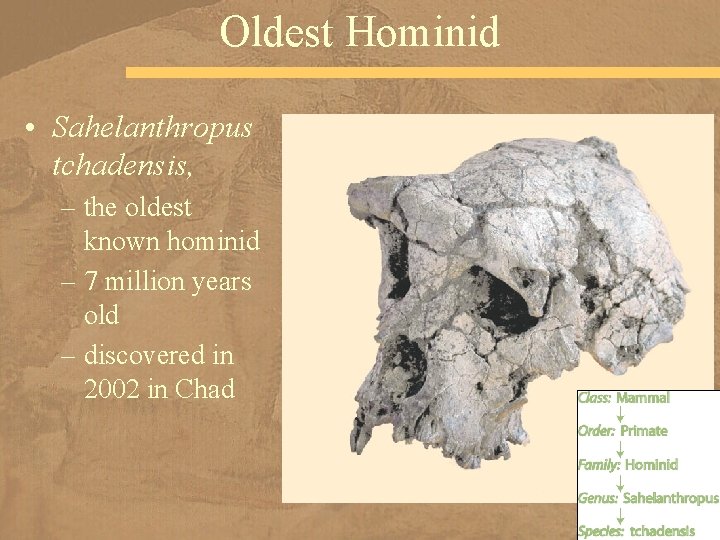
Oldest Hominid • Sahelanthropus tchadensis, – the oldest known hominid – 7 million years old – discovered in 2002 in Chad
Sahelanthropus tchadensis • Skull found in the African nation of Chad in 2002 – pushed back the origins of humans to nearly 7 million years ago – its discovery has raised more questions than it answered
“Bushy” Model of Human Evolution • Paleoanthropologists now think – human evolution branched many times – rather than evolving in a somewhat straight line • Key traits such as • upright walking • manual dexterity • “large” brain – evolved more than once, and produced many evolutionary dead-ends
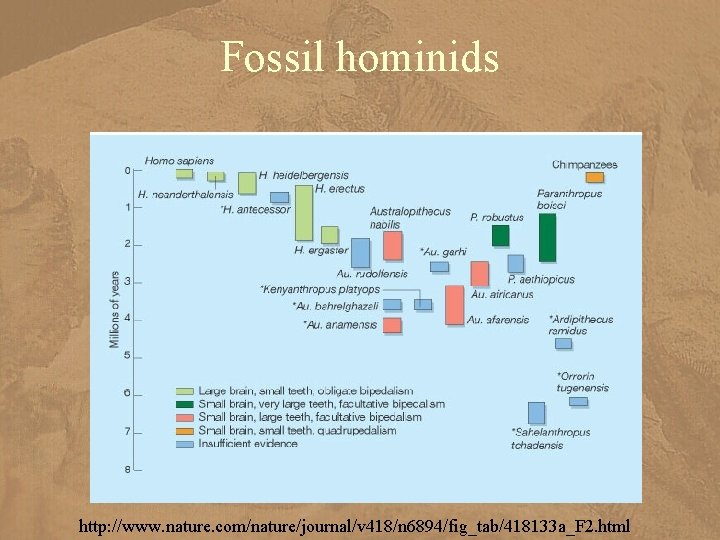
Fossil hominids http: //www. nature. com/nature/journal/v 418/n 6894/fig_tab/418133 a_F 2. html
Oldest Hominid • Sahelanthropus tchadensis shows a mosaic of primitive and advanced features • The small brain case and most of the teeth are chimplike • Fairly flat nose and the prominent brow ridges – are features only seen, until now, in the human genus Homo • Looks more human than hominids that came millions of years later!
Early History of Ancestral Hominids • Much of our knowledge – comes from fossils found in a small desert area southwest of Cairo, Egypt • During the Late Eocene and Oligocene – this region was a lush, tropical rain forest – supported a diverse and abundant fauna and flora
Thousands of Fossil Specimens • Several thousand fossil specimens – representing more than 20 species of primates – recovered from rocks of this region • One of the earliest ancestral hominids – was Aegyptopithecus, • small, fruit-eating, arboreal primate • weighed about 5 kg
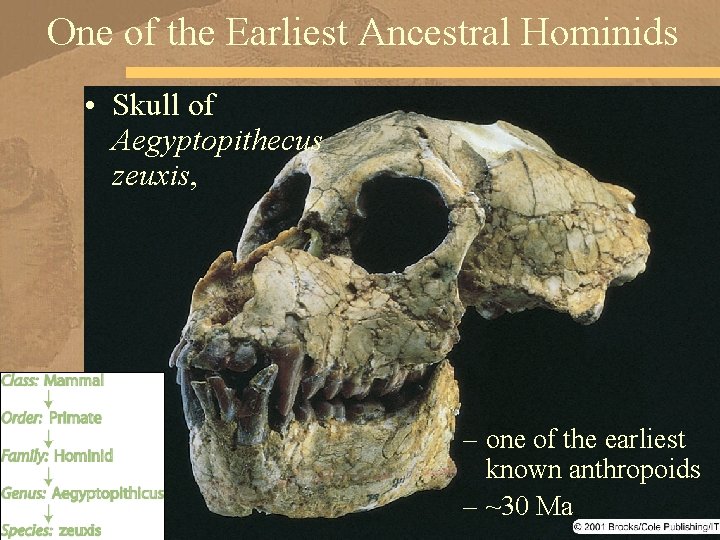
One of the Earliest Ancestral Hominids • Skull of Aegyptopithecus zeuxis, – one of the earliest known anthropoids – ~30 Ma
Hominids • The hominids (family Hominidae) – primate family that includes present-day humans – fossil record extending back 7 million years • Hominids are bipedal – that is, they have an upright posture – Skeletal structure shows bipedal traits • Hominid brain organization: larger compared to other primates
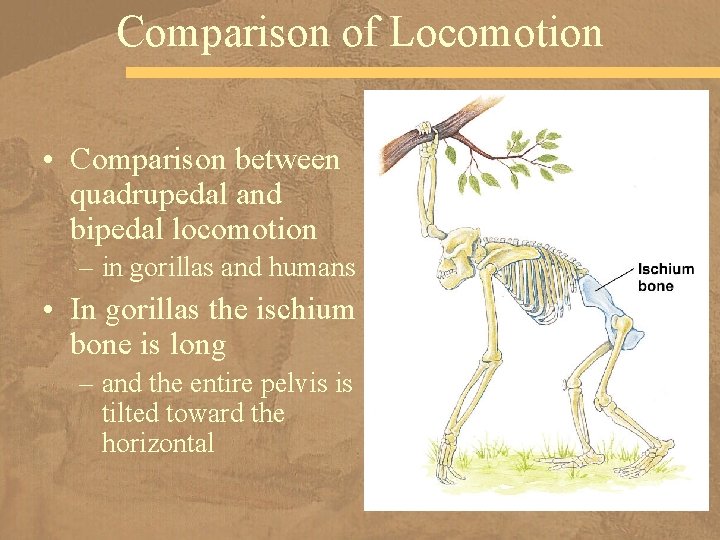
Comparison of Locomotion • Comparison between quadrupedal and bipedal locomotion – in gorillas and humans • In gorillas the ischium bone is long – and the entire pelvis is tilted toward the horizontal
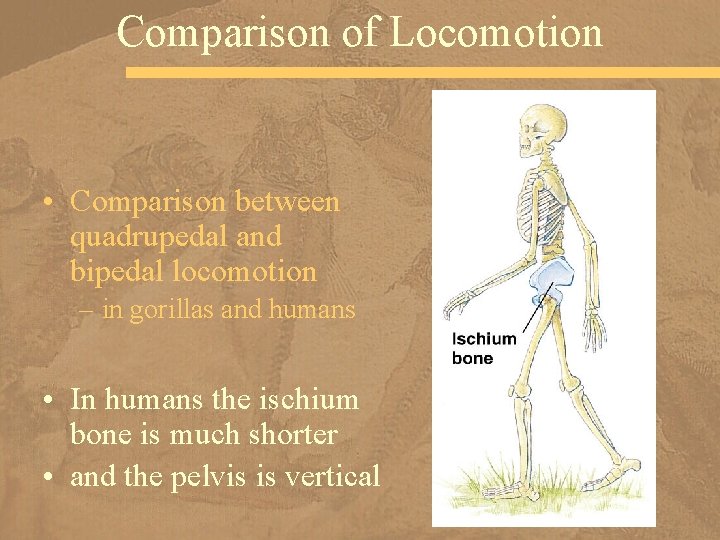
Comparison of Locomotion • Comparison between quadrupedal and bipedal locomotion – in gorillas and humans • In humans the ischium bone is much shorter • and the pelvis is vertical
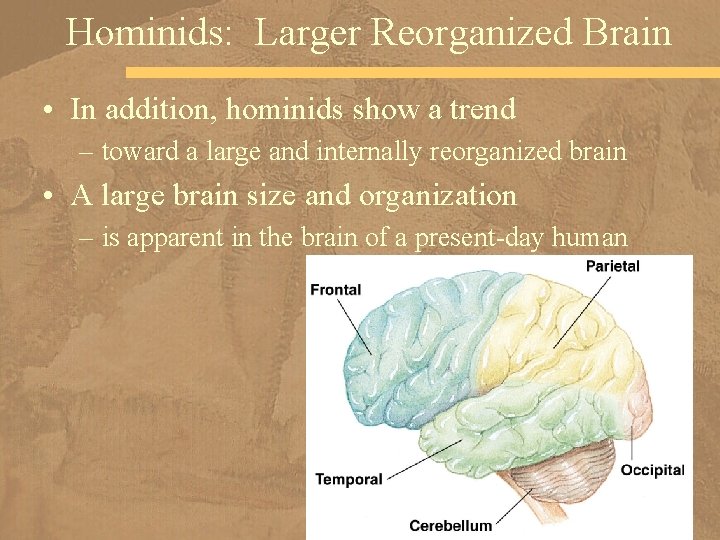
Hominids: Larger Reorganized Brain • In addition, hominids show a trend – toward a large and internally reorganized brain • A large brain size and organization – is apparent in the brain of a present-day human
Response to Climatic Changes • Many anthropologists think – hominid features evolved in response to major climatic changes • During this time – vast savannas replaced the African tropical rain forests – where the lower primates had been so abundant
Mixed Forests and Grasslands • As the savannas and grasslands continued to expand – hominids made the transition from true forest dwelling – to life in an environment of mixed forests and grasslands
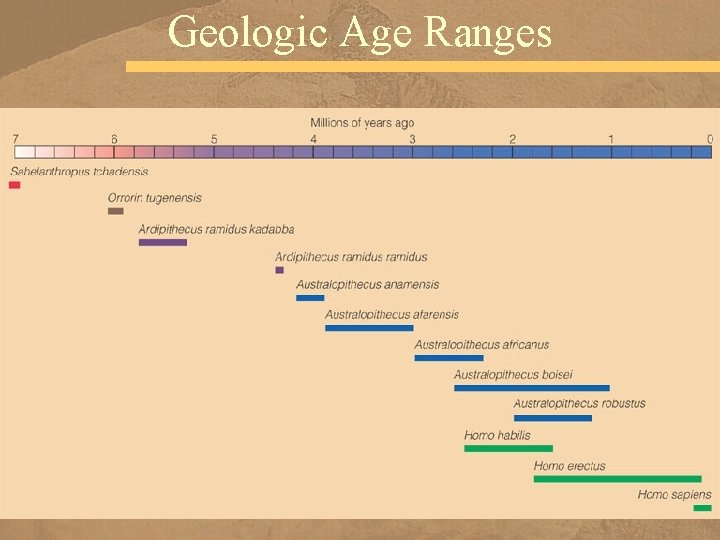
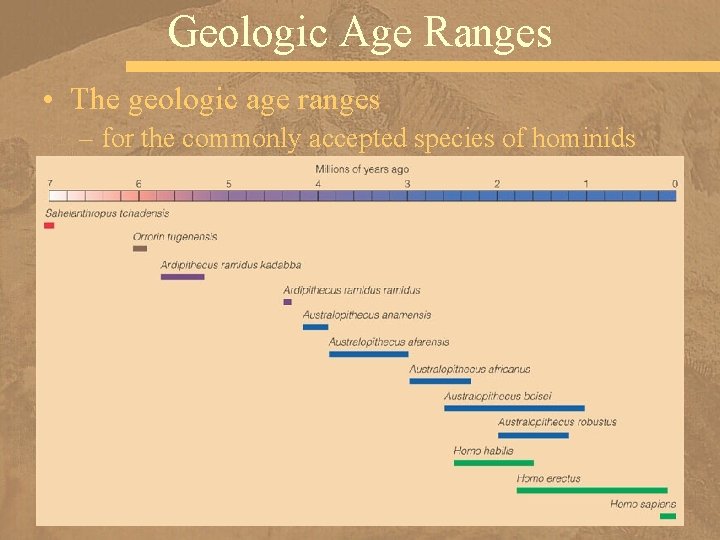
Geologic Age Ranges
Oldest Known Hominid • Discovered in Chad in 2002 – nearly 7 -million-year-old skull and dental remains of Sahelanthropus tchadensis – make it the oldest known hominid yet unearthed
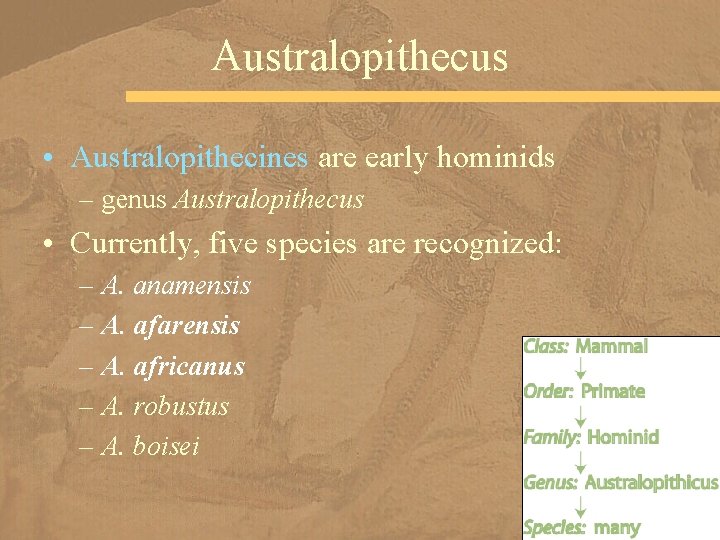
Australopithecus • Australopithecines are early hominids – genus Australopithecus • Currently, five species are recognized: – A. anamensis – A. afarensis – A. africanus – A. robustus – A. boisei
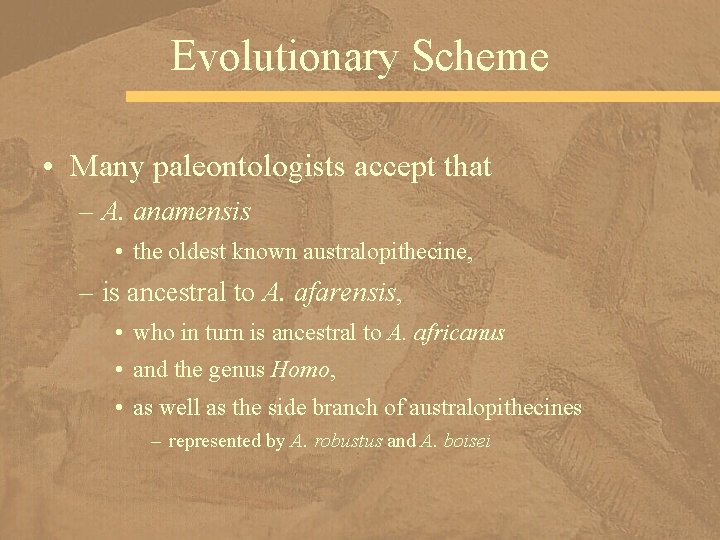
Evolutionary Scheme • Many paleontologists accept that – A. anamensis • the oldest known australopithecine, – is ancestral to A. afarensis, • who in turn is ancestral to A. africanus • and the genus Homo, • as well as the side branch of australopithecines – represented by A. robustus and A. boisei
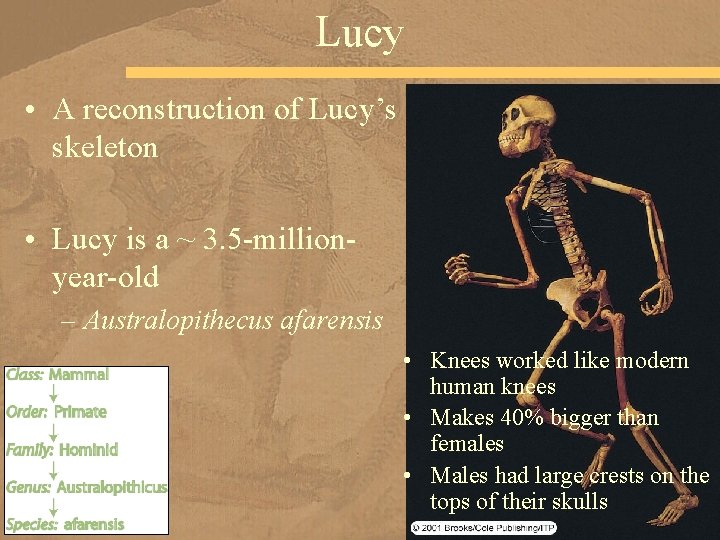
Lucy • A reconstruction of Lucy’s skeleton • Lucy is a ~ 3. 5 -millionyear-old – Australopithecus afarensis • Knees worked like modern human knees • Makes 40% bigger than females • Males had large crests on the tops of their skulls
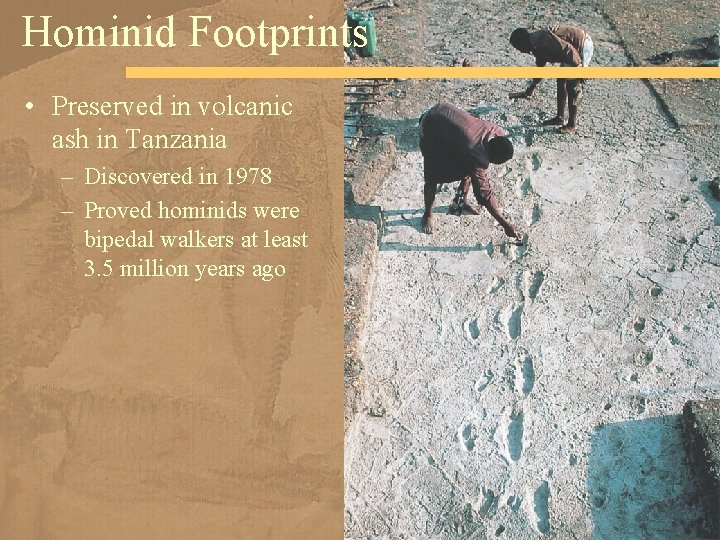
Hominid Footprints • Preserved in volcanic ash in Tanzania – Discovered in 1978 – Proved hominids were bipedal walkers at least 3. 5 million years ago
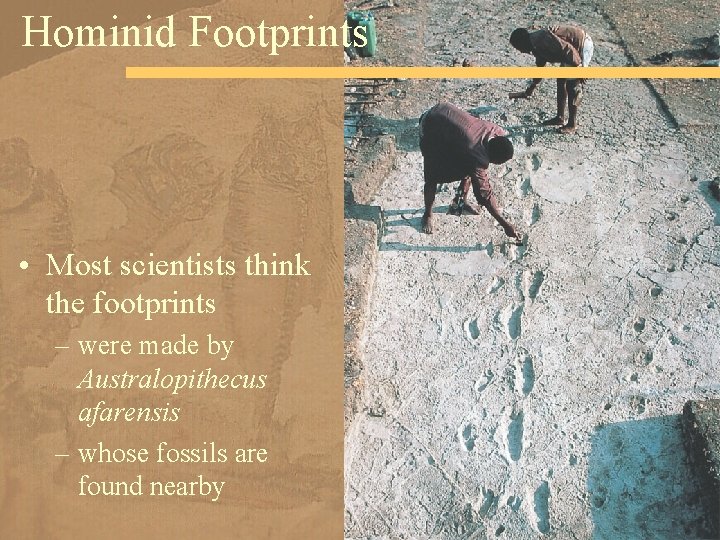
Hominid Footprints • Most scientists think the footprints – were made by Australopithecus afarensis – whose fossils are found nearby
Brain Size of A. afarensis • A. afarensis had a brain size of 380– 450 cubic centimeters (cc), – larger than the 300– 400 cc of a chimpanzee – much smaller than that of present-day humans (1350 cc average)
Apelike Features • The skull of A. afarensis retained many apelike features – massive brow ridges – forward-jutting jaw – teeth were intermediate between those of apes and humans • The heavily enameled molars – adaptation to chewing fruits, seeds, and roots
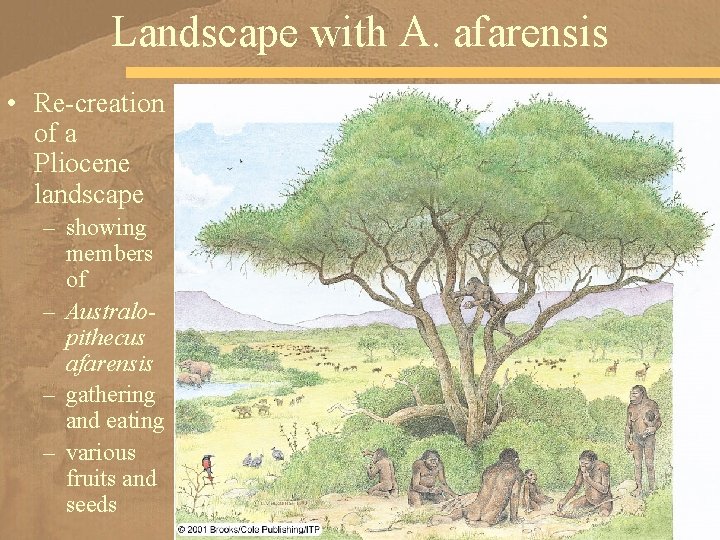
Landscape with A. afarensis • Re-creation of a Pliocene landscape – showing members of – Australopithecus afarensis – gathering and eating – various fruits and seeds
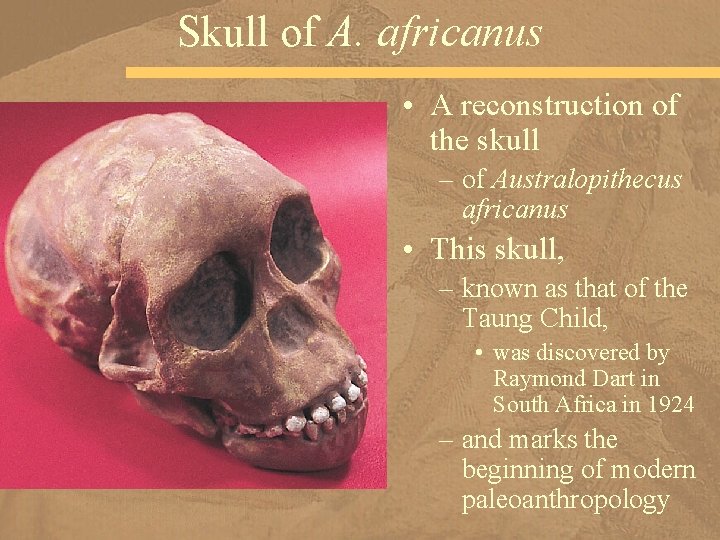
Skull of A. africanus • A reconstruction of the skull – of Australopithecus africanus • This skull, – known as that of the Taung Child, • was discovered by Raymond Dart in South Africa in 1924 – and marks the beginning of modern paleoanthropology
Not As Well Adapted for Bipedalism • It appears the limbs – of A. africanus may not have been as well adapted for bipedalism as those of A. afarensis
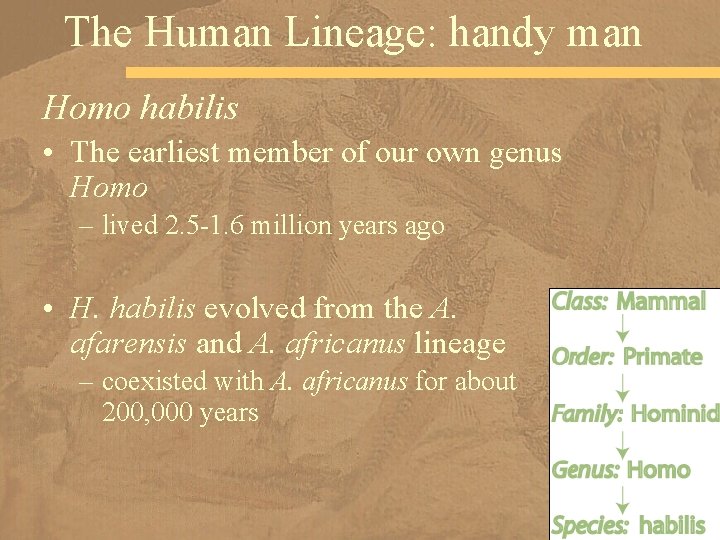
The Human Lineage: handy man Homo habilis • The earliest member of our own genus Homo – lived 2. 5 -1. 6 million years ago • H. habilis evolved from the A. afarensis and A. africanus lineage – coexisted with A. africanus for about 200, 000 years
Geologic Age Ranges • The geologic age ranges – for the commonly accepted species of hominids
Characteristics of Homo habilis • H. habilis had a larger brain (700 cc average) – than its australopithecine ancestors but smaller teeth • It was about 1. 2 -1. 3 m tall and weighed 32 -37 kg
Homo Erectus • In contrast to the australopithecines and H. habilis, – which are unknown outside Africa, – Homo erectus was a widely distributed species – migrated from Africa during the Pleistocene • Specimens have been found – not only in Africa – also in Europe, India, China ("Peking Man"), and Indonesia ("Java Man")
Survived in Asia Until About 100, 000 Years Ago • H. erectus evolved in Africa 1. 8 million years ago – and by 1 million years ago – was present in southeastern and eastern Asia, – where it survived until about 100, 000 years ago
H. erectus Differed From Modern Humans • Although H. erectus developed regional variations in form, – the species differed from modern humans in several ways • Its brain size of 800 -1300 cc, – though much larger than that of H. habilis, – was still less than the average for Homo sapiens (1350 cc)
Size Similar to Humans • H. erectus's skull was thick-walled – face was massive – prominent brow ridges – teeth were slightly larger than those of present-day humans • H. erectus was comparable to size to modern humans – between 1. 6 and 1. 8 m tall – weighing between 53 and 63 kg
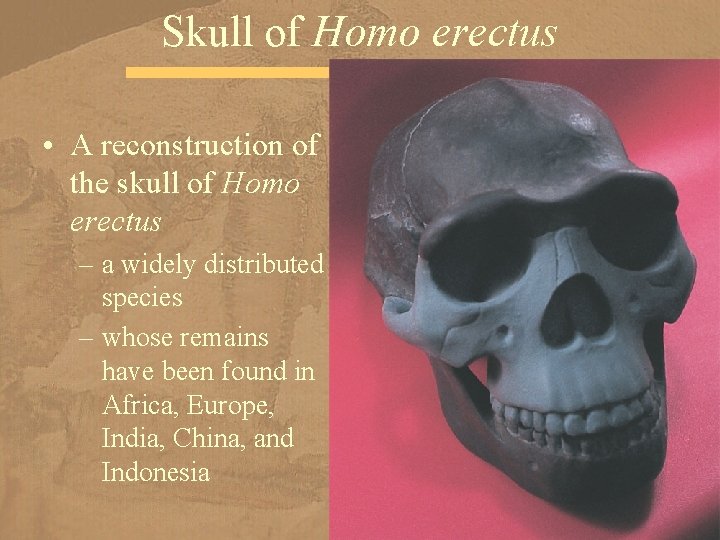
Skull of Homo erectus • A reconstruction of the skull of Homo erectus – a widely distributed species – whose remains have been found in Africa, Europe, India, China, and Indonesia
H. erectus Was a Tool Maker • The archaeological record indicates – that H. erectus was a tool maker • Furthermore, some sites show evidence – that its members used fire and lived in caves – an advantage for those living in more northerly climates
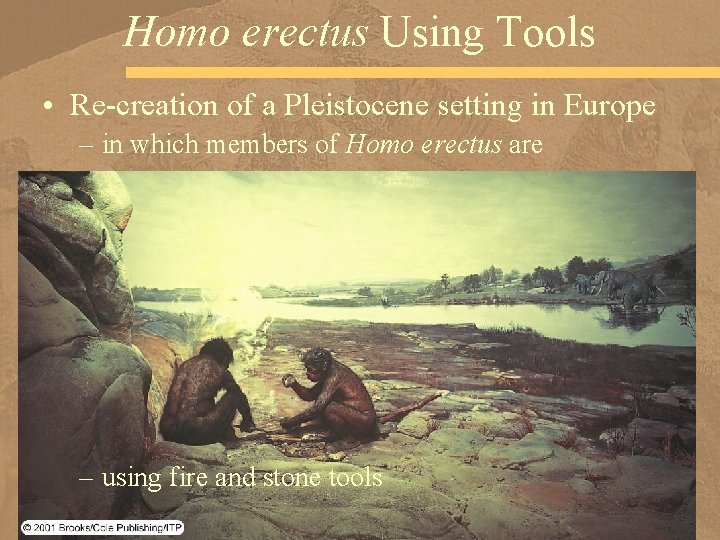
Homo erectus Using Tools • Re-creation of a Pleistocene setting in Europe – in which members of Homo erectus are – using fire and stone tools
The "Out of Africa" View • Currently, a heated debate surrounds the transition – from H. erectus to our own species Homo sapiens • “Out of Africa" view – early modern humans evolved from a small African colony – offspring then migrated from Africa and populated Europe and Asia, driving the earlier hominid populations to extinction
The "Multiregional" View • “Multiregional" view – early modern humans did not have an isolated origin in Africa – established separate populations throughout Eurasia • Occasional contact and interbreeding – enabled our species to maintain its overall cohesiveness – still preserving the regional differences in people we see today
Homo sapiens Evolved From H. erectus • Regardless of which theory turns out to be correct, – our species, H. sapiens, most certainly evolved from H. erectus
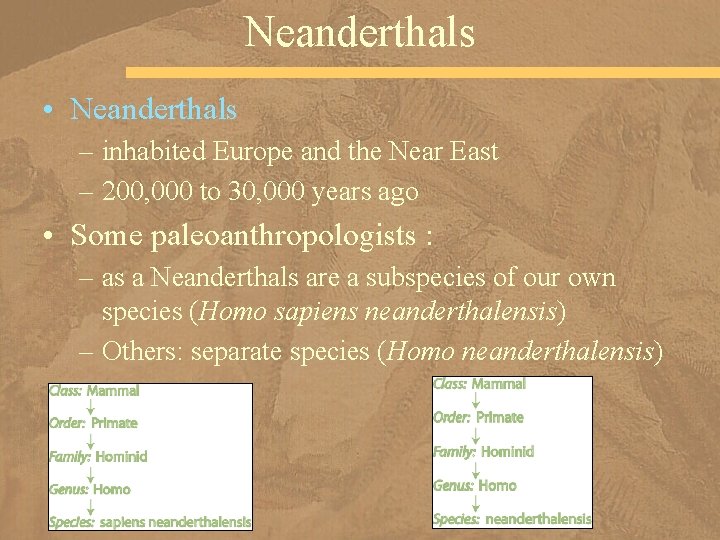
Neanderthals • Neanderthals – inhabited Europe and the Near East – 200, 000 to 30, 000 years ago • Some paleoanthropologists : – as a Neanderthals are a subspecies of our own species (Homo sapiens neanderthalensis) – Others: separate species (Homo neanderthalensis)
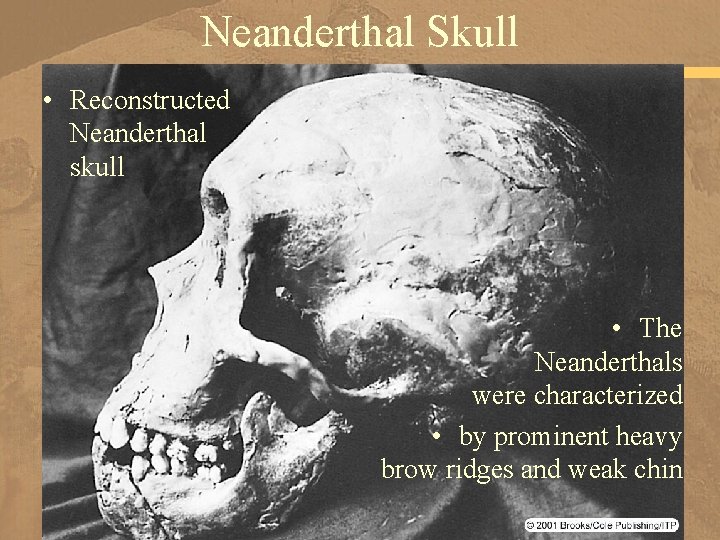
Neanderthals Difference • Main difference between Neanderthals and present-day humans is in the skull – Neanderthal skulls were long and low – heavy brow ridges, a projecting mouth, and a weak, receding chin • Their brain was slightly larger on average – than our own, and somewhat differently shaped
Neanderthal Skull • Reconstructed Neanderthal skull • The Neanderthals were characterized • by prominent heavy brow ridges and weak chin
First Humans in Cold Climates • Given the specimens from more than 100 sites – we now know Neanderthals were not much different from us, only more robust • Europe's Neanderthals were the first humans – to move into truly cold climates – enduring miserably long winters and short summers – as they pushed north into tundra ecosystems
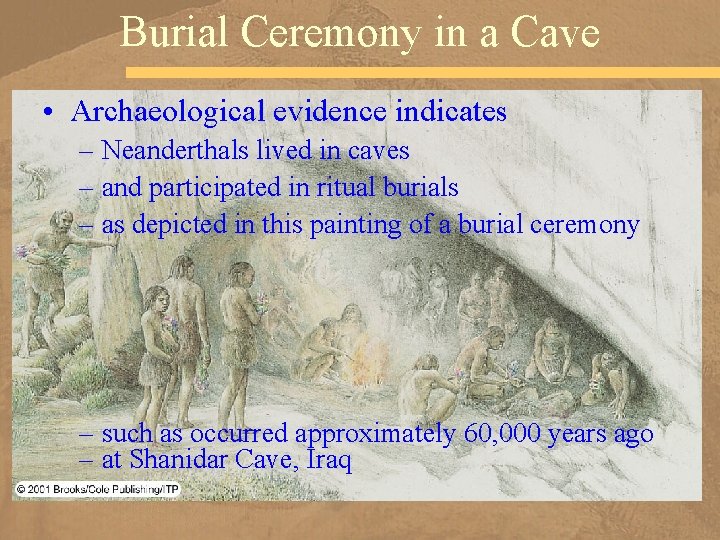
Burial Ceremony in a Cave • Archaeological evidence indicates – Neanderthals lived in caves – and participated in ritual burials – as depicted in this painting of a burial ceremony – such as occurred approximately 60, 000 years ago – at Shanidar Cave, Iraq
Cro-Magnons • About 30, 000 years ago – humans closely resembling modern Europeans – moved into the region inhabited by the Neanderthals and completely replaced them • Cro-Magnons – successors of the Neanderthals in France – 35, 000 to 10, 000 years ago – huge advances in development of art and technology
Cave Painters • Cro-Magnons were cave painters • Using paints made from manganese and iron oxides – painted hundreds of scenes on the ceilings and walls of caves in France and Spain – many of them are still preserved today
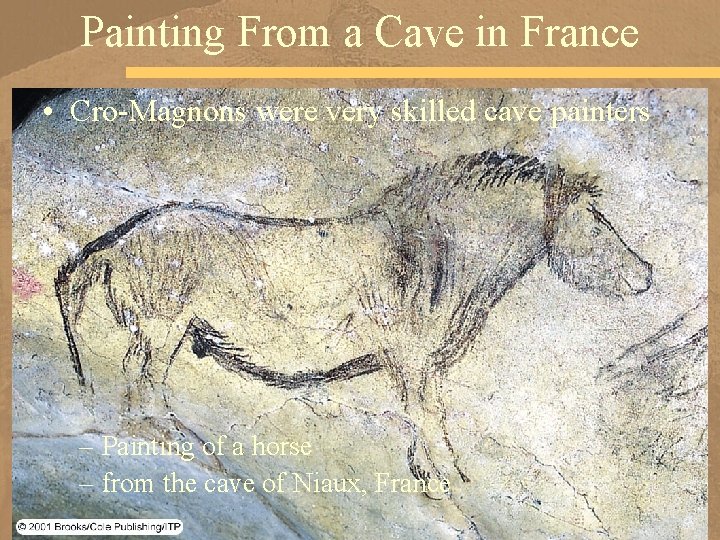
Painting From a Cave in France • Cro-Magnons were very skilled cave painters – Painting of a horse – from the cave of Niaux, France
Cultural Evolution • With the appearance of Cro-Magnons, – human evolution has become almost entirely cultural rather than biological • Humans have spread throughout the world – by devising means to deal with a broad range of environmental conditions
Summary • Aegyptopithecus 32 Ma (ancestral hominid – primate) – Somewhat developed forehead • Australopithecus 5 Ma (early hominids) – Afarensis (Lucy) 4 Ma, bipedalism, still tree climbers, small skull – Africanus 2 -3 Ma slightly larger brain • Homo habilis 2 Ma – Larger brain, less pronounced brow, rounder head, smaller face – Use of stone tools • Homo erectus 500 K-2 Ma – Larger brain and body – Longer skull, large brow ridges • Homo sapiens neanderthalensis 200 K – Large brains and bodies, lack of frontal lobes? • Homo sapiens (cro-magnon) 90 K – Anatomically similar to humans
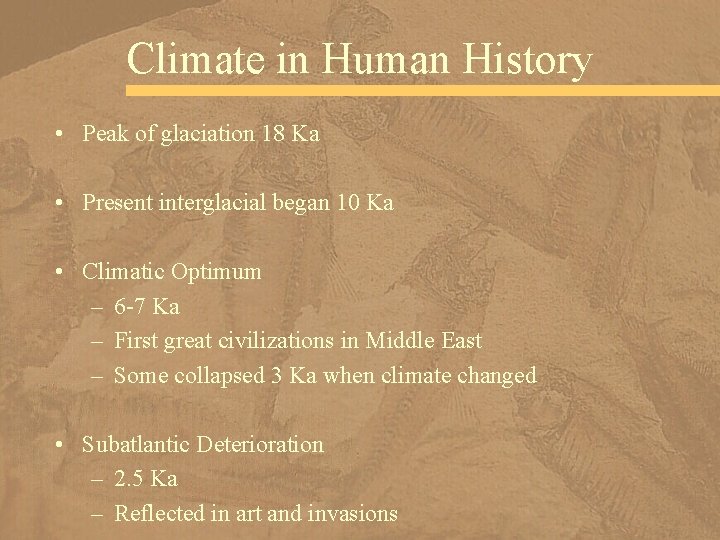
Climate in Human History • Peak of glaciation 18 Ka • Present interglacial began 10 Ka • Climatic Optimum – 6 -7 Ka – First great civilizations in Middle East – Some collapsed 3 Ka when climate changed • Subatlantic Deterioration – 2. 5 Ka – Reflected in art and invasions
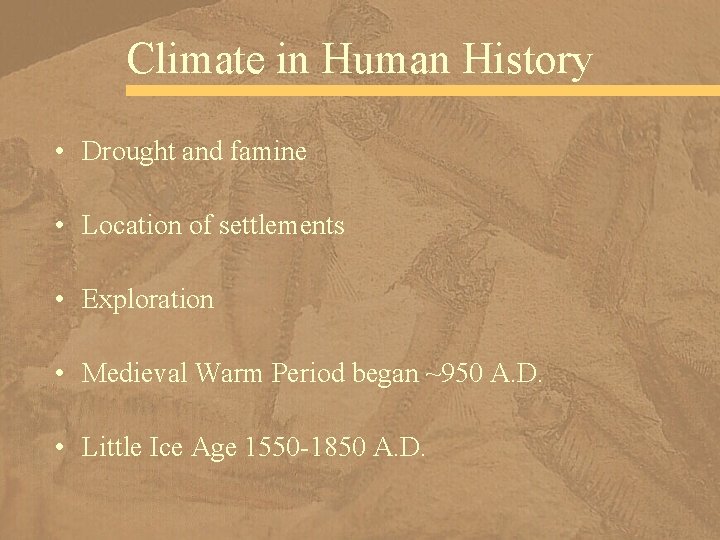
Climate in Human History • Drought and famine • Location of settlements • Exploration • Medieval Warm Period began ~950 A. D. • Little Ice Age 1550 -1850 A. D.
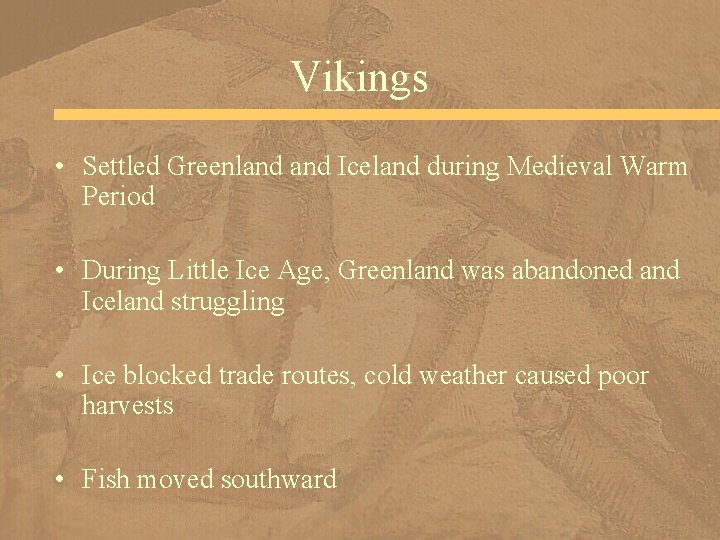
Vikings • Settled Greenland Iceland during Medieval Warm Period • During Little Ice Age, Greenland was abandoned and Iceland struggling • Ice blocked trade routes, cold weather caused poor harvests • Fish moved southward
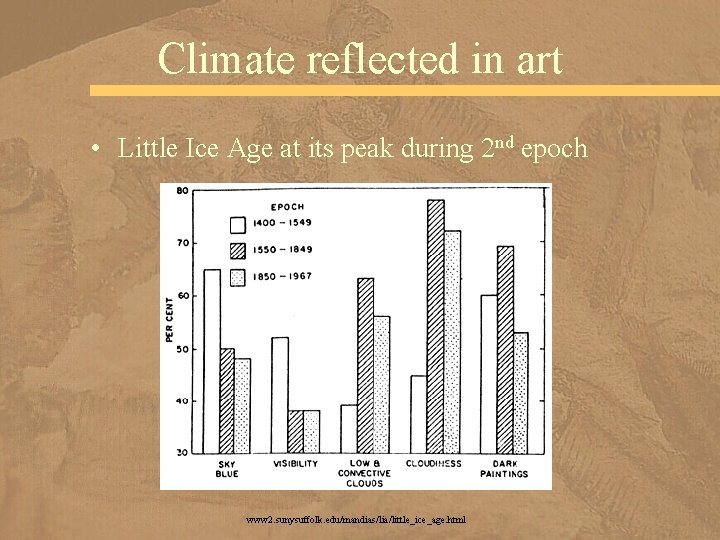
Climate reflected in art • Little Ice Age at its peak during 2 nd epoch www 2. sunysuffolk. edu/mandias/lia/little_ice_age. html
Recent History • Two centuries of warm, mild climate • Continual drying of northern Africa • Interglacial should be coming to an end – will humans prolong it?