
Chapter 19 Electric Currents Sources of Electromotive Force
![V=RI Resistance, R = V/I [R] = V/A = W (Ohm) For a fixed](https://slidetodoc.com/presentation_image/f84818e699aa1a2f39e1708e5ffc6407/image-11.jpg "V=RI Resistance, R = V/I [R] = V/A = W (Ohm) For a fixed")
- Slides: 27
Chapter 19 Electric Currents
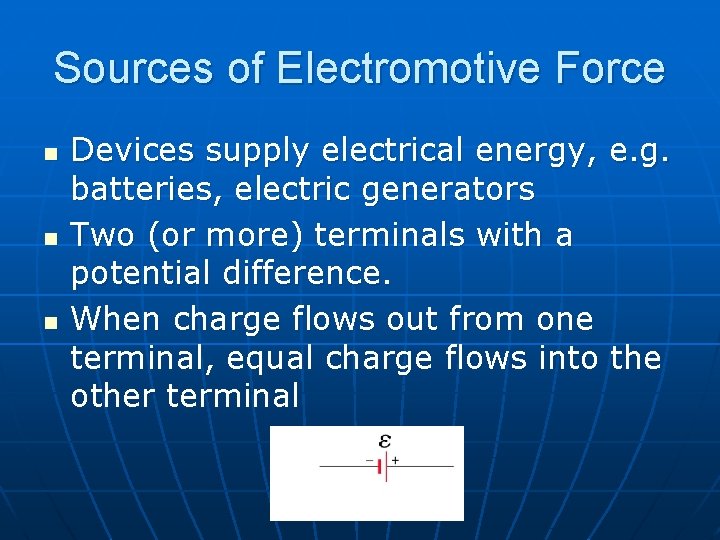
Sources of Electromotive Force n n n Devices supply electrical energy, e. g. batteries, electric generators Two (or more) terminals with a potential difference. When charge flows out from one terminal, equal charge flows into the other terminal
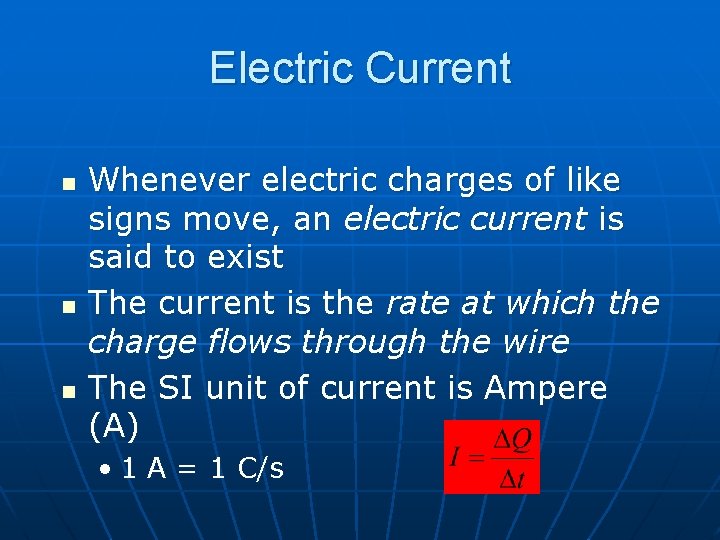
Electric Current n n n Whenever electric charges of like signs move, an electric current is said to exist The current is the rate at which the charge flows through the wire The SI unit of current is Ampere (A) • 1 A = 1 C/s
Example In a tv tube, 5 x 10¹⁴ electrons shoot out in 4 s. What is the electric current?
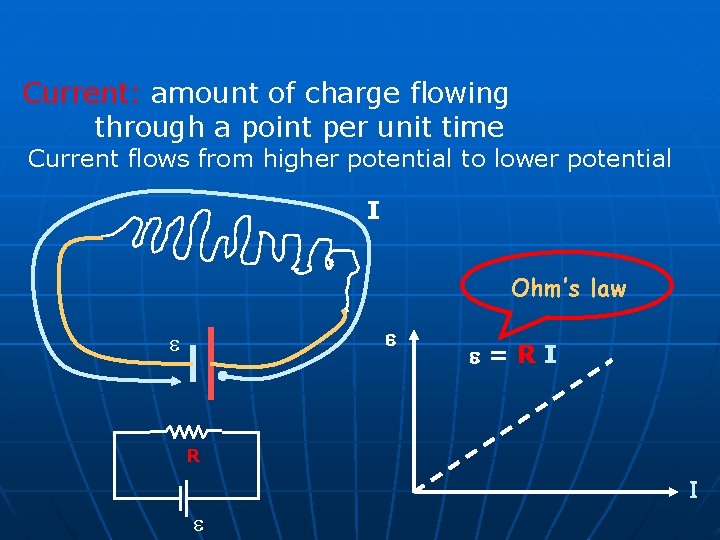
Current: amount of charge flowing through a point per unit time Current flows from higher potential to lower potential I Ohm’s law e e e=RI R I e
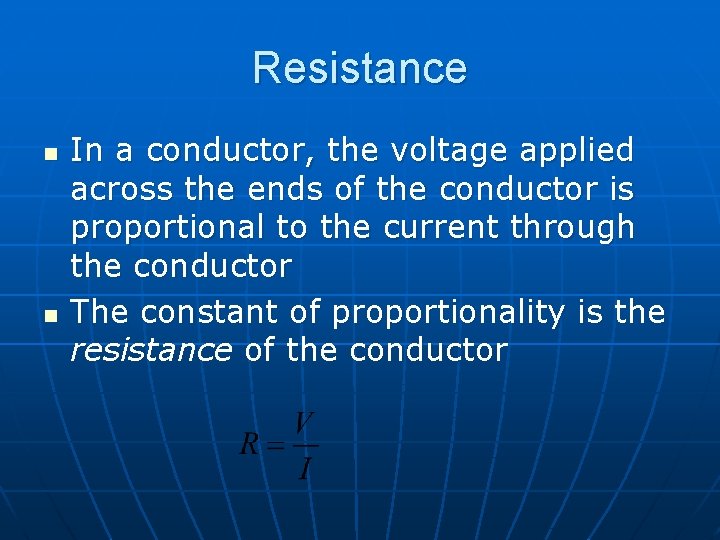
Resistance n n In a conductor, the voltage applied across the ends of the conductor is proportional to the current through the conductor The constant of proportionality is the resistance of the conductor
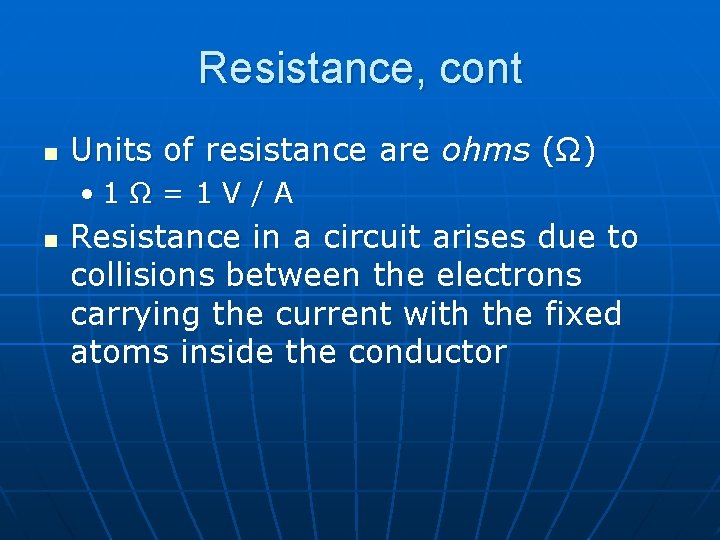
Resistance, cont n Units of resistance are ohms (Ω) • 1 Ω = 1 V / A n Resistance in a circuit arises due to collisions between the electrons carrying the current with the fixed atoms inside the conductor
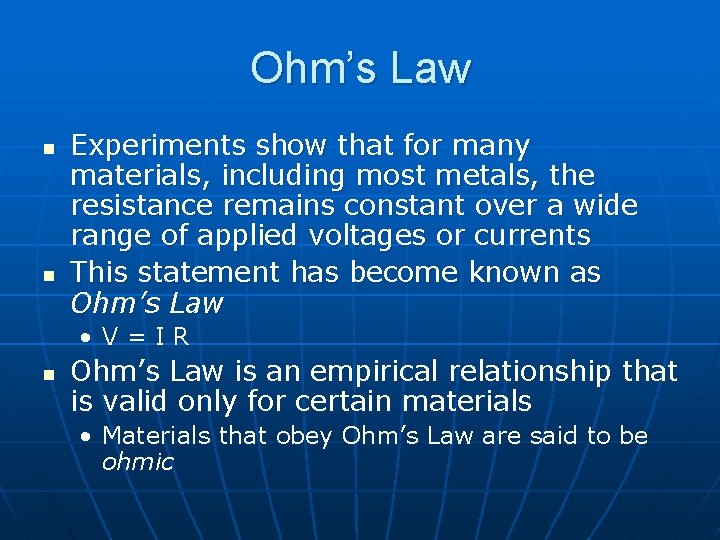
Ohm’s Law n n Experiments show that for many materials, including most metals, the resistance remains constant over a wide range of applied voltages or currents This statement has become known as Ohm’s Law • V=IR n Ohm’s Law is an empirical relationship that is valid only for certain materials • Materials that obey Ohm’s Law are said to be ohmic
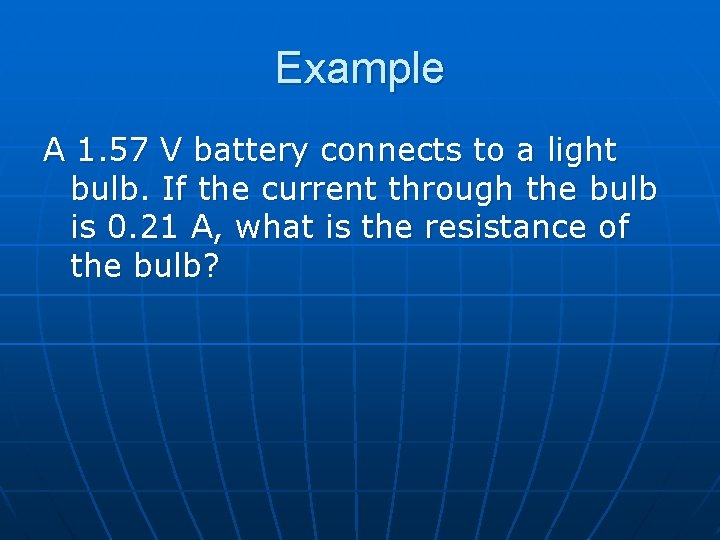
Example A 1. 57 V battery connects to a light bulb. If the current through the bulb is 0. 21 A, what is the resistance of the bulb?
V=RI Resistance, R = V/I [R] = V/A = W (Ohm) For a fixed potential difference across a resistor, the larger R, the smaller current passing through it. Req
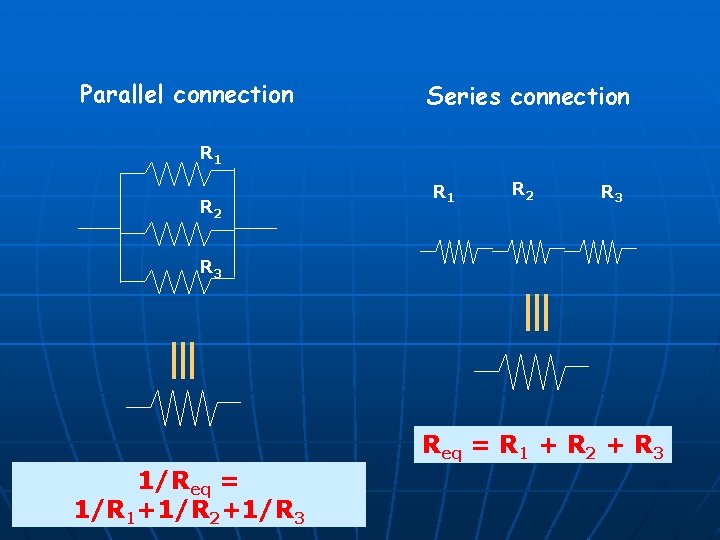
Parallel connection Series connection R 1 R 2 R 3 Req = R 1 + R 2 + R 3 1/Req = 1/R 1+1/R 2+1/R 3
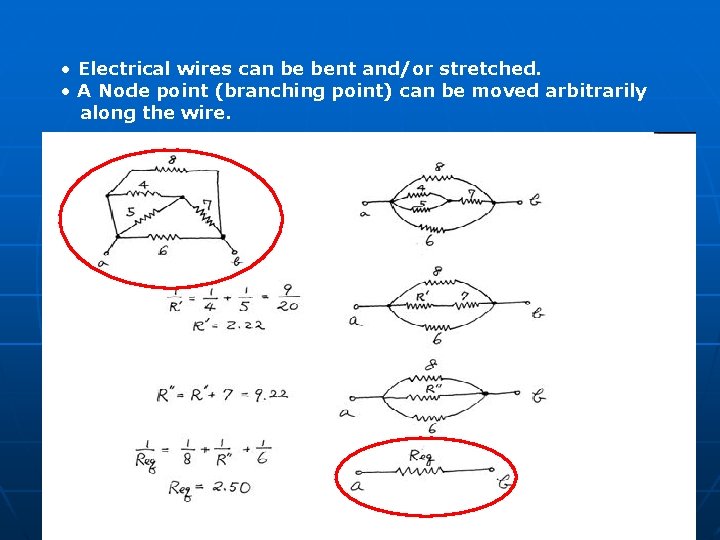
• Electrical wires can be bent and/or stretched. • A Node point (branching point) can be moved arbitrarily along the wire.
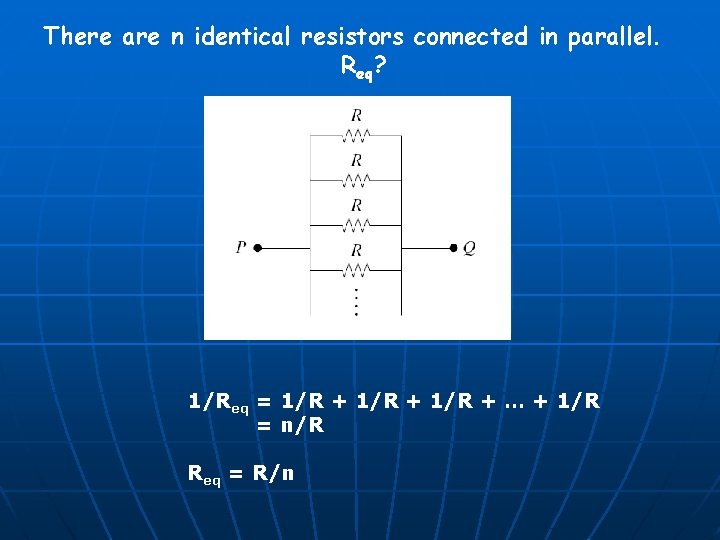
There are n identical resistors connected in parallel. Req? 1/Req = 1/R + … + 1/R = n/R Req = R/n
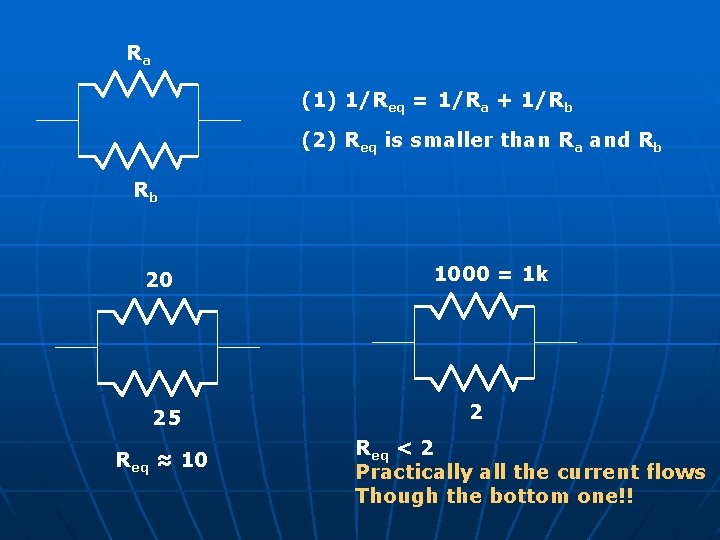
Ra (1) 1/Req = 1/Ra + 1/Rb (2) Req is smaller than Ra and Rb Rb 20 25 Req ≈ 10 1000 = 1 k 2 Req < 2 Practically all the current flows Though the bottom one!!
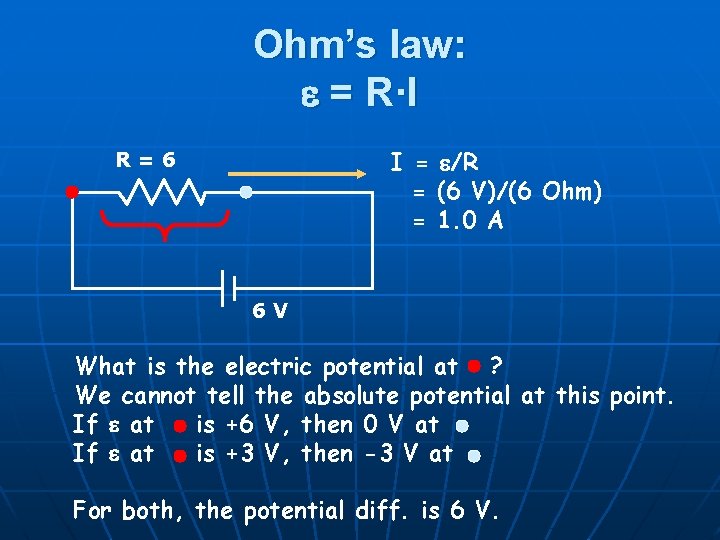
Ohm’s law: e = R·I I = e/R = (6 V)/(6 Ohm) = 1. 0 A R=6 6 V What is the electric potential at ? We cannot tell the absolute potential at this point. If e at is +6 V, then 0 V at If e at is +3 V, then -3 V at For both, the potential diff. is 6 V.
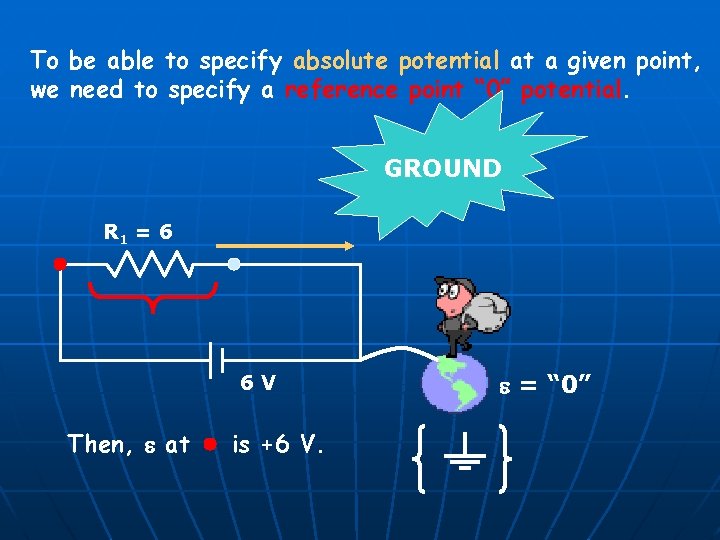
To be able to specify absolute potential at a given point, we need to specify a reference point “ 0” potential. GROUND R 1 = 6 6 V Then, e at is +6 V. e = “ 0”
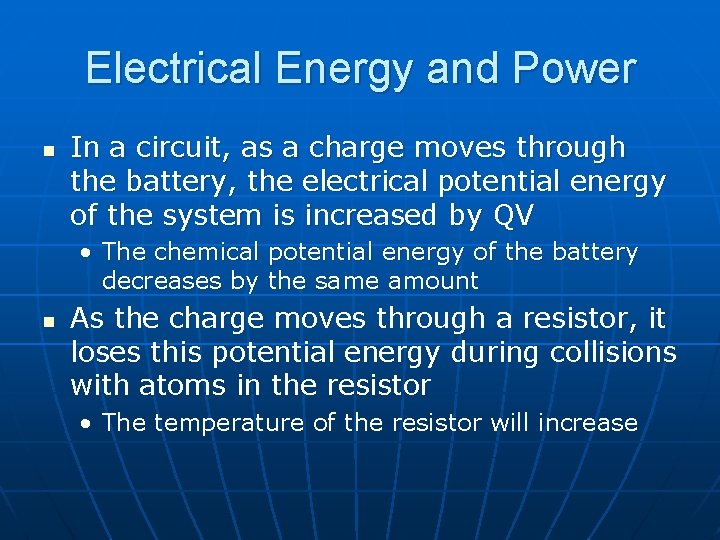
Electrical Energy and Power n In a circuit, as a charge moves through the battery, the electrical potential energy of the system is increased by QV • The chemical potential energy of the battery decreases by the same amount n As the charge moves through a resistor, it loses this potential energy during collisions with atoms in the resistor • The temperature of the resistor will increase
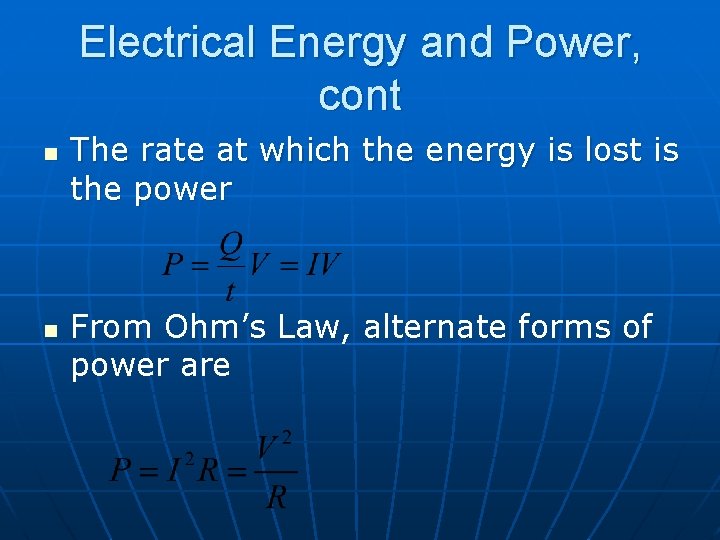
Electrical Energy and Power, cont n n The rate at which the energy is lost is the power From Ohm’s Law, alternate forms of power are
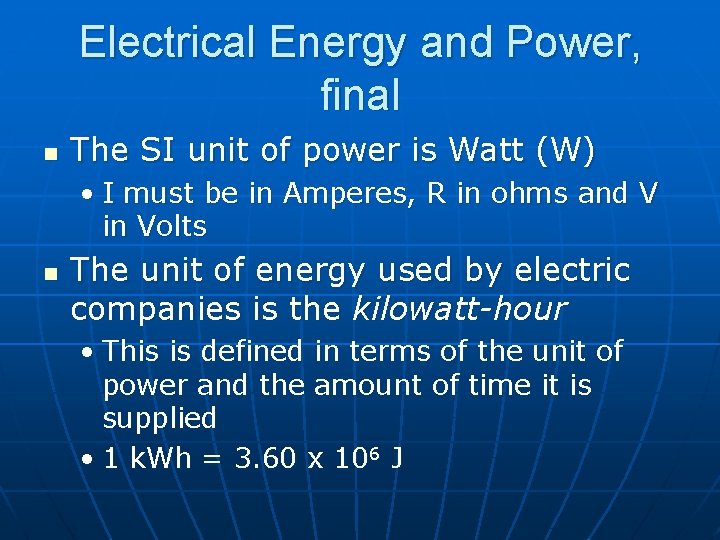
Electrical Energy and Power, final n The SI unit of power is Watt (W) • I must be in Amperes, R in ohms and V in Volts n The unit of energy used by electric companies is the kilowatt-hour • This is defined in terms of the unit of power and the amount of time it is supplied • 1 k. Wh = 3. 60 x 106 J
Example n n n Light bulb 60 W, 120 V. Find resistance of the light bulb. Bulbs in series Bulbs in parallel
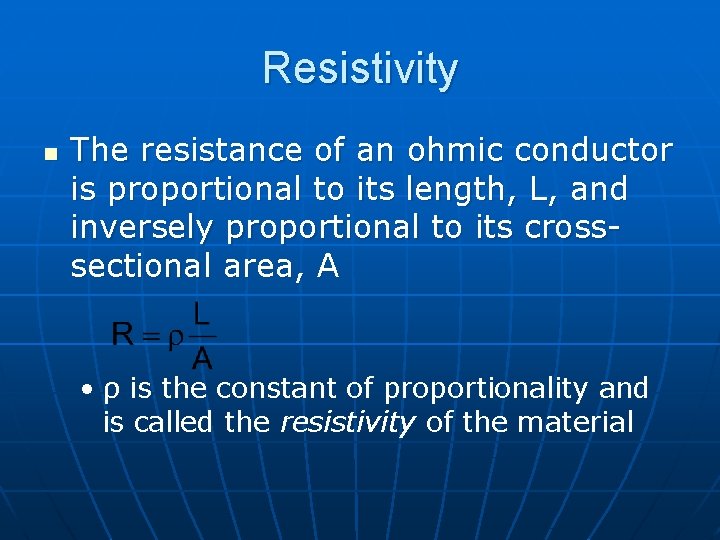
Resistivity n The resistance of an ohmic conductor is proportional to its length, L, and inversely proportional to its crosssectional area, A • ρ is the constant of proportionality and is called the resistivity of the material
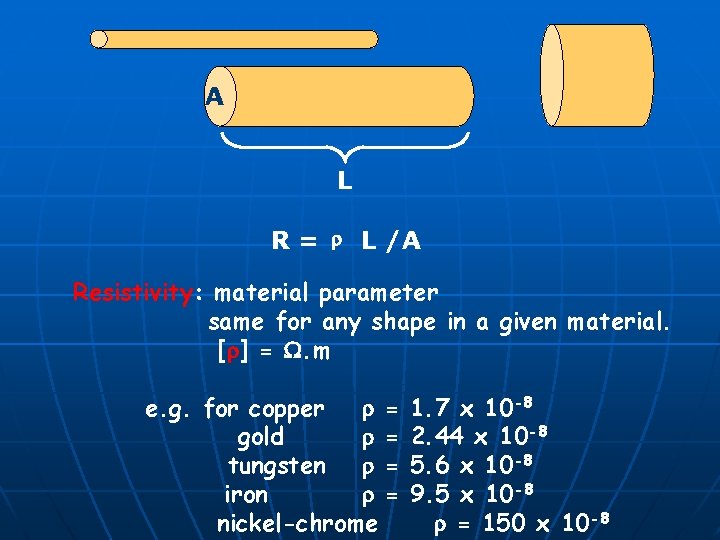
A L R = r L /A Resistivity: material parameter same for any shape in a given material. [r] = W. m e. g. for copper r = gold r = tungsten r = iron r = nickel-chrome 1. 7 x 10 -8 2. 44 x 10 -8 5. 6 x 10 -8 9. 5 x 10 -8 r = 150 x 10 -8
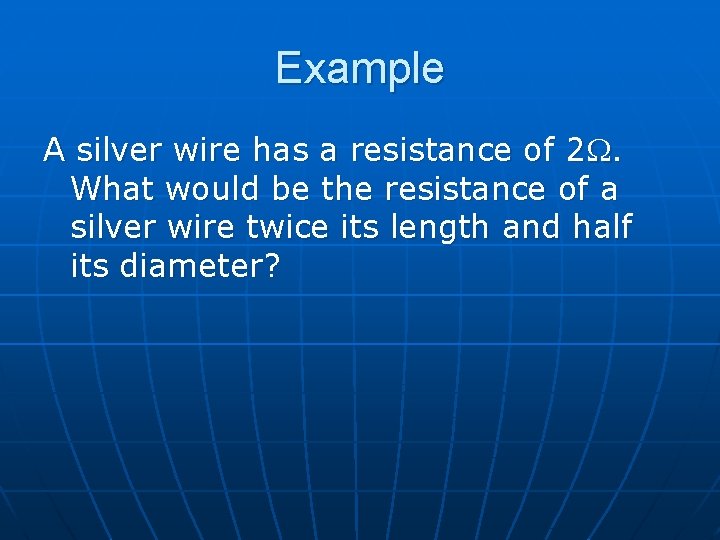
Example A silver wire has a resistance of 2. What would be the resistance of a silver wire twice its length and half its diameter?
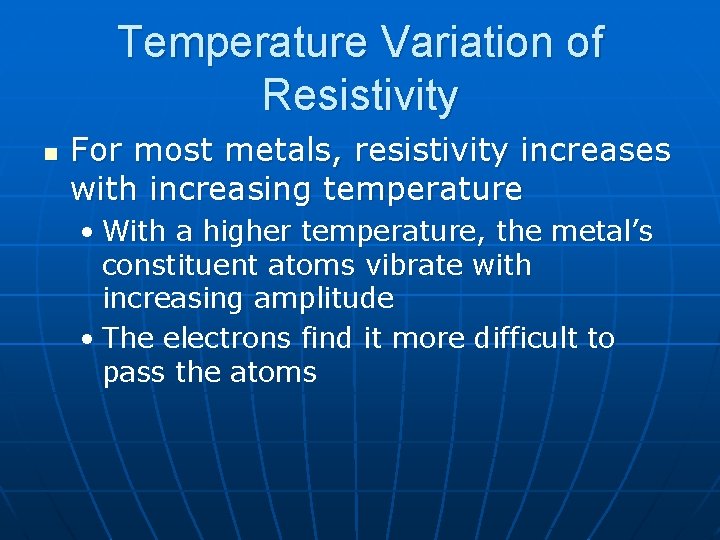
Temperature Variation of Resistivity n For most metals, resistivity increases with increasing temperature • With a higher temperature, the metal’s constituent atoms vibrate with increasing amplitude • The electrons find it more difficult to pass the atoms
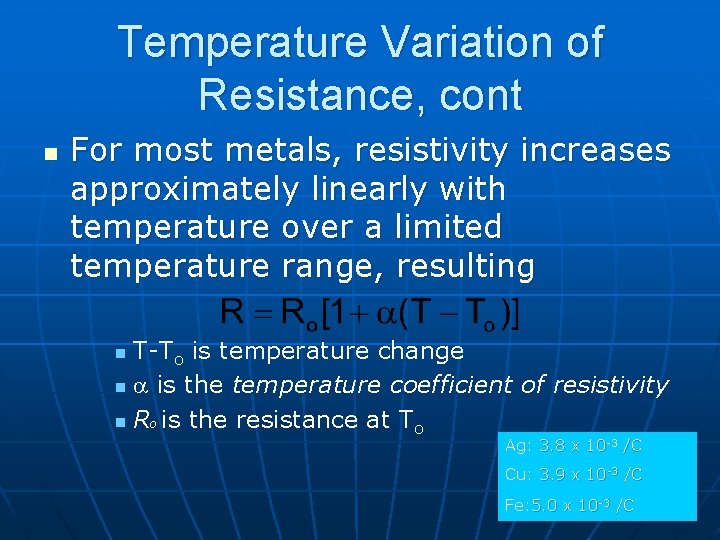
Temperature Variation of Resistance, cont n For most metals, resistivity increases approximately linearly with temperature over a limited temperature range, resulting T-To is temperature change n is the temperature coefficient of resistivity n Ro is the resistance at To n Ag: 3. 8 x 10 -3 /C Cu: 3. 9 x 10 -3 /C Fe: 5. 0 x 10 -3 /C
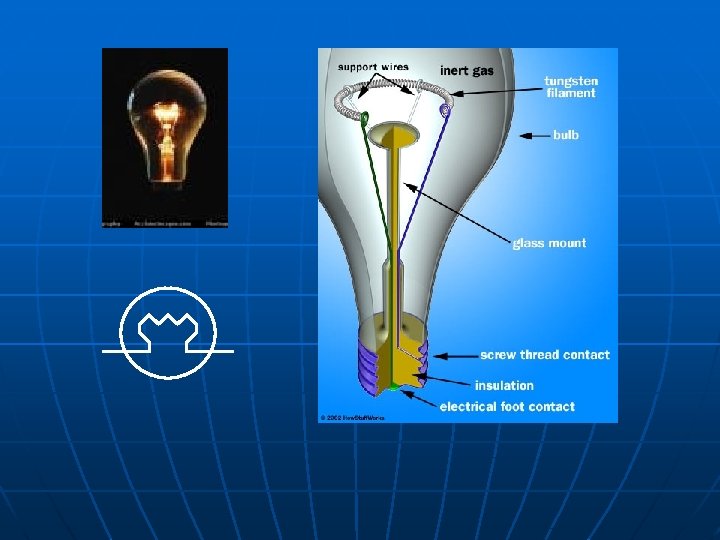
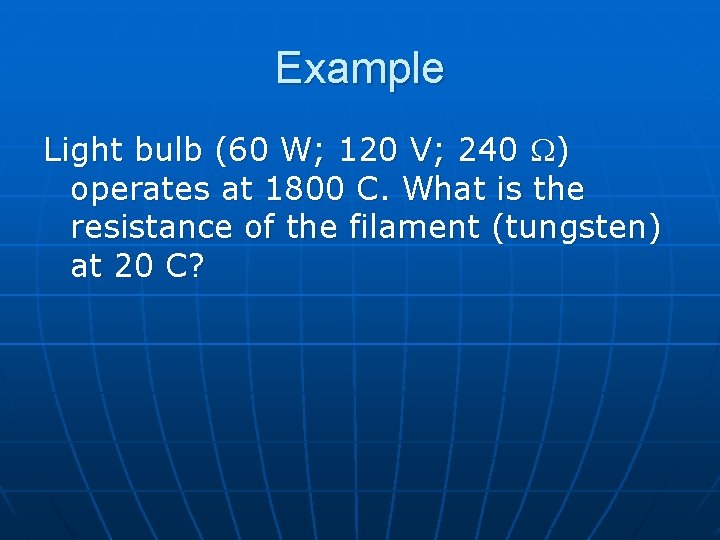
Example Light bulb (60 W; 120 V; 240 ) operates at 1800 C. What is the resistance of the filament (tungsten) at 20 C?