
Chapter 19 Current and Resistance 19 1 Electric

- Slides: 46
Chapter 19 Current and Resistance
19. 1 Electric Current Objectives 1. Describe the basic properties of electric current 2. Solve problems relating current, charge and time 3. Distinguish between the drift speed of a charge carrier and the average speed of the charge carrier between collisions 4. Differentiate between direct current and alternating current
Where is electric current? …. wherever there is a net movement of electric charge through a medium. Examples In any electronic device In our car engines In our body
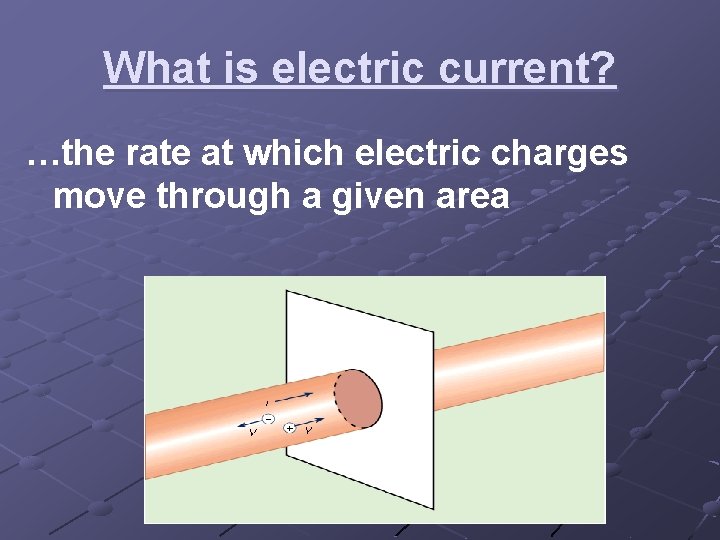
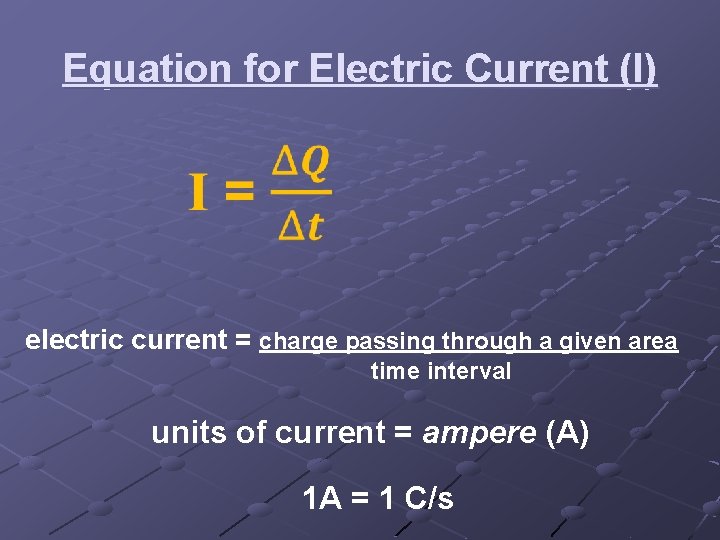
What is electric current? …the rate at which electric charges move through a given area
Equation for Electric Current (I) electric current = charge passing through a given area time interval units of current = ampere (A) 1 A = 1 C/s
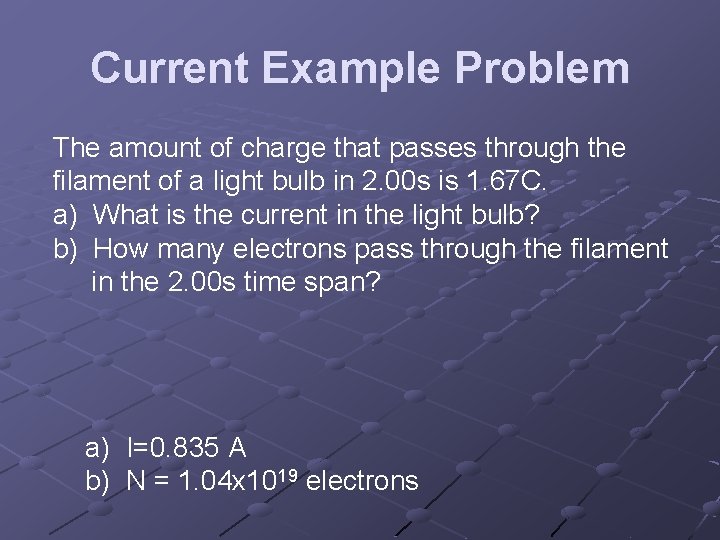
Current Example Problem The amount of charge that passes through the filament of a light bulb in 2. 00 s is 1. 67 C. a) What is the current in the light bulb? b) How many electrons pass through the filament in the 2. 00 s time span? a) I=0. 835 A b) N = 1. 04 x 1019 electrons
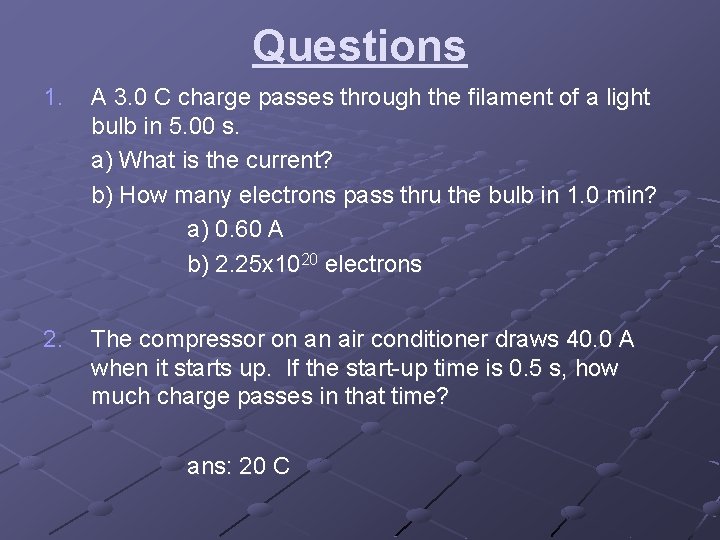
Questions 1. A 3. 0 C charge passes through the filament of a light bulb in 5. 00 s. a) What is the current? b) How many electrons pass thru the bulb in 1. 0 min? a) 0. 60 A b) 2. 25 x 1020 electrons 2. The compressor on an air conditioner draws 40. 0 A when it starts up. If the start-up time is 0. 5 s, how much charge passes in that time? ans: 20 C
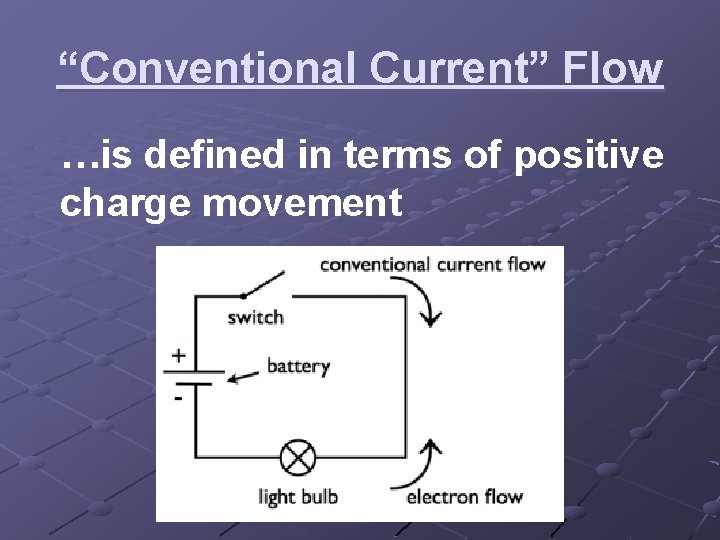
“Conventional Current” Flow …is defined in terms of positive charge movement
Charge Movement Requires a good conductor Examples of good conductors? Copper and other metals n Salt water and other electrolytes n
Electron Motion in a Conductor When you flip on a light switch, you introduce an E-field that travels through the wire at nearly the speed of light (3. 0 x 108 m/s). But the electrons themselves do not actually travel that fast…. instead they travel at a rate called the “drift velocity”.
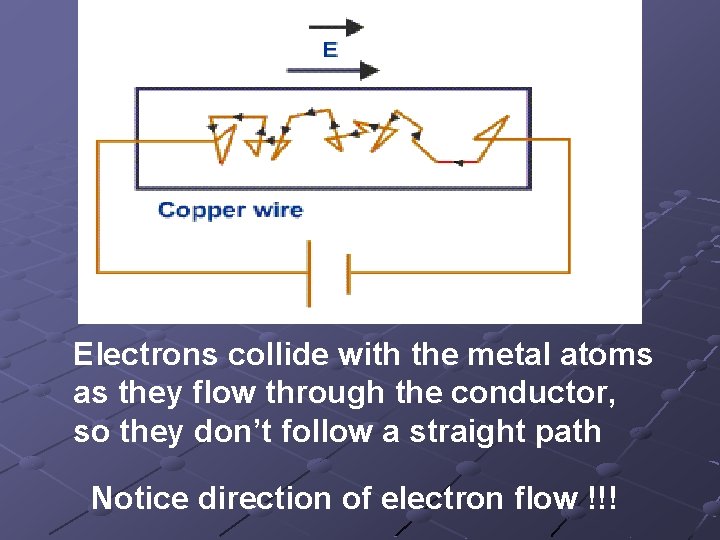
Electrons collide with the metal atoms as they flow through the conductor, so they don’t follow a straight path Notice direction of electron flow !!!
Drift Velocity Is the net velocity of the charge carrier moving in an electric field Because there are so many collisions as the electrons move in the electric field, drift velocity is very small, even though E is moving VERY fast (about the speed of light)
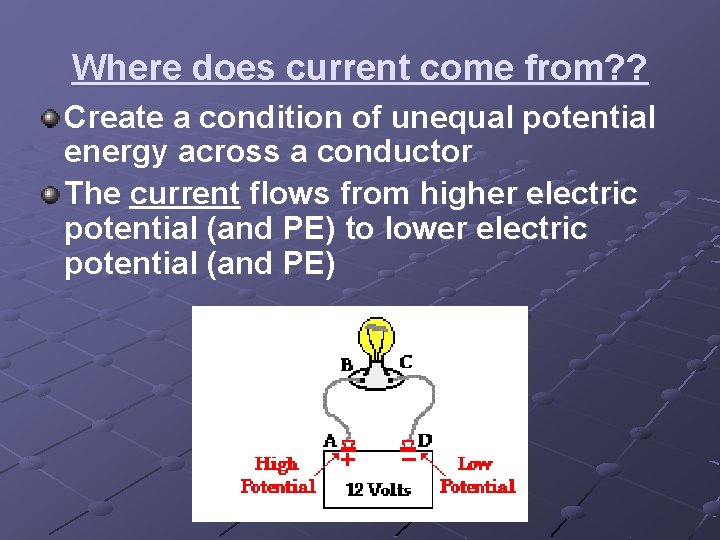
Where does current come from? ? Create a condition of unequal potential energy across a conductor The current flows from higher electric potential (and PE) to lower electric potential (and PE)
Sources of Current Batteries: convert chemical energy into electrical energy Generators : convert mechanical energy into electrical energy When will the current stop moving?
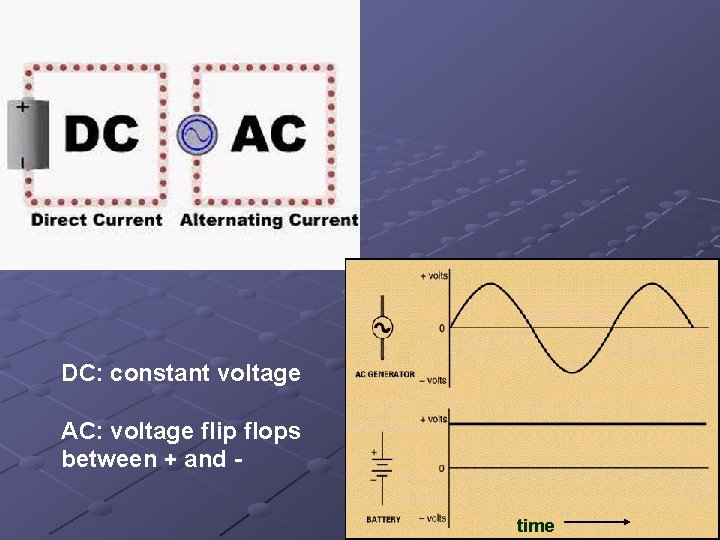
Types of Current Direct current (DC) – charges move only one direction because the terminals of the charge source always maintain the same sign (example: current flowing in a battery circuit) Alternating current (AC) – charges move in both directions because the terminals of the charge source are constantly changing signs. There is no net motion of charge, they just vibrate back and forth (example: current in your house)
DC: constant voltage AC: voltage flip flops between + and time
19. 2 Resistance Objectives 1. Calculate the resistance, current and potential difference using the definition of resistance 2. Distinguish between ohmic and nonohmic materials 3. Know what factors affect resistance 4. Describe what is unique about superconductors
What is resistance? …. the impedance of motion of charge through a conductor.
Which battery can provide more current to a light bulb, a 9 V or a 12 V? All things being equal, the 12 V battery would provide more current. But the current provided to the bulb by the battery also depends on the connecting wires and the bulb’s filament etc. These other features in the circuit that impede current flow comprise the circuit’s resistance.
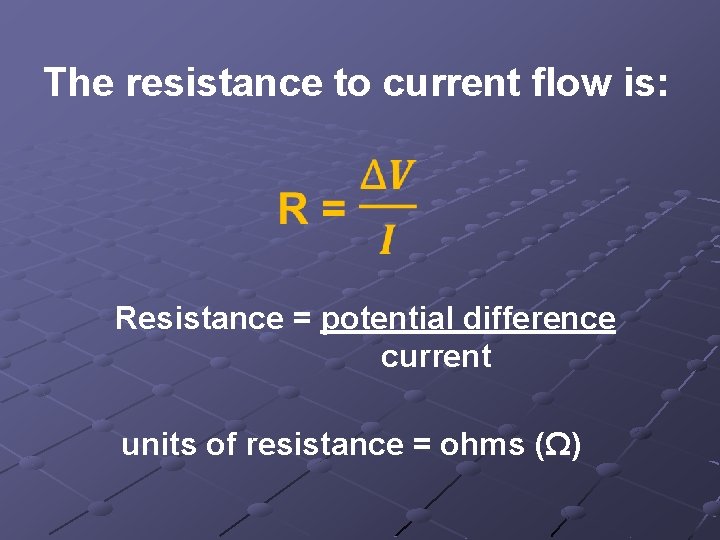
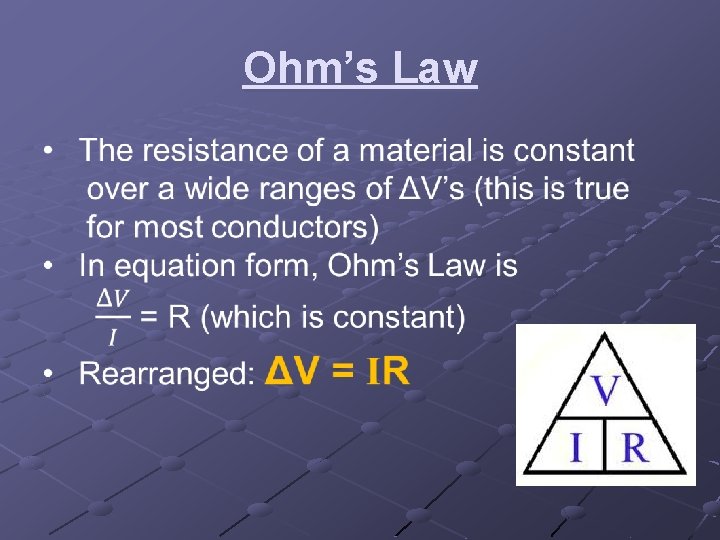
The resistance to current flow is: Resistance = potential difference current units of resistance = ohms (Ω)
Ohm’s Law
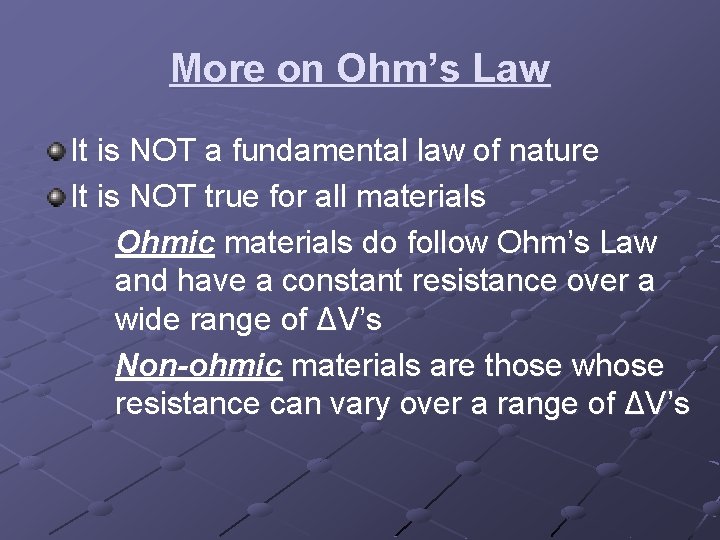
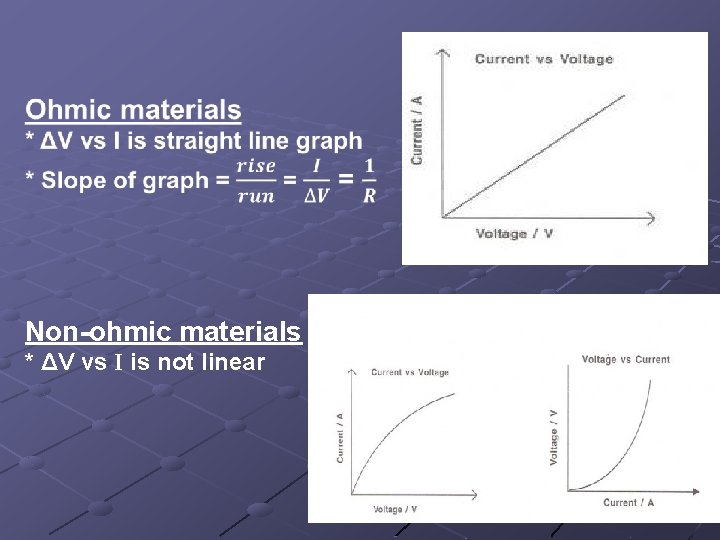
More on Ohm’s Law It is NOT a fundamental law of nature It is NOT true for all materials Ohmic materials do follow Ohm’s Law and have a constant resistance over a wide range of ΔV’s Non-ohmic materials are those whose resistance can vary over a range of ΔV’s
Non-ohmic materials * ΔV vs I is not linear
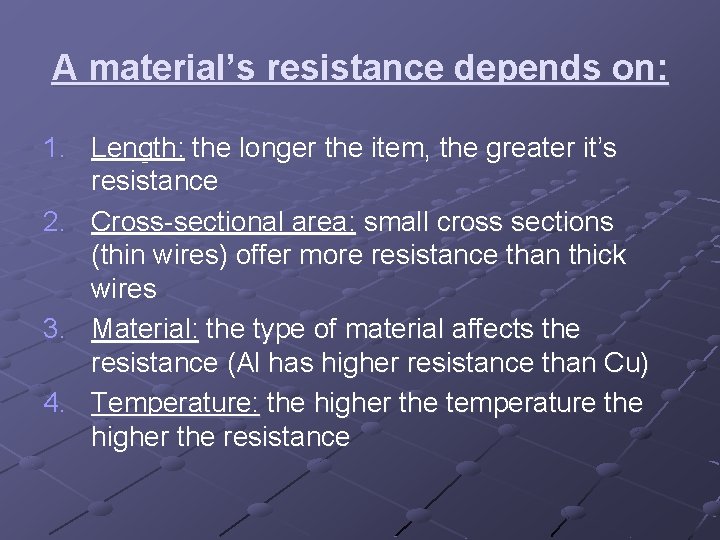
A material’s resistance depends on: 1. Length: the longer the item, the greater it’s resistance 2. Cross-sectional area: small cross sections (thin wires) offer more resistance than thick wires 3. Material: the type of material affects the resistance (Al has higher resistance than Cu) 4. Temperature: the higher the temperature the higher the resistance
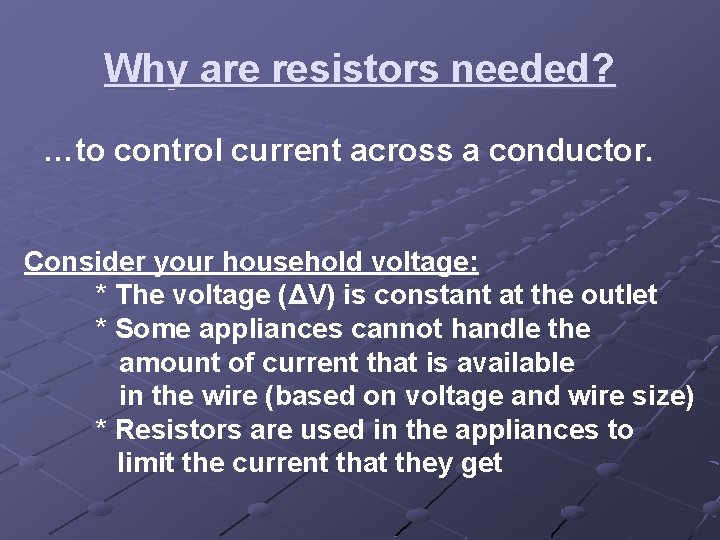
Why are resistors needed? …to control current across a conductor. Consider your household voltage: * The voltage (ΔV) is constant at the outlet * Some appliances cannot handle the amount of current that is available in the wire (based on voltage and wire size) * Resistors are used in the appliances to limit the current that they get
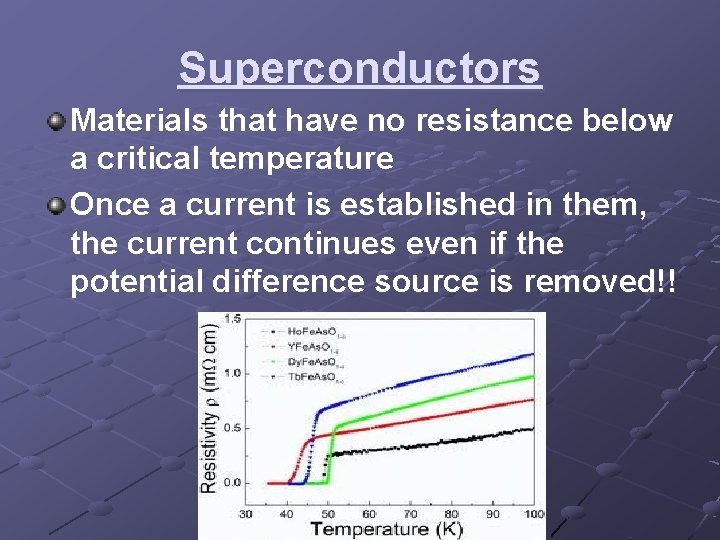
Superconductors Materials that have no resistance below a critical temperature Once a current is established in them, the current continues even if the potential difference source is removed!!
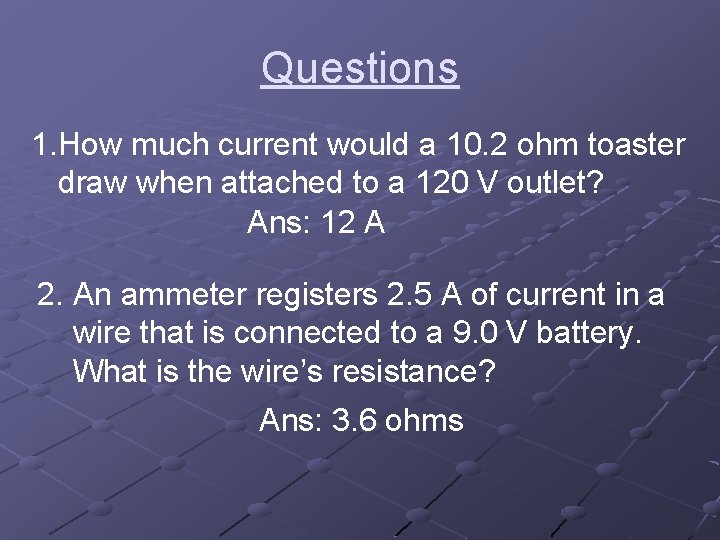
Questions 1. How much current would a 10. 2 ohm toaster draw when attached to a 120 V outlet? Ans: 12 A 2. An ammeter registers 2. 5 A of current in a wire that is connected to a 9. 0 V battery. What is the wire’s resistance? Ans: 3. 6 ohms
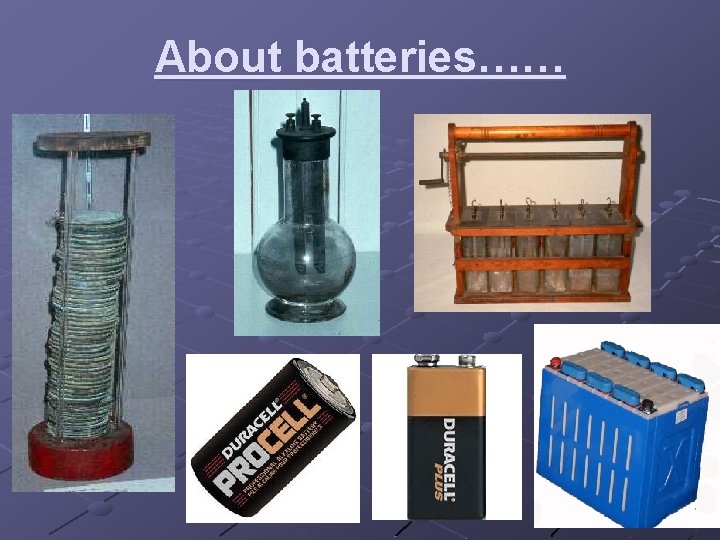
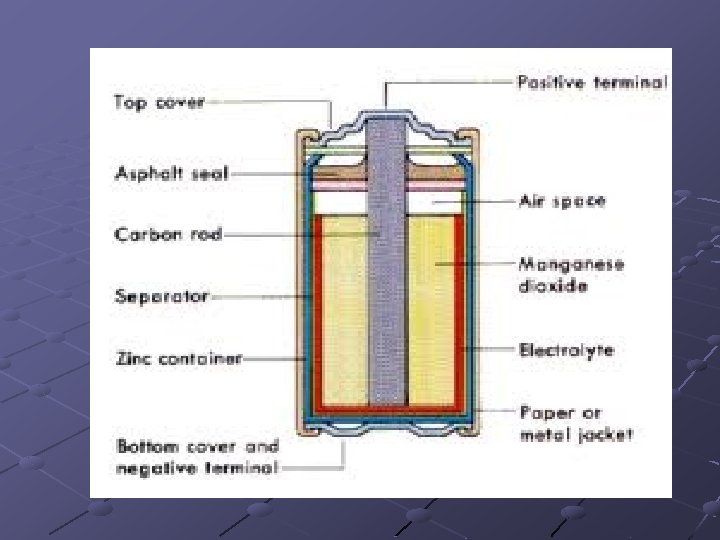
About batteries……
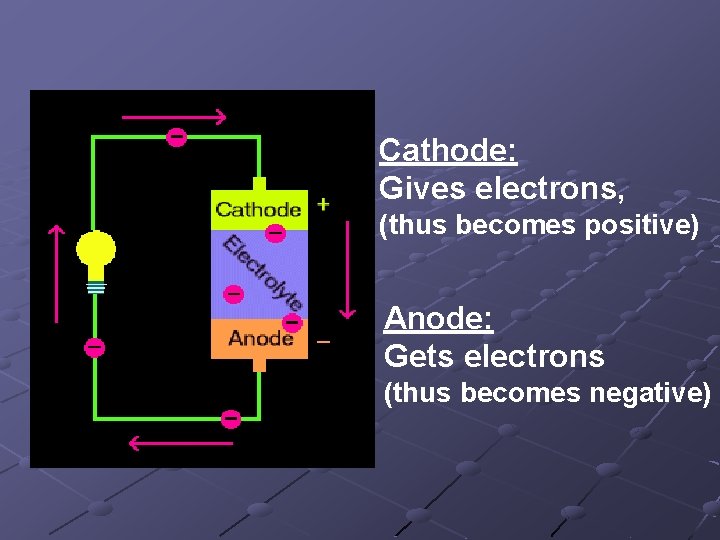
Cathode: Gives electrons, (thus becomes positive) Anode: Gets electrons (thus becomes negative)
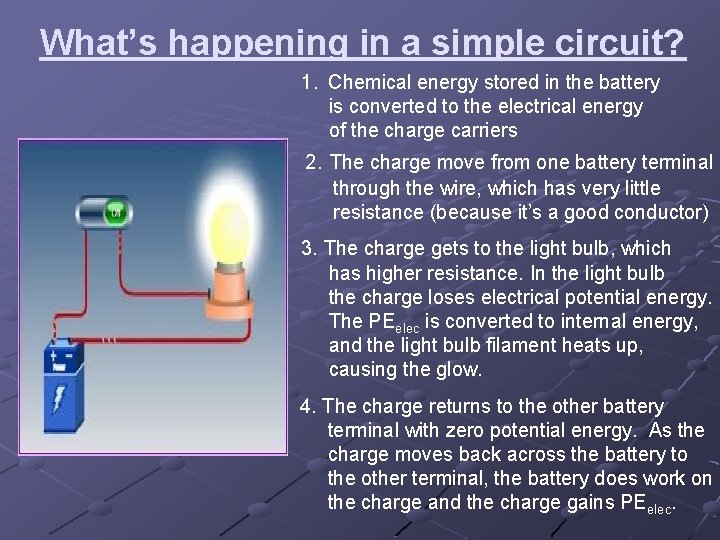
What’s happening in a simple circuit? 1. Chemical energy stored in the battery is converted to the electrical energy of the charge carriers 2. The charge move from one battery terminal through the wire, which has very little resistance (because it’s a good conductor) 3. The charge gets to the light bulb, which has higher resistance. In the light bulb the charge loses electrical potential energy. The PEelec is converted to internal energy, and the light bulb filament heats up, causing the glow. 4. The charge returns to the other battery terminal with zero potential energy. As the charge moves back across the battery to the other terminal, the battery does work on the charge and the charge gains PEelec.
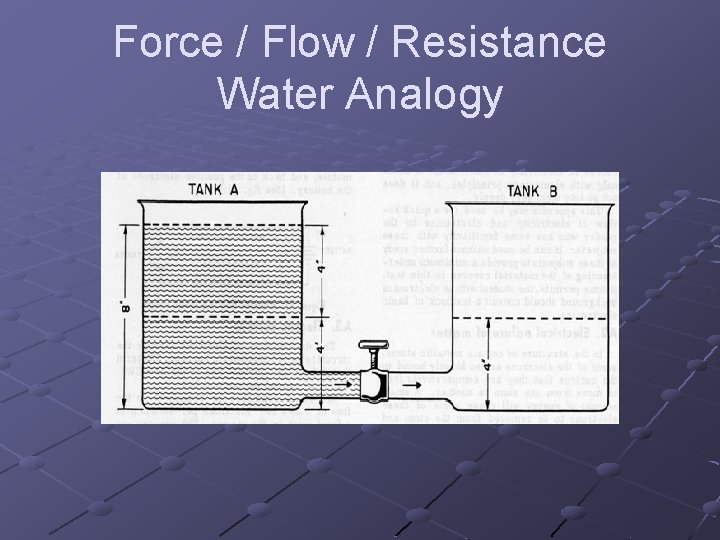
Force / Flow / Resistance Water Analogy
Force / Flow / Resistance Blocking Sled Analogy
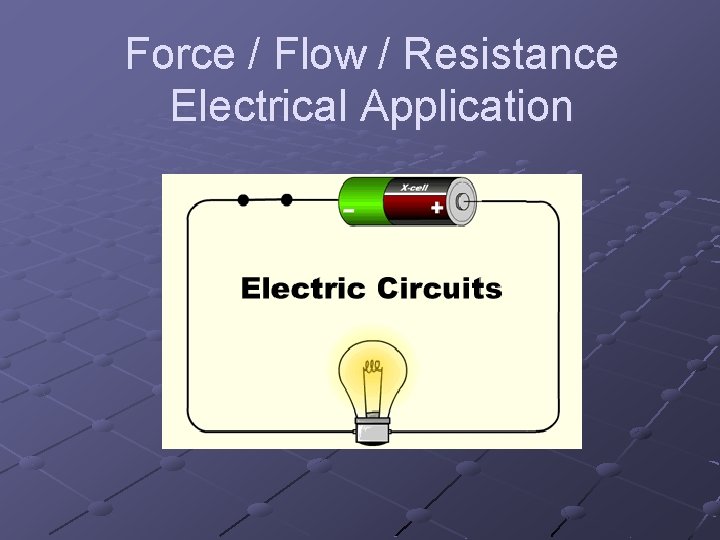
Force / Flow / Resistance Electrical Application
19. 3 Electric Power Objectives 1. Relate electric power to the rate at which electrical energy is converted to other forms of energy 2. Calculate electric power 3. Calculate the cost of running electrical appliances
Electrical Power …. . the rate at which the charge carriers do work. Aka: the rate at which the charge carriers convert electrical potential energy to non-electrical forms of energy.
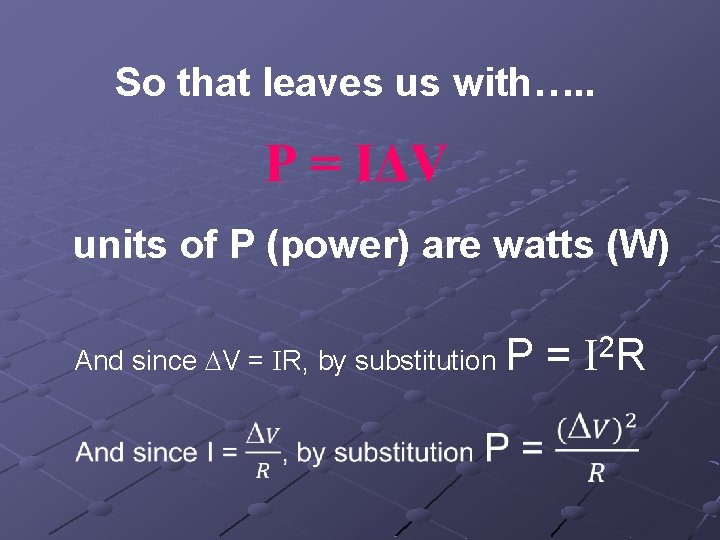
Equations for Power is the rate at which work is done P = W = ΔPE Δt Δt Since ΔPE = qΔV, then P = qΔV Δt But from 19. 1 we know I = q Δt
So that leaves us with…. . P = IΔV units of P (power) are watts (W) And since V = IR, by substitution P = I 2 R
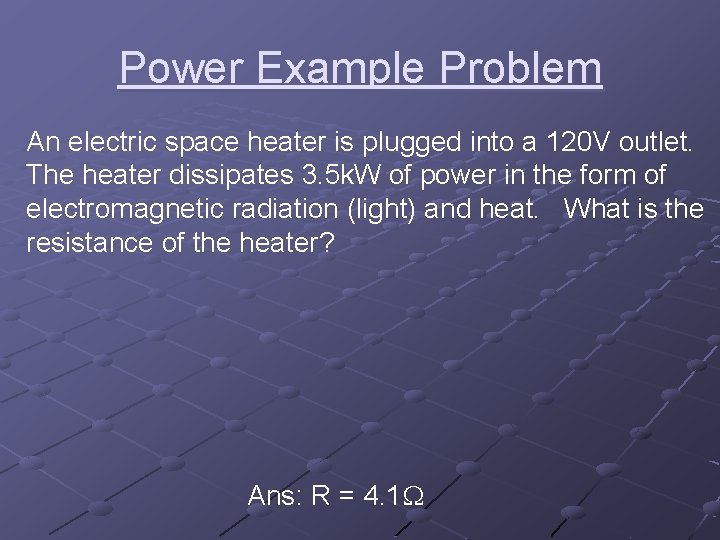
Power Example Problem An electric space heater is plugged into a 120 V outlet. The heater dissipates 3. 5 k. W of power in the form of electromagnetic radiation (light) and heat. What is the resistance of the heater? Ans: R = 4. 1
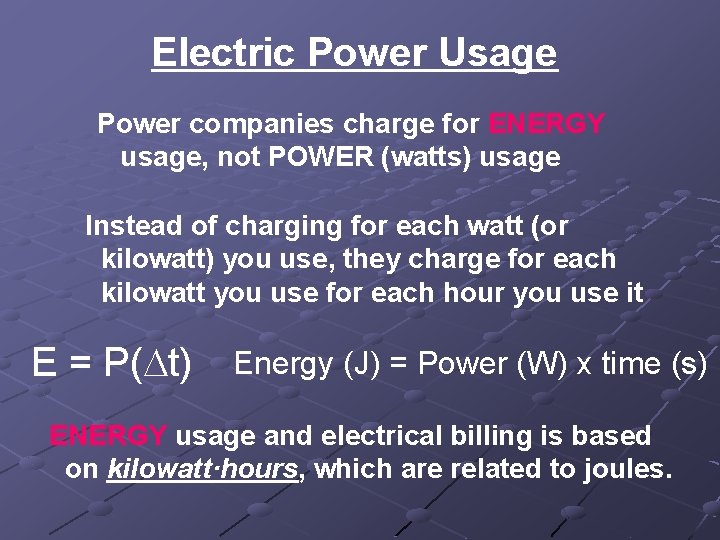
Electric Power Usage Power companies charge for ENERGY usage, not POWER (watts) usage Instead of charging for each watt (or kilowatt) you use, they charge for each kilowatt you use for each hour you use it E = P( t) Energy (J) = Power (W) x time (s) ENERGY usage and electrical billing is based on kilowatt·hours, which are related to joules.
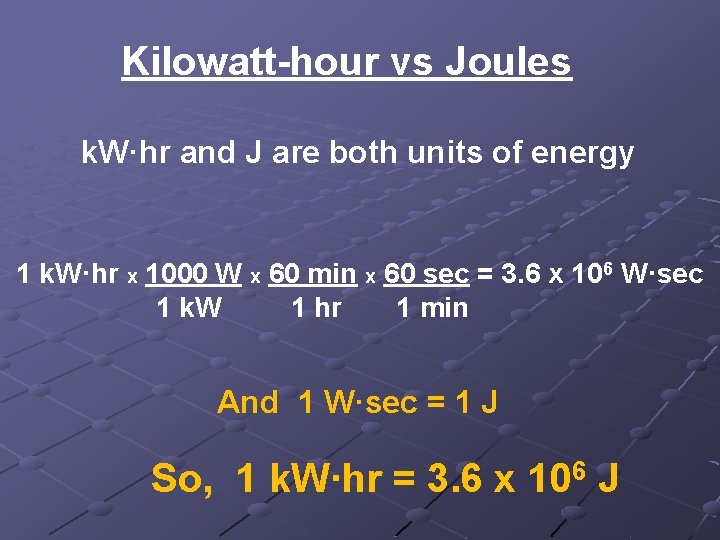
Kilowatt-hour vs Joules k. W·hr and J are both units of energy 1 k. W·hr x 1000 W x 60 min x 60 sec = 3. 6 x 10⁶ W·sec 1 k. W 1 hr 1 min And 1 W·sec = 1 J So, 1 k. W·hr = 3. 6 x 10⁶ J
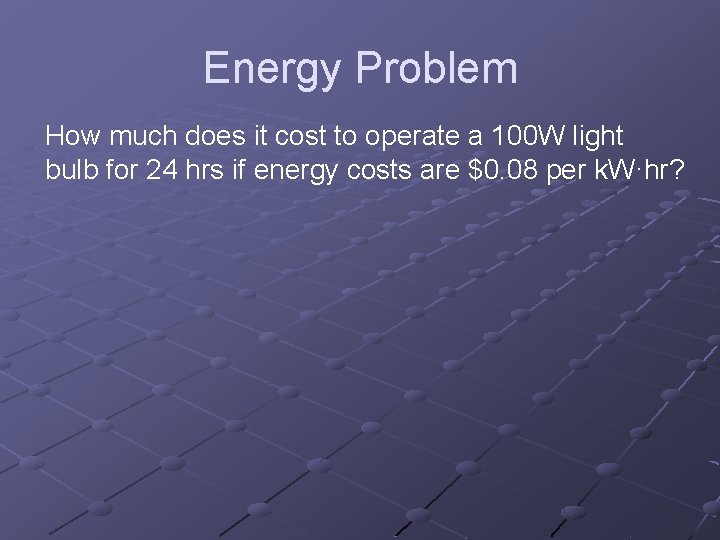
Energy Problem How much does it cost to operate a 100 W light bulb for 24 hrs if energy costs are $0. 08 per k. W·hr?
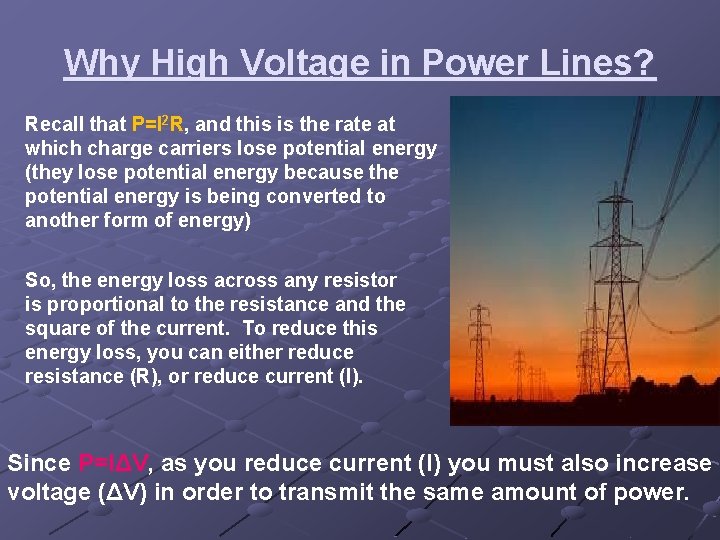
Why High Voltage in Power Lines? Recall that P=I 2 R, and this is the rate at which charge carriers lose potential energy (they lose potential energy because the potential energy is being converted to another form of energy) So, the energy loss across any resistor is proportional to the resistance and the square of the current. To reduce this energy loss, you can either reduce resistance (R), or reduce current (I). Since P=IΔV, as you reduce current (I) you must also increase voltage (ΔV) in order to transmit the same amount of power.
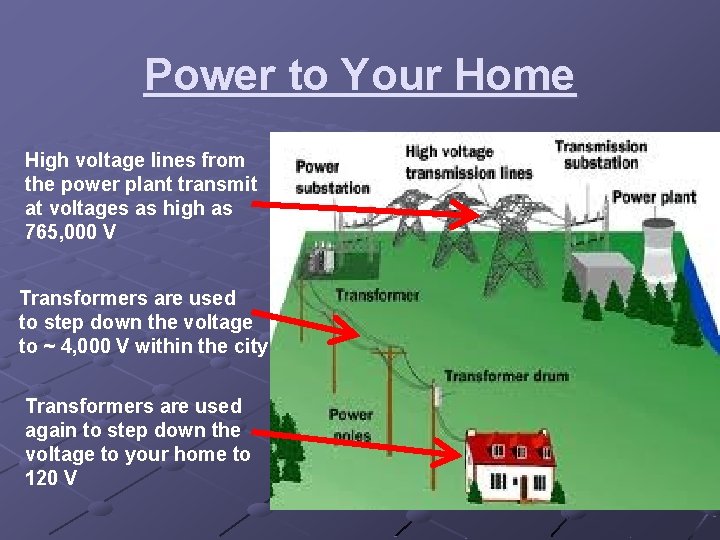
Power to Your Home High voltage lines from the power plant transmit at voltages as high as 765, 000 V Transformers are used to step down the voltage to ~ 4, 000 V within the city Transformers are used again to step down the voltage to your home to 120 V
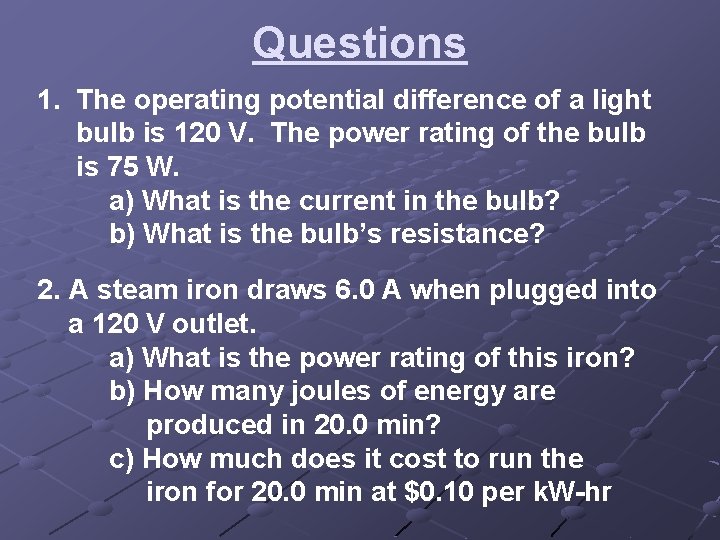
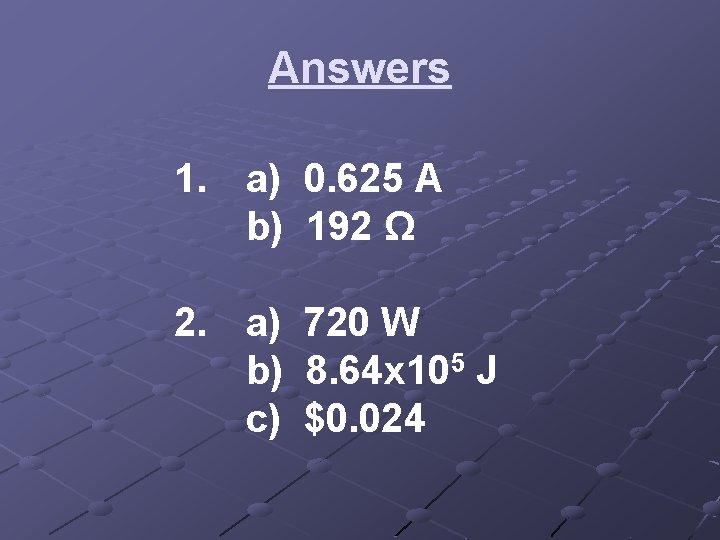
Questions 1. The operating potential difference of a light bulb is 120 V. The power rating of the bulb is 75 W. a) What is the current in the bulb? b) What is the bulb’s resistance? 2. A steam iron draws 6. 0 A when plugged into a 120 V outlet. a) What is the power rating of this iron? b) How many joules of energy are produced in 20. 0 min? c) How much does it cost to run the iron for 20. 0 min at $0. 10 per k. W-hr
Answers 1. a) 0. 625 A b) 192 Ω 2. a) 720 W b) 8. 64 x 105 J c) $0. 024