
Chapter 19 Corporate Formation Reorganization and Liquidation Mc
- Slides: 33
Chapter 19 Corporate Formation, Reorganization, and Liquidation Mc. Graw-Hill Education Copyright © 2017 Mc. Graw-Hill Education. All rights reserved. No reproduction or distribution without the prior written consent of Mc. Graw-Hill Education.
Learning Objectives 1. Review the taxation of property dispositions. 2. Compute the tax consequences to the parties to a taxdeferred corporate formation. 3. Identify the different forms of taxable and tax-deferred acquisitions. 4. Determine the tax consequences to the parties to a corporate acquisition. 5. Calculate the tax consequences that apply to the parties to a complete liquidation of a corporation. Mc. Graw-Hill Education 19 -2 Copyright © 2017 Mc. Graw-Hill Education. All rights reserved. No reproduction or distribution without the prior written consent of Mc. Graw-Hill Education.
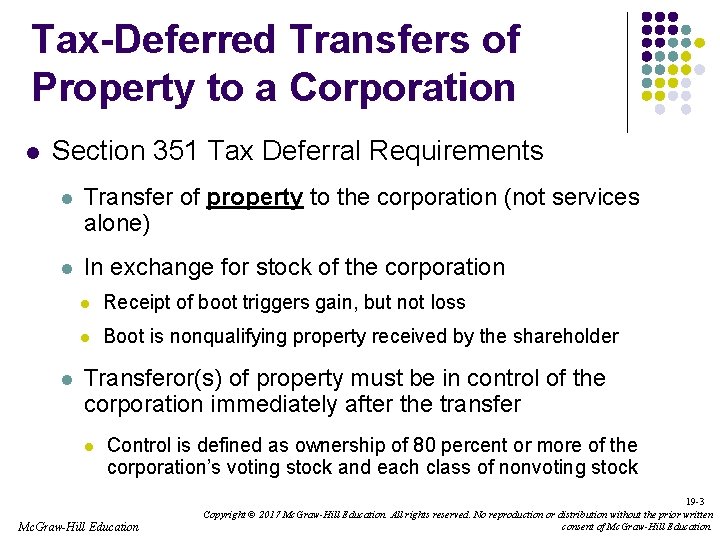
Tax-Deferred Transfers of Property to a Corporation l Section 351 Tax Deferral Requirements l Transfer of property to the corporation (not services alone) l In exchange for stock of the corporation l l Receipt of boot triggers gain, but not loss l Boot is nonqualifying property received by the shareholder Transferor(s) of property must be in control of the corporation immediately after the transfer l Control is defined as ownership of 80 percent or more of the corporation’s voting stock and each class of nonvoting stock Mc. Graw-Hill Education 19 -3 Copyright © 2017 Mc. Graw-Hill Education. All rights reserved. No reproduction or distribution without the prior written consent of Mc. Graw-Hill Education.
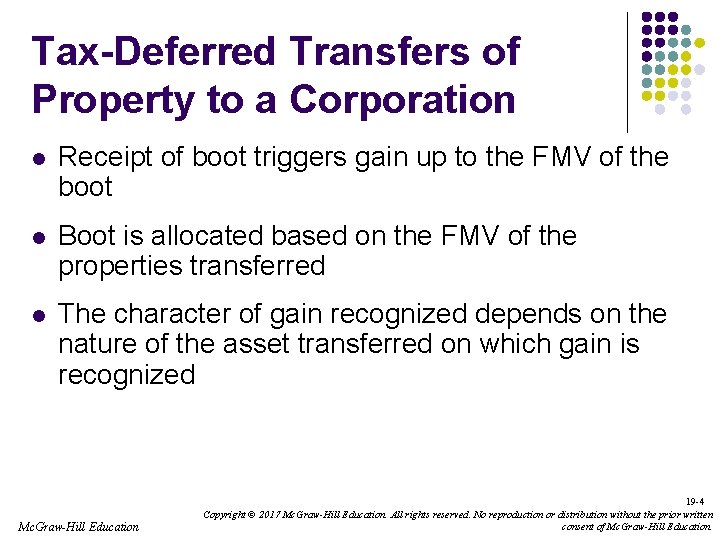
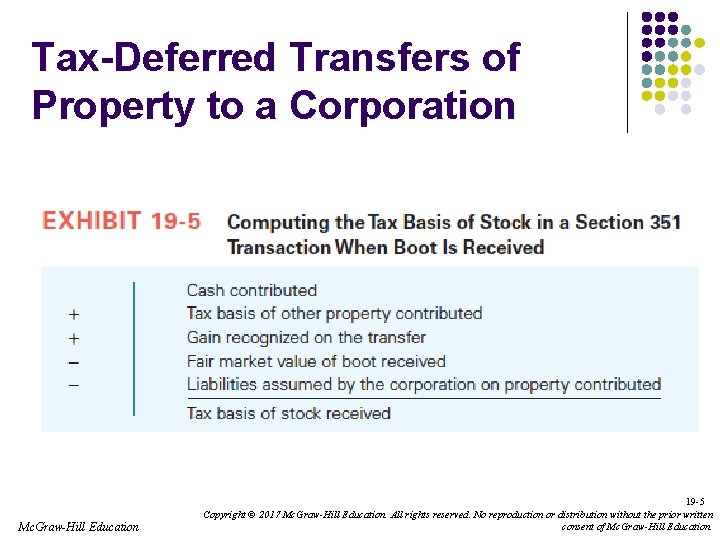
Tax-Deferred Transfers of Property to a Corporation l Receipt of boot triggers gain up to the FMV of the boot l Boot is allocated based on the FMV of the properties transferred l The character of gain recognized depends on the nature of the asset transferred on which gain is recognized Mc. Graw-Hill Education 19 -4 Copyright © 2017 Mc. Graw-Hill Education. All rights reserved. No reproduction or distribution without the prior written consent of Mc. Graw-Hill Education.
Tax-Deferred Transfers of Property to a Corporation Mc. Graw-Hill Education 19 -5 Copyright © 2017 Mc. Graw-Hill Education. All rights reserved. No reproduction or distribution without the prior written consent of Mc. Graw-Hill Education.
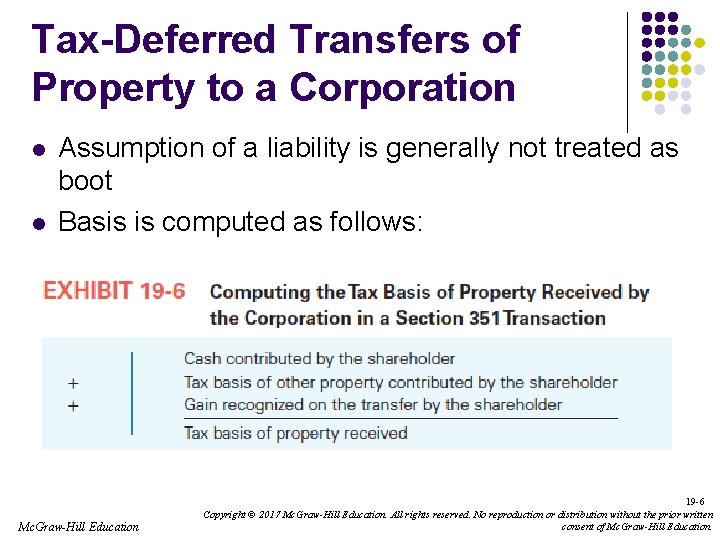
Tax-Deferred Transfers of Property to a Corporation l l Assumption of a liability is generally not treated as boot Basis is computed as follows: Mc. Graw-Hill Education 19 -6 Copyright © 2017 Mc. Graw-Hill Education. All rights reserved. No reproduction or distribution without the prior written consent of Mc. Graw-Hill Education.
Tax-Deferred Transfers of Property to a Corporation l Contributions to Capital l Transfer of property but no stock or other property is received in return l Corporation takes a carryover tax basis in property contributed by a shareholder, l Corporation takes a zero tax basis in property contributed by a nonshareholder, l Shareholder making a capital contribution increases the tax basis in existing stock by the tax basis of the property contributed Mc. Graw-Hill Education 19 -7 Copyright © 2017 Mc. Graw-Hill Education. All rights reserved. No reproduction or distribution without the prior written consent of Mc. Graw-Hill Education.
Tax-Deferred Transfers of Property to a Corporation l Section 1244 Stock l Small corporation (<$1 million capitalization) and l Original shareholder l Corporation must meet an active trade or business requirement for 5 years before the stock meets the § 1244 requirements l Shareholder can recognize up to $50, 000 per year of ordinary loss ($100, 000 if married joint) on sale of the stock (excess is capital loss) Mc. Graw-Hill Education 19 -8 Copyright © 2017 Mc. Graw-Hill Education. All rights reserved. No reproduction or distribution without the prior written consent of Mc. Graw-Hill Education.
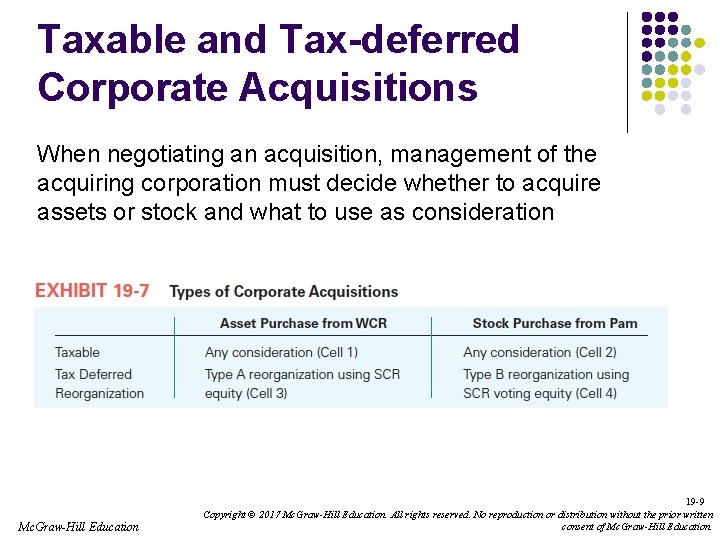
Taxable and Tax-deferred Corporate Acquisitions When negotiating an acquisition, management of the acquiring corporation must decide whether to acquire assets or stock and what to use as consideration Mc. Graw-Hill Education 19 -9 Copyright © 2017 Mc. Graw-Hill Education. All rights reserved. No reproduction or distribution without the prior written consent of Mc. Graw-Hill Education.
Taxable and Tax-Deferred Corporate Acquisitions l Buyer can purchase either stock or assets in a transaction that is either taxable or tax-deferred to the seller l Allows the acquiring corporation to step-up the tax basis of the assets acquired to fair value l Stock acquisitions and tax-deferred asset acquisitions l Tax basis of the target corporation’s assets remain at their carryover basis (generally, cost less any depreciation) Mc. Graw-Hill Education 19 -10 Copyright © 2017 Mc. Graw-Hill Education. All rights reserved. No reproduction or distribution without the prior written consent of Mc. Graw-Hill Education.
Computing the Tax Consequences to the Parties from a Corporate Acquisition l Taxable Acquisitions l Cash purchases of stock are common for public firms l Cash has nontax advantages l A stock acquisition for cash results in the acquired company retaining its tax and legal identity albeit as a subsidiary of the acquiring company l The acquiring company can liquidate acquired company into itself or merge it into an existing subsidiary to remove the subsidiary Mc. Graw-Hill Education 19 -11 Copyright © 2017 Mc. Graw-Hill Education. All rights reserved. No reproduction or distribution without the prior written consent of Mc. Graw-Hill Education.
Computing the Tax Consequences to the Parties from a Corporate Acquisition l Tax-Deferred Acquisitions l l l Taxpayers to organize a corporation in a tax-deferred manner under § 351 Taxpayers to reorganize their corporate structure in a tax deferred manner For tax purposes, reorganizations include: l l Acquisitions and dispositions of corporate assets (including subsidiaries stock) Corporation’s restructuring of its capital structure Mc. Graw-Hill Education 19 -12 Copyright © 2017 Mc. Graw-Hill Education. All rights reserved. No reproduction or distribution without the prior written consent of Mc. Graw-Hill Education.
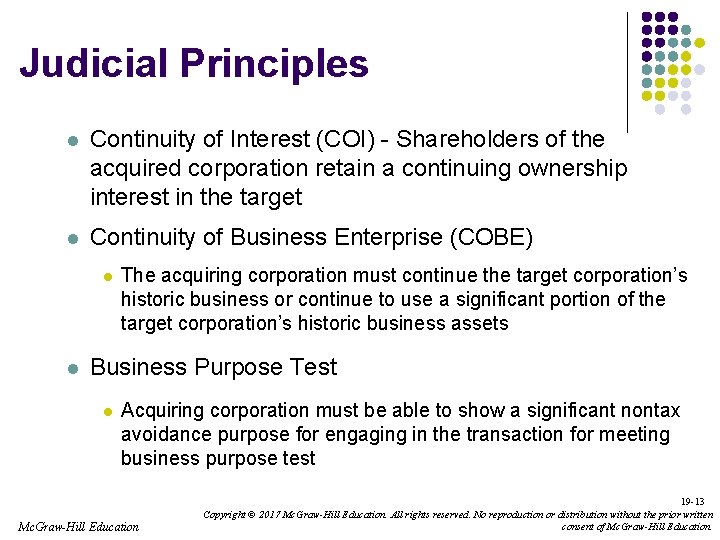
Judicial Principles l Continuity of Interest (COI) - Shareholders of the acquired corporation retain a continuing ownership interest in the target l Continuity of Business Enterprise (COBE) l l The acquiring corporation must continue the target corporation’s historic business or continue to use a significant portion of the target corporation’s historic business assets Business Purpose Test l Acquiring corporation must be able to show a significant nontax avoidance purpose for engaging in the transaction for meeting business purpose test Mc. Graw-Hill Education 19 -13 Copyright © 2017 Mc. Graw-Hill Education. All rights reserved. No reproduction or distribution without the prior written consent of Mc. Graw-Hill Education.
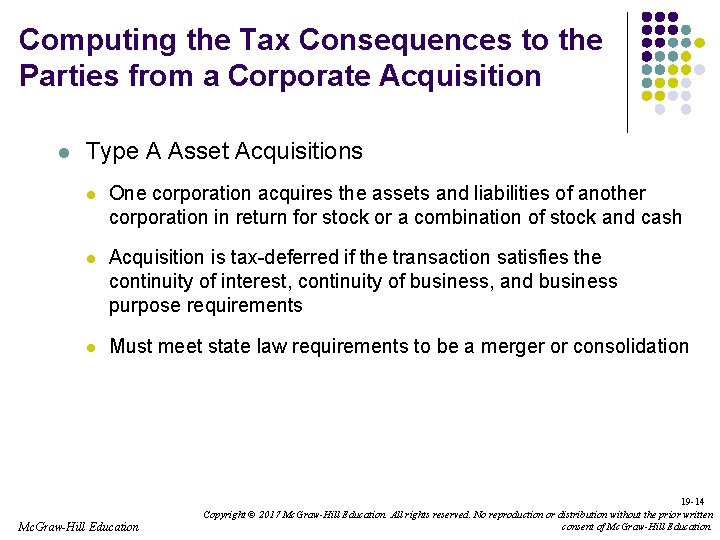
Computing the Tax Consequences to the Parties from a Corporate Acquisition l Type A Asset Acquisitions l One corporation acquires the assets and liabilities of another corporation in return for stock or a combination of stock and cash l Acquisition is tax-deferred if the transaction satisfies the continuity of interest, continuity of business, and business purpose requirements l Must meet state law requirements to be a merger or consolidation Mc. Graw-Hill Education 19 -14 Copyright © 2017 Mc. Graw-Hill Education. All rights reserved. No reproduction or distribution without the prior written consent of Mc. Graw-Hill Education.
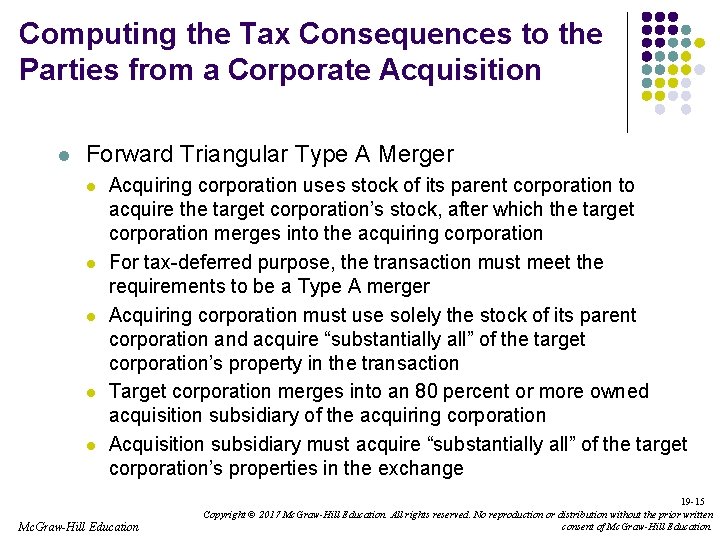
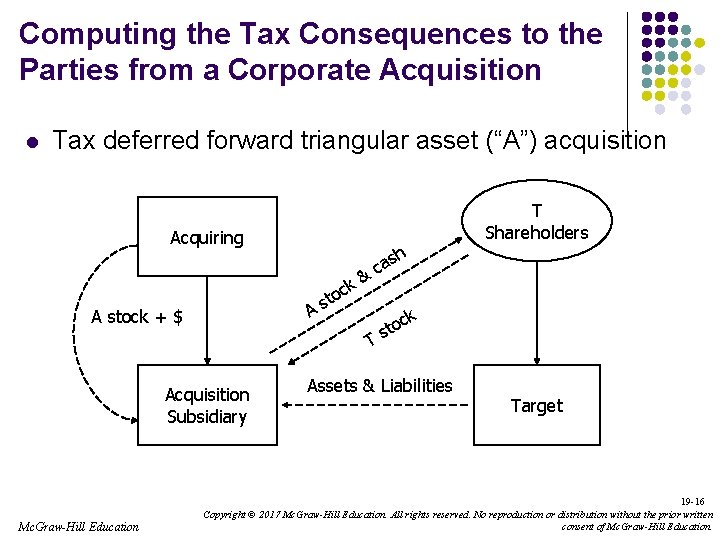
Computing the Tax Consequences to the Parties from a Corporate Acquisition l Forward Triangular Type A Merger l l l Acquiring corporation uses stock of its parent corporation to acquire the target corporation’s stock, after which the target corporation merges into the acquiring corporation For tax-deferred purpose, the transaction must meet the requirements to be a Type A merger Acquiring corporation must use solely the stock of its parent corporation and acquire “substantially all” of the target corporation’s property in the transaction Target corporation merges into an 80 percent or more owned acquisition subsidiary of the acquiring corporation Acquisition subsidiary must acquire “substantially all” of the target corporation’s properties in the exchange Mc. Graw-Hill Education 19 -15 Copyright © 2017 Mc. Graw-Hill Education. All rights reserved. No reproduction or distribution without the prior written consent of Mc. Graw-Hill Education.
Computing the Tax Consequences to the Parties from a Corporate Acquisition l Tax deferred forward triangular asset (“A”) acquisition T Shareholders Acquiring ck o t As A stock + $ Acquisition Subsidiary Mc. Graw-Hill Education & ca sh k toc s T Assets & Liabilities Target 19 -16 Copyright © 2017 Mc. Graw-Hill Education. All rights reserved. No reproduction or distribution without the prior written consent of Mc. Graw-Hill Education.
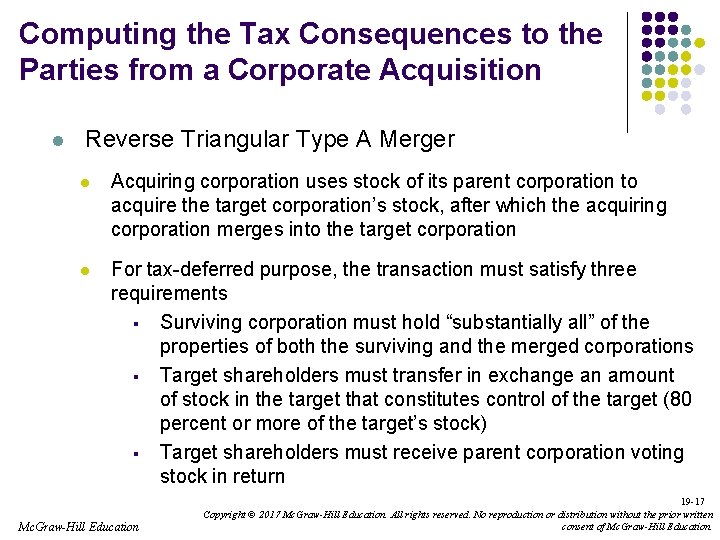
Computing the Tax Consequences to the Parties from a Corporate Acquisition l Reverse Triangular Type A Merger l Acquiring corporation uses stock of its parent corporation to acquire the target corporation’s stock, after which the acquiring corporation merges into the target corporation l For tax-deferred purpose, the transaction must satisfy three requirements § Surviving corporation must hold “substantially all” of the properties of both the surviving and the merged corporations § Target shareholders must transfer in exchange an amount of stock in the target that constitutes control of the target (80 percent or more of the target’s stock) § Target shareholders must receive parent corporation voting stock in return Mc. Graw-Hill Education 19 -17 Copyright © 2017 Mc. Graw-Hill Education. All rights reserved. No reproduction or distribution without the prior written consent of Mc. Graw-Hill Education.
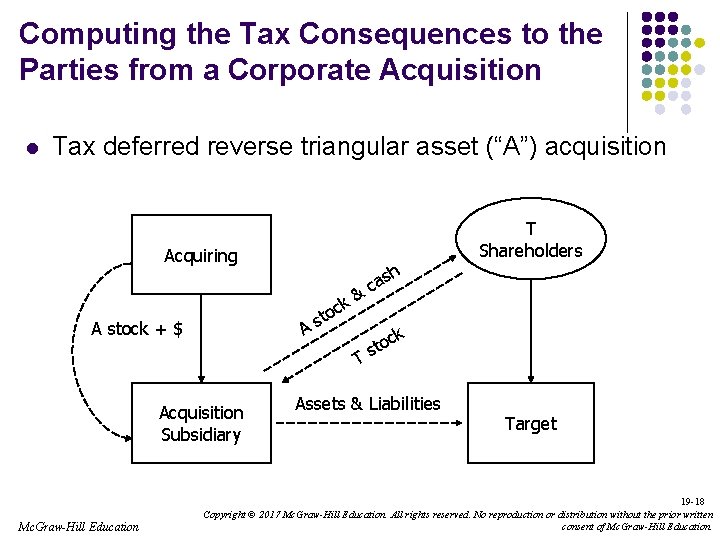
Computing the Tax Consequences to the Parties from a Corporate Acquisition l Tax deferred reverse triangular asset (“A”) acquisition T Shareholders Acquiring ck o t As A stock + $ Acquisition Subsidiary Mc. Graw-Hill Education & sh a c k toc s T Assets & Liabilities Target 19 -18 Copyright © 2017 Mc. Graw-Hill Education. All rights reserved. No reproduction or distribution without the prior written consent of Mc. Graw-Hill Education.
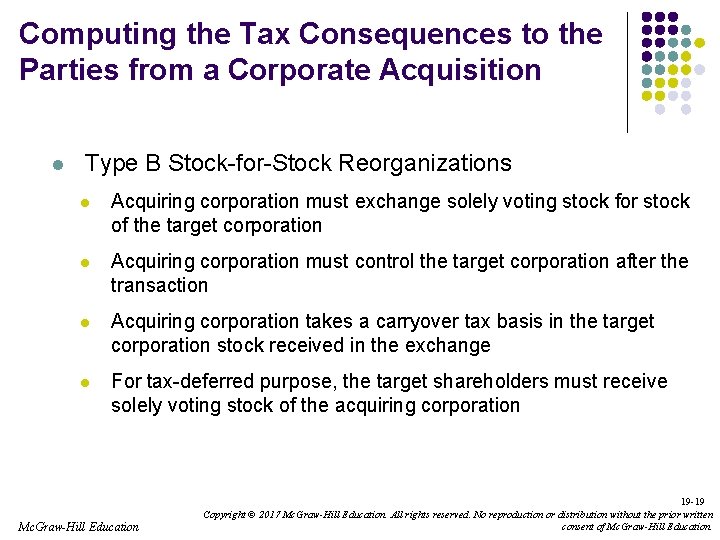
Computing the Tax Consequences to the Parties from a Corporate Acquisition l Type B Stock-for-Stock Reorganizations l Acquiring corporation must exchange solely voting stock for stock of the target corporation l Acquiring corporation must control the target corporation after the transaction l Acquiring corporation takes a carryover tax basis in the target corporation stock received in the exchange l For tax-deferred purpose, the target shareholders must receive solely voting stock of the acquiring corporation Mc. Graw-Hill Education 19 -19 Copyright © 2017 Mc. Graw-Hill Education. All rights reserved. No reproduction or distribution without the prior written consent of Mc. Graw-Hill Education.
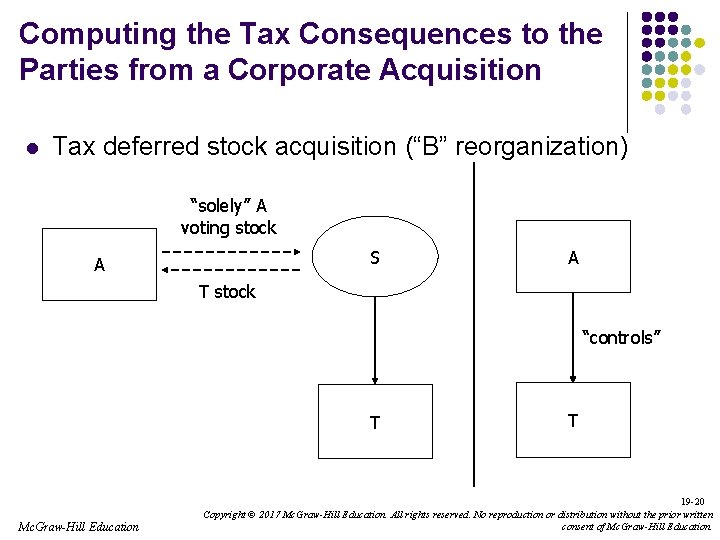
Computing the Tax Consequences to the Parties from a Corporate Acquisition l Tax deferred stock acquisition (“B” reorganization) “solely” A voting stock S A A T stock “controls” T Mc. Graw-Hill Education T 19 -20 Copyright © 2017 Mc. Graw-Hill Education. All rights reserved. No reproduction or distribution without the prior written consent of Mc. Graw-Hill Education.
Computing the Tax Consequences to the Parties from a Corporate Acquisition l Type C l l Acquiring corporation uses its voting stock to acquire “substantially all” of the target corporation’s assets End result of a Type C reorganization resembles a Type A reorganization Major difference between Type C and Type A is that state law governs the form of the Type A merger, while the IRC governs the form of the Type C reorganization Type D l Corporation transfers all or part of its assets to another corporation, and immediately after the transfer the shareholders of the transferor corporation own at least 50 percent of the voting power or value of the transferee corporation and own at least 80 percent of the transferee corporation Mc. Graw-Hill Education 19 -21 Copyright © 2017 Mc. Graw-Hill Education. All rights reserved. No reproduction or distribution without the prior written consent of Mc. Graw-Hill Education.
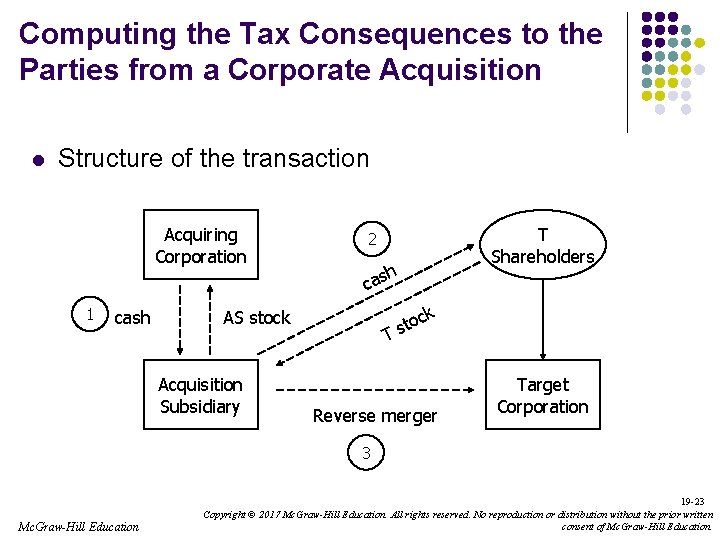
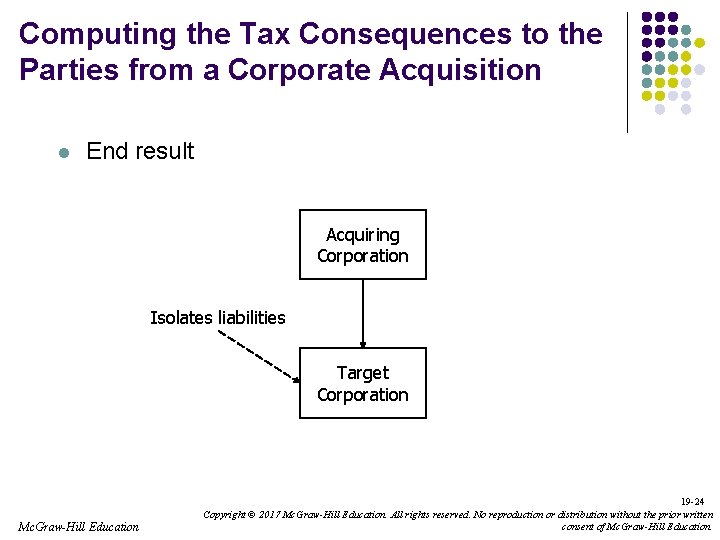
Computing the Tax Consequences to the Parties from a Corporate Acquisition l Cash mergers generally are carried out through an acquisition (merger) subsidiary l An acquisition subsidiary isolates the liabilities of T in a separate corporation apart from the parent company l The transfer of cash to the Target shareholders is taxable to the shareholders Mc. Graw-Hill Education 19 -22 Copyright © 2017 Mc. Graw-Hill Education. All rights reserved. No reproduction or distribution without the prior written consent of Mc. Graw-Hill Education.
Computing the Tax Consequences to the Parties from a Corporate Acquisition l Structure of the transaction Acquiring Corporation 1 cash h cas k AS stock Acquisition Subsidiary T Shareholders 2 T c sto Reverse merger Target Corporation 3 Mc. Graw-Hill Education 19 -23 Copyright © 2017 Mc. Graw-Hill Education. All rights reserved. No reproduction or distribution without the prior written consent of Mc. Graw-Hill Education.
Computing the Tax Consequences to the Parties from a Corporate Acquisition l End result Acquiring Corporation Isolates liabilities Target Corporation Mc. Graw-Hill Education 19 -24 Copyright © 2017 Mc. Graw-Hill Education. All rights reserved. No reproduction or distribution without the prior written consent of Mc. Graw-Hill Education.
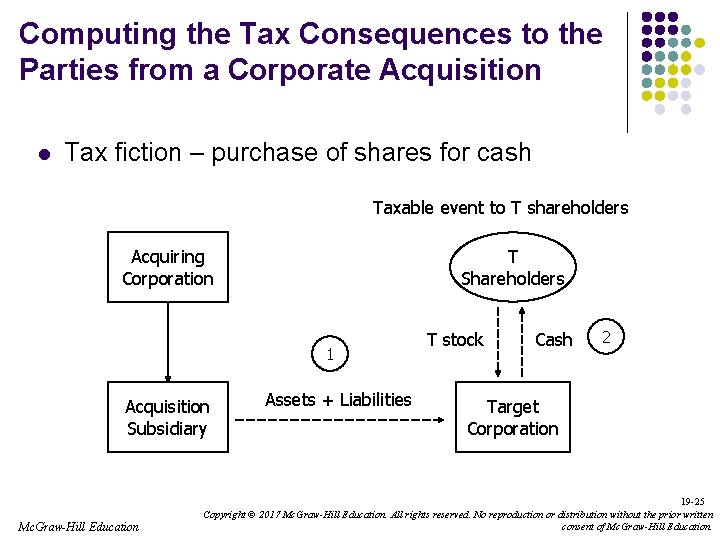
Computing the Tax Consequences to the Parties from a Corporate Acquisition l Tax fiction – purchase of shares for cash Taxable event to T shareholders Acquiring Corporation T Shareholders 1 Acquisition Subsidiary Mc. Graw-Hill Education Assets + Liabilities T stock Cash 2 Target Corporation 19 -25 Copyright © 2017 Mc. Graw-Hill Education. All rights reserved. No reproduction or distribution without the prior written consent of Mc. Graw-Hill Education.
Complete Liquidation of a Corporation l Occurs when a corporation acquires all of its stock from all of its shareholders in exchange for “all” of its net assets, after which time the corporation ceases to do business l For tax purposes, Form 966 needs to be filed by corporation in order to inform IRS of its intention to liquidate its tax existence l Form should be filed within 30 days after the owners resolve to liquidate the corporation Mc. Graw-Hill Education 19 -26 Copyright © 2017 Mc. Graw-Hill Education. All rights reserved. No reproduction or distribution without the prior written consent of Mc. Graw-Hill Education.
Complete Liquidation of a Corporation l Tax Consequences to the Shareholders in a Complete Liquidation l Depends on l l Shareholder’s identity Ownership percentage in the corporation l All noncorporate shareholders receiving liquidating distributions have a fully taxable transaction l Shareholders treat the property received as in “full payment in exchange for the stock” transferred Mc. Graw-Hill Education 19 -27 Copyright © 2017 Mc. Graw-Hill Education. All rights reserved. No reproduction or distribution without the prior written consent of Mc. Graw-Hill Education.
Complete Liquidation of a Corporation l A noncorporate shareholder computes capital gain or loss by subtracting the stock’s tax basis from the money and FMV of property received in return l l l Shareholder’s tax basis in the property received equals the property’s fair market value Debt assumed by the shareholder reduces the (net) FMV of property received FMV of the property cannot be less than the debt assumed by the shareholder (IRC § 336(b)) Mc. Graw-Hill Education 19 -28 Copyright © 2017 Mc. Graw-Hill Education. All rights reserved. No reproduction or distribution without the prior written consent of Mc. Graw-Hill Education.
Complete Liquidation of a Corporation l Corporate shareholders owning 80 percent or more of the stock of the liquidating corporation do not recognize gain or loss on the receipt of liquidating distributions l The tax basis in the property transferred carries over to the recipient which allows a group of corporations under common control to reorganize their organizational structure without tax consequences Mc. Graw-Hill Education 19 -29 Copyright © 2017 Mc. Graw-Hill Education. All rights reserved. No reproduction or distribution without the prior written consent of Mc. Graw-Hill Education.
Complete Liquidation of a Corporation l Taxable Liquidating Distributions l Liquidating corporation recognizes all gains and certain losses on taxable distributions of property to shareholders l Liquidating corporation does not recognize loss if the property is l l l Distributed to a related party Distribution is non-pro rata Asset distributed is disqualified property Mc. Graw-Hill Education 19 -30 Copyright © 2017 Mc. Graw-Hill Education. All rights reserved. No reproduction or distribution without the prior written consent of Mc. Graw-Hill Education.
Complete Liquidation of a Corporation l Disqualified property is property acquired within five years of the date of distribution in a tax deferred § 351 transaction or as a nontaxable contribution to capital l Loss on the complete liquidation of such property is not recognized if the property distributed was acquired in a § 351 transaction or as a contribution to capital, and a principal purpose of the contribution was to recognize a loss by the liquidating corporation Mc. Graw-Hill Education 19 -31 Copyright © 2017 Mc. Graw-Hill Education. All rights reserved. No reproduction or distribution without the prior written consent of Mc. Graw-Hill Education.
Complete Liquidation of a Corporation l This rule prevents a built-in loss existing at the time of the distribution from being recognized by treating the basis of the property distributed as being its FMV at the time it was contributed to the corporation l This provision is designed as an anti-stuffing provision to prevent shareholders from contributing property with built-in losses to a corporation shortly before a liquidation to offset gain property distributed in the liquidation Mc. Graw-Hill Education 19 -32 Copyright © 2017 Mc. Graw-Hill Education. All rights reserved. No reproduction or distribution without the prior written consent of Mc. Graw-Hill Education.
Complete Liquidation of a Corporation Nontaxable Liquidating Distributions l l The liquidating corporation does not recognize gain or loss on tax-free distributions of property to an 80 percent corporate shareholder l Liquidation-related expenses, including the cost of preparing and effectuating a plan of complete liquidation, are deductible by the liquidating corporation on its final Form 1120 l Deferred or capitalized expenditures such as organizational expenditures also are deductible on the final tax return Mc. Graw-Hill Education 19 -33 Copyright © 2017 Mc. Graw-Hill Education. All rights reserved. No reproduction or distribution without the prior written consent of Mc. Graw-Hill Education.