
Chapter 19 Binary Trees Starting Out with C
Chapter 19: Binary Trees Starting Out with C++ Early Objects Eighth Edition by Tony Gaddis, Judy Walters, and Godfrey Muganda Copyright © 2014, 2008 Pearson Education, Inc. Publishing as Pearson Addison-Wesley
Topics 19. 1 Definition and Application of Binary Trees 19. 2 Binary Search Tree Operations 19. 3 Template Considerations for Binary Search Trees Copyright © 2014, 2008 Pearson Education, Inc. Publishing as Pearson Addison-Wesley 19 -2
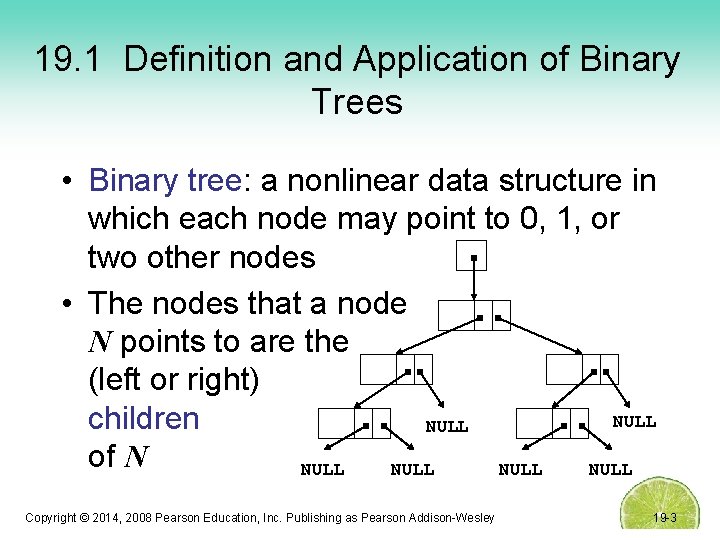
19. 1 Definition and Application of Binary Trees • Binary tree: a nonlinear data structure in which each node may point to 0, 1, or two other nodes • The nodes that a node N points to are the (left or right) NULL children NULL of N NULL Copyright © 2014, 2008 Pearson Education, Inc. Publishing as Pearson Addison-Wesley 19 -3
Terminology • • • If a node N is a child of another node P, then P is called the parent of N A node that has no children is called a leaf node In a binary tree there is a unique node with no parent. This is the root of the tree Copyright © 2014, 2008 Pearson Education, Inc. Publishing as Pearson Addison-Wesley 19 -4
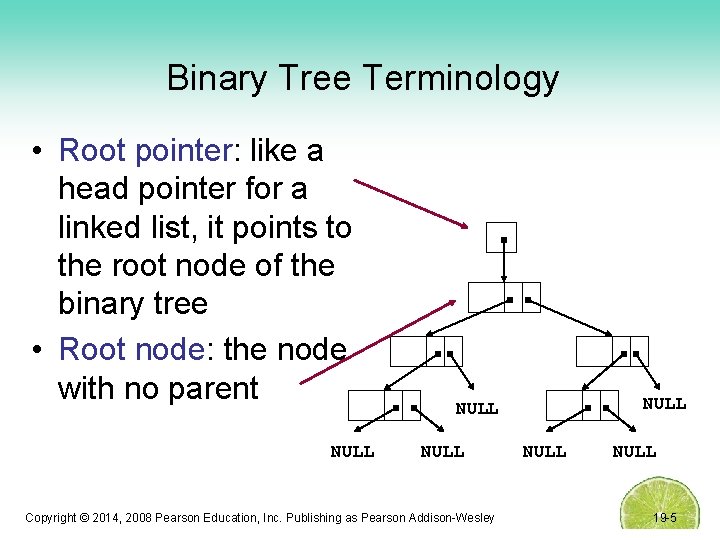
Binary Tree Terminology • Root pointer: like a head pointer for a linked list, it points to the root node of the binary tree • Root node: the node with no parent NULL Copyright © 2014, 2008 Pearson Education, Inc. Publishing as Pearson Addison-Wesley NULL 19 -5
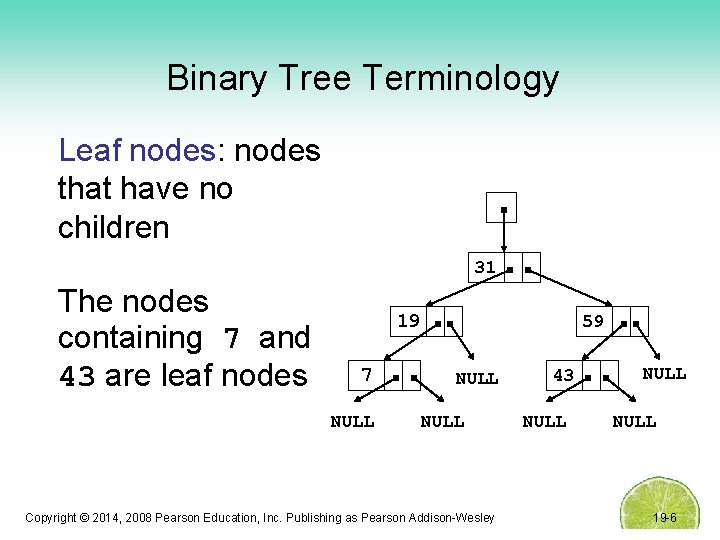
Binary Tree Terminology Leaf nodes: nodes that have no children 31 The nodes containing 7 and 43 are leaf nodes 19 7 NULL 59 NULL Copyright © 2014, 2008 Pearson Education, Inc. Publishing as Pearson Addison-Wesley 43 NULL 19 -6
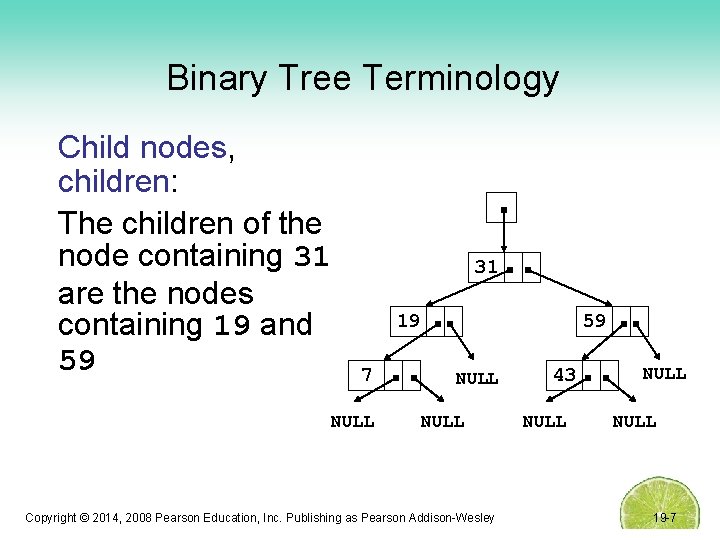
Binary Tree Terminology Child nodes, children: The children of the node containing 31 are the nodes containing 19 and 59 31 19 7 NULL 59 NULL Copyright © 2014, 2008 Pearson Education, Inc. Publishing as Pearson Addison-Wesley 43 NULL 19 -7
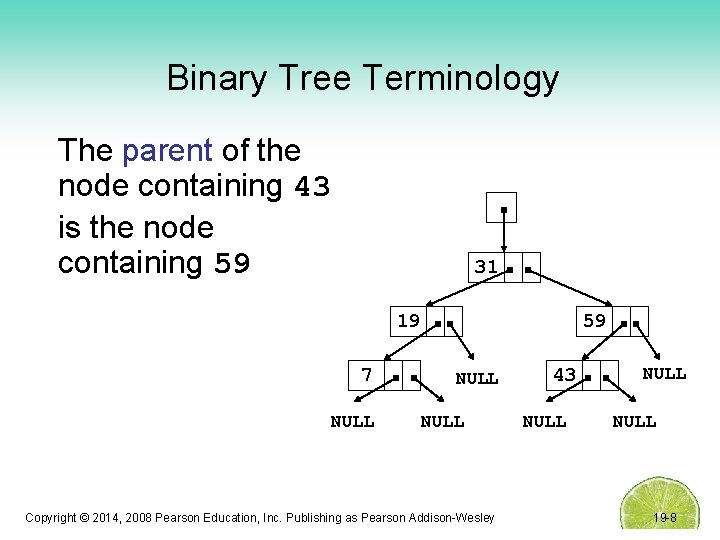
Binary Tree Terminology The parent of the node containing 43 is the node containing 59 31 19 7 NULL 59 NULL Copyright © 2014, 2008 Pearson Education, Inc. Publishing as Pearson Addison-Wesley 43 NULL 19 -8
Binary Tree Terminology • A subtree of a binary tree is a part of the tree from a node N down to the leaf nodes • Such a subtree is said to be rooted at N, and N is called the root of the subtree Copyright © 2014, 2008 Pearson Education, Inc. Publishing as Pearson Addison-Wesley 19 -9
Subtrees of Binary Trees • A subtree of a binary tree is itself a binary tree • A nonempty binary tree consists of a root node, with the rest of its nodes forming two subtrees, called the left and right subtree Copyright © 2014, 2008 Pearson Education, Inc. Publishing as Pearson Addison-Wesley 19 -10
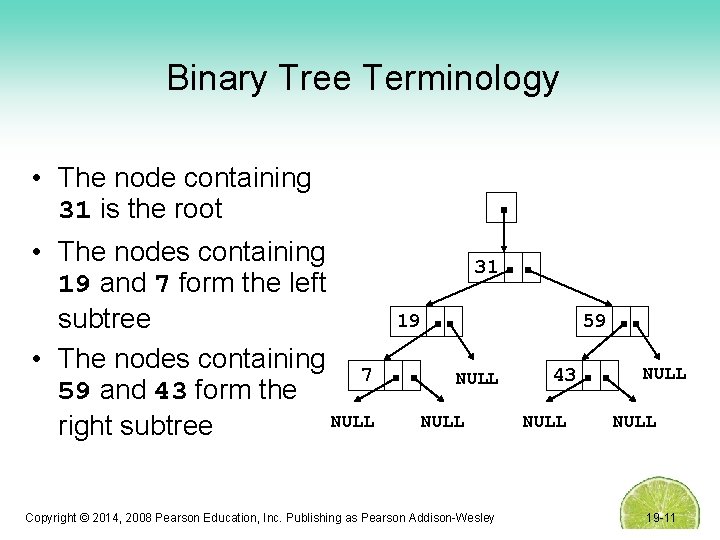
Binary Tree Terminology • The node containing 31 is the root • The nodes containing 19 and 7 form the left subtree • The nodes containing 7 59 and 43 form the NULL right subtree 31 19 59 NULL Copyright © 2014, 2008 Pearson Education, Inc. Publishing as Pearson Addison-Wesley 43 NULL 19 -11
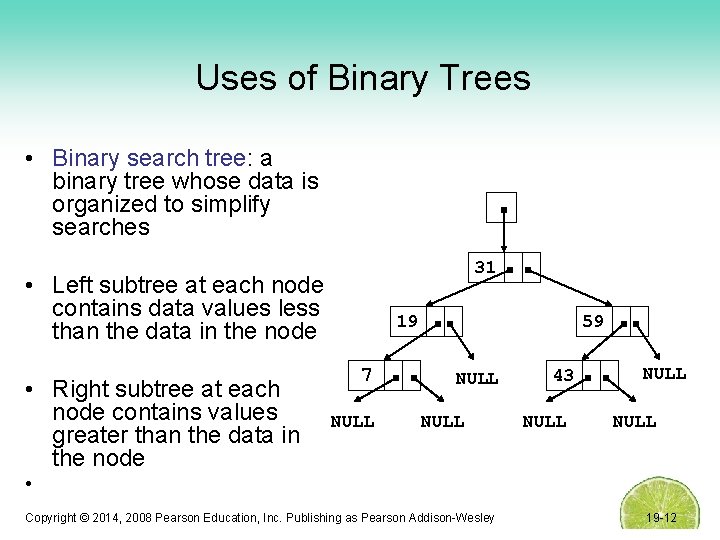
Uses of Binary Trees • Binary search tree: a binary tree whose data is organized to simplify searches 31 • Left subtree at each node contains data values less than the data in the node • Right subtree at each node contains values greater than the data in the node 19 7 NULL 59 NULL 43 NULL • Copyright © 2014, 2008 Pearson Education, Inc. Publishing as Pearson Addison-Wesley 19 -12
19. 2 Binary Search Tree Operations • Create a binary search tree • Insert a node into a binary tree – put node into tree in its correct position to maintain order • Find a node in a binary tree – locate a node with particular data value • Delete a node from a binary tree – remove a node and adjust links to preserve the binary tree and the order Copyright © 2014, 2008 Pearson Education, Inc. Publishing as Pearson Addison-Wesley 19 -13
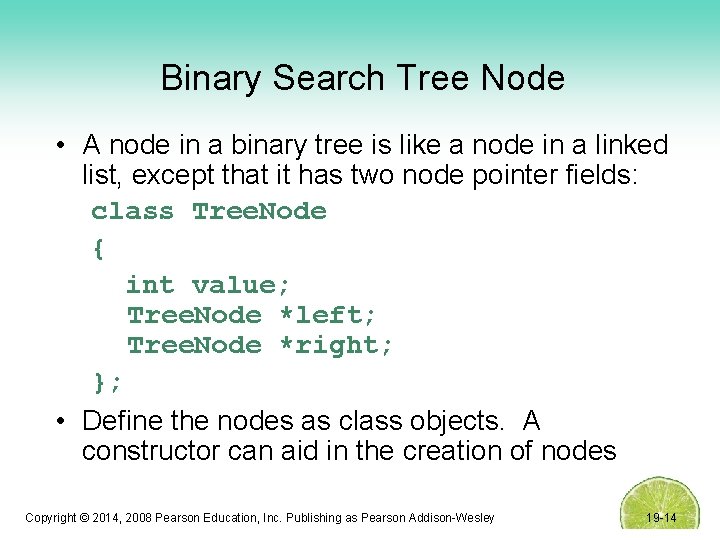
Binary Search Tree Node • A node in a binary tree is like a node in a linked list, except that it has two node pointer fields: class Tree. Node { int value; Tree. Node *left; Tree. Node *right; }; • Define the nodes as class objects. A constructor can aid in the creation of nodes Copyright © 2014, 2008 Pearson Education, Inc. Publishing as Pearson Addison-Wesley 19 -14
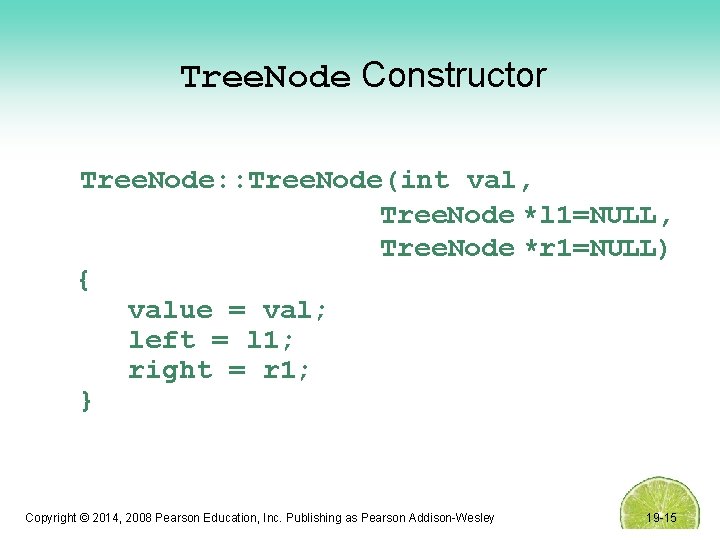
Tree. Node Constructor Tree. Node: : Tree. Node(int val, Tree. Node *l 1=NULL, Tree. Node *r 1=NULL) { value = val; left = l 1; right = r 1; } Copyright © 2014, 2008 Pearson Education, Inc. Publishing as Pearson Addison-Wesley 19 -15
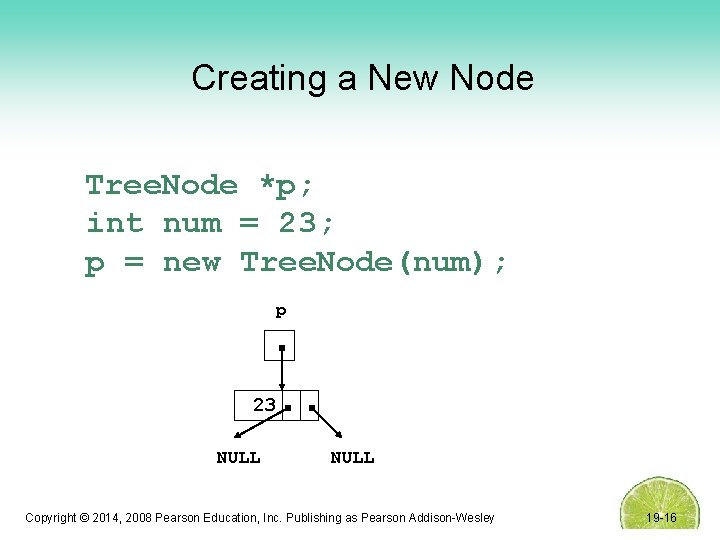
Creating a New Node Tree. Node *p; int num = 23; p = new Tree. Node(num); p 23 NULL Copyright © 2014, 2008 Pearson Education, Inc. Publishing as Pearson Addison-Wesley 19 -16
Inserting an item into a Binary Search Tree 1) If the tree is empty, replace the empty tree with a new binary tree consisting of the new node as root, with empty left and right subtrees 2) Otherwise, if the item is less than the root, recursively insert the item in the left subtree. If the item is greater than the root, recursively insert the item into the right subtree Copyright © 2014, 2008 Pearson Education, Inc. Publishing as Pearson Addison-Wesley 19 -17
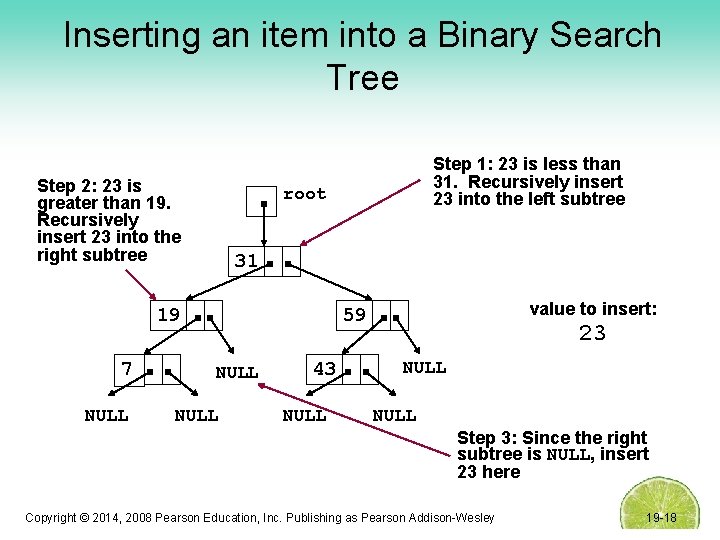
Inserting an item into a Binary Search Tree Step 2: 23 is greater than 19. Recursively insert 23 into the right subtree root 31 19 7 NULL Step 1: 23 is less than 31. Recursively insert 23 into the left subtree value to insert: 59 NULL 43 NULL 23 NULL Step 3: Since the right subtree is NULL, insert 23 here Copyright © 2014, 2008 Pearson Education, Inc. Publishing as Pearson Addison-Wesley 19 -18
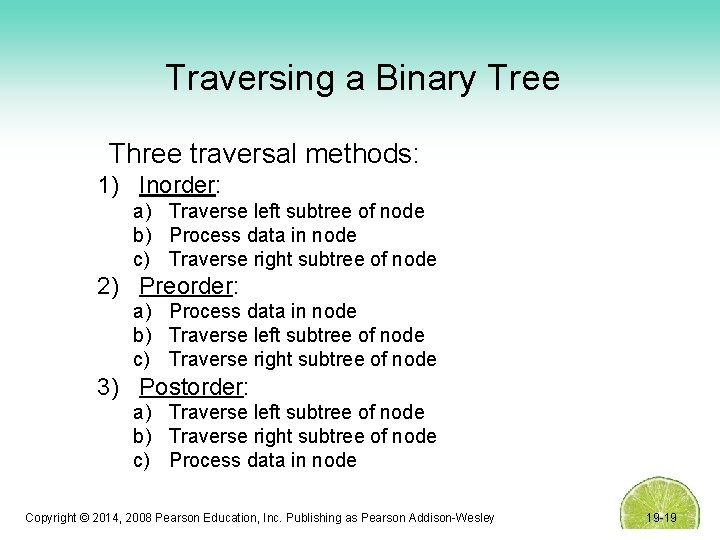
Traversing a Binary Tree Three traversal methods: 1) Inorder: a) Traverse left subtree of node b) Process data in node c) Traverse right subtree of node 2) Preorder: a) Process data in node b) Traverse left subtree of node c) Traverse right subtree of node 3) Postorder: a) Traverse left subtree of node b) Traverse right subtree of node c) Process data in node Copyright © 2014, 2008 Pearson Education, Inc. Publishing as Pearson Addison-Wesley 19 -19
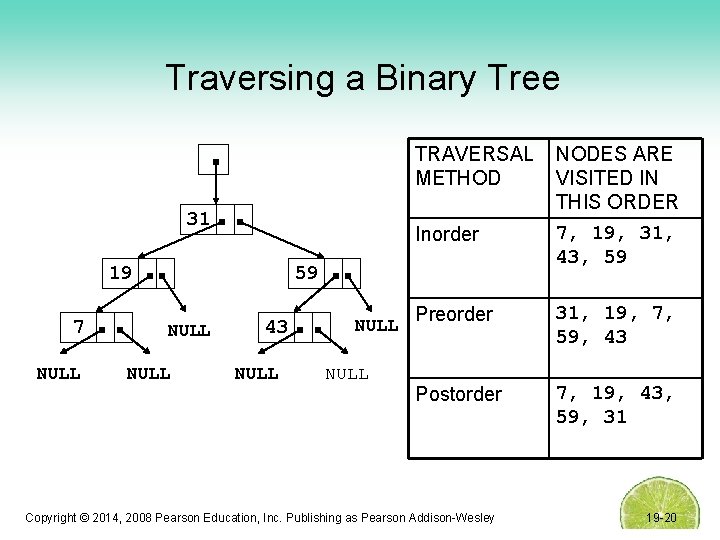
Traversing a Binary Tree 31 19 7 NULL TRAVERSAL METHOD NODES ARE VISITED IN THIS ORDER Inorder 7, 19, 31, 43, 59 Preorder 31, 19, 7, 59, 43 Postorder 7, 19, 43, 59, 31 59 NULL 43 NULL Copyright © 2014, 2008 Pearson Education, Inc. Publishing as Pearson Addison-Wesley 19 -20
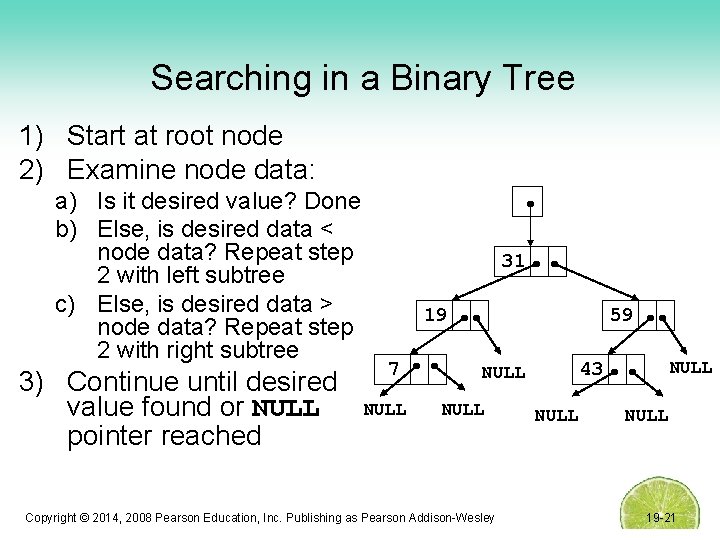
Searching in a Binary Tree 1) Start at root node 2) Examine node data: a) Is it desired value? Done b) Else, is desired data < node data? Repeat step 2 with left subtree c) Else, is desired data > node data? Repeat step 2 with right subtree 3) Continue until desired value found or NULL pointer reached 31 19 7 NULL 59 NULL Copyright © 2014, 2008 Pearson Education, Inc. Publishing as Pearson Addison-Wesley NULL 43 NULL 19 -21
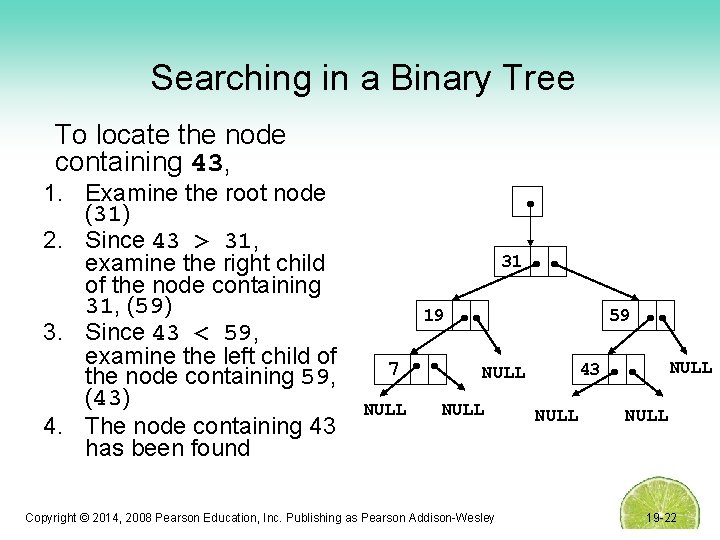
Searching in a Binary Tree To locate the node containing 43, 1. Examine the root node (31) 2. Since 43 > 31, examine the right child of the node containing 31, (59) 3. Since 43 < 59, examine the left child of the node containing 59, (43) 4. The node containing 43 has been found 31 19 7 NULL 59 NULL Copyright © 2014, 2008 Pearson Education, Inc. Publishing as Pearson Addison-Wesley NULL 43 NULL 19 -22
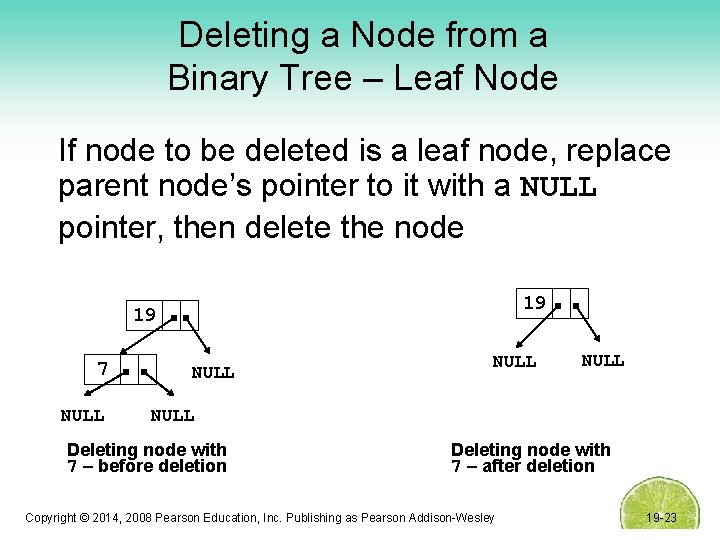
Deleting a Node from a Binary Tree – Leaf Node If node to be deleted is a leaf node, replace parent node’s pointer to it with a NULL pointer, then delete the node 19 19 7 NULL NULL Deleting node with 7 – before deletion Deleting node with 7 – after deletion Copyright © 2014, 2008 Pearson Education, Inc. Publishing as Pearson Addison-Wesley 19 -23
Deleting a Node from a Binary Tree – One Child If node to be deleted has one child node, adjust pointers so that parent of node to be deleted points to child of node to be deleted, then delete the node Copyright © 2014, 2008 Pearson Education, Inc. Publishing as Pearson Addison-Wesley 19 -24
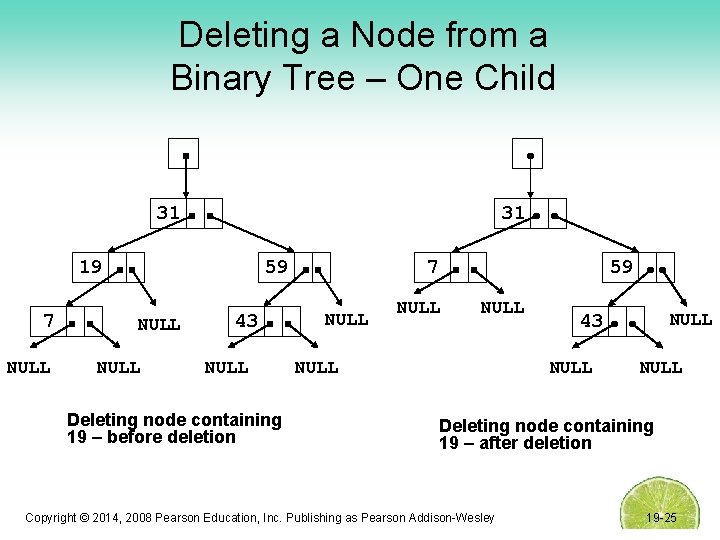
Deleting a Node from a Binary Tree – One Child 31 31 19 7 NULL 59 NULL 43 NULL Deleting node containing 19 – before deletion 7 NULL 59 NULL 43 NULL Deleting node containing 19 – after deletion Copyright © 2014, 2008 Pearson Education, Inc. Publishing as Pearson Addison-Wesley 19 -25
Deleting a Node from a Binary Tree – Two Children • If node to be deleted has left and right children, – ‘Promote’ one child to take the place of the deleted node – Locate correct position for other child in subtree of promoted child • Convention in text: “attach" the right subtree to its parent, then position the left subtree at the appropriate point in the right subtree Copyright © 2014, 2008 Pearson Education, Inc. Publishing as Pearson Addison-Wesley 19 -26
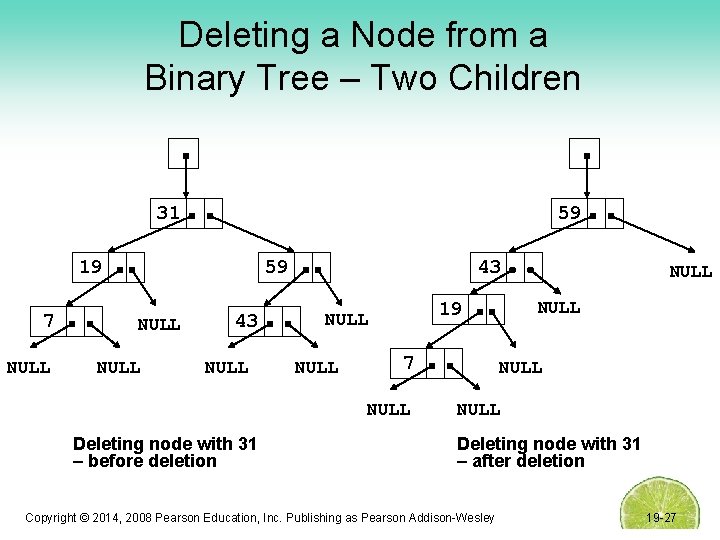
Deleting a Node from a Binary Tree – Two Children 31 59 19 7 NULL 59 NULL 43 NULL 7 NULL Deleting node with 31 – before deletion NULL 19 NULL Deleting node with 31 – after deletion Copyright © 2014, 2008 Pearson Education, Inc. Publishing as Pearson Addison-Wesley 19 -27
19. 3 Template Considerations for Binary Search Trees • Binary tree can be implemented as a template, allowing flexibility in determining type of data stored • Implementation must support relational operators >, <, and == to allow comparison of nodes Copyright © 2014, 2008 Pearson Education, Inc. Publishing as Pearson Addison-Wesley 19 -28
Chapter 19: Binary Trees Starting Out with C++ Early Objects Eighth Edition by Tony Gaddis, Judy Walters, and Godfrey Muganda Copyright © 2014, 2008 Pearson Education, Inc. Publishing as Pearson Addison-Wesley
- Slides: 29