
Chapter 19 Bacteria and Viruses A Topic 1
Chapter 19 – Bacteria and Viruses A Topic 1 Topic 2 Topic 3 Topic 4 Topic 5 $100 $100 $200 $200 $300 $300 $400 $400 $500 $500 FINAL ROUND
Topic 1: $100 Question Based on DNA sequences of key archaebacterial genes, archaebacteria and ______ seem to share a more recent common ancestor than do archaebacteria and _____. a. eukaryotes, eubacteria b. prokaryotes, prokarya c. plants, animals d. fungi, protists ANSWER BACK TO GAME
Topic 1: $100 Answer Based on DNA sequences of key archaebacterial genes, archaebacteria and ______ seem to share a more recent common ancestor than do archaebacteria and _____. a. eukaryotes, eubacteria b. prokaryotes, prokarya c. plants, animals d. fungi, protists BACK TO GAME

Topic 1: $200 Question According to this figure, the structure labeled ___ determines whether a eubacterium is Gram positive or Gram negative. a. A b. C c. D d. E ANSWER BACK TO GAME
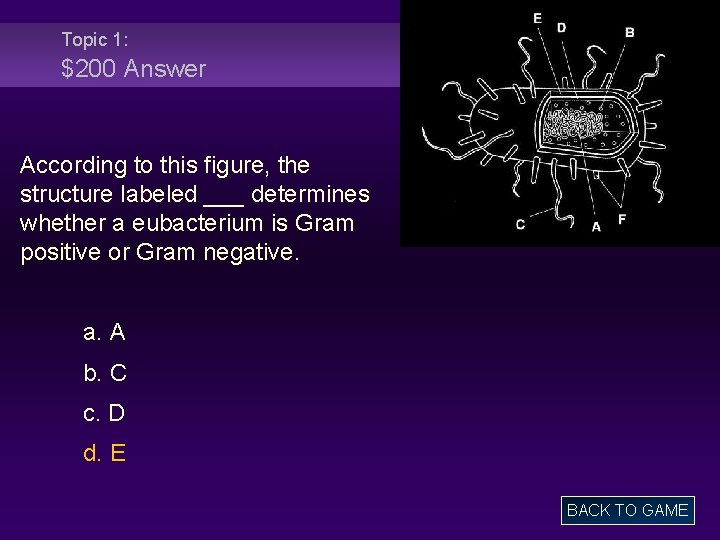
Topic 1: $200 Answer According to this figure, the structure labeled ___ determines whether a eubacterium is Gram positive or Gram negative. a. A b. C c. D d. E BACK TO GAME
Topic 1: $300 Question Some bacteria carry out photosynthesis in a manner similar to that of plants and are called _____. a. chemoautotrophs b. chemoheterotrophs c. photoautotrophs d. photoheterotrophs ANSWER BACK TO GAME
Topic 1: $300 Answer Some bacteria carry out photosynthesis in a manner similar to that of plants and are called _____. a. chemoautotrophs b. chemoheterotrophs c. photoautotrophs d. photoheterotrophs BACK TO GAME
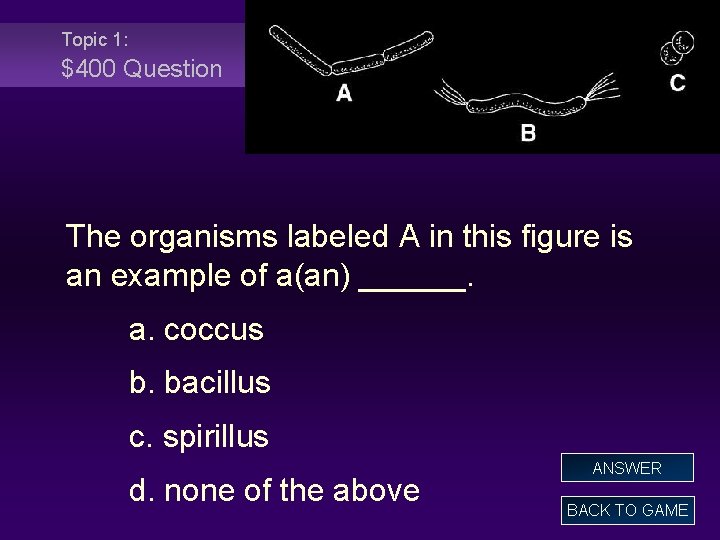
Topic 1: $400 Question The organisms labeled A in this figure is an example of a(an) ______. a. coccus b. bacillus c. spirillus d. none of the above ANSWER BACK TO GAME
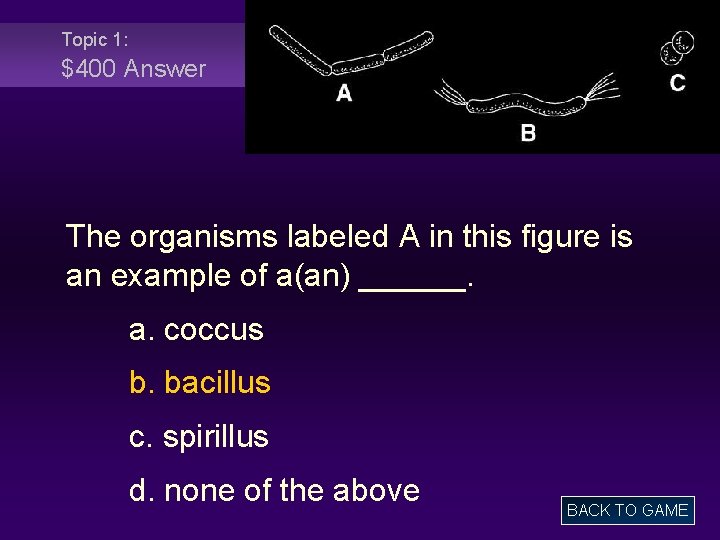
Topic 1: $400 Answer The organisms labeled A in this figure is an example of a(an) ______. a. coccus b. bacillus c. spirillus d. none of the above BACK TO GAME
Topic 1: $500 Question The process of converting nitrogen to a form plants can use is called ____. a. nitrogen fixation b. oil filtration c. phosphorylation d. nitrogen filtration ANSWER BACK TO GAME
Topic 1: $500 Answer The process of converting nitrogen to a form plants can use is called ____. a. nitrogen fixation b. oil filtration c. phosphorylation d. nitrogen filtration BACK TO GAME
Topic 2: $100 Question By breaking down the nutrients from dead organisms in an ecosystem, bacteria act as _____. a. carnivores b. primary producers c. decomposers d. herbivores ANSWER BACK TO GAME
Topic 2: $100 Answer By breaking down the nutrients from dead organisms in an ecosystem, bacteria act as _____. a. carnivores b. primary producers c. decomposers d. herbivores BACK TO GAME
Topic 2: $200 Question Although viruses come in many different shapes, the core of every virus contains _____. a. Proteins and DNA b. DNA and prions c. RNA and prions d. RNA and DNA ANSWER BACK TO GAME
Topic 2: $200 Answer Although viruses come in many different shapes, the core of every virus contains _____. a. Proteins and DNA b. DNA and prions c. RNA and prions d. RNA and DNA BACK TO GAME
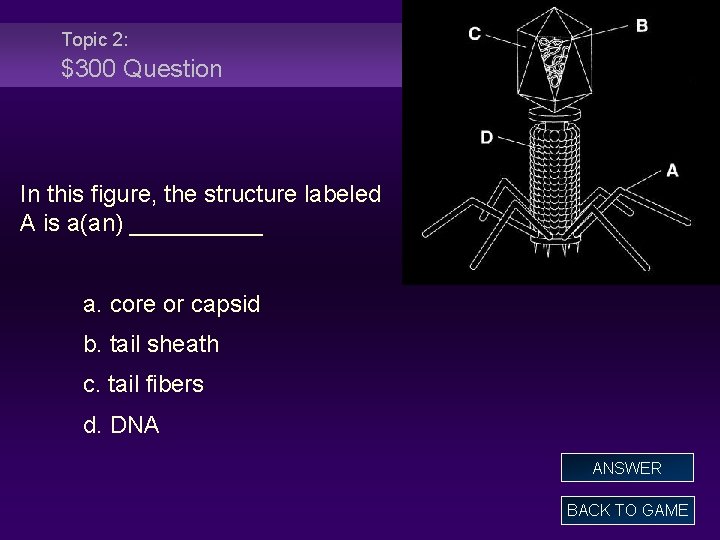
Topic 2: $300 Question In this figure, the structure labeled A is a(an) _____ a. core or capsid b. tail sheath c. tail fibers d. DNA ANSWER BACK TO GAME
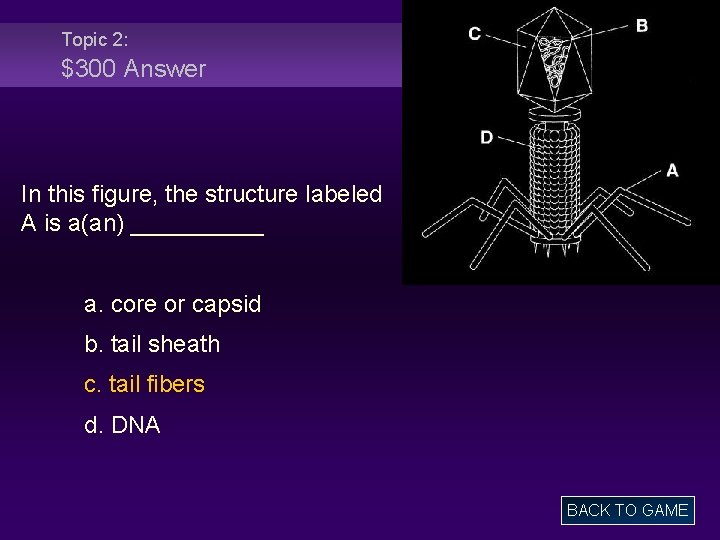
Topic 2: $300 Answer In this figure, the structure labeled A is a(an) _____ a. core or capsid b. tail sheath c. tail fibers d. DNA BACK TO GAME
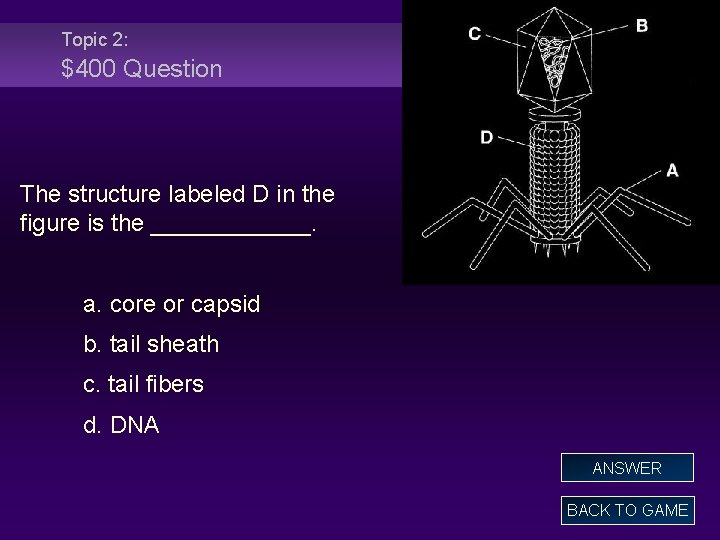
Topic 2: $400 Question The structure labeled D in the figure is the ______. a. core or capsid b. tail sheath c. tail fibers d. DNA ANSWER BACK TO GAME
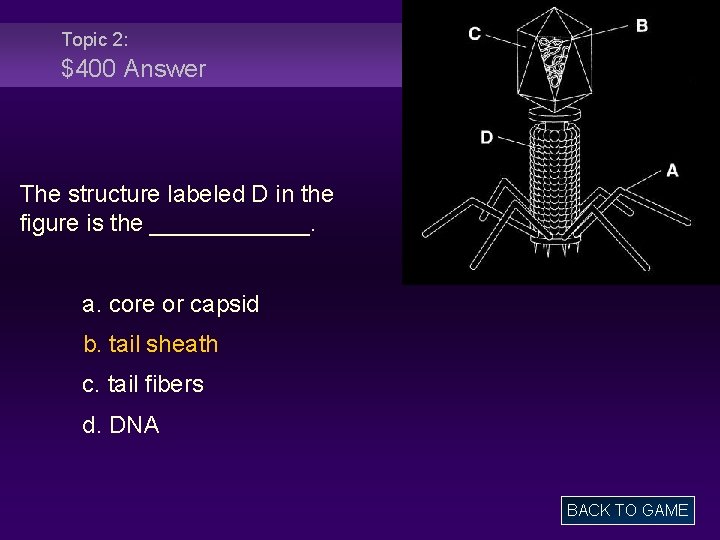
Topic 2: $400 Answer The structure labeled D in the figure is the ______. a. core or capsid b. tail sheath c. tail fibers d. DNA BACK TO GAME
Topic 2: $500 Question Certain viruses called ____ viruses cause cancer in animals. a. priugenic b. yugogenic c. yukogenic d. oncogenic ANSWER BACK TO GAME
Topic 2: $500 Answer Certain viruses called ____ viruses cause cancer in animals. a. priugenic b. yugogenic c. yukogenic d. oncogenic BACK TO GAME
Topic 3: $100 Question Scrapie, an infectious disease in sheep, is caused by a(an) _______. a. viron b. noid c. prion d. pox virus ANSWER BACK TO GAME
Topic 3: $100 Answer Scrapie, an infectious disease in sheep, is caused by a(an) _______. a. viron b. noid c. prion d. pox virus BACK TO GAME
Topic 3: $200 Question The germ theory of disease was first proposed by ______. a. Rudolph Virchow b. Francis Bacon c. Eric Lander d. Louis Pasteur ANSWER BACK TO GAME
Topic 3: $200 Answer The germ theory of disease was first proposed by ______. a. Rudolph Virchow b. Francis Bacon c. Eric Lander d. Louis Pasteur BACK TO GAME
Topic 3: $300 Question In lysogenic infection, the viral DNA that is embedded in a host cell’s DNA is called a(an) _______. a. protégé’ b. proglottid c. prophage d. promoxyribonucleic acid ANSWER BACK TO GAME
Topic 3: $300 Answer In lysogenic infection, the viral DNA that is embedded in a host cell’s DNA is called a(an) _______. a. protégé’ b. proglottid c. prophage d. promoxyribonucleic acid BACK TO GAME
Topic 3: $400 Question Destroying bacteria by subjecting them to great heat or to chemical action is called _____. a. gleanification b. sterilization c. incubation d. lysolation ANSWER BACK TO GAME
Topic 3: $400 Answer Destroying bacteria by subjecting them to great heat or to chemical action is called _____. a. gleanification b. sterilization c. incubation d. lysolation BACK TO GAME
Topic 3: $500 Question A chemical solution that is used in hospitals, schools, etc. , to kill bacteria is called a(an) ______. a. lubricant b. supplement c. disinfectant d. histamine ANSWER BACK TO GAME
Topic 3: $500 Answer A chemical solution that is used in hospitals, schools, etc. , to kill bacteria is called a(an) ______. a. lubricant b. supplement c. disinfectant d. histamine BACK TO GAME
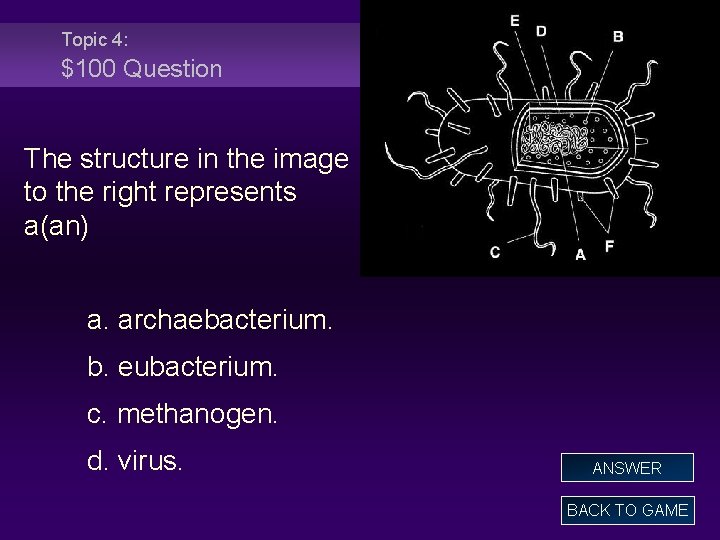
Topic 4: $100 Question The structure in the image to the right represents a(an) a. archaebacterium. b. eubacterium. c. methanogen. d. virus. ANSWER BACK TO GAME
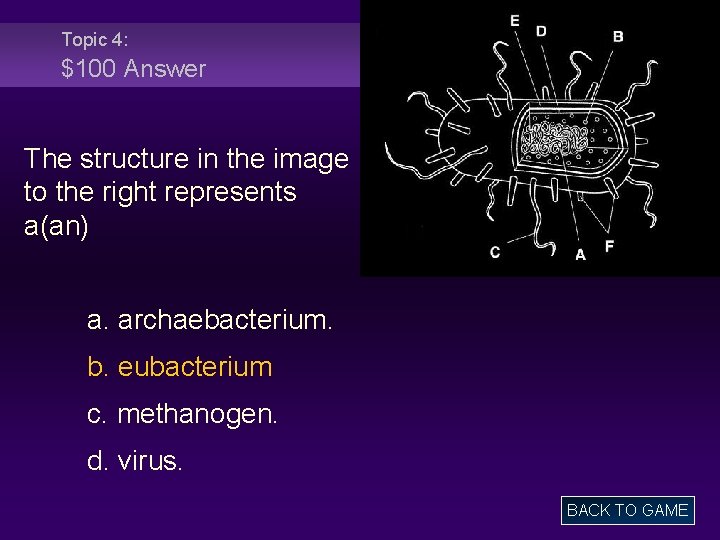
Topic 4: $100 Answer The structure in the image to the right represents a(an) a. archaebacterium. b. eubacterium c. methanogen. d. virus. BACK TO GAME
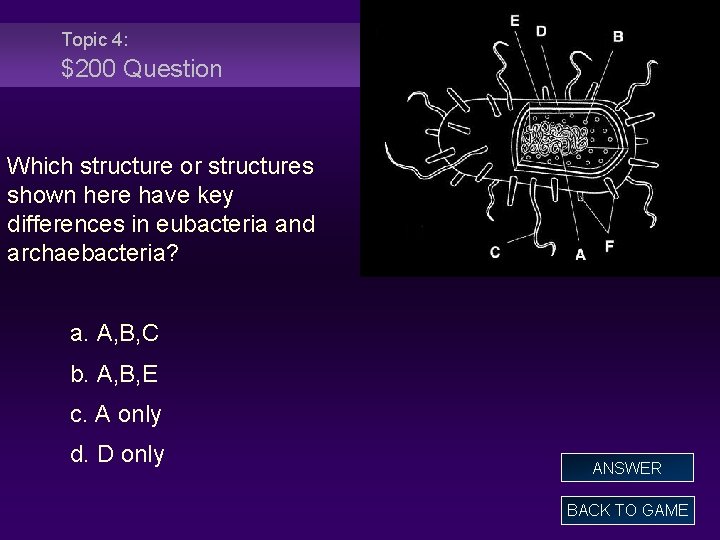
Topic 4: $200 Question Which structure or structures shown here have key differences in eubacteria and archaebacteria? a. A, B, C b. A, B, E c. A only d. D only ANSWER BACK TO GAME
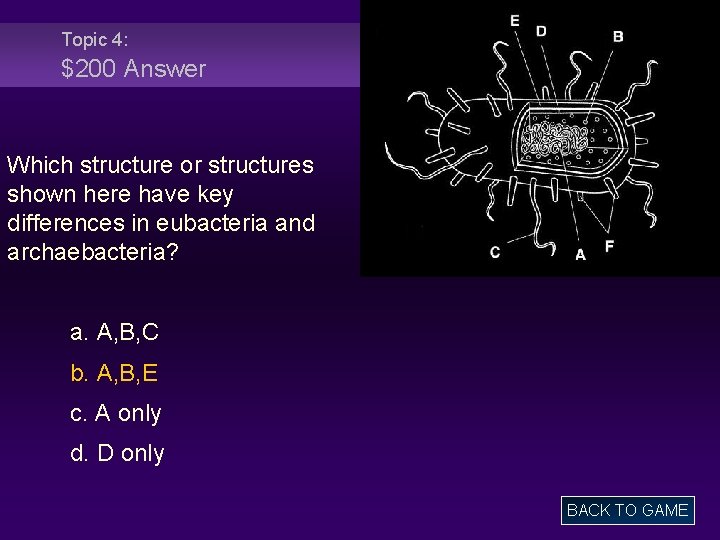
Topic 4: $200 Answer Which structure or structures shown here have key differences in eubacteria and archaebacteria? a. A, B, C b. A, B, E c. A only d. D only BACK TO GAME
Topic 4: $300 Question Which of the following is(are) used to identify prokaryotes? a. cell shape b. the way prokaryotes obtain energy c. the way prokaryotes move d. all of the above ANSWER BACK TO GAME
Topic 4: $300 Answer Which of the following is(are) used to identify prokaryotes? a. cell shape b. the way prokaryotes obtain energy c. the way prokaryotes move d. all of the above BACK TO GAME
Topic 4: $400 Question Which of the following are members of the kingdom Archaebacteria? a. eubacteria b. eukaryotes c. methanogens d. E. coli ANSWER BACK TO GAME
Topic 4: $400 Answer Which of the following are members of the kingdom Archaebacteria? a. eubacteria b. eukaryotes c. methanogens d. E. coli BACK TO GAME
Topic 4: $500 Question Some bacteria are able to survive unfavorable conditions by forming a. endospores b. coccus c. capsids d. tail fibers ANSWER BACK TO GAME
Topic 4: $500 Answer Some bacteria are able to survive unfavorable conditions by forming a. endospores b. coccus c. capsids d. tail fibers BACK TO GAME
Topic 5: $100 Question Which of the following can survive either with oxygen or without it? a. obligate aerobes b. bacteriophages c. facultative anaerobes d. obligate anaerobes ANSWER BACK TO GAME
Topic 5: $100 Answer Which of the following can survive either with oxygen or without it? a. obligate aerobes b. bacteriophages c. facultative anaerobes d. obligate anaerobes BACK TO GAME
Topic 5: $200 Question Which of the following is NOT a way in which archaebacteria and eubacteria differ? a. Archaebacteria lack an important carbohydrate found in the cell walls of eubacteria. b. Archaebacteria follow the lytic cycle, while eubacteria follow the lysogenic cycle. c. Archaebacteria have gene sequences that are similar to those of eukaryotes. d. The two groups have very different membrane lipids. ANSWER BACK TO GAME
Topic 5: $200 Answer Which of the following is NOT a way in which archaebacteria and eubacteria differ? a. Archaebacteria lack an important carbohydrate found in the cell walls of eubacteria. b. Archaebacteria follow the lytic cycle, while eubacteria follow the lysogenic cycle. c. Archaebacteria have gene sequences that are similar to those of eukaryotes. d. The two groups have very different membrane lipids. BACK TO GAME
Topic 5: $300 Question Viruses a. are all about the same size. b. can be seen with a basic compound light microscope. c. rarely contain RNA or DNA. d. vary greatly in size and structure. ANSWER BACK TO GAME
Topic 5: $300 Answer Viruses a. are all about the same size. b. can be seen with a basic compound light microscope. c. rarely contain RNA or DNA. d. vary greatly in size and structure. BACK TO GAME
Topic 5: $400 Question Where are you likely to find a photoautotroph? a. in your refrigerator b. in the darkness of the ocean c. in your digestive system d. near the surfaces of lakes, streams, and oceans ANSWER BACK TO GAME
Topic 5: $400 Answer Where are you likely to find a photoautotroph? a. in your refrigerator b. in the darkness of the ocean c. in your digestive system d. near the surfaces of lakes, streams, and oceans. BACK TO GAME
Topic 5: $500 Question Bacteria living in extreme environments may be a good source of a. gram stains. b. nitrogen-fixing bacteria. c. antibiotics. d. heat-stable enzymes ANSWER BACK TO GAME
Topic 5: $500 Answer Bacteria living in extreme environments may be a good source of a. gram stains. b. nitrogen-fixing bacteria. c. antibiotics. d. heat-stable enzymes BACK TO GAME
FINAL ROUND Question: a. Choice 1 b. Choice 2 c. Choice 3 d. Choice 4 ANSWER BACK TO GAME
FINAL ROUND Answer Question: a. Choice 1 b. Choice 2 c. Choice 3 (correct answer) d. Choice 4 BACK TO GAME
- Slides: 53