
Chapter 19 b The Kidneys Reabsorption Principles governing
Chapter 19 b The Kidneys
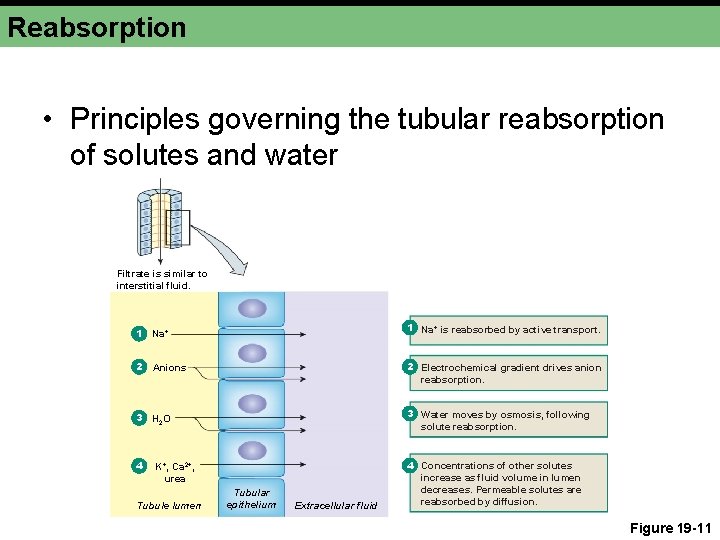
Reabsorption • Principles governing the tubular reabsorption of solutes and water Filtrate is similar to interstitial fluid. 1 Na+ is reabsorbed by active transport. 1 Na+ 2 2 Electrochemical gradient drives anion reabsorption. Anions 3 H 2 O 3 Water moves by osmosis, following solute reabsorption. 4 4 Concentrations of other solutes increase as fluid volume in lumen decreases. Permeable solutes are reabsorbed by diffusion. K+, Ca 2+, urea Tubule lumen Tubular epithelium Extracellular fluid Figure 19 -11
Reabsorption • Transepithelial transport • Substances cross both apical (lumen side) and basolateral membrane • Paracellular pathway • Substances pass through the junction between two adjacent cells
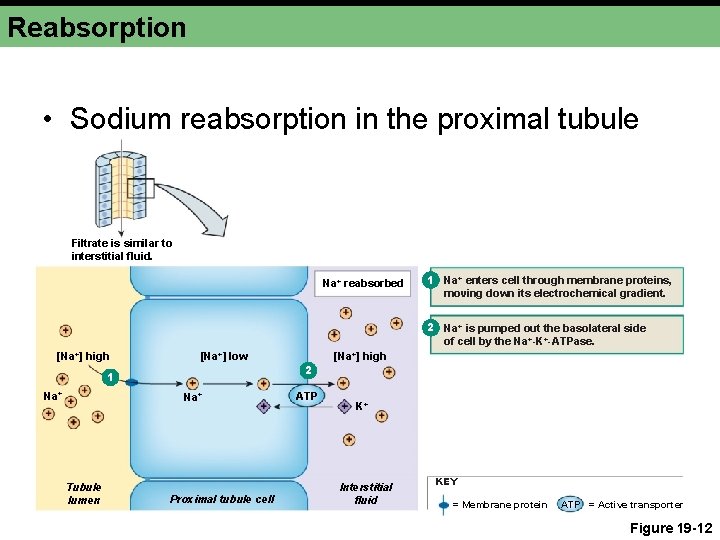
Reabsorption • Sodium reabsorption in the proximal tubule Filtrate is similar to interstitial fluid. Na+ reabsorbed 1 Na+ enters cell through membrane proteins, moving down its electrochemical gradient. 2 Na+ is pumped out the basolateral side of cell by the Na+-K+-ATPase. [Na+] high [Na+] low 1 Na+ Tubule lumen Proximal tubule cell 2 ATP [Na+] high K+ Interstitial fluid KEY = Membrane protein ATP = Active transporter Figure 19 -12
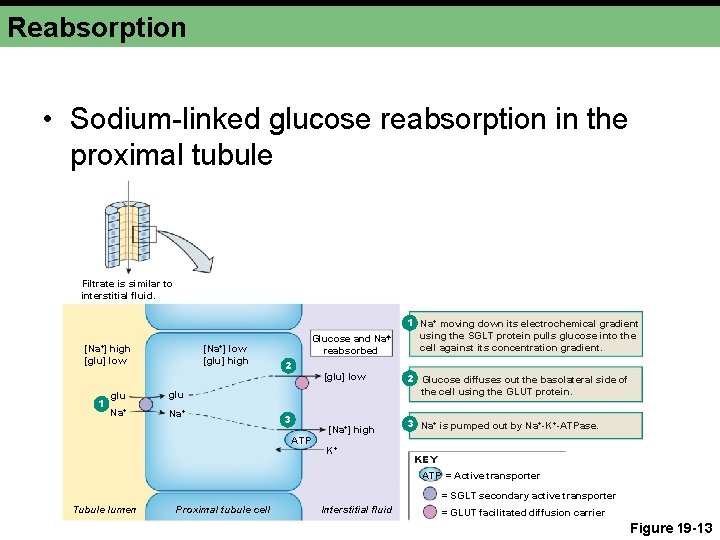
Reabsorption • Sodium-linked glucose reabsorption in the proximal tubule Filtrate is similar to interstitial fluid. low [glu] high [glu] low 1 Glucose and Na++ reabsorbed [Na+] glu Na+ 2 3 ATP [glu] low [Na+] high K+ 1 Na+ moving down its electrochemical gradient using the SGLT protein pulls glucose into the cell against its concentration gradient. 2 Glucose diffuses out the basolateral side of the cell using the GLUT protein. 3 Na+ is pumped out by Na+-K+-ATPase. KEY ATP = Active transporter = SGLT secondary active transporter Tubule lumen Proximal tubule cell Interstitial fluid = GLUT facilitated diffusion carrier Figure 19 -13
Reabsorption • Urea • Passive reabsorption • Plasma proteins • Transcytosis

Reabsorption Transport rate of substrate (mg/min) • Saturation of mediated transport Transport maximum (Tm) is transport rate at saturation. Saturation occurs. Renal threshold is plasma concentration at which saturation occurs. Plasma [substrate] (mg/m. L) Figure 19 -14
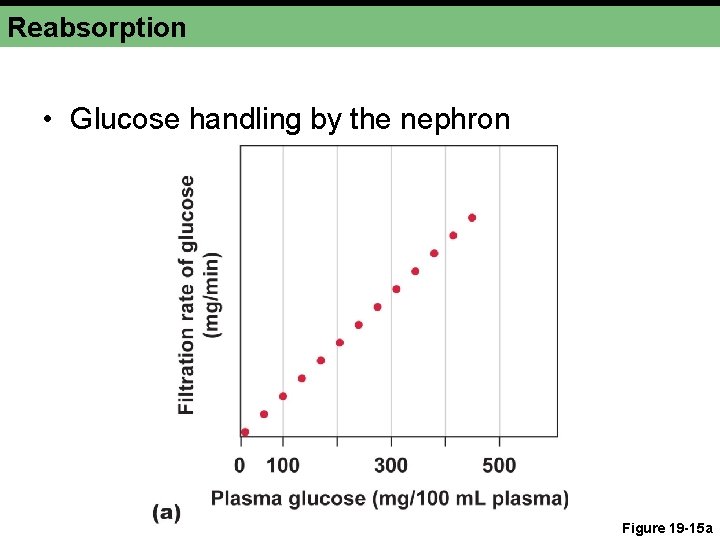
Reabsorption • Glucose handling by the nephron Figure 19 -15 a
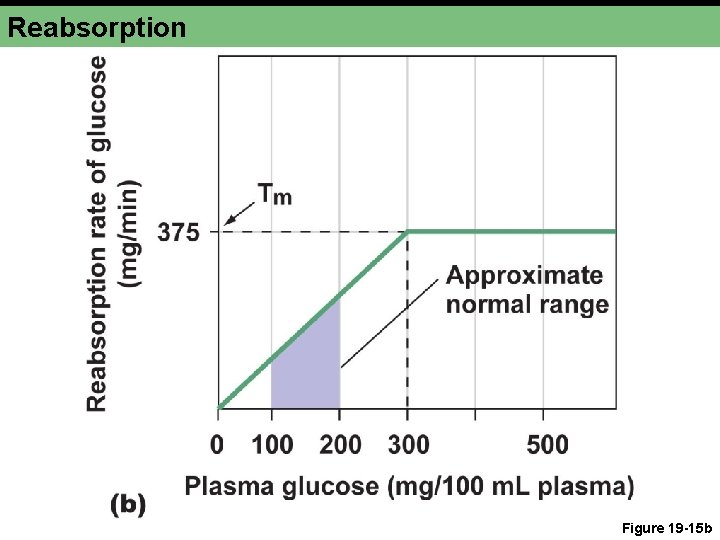
Reabsorption Figure 19 -15 b
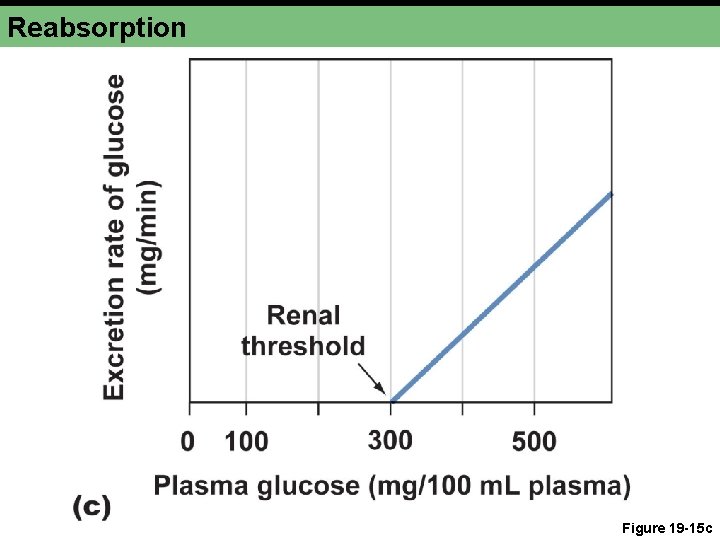
Reabsorption Figure 19 -15 c
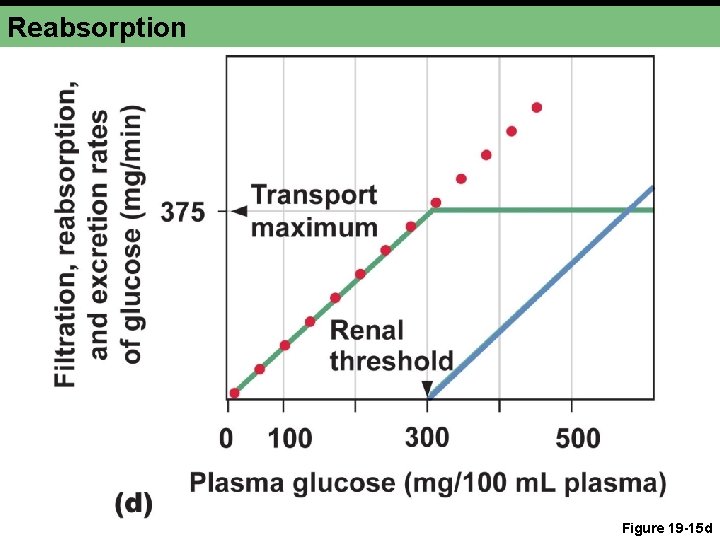
Reabsorption Figure 19 -15 d
Secretion • Transfer of molecules from extracellular fluid into lumen of the nephron • Active process • Important in homeostatic regulation • K+ and H+ • Increasing secretion enhances nephron excretion • A competitive process • Penicillin and probenecid
Excretion • Excretion = filtration – reabsorption + secretion • Clearance • Rate at which a solute disappears from the body by excretion or by metabolism • Non-invasive way to measure GFR • Inulin and creatinine used to measure GFR
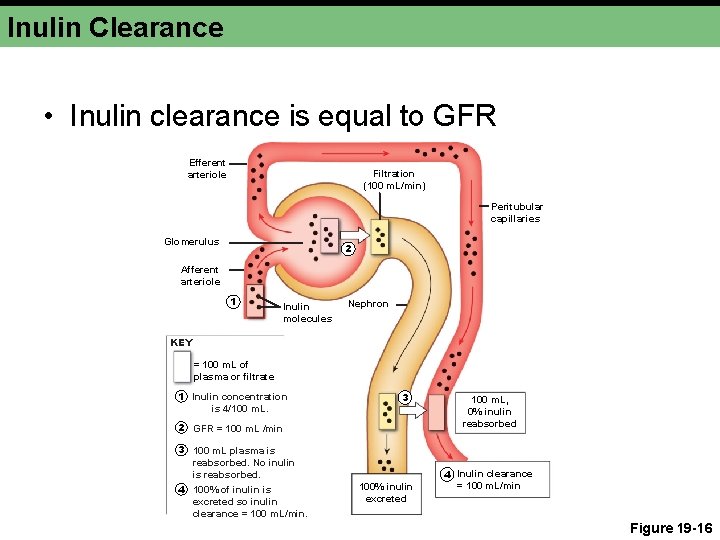
Inulin Clearance • Inulin clearance is equal to GFR Efferent arteriole Filtration (100 m. L/min) Peritubular capillaries Glomerulus 2 Afferent arteriole 1 Inulin molecules Nephron KEY = 100 m. L of plasma or filtrate 1 Inulin concentration is 4/100 m. L. 3 2 GFR = 100 m. L /min 3 100 m. L plasma is reabsorbed. No inulin is reabsorbed. 4 100% of inulin is excreted so inulin clearance = 100 m. L/min. 100% inulin excreted 100 m. L, 0% inulin reabsorbed 4 Inulin clearance = 100 m. L/min Figure 19 -16
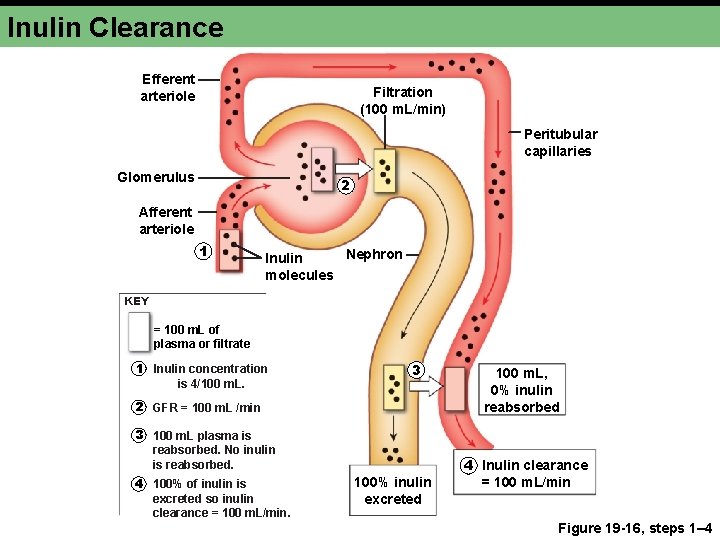
Inulin Clearance Efferent arteriole Filtration (100 m. L/min) Peritubular capillaries Glomerulus 2 Afferent arteriole 1 Nephron Inulin molecules KEY = 100 m. L of plasma or filtrate 1 Inulin concentration is 4/100 m. L. 3 2 GFR = 100 m. L /min 3 100 m. L plasma is reabsorbed. No inulin is reabsorbed. 4 100% of inulin is excreted so inulin clearance = 100 m. L/min. 100% inulin excreted 100 m. L, 0% inulin reabsorbed 4 Inulin clearance = 100 m. L/min Figure 19 -16, steps 1– 4
![GFR • Filtered load of X = [X]plasma GFR • Filtered load of inulin](http://slidetodoc.com/presentation_image_h2/5118d3a7d321e8fea07b895246c6d301/image-16.jpg "GFR • Filtered load of X = [X]plasma GFR • Filtered load of inulin")
GFR • Filtered load of X = [X]plasma GFR • Filtered load of inulin = excretion rate of inulin • GFR = excretion rate of inulin/[inulin]plasma = inulin clearance • GFR = inulin clearance
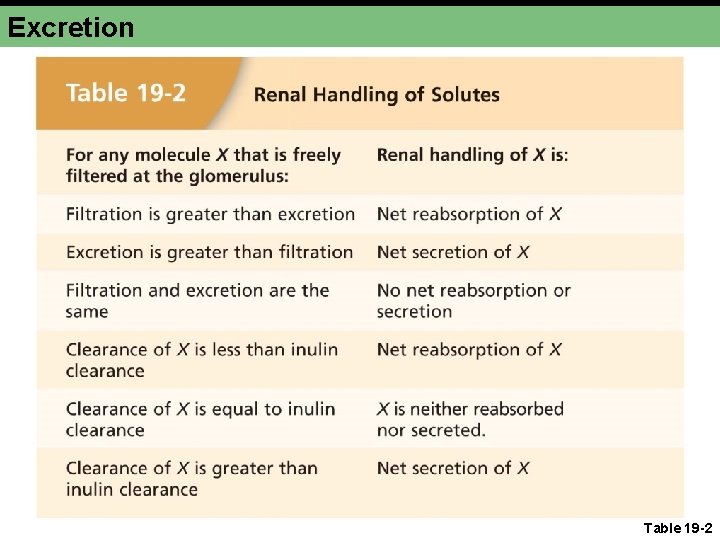
Excretion Table 19 -2
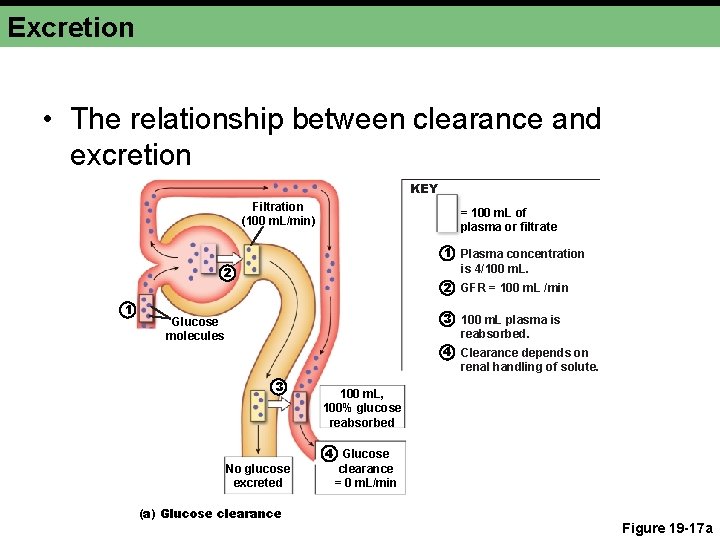
Excretion • The relationship between clearance and excretion KEY Filtration (100 m. L/min) = 100 m. L of plasma or filtrate 1 Plasma concentration is 4/100 m. L. 2 1 2 GFR = 100 m. L /min 3 100 m. L plasma is reabsorbed. Glucose molecules 4 Clearance depends on renal handling of solute. 3 No glucose excreted (a) Glucose clearance 100 m. L, 100% glucose reabsorbed 4 Glucose clearance = 0 m. L/min Figure 19 -17 a
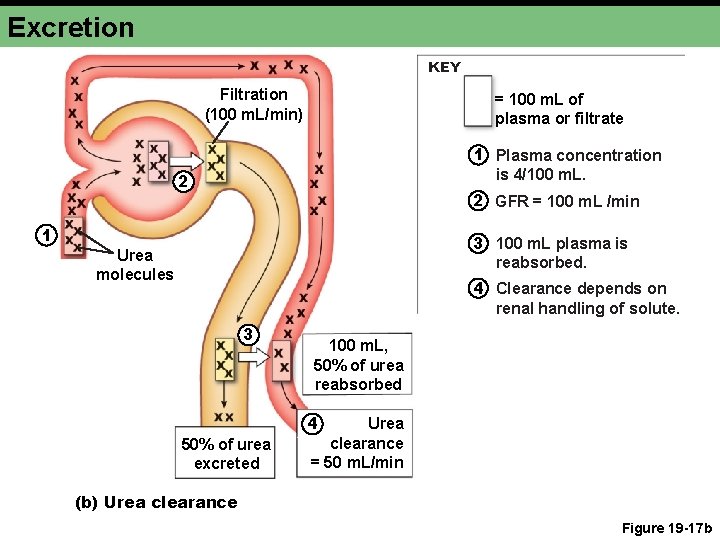
Excretion KEY Filtration (100 m. L/min) = 100 m. L of plasma or filtrate 1 Plasma concentration is 4/100 m. L. 2 2 GFR = 100 m. L /min 1 3 100 m. L plasma is reabsorbed. Urea molecules 4 Clearance depends on renal handling of solute. 3 100 m. L, 50% of urea reabsorbed 4 50% of urea excreted Urea clearance = 50 m. L/min (b) Urea clearance Figure 19 -17 b
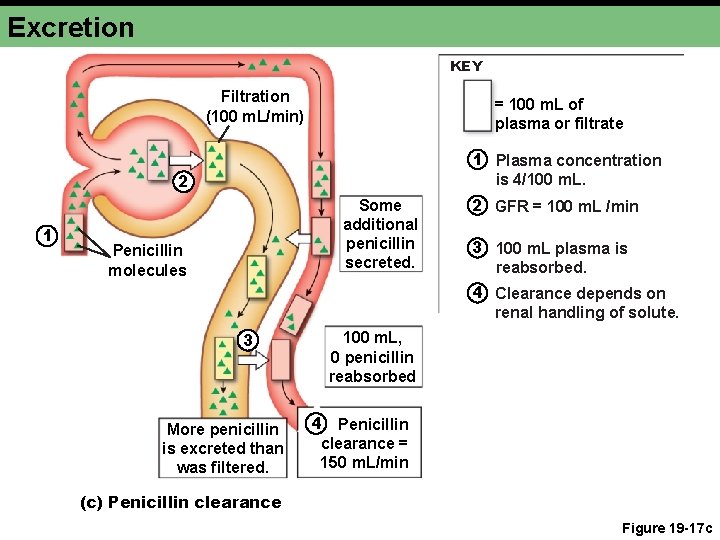
Excretion KEY Filtration (100 m. L/min) = 100 m. L of plasma or filtrate 1 Plasma concentration is 4/100 m. L. 2 1 Some additional penicillin secreted. Penicillin molecules 2 GFR = 100 m. L /min 3 100 m. L plasma is reabsorbed. 4 Clearance depends on renal handling of solute. 3 More penicillin is excreted than was filtered. 100 m. L, 0 penicillin reabsorbed 4 Penicillin clearance = 150 m. L/min (c) Penicillin clearance Figure 19 -17 c
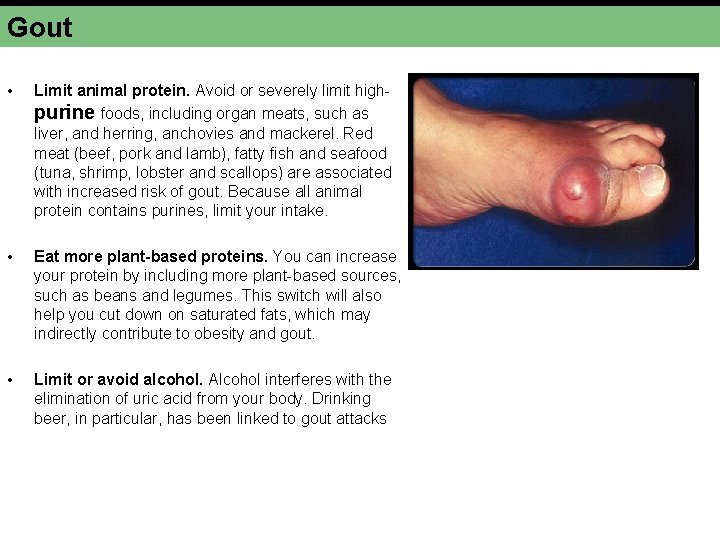
Gout • Limit animal protein. Avoid or severely limit highpurine foods, including organ meats, such as liver, and herring, anchovies and mackerel. Red meat (beef, pork and lamb), fatty fish and seafood (tuna, shrimp, lobster and scallops) are associated with increased risk of gout. Because all animal protein contains purines, limit your intake. • Eat more plant-based proteins. You can increase your protein by including more plant-based sources, such as beans and legumes. This switch will also help you cut down on saturated fats, which may indirectly contribute to obesity and gout. • Limit or avoid alcohol. Alcohol interferes with the elimination of uric acid from your body. Drinking beer, in particular, has been linked to gout attacks
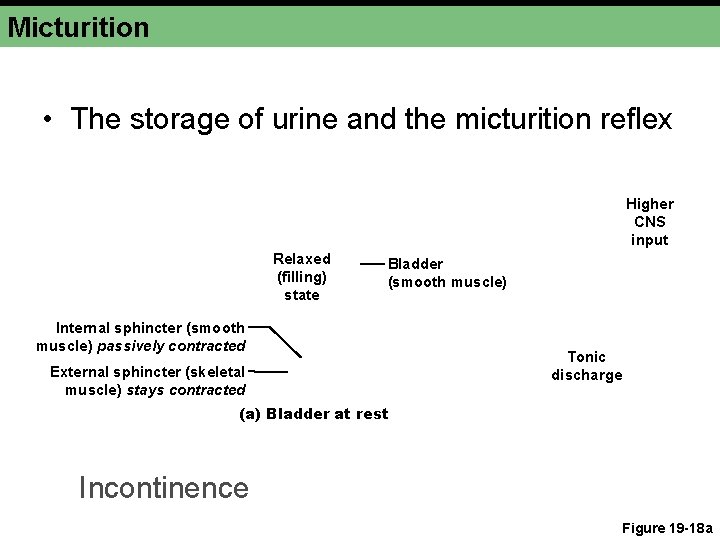
Micturition • The storage of urine and the micturition reflex Higher CNS input Relaxed (filling) state Bladder (smooth muscle) Internal sphincter (smooth muscle) passively contracted External sphincter (skeletal muscle) stays contracted Tonic discharge (a) Bladder at rest Incontinence Figure 19 -18 a
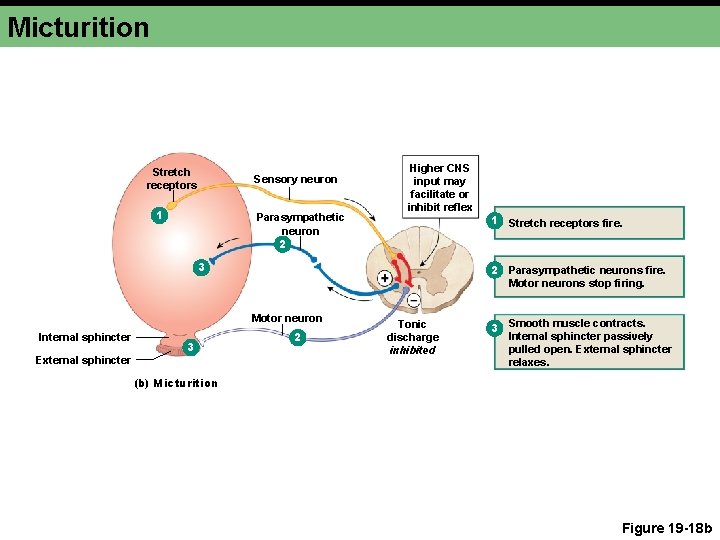
Micturition Stretch receptors Sensory neuron 1 Parasympathetic neuron 2 Higher CNS input may facilitate or inhibit reflex 3 2 Parasympathetic neurons fire. Motor neurons stop firing. Motor neuron Internal sphincter External sphincter 3 1 Stretch receptors fire. 2 Tonic discharge inhibited 3 Smooth muscle contracts. Internal sphincter passively pulled open. External sphincter relaxes. (b) Micturition Figure 19 -18 b
Summary • Functions of the kidneys • Anatomy • Kidney, nephron, cortex, and medulla • Renal blood flow and fluid flow from glomerulus to renal pelvis • Overview of kidney function • Filtration • Podocytes, filtration slits, and mesangial cells • Filtration fraction, GFR, and regulation of GFR
Summary • Reabsorption • How solutes are transported • Transport maximum and renal threshold • Secretion • Excretion • Clearance, inulin, and creatinine • Micturition
- Slides: 25