
Chapter 19 B ALLAIR SYSTEMS FOR MULTIPLE ZONES
Chapter 19 B: ALL-AIR SYSTEMS FOR MULTIPLE ZONES Agami Reddy (rev May 2019) 1) 2) 3) 4) 5) 6) 7) 8) CAV terminal reheat CAV multizone and dual-duct VAV terminal reheat Example of sizing an all-air system Part-load performance of all three systems- solved example Fan powered VAV systems: primary and secondary air flows Measures to improve energy efficiency - Fan control - Outdoor air economizer - Heat recovery devices - Deck reset Advantages of all-air systems HCB 3 -Chap 19 B: All-Air Systems_Multizone 1
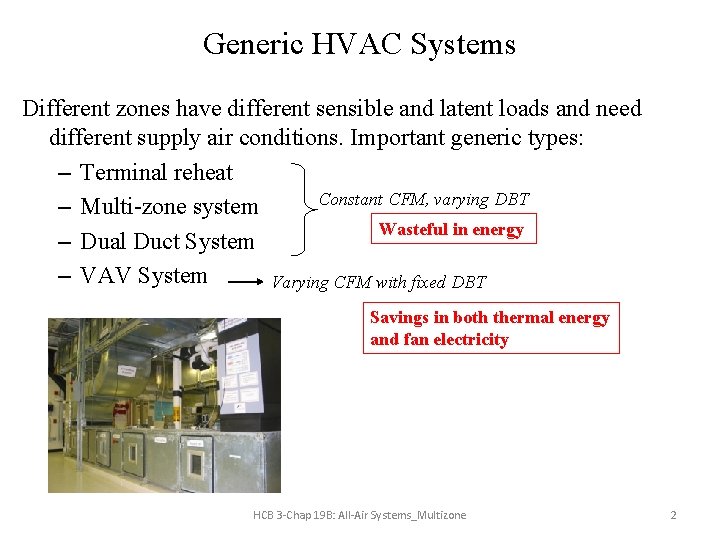
Generic HVAC Systems Different zones have different sensible and latent loads and need different supply air conditions. Important generic types: – Terminal reheat Constant CFM, varying DBT – Multi-zone system Wasteful in energy – Dual Duct System – VAV System Varying CFM with fixed DBT Savings in both thermal energy and fan electricity HCB 3 -Chap 19 B: All-Air Systems_Multizone 2
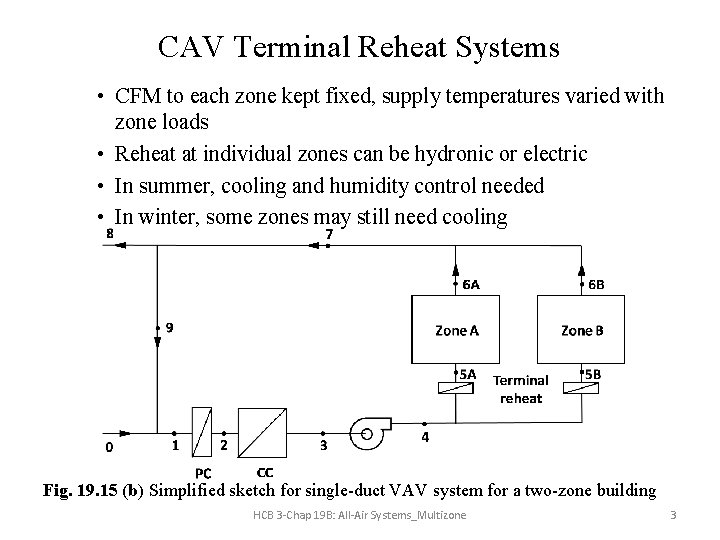
CAV Terminal Reheat Systems • CFM to each zone kept fixed, supply temperatures varied with zone loads • Reheat at individual zones can be hydronic or electric • In summer, cooling and humidity control needed • In winter, some zones may still need cooling Fig. 19. 15 (b) Simplified sketch for single-duct VAV system for a two-zone building HCB 3 -Chap 19 B: All-Air Systems_Multizone 3
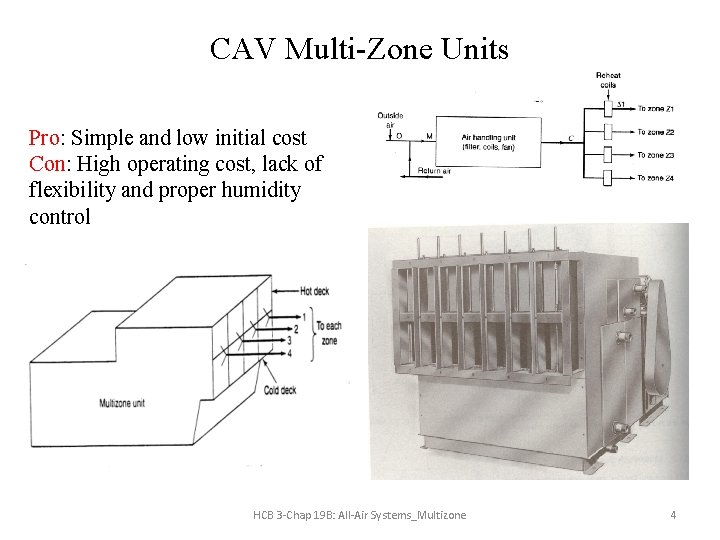
CAV Multi-Zone Units Pro: Simple and low initial cost Con: High operating cost, lack of flexibility and proper humidity control HCB 3 -Chap 19 B: All-Air Systems_Multizone 4
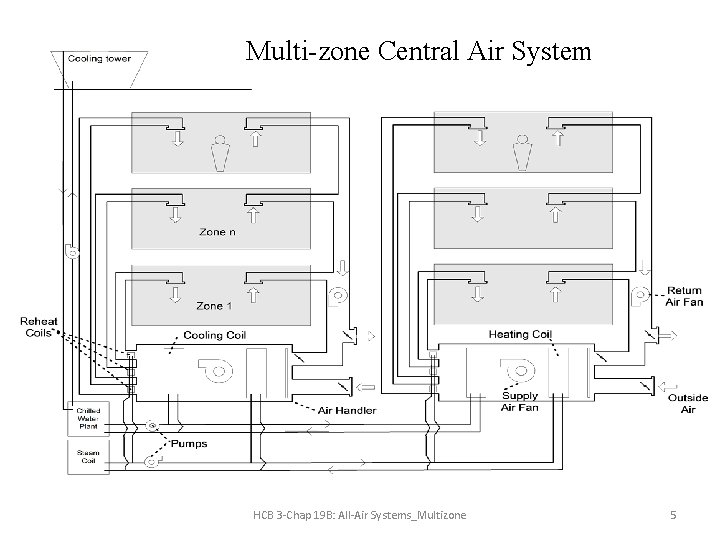
Multi-zone Central Air System HCB 3 -Chap 19 B: All-Air Systems_Multizone 5
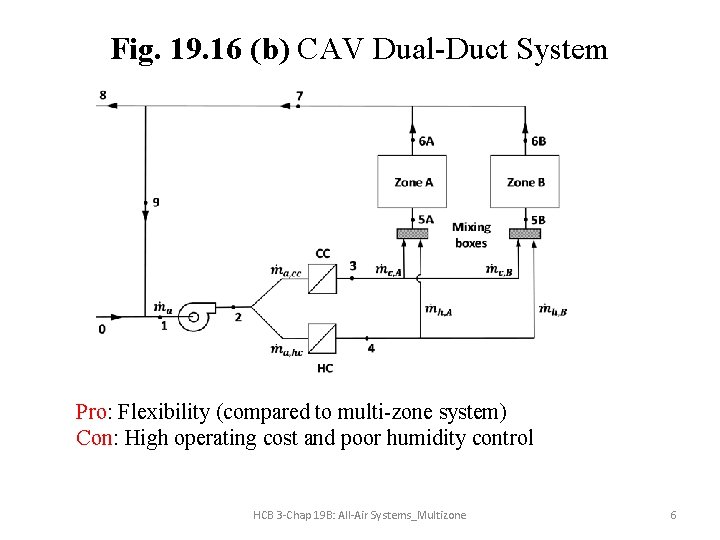
Fig. 19. 16 (b) CAV Dual-Duct System Pro: Flexibility (compared to multi-zone system) Con: High operating cost and poor humidity control HCB 3 -Chap 19 B: All-Air Systems_Multizone 6
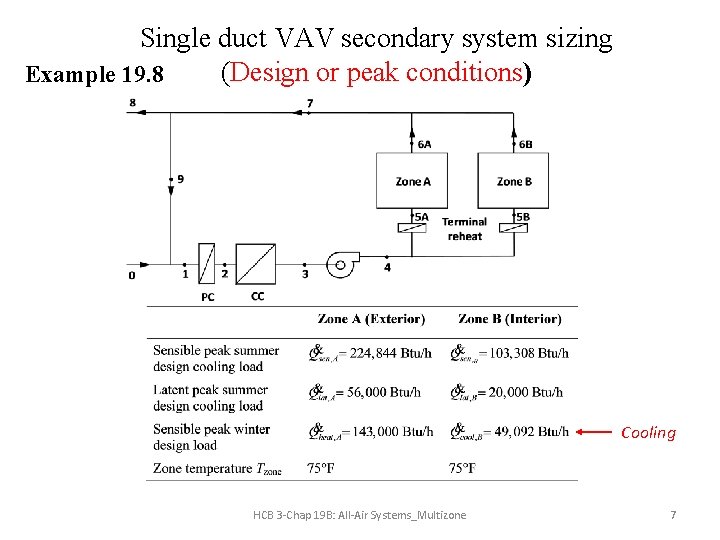
Single duct VAV secondary system sizing (Design or peak conditions) Example 19. 8 Cooling HCB 3 -Chap 19 B: All-Air Systems_Multizone 7

Other Specifications HCB 3 -Chap 19 B: All-Air Systems_Multizone 8
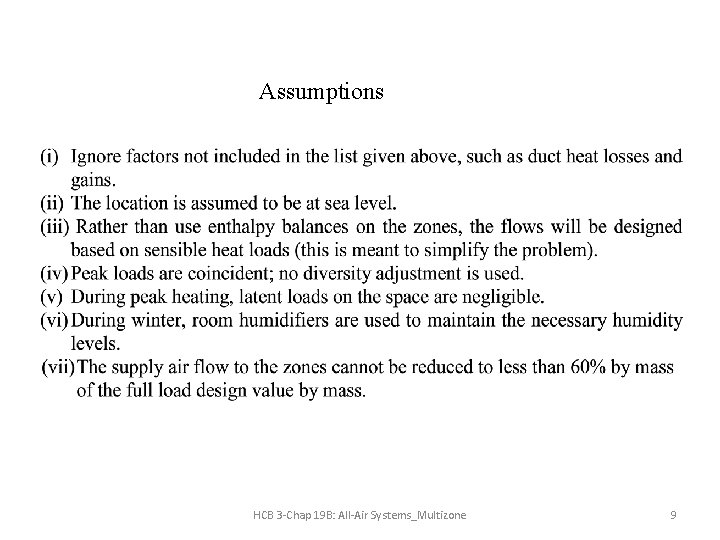
Assumptions HCB 3 -Chap 19 B: All-Air Systems_Multizone 9
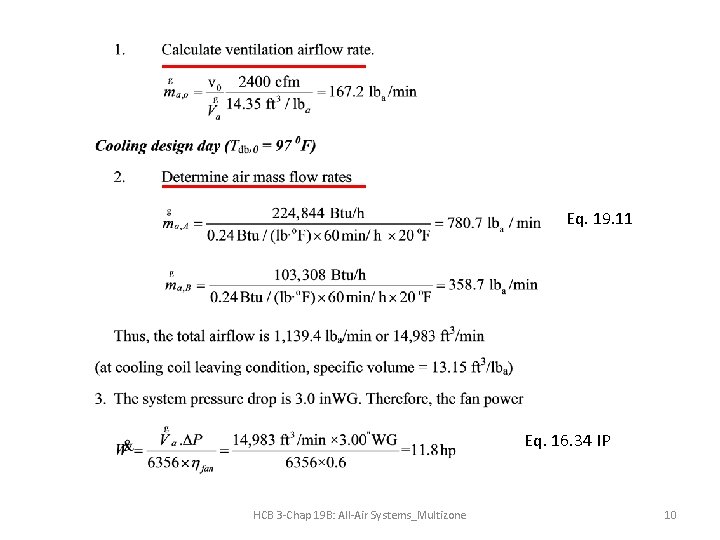
Eq. 19. 11 Eq. 16. 34 IP HCB 3 -Chap 19 B: All-Air Systems_Multizone 10
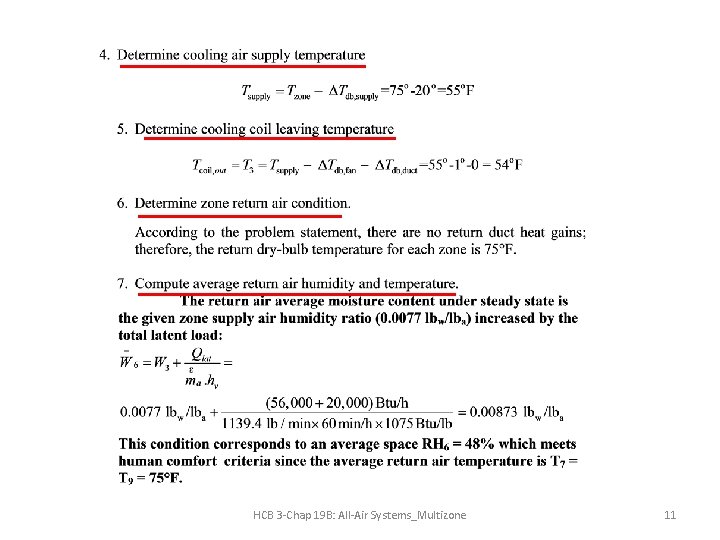
HCB 3 -Chap 19 B: All-Air Systems_Multizone 11
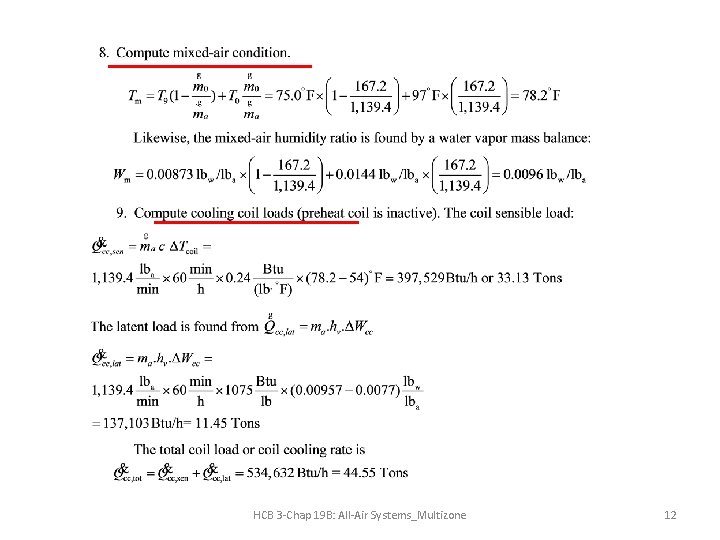
HCB 3 -Chap 19 B: All-Air Systems_Multizone 12
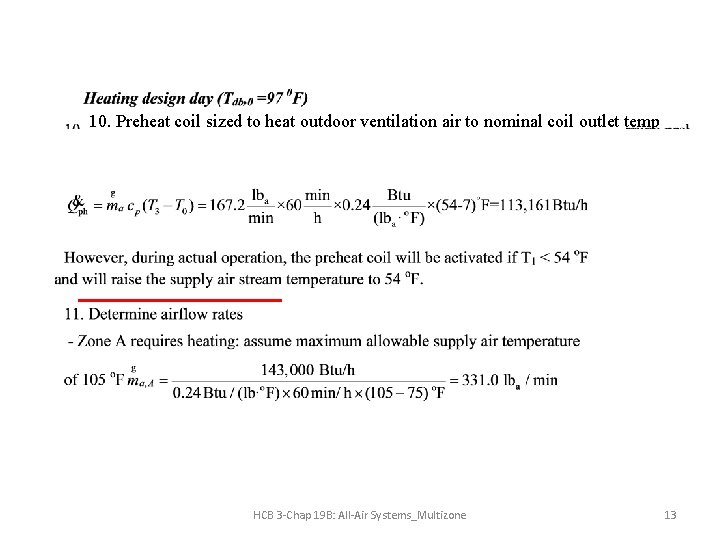
10. Preheat coil sized to heat outdoor ventilation air to nominal coil outlet temp HCB 3 -Chap 19 B: All-Air Systems_Multizone 13
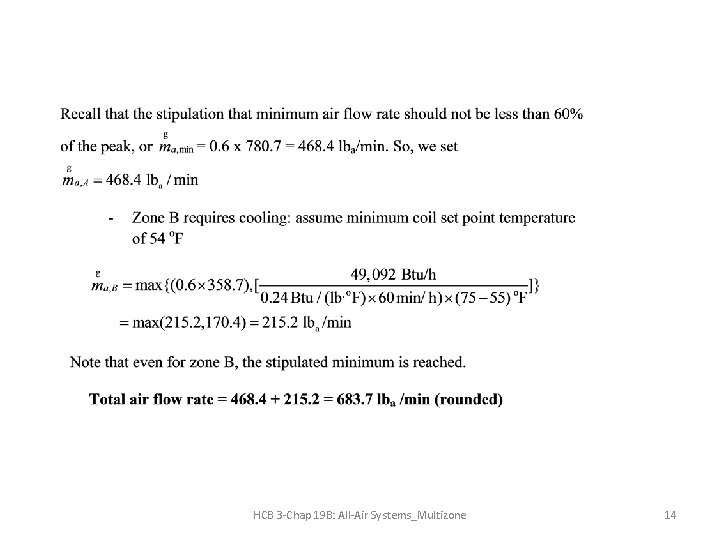
HCB 3 -Chap 19 B: All-Air Systems_Multizone 14
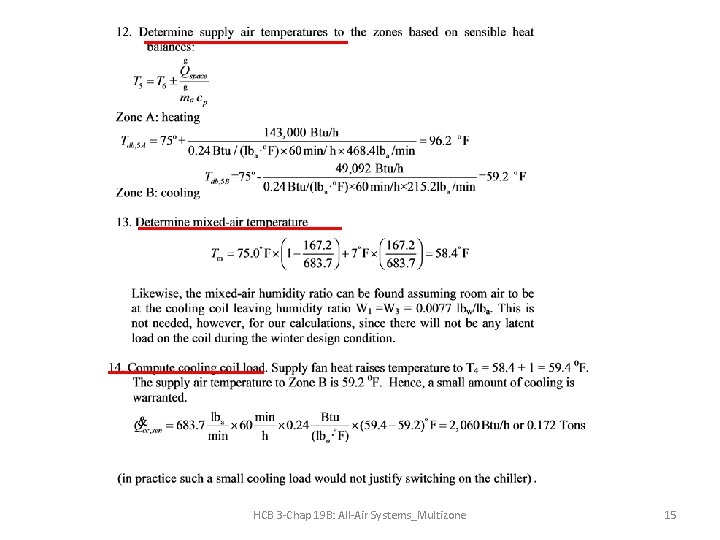
HCB 3 -Chap 19 B: All-Air Systems_Multizone 15
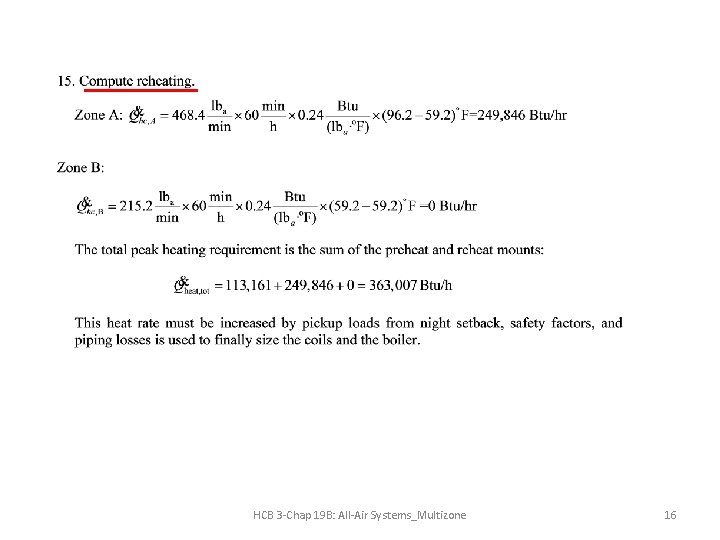
HCB 3 -Chap 19 B: All-Air Systems_Multizone 16
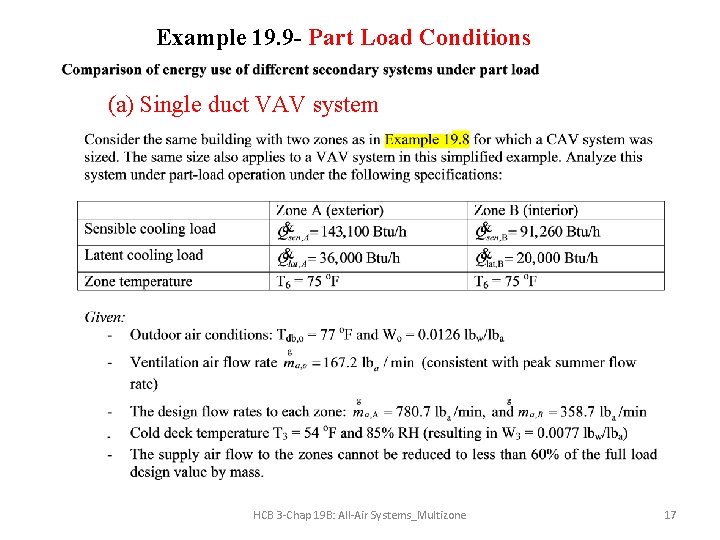
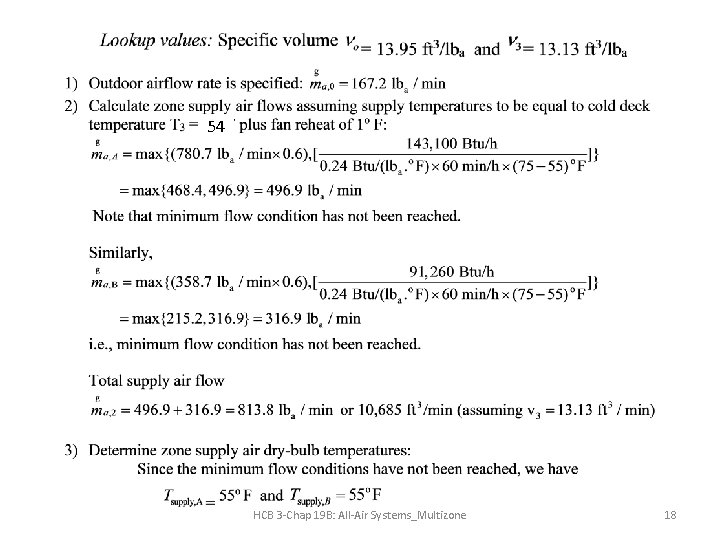
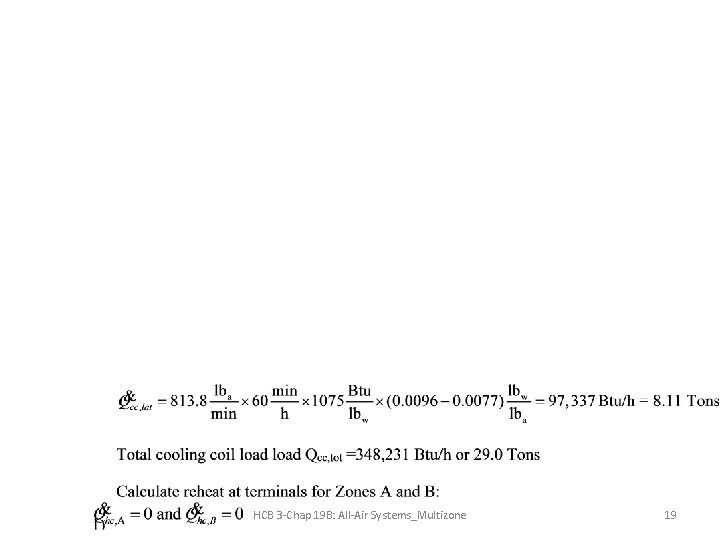
Example 19. 9 - Part Load Conditions (a) Single duct VAV system HCB 3 -Chap 19 B: All-Air Systems_Multizone 17
54 HCB 3 -Chap 19 B: All-Air Systems_Multizone 18
HCB 3 -Chap 19 B: All-Air Systems_Multizone 19
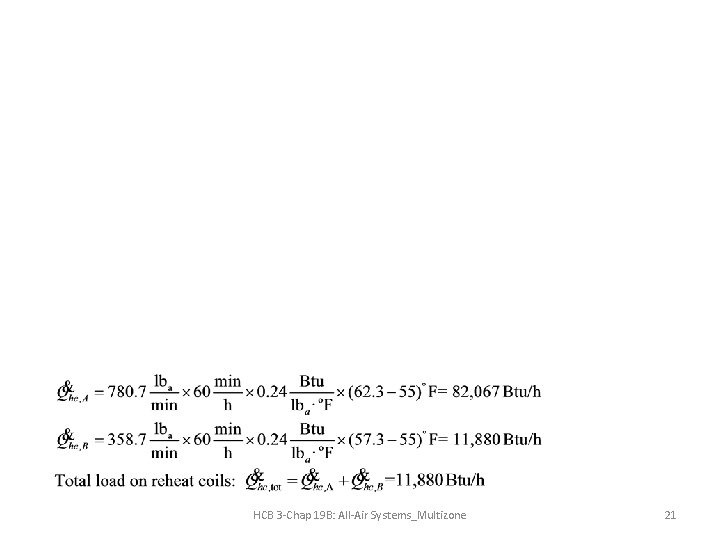
(b) Single duct CAV system HCB 3 -Chap 19 B: All-Air Systems_Multizone 20
HCB 3 -Chap 19 B: All-Air Systems_Multizone 21
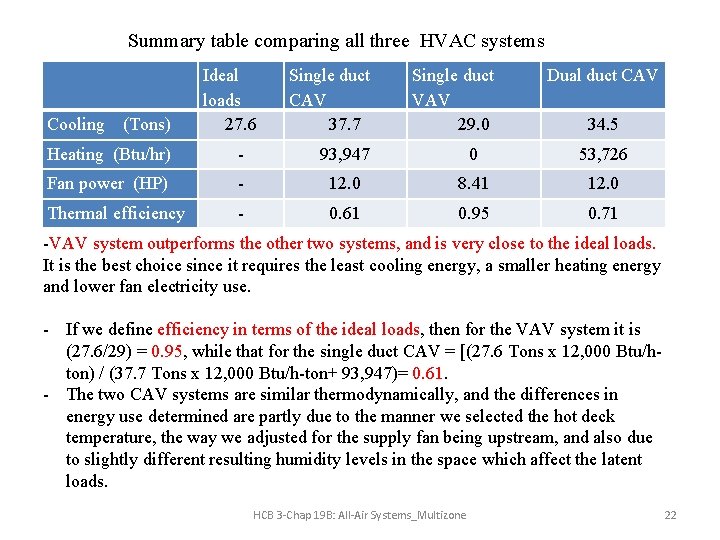
Summary table comparing all three HVAC systems Cooling (Tons) Ideal loads 27. 6 Single duct CAV 37. 7 Single duct VAV 29. 0 Dual duct CAV 34. 5 Heating (Btu/hr) - 93, 947 0 53, 726 Fan power (HP) - 12. 0 8. 41 12. 0 Thermal efficiency - 0. 61 0. 95 0. 71 -VAV system outperforms the other two systems, and is very close to the ideal loads. It is the best choice since it requires the least cooling energy, a smaller heating energy and lower fan electricity use. - If we define efficiency in terms of the ideal loads, then for the VAV system it is (27. 6/29) = 0. 95, while that for the single duct CAV = [(27. 6 Tons x 12, 000 Btu/hton) / (37. 7 Tons x 12, 000 Btu/h-ton+ 93, 947)= 0. 61. - The two CAV systems are similar thermodynamically, and the differences in energy use determined are partly due to the manner we selected the hot deck temperature, the way we adjusted for the supply fan being upstream, and also due to slightly different resulting humidity levels in the space which affect the latent loads. HCB 3 -Chap 19 B: All-Air Systems_Multizone 22
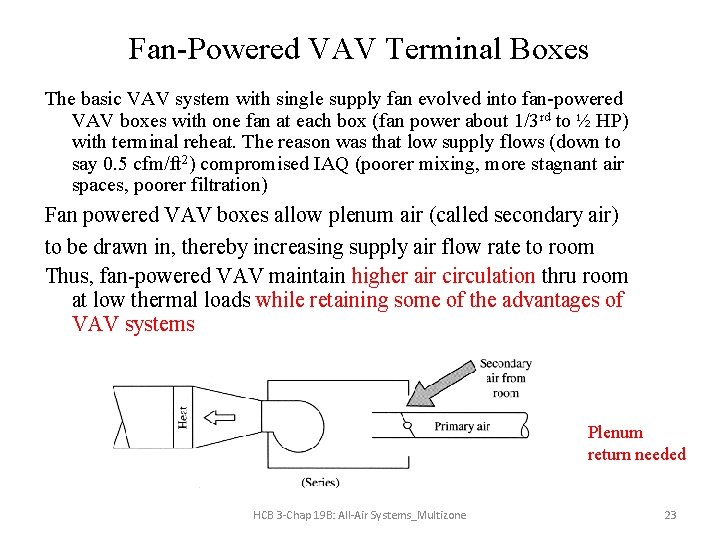
Fan-Powered VAV Terminal Boxes The basic VAV system with single supply fan evolved into fan-powered VAV boxes with one fan at each box (fan power about 1/3 rd to ½ HP) with terminal reheat. The reason was that low supply flows (down to say 0. 5 cfm/ft 2) compromised IAQ (poorer mixing, more stagnant air spaces, poorer filtration) Fan powered VAV boxes allow plenum air (called secondary air) to be drawn in, thereby increasing supply air flow rate to room Thus, fan-powered VAV maintain higher air circulation thru room at low thermal loads while retaining some of the advantages of VAV systems Plenum return needed HCB 3 -Chap 19 B: All-Air Systems_Multizone 23
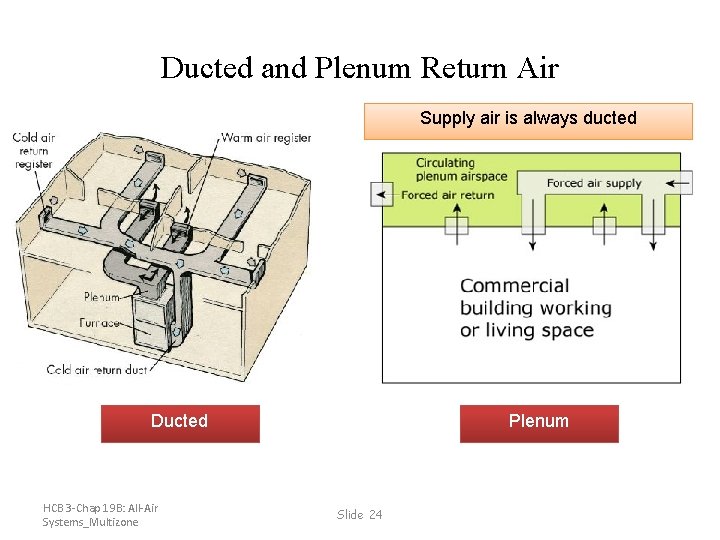
Ducted and Plenum Return Air Supply air is always ducted Ducted HCB 3 -Chap 19 B: All-Air Systems_Multizone Plenum Slide 24
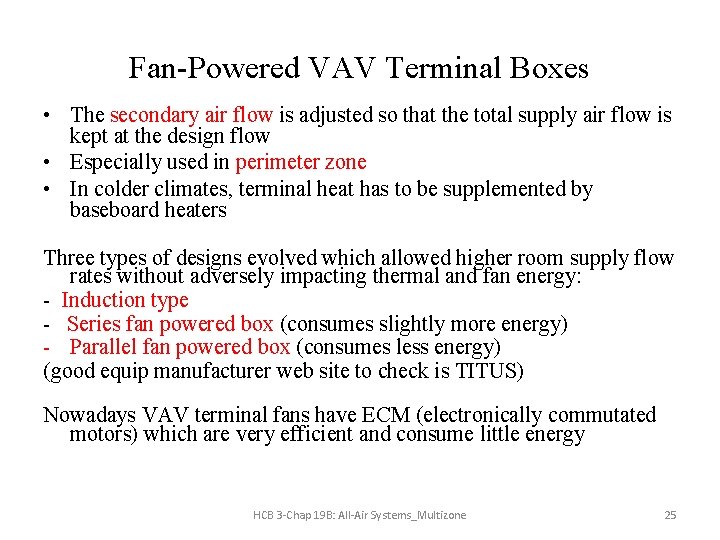
Fan-Powered VAV Terminal Boxes • The secondary air flow is adjusted so that the total supply air flow is kept at the design flow • Especially used in perimeter zone • In colder climates, terminal heat has to be supplemented by baseboard heaters Three types of designs evolved which allowed higher room supply flow rates without adversely impacting thermal and fan energy: - Induction type - Series fan powered box (consumes slightly more energy) - Parallel fan powered box (consumes less energy) (good equip manufacturer web site to check is TITUS) Nowadays VAV terminal fans have ECM (electronically commutated motors) which are very efficient and consume little energy HCB 3 -Chap 19 B: All-Air Systems_Multizone 25
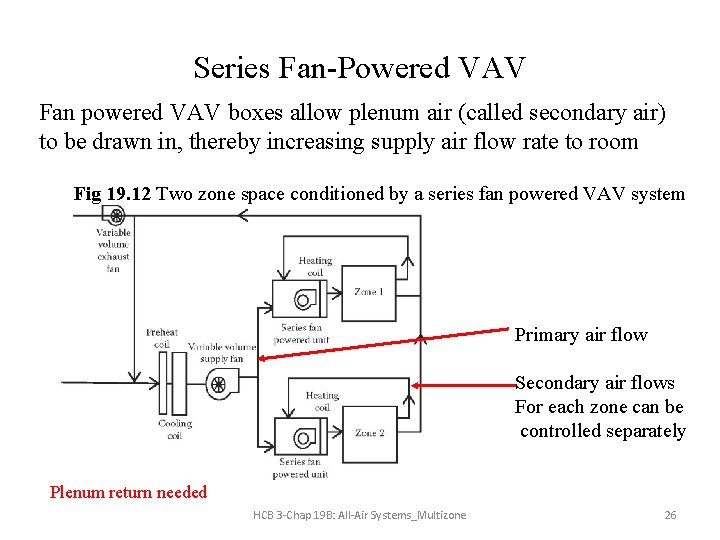
Series Fan-Powered VAV Fan powered VAV boxes allow plenum air (called secondary air) to be drawn in, thereby increasing supply air flow rate to room Fig 19. 12 Two zone space conditioned by a series fan powered VAV system Primary air flow Secondary air flows For each zone can be controlled separately Plenum return needed HCB 3 -Chap 19 B: All-Air Systems_Multizone 26
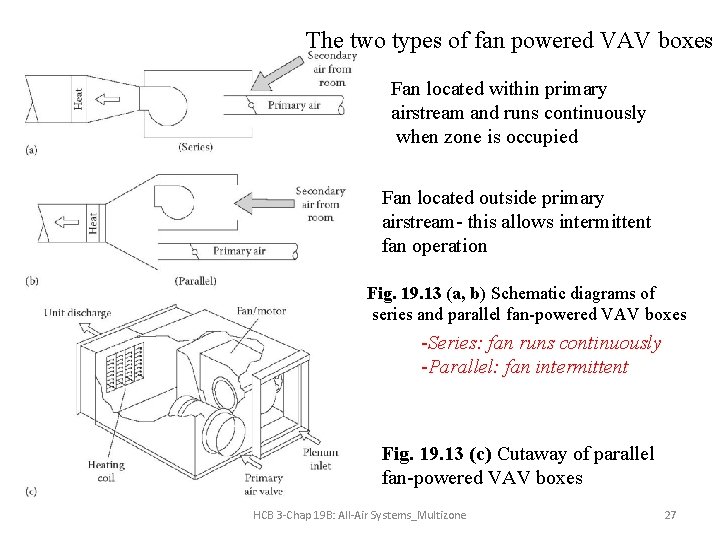
The two types of fan powered VAV boxes Fan located within primary airstream and runs continuously when zone is occupied Fan located outside primary airstream- this allows intermittent fan operation Fig. 19. 13 (a, b) Schematic diagrams of series and parallel fan-powered VAV boxes -Series: fan runs continuously -Parallel: fan intermittent Fig. 19. 13 (c) Cutaway of parallel fan-powered VAV boxes HCB 3 -Chap 19 B: All-Air Systems_Multizone 27
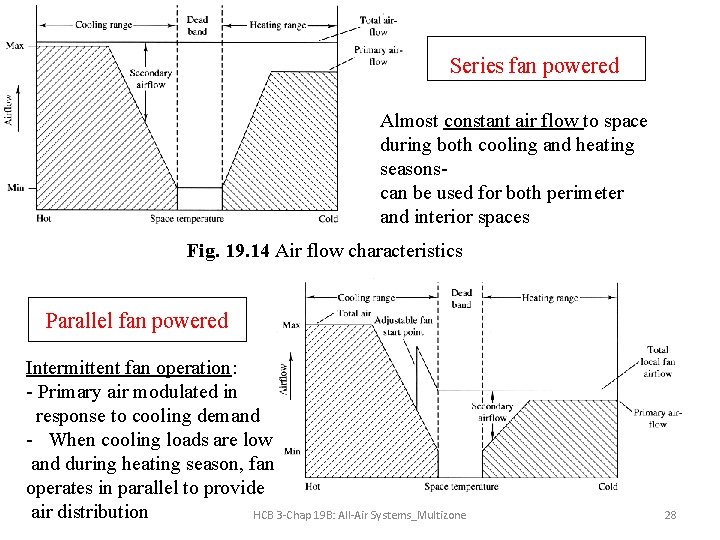
Series fan powered Almost constant air flow to space during both cooling and heating seasonscan be used for both perimeter and interior spaces Fig. 19. 14 Air flow characteristics Parallel fan powered Intermittent fan operation: - Primary air modulated in response to cooling demand - When cooling loads are low and during heating season, fan operates in parallel to provide air distribution HCB 3 -Chap 19 B: All-Air Systems_Multizone 28
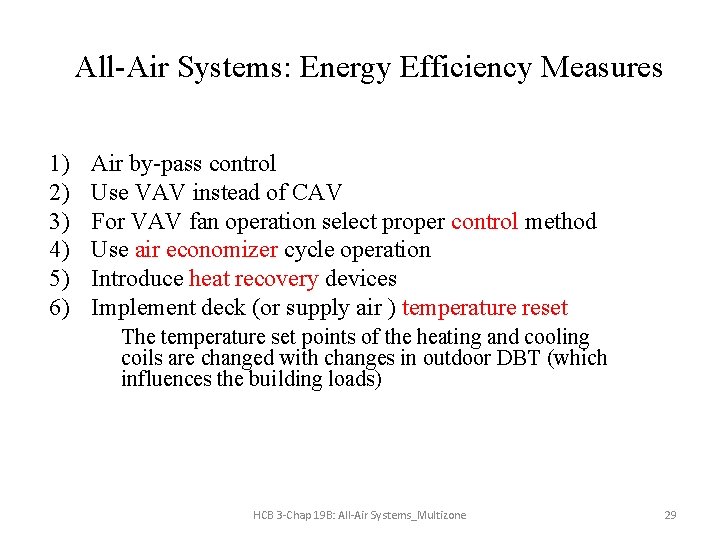
All-Air Systems: Energy Efficiency Measures 1) 2) 3) 4) 5) 6) Air by-pass control Use VAV instead of CAV For VAV fan operation select proper control method Use air economizer cycle operation Introduce heat recovery devices Implement deck (or supply air ) temperature reset The temperature set points of the heating and cooling coils are changed with changes in outdoor DBT (which influences the building loads) HCB 3 -Chap 19 B: All-Air Systems_Multizone 29
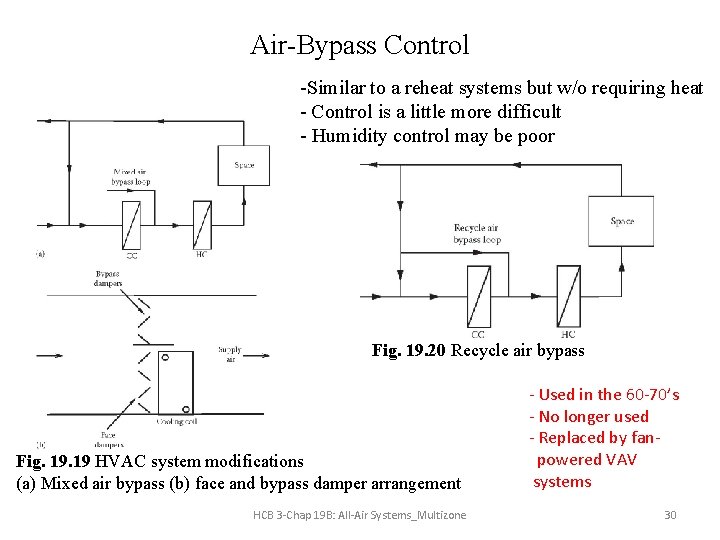
Air-Bypass Control -Similar to a reheat systems but w/o requiring heat - Control is a little more difficult - Humidity control may be poor Fig. 19. 20 Recycle air bypass Fig. 19 HVAC system modifications (a) Mixed air bypass (b) face and bypass damper arrangement HCB 3 -Chap 19 B: All-Air Systems_Multizone - Used in the 60 -70’s - No longer used - Replaced by fanpowered VAV systems 30
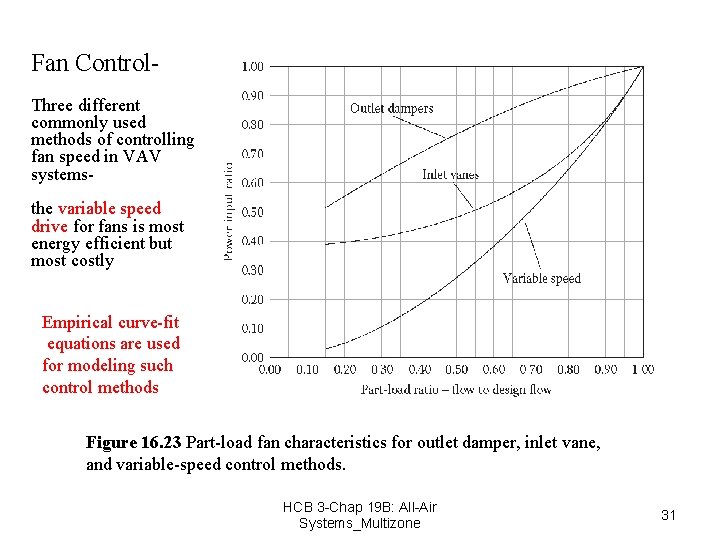
Fan Control. Three different commonly used methods of controlling fan speed in VAV systemsthe variable speed drive for fans is most energy efficient but most costly Empirical curve-fit equations are used for modeling such control methods Figure 16. 23 Part-load fan characteristics for outlet damper, inlet vane, and variable-speed control methods. HCB 3 -Chap 19 B: All-Air Systems_Multizone 31
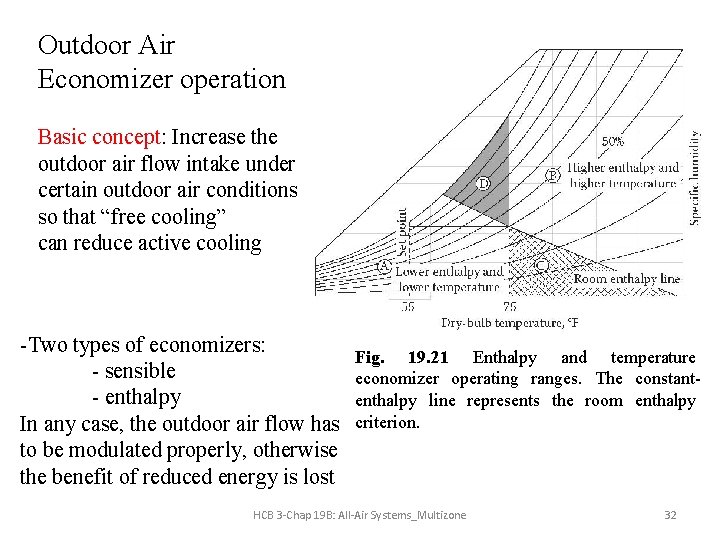
Outdoor Air Economizer operation Basic concept: Increase the outdoor air flow intake under certain outdoor air conditions so that “free cooling” can reduce active cooling -Two types of economizers: - sensible - enthalpy In any case, the outdoor air flow has to be modulated properly, otherwise the benefit of reduced energy is lost Fig. 19. 21 Enthalpy and temperature economizer operating ranges. The constantenthalpy line represents the room enthalpy criterion. HCB 3 -Chap 19 B: All-Air Systems_Multizone 32
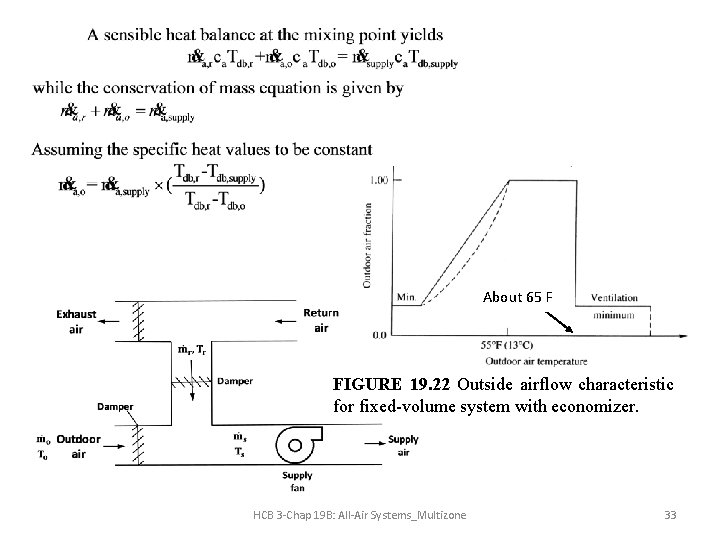
About 65 F FIGURE 19. 22 Outside airflow characteristic for fixed-volume system with economizer. HCB 3 -Chap 19 B: All-Air Systems_Multizone 33
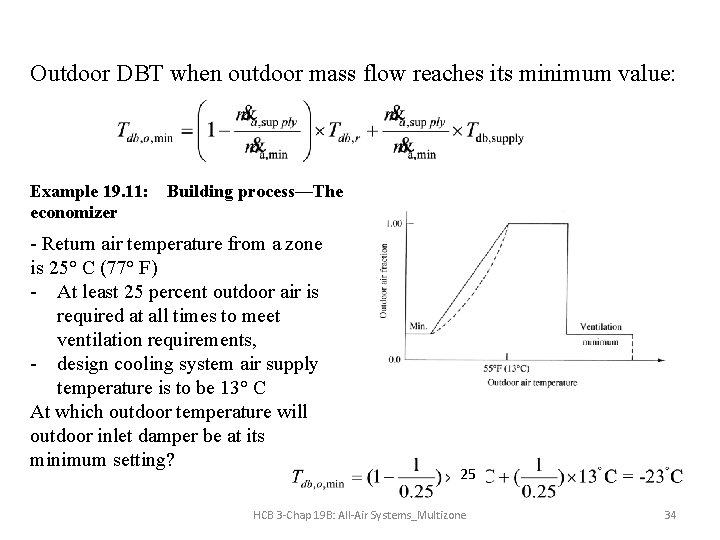
Outdoor DBT when outdoor mass flow reaches its minimum value: Example 19. 11: economizer Building process—The - Return air temperature from a zone is 25° C (77° F) - At least 25 percent outdoor air is required at all times to meet ventilation requirements, - design cooling system air supply temperature is to be 13° C At which outdoor temperature will outdoor inlet damper be at its minimum setting? 25 HCB 3 -Chap 19 B: All-Air Systems_Multizone 34
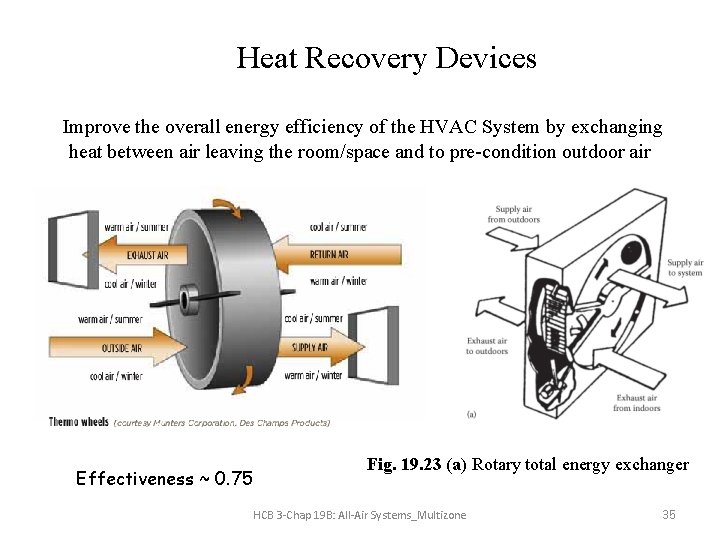
Heat Recovery Devices Improve the overall energy efficiency of the HVAC System by exchanging heat between air leaving the room/space and to pre-condition outdoor air Effectiveness ~ 0. 75 Fig. 19. 23 (a) Rotary total energy exchanger HCB 3 -Chap 19 B: All-Air Systems_Multizone 35
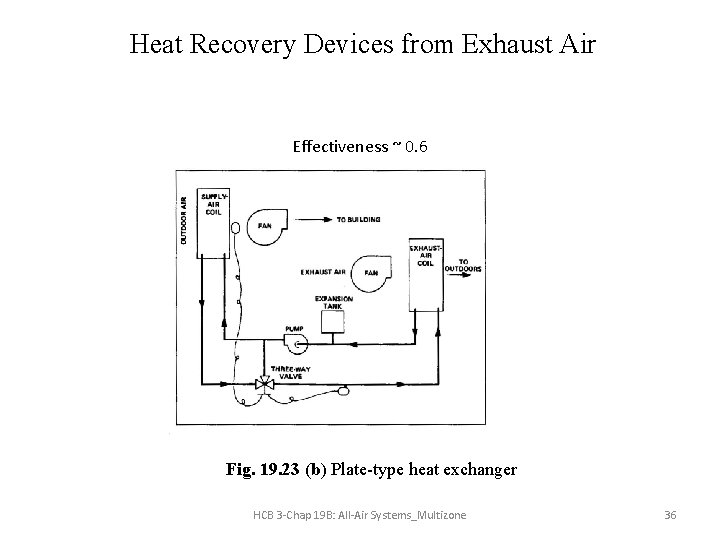
Heat Recovery Devices from Exhaust Air Effectiveness ~ 0. 6 Fig. 19. 23 (b) Plate-type heat exchanger HCB 3 -Chap 19 B: All-Air Systems_Multizone 36
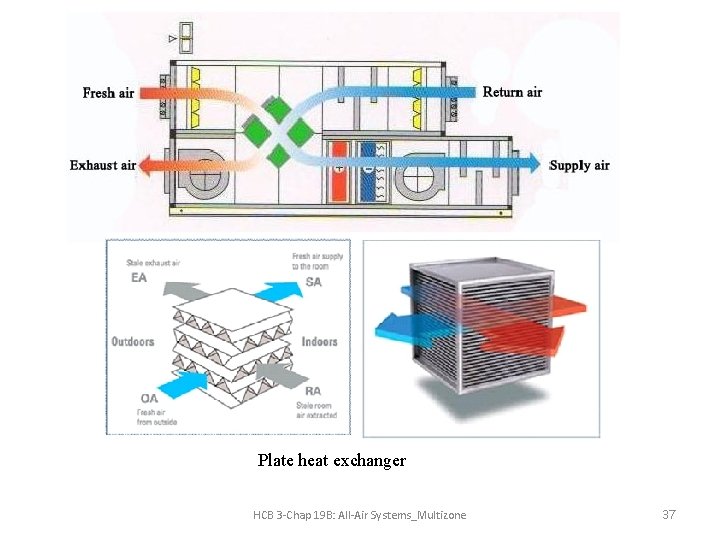
Plate heat exchanger HCB 3 -Chap 19 B: All-Air Systems_Multizone 37
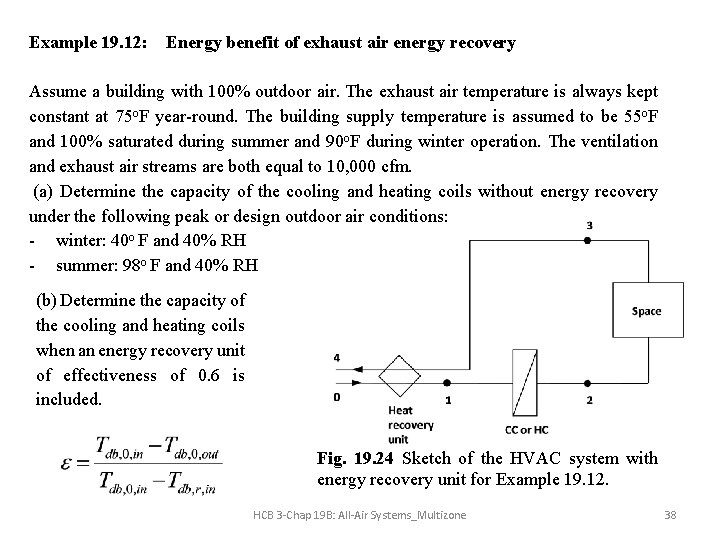
Example 19. 12: Energy benefit of exhaust air energy recovery Assume a building with 100% outdoor air. The exhaust air temperature is always kept constant at 75 o. F year-round. The building supply temperature is assumed to be 55 o. F and 100% saturated during summer and 90 o. F during winter operation. The ventilation and exhaust air streams are both equal to 10, 000 cfm. (a) Determine the capacity of the cooling and heating coils without energy recovery under the following peak or design outdoor air conditions: - winter: 40 o F and 40% RH - summer: 98 o F and 40% RH (b) Determine the capacity of the cooling and heating coils when an energy recovery unit of effectiveness of 0. 6 is included. Fig. 19. 24 Sketch of the HVAC system with energy recovery unit for Example 19. 12. HCB 3 -Chap 19 B: All-Air Systems_Multizone 38

HCB 3 -Chap 19 B: All-Air Systems_Multizone 39
Or a reduction of 44% HCB 3 -Chap 19 B: All-Air Systems_Multizone 40
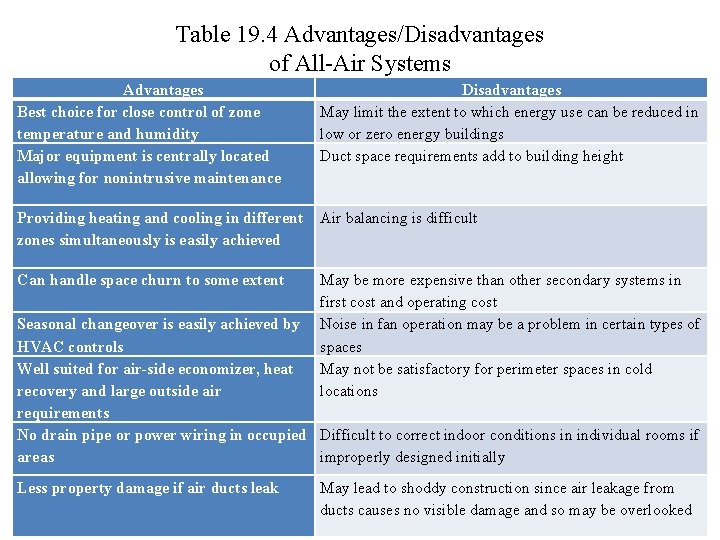
Table 19. 4 Advantages/Disadvantages of All-Air Systems Advantages Best choice for close control of zone temperature and humidity Major equipment is centrally located allowing for nonintrusive maintenance Disadvantages May limit the extent to which energy use can be reduced in low or zero energy buildings Duct space requirements add to building height Providing heating and cooling in different zones simultaneously is easily achieved Air balancing is difficult Can handle space churn to some extent May be more expensive than other secondary systems in first cost and operating cost Noise in fan operation may be a problem in certain types of spaces May not be satisfactory for perimeter spaces in cold locations Seasonal changeover is easily achieved by HVAC controls Well suited for air-side economizer, heat recovery and large outside air requirements No drain pipe or power wiring in occupied Difficult to correct indoor conditions in individual rooms if areas improperly designed initially Less property damage if air ducts leak May lead to shoddy construction since air leakage from ducts causes no visible damage and so may be overlooked HCB 3 -Chap 19 B: All-Air Systems_Multizone 41
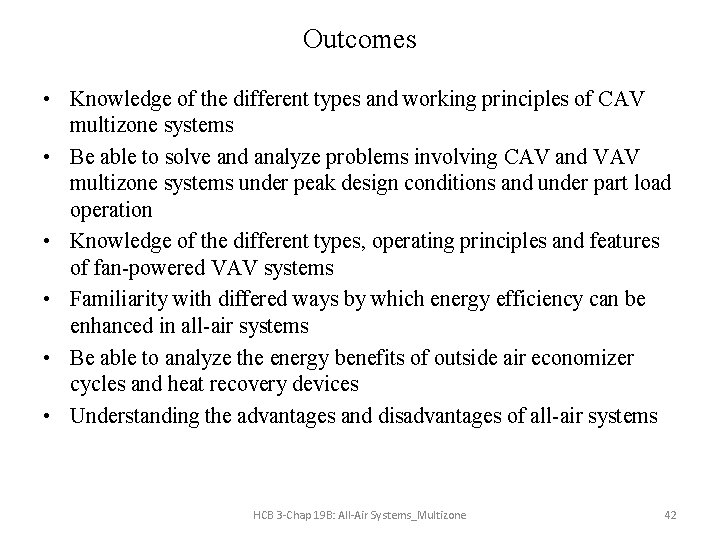
Outcomes • Knowledge of the different types and working principles of CAV multizone systems • Be able to solve and analyze problems involving CAV and VAV multizone systems under peak design conditions and under part load operation • Knowledge of the different types, operating principles and features of fan-powered VAV systems • Familiarity with differed ways by which energy efficiency can be enhanced in all-air systems • Be able to analyze the energy benefits of outside air economizer cycles and heat recovery devices • Understanding the advantages and disadvantages of all-air systems HCB 3 -Chap 19 B: All-Air Systems_Multizone 42
- Slides: 42