
Chapter 19 AdrenergicBlocking Drugs Copyright 2017 Elsevier Inc
Chapter 19 Adrenergic-Blocking Drugs Copyright © 2017, Elsevier Inc. All rights reserved.
Adrenergic Blockers Bind to adrenergic receptors but inhibit or block stimulation of the sympathetic nervous system (SNS) Have the opposite effect of adrenergic drugs Inhibit—or lyse—sympathetic stimulation Copyright © 2017, Elsevier Inc. All rights reserved. 2
Adrenergic Blockers (Cont. ) Also known as: Adrenergic antagonists Ø Sympatholytics Ø Alpha blockers, beta blockers, or alpha-beta blockers Ø Classified by the type of adrenergic receptor they block Alpha 1 and alpha 2 receptors Ø Beta 1 and beta 2 receptors Ø Copyright © 2017, Elsevier Inc. All rights reserved. 3
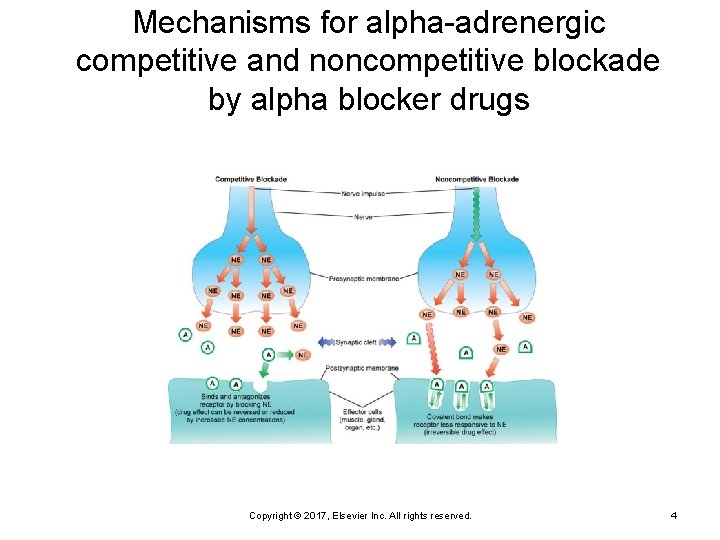
Mechanisms for alpha-adrenergic competitive and noncompetitive blockade by alpha blocker drugs Copyright © 2017, Elsevier Inc. All rights reserved. 4

Drug Effects and Indications: Alpha Blockers Cause both arterial and venous dilation, reducing peripheral vascular resistance and blood pressure (BP) Used to treat hypertension Effect on receptors on prostate gland bladder decreases resistance to urinary outflow, thus reducing urinary obstruction and relieving effects of benign prostatic hyperplasia (BPH) Copyright © 2017, Elsevier Inc. All rights reserved. 5

Drug Effects and Indications: Alpha Blockers (Cont. ) Used to control and prevent hypertension in patients with pheochromocytoma Raynaud’s disease, acrocyanosis, and frostbite Phentolamine Quickly reverses the potent vasoconstrictive effects of extravasated vasopressors such as norepinephrine or epinephrine Ø Restores blood flow and prevents tissue necrosis Ø Copyright © 2017, Elsevier Inc. All rights reserved. 6
Audience Response System Question When phentolamine is used to diagnose the presence of pheochromocytoma, the nurse will assess for what indicative finding? A. B. C. D. Rapid decrease in blood pressure Steady increase in blood pressure Slower heart rate Reduced cardiac ectopy Copyright © 2017, Elsevier Inc. All rights reserved. 7
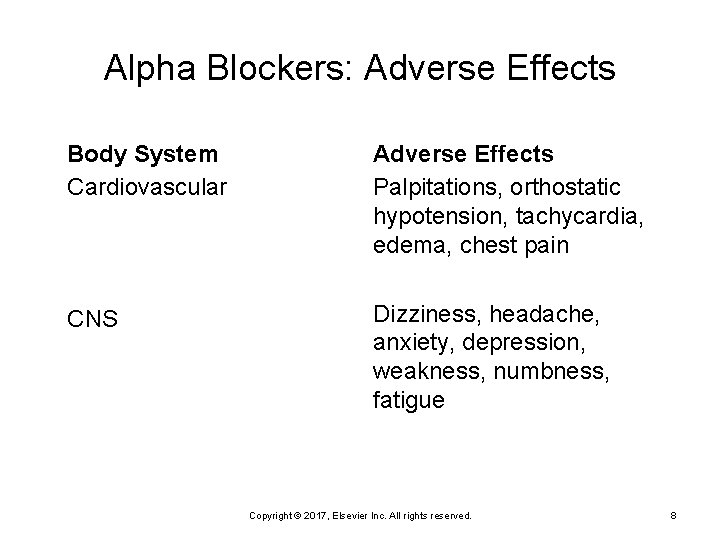
Alpha Blockers: Adverse Effects Body System Cardiovascular Adverse Effects Palpitations, orthostatic hypotension, tachycardia, edema, chest pain CNS Dizziness, headache, anxiety, depression, weakness, numbness, fatigue Copyright © 2017, Elsevier Inc. All rights reserved. 8
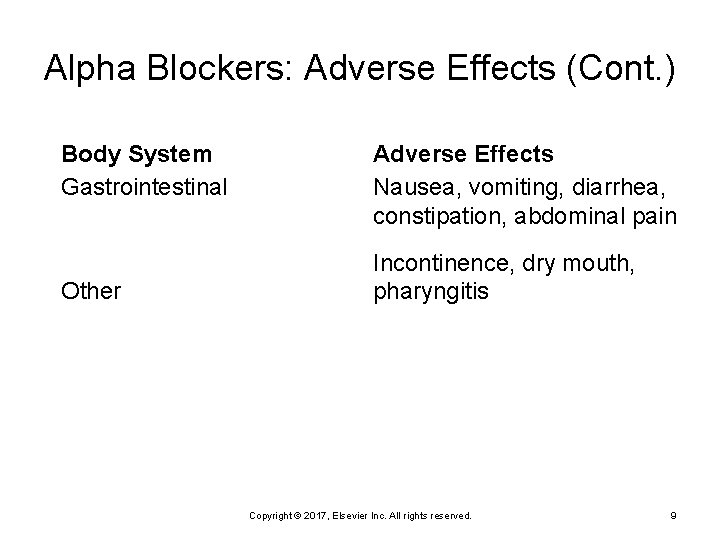
Alpha Blockers: Adverse Effects (Cont. ) Body System Gastrointestinal Other Adverse Effects Nausea, vomiting, diarrhea, constipation, abdominal pain Incontinence, dry mouth, pharyngitis Copyright © 2017, Elsevier Inc. All rights reserved. 9
Audience Response System Question When administering an alpha blocker for the first time, it is most important for the nurse to assess the patient for the development of A. B. C. D. renal failure. hypotension. blood dyscrasia. dysrhythmias. Copyright © 2017, Elsevier Inc. All rights reserved. 10
Common Alpha Blockers phenoxybenzamine HCl (Dibenzyline) phentolamine (Generic) prazosin (Minipress) terazosin (Hytrin) alfuzosin (Uro. Xatral) tamsulosin (Flomax) doxazosin (Cardura) Copyright © 2017, Elsevier Inc. All rights reserved. 11
Phentolamine (Regitine) Alpha blocker that reduces peripheral vascular resistance and is also used to treat hypertension. Establish a diagnosis of pheochromocytoma Most commonly used to treat the extravasation of vasoconstricting drugs such as norepinephrine, and dopamine Contraindicated in known hypersensitivity, myocardial infarction (MI), and coronary artery disease. Copyright © 2017, Elsevier Inc. All rights reserved. 12
Tamsulosin (Flomax) Alpha blocker used primarily to treat BPH; is exclusively indicated for male patients Contraindications: known drug allergy and concurrent use of erectile dysfunction drugs such as sildenafil. Adverse effects: headache, abnormal ejaculation, rhinitis, and others Copyright © 2017, Elsevier Inc. All rights reserved. 13
Beta Blockers Block stimulation of beta receptors in the SNS Compete with norepinephrine and epinephrine Can be selective or nonselective Cardioselective beta blockers or beta 1 -blocking drugs Ø Nonselective beta blockers block both beta 1 and beta 2 receptors Ø Beta 2 receptors are located primarily on the smooth muscles of the bronchioles and blood vessels. Copyright © 2017, Elsevier Inc. All rights reserved. 14
Intrinsic Sympathomimetic Activity Acebutolol, penbutolol, pindolol: not only block beta-adrenergic receptors but also partially stimulate them Carvedilol and labetalol: alpha-receptor– blocking activity, especially at higher dosages Copyright © 2017, Elsevier Inc. All rights reserved. 15
Beta Receptors Beta 1 receptors Located primarily on the heart Ø Beta blockers selective for these receptors are called cardioselective beta blockers Ø Beta 2 receptors Ø Located primarily on smooth muscle of bronchioles and blood vessels Copyright © 2017, Elsevier Inc. All rights reserved. 16
Mechanism of Action Cardioselective beta blockers (beta 1) Reduce SNS stimulation of the heart Ø Decrease heart rate Ø Prolong sinoatrial (SA) node recovery Ø Slow conduction rate through the AV node Ø Decrease myocardial contractility, thus reducing myocardial oxygen demand Ø Copyright © 2017, Elsevier Inc. All rights reserved. 17
Mechanism of Action (Cont. ) Nonselective beta blockers (beta 1 and beta 2) Cause same effects on heart as cardioselective beta blockers Ø Constrict bronchioles, resulting in narrowing of airways and shortness of breath Ø Produce vasoconstriction of blood vessels Ø Other effects Ø Copyright © 2017, Elsevier Inc. All rights reserved. 18
Indications Angina Ø Cardioprotective Ø Inhibits stimulation from circulating catecholamines Dysrhythmias Ø Decreases demand for myocardial oxygen Class II antidysrhythmic Migraine headache Ø Lipophilicity allows entry into CNS Copyright © 2017, Elsevier Inc. All rights reserved. 19
Audience Response System Question A 58 -year-old patient is recovering in the intensive care unit after a myocardial infarction (MI). The nurse notes an order for the beta blocker metoprolol (Lopressor). The purpose of this drug is to A. dilate the coronary arteries. B. inhibit stimulation of the myocardium by circulating catecholamines. C. provide a positive inotropic effect. D. maintain the patient’s BP. Copyright © 2017, Elsevier Inc. All rights reserved. 20
Indications (Cont. ) Antihypertensive Heart failure Glaucoma (topical use) Copyright © 2017, Elsevier Inc. All rights reserved. 21
Adverse Effects: Beta Blockers Body System Blood Adverse Effects Agranulocytosis, thrombocytopenia Cardiovascular AV block, bradycardia, heart failure CNS Dizziness, depression, unusual dreams, drowsiness Copyright © 2017, Elsevier Inc. All rights reserved. 22
Adverse Effects: Beta Blockers Body System Gastrointestinal Adverse Effects Nausea, vomiting, constipation, diarrhea Other Impotence, alopecia, wheezing, bronchospasm, dry mouth Copyright © 2017, Elsevier Inc. All rights reserved. 23
Adverse Effects: Beta Blockers (Cont. ) Nonselective beta blockers may interfere with normal responses to hypoglycemia (tremor, tachycardia, nervousness). May mask signs and symptoms of hypoglycemia Ø Use with caution in patients with diabetes mellitus. Ø Copyright © 2017, Elsevier Inc. All rights reserved. 24
Atenolol (Tenormin) Cardioselective beta blocker Commonly used to prevent future heart attacks in patients who have had one. Hypertension and angina Management of thyrotoxicosis to help block the symptoms of excessive thyroid activity Atenolol is available for oral use. Copyright © 2017, Elsevier Inc. All rights reserved. 25
Carvedilol (Coreg) Nonselective beta blocker, an alpha 1 -blocker, a calcium channel blocker, and possibly an antioxidant Uses: heart failure, hypertension, and angina Slows progression of heart failure and to decrease the frequency of hospitalization in patients with mild to moderate (class II or III) heart failure Most commonly added to digoxin, furosemide, and angiotensin-converting enzyme inhibitors when used to treat heart failure Copyright © 2017, Elsevier Inc. All rights reserved. 26
Esmolol (Brevibloc) Very strong short-acting beta 1 -blocker. Primary use: acute situations to provide rapid temporary control of the ventricular rate in patients with supraventricular tachydysrhythmias Administered IV Copyright © 2017, Elsevier Inc. All rights reserved. 27
Audience Response System Question The nurse knows that the adverse effects of a nonselective beta blocker are likely to be the most immediately life threatening in which patient? A. Patient with type I diabetes B. Patient with asthma C. Patient with gastroesophageal reflux disease D. Patient with hypertension Copyright © 2017, Elsevier Inc. All rights reserved. 28

Nonselective Beta Blockers carvedilol (Coreg, Coreg CR) labetalol (Normodyne, Trandate) nadolol (Corgard) penbutolol (Levatol) pindolol (Visken) propranolol (Inderal) sotalol (Betapace) timolol (Blocadren, Timoptic Copyright © 2017, Elsevier Inc. All rights reserved. 29
Cardioselective Beta Blockers acebutolol (Sectral) atenolol (Tenormin) betaxolol (Kerlone) esmolol (Brevibloc) nebivolol (Bystolic) metoprolol (Lopressor, Toprol. XL) Copyright © 2017, Elsevier Inc. All rights reserved. 30
Adrenergic-Blocking Drugs: Nursing Implications Assess for allergies and history of COPD, hypotension, cardiac dysrhythmias, bradycardia, heart failure, and other cardiovascular problems. Ø Any preexisting condition that might be exacerbated by the use of these drugs might be a contraindication to their use. Copyright © 2017, Elsevier Inc. All rights reserved. 31
Adrenergic-Blocking Drugs: Nursing Implications (Cont. ) Remember that alpha blockers may precipitate hypotension. Remember that some beta blockers may precipitate bradycardia, hypotension, heart block, heart failure, and bronchoconstriction. Copyright © 2017, Elsevier Inc. All rights reserved. 32
Adrenergic-Blocking Drugs: Nursing Implications (Cont. ) Avoid over-the-counter medications because of possible interactions. Possible drug interactions may occur with Ø Ø Ø Antacids (aluminum hydroxide type) Antimuscarinics or anticholinergics Diuretics and cardiovascular drugs Neuromuscular blocking drugs Oral hypoglycemic drugs Copyright © 2017, Elsevier Inc. All rights reserved. 33
Adrenergic-Blocking Drugs: Nursing Implications (Cont. ) Encourage patients to take medications as prescribed. Instruct patients that these medications should never be stopped abruptly. Inform patients to report constipation or the development of urinary hesitancy or bladder distention. Copyright © 2017, Elsevier Inc. All rights reserved. 34
Adrenergic-Blocking Drugs: Nursing Implications (Cont. ) Teach patients to change positions slowly to prevent or minimize postural hypotension. Instruct patients to avoid caffeine (excessive irritability). Instruct patients to avoid alcohol ingestion and hazardous activities until blood levels become stable. Instruct patients to notify their physicians if palpitations, dyspnea, nausea, or vomiting occurs. Copyright © 2017, Elsevier Inc. All rights reserved. 35
Adrenergic-Blocking Drugs: Nursing Implications (Cont. ) Monitor for adverse effects. Monitor for therapeutic effects. Decreased chest pain in patients with angina Ø Return to normal BP and heart rate Ø Other specific effects, depending on the use Ø Copyright © 2017, Elsevier Inc. All rights reserved. 36
Audience Response System Question A patient with type 2 diabetes is taking a beta blocker as part of treatment for hypertension. Which complication is most likely to develop? A. Hypertension B. Hyperkalemia C. Hypoglycemia D. Angina Copyright © 2017, Elsevier Inc. All rights reserved. 37
Beta-Blocking Drugs: Nursing Implications Rebound hypertension or chest pain may occur if this medication is discontinued abruptly. Instruct patients to notify their physicians if they become ill and unable to take medication. Inform patients that they may notice a decrease in tolerance for exercise (dizziness and fainting may occur with increased activity) and have patients notify their physicians if these problems occur. Copyright © 2017, Elsevier Inc. All rights reserved. 38
Beta-Blocking Drugs: Nursing Implications (Cont. ) Inform patients to report the following to their physicians Weight gain of more than 2 lb in 1 day or 5 lb in 1 week Ø Edema of the feet or ankles Ø Shortness of breath Ø Excessive fatigue or weakness Ø Syncope or dizziness Ø Copyright © 2017, Elsevier Inc. All rights reserved. 39
- Slides: 39