
Chapter 19 Acids Bases and Salts Jennie L
Chapter 19 – Acids, Bases, and Salts Jennie L. Borders
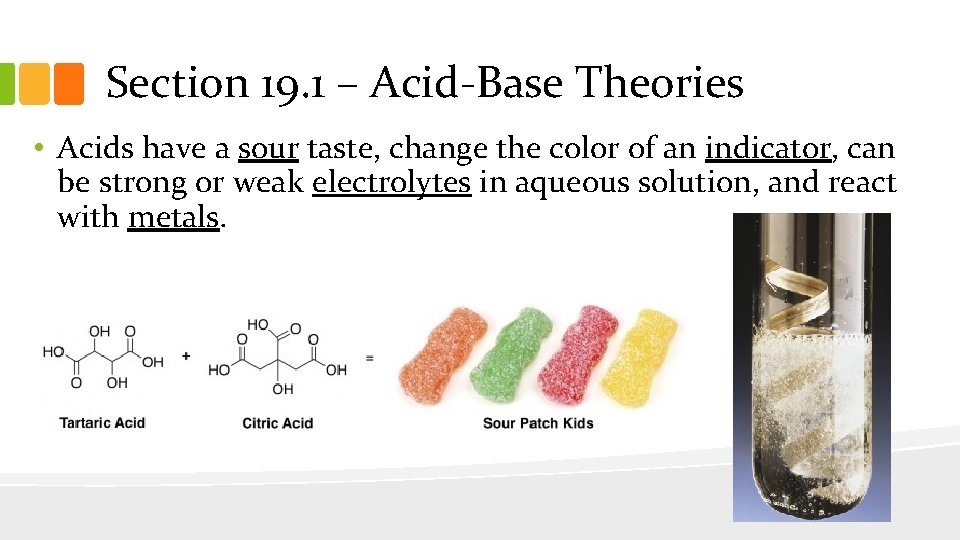
Section 19. 1 – Acid-Base Theories • Acids have a sour taste, change the color of an indicator, can be strong or weak electrolytes in aqueous solution, and react with metals.
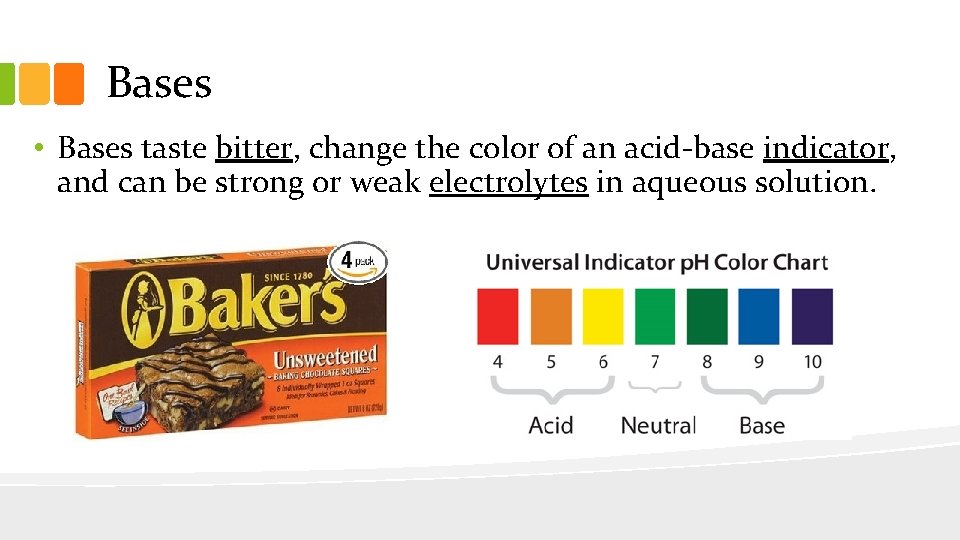
Bases • Bases taste bitter, change the color of an acid-base indicator, and can be strong or weak electrolytes in aqueous solution.
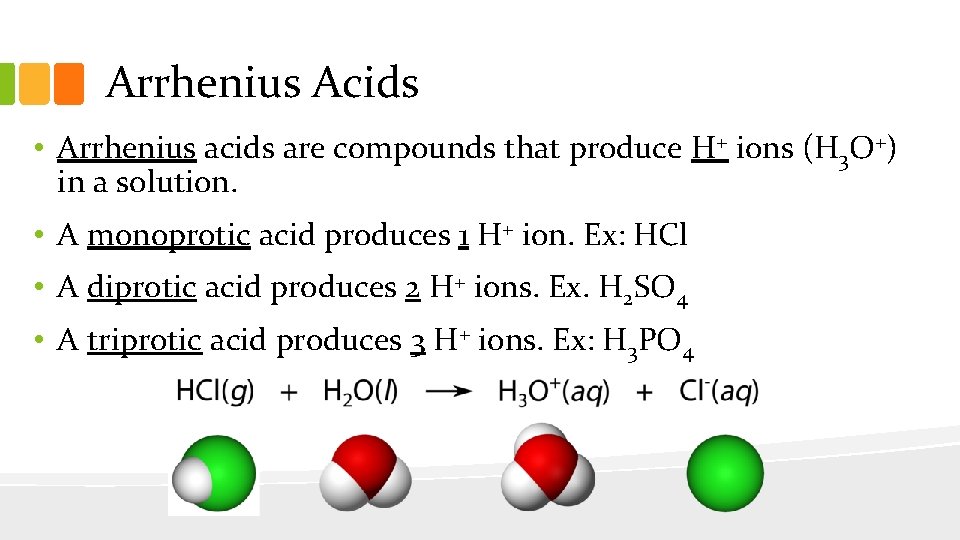
Arrhenius Acids • Arrhenius acids are compounds that produce H+ ions (H 3 O+) in a solution. • A monoprotic acid produces 1 H+ ion. Ex: HCl • A diprotic acid produces 2 H+ ions. Ex. H 2 SO 4 • A triprotic acid produces 3 H+ ions. Ex: H 3 PO 4
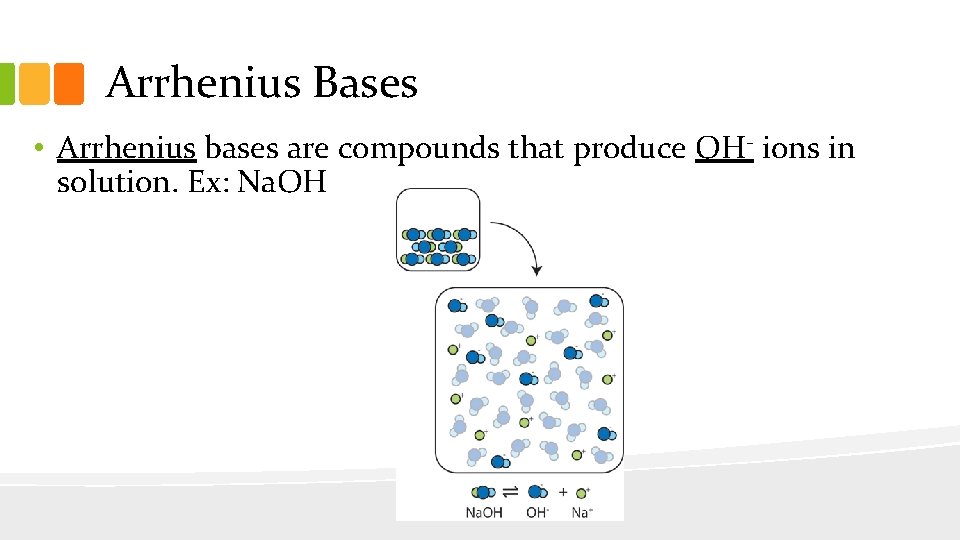
Arrhenius Bases • Arrhenius bases are compounds that produce OH- ions in solution. Ex: Na. OH
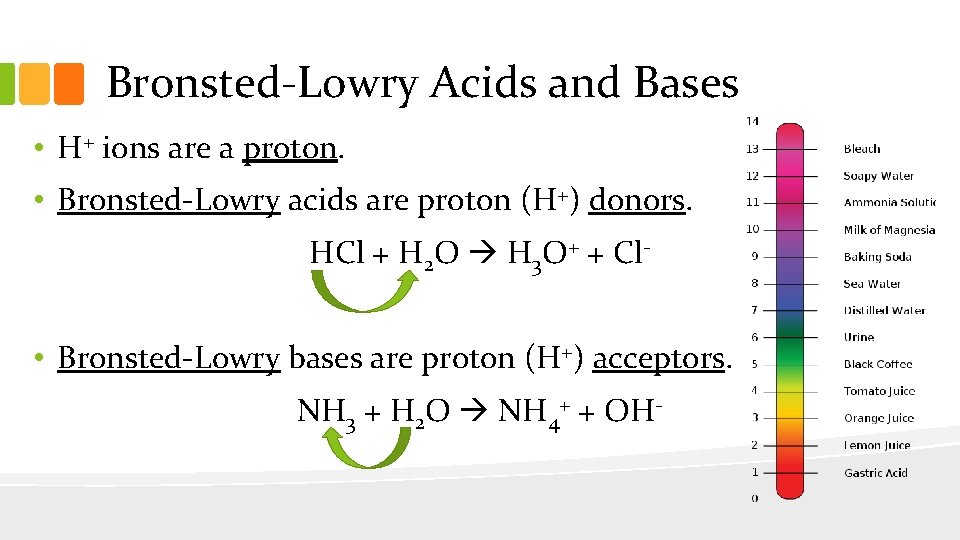
Bronsted-Lowry Acids and Bases • H+ ions are a proton. • Bronsted-Lowry acids are proton (H+) donors. HCl + H 2 O H 3 O+ + Cl- • Bronsted-Lowry bases are proton (H+) acceptors. NH 3 + H 2 O NH 4+ + OH-
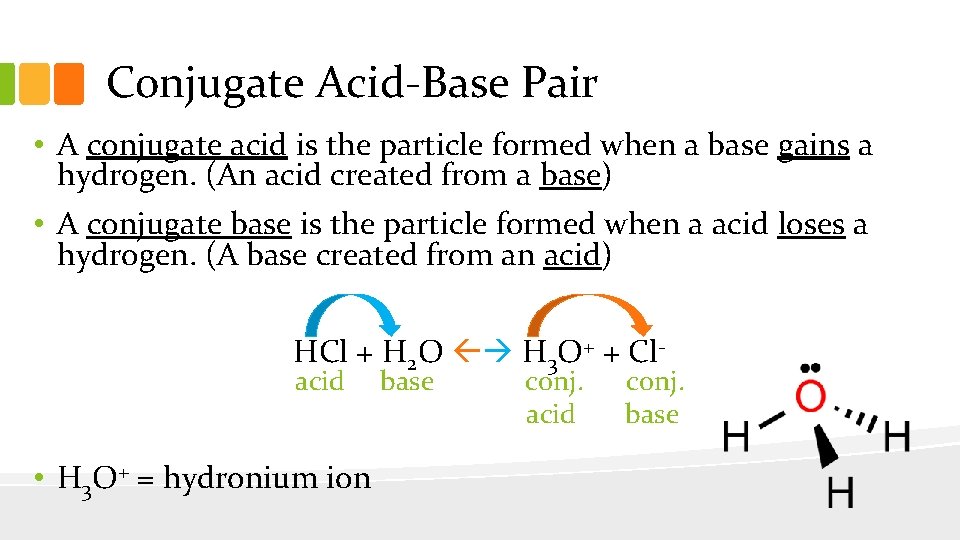
Conjugate Acid-Base Pair • A conjugate acid is the particle formed when a base gains a hydrogen. (An acid created from a base) • A conjugate base is the particle formed when a acid loses a hydrogen. (A base created from an acid) HCl + H 2 O H 3 O+ + Clacid • H 3 O+ = hydronium ion base conj. acid conj. base
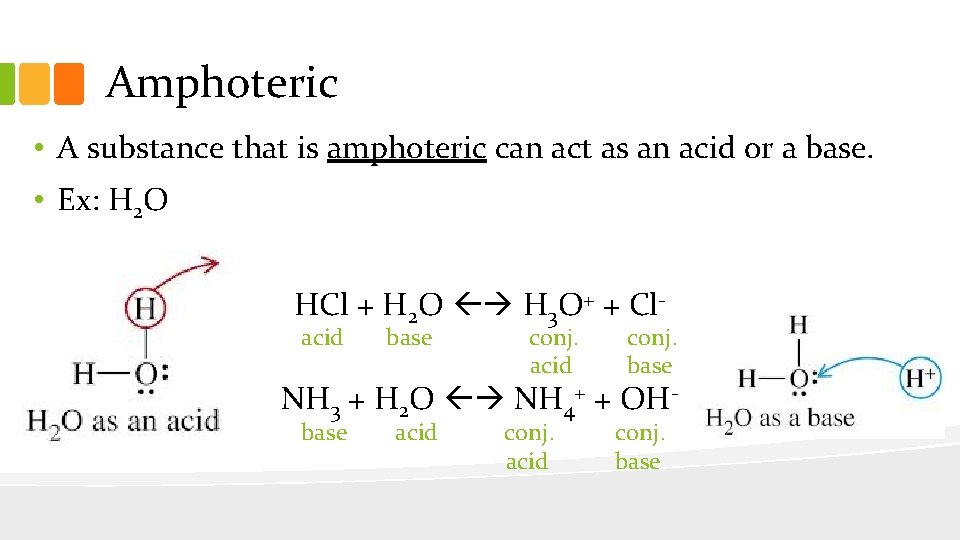
Amphoteric • A substance that is amphoteric can act as an acid or a base. • Ex: H 2 O HCl + H 2 O H 3 O+ + Clacid base conj. acid conj. base NH 3 + H 2 O NH 4+ + OHbase acid conj. base
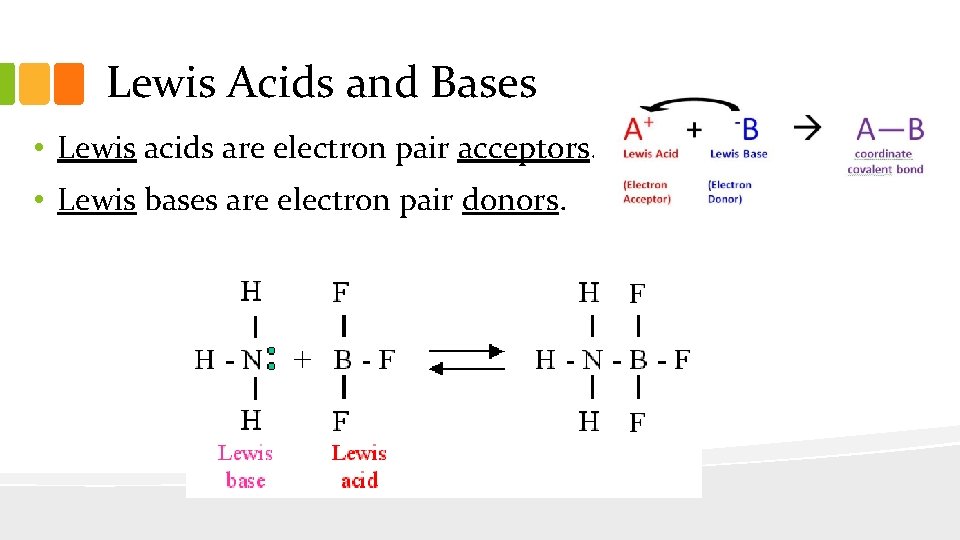
Lewis Acids and Bases • Lewis acids are electron pair acceptors. • Lewis bases are electron pair donors.
Section 19. 1 Assessment 1. What are the properties of acids and bases? 2. How did Arrhenius define an acid and a base? 3. How are acids and bases defined by the Bronsted-Lowry theory? 4. What is the Lewis theory of acids and bases? 5. Identify the following acids as monoprotic, diprotic, or triprotic. a. H 2 CO 3 b. H 3 PO 4 c. HCl d. H 2 SO 4
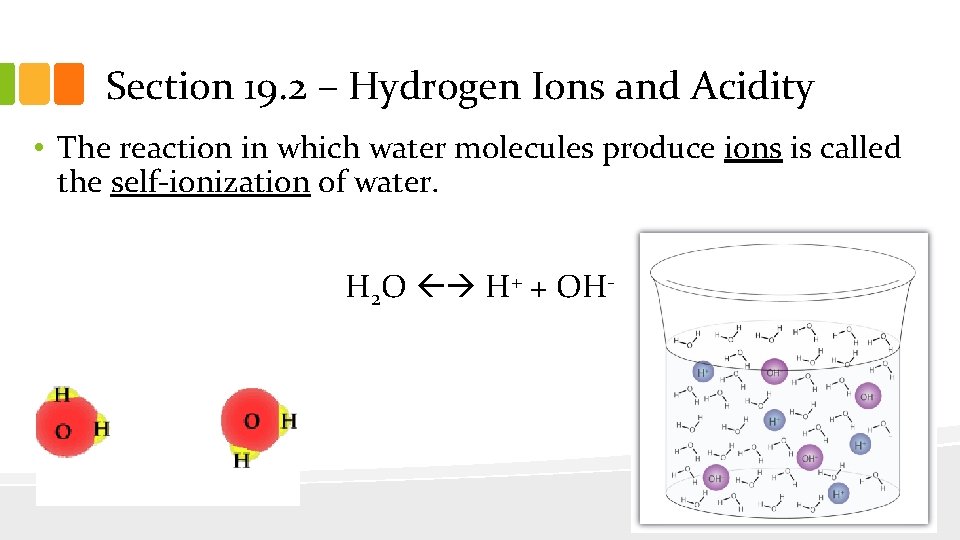
Section 19. 2 – Hydrogen Ions and Acidity • The reaction in which water molecules produce ions is called the self-ionization of water. H 2 O H+ + OH-
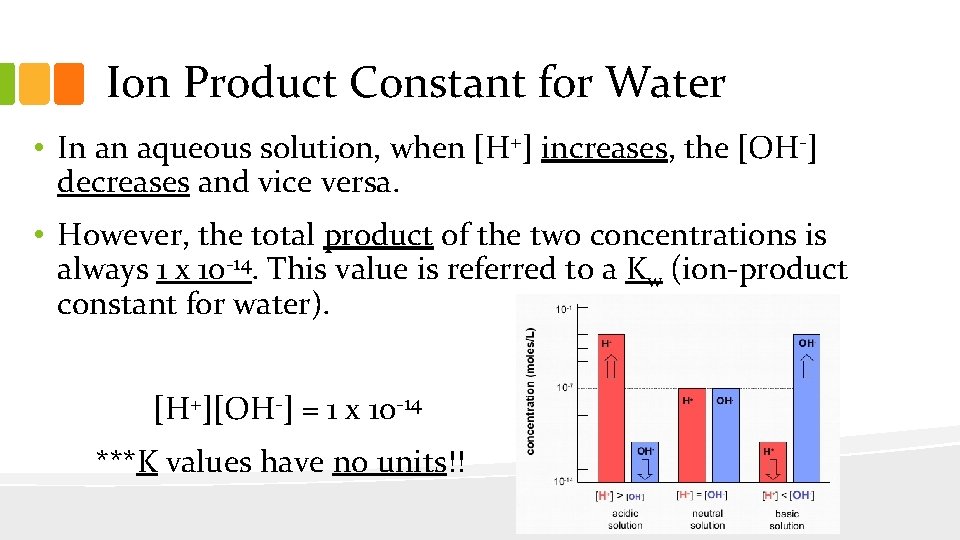
Ion Product Constant for Water • In an aqueous solution, when [H+] increases, the [OH-] decreases and vice versa. • However, the total product of the two concentrations is always 1 x 10 -14. This value is referred to a Kw (ion-product constant for water). [H+][OH-] = 1 x 10 -14 ***K values have no units!!
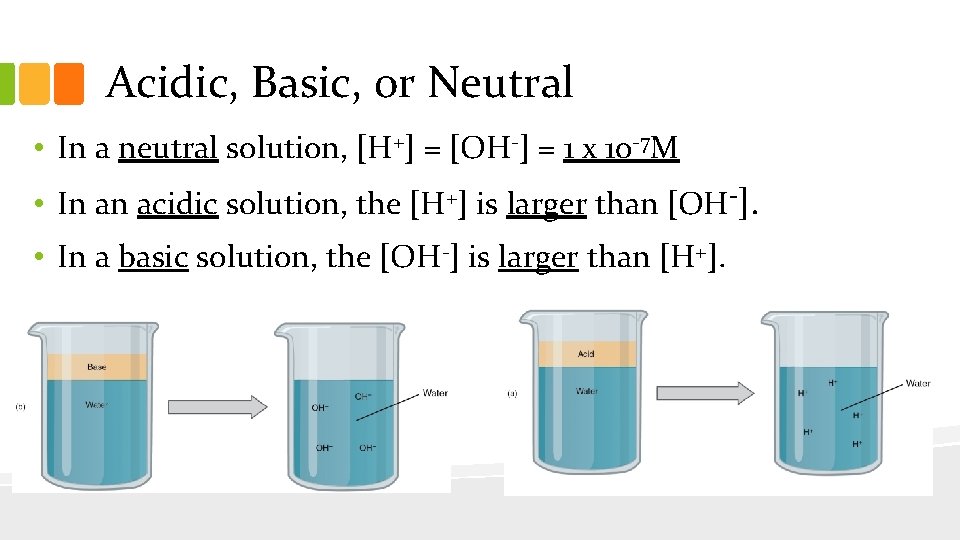
Acidic, Basic, or Neutral • In a neutral solution, [H+] = [OH-] = 1 x 10 -7 M • In an acidic solution, the [H+] is larger than [OH-]. • In a basic solution, the [OH-] is larger than [H+].
Sample Problem • If the [H+] in a coke is 1. 0 x 10 -5 M, what is the [OH-] and is the solution acidic, basic, or neutral? [OH-] = 1. 0 x 10 -9 M acidic
Practice Problems 1. Calculate the [OH-] of a solution that has an [H+] = 6. 0 x 10 -10 M. Is the solution acidic, basic, or neutral? [OH-] = 1. 67 x 10 -5 M basic 2. Calculate the [H+] of a solution that has a [OH-] = 3. 0 x 10 -2 M. Is the solution acidic, basic, or neutral? [H+] = 3. 33 x 10 -13 M basic
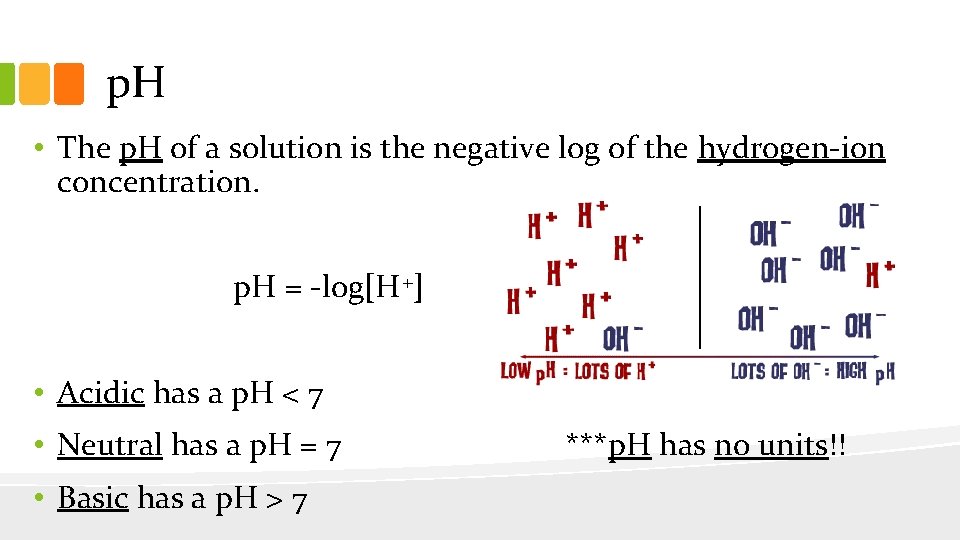
p. H • The p. H of a solution is the negative log of the hydrogen-ion concentration. p. H = -log[H +] • Acidic has a p. H < 7 • Neutral has a p. H = 7 • Basic has a p. H > 7 ***p. H has no units!!
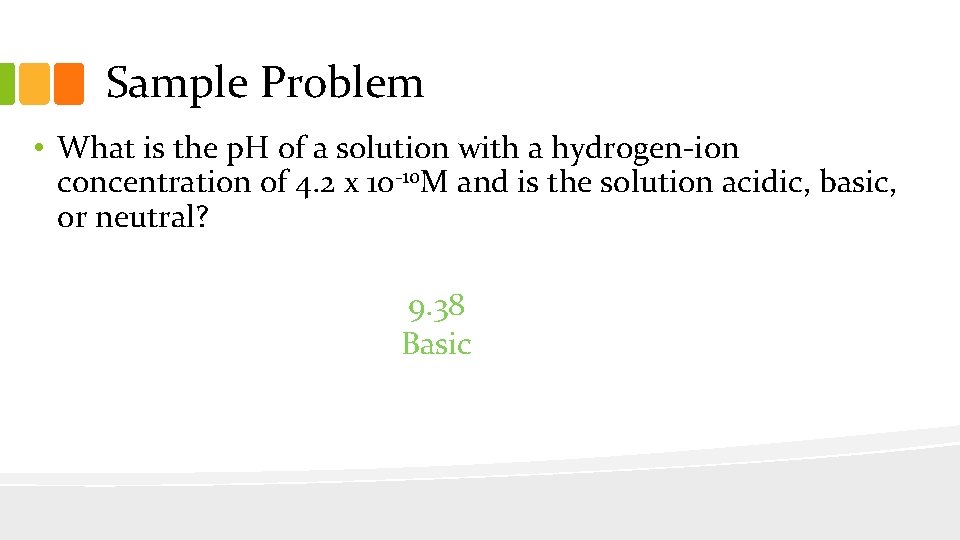
Sample Problem • What is the p. H of a solution with a hydrogen-ion concentration of 4. 2 x 10 -10 M and is the solution acidic, basic, or neutral? 9. 38 Basic
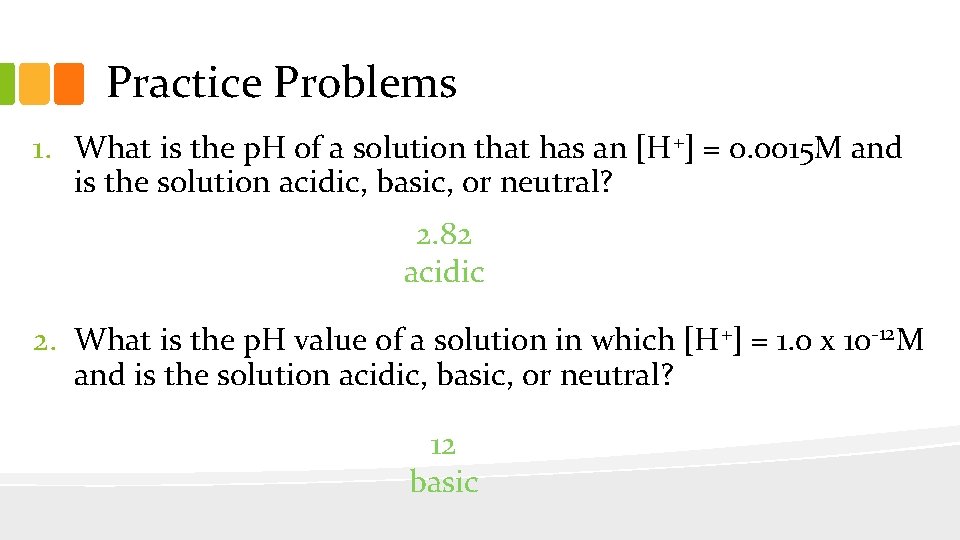
Practice Problems 1. What is the p. H of a solution that has an [H+] = 0. 0015 M and is the solution acidic, basic, or neutral? 2. 82 acidic 2. What is the p. H value of a solution in which [H+] = 1. 0 x 10 -12 M and is the solution acidic, basic, or neutral? 12 basic
p. OH • The p. OH scale measures the OH- concentration, so it is the opposite of the p. H scale. p. OH = -log[OH-] • Acidic has a p. OH > 7 • Neutral has a p. OH = 7 • Basic has a p. OH < 7 ***p. OH has no units!!
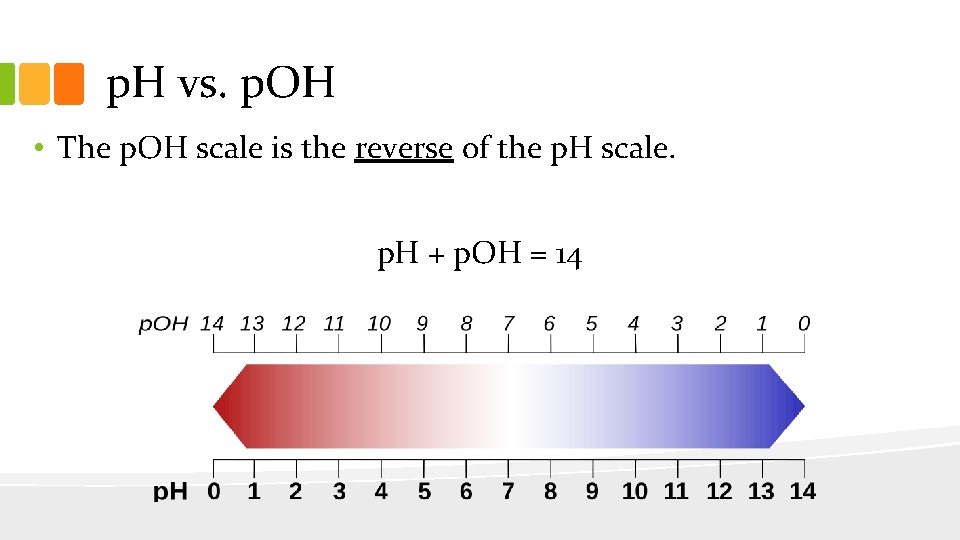
p. H vs. p. OH • The p. OH scale is the reverse of the p. H scale. p. H + p. OH = 14
Calculating Concentration • When going from the p. H or p. OH to concentration, you must rearrange the log formulas. [H+] = 10 -p. H [OH-] = 10 -p. OH
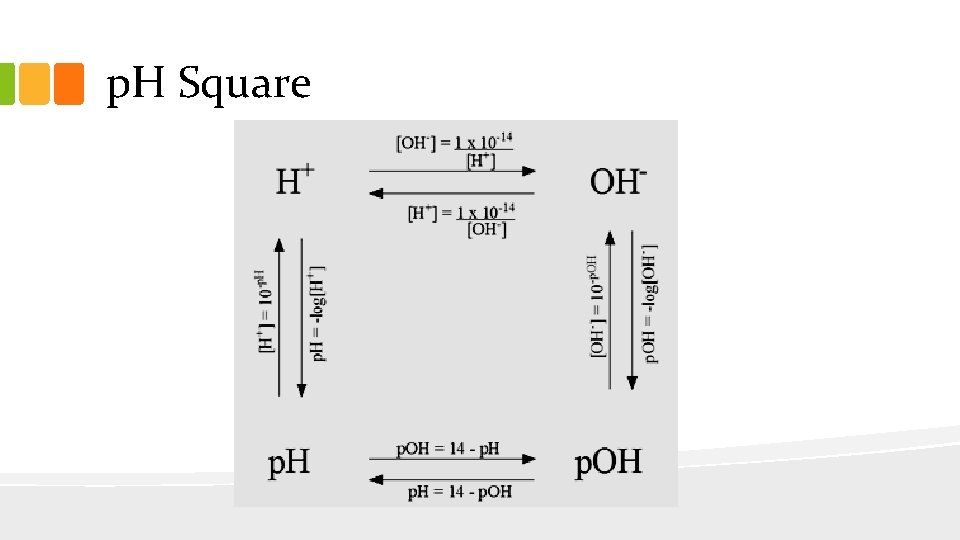
p. H Square
Sample Problem • The p. H of an unknown solution is 6. 35. What is the hydrogenion concentration and is the solution acidic, basic, or neutral? [H+] = 4. 5 x 10 -7 M acidic
Practice Problems 1. Calculate the p. H of a solution with a p. OH = 12. 17 and is the solution acidic, basic, or neutral? 1. 83 acidic 2. What is the p. H of a solution if [OH-] = 4. 0 x 10 -11 M and is the solution acidic, basic, or neutral? 3. 60 acidic
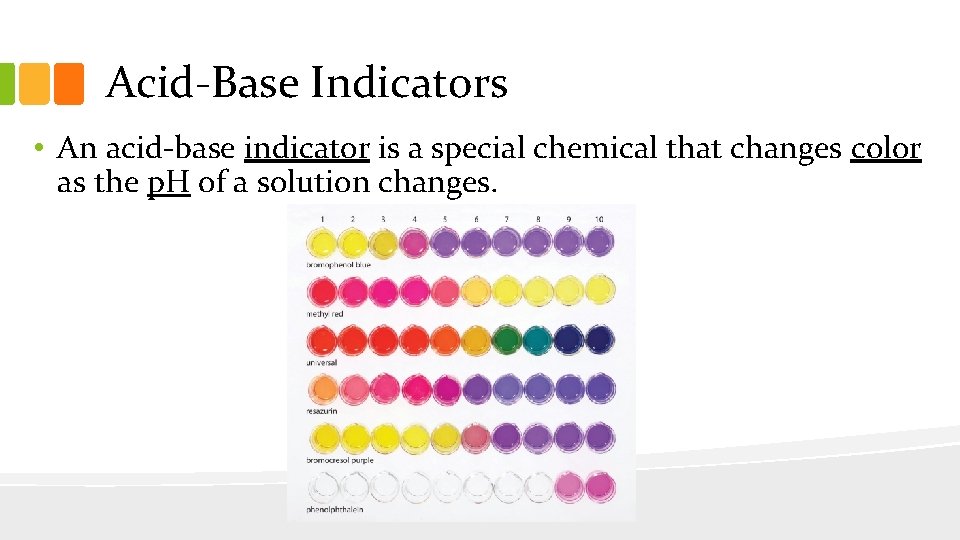
Acid-Base Indicators • An acid-base indicator is a special chemical that changes color as the p. H of a solution changes.
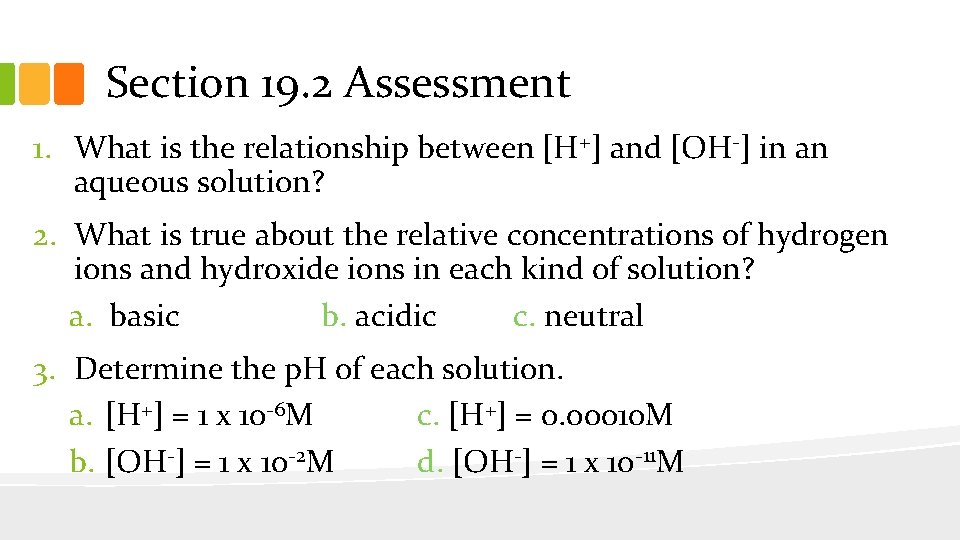
Section 19. 2 Assessment 1. What is the relationship between [H+] and [OH-] in an aqueous solution? 2. What is true about the relative concentrations of hydrogen ions and hydroxide ions in each kind of solution? a. basic b. acidic c. neutral 3. Determine the p. H of each solution. a. [H+] = 1 x 10 -6 M c. [H+] = 0. 00010 M b. [OH-] = 1 x 10 -2 M d. [OH-] = 1 x 10 -11 M
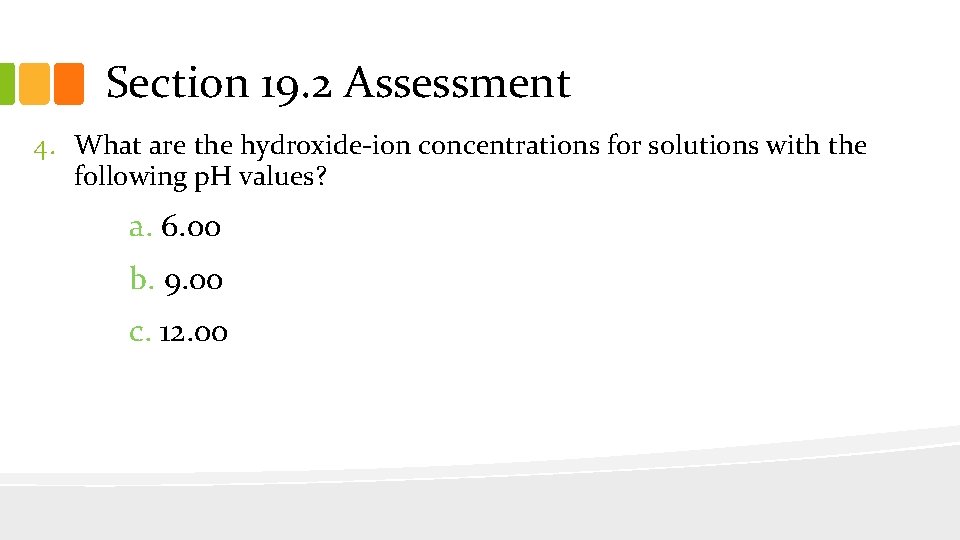
Section 19. 2 Assessment 4. What are the hydroxide-ion concentrations for solutions with the following p. H values? a. 6. 00 b. 9. 00 c. 12. 00
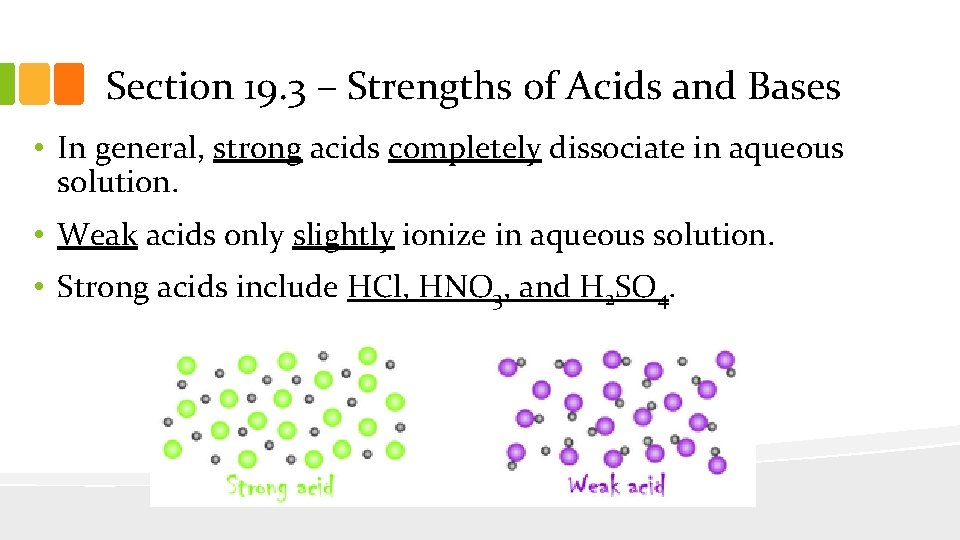
Section 19. 3 – Strengths of Acids and Bases • In general, strong acids completely dissociate in aqueous solution. • Weak acids only slightly ionize in aqueous solution. • Strong acids include HCl, HNO 3, and H 2 SO 4.
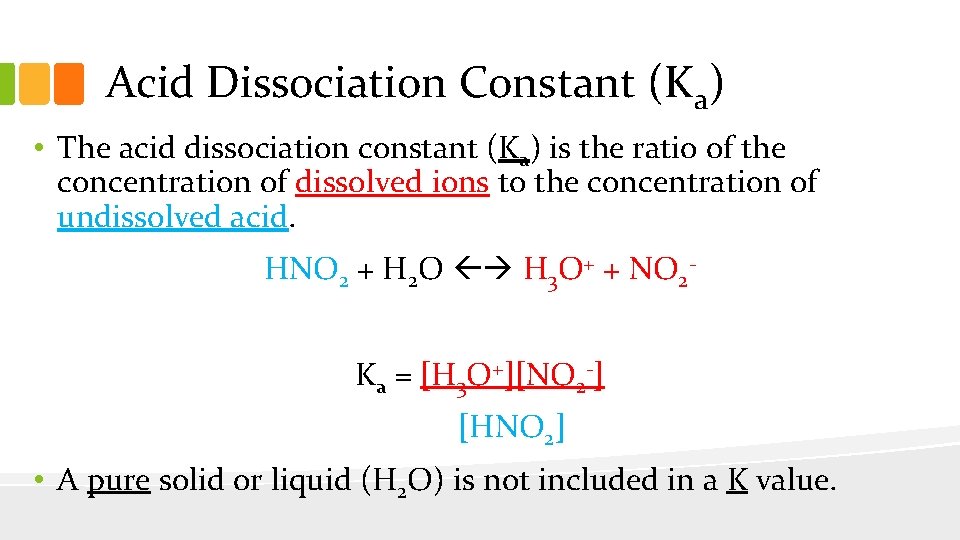
Acid Dissociation Constant (Ka) • The acid dissociation constant (Ka) is the ratio of the concentration of dissolved ions to the concentration of undissolved acid. HNO 2 + H 2 O H 3 O+ + NO 2 Ka = [H 3 O+][NO 2 -] [HNO 2] • A pure solid or liquid (H 2 O) is not included in a K value.
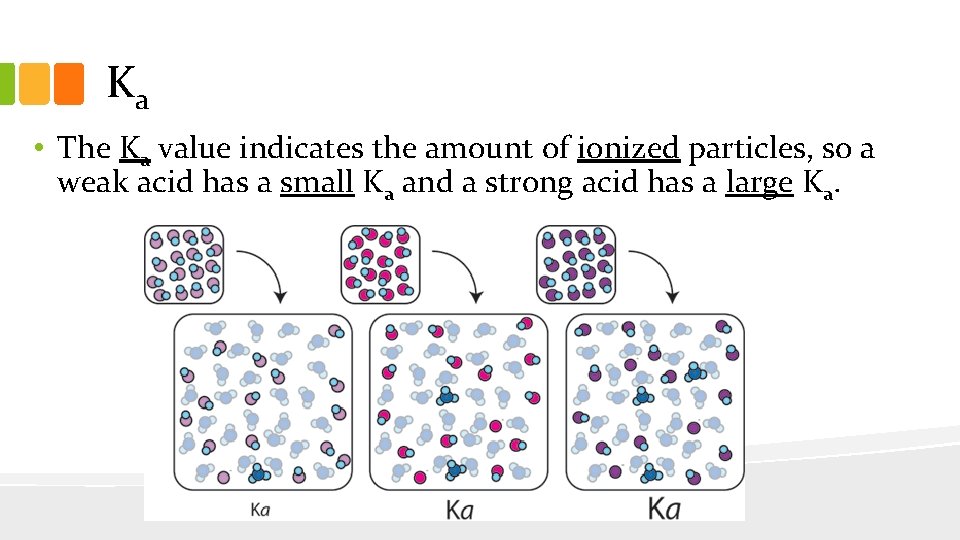
Ka • The Ka value indicates the amount of ionized particles, so a weak acid has a small Ka and a strong acid has a large Ka.
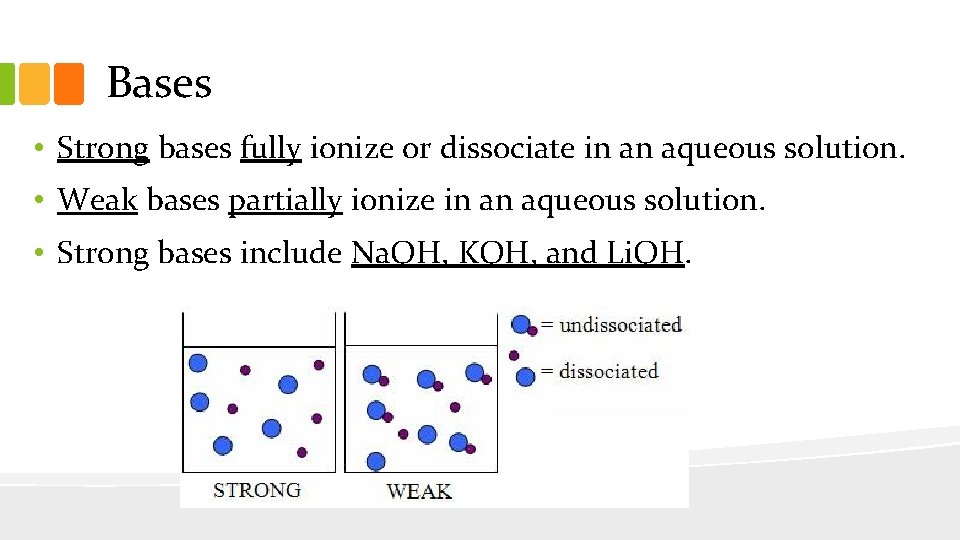
Bases • Strong bases fully ionize or dissociate in an aqueous solution. • Weak bases partially ionize in an aqueous solution. • Strong bases include Na. OH, KOH, and Li. OH.
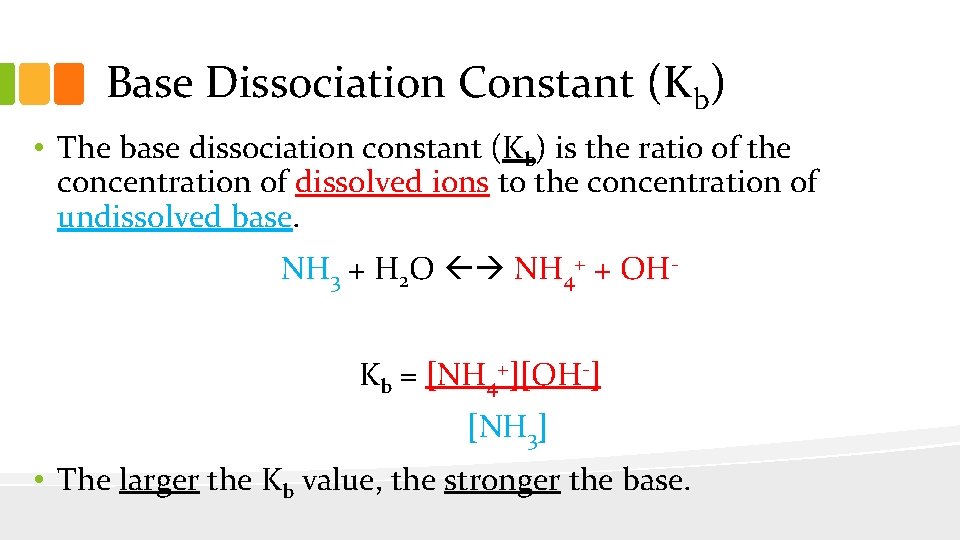
Base Dissociation Constant (Kb) • The base dissociation constant (Kb) is the ratio of the concentration of dissolved ions to the concentration of undissolved base. NH 3 + H 2 O NH 4+ + OHKb = [NH 4+][OH-] [NH 3] • The larger the Kb value, the stronger the base.
Generic K Equations • The generic Ka formula: HA H+ + AKa = [H+][A-] [HA] • The generic Kb formula: B + H 2 O BH+ + OHKb = [BH+][OH-] [B]
Sample Problem • A 0. 1000 M solution of ethanoic acid is only partially ionized. From measurements of the p. H of the solution, [H+] is determined to be 1. 34 x 10 -3 M. What is the acid dissociation constant (Ka) of ethanoic acid? It doesn’t matter whether or not you know what the formula for ethanoic acid is. CH 3 COOH + H 2 O H 3 O+ + CH 3 COORemember the generic formula HA H+ + AKa = [H+][A-] [HA]
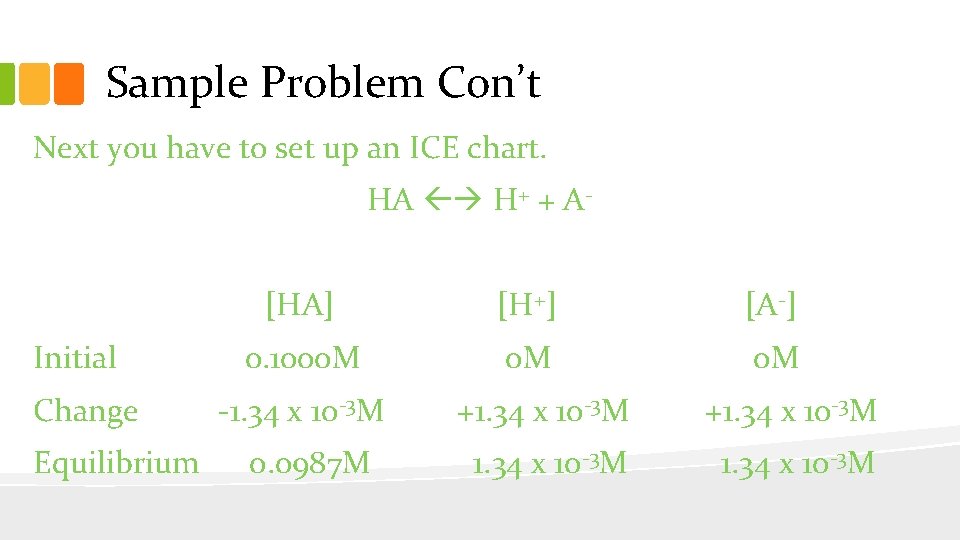
Sample Problem Con’t Next you have to set up an ICE chart. HA H+ + A- Initial Change Equilibrium [HA] [H+] [A-] 0. 1000 M 0 M 0 M -1. 34 x 10 -3 M +1. 34 x 10 -3 M 0. 0987 M 1. 34 x 10 -3 M
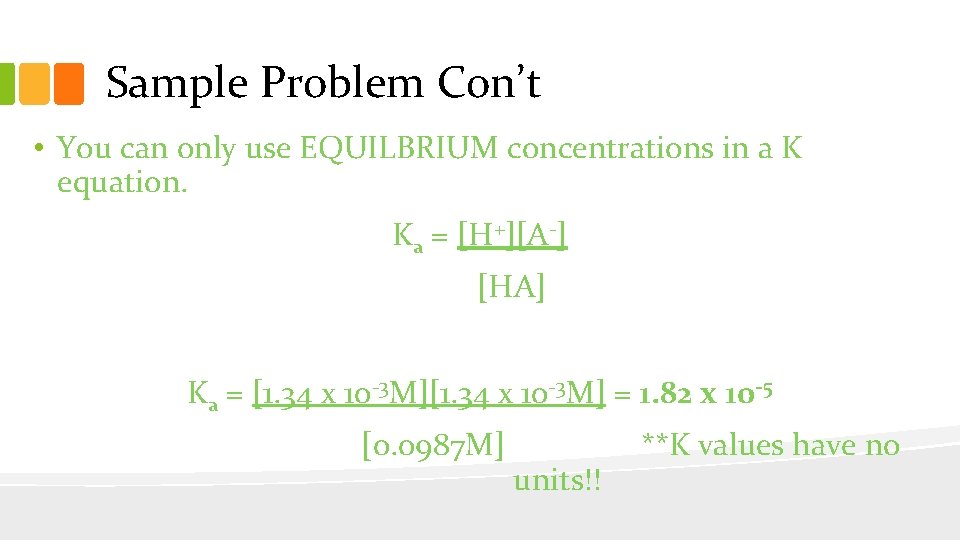
Sample Problem Con’t • You can only use EQUILBRIUM concentrations in a K equation. Ka = [H+][A-] [HA] Ka = [1. 34 x 10 -3 M] = 1. 82 x 10 -5 [0. 0987 M] units!! **K values have no
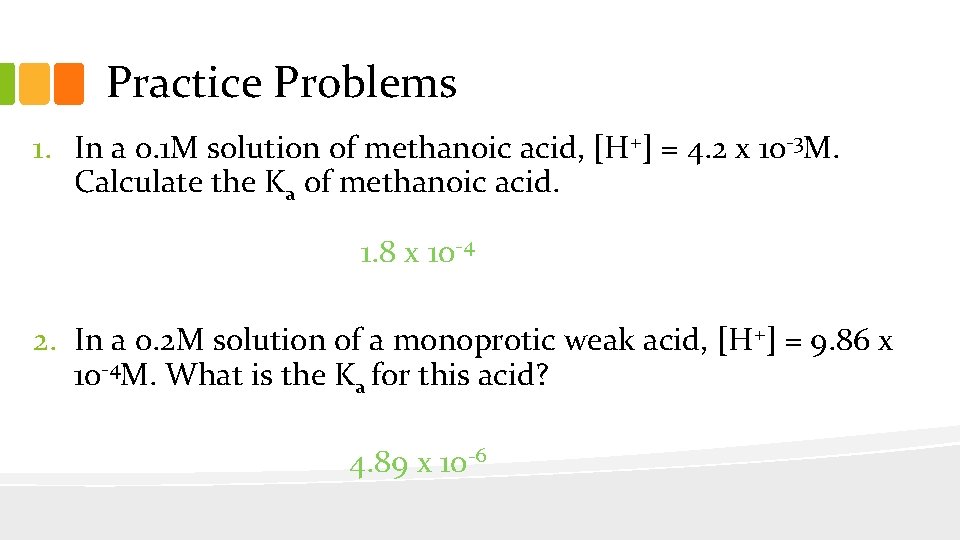
Practice Problems 1. In a 0. 1 M solution of methanoic acid, [H+] = 4. 2 x 10 -3 M. Calculate the Ka of methanoic acid. 1. 8 x 10 -4 2. In a 0. 2 M solution of a monoprotic weak acid, [H+] = 9. 86 x 10 -4 M. What is the Ka for this acid? 4. 89 x 10 -6
Section 19. 3 Assessment 3. Compare a strong acid and a weak acid in terms of the acid dissociation constant.
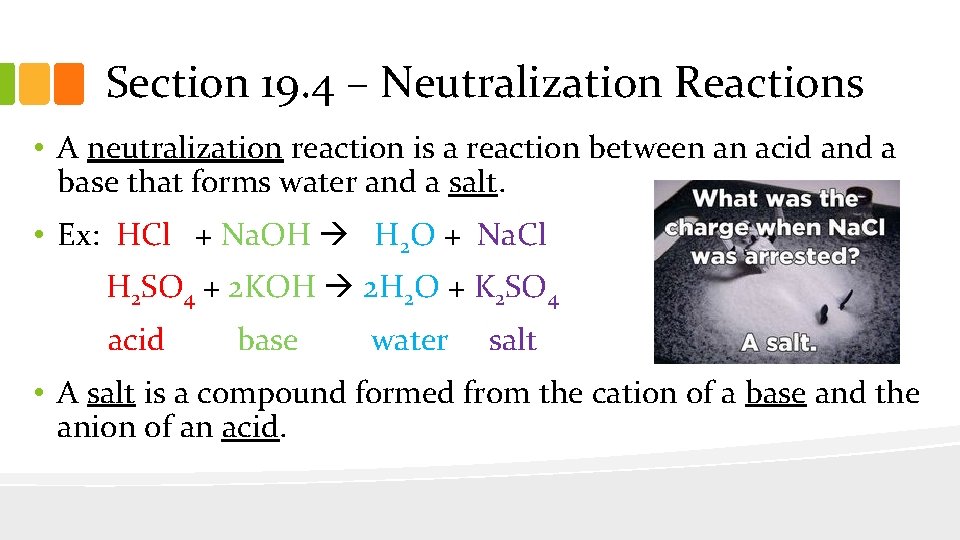
Section 19. 4 – Neutralization Reactions • A neutralization reaction is a reaction between an acid and a base that forms water and a salt. • Ex: HCl + Na. OH H 2 O + Na. Cl H 2 SO 4 + 2 KOH 2 H 2 O + K 2 SO 4 acid base water salt • A salt is a compound formed from the cation of a base and the anion of an acid.
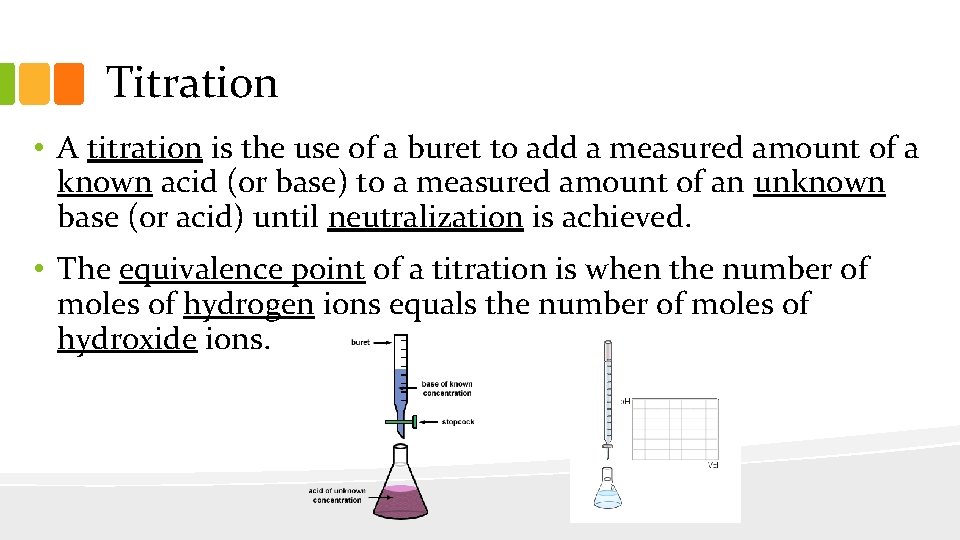
Titration • A titration is the use of a buret to add a measured amount of a known acid (or base) to a measured amount of an unknown base (or acid) until neutralization is achieved. • The equivalence point of a titration is when the number of moles of hydrogen ions equals the number of moles of hydroxide ions.
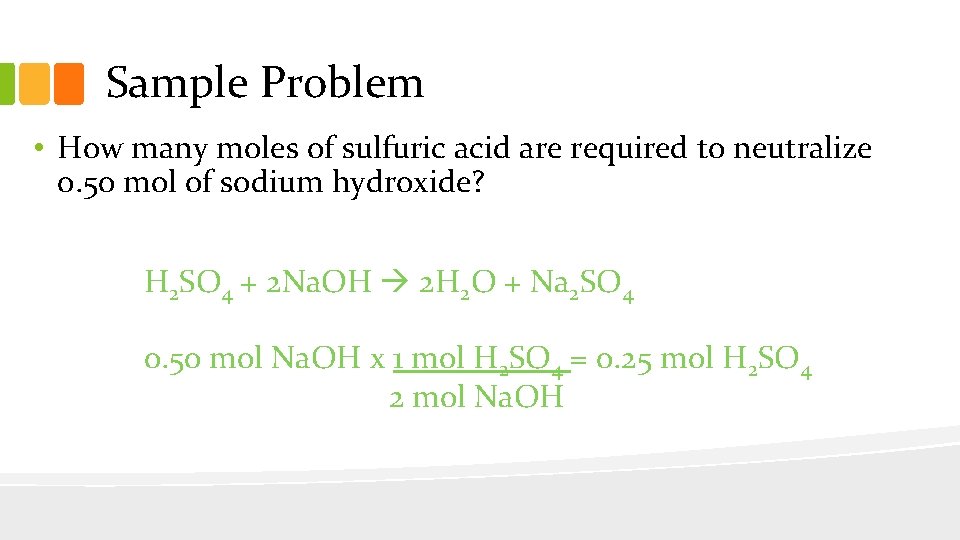
Sample Problem • How many moles of sulfuric acid are required to neutralize 0. 50 mol of sodium hydroxide? H 2 SO 4 + 2 Na. OH 2 H 2 O + Na 2 SO 4 0. 50 mol Na. OH x 1 mol H 2 SO 4 = 0. 25 mol H 2 SO 4 2 mol Na. OH
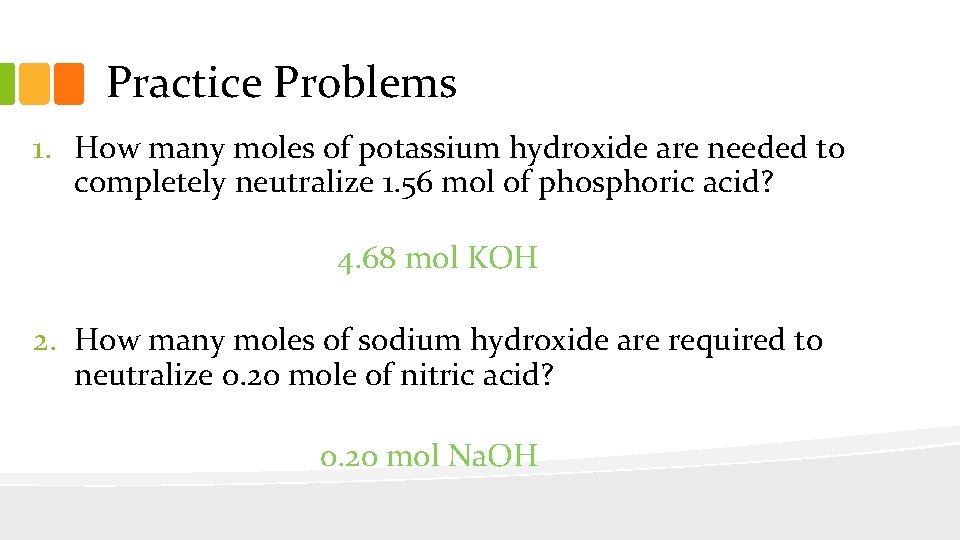
Practice Problems 1. How many moles of potassium hydroxide are needed to completely neutralize 1. 56 mol of phosphoric acid? 4. 68 mol KOH 2. How many moles of sodium hydroxide are required to neutralize 0. 20 mole of nitric acid? 0. 20 mol Na. OH
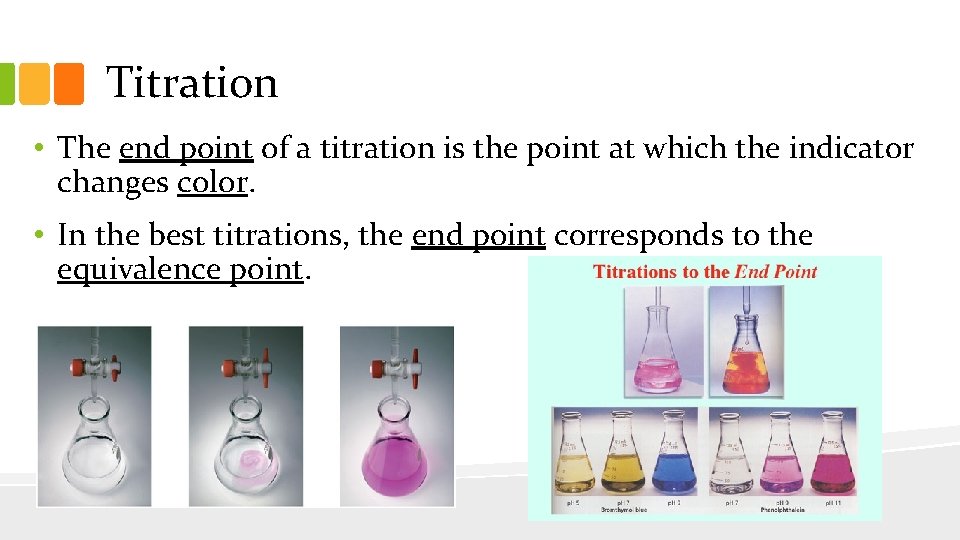
Titration • The end point of a titration is the point at which the indicator changes color. • In the best titrations, the end point corresponds to the equivalence point.
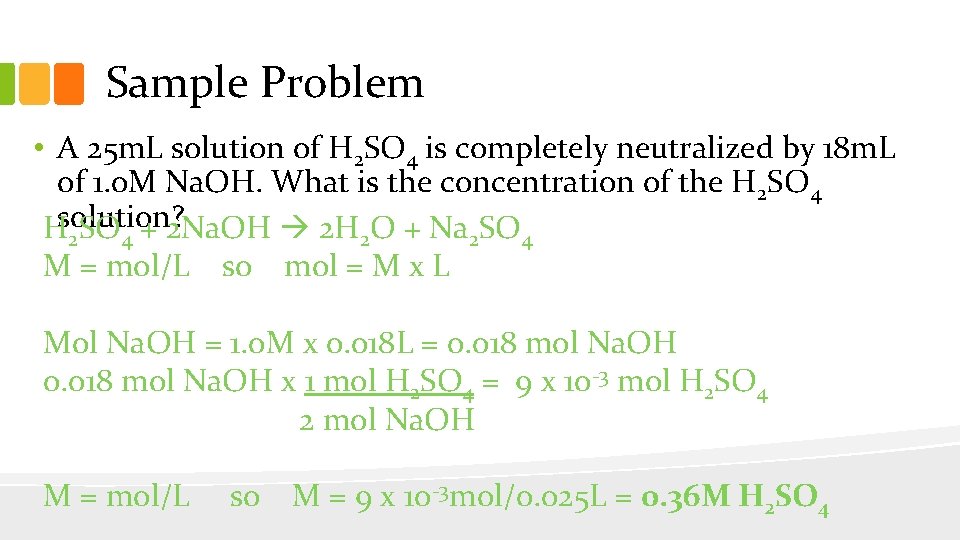
Sample Problem • A 25 m. L solution of H 2 SO 4 is completely neutralized by 18 m. L of 1. 0 M Na. OH. What is the concentration of the H 2 SO 4 Hsolution? 2 SO 4 + 2 Na. OH 2 H 2 O + Na 2 SO 4 M = mol/L so mol = M x L Mol Na. OH = 1. 0 M x 0. 018 L = 0. 018 mol Na. OH x 1 mol H 2 SO 4 = 9 x 10 -3 mol H 2 SO 4 2 mol Na. OH M = mol/L so M = 9 x 10 -3 mol/0. 025 L = 0. 36 M H 2 SO 4
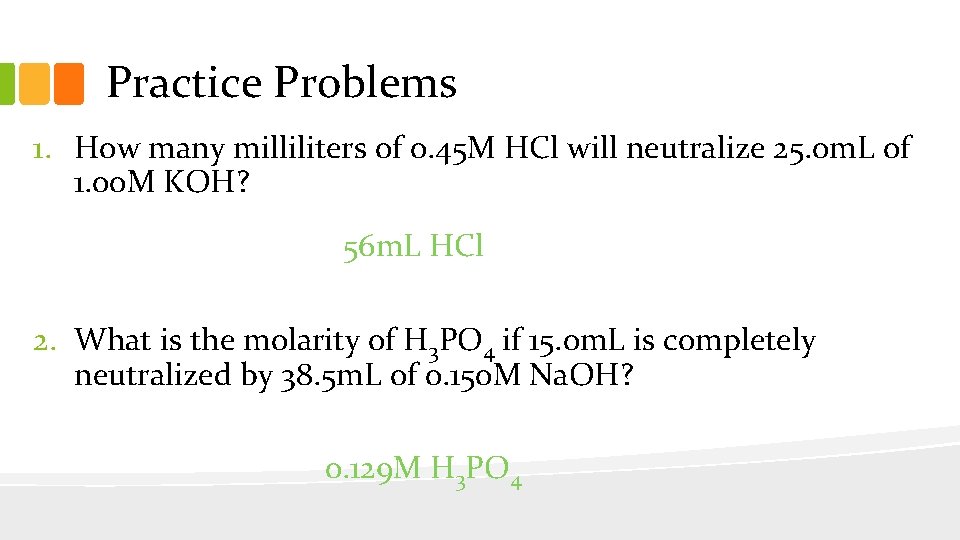
Practice Problems 1. How many milliliters of 0. 45 M HCl will neutralize 25. 0 m. L of 1. 00 M KOH? 56 m. L HCl 2. What is the molarity of H 3 PO 4 if 15. 0 m. L is completely neutralized by 38. 5 m. L of 0. 150 M Na. OH? 0. 129 M H 3 PO 4
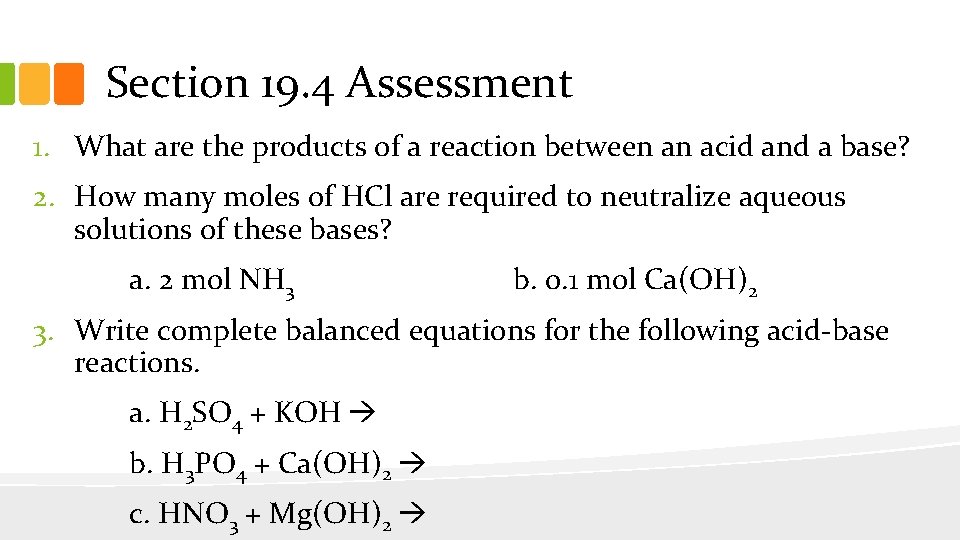
Section 19. 4 Assessment 1. What are the products of a reaction between an acid and a base? 2. How many moles of HCl are required to neutralize aqueous solutions of these bases? a. 2 mol NH 3 b. 0. 1 mol Ca(OH)2 3. Write complete balanced equations for the following acid-base reactions. a. H 2 SO 4 + KOH b. H 3 PO 4 + Ca(OH)2 c. HNO 3 + Mg(OH)2
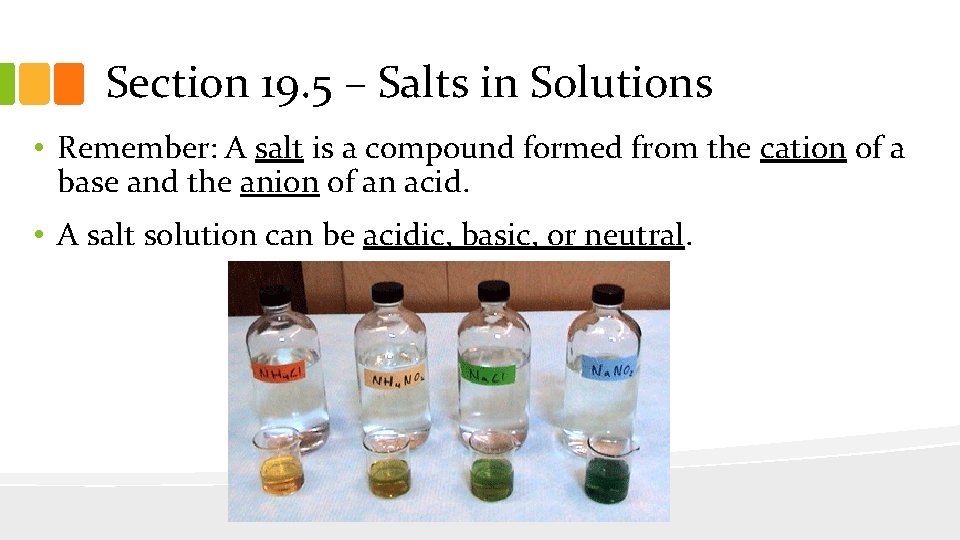
Section 19. 5 – Salts in Solutions • Remember: A salt is a compound formed from the cation of a base and the anion of an acid. • A salt solution can be acidic, basic, or neutral.
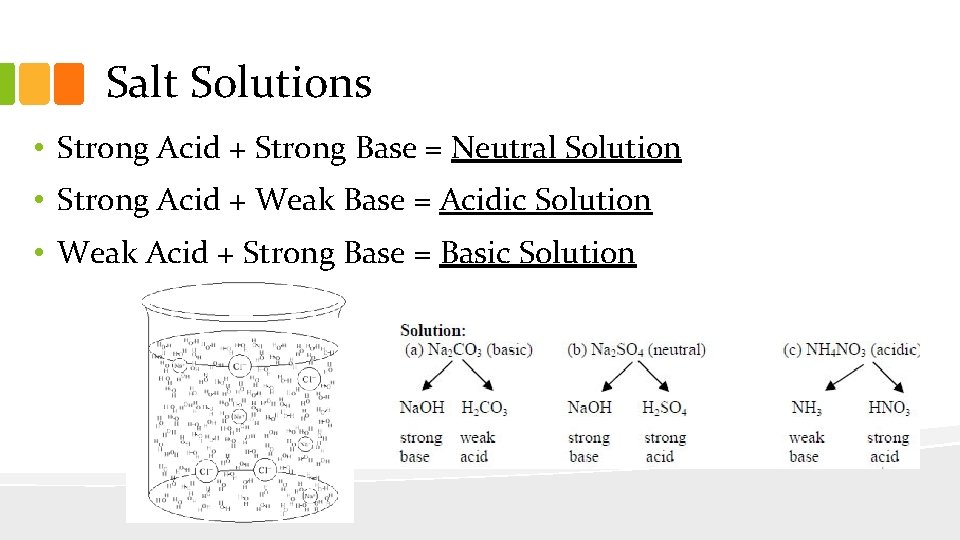
Salt Solutions • Strong Acid + Strong Base = Neutral Solution • Strong Acid + Weak Base = Acidic Solution • Weak Acid + Strong Base = Basic Solution
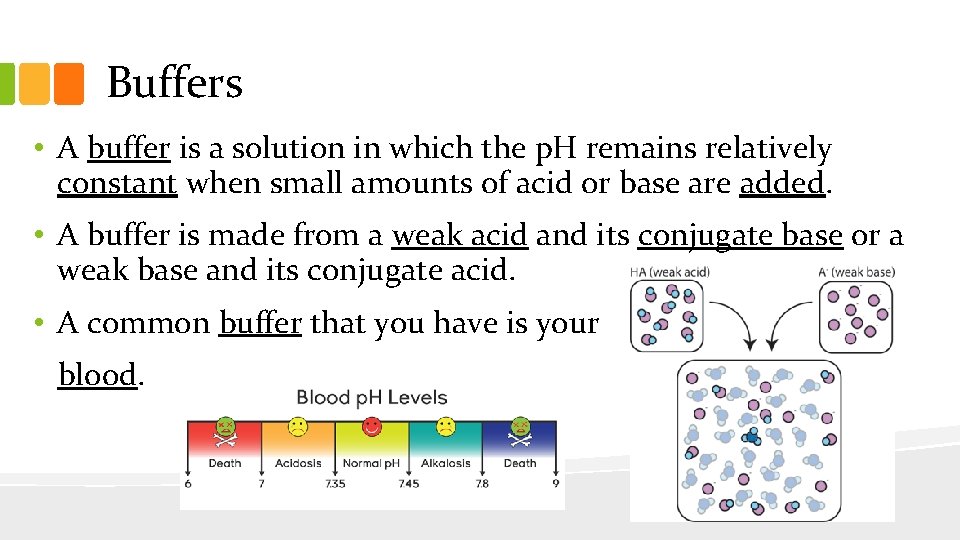
Buffers • A buffer is a solution in which the p. H remains relatively constant when small amounts of acid or base are added. • A buffer is made from a weak acid and its conjugate base or a weak base and its conjugate acid. • A common buffer that you have is your blood.
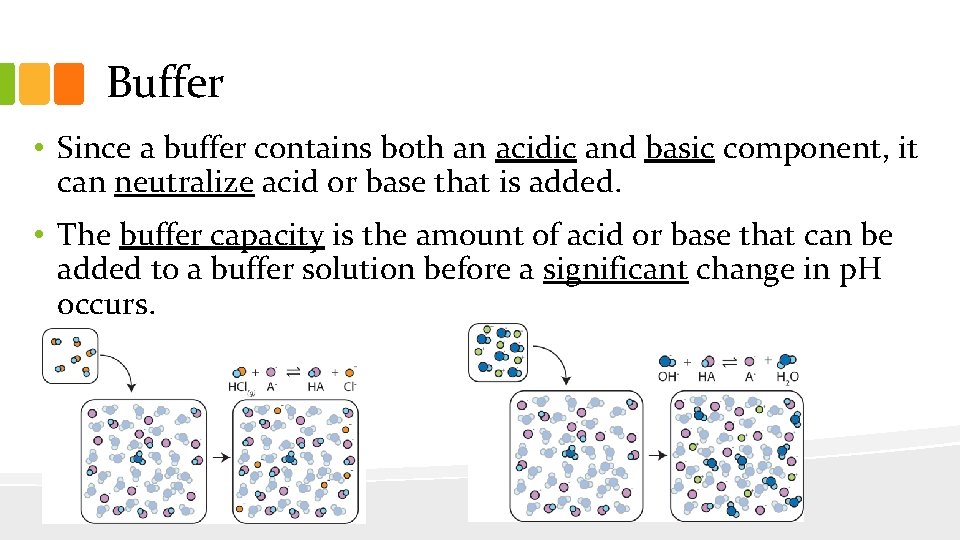
Buffer • Since a buffer contains both an acidic and basic component, it can neutralize acid or base that is added. • The buffer capacity is the amount of acid or base that can be added to a buffer solution before a significant change in p. H occurs.
Section 19. 5 Assessment 1. What substances are combined to make a buffer? 2. Which of these salts would form an acidic aqueous solution? a. KC 2 H 3 O 2 b. Li. Cl c. Na. HCO 3 d. (NH 4)2 SO 4

THE END
- Slides: 52