
Chapter 19 Acids Bases 1 Properties of Acids
Chapter 19 Acids & Bases 1
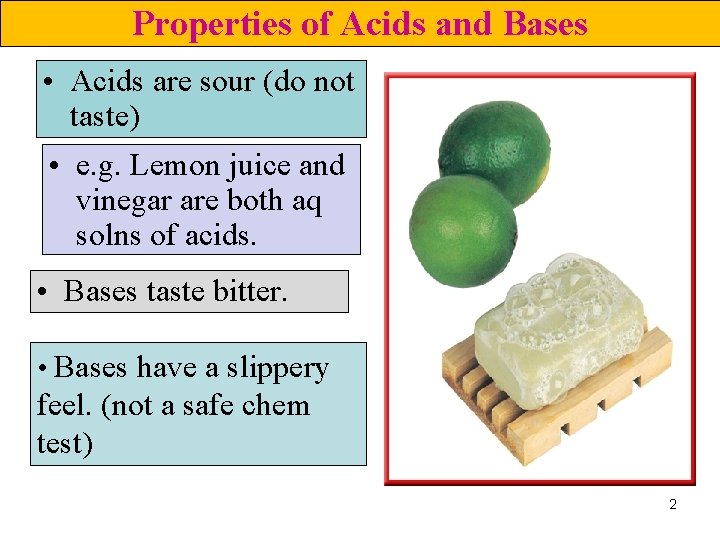
Properties of Acids and Bases • Acids are sour (do not taste) • e. g. Lemon juice and vinegar are both aq solns of acids. • Bases taste bitter. • Bases have a slippery feel. (not a safe chem test) 2
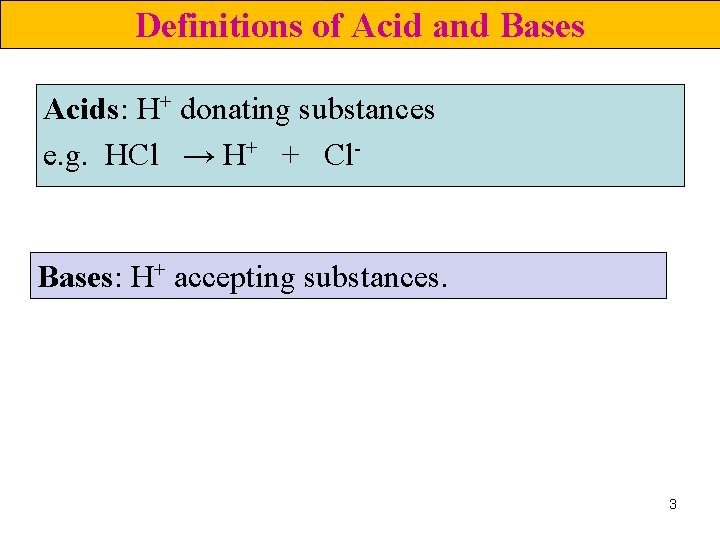
Definitions of Acid and Bases Acids: H+ donating substances e. g. HCl → H+ + Cl- Bases: H+ accepting substances. 3
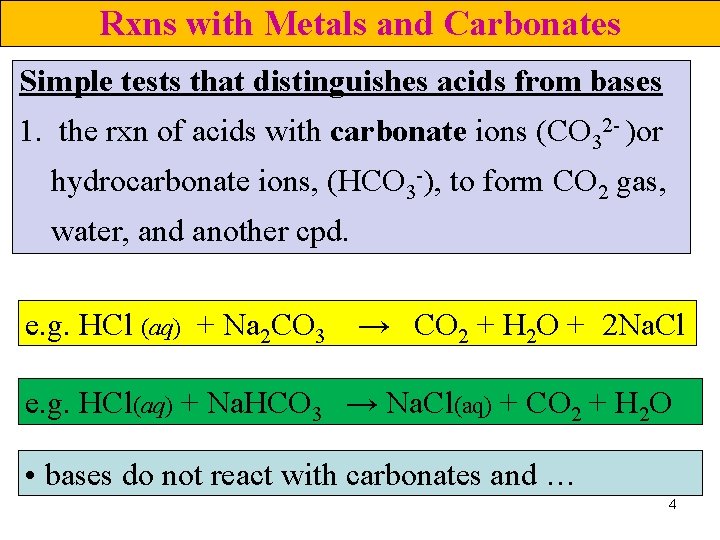
Rxns with Metals and Carbonates Simple tests that distinguishes acids from bases 1. the rxn of acids with carbonate ions (CO 32 - )or hydrocarbonate ions, (HCO 3 -), to form CO 2 gas, water, and another cpd. e. g. HCl (aq) + Na 2 CO 3 → CO 2 + H 2 O + 2 Na. Cl e. g. HCl(aq) + Na. HCO 3 → Na. Cl(aq) + CO 2 + H 2 O • bases do not react with carbonates and … 4
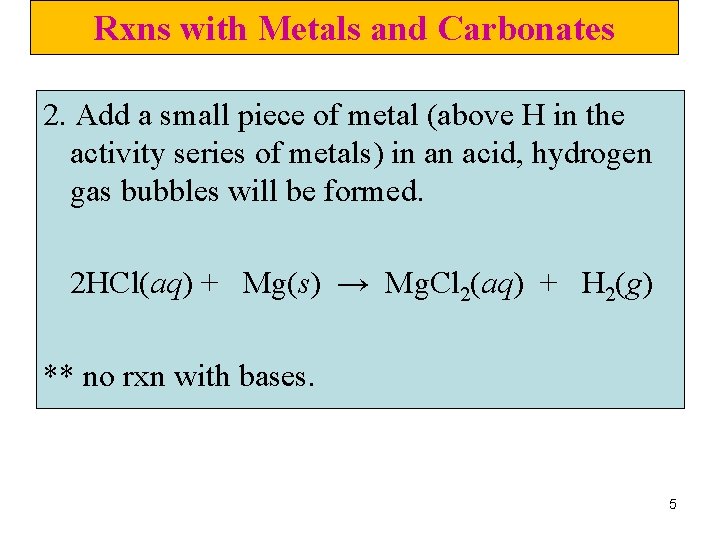
Rxns with Metals and Carbonates 2. Add a small piece of metal (above H in the activity series of metals) in an acid, hydrogen gas bubbles will be formed. 2 HCl(aq) + Mg(s) → Mg. Cl 2(aq) + H 2(g) ** no rxn with bases. 5

Submicroscopic Behavior of Acids The simplest definition of an acid • a sub that produces (H+) when it dissolves in water. Acidity of a soln depends on the [H+] in the soln 6
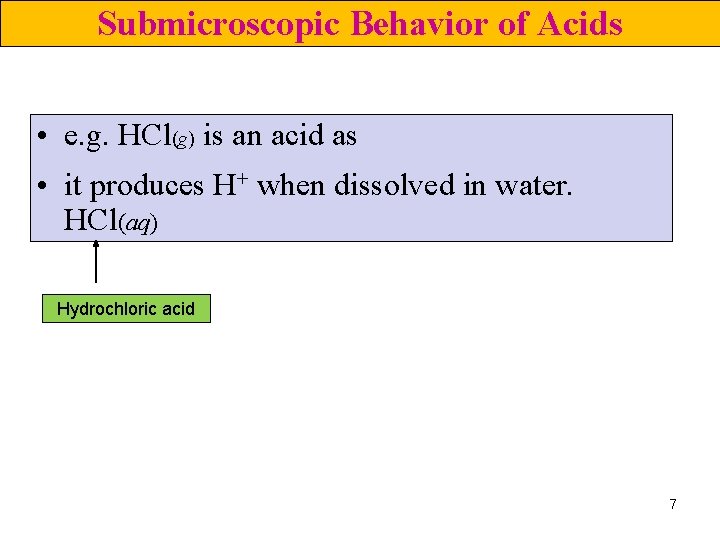
Submicroscopic Behavior of Acids • e. g. HCl(g) is an acid as • it produces H+ when dissolved in water. HCl(aq) Hydrochloric acid 7
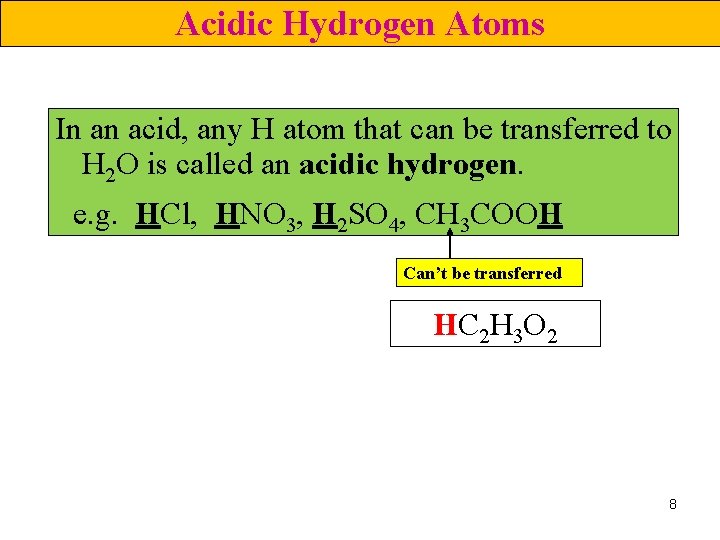
Acidic Hydrogen Atoms In an acid, any H atom that can be transferred to H 2 O is called an acidic hydrogen. e. g. HCl, HNO 3, H 2 SO 4, CH 3 COOH Can’t be transferred HC 2 H 3 O 2 8
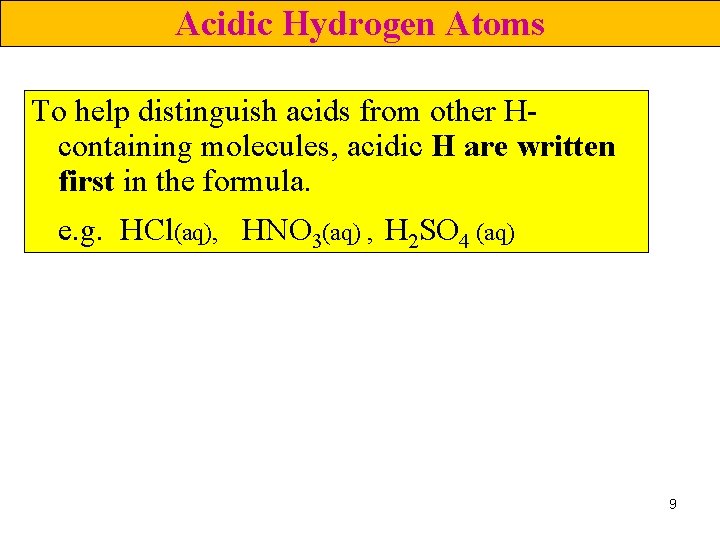
Acidic Hydrogen Atoms To help distinguish acids from other Hcontaining molecules, acidic H are written first in the formula. e. g. HCl(aq), HNO 3(aq) , H 2 SO 4 (aq) 9
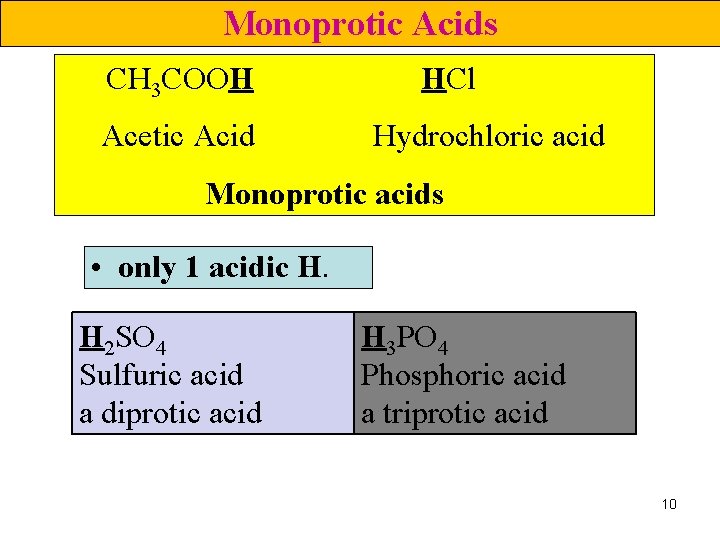
Monoprotic Acids CH 3 COOH Acetic Acid HCl Hydrochloric acid Monoprotic acids • only 1 acidic H. H 2 SO 4 Sulfuric acid a diprotic acid H 3 PO 4 Phosphoric acid a triprotic acid 10
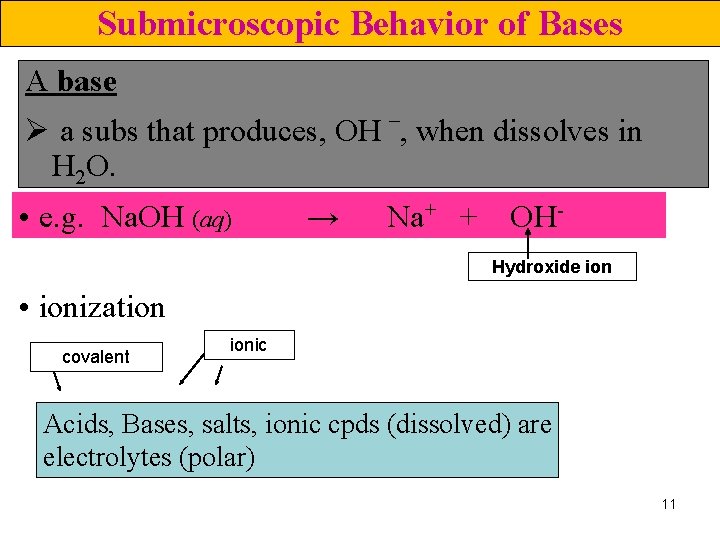
Submicroscopic Behavior of Bases A base – Ø a subs that produces, OH , when dissolves in H 2 O. • e. g. Na. OH (aq) → Na+ + OHHydroxide ion • ionization covalent ionic Acids, Bases, salts, ionic cpds (dissolved) are electrolytes (polar) 11
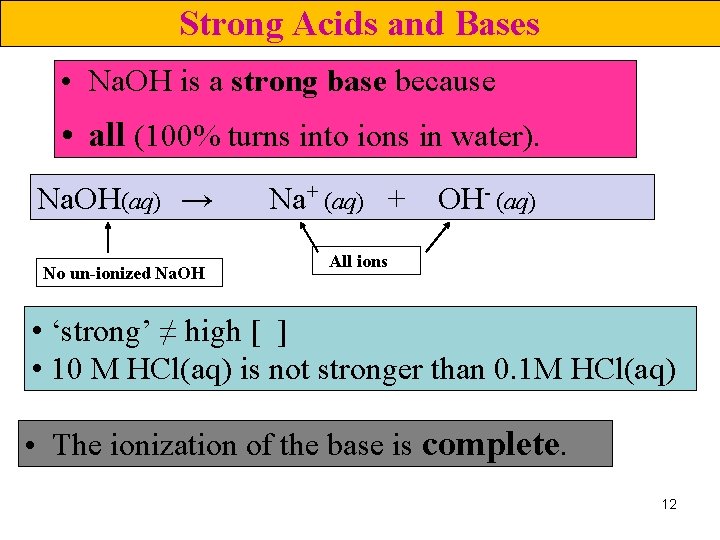
Strong Acids and Bases • Na. OH is a strong base because • all (100% turns into ions in water). Na. OH(aq) → No un-ionized Na. OH Na+ (aq) + OH- (aq) All ions • ‘strong’ ≠ high [ ] • 10 M HCl(aq) is not stronger than 0. 1 M HCl(aq) • The ionization of the base is complete. 12

Strong and Weak Acids Strong Acids Weak Acids Hydrochloric acid Acetic acid Sulfuric acid Carbonic acid H 2 CO 3 Nitric acid Not 100% ionized CH 3 COOH(s) CH 3 COO−(aq) + H+(aq) weak HCl(g) strong < 10% most → H+ (aq) + Cl- (aq) 100% 13
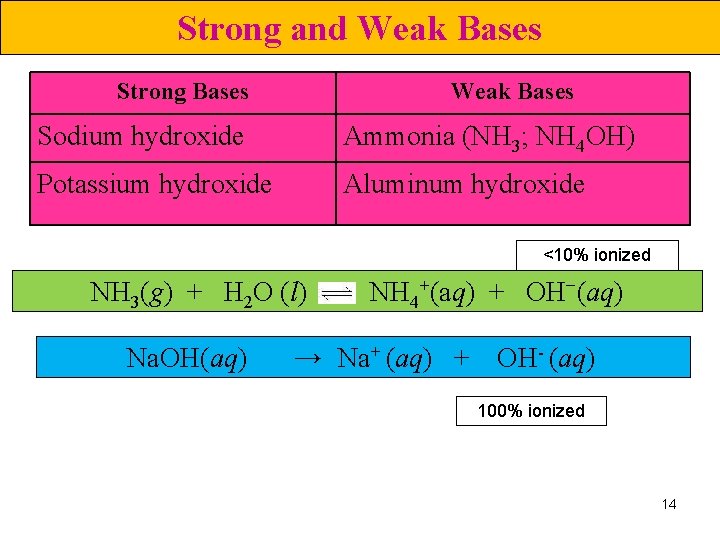
Strong and Weak Bases Strong Bases Weak Bases Sodium hydroxide Ammonia (NH 3; NH 4 OH) Potassium hydroxide Aluminum hydroxide <10% ionized NH 3(g) + H 2 O (l) Na. OH(aq) NH 4+(aq) + OH−(aq) → Na+ (aq) + OH- (aq) 100% ionized 14
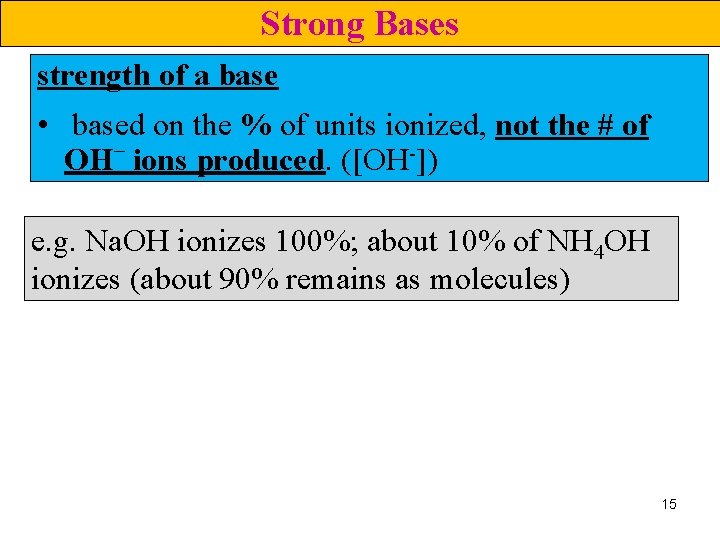
Strong Bases strength of a base • based on the % of units ionized, not the # of OH– ions produced. ([OH-]) e. g. Na. OH ionizes 100%; about 10% of NH 4 OH ionizes (about 90% remains as molecules) 15
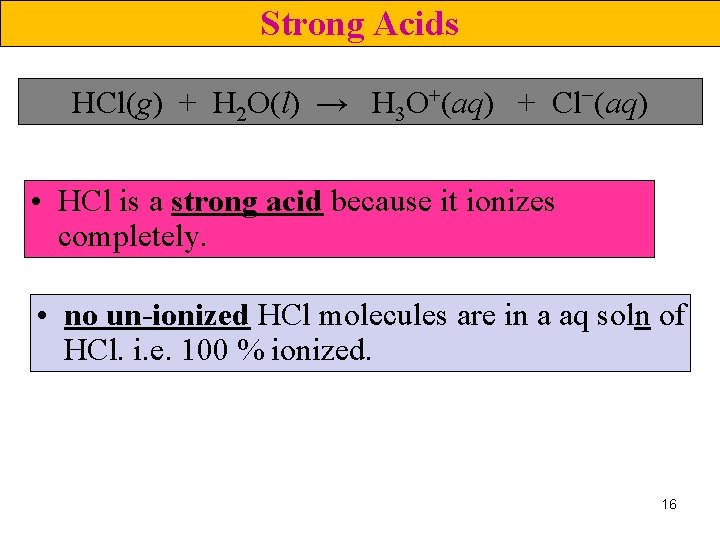
Strong Acids HCl(g) + H 2 O(l) → H 3 O+(aq) + Cl−(aq) • HCl is a strong acid because it ionizes completely. • no un-ionized HCl molecules are in a aq soln of HCl. i. e. 100 % ionized. 16
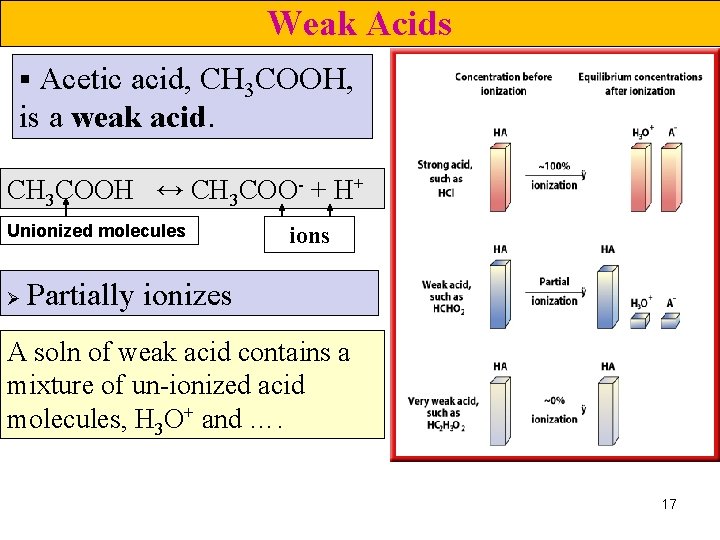
Weak Acids § Acetic acid, CH 3 COOH, is a weak acid. CH 3 COOH ↔ CH 3 COO- + H+ Unionized molecules Ø ions Partially ionizes A soln of weak acid contains a mixture of un-ionized acid molecules, H 3 O+ and …. 17
![Weak Acids The [ ] of the unionized acid is always the greatest. Un-ionized](http://slidetodoc.com/presentation_image_h2/63531e395018b681c37b9b3e256b9882/image-18.jpg "Weak Acids The [ ] of the unionized acid is always the greatest. Un-ionized")
Weak Acids The [ ] of the unionized acid is always the greatest. Un-ionized acid 18
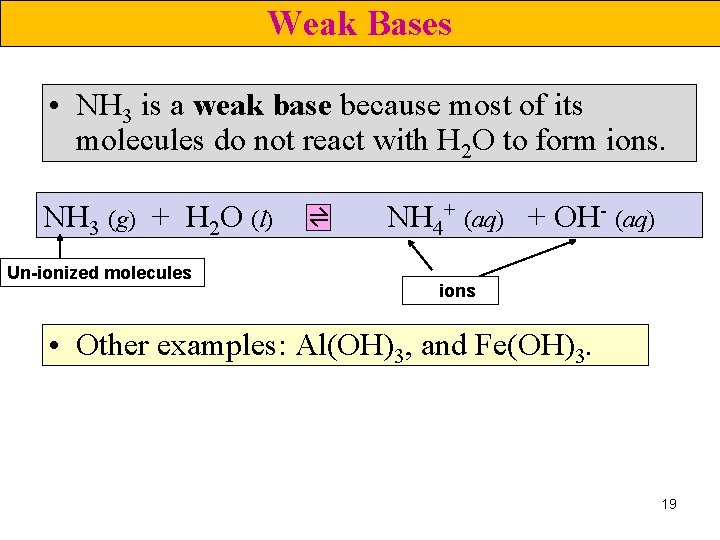
Weak Bases • NH 3 is a weak base because most of its molecules do not react with H 2 O to form ions. NH 3 (g) + H 2 O (l) Un-ionized molecules NH 4+ (aq) + OH- (aq) ions • Other examples: Al(OH)3, and Fe(OH)3. 19
Strength Is Not Concentration Strength concentration • weak and strong : compare the strengths of acids and base (degree of ionization). • dilute and concentrated : describe the [ ] of solns. (molarity) • The combn of strength and [ ] ultimately determines the behavior of the soln. 20
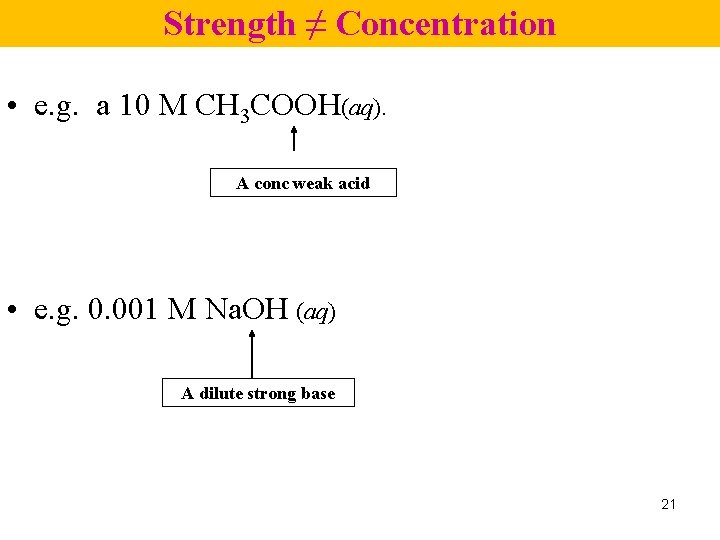
Strength ≠ Concentration • e. g. a 10 M CH 3 COOH(aq). A conc weak acid • e. g. 0. 001 M Na. OH (aq) A dilute strong base 21
![The p. H Scale p. H • a math scale in which the [H+]](http://slidetodoc.com/presentation_image_h2/63531e395018b681c37b9b3e256b9882/image-22.jpg "The p. H Scale p. H • a math scale in which the [H+]")
The p. H Scale p. H • a math scale in which the [H+] in a soln is expressed as a # from 0 to 14. 22
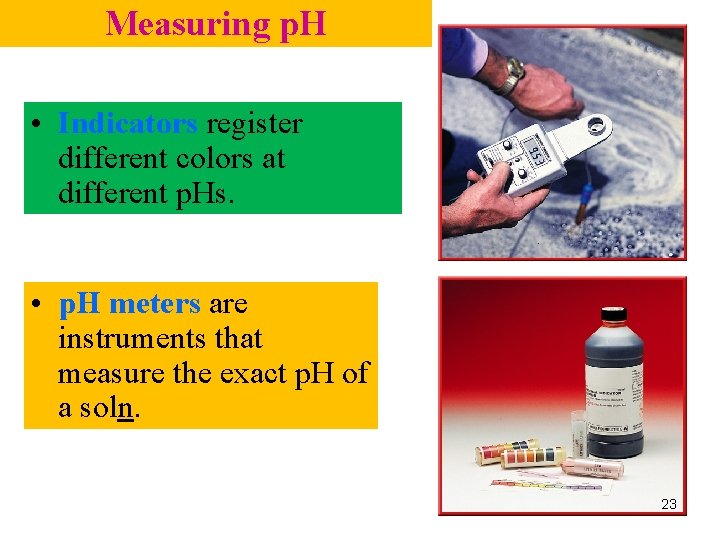
Measuring p. H • Indicators register different colors at different p. Hs. • p. H meters are instruments that measure the exact p. H of a soln. 23
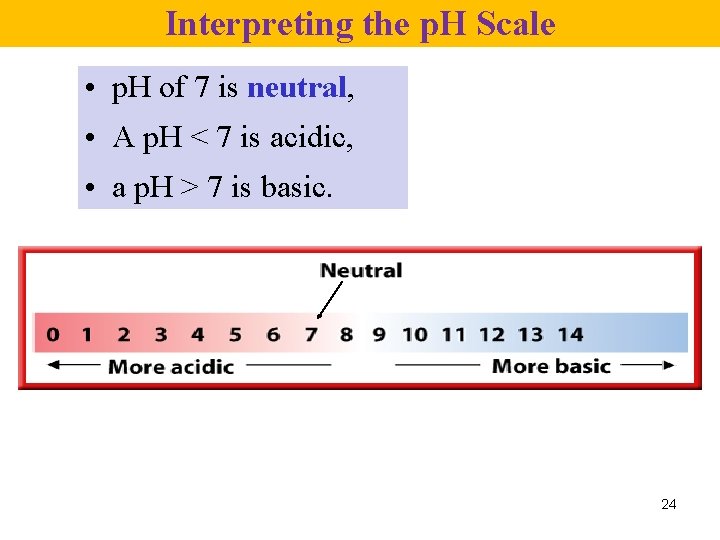
Interpreting the p. H Scale • p. H of 7 is neutral, • A p. H < 7 is acidic, • a p. H > 7 is basic. 24
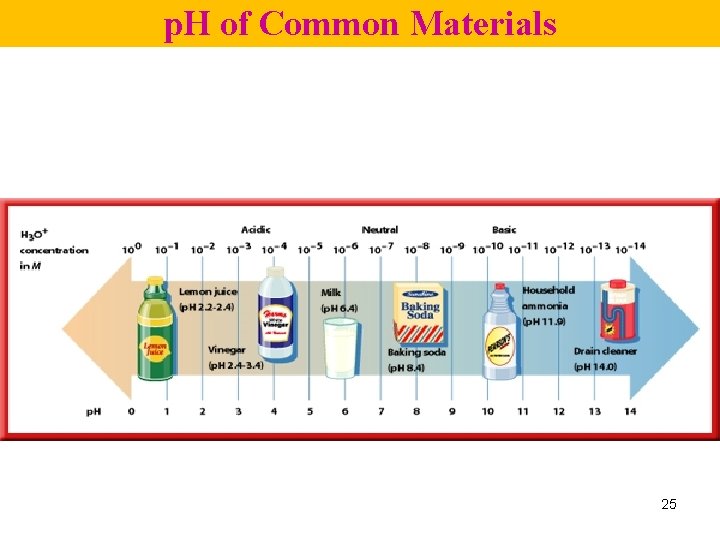
p. H of Common Materials 25
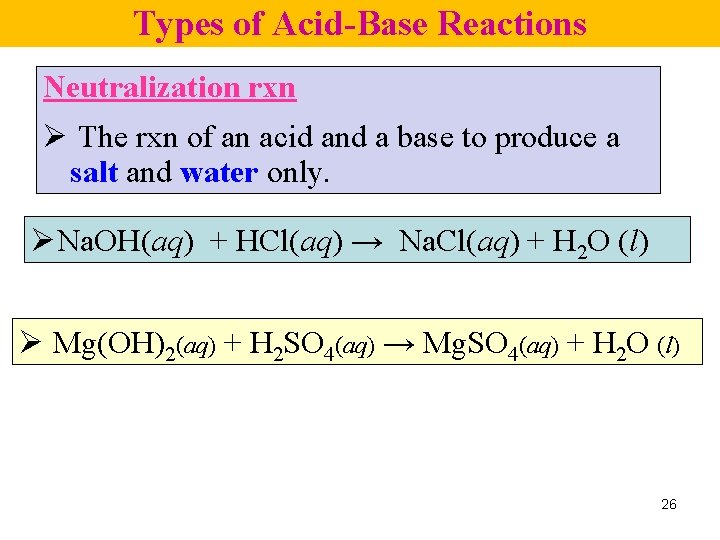
Types of Acid-Base Reactions Neutralization rxn Ø The rxn of an acid and a base to produce a salt and water only. ØNa. OH(aq) + HCl(aq) → Na. Cl(aq) + H 2 O (l) Ø Mg(OH)2(aq) + H 2 SO 4(aq) → Mg. SO 4(aq) + H 2 O (l) 26
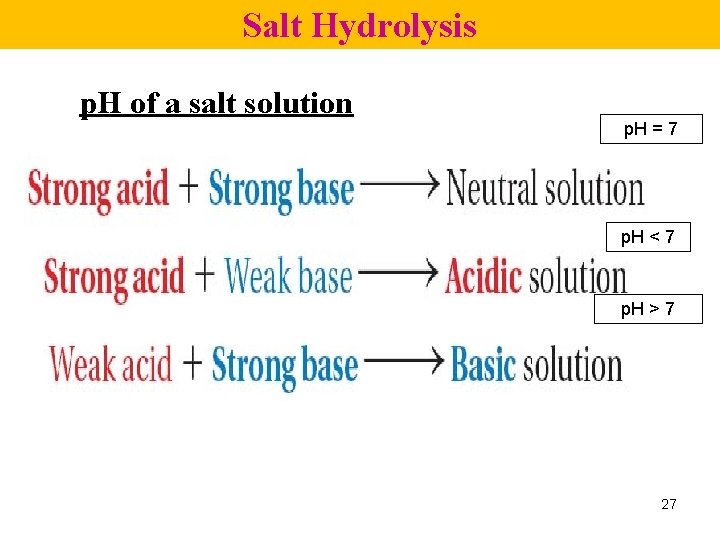
Salt Hydrolysis p. H of a salt solution p. H = 7 p. H < 7 p. H > 7 27
CST example 1 Equal volumes of 1 M hydrochloric acid (HCl) and 1 M sodium hydroxide base (Na. OH) are mixed. After mixing, the soln will be A strongly acidic B weakly acidic C nearly neutral D weakly basic 28
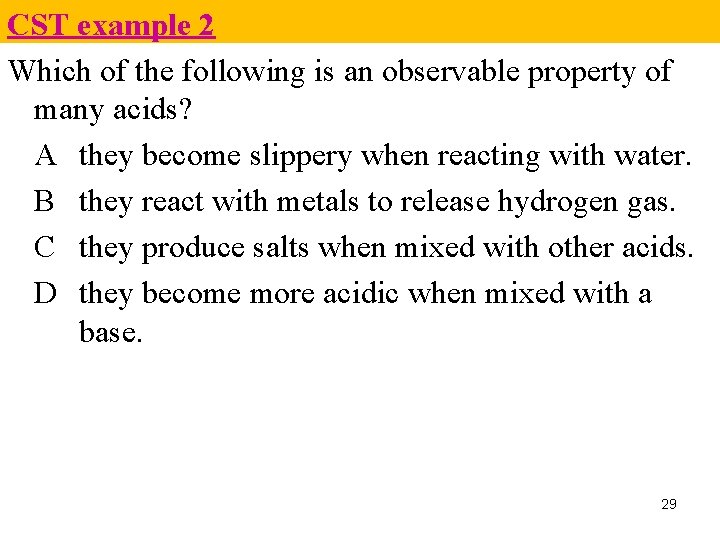
CST example 2 Which of the following is an observable property of many acids? A they become slippery when reacting with water. B they react with metals to release hydrogen gas. C they produce salts when mixed with other acids. D they become more acidic when mixed with a base. 29
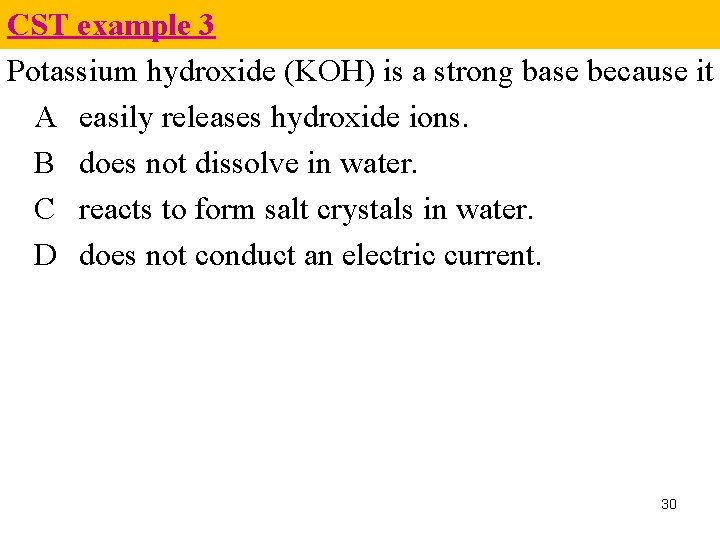
CST example 3 Potassium hydroxide (KOH) is a strong base because it A easily releases hydroxide ions. B does not dissolve in water. C reacts to form salt crystals in water. D does not conduct an electric current. 30
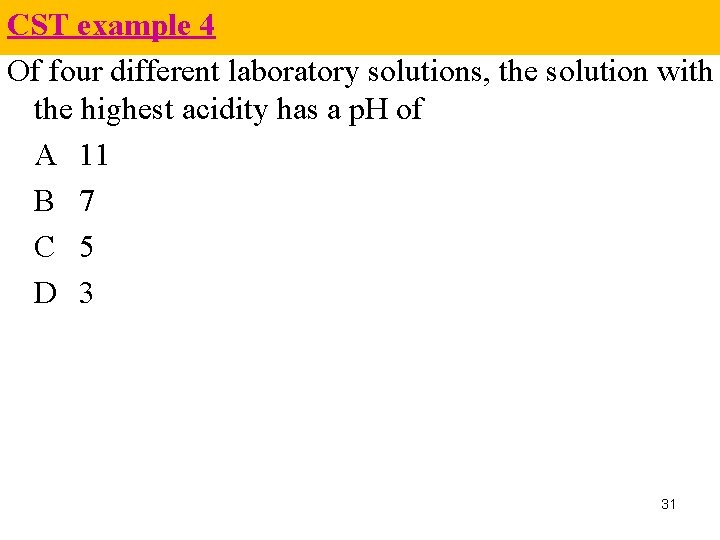
CST example 4 Of four different laboratory solutions, the solution with the highest acidity has a p. H of A 11 B 7 C 5 D 3 31
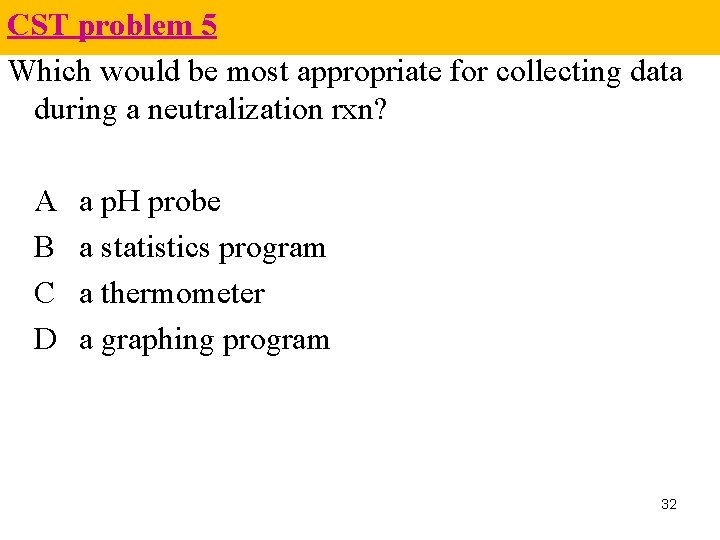
CST problem 5 Which would be most appropriate for collecting data during a neutralization rxn? A B C D a p. H probe a statistics program a thermometer a graphing program 32
CST problem 6 Copper (II) nitrate and sodium hydroxide solns react in a test tube as shown below. Cu(NO 3)2(aq) + 2 Na. OH(aq) Cu(OH)2(s) + 2 Na. NO 3(aq) If nitric acid is added to the test tube, the amt of (s) ppt decreases. The best explanation for this is that the acid A dilutes the soln making the ppt dissolve. B reacts with the copper (II) nitrate, pushing the eqm to the left. C will dissolve most solids, including sodium nitrate. D will react with the copper (II) hydroxide to form water and soluble copper (II) nitrate. 33
The End 34
- Slides: 34