
Chapter 18 Vectors and Arrays Bjarne Stroustrup www
Chapter 18 Vectors and Arrays Bjarne Stroustrup www. stroustrup. com/Programming
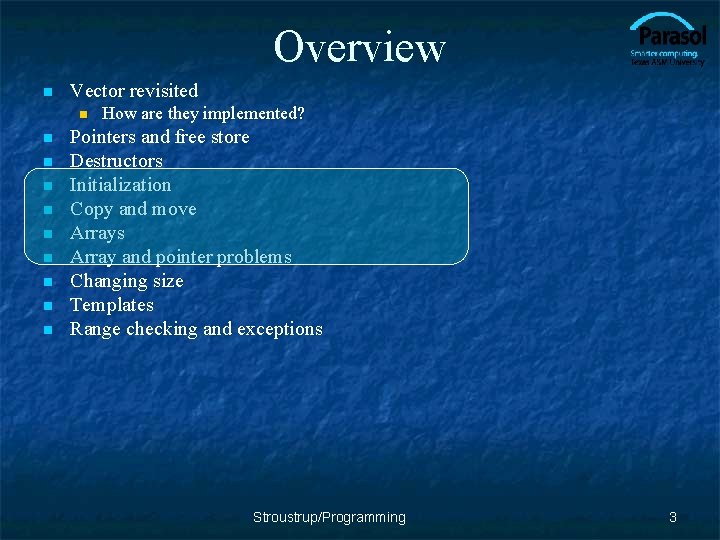
Overview n Vector revisited n n n n n How are they implemented? Pointers and free store Destructors Initialization Copy and move Arrays Array and pointer problems Changing size Templates Range checking and exceptions Stroustrup/Programming 3
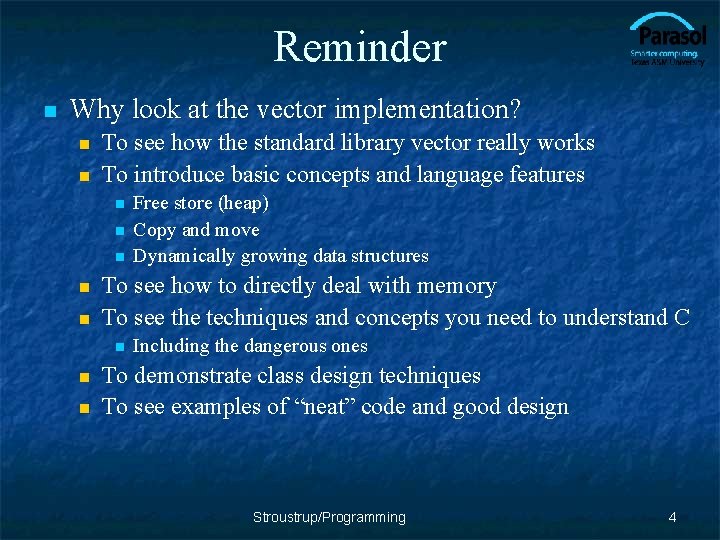
Reminder n Why look at the vector implementation? n n To see how the standard library vector really works To introduce basic concepts and language features n n n To see how to directly deal with memory To see the techniques and concepts you need to understand C n n n Free store (heap) Copy and move Dynamically growing data structures Including the dangerous ones To demonstrate class design techniques To see examples of “neat” code and good design Stroustrup/Programming 4
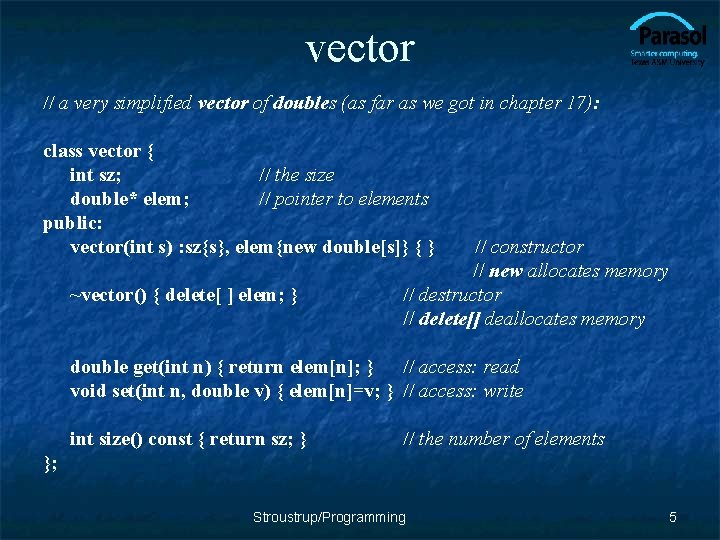
vector // a very simplified vector of doubles (as far as we got in chapter 17): class vector { int sz; // the size double* elem; // pointer to elements public: vector(int s) : sz{s}, elem{new double[s]} { } ~vector() { delete[ ] elem; } // constructor // new allocates memory // destructor // delete[] deallocates memory double get(int n) { return elem[n]; } // access: read void set(int n, double v) { elem[n]=v; } // access: write int size() const { return sz; } // the number of elements }; Stroustrup/Programming 5
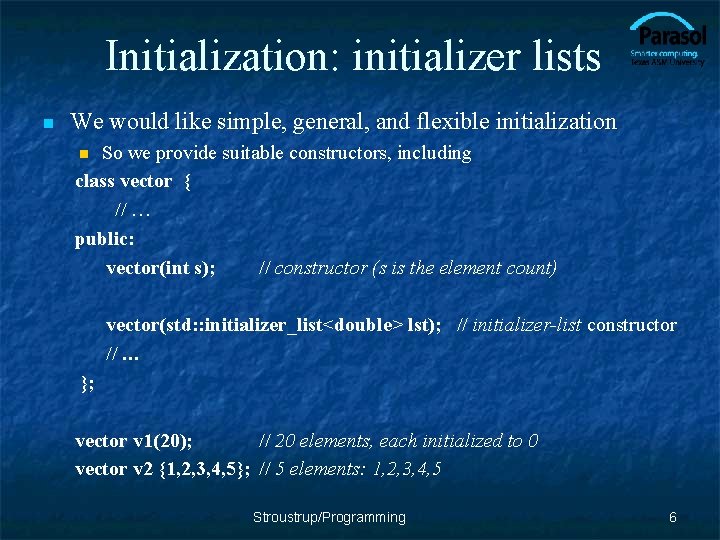
Initialization: initializer lists n We would like simple, general, and flexible initialization So we provide suitable constructors, including class vector { // … public: vector(int s); // constructor (s is the element count) n vector(std: : initializer_list<double> lst); // initializer-list constructor // … }; vector v 1(20); // 20 elements, each initialized to 0 vector v 2 {1, 2, 3, 4, 5}; // 5 elements: 1, 2, 3, 4, 5 Stroustrup/Programming 6
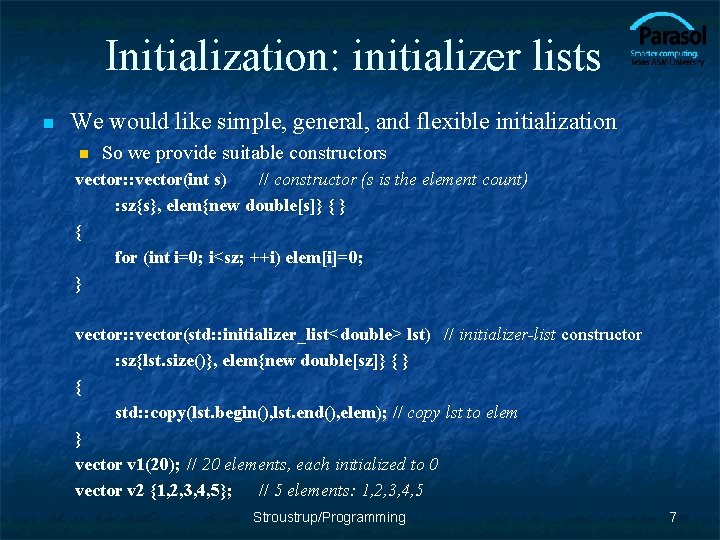
Initialization: initializer lists n We would like simple, general, and flexible initialization n So we provide suitable constructors vector: : vector(int s) // constructor (s is the element count) : sz{s}, elem{new double[s]} { for (int i=0; i<sz; ++i) elem[i]=0; } vector: : vector(std: : initializer_list<double> lst) // initializer-list constructor : sz{lst. size()}, elem{new double[sz]} { std: : copy(lst. begin(), lst. end(), elem); // copy lst to elem } vector v 1(20); // 20 elements, each initialized to 0 vector v 2 {1, 2, 3, 4, 5}; // 5 elements: 1, 2, 3, 4, 5 Stroustrup/Programming 7

Initialization: lists and sizes n If we initialize a vector by 17 is it n n n By convention use n n n 17 elements (with value 0)? 1 element with value 17? () for number of elements {} for elements For example n n vector v 1(17); vector v 2 {17}; // 17 elements, each with the value 0 // 1 element with value 17 Stroustrup/Programming 8
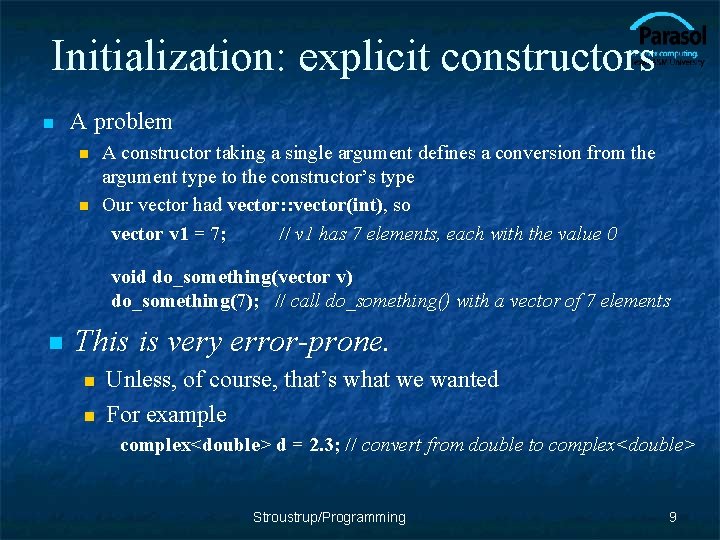
Initialization: explicit constructors n A problem n n A constructor taking a single argument defines a conversion from the argument type to the constructor’s type Our vector had vector: : vector(int), so vector v 1 = 7; // v 1 has 7 elements, each with the value 0 void do_something(vector v) do_something(7); // call do_something() with a vector of 7 elements n This is very error-prone. n n Unless, of course, that’s what we wanted For example complex<double> d = 2. 3; // convert from double to complex<double> Stroustrup/Programming 9
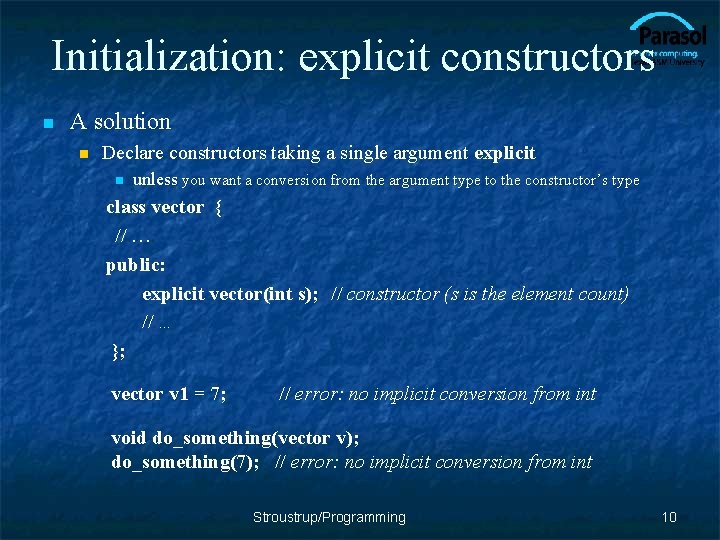
Initialization: explicit constructors n A solution n Declare constructors taking a single argument explicit n unless you want a conversion from the argument type to the constructor’s type class vector { // … public: explicit vector(int s); // constructor (s is the element count) // … }; vector v 1 = 7; // error: no implicit conversion from int void do_something(vector v); do_something(7); // error: no implicit conversion from int Stroustrup/Programming 10
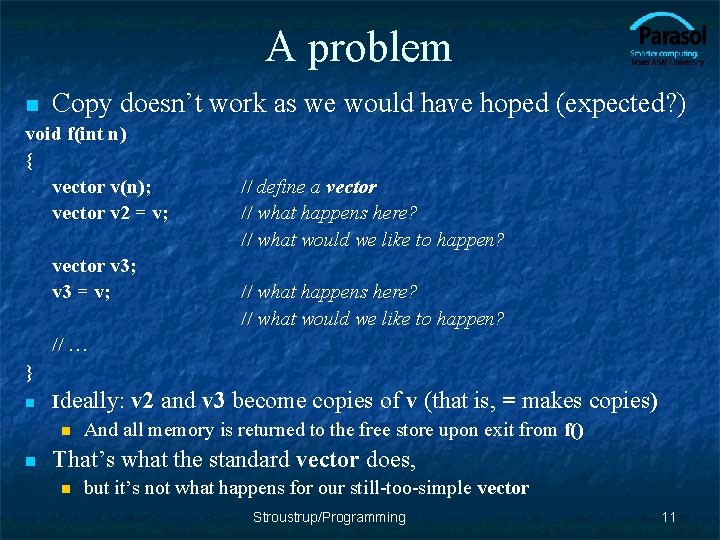
A problem n Copy doesn’t work as we would have hoped (expected? ) void f(int n) { vector v(n); vector v 2 = v; vector v 3; v 3 = v; // define a vector // what happens here? // what would we like to happen? // … } n n Ideally: v 2 and v 3 become copies of v (that is, = makes copies) n And all memory is returned to the free store upon exit from f() That’s what the standard vector does, n but it’s not what happens for our still-too-simple vector Stroustrup/Programming 11
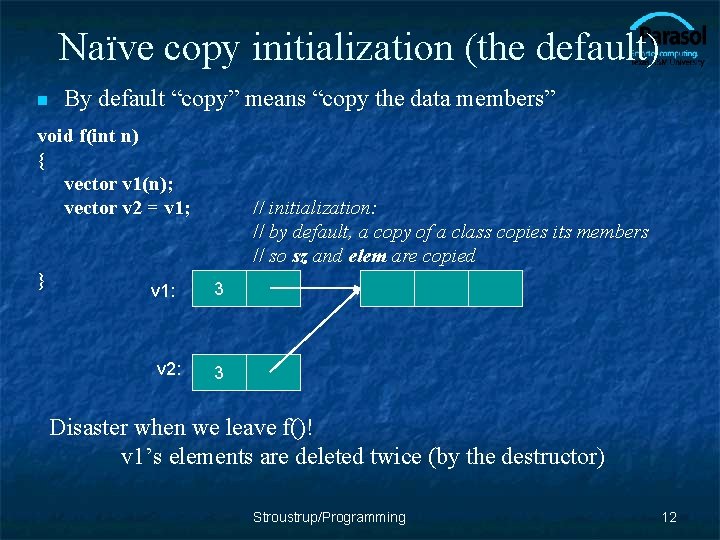
Naïve copy initialization (the default) n By default “copy” means “copy the data members” void f(int n) { vector v 1(n); vector v 2 = v 1; } v 1: v 2: // initialization: // by default, a copy of a class copies its members // so sz and elem are copied 3 3 Disaster when we leave f()! v 1’s elements are deleted twice (by the destructor) Stroustrup/Programming 12
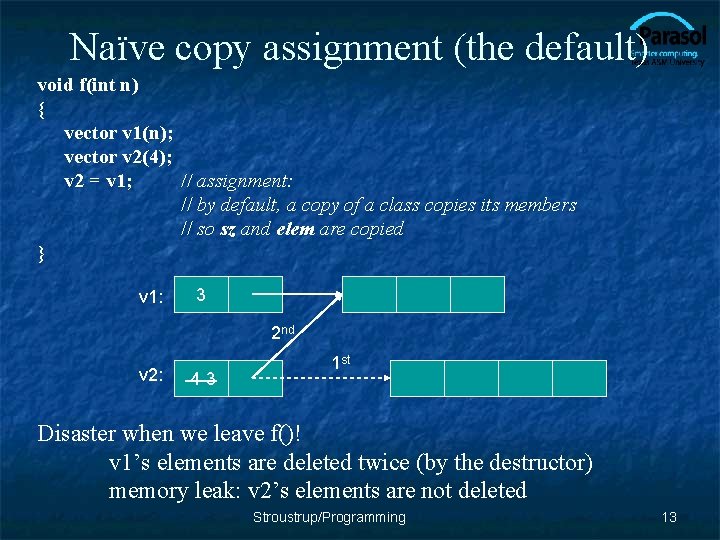
Naïve copy assignment (the default) void f(int n) { vector v 1(n); vector v 2(4); v 2 = v 1; // assignment: // by default, a copy of a class copies its members // so sz and elem are copied } v 1: 3 2 nd v 2: 43 1 st Disaster when we leave f()! v 1’s elements are deleted twice (by the destructor) memory leak: v 2’s elements are not deleted Stroustrup/Programming 13
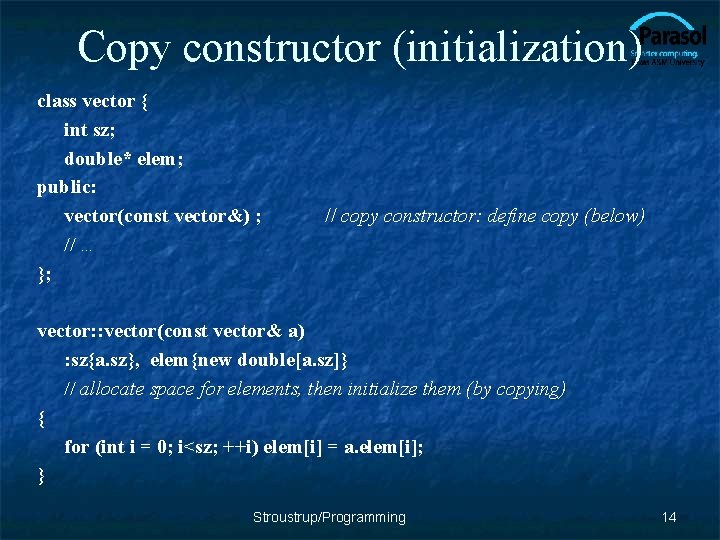
Copy constructor (initialization) class vector { int sz; double* elem; public: vector(const vector&) ; // … }; // copy constructor: define copy (below) vector: : vector(const vector& a) : sz{a. sz}, elem{new double[a. sz]} // allocate space for elements, then initialize them (by copying) { for (int i = 0; i<sz; ++i) elem[i] = a. elem[i]; } Stroustrup/Programming 14
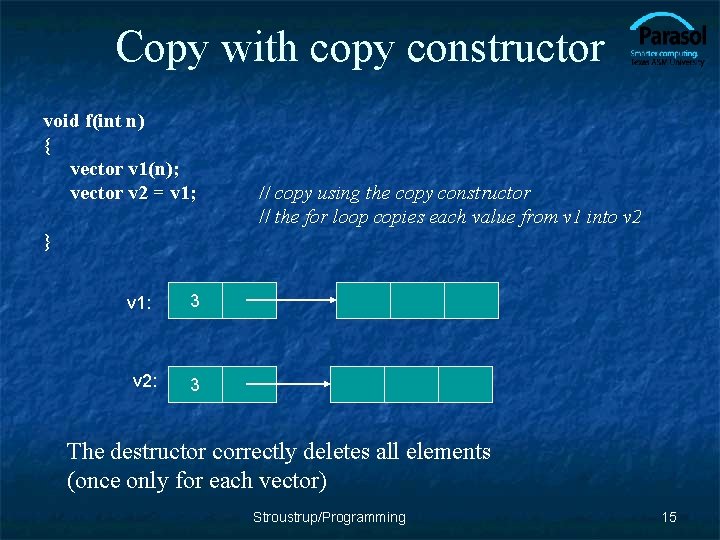
Copy with copy constructor void f(int n) { vector v 1(n); vector v 2 = v 1; // copy using the copy constructor // the for loop copies each value from v 1 into v 2 } v 1: v 2: 3 3 The destructor correctly deletes all elements (once only for each vector) Stroustrup/Programming 15
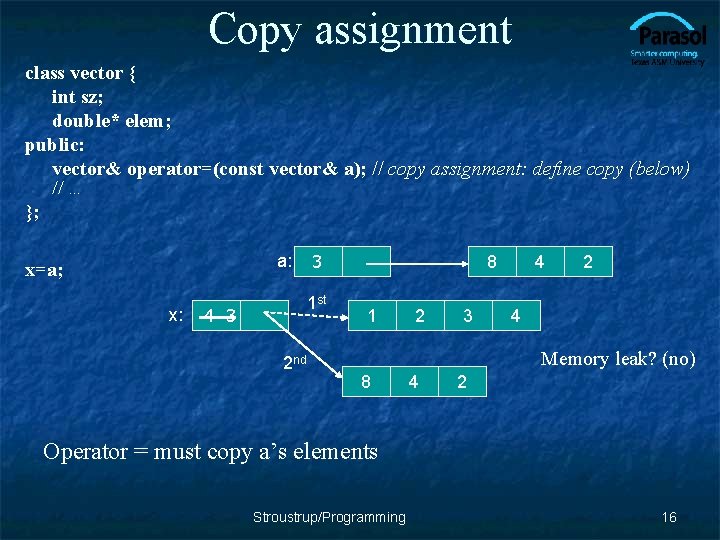
Copy assignment class vector { int sz; double* elem; public: vector& operator=(const vector& a); // copy assignment: define copy (below) // … }; a: x=a; x: 3 1 st 4 3 2 nd 8 1 2 3 4 2 4 Memory leak? (no) 8 4 2 Operator = must copy a’s elements Stroustrup/Programming 16
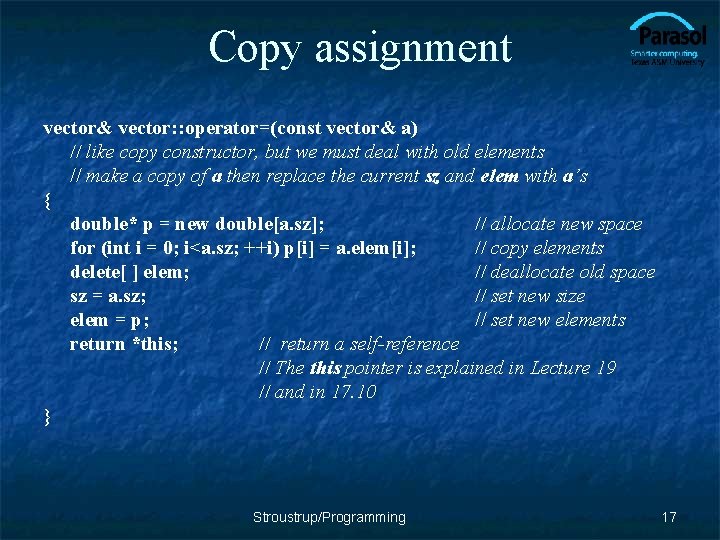
Copy assignment vector& vector: : operator=(const vector& a) // like copy constructor, but we must deal with old elements // make a copy of a then replace the current sz and elem with a’s { double* p = new double[a. sz]; // allocate new space for (int i = 0; i<a. sz; ++i) p[i] = a. elem[i]; // copy elements delete[ ] elem; // deallocate old space sz = a. sz; // set new size elem = p; // set new elements return *this; // return a self-reference // The this pointer is explained in Lecture 19 // and in 17. 10 } Stroustrup/Programming 17
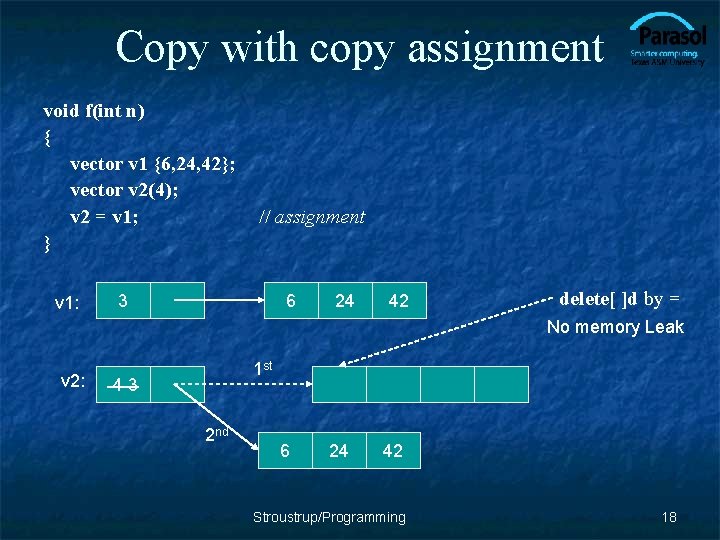
Copy with copy assignment void f(int n) { vector v 1 {6, 24, 42}; vector v 2(4); v 2 = v 1; } v 1: // assignment 3 6 24 42 delete[ ]d by = No memory Leak v 2: 1 st 43 2 nd 6 24 42 Stroustrup/Programming 18
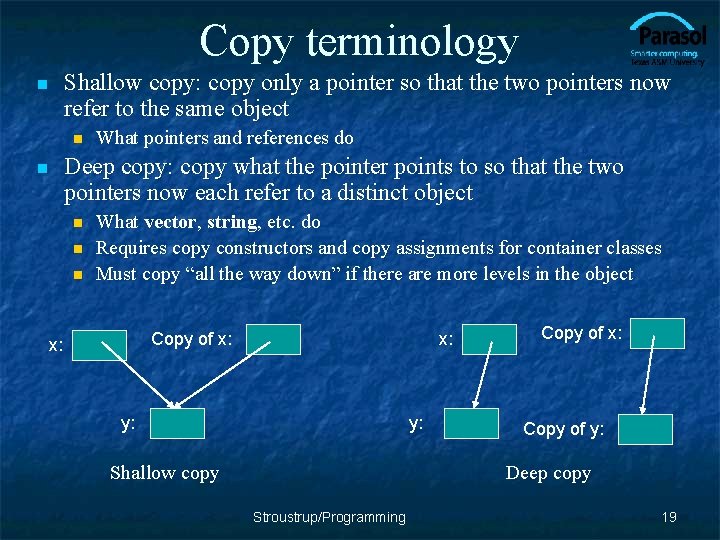
Copy terminology n Shallow copy: copy only a pointer so that the two pointers now refer to the same object n n What pointers and references do Deep copy: copy what the pointer points to so that the two pointers now each refer to a distinct object n n n What vector, string, etc. do Requires copy constructors and copy assignments for container classes Must copy “all the way down” if there are more levels in the object Copy of x: x: y: Shallow copy Copy of x: Copy of y: Deep copy Stroustrup/Programming 19
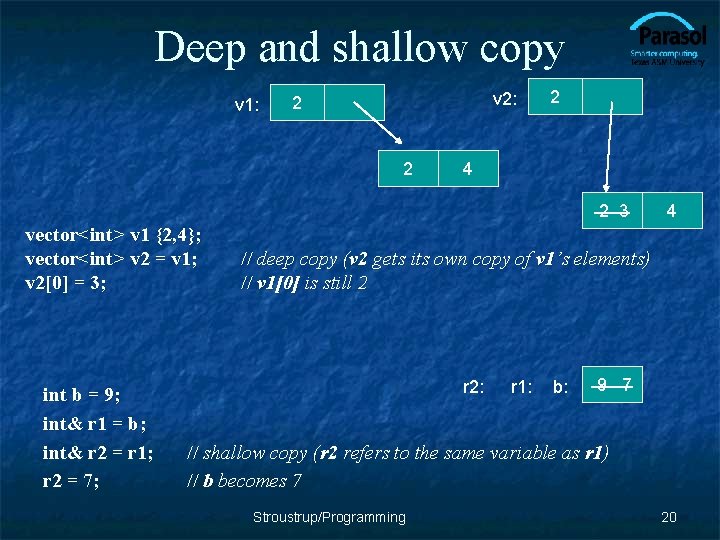
Deep and shallow copy v 1: v 2: 2 2 2 4 2 3 vector<int> v 1 {2, 4}; vector<int> v 2 = v 1; v 2[0] = 3; int b = 9; int& r 1 = b; int& r 2 = r 1; r 2 = 7; 4 // deep copy (v 2 gets its own copy of v 1’s elements) // v 1[0] is still 2 r 2: r 1: b: 9 7 // shallow copy (r 2 refers to the same variable as r 1) // b becomes 7 Stroustrup/Programming 20
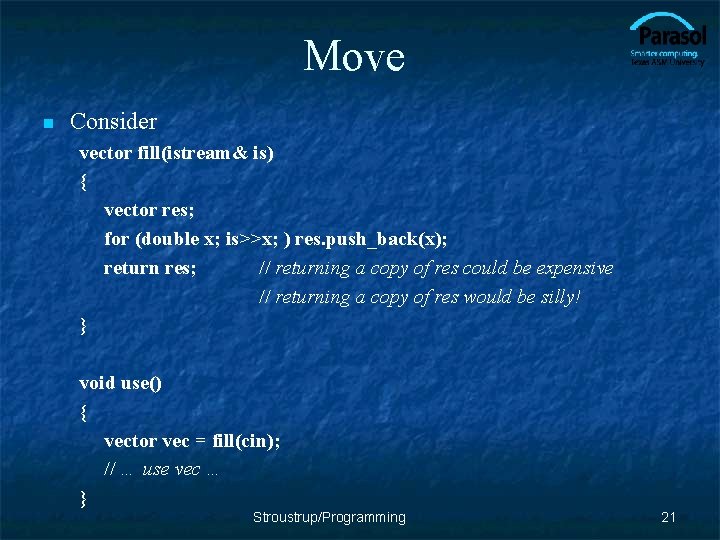
Move n Consider vector fill(istream& is) { vector res; for (double x; is>>x; ) res. push_back(x); return res; // returning a copy of res could be expensive // returning a copy of res would be silly! } void use() { vector vec = fill(cin); // … use vec … } Stroustrup/Programming 21
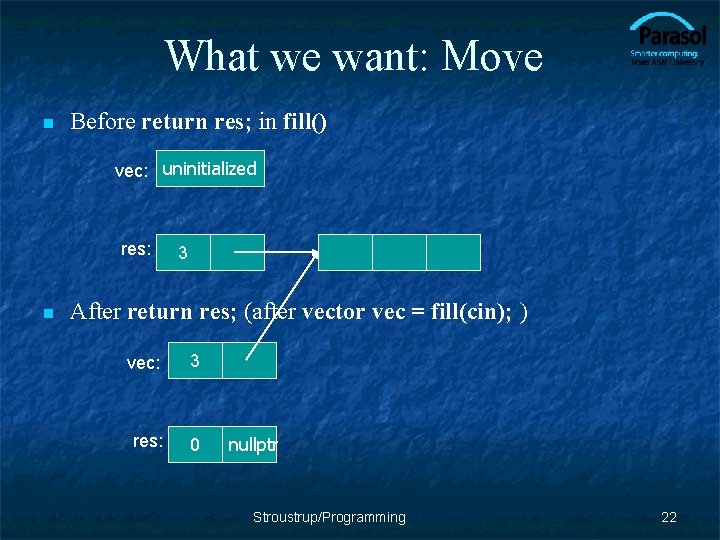
What we want: Move n Before return res; in fill() vec: uninitialized res: n 3 After return res; (after vector vec = fill(cin); ) vec: 3 res: 0 nullptr Stroustrup/Programming 22
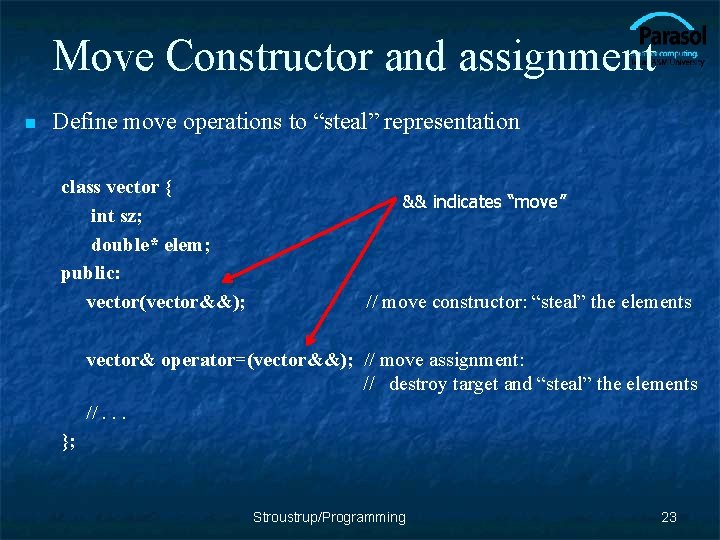
Move Constructor and assignment n Define move operations to “steal” representation class vector { int sz; double* elem; public: vector(vector&&); && indicates “move” // move constructor: “steal” the elements vector& operator=(vector&&); // move assignment: // destroy target and “steal” the elements //. . . }; Stroustrup/Programming 23
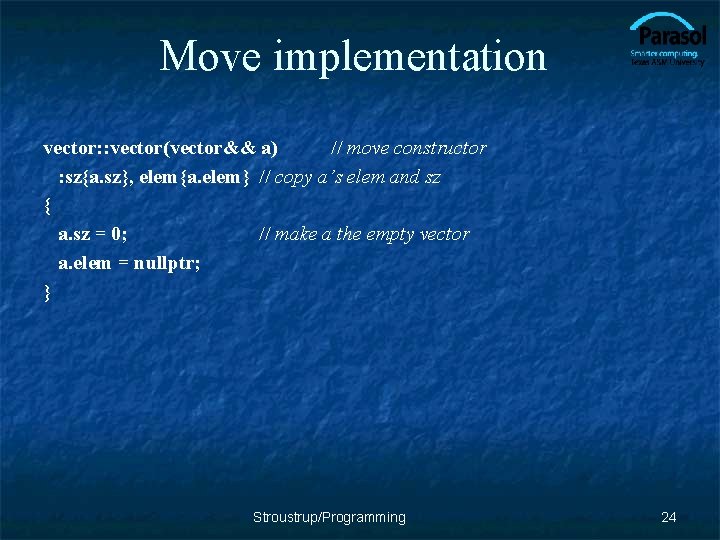
Move implementation vector: : vector(vector&& a) // move constructor : sz{a. sz}, elem{a. elem} // copy a’s elem and sz { a. sz = 0; // make a the empty vector a. elem = nullptr; } Stroustrup/Programming 24
![Move implementation vector& vector: : operator=(vector&& a) // move assignment { delete[] elem; //](http://slidetodoc.com/presentation_image_h2/02bb06fccec83770a304313f7e12b2f3/image-24.jpg "Move implementation vector& vector: : operator=(vector&& a) // move assignment { delete[] elem; //")
Move implementation vector& vector: : operator=(vector&& a) // move assignment { delete[] elem; // deallocate old space elem = a. elem; // copy a’s elem and sz sz = a. sz; a. elem = nullptr; // make a the empty vector a. sz = 0; return *this; // return a self-reference (see § 17. 10) } Stroustrup/Programming 25
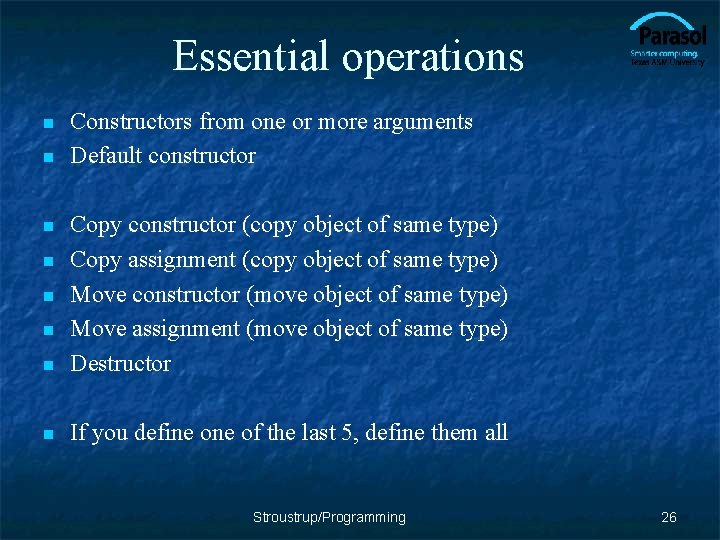
Essential operations n n Constructors from one or more arguments Default constructor n Copy constructor (copy object of same type) Copy assignment (copy object of same type) Move constructor (move object of same type) Move assignment (move object of same type) Destructor n If you define of the last 5, define them all n n Stroustrup/Programming 26
![Arrays n Arrays don’t have to be on the free store char ac[7]; int](http://slidetodoc.com/presentation_image_h2/02bb06fccec83770a304313f7e12b2f3/image-26.jpg "Arrays n Arrays don’t have to be on the free store char ac[7]; int")
Arrays n Arrays don’t have to be on the free store char ac[7]; int max = 100; int ai[max]; // global array – “lives” forever – in static storage int f(int n) { char lc[20]; // local array – ”lives” until the end of scope – on stack int li[60]; double lx[n]; // error: a local array size must be known at compile time // vector<double> lx(n); would work // … } Stroustrup/Programming 27
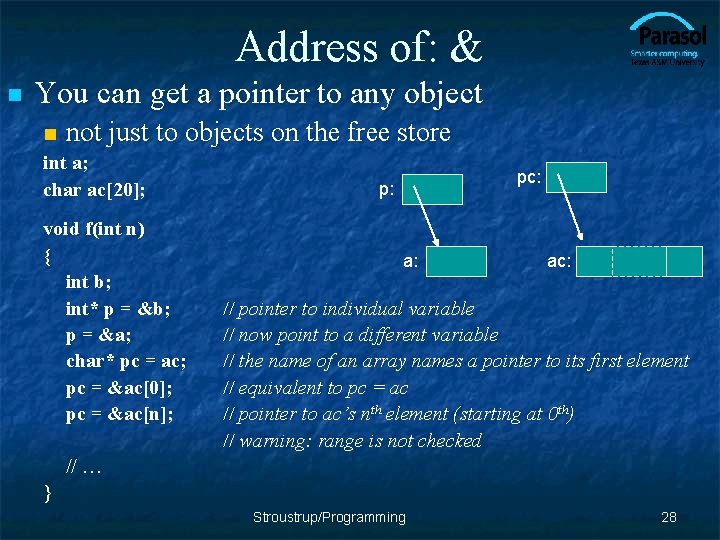
Address of: & n You can get a pointer to any object n not just to objects on the free store int a; char ac[20]; void f(int n) { int b; int* p = &b; p = &a; char* pc = ac; pc = &ac[0]; pc = &ac[n]; pc: p: ac: // pointer to individual variable // now point to a different variable // the name of an array names a pointer to its first element // equivalent to pc = ac // pointer to ac’s nth element (starting at 0 th) // warning: range is not checked // … } Stroustrup/Programming 28
![Arrays (often) convert to pointers void f(int pi[ ]) // equivalent to void f(int*](http://slidetodoc.com/presentation_image_h2/02bb06fccec83770a304313f7e12b2f3/image-28.jpg "Arrays (often) convert to pointers void f(int pi[ ]) // equivalent to void f(int*")
Arrays (often) convert to pointers void f(int pi[ ]) // equivalent to void f(int* pi) { int a[ ] = { 1, 2, 3, 4 }; int b[ ] = a; // error: copy isn’t defined for arrays b = pi; // error: copy isn’t defined for arrays. Think of a // (non-argument) array name as an immutable pointer pi = a; // ok: but it doesn’t copy: pi now points to a’s first element // Is this a memory leak? (maybe) int* p = a; // p points to the first element of a int* q = pi; // q points to the first element of a } pi: 1 st 2 nd a: 1 2 3 4 p: q: Stroustrup/Programming 29
![Arrays don’t know their own size void f(int pi[ ], int n, char pc[](http://slidetodoc.com/presentation_image_h2/02bb06fccec83770a304313f7e12b2f3/image-29.jpg "Arrays don’t know their own size void f(int pi[ ], int n, char pc[")
Arrays don’t know their own size void f(int pi[ ], int n, char pc[ ]) // equivalent to void f(int* pi, int n, char* pc) // warning: very dangerous code, for illustration only, // never “hope” that sizes will always be correct { char buf 1[200]; strcpy(buf 1, pc); // copy characters from pc into buf 1 // strcpy terminates when a '' character is found // hope that pc holds less than 200 characters strncpy(buf 1, pc, 200); // copy 200 characters from pc to buf 1 // padded if necessary, but final '' not guaranteed int buf 2[300]; // you can’t say int buf 2[n]; n is a variable if (300 < n) error("not enough space"); for (int i=0; i<n; ++i) buf 2[i] = pi[i]; // hope that pi really has space for // n ints; it might have less } Stroustrup/Programming 30
![Be careful with arrays and pointers char* f() { char ch[20]; char* p =](http://slidetodoc.com/presentation_image_h2/02bb06fccec83770a304313f7e12b2f3/image-30.jpg "Be careful with arrays and pointers char* f() { char ch[20]; char* p =")
Be careful with arrays and pointers char* f() { char ch[20]; char* p = &ch[90]; // … *p = 'a'; char* q; *q = 'b'; return &ch[10]; // we don’t know what this will overwrite // forgot to initialize // we don’t know what this will overwrite // oops: ch disappears upon return from f() // (an infamous “dangling pointer”) } void g() { char* pp = f(); // … *pp = 'c'; // we don’t know what this will overwrite // (f’s ch is gone for good after the return from f) Stroustrup/Programming } 31
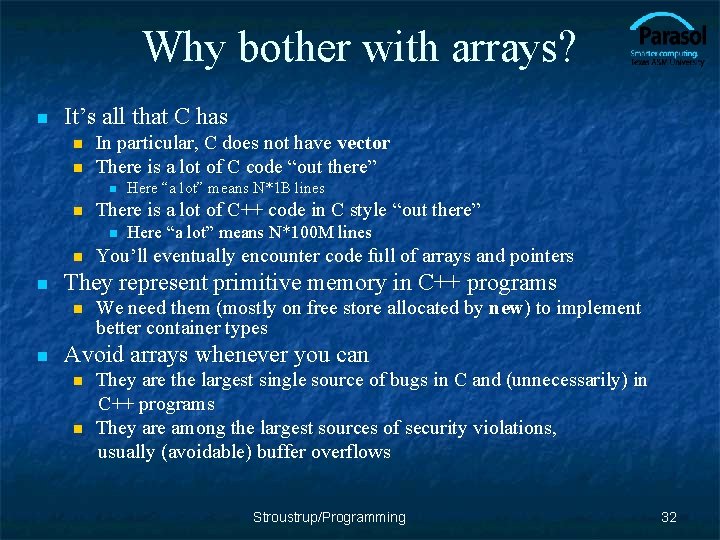
Why bother with arrays? n It’s all that C has n n In particular, C does not have vector There is a lot of C code “out there” n n There is a lot of C++ code in C style “out there” n n n Here “a lot” means N*100 M lines You’ll eventually encounter code full of arrays and pointers They represent primitive memory in C++ programs n n Here “a lot” means N*1 B lines We need them (mostly on free store allocated by new) to implement better container types Avoid arrays whenever you can n n They are the largest single source of bugs in C and (unnecessarily) in C++ programs They are among the largest sources of security violations, usually (avoidable) buffer overflows Stroustrup/Programming 32
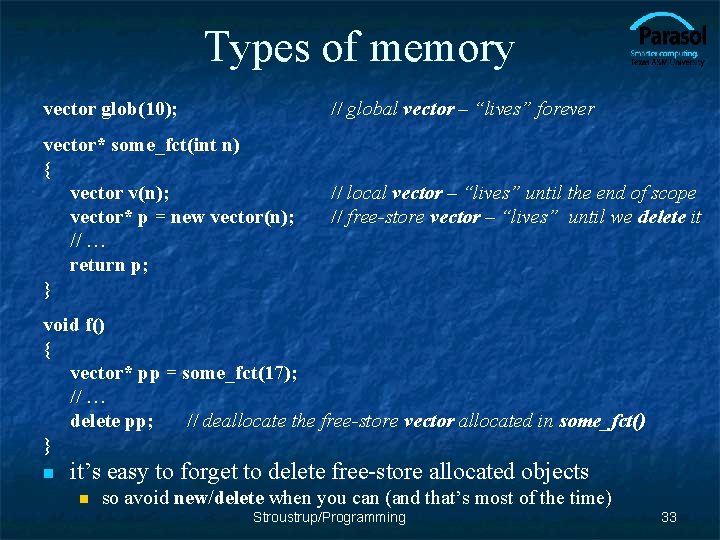
Types of memory vector glob(10); // global vector – “lives” forever vector* some_fct(int n) { vector v(n); vector* p = new vector(n); // … return p; } // local vector – “lives” until the end of scope // free-store vector – “lives” until we delete it void f() { vector* pp = some_fct(17); // … delete pp; // deallocate the free-store vector allocated in some_fct() } n it’s easy to forget to delete free-store allocated objects n so avoid new/delete when you can (and that’s most of the time) Stroustrup/Programming 33
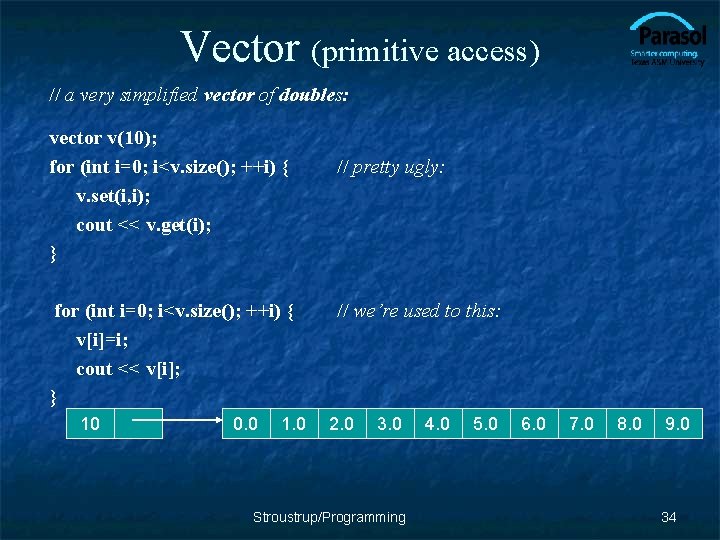
Vector (primitive access) // a very simplified vector of doubles: vector v(10); for (int i=0; i<v. size(); ++i) { v. set(i, i); cout << v. get(i); } for (int i=0; i<v. size(); ++i) { v[i]=i; cout << v[i]; } 10 0. 0 1. 0 // pretty ugly: // we’re used to this: 2. 0 3. 0 Stroustrup/Programming 4. 0 5. 0 6. 0 7. 0 8. 0 9. 0 34
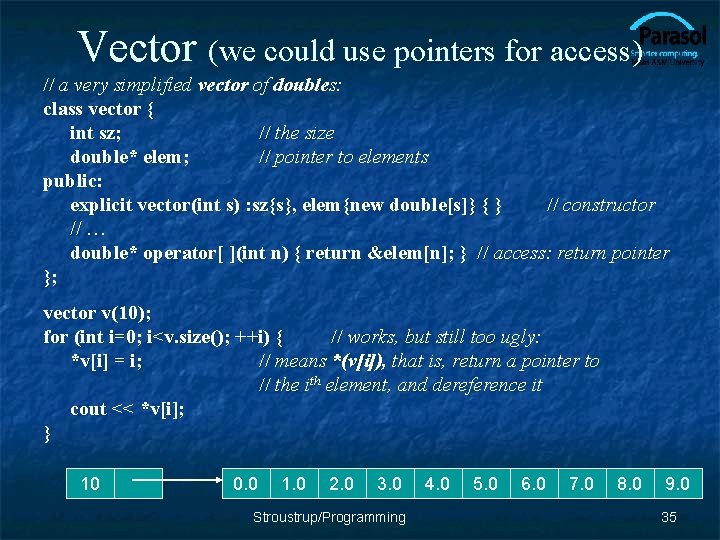
Vector (we could use pointers for access) // a very simplified vector of doubles: class vector { int sz; // the size double* elem; // pointer to elements public: explicit vector(int s) : sz{s}, elem{new double[s]} { } // constructor // … double* operator[ ](int n) { return &elem[n]; } // access: return pointer }; vector v(10); for (int i=0; i<v. size(); ++i) { // works, but still too ugly: *v[i] = i; // means *(v[i]), that is, return a pointer to // the ith element, and dereference it cout << *v[i]; } 10 0. 0 1. 0 2. 0 3. 0 Stroustrup/Programming 4. 0 5. 0 6. 0 7. 0 8. 0 9. 0 35
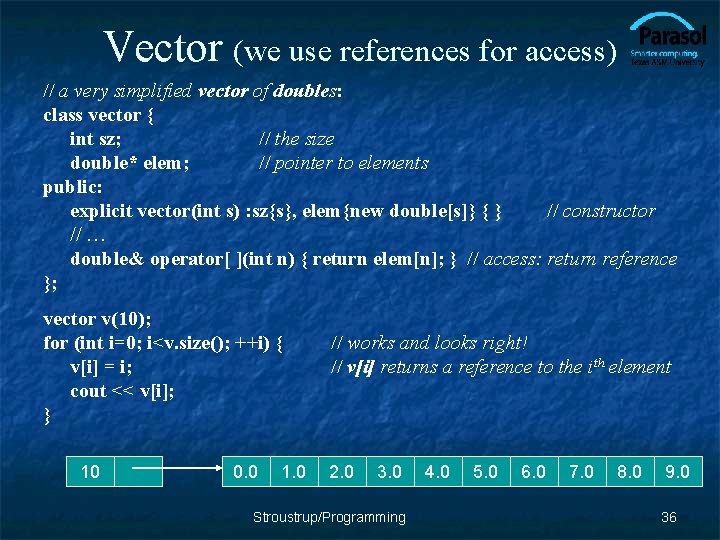
Vector (we use references for access) // a very simplified vector of doubles: class vector { int sz; // the size double* elem; // pointer to elements public: explicit vector(int s) : sz{s}, elem{new double[s]} { } // constructor // … double& operator[ ](int n) { return elem[n]; } // access: return reference }; vector v(10); for (int i=0; i<v. size(); ++i) { v[i] = i; cout << v[i]; } 10 0. 0 1. 0 // works and looks right! // v[i] returns a reference to the ith element 2. 0 3. 0 Stroustrup/Programming 4. 0 5. 0 6. 0 7. 0 8. 0 9. 0 36
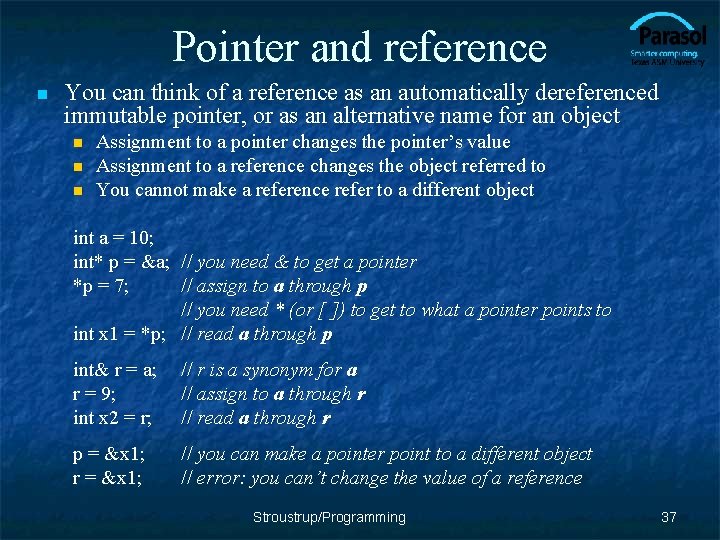
Pointer and reference n You can think of a reference as an automatically dereferenced immutable pointer, or as an alternative name for an object n n n Assignment to a pointer changes the pointer’s value Assignment to a reference changes the object referred to You cannot make a reference refer to a different object int a = 10; int* p = &a; *p = 7; // you need & to get a pointer // assign to a through p // you need * (or [ ]) to get to what a pointer points to int x 1 = *p; // read a through p int& r = a; r = 9; int x 2 = r; // r is a synonym for a // assign to a through r // read a through r p = &x 1; r = &x 1; // you can make a pointer point to a different object // error: you can’t change the value of a reference Stroustrup/Programming 37
Next lecture n We’ll see how we can change vector’s implementation to better allow for changes in the number of elements. Then we’ll modify vector to take elements of an arbitrary type and add range checking. That’ll imply looking at templates and revisiting exceptions. Stroustrup/Programming 38
- Slides: 37