
Chapter 18 THERMODYNAMICS MFMc Graw Chap 18 bThermoRevised42810
Chapter 18 THERMODYNAMICS MFMc. Graw Chap 18 b-Thermo-Revised-4/28/10
This lecture will help you understand: • • • MFMc. Graw Thermodynamics Absolute Zero Internal Energy First Law of Thermodynamics Adiabatic Processes Meteorology and the First Law Second Law of Thermodynamics Order Tends to Disorder Entropy Chap 18 b-Thermo-Revised-4/28/10
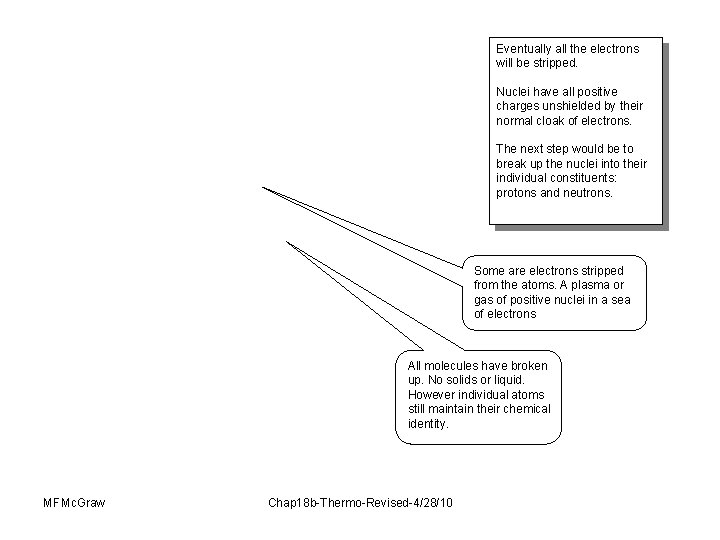
Eventually all the electrons will be stripped. Nuclei have all positive charges unshielded by their normal cloak of electrons. The next step would be to break up the nuclei into their individual constituents: protons and neutrons. Some are electrons stripped from the atoms. A plasma or gas of positive nuclei in a sea of electrons All molecules have broken up. No solids or liquid. However individual atoms still maintain their chemical identity. MFMc. Graw Chap 18 b-Thermo-Revised-4/28/10
Thermodynamics • The science of thermodynamics was developed in the early 19 th century. • Atomic and molecular theory of matter was not understood then, so early thermodynamics invoked macroscopic ideas such as mechanical work, pressure, and temperature. • The foundation stones of thermodynamics are: – The conservation of energy and – The fact that heat flows spontaneously from hot to cold and not the other way around MFMc. Graw Chap 18 b-Thermo-Revised-4/28/10
Thermodynamics “Thermodynamics is a funny subject. The first time you go through it, you don’t understand it at all. The second time you go through it, you think you understand it, except for one or two small points. The third time you go through it, you know you don’t understand it, but by that time you are so used to it, it doesn’t bother you any more. ” - Arnold Sommerfeld MFMc. Graw Chap 18 b-Thermo-Revised-4/28/10
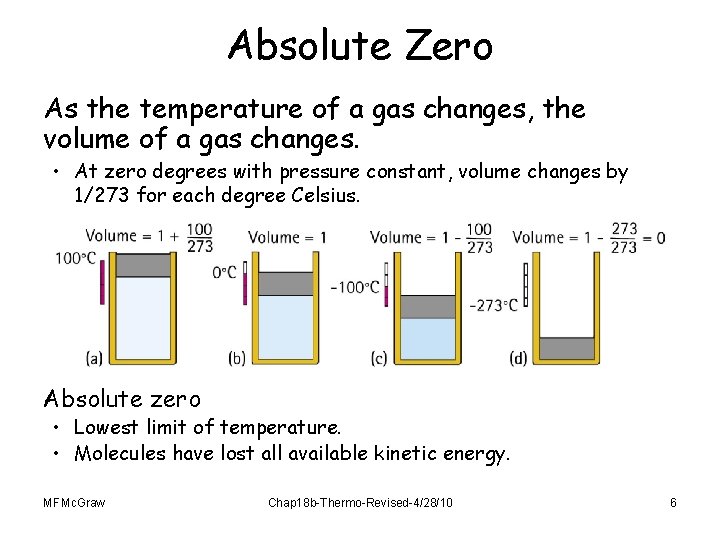
Absolute Zero As the temperature of a gas changes, the volume of a gas changes. • At zero degrees with pressure constant, volume changes by 1/273 for each degree Celsius. Absolute zero • Lowest limit of temperature. • Molecules have lost all available kinetic energy. MFMc. Graw Chap 18 b-Thermo-Revised-4/28/10 6
Internal Energy • Energy at the particle level within a substance in several forms, which, when taken together, are called internal energy. • The internal energy of a substance is quite complicated; the simplest form are the kinetic and potential energies of the molecules. • Our study focuses not on the internal energy, per se, but rather on the changes in internal energy of a substance. MFMc. Graw Chap 18 b-Thermo-Revised-4/28/10 7
The First Law of Thermodynamics (Energy Conservation) The first law of thermodynamics is a restatement of the law of conservation of energy: Energy can neither be created nor destroyed. MFMc. Graw Chap 18 b-Thermo-Revised-4/28/10 8
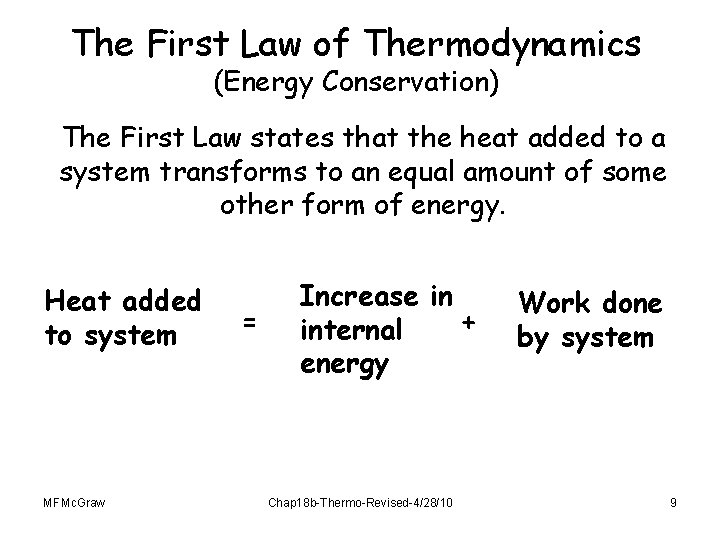
The First Law of Thermodynamics (Energy Conservation) The First Law states that the heat added to a system transforms to an equal amount of some other form of energy. Heat added to system MFMc. Graw = Increase in + internal energy Chap 18 b-Thermo-Revised-4/28/10 Work done by system 9
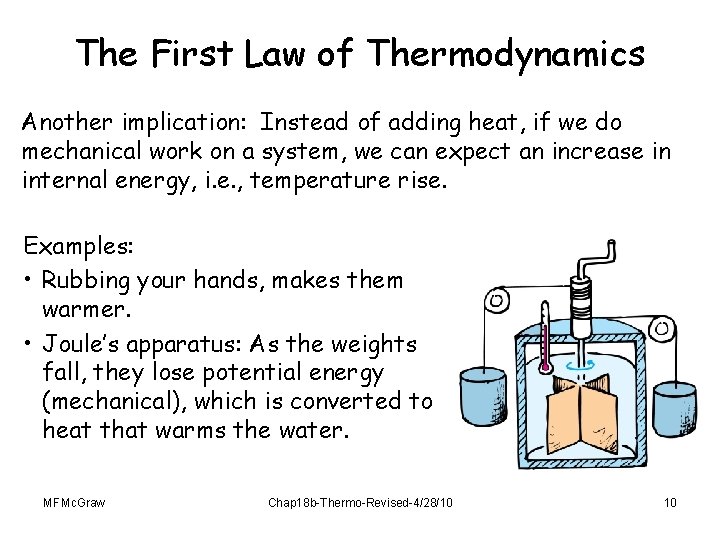
The First Law of Thermodynamics Another implication: Instead of adding heat, if we do mechanical work on a system, we can expect an increase in internal energy, i. e. , temperature rise. Examples: • Rubbing your hands, makes them warmer. • Joule’s apparatus: As the weights fall, they lose potential energy (mechanical), which is converted to heat that warms the water. MFMc. Graw Chap 18 b-Thermo-Revised-4/28/10 10
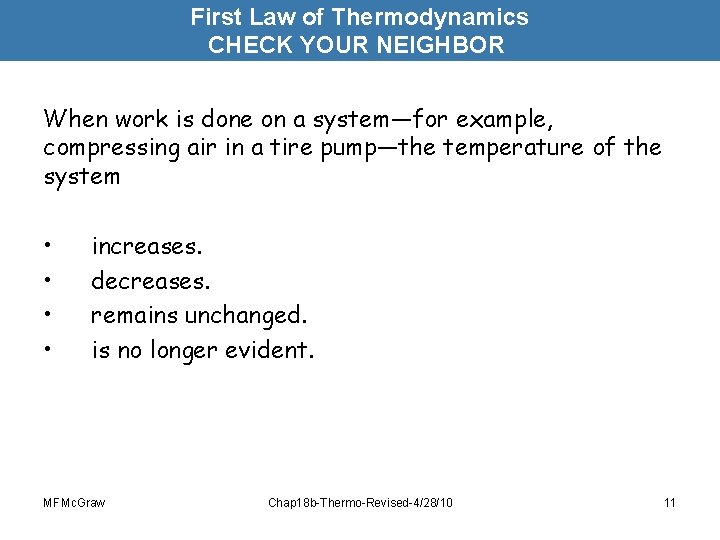
First Law of Thermodynamics CHECK YOUR NEIGHBOR When work is done on a system—for example, compressing air in a tire pump—the temperature of the system • • increases. decreases. remains unchanged. is no longer evident. MFMc. Graw Chap 18 b-Thermo-Revised-4/28/10 11
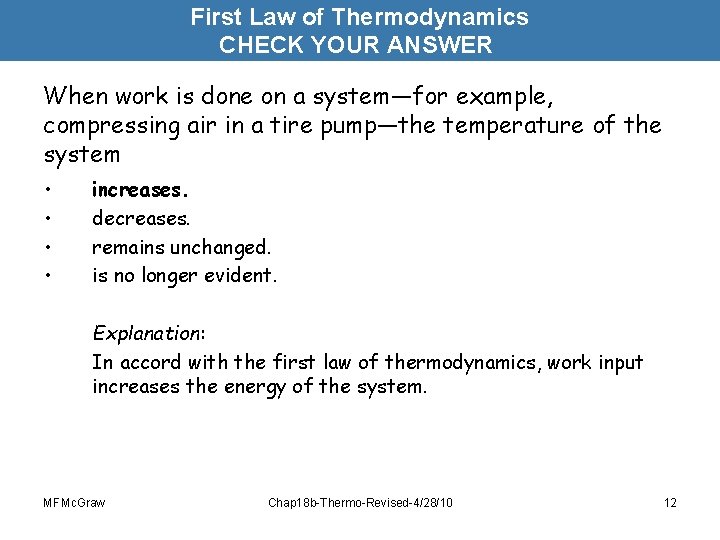
First Law of Thermodynamics CHECK YOUR ANSWER When work is done on a system—for example, compressing air in a tire pump—the temperature of the system • • increases. decreases. remains unchanged. is no longer evident. Explanation: In accord with the first law of thermodynamics, work input increases the energy of the system. MFMc. Graw Chap 18 b-Thermo-Revised-4/28/10 12
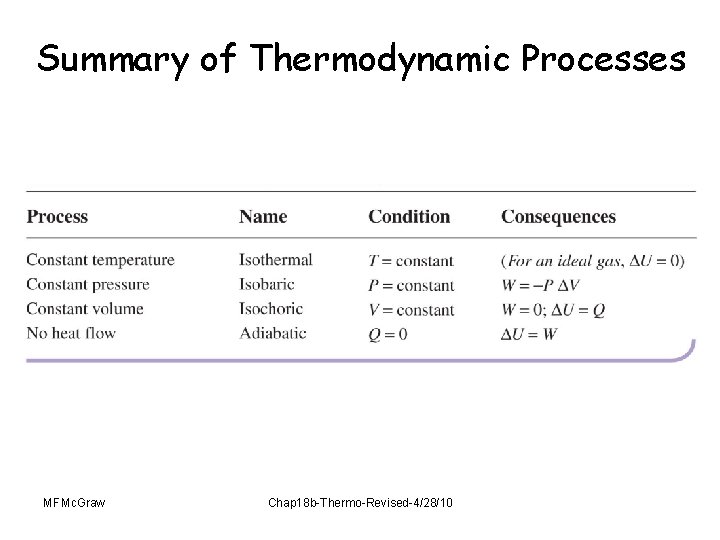
Summary of Thermodynamic Processes MFMc. Graw Chap 18 b-Thermo-Revised-4/28/10
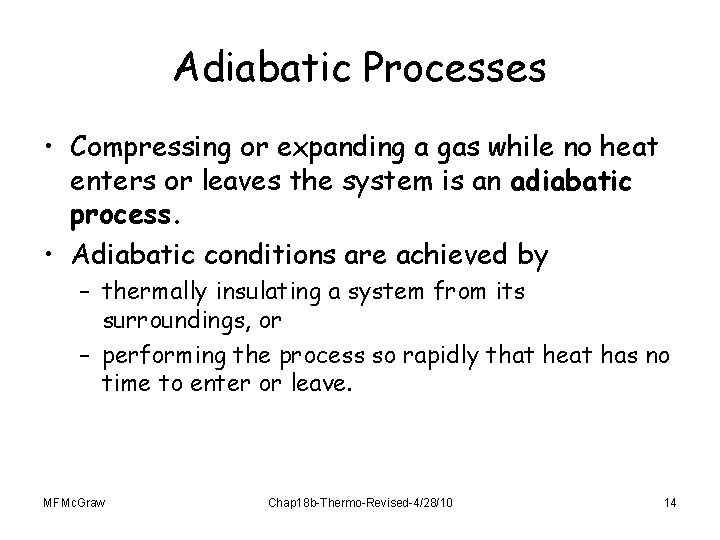
Adiabatic Processes • Compressing or expanding a gas while no heat enters or leaves the system is an adiabatic process. • Adiabatic conditions are achieved by – thermally insulating a system from its surroundings, or – performing the process so rapidly that heat has no time to enter or leave. MFMc. Graw Chap 18 b-Thermo-Revised-4/28/10 14
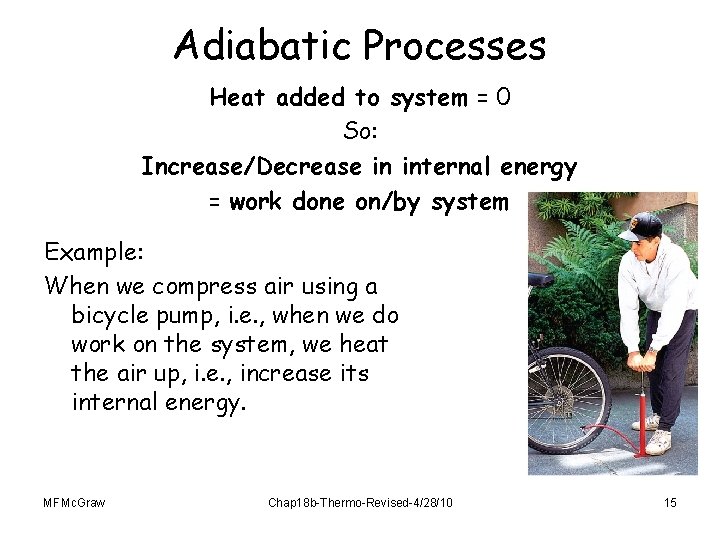
Adiabatic Processes Heat added to system = 0 So: Increase/Decrease in internal energy = work done on/by system Example: When we compress air using a bicycle pump, i. e. , when we do work on the system, we heat the air up, i. e. , increase its internal energy. MFMc. Graw Chap 18 b-Thermo-Revised-4/28/10 15
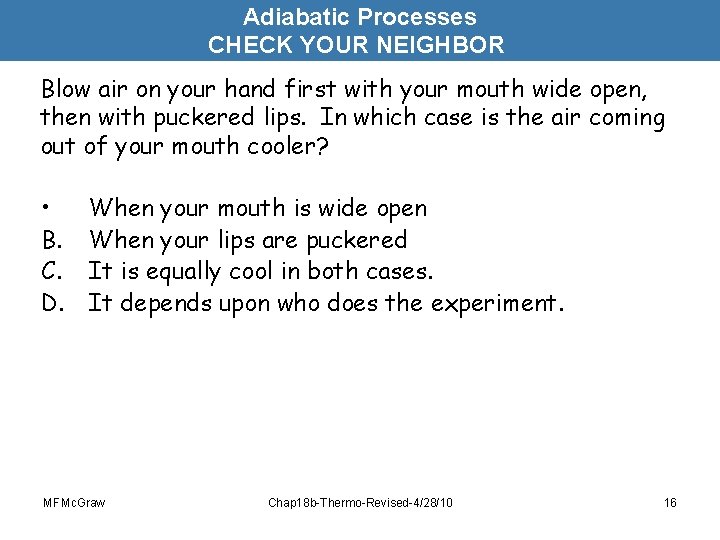
Adiabatic Processes CHECK YOUR NEIGHBOR Blow air on your hand first with your mouth wide open, then with puckered lips. In which case is the air coming out of your mouth cooler? • B. C. D. When your mouth is wide open When your lips are puckered It is equally cool in both cases. It depends upon who does the experiment. MFMc. Graw Chap 18 b-Thermo-Revised-4/28/10 16
Adiabatic Processes CHECK YOUR ANSWER Blow air on your hand first with your mouth wide open, then with puckered lips. In which case is the air coming out of your mouth cooler? • B. C. D. When your mouth is wide open When your lips are puckered It is equally cool in both cases. It depends upon who does the experiment. Explanation: When you pucker your lips the air expands as it comes out. Air expanding adiabatically does work on the surroundings. So, it loses internal energy which makes it cooler. MFMc. Graw Chap 18 b-Thermo-Revised-4/28/10 17
Meteorology and the First Law • Thermodynamics is useful to meteorologists when analyzing weather. • The first law of thermodynamics is expressed as: Air temperature rises as heat is added or as pressure is increased. • Heat may be added as – – incoming solar radiation back from Earth. moisture condensation. contact with ground. MFMc. Graw Chap 18 b-Thermo-Revised-4/28/10 18
Meteorology and the First Law • In the adiabatic form (i. e. , when no heat is added), the first law of thermodynamics becomes: Air temperature rises (or falls) as pressure increases (or decreases). • Adiabatic processes in the atmosphere occur in large parts of the air, called parcels. – Parcels are large enough that outside air doesn’t appreciably mix with the air inside them. – They behave as if they are enclosed in giant, tissue-light garment bags. MFMc. Graw Chap 18 b-Thermo-Revised-4/28/10 19
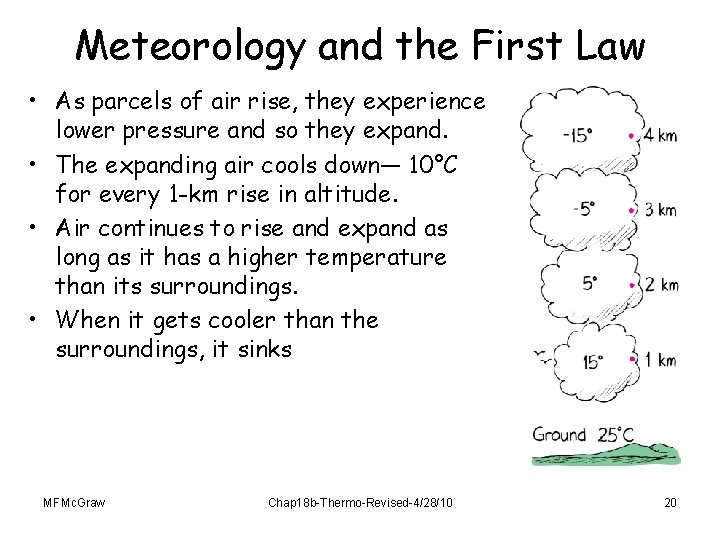
Meteorology and the First Law • As parcels of air rise, they experience lower pressure and so they expand. • The expanding air cools down— 10°C for every 1 -km rise in altitude. • Air continues to rise and expand as long as it has a higher temperature than its surroundings. • When it gets cooler than the surroundings, it sinks MFMc. Graw Chap 18 b-Thermo-Revised-4/28/10 20
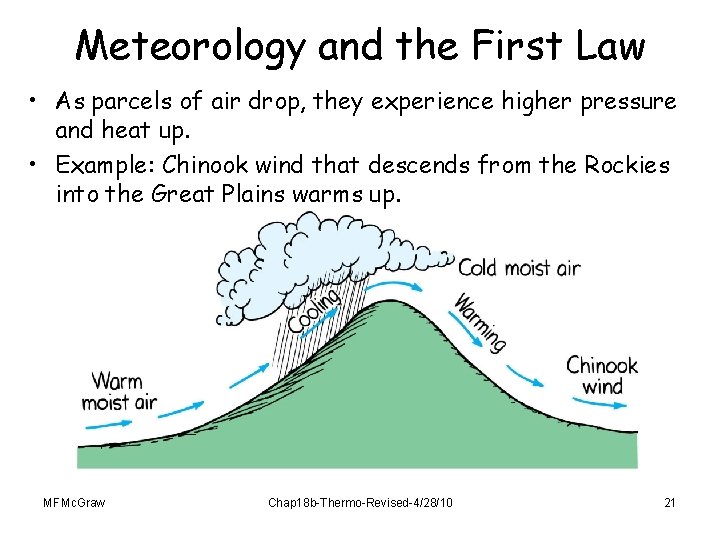
Meteorology and the First Law • As parcels of air drop, they experience higher pressure and heat up. • Example: Chinook wind that descends from the Rockies into the Great Plains warms up. MFMc. Graw Chap 18 b-Thermo-Revised-4/28/10 21
Meteorology and the First Law • Air continues to rise and expand as long as it has a higher temperature than its surroundings. • When it gets cooler than the surroundings, it sinks. • So, sometimes cooler air occurs at an altitude lower than warmer air: temperature inversion. MFMc. Graw Chap 18 b-Thermo-Revised-4/28/10 22
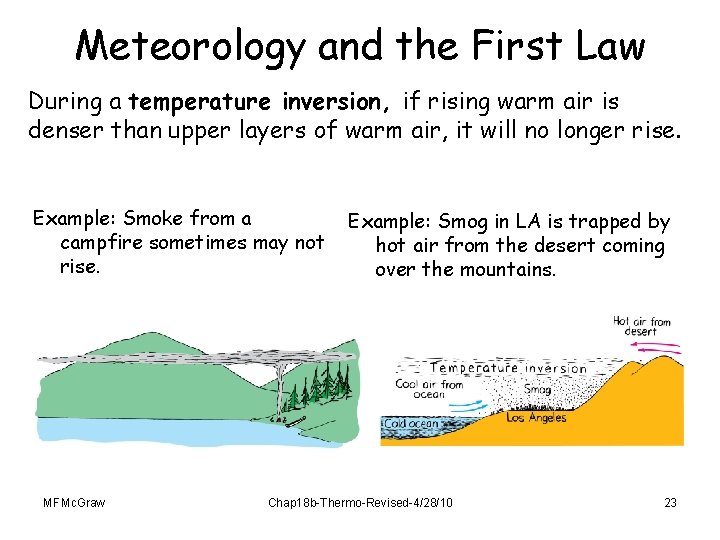
Meteorology and the First Law During a temperature inversion, if rising warm air is denser than upper layers of warm air, it will no longer rise. Example: Smoke from a campfire sometimes may not rise. MFMc. Graw Example: Smog in LA is trapped by hot air from the desert coming over the mountains. Chap 18 b-Thermo-Revised-4/28/10 23
Metrology and the First Law CHECK YOUR NEIGHBOR If a parcel of dry air initially at 10°C at ground level expands adiabatically while flowing upward alongside a mountain a vertical distance of 5 km, what will its temperature be? • • 10°C 20°C 40°C 50°C MFMc. Graw Chap 18 b-Thermo-Revised-4/28/10 24
Metrology and the First Law CHECK YOUR ANSWER If a parcel of dry air initially at 10°C at ground level expands adiabatically while flowing upward alongside a mountain a vertical distance of 5 km, what will its temperature be? A. • • • 10°C 20°C 40°C 50°C Explanation: Air cools at the rate of 10°C for every 1 km. So, if it rises 5 km, it will cool: 10°C 5 = 50°C. So, it will be 50°C cooler than on the ground. Its temp. on the ground was 10°C. So, its temp. at the top will be 10°C – 50°C = 40°C. MFMc. Graw Chap 18 b-Thermo-Revised-4/28/10 25
Second Law of Thermodynamics Heat itself never spontaneously flows from a cold object to a hot substance. • Example: – In summer, heat flows from the hot air outside into the cooler interior. – In winter, heat flows from the warm inside to the cold exterior. • Heat can flow from cold to hot only when work is done on the system or by adding energy from another source. – Example: heat pumps, air conditioners MFMc. Graw Chap 18 b-Thermo-Revised-4/28/10 26
Second Law of Thermodynamics • A heat engine is any device that converts internal energy into mechanical work. • The basic idea behind a heat engine is that mechanical work can be obtained only when heat flows from a high temperature to a low temperature. • In every heat engine, only some of the heat can be transformed into work. MFMc. Graw Chap 18 b-Thermo-Revised-4/28/10 27
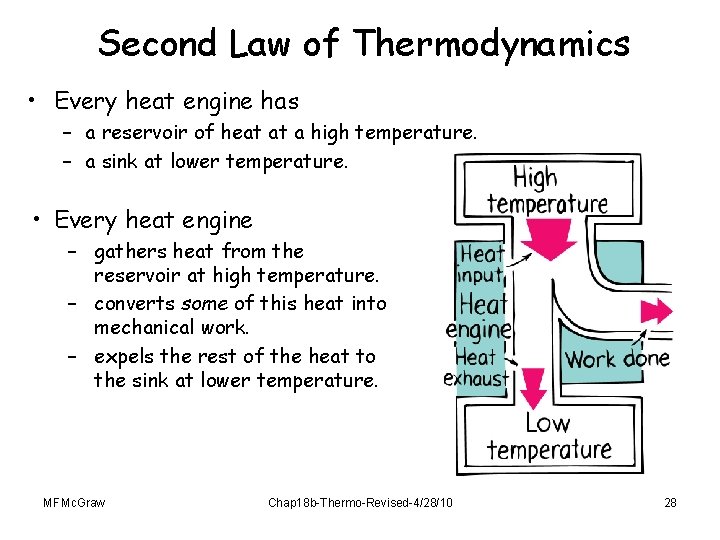
Second Law of Thermodynamics • Every heat engine has – a reservoir of heat at a high temperature. – a sink at lower temperature. • Every heat engine – gathers heat from the reservoir at high temperature. – converts some of this heat into mechanical work. – expels the rest of the heat to the sink at lower temperature. MFMc. Graw Chap 18 b-Thermo-Revised-4/28/10 28
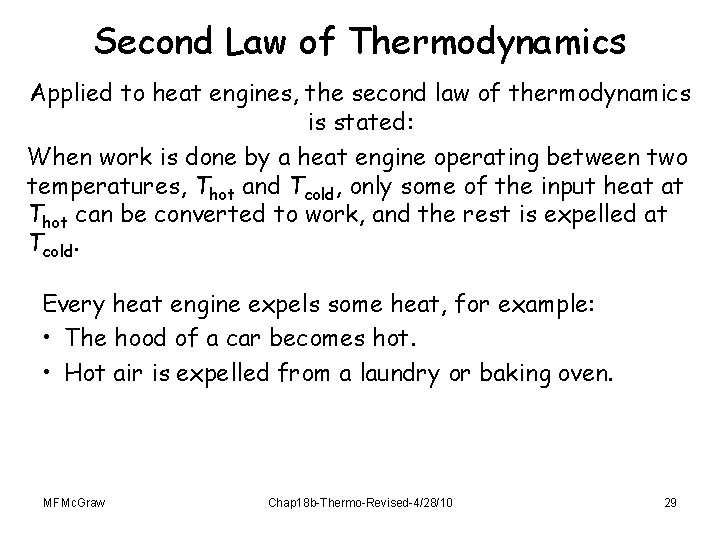
Second Law of Thermodynamics Applied to heat engines, the second law of thermodynamics is stated: When work is done by a heat engine operating between two temperatures, Thot and Tcold, only some of the input heat at Thot can be converted to work, and the rest is expelled at Tcold. Every heat engine expels some heat, for example: • The hood of a car becomes hot. • Hot air is expelled from a laundry or baking oven. MFMc. Graw Chap 18 b-Thermo-Revised-4/28/10 29
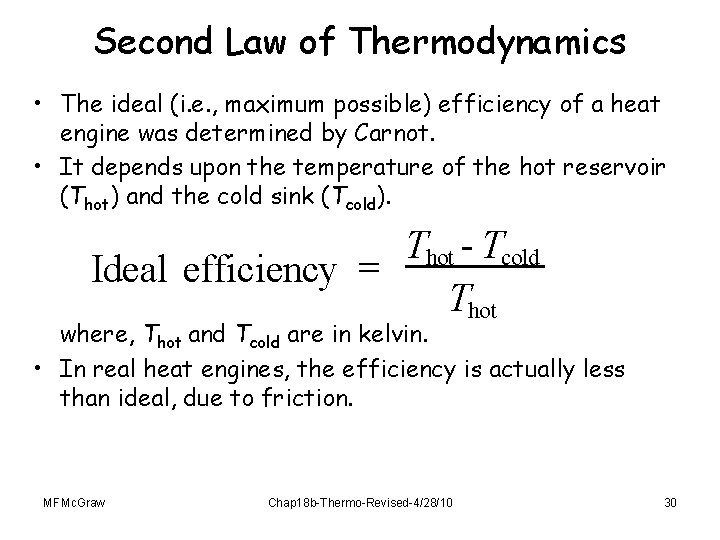
Second Law of Thermodynamics • The ideal (i. e. , maximum possible) efficiency of a heat engine was determined by Carnot. • It depends upon the temperature of the hot reservoir (Thot) and the cold sink (Tcold). Thot - Tcold Ideal efficiency = Thot where, Thot and Tcold are in kelvin. • In real heat engines, the efficiency is actually less than ideal, due to friction. MFMc. Graw Chap 18 b-Thermo-Revised-4/28/10 30
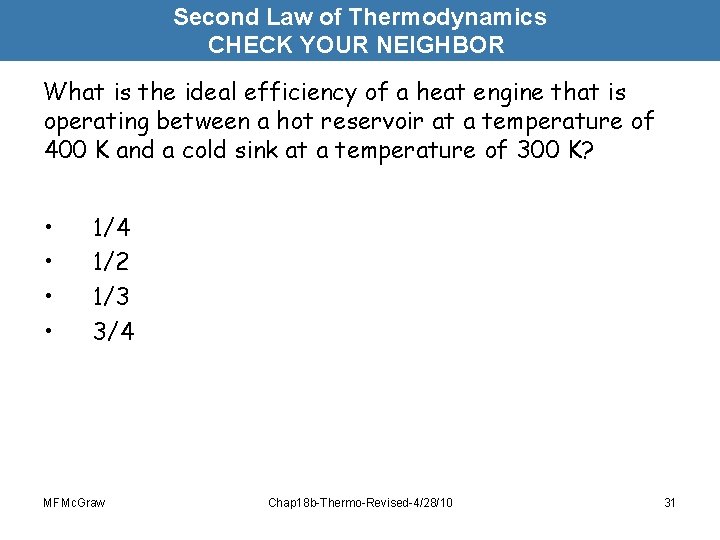
Second Law of Thermodynamics CHECK YOUR NEIGHBOR What is the ideal efficiency of a heat engine that is operating between a hot reservoir at a temperature of 400 K and a cold sink at a temperature of 300 K? • • 1/4 1/2 1/3 3/4 MFMc. Graw Chap 18 b-Thermo-Revised-4/28/10 31
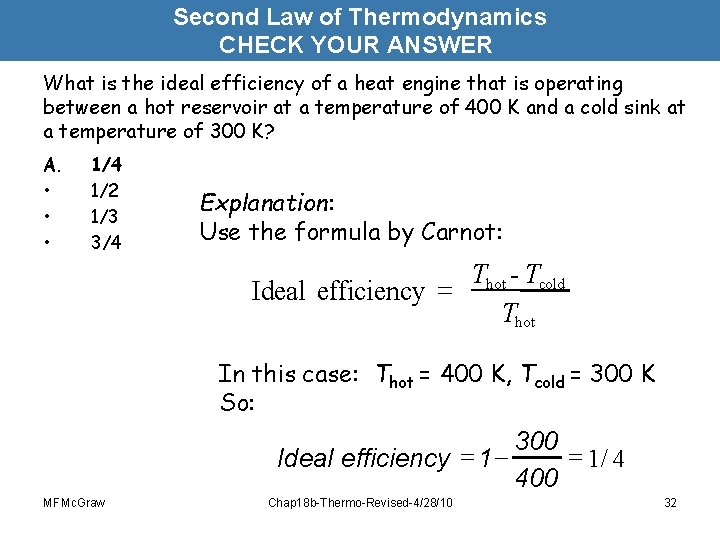
Second Law of Thermodynamics CHECK YOUR ANSWER What is the ideal efficiency of a heat engine that is operating between a hot reservoir at a temperature of 400 K and a cold sink at a temperature of 300 K? A. • • • 1/4 1/2 1/3 3/4 Explanation: Use the formula by Carnot: Thot - Tcold Ideal ef efficiency = Thot In this case: Thot = 400 K, Tcold = 300 K So: 300 = 1/ 4 Ideal efficiency = 1 400 MFMc. Graw Chap 18 b-Thermo-Revised-4/28/10 32
Order Tends to Disorder Restatement of the second law of thermodynamics In natural processes, high-quality energy tends to transform into lower-quality energy—order tends to disorder. • Processes in nature do not move from disorder to order without external assistance. MFMc. Graw Chap 18 b-Thermo-Revised-4/28/10 33
Order-Disorder Examples • Ink drop in a glass of water. • Tossing a deck of cards into the air. • Releasing a small amount of ether in the corner of a room. • Dropping a bag of marbles on the floor. • Any others? MFMc. Graw Chap 18 b-Thermo-Revised-4/28/10 34
Entropy • The measure of the amount of disorder in a system is called entropy. • If disorder increases, then entropy increases. • Entropy can decrease if work is put into the system. Example: Living organisms take in food or extract energy from their surroundings and become more organized. MFMc. Graw Chap 18 b-Thermo-Revised-4/28/10 35
Entropy CHECK YOUR NEIGHBOR Your locker gets messier each week. In this case, the entropy of your locker is • • increasing. decreasing. hanging steady. nonexistent. MFMc. Graw Chap 18 b-Thermo-Revised-4/28/10 36
Entropy CHECK YOUR ANSWER Your locker gets messier each week. In this case, the entropy of your locker is • • increasing. decreasing. hanging steady. nonexistent. Comment: If your locker became more organized each week, then entropy would decrease in proportion to the effort expended. MFMc. Graw Chap 18 b-Thermo-Revised-4/28/10 37
Entropy The net entropy in the universe is continually increasing (continually running “downhill”). • We say net because there are some regions in which energy is actually being organized and concentrated. – This occurs in living organisms, which survive by concentrating and organizing energy from food sources. – Energy must be transformed into the living system to support life. When it isn’t, the organism soon dies and tends toward disorder. MFMc. Graw Chap 18 b-Thermo-Revised-4/28/10 38
Entropy The second law of thermodynamics is a probabilistic statement. • Given enough time, even the most improbable states may occur; entropy may sometimes decrease. – For example, the haphazard motions of air molecules could momentarily become harmonious in a corner of the room. • These situations are possible, but they are not probable. MFMc. Graw Chap 18 b-Thermo-Revised-4/28/10 39
Possible and Not Probable • The probability of an event occurring can be assigned a value in the form of a fraction - as a decimal it is between 0 and 1 and may assume either of those end point values. • The probability is called the p value. • If an event can happen in one of 6 ways - all different and equally probable then the p value of each of those events is 1/6. • “Possible” means that the p value is not 0 - the event could happen. • “Not probable” means that the p value is very small. MFMc. Graw Chap 18 b-Thermo-Revised-4/28/10 40

Particles in a Box -Entropy Demo MFMc. Graw Chap 18 b-Thermo-Revised-4/28/10
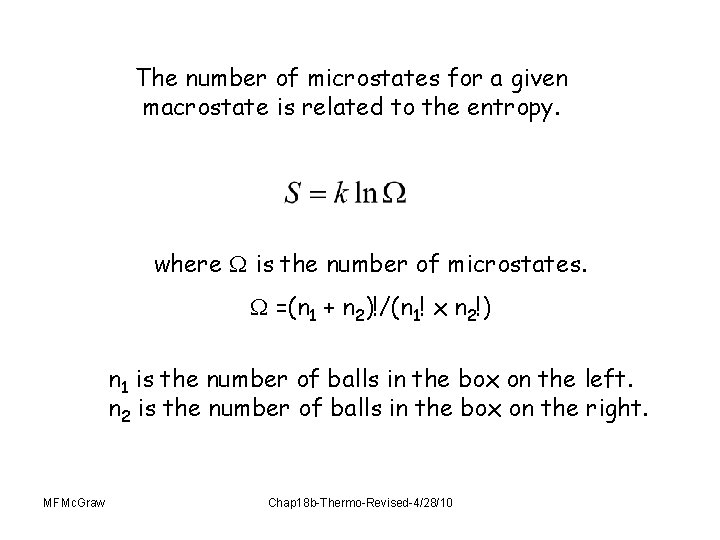
The number of microstates for a given macrostate is related to the entropy. where is the number of microstates. =(n 1 + n 2)!/(n 1! x n 2!) n 1 is the number of balls in the box on the left. n 2 is the number of balls in the box on the right. MFMc. Graw Chap 18 b-Thermo-Revised-4/28/10
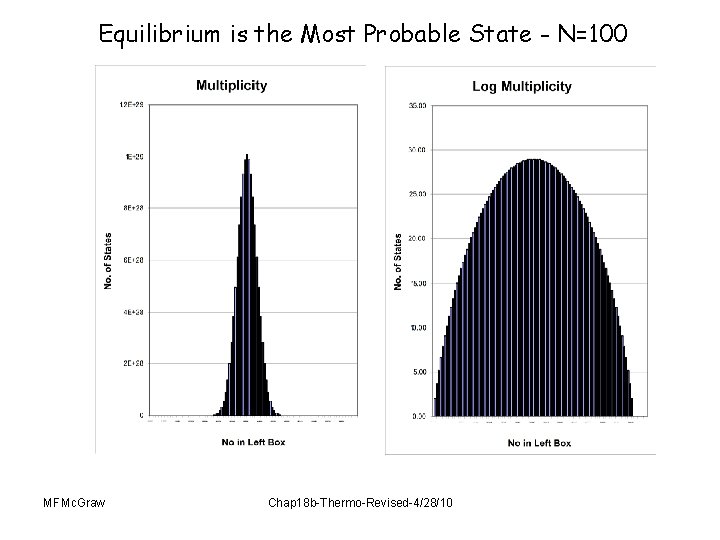
Equilibrium is the Most Probable State - N=100 MFMc. Graw Chap 18 b-Thermo-Revised-4/28/10
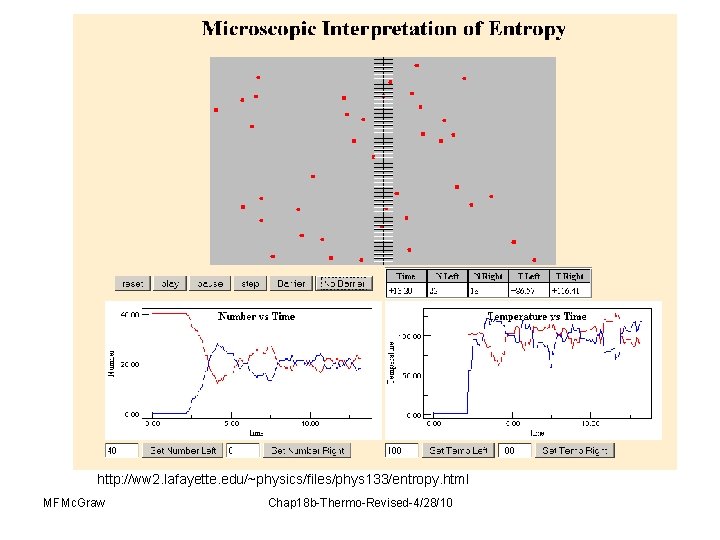
http: //ww 2. lafayette. edu/~physics/files/phys 133/entropy. html MFMc. Graw Chap 18 b-Thermo-Revised-4/28/10
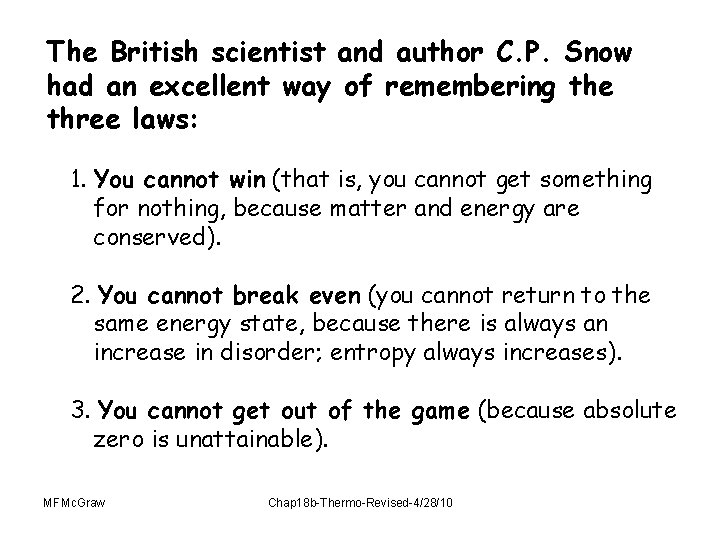
The British scientist and author C. P. Snow had an excellent way of remembering the three laws: 1. You cannot win (that is, you cannot get something for nothing, because matter and energy are conserved). 2. You cannot break even (you cannot return to the same energy state, because there is always an increase in disorder; entropy always increases). 3. You cannot get out of the game (because absolute zero is unattainable). MFMc. Graw Chap 18 b-Thermo-Revised-4/28/10
Summary • • • MFMc. Graw Thermodynamics Absolute Zero Internal Energy First Law of Thermodynamics Adiabatic Processes Meteorology and the First Law Second Law of Thermodynamics Order Tends to Disorder Entropy Chap 18 b-Thermo-Revised-4/28/10
- Slides: 46