
CHAPTER 18 SURVIVAL ANALYSIS Damodar Gujarati Econometrics by
CHAPTER 18 SURVIVAL ANALYSIS Damodar Gujarati Econometrics by Example
SURVIVAL ANALYSIS (SA) Ø The primary goals of survival analysis are to: Ø (1) Estimate and interpret survivor or hazard functions from survival data Ø (2) Assess the impact of explanatory variables on survival time Ø Ø Ø Survival analysis goes by various names, such as: Duration analysis Event history analysis Reliability or failure time analysis Transition analysis Hazard rate analysis Damodar Gujarati Econometrics by Example
TERMINOLOGY OF SURVIVAL ANALYSIS Ø Event: “An event consists of some qualitative change that occurs at a specific point in time…. The change must consist of a relatively sharp disjunction between what precedes and what follows. ” Ø Duration Spell: The length of time before an event occurs. Ø Discrete Time Analysis: Some events occur only at discrete times. Ø Continuous Time Analysis: Continuous time SA analysis treats time as continuous. Damodar Gujarati Econometrics by Example
CUMULATIVE DISTRIBUTION FUNCTION OF TIME Ø If we treat T, the time until an event occurs, as a continuous variable, the distribution of the T is given by the CDF: which gives the probability that the event has occurred by duration t. Ø If F(t) is differentiable, its density function can be expressed as: Damodar Gujarati Econometrics by Example

SURVIVAL AND HAZARD FUNCTIONS Ø The Survivor Function S(t): is the probability of surviving past time t and is defined as: Ø The Hazard Function h(t): Consider the following function: where the numerator is the conditional probability of leaving the initial state in the (time) interval {t, t+h}, given survival up to time t. Ø The hazard function is the ratio of the density function to the survivor function for a random variable: Damodar Gujarati Econometrics by Example
SOME PROBLEMS ASSOCIATED WITH SA Ø 1. Censoring: A frequently encountered problem in SA is that the data are often censored. Ø 2. Hazard Function With or Without Covariates: We have to determine if covariates are time-variant or timeinvariant. Ø 3. Duration Dependence: If the hazard function is not constant, there is duration dependence. Ø 4. Unobserved Heterogeneity: No matter how many covariates we consider, there may be intrinsic heterogeneity among individuals. Damodar Gujarati Econometrics by Example
SOME PROBLEMS ASSOCIATED WITH SA Ø There are several parametric models that are used in duration analysis. Ø Each depends on the assumed probability distribution, such as: ØExponential Distribution ØWeibull Distribution ØLognormal Distribution ØLoglogistic Distribution Damodar Gujarati Econometrics by Example
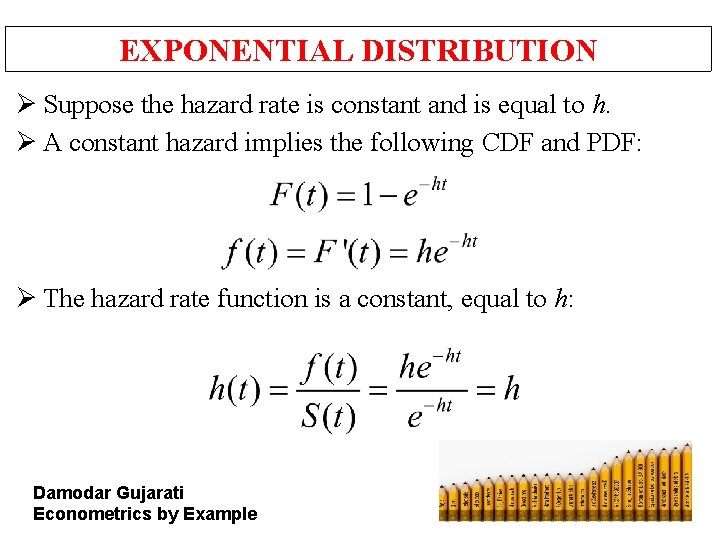
EXPONENTIAL DISTRIBUTION Ø Suppose the hazard rate is constant and is equal to h. Ø A constant hazard implies the following CDF and PDF: Ø The hazard rate function is a constant, equal to h: Damodar Gujarati Econometrics by Example
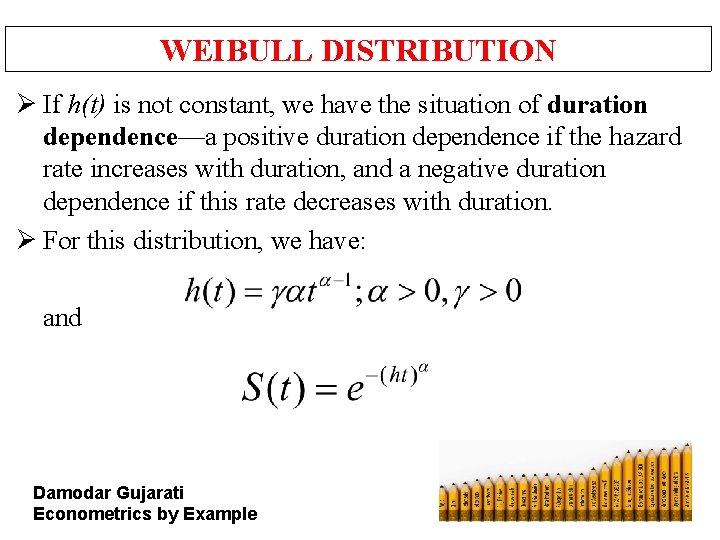
WEIBULL DISTRIBUTION Ø If h(t) is not constant, we have the situation of duration dependence—a positive duration dependence if the hazard rate increases with duration, and a negative duration dependence if this rate decreases with duration. Ø For this distribution, we have: and Damodar Gujarati Econometrics by Example
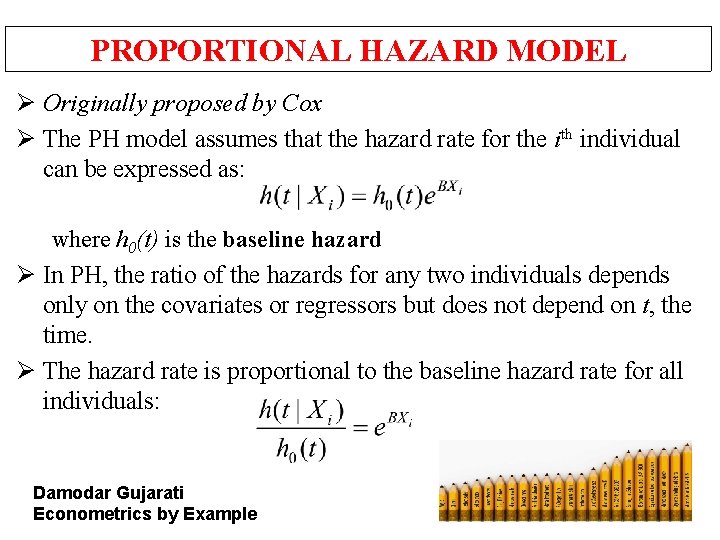
PROPORTIONAL HAZARD MODEL Ø Originally proposed by Cox Ø The PH model assumes that the hazard rate for the ith individual can be expressed as: where h 0(t) is the baseline hazard Ø In PH, the ratio of the hazards for any two individuals depends only on the covariates or regressors but does not depend on t, the time. Ø The hazard rate is proportional to the baseline hazard rate for all individuals: Damodar Gujarati Econometrics by Example
SALIENT FEATURES OF SOME DURATION MODELS Damodar Gujarati Econometrics by Example
- Slides: 11