
Chapter 18 Real Estate Appraisal 2010 by Cengage
Chapter 18 ________ Real Estate Appraisal © 2010 by Cengage Learning
Purpose and Use of Appraisal § § § Appraisal: Informal appraisal: Formal appraisal: § § § Set prices, to base loan values, set insurance premiums, set tax values Estimate of value Written statement of an impartial opinion of value based on analysis of relevant market information © 2010 by Cengage Learning 2
Defining Value § § Fair Market Value (or just Market Value): § the cash price that a willing buyer will pay to a willing seller given reasonable exposure of the property to the marketplace each with full information as to the potential uses of the property and neither undue compulsion or hardship to act, no impediments as to title or terms. Nebraska common law definition: § the price that someone ready to sell, but not required to do so, would be willing to accept in payment for the property, and that someone ready to buy, but not required to do so, would be willing to pay for the property. © 2010 by Cengage Learning 3
Defining Value (b) § Details of FMV: 1) marketable title, 2) time to close, 3) motivation, 4) informed sale/purchase, 5) exposure to market, 6) market terms, 7) normal consideration (no special financing). © 2010 by Cengage Learning
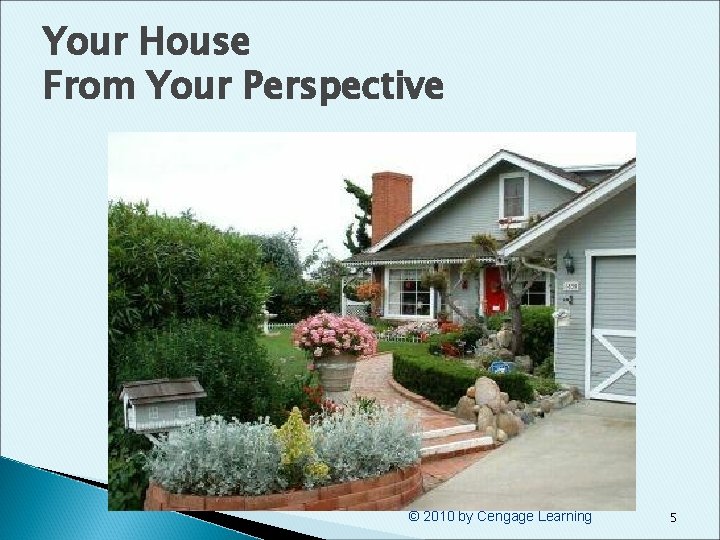
Your House From Your Perspective © 2010 by Cengage Learning 5
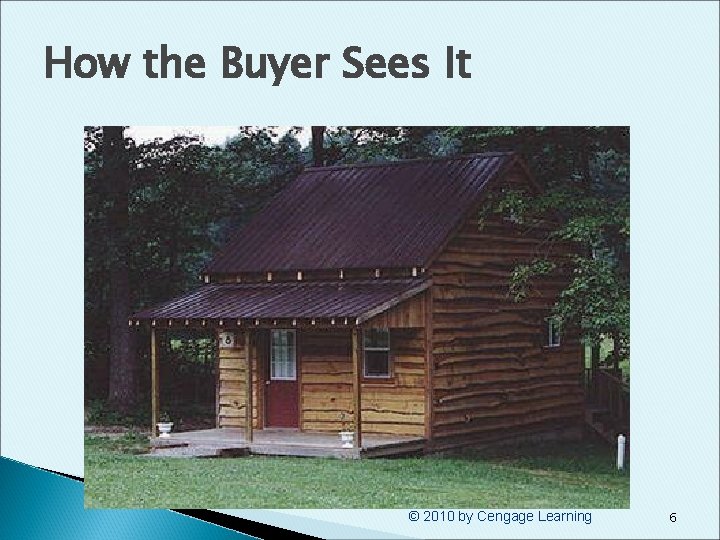
How the Buyer Sees It © 2010 by Cengage Learning 6
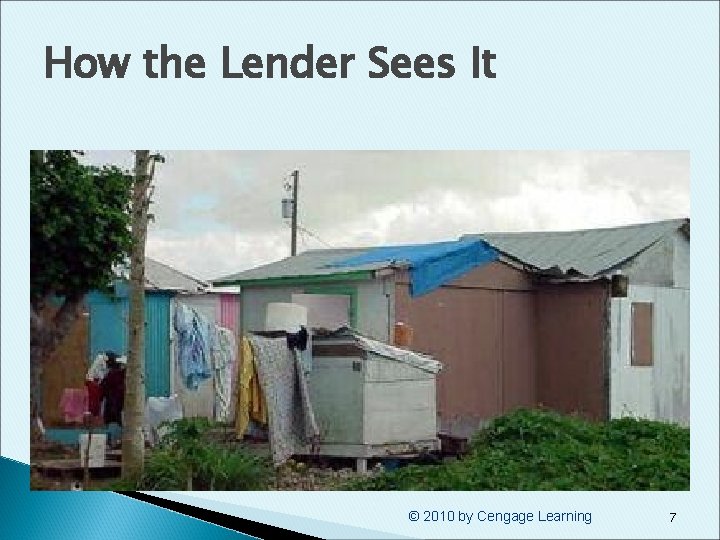
How the Lender Sees It © 2010 by Cengage Learning 7
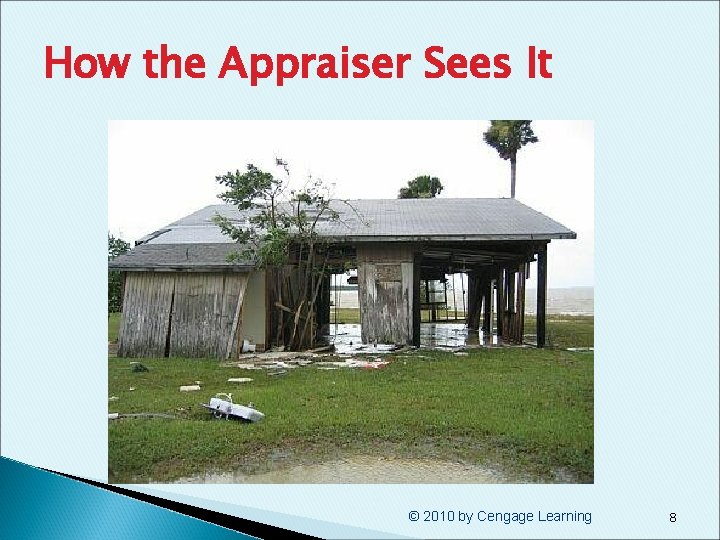
How the Appraiser Sees It © 2010 by Cengage Learning 8
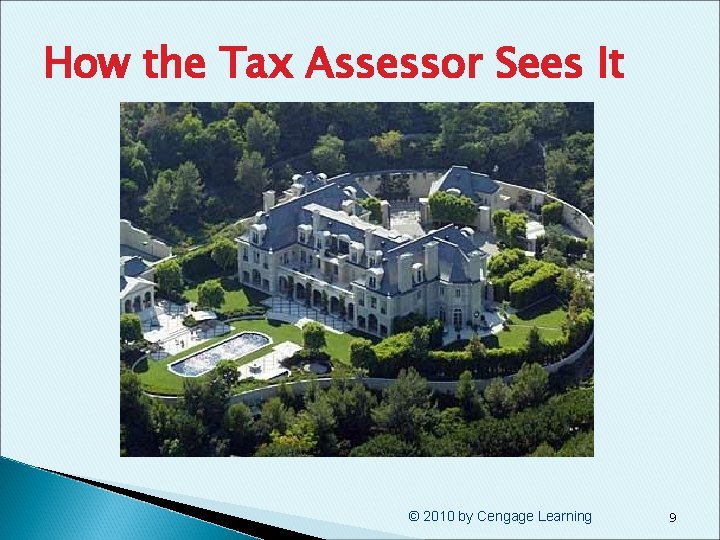
How the Tax Assessor Sees It © 2010 by Cengage Learning 9
Valuation Process § Step by step procedure refined by the Uniform Standards of Professional Appraisal Practice (USPAP) § Define problem § Conduct preliminary analysis/collect data § Estimate highest and best use § Estimate land value § Estimate improved property value § Reconcile results § Report conclusion © 2010 by Cengage Learning 10
Value Approaches § Market Comparison § § Cost § § Income § Comparable properties recently sold Acquisition of land, build improvements Based on monetary return a property can generate © 2010 by Cengage Learning 11
Market Comparison Approach § § § Comps (usually 3 to 5) Sales records, where to find Adjustments § § Market differences and time on market Differences of amenities, physical features, terms Adjusted market price (of each property) Correlation process (assign weight to more similar property) © 2010 by Cengage Learning 12
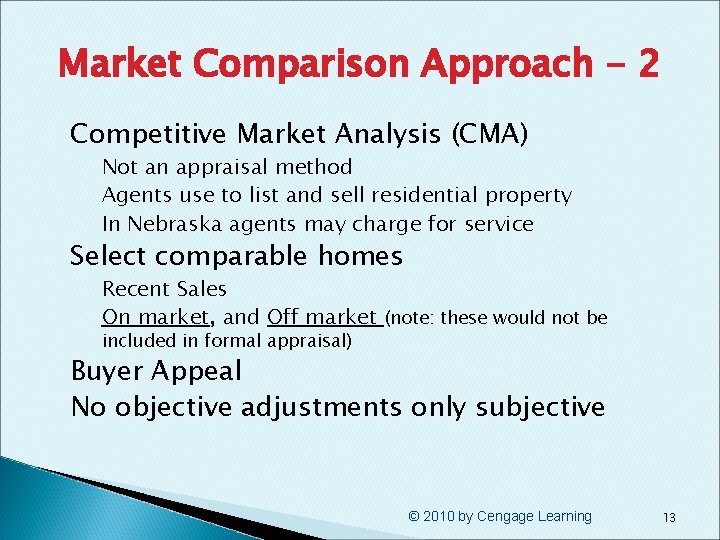
Market Comparison Approach - 2 § Competitive Market Analysis (CMA) § § Not an appraisal method Agents use to list and sell residential property In Nebraska agents may charge for service Select comparable homes § § Recent Sales On market, and Off market (note: these would not be included in formal appraisal) § § Buyer Appeal No objective adjustments only subjective © 2010 by Cengage Learning 13
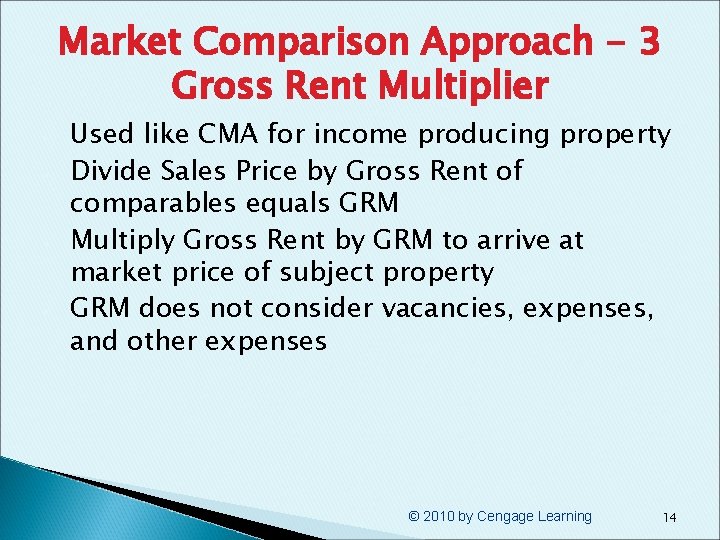
Market Comparison Approach - 3 Gross Rent Multiplier § § Used like CMA for income producing property Divide Sales Price by Gross Rent of comparables equals GRM Multiply Gross Rent by GRM to arrive at market price of subject property GRM does not consider vacancies, expenses, and other expenses © 2010 by Cengage Learning 14
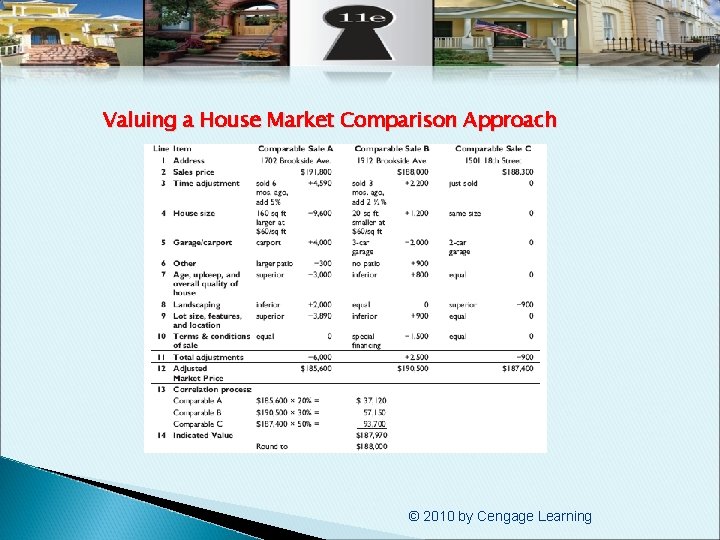
Valuing a House Market Comparison Approach © 2010 by Cengage Learning
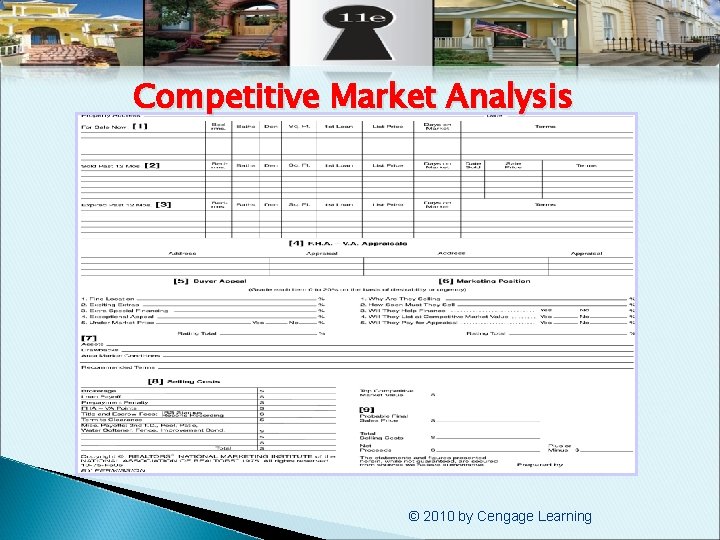
Competitive Market Analysis © 2010 by Cengage Learning
Cost Approach § § § Determine cost of land Determine cost of building Estimate depreciation Compute value of improvements Compute value of property § § Land is valued as vacant Based on comparable market information © 2010 by Cengage Learning 17
Cost Approach § § § Determine cost of land Determine cost of building Estimate depreciation Compute value of improvements Compute value of property § Reproduction cost § § § Replacement cost § § § Exact replica Same or similar materials Today’s prices and methods Equivalent usefulness Eliminates obsolete features Square Foot Method Cost Handbook © 2010 by Cengage Learning 18
Cost Approach § § § Determine cost of land Determine cost of building Estimate depreciation Compute value of improvements Compute value of property § Reproduction cost § § § Replacement cost § § § Exact replica Same or similar materials Today’s prices and methods Equivalent usefulness Eliminates obsolete features Square Foot Method Cost Handbook © 2010 by Cengage Learning 19
Cost Approach § § § Determine cost of land Determine cost of building Estimate depreciation Compute value of improvements Compute value of property § Physical Deterioration § § § Functional obsolescence § § § Wear and tear Acts of nature Outmoded/outdated Curable and incurable depreciation Economic obsolescence § § External forces Appreciation © 2010 by Cengage Learning 20
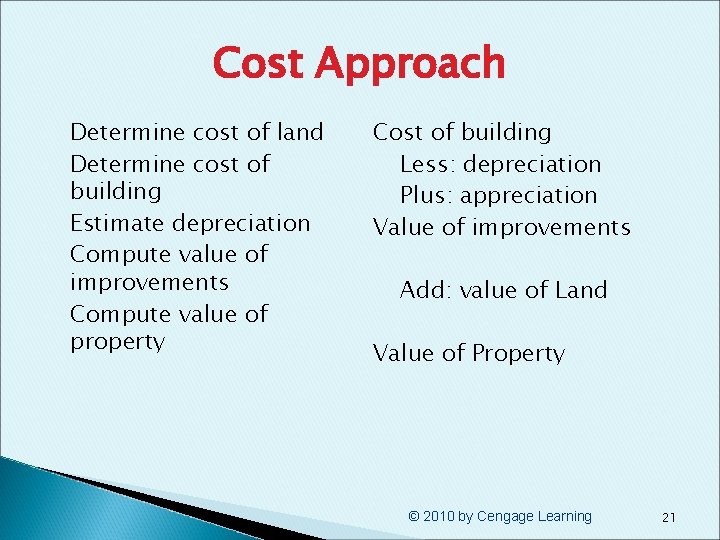
Cost Approach § § § Determine cost of land Determine cost of building Estimate depreciation Compute value of improvements Compute value of property Cost of building Less: depreciation Plus: appreciation Value of improvements Add: value of Land Value of Property © 2010 by Cengage Learning 21
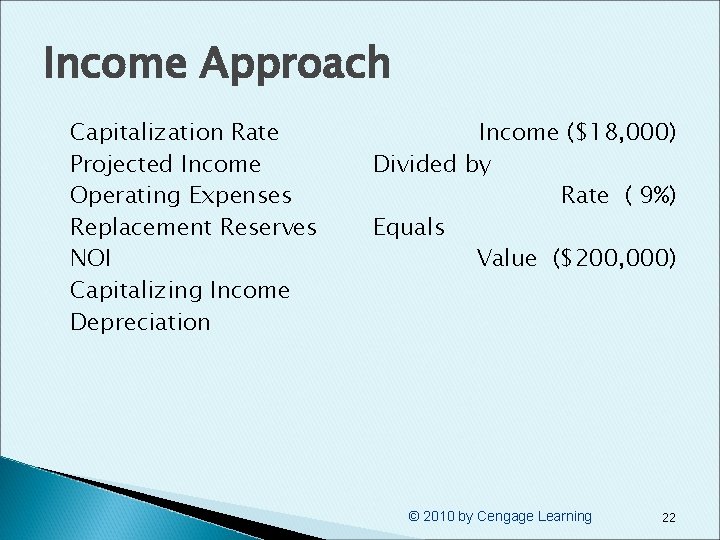
Income Approach § § § § Capitalization Rate Projected Income Operating Expenses Replacement Reserves NOI Capitalizing Income Depreciation Income ($18, 000) Divided by Rate ( 9%) Equals Value ($200, 000) © 2010 by Cengage Learning 22
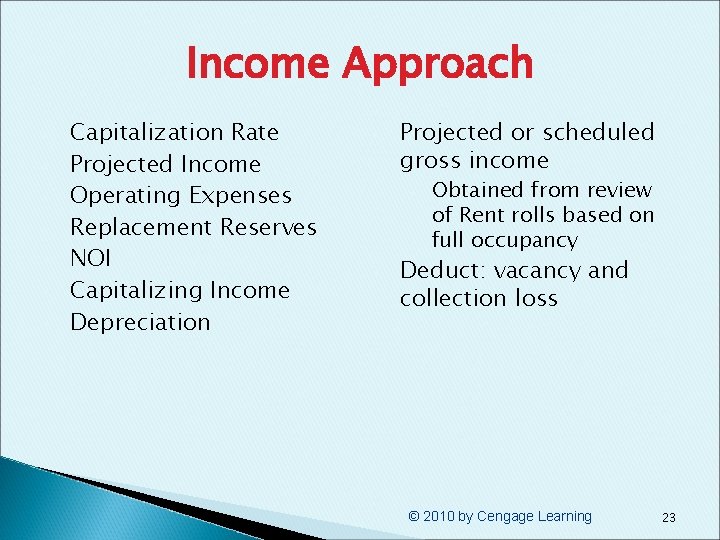
Income Approach § § § § Capitalization Rate Projected Income Operating Expenses Replacement Reserves NOI Capitalizing Income Depreciation § Projected or scheduled gross income § § Obtained from review of Rent rolls based on full occupancy Deduct: vacancy and collection loss © 2010 by Cengage Learning 23
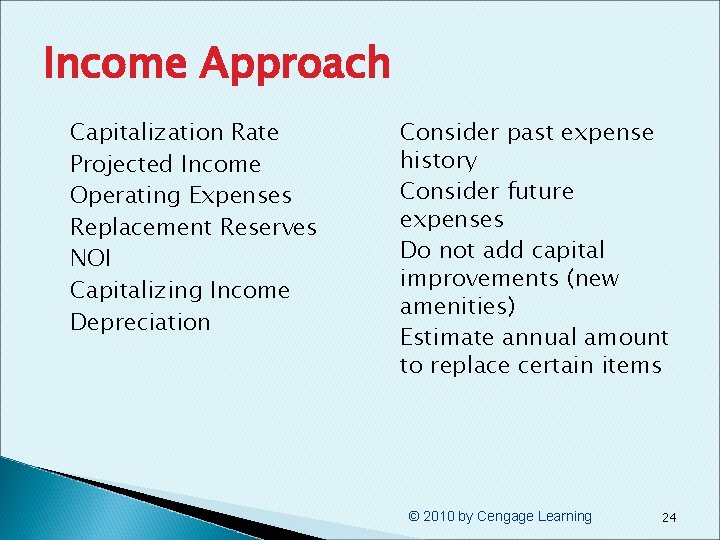
Income Approach § § § § Capitalization Rate Projected Income Operating Expenses Replacement Reserves NOI Capitalizing Income Depreciation § § Consider past expense history Consider future expenses Do not add capital improvements (new amenities) Estimate annual amount to replace certain items © 2010 by Cengage Learning 24
Income Approach § § § § Capitalization Rate Projected Income Operating Expenses Replacement Reserves NOI Capitalizing Income Depreciation § § § Perform I/R=V computations Consider mortgage expense Consider effect of depreciation and fictional depreciation (tax write-off) © 2010 by Cengage Learning 25
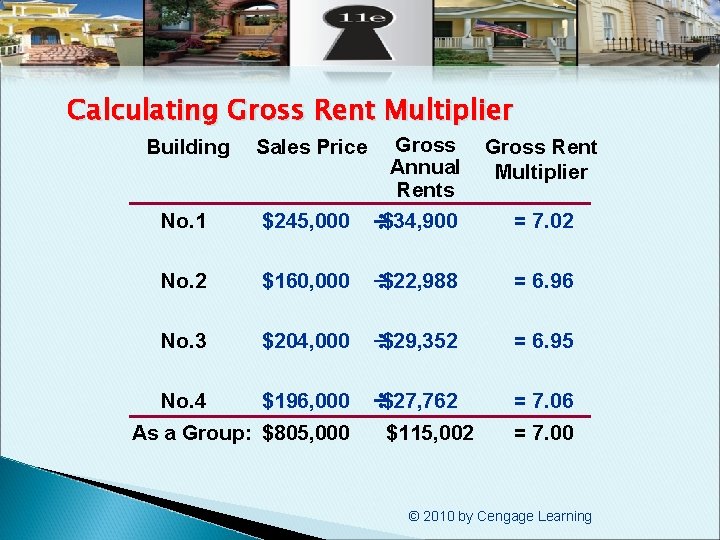
Calculating Gross Rent Multiplier $245, 000 Gross Annual Rents $34, 900 No. 2 $160, 000 $22, 988 = 6. 96 No. 3 $204, 000 $29, 352 = 6. 95 No. 4 $196, 000 $27, 762 = 7. 06 $115, 002 = 7. 00 Building Sales Price No. 1 As a Group: $805, 000 = 7. 02 © 2010 by Cengage Learning
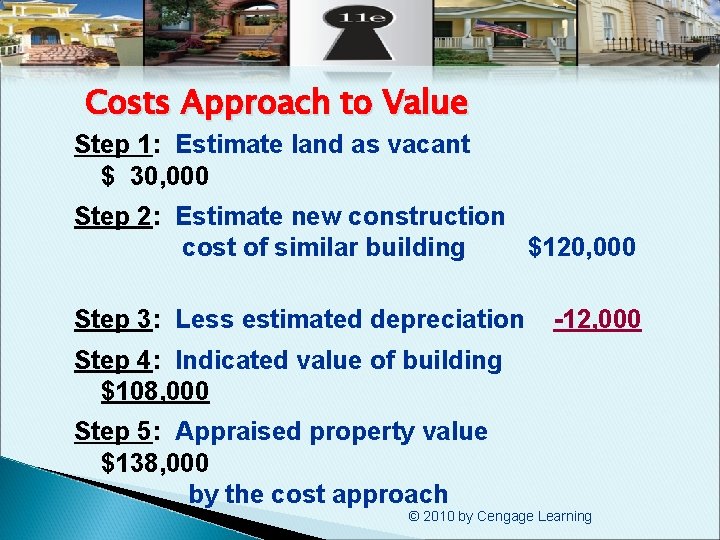
Costs Approach to Value Step 1: Estimate land as vacant $ 30, 000 Step 2: Estimate new construction cost of similar building $120, 000 Step 3: Less estimated depreciation -12, 000 Step 4: Indicated value of building $108, 000 Step 5: Appraised property value $138, 000 by the cost approach © 2010 by Cengage Learning
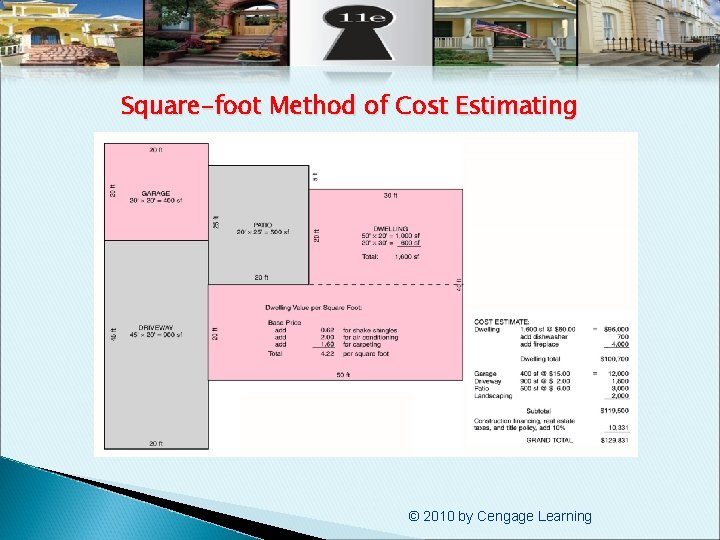
Square-foot Method of Cost Estimating © 2010 by Cengage Learning
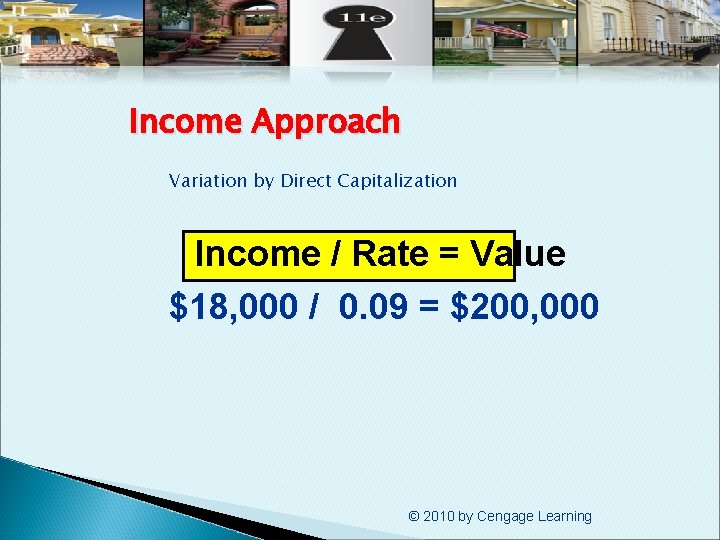
Income Approach Variation by Direct Capitalization Income / Rate = Value $18, 000 / 0. 09 = $200, 000 © 2010 by Cengage Learning
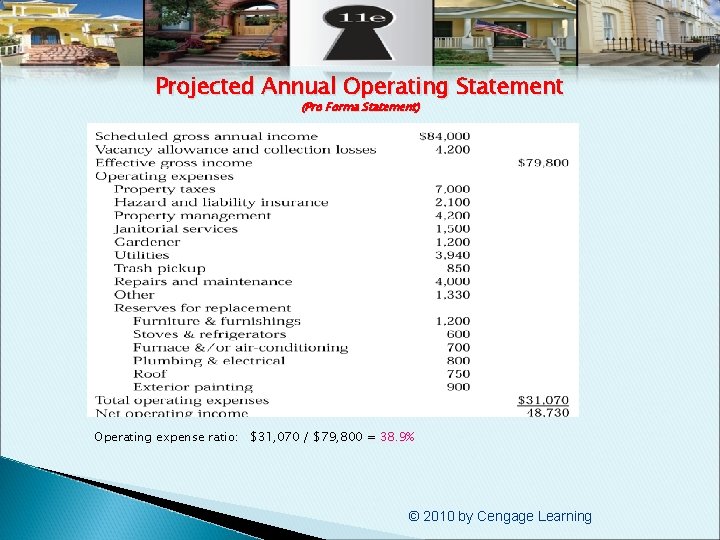
Projected Annual Operating Statement (Pro Forma Statement) Operating expense ratio: $31, 070 / $79, 800 = 38. 9% © 2010 by Cengage Learning
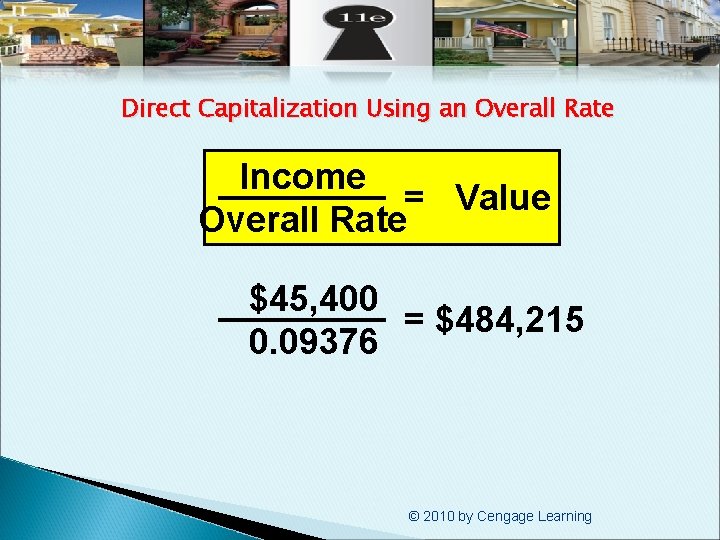
Direct Capitalization Using an Overall Rate Income = Value Overall Rate $45, 400 = $484, 215 0. 09376 © 2010 by Cengage Learning
© 2010 by Cengage Learning
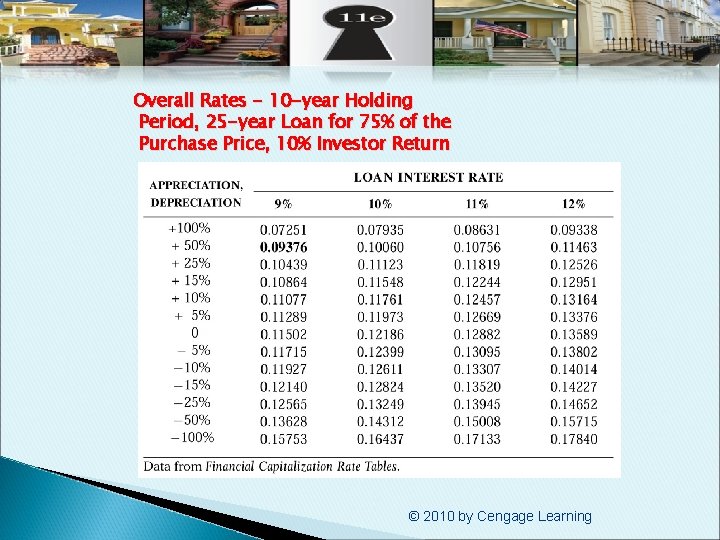
Overall Rates - 10 -year Holding Period, 25 -year Loan for 75% of the Purchase Price, 10% Investor Return © 2010 by Cengage Learning
Choice of Approaches § § Market Approach Cost Approach § § Income Approach Will produce values best for residential property Ideal when number of comparable properties sold New construction may not be represented by comps © 2010 by Cengage Learning 34
Choice of Approaches § Market Approach § Cost Approach § Income Approach § § § Used to value property without comps Used to value property without income streams Used to value property recently constructed or with “standard” construction © 2010 by Cengage Learning 35
Choice of Approaches § Market Approach § Cost Approach § Income Approach § § Properties used for investment purposes Apartment buildings, shopping centers, office buildings May be price per unit (apartment) or price per square foot May also determine if cheaper to build than buy © 2010 by Cengage Learning 36
Reconciliation and Estimate § § Apply weight to each method as best fits the perceived market or the project Add the weighted values Arrive at Best Estimate or Opinion of Value NOTE: An appraisal does not take into consideration the seller’s circumstances, or other subjective motivation. No guarantee of sale at appraised value nor guarantee of condition of property or future value. Not a loan guarantee (though may establish loan to value ratio), nor an Offer to purchase. © 2010 by Cengage Learning 37
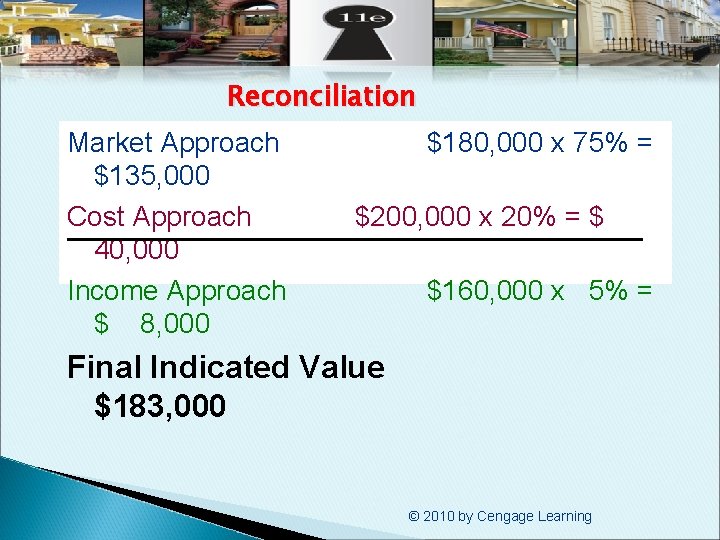
Reconciliation Market Approach $135, 000 Cost Approach 40, 000 Income Approach $ 8, 000 $180, 000 x 75% = $200, 000 x 20% = $ $160, 000 x 5% = Final Indicated Value $183, 000 © 2010 by Cengage Learning
Types of Appraisals and Reporting Options Under USPAP Types of Appraisals ◦ Complete appraisal ◦ Limited appraisal Reporting Options ◦ Self-contained appraisal report ◦ Summary report ◦ Restrictive report © 2010 by Cengage Learning
Formats of Appraisal Reports 1. Letter report 2. Form report 3. Narrative report 4. Review appraisals 5. Real estate analysis © 2010 by Cengage Learning
Appraiser License Certified General Appraiser Certified Residential Appraiser State licensed appraiser Provisional licensed real estate appraiser Appraiser trainee © 2010 by Cengage Learning
Principles of Value l Principle of Anticipation l Principle of Substitution l Highest and best use of a property l Principle of competition l Principle of supply and demand l Principle of change l Principle of contribution l Principle of conformity © 2010 by Cengage Learning
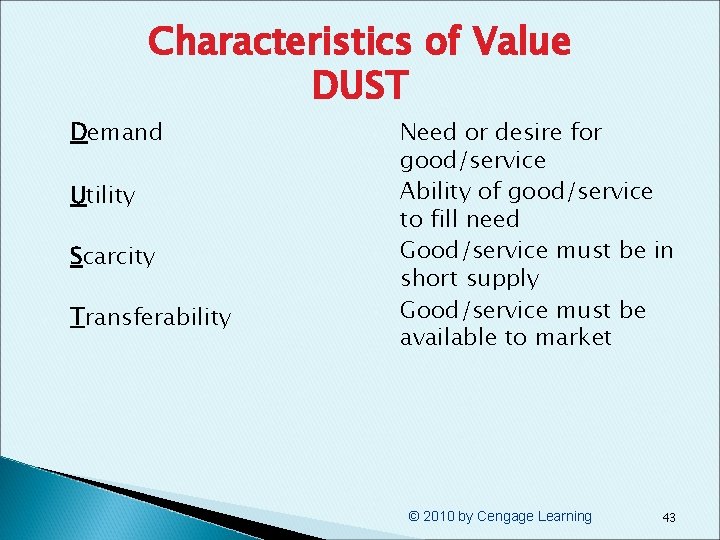
Characteristics of Value DUST § Demand § § Utility § § Scarcity § § Transferability § Need or desire for good/service Ability of good/service to fill need Good/service must be in short supply Good/service must be available to market © 2010 by Cengage Learning 43
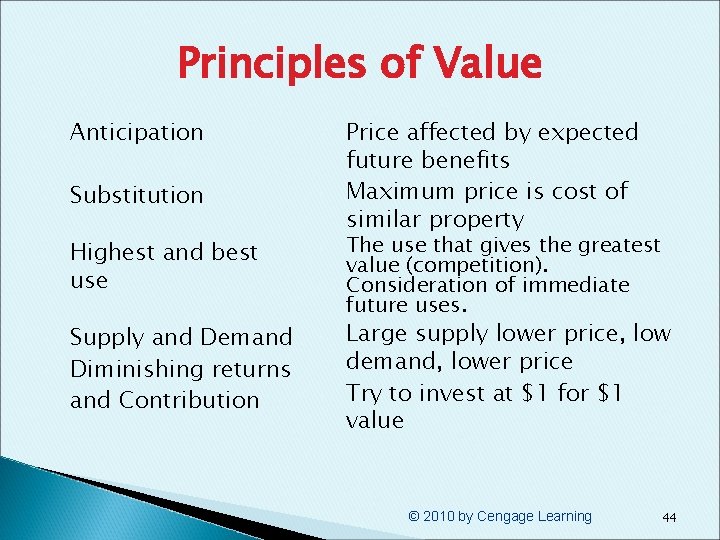
Principles of Value § Anticipation § § Substitution § § Highest and best use Supply and Demand Diminishing returns and Contribution § § § Price affected by expected future benefits Maximum price is cost of similar property The use that gives the greatest value (competition). Consideration of immediate future uses. Large supply lower price, low demand, lower price Try to invest at $1 for $1 value © 2010 by Cengage Learning 44
What is “Value” Market value Assessed value Insurance value Loan value Estate tax value Plottage value Rental value Replacement value © 2010 by Cengage Learning
Markets Buyer’s market – excess supply of housing for sale. Seller’s market – demand exceeds supply. © 2010 by Cengage Learning
Professional Appraisal Societies The American Institute of Real Estate Appraisers (AIREA) ◦ MAI ◦ SRA Society of Real Estate Appraisers NATIONAL Association of Independent Fee Appraisers Farm Managers and Rural Appraisers National Society of Real Estate Appraisers American Society of Appraisers © 2010 by Cengage Learning
Key Terms l l l l Appraisal Capitalize Comparables Cost approach Depreciation FIRREA Gross rent multiplier l l l l Highest and best use Income approach Market value Operating expenses Scheduled gross, Projected gross USPAP © 2010 by Cengage Learning
- Slides: 48