
Chapter 18 Reaction Rates and Equilibrium Activated Complex
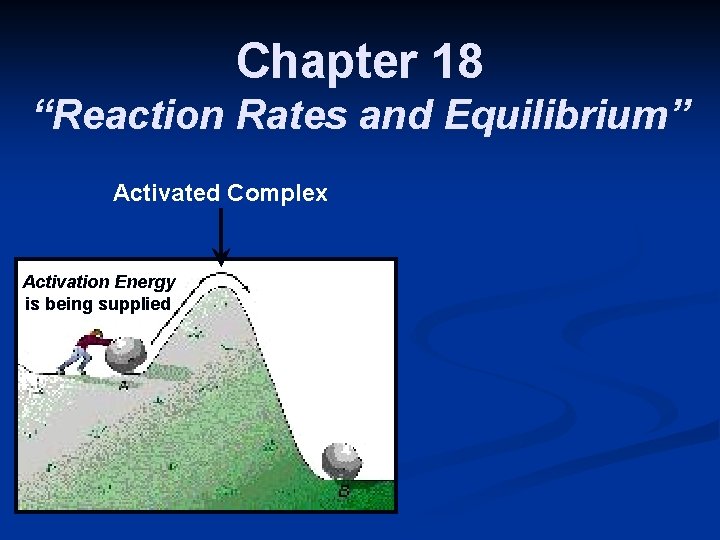
Chapter 18 “Reaction Rates and Equilibrium” Activated Complex Activation Energy is being supplied
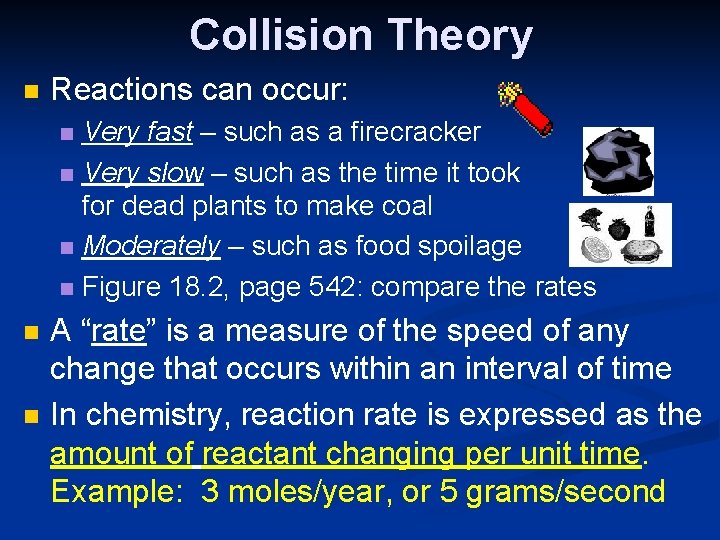
Collision Theory n Reactions can occur: Very fast – such as a firecracker n Very slow – such as the time it took for dead plants to make coal n Moderately – such as food spoilage n Figure 18. 2, page 542: compare the rates n n n A “rate” is a measure of the speed of any change that occurs within an interval of time In chemistry, reaction rate is expressed as the amount of reactant changing per unit time. Example: 3 moles/year, or 5 grams/second
I wonder what happens if I mix these two solutions…
WOW, that was really FAST
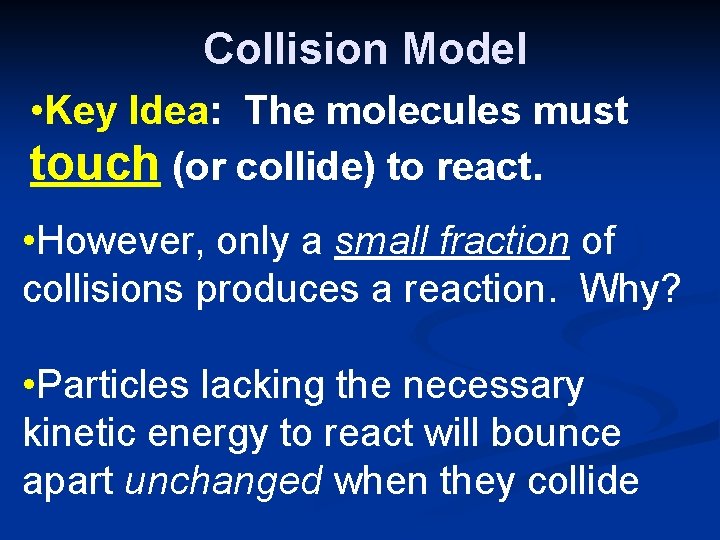
Collision Model • Key Idea: The molecules must touch (or collide) to react. • However, only a small fraction of collisions produces a reaction. Why? • Particles lacking the necessary kinetic energy to react will bounce apart unchanged when they collide
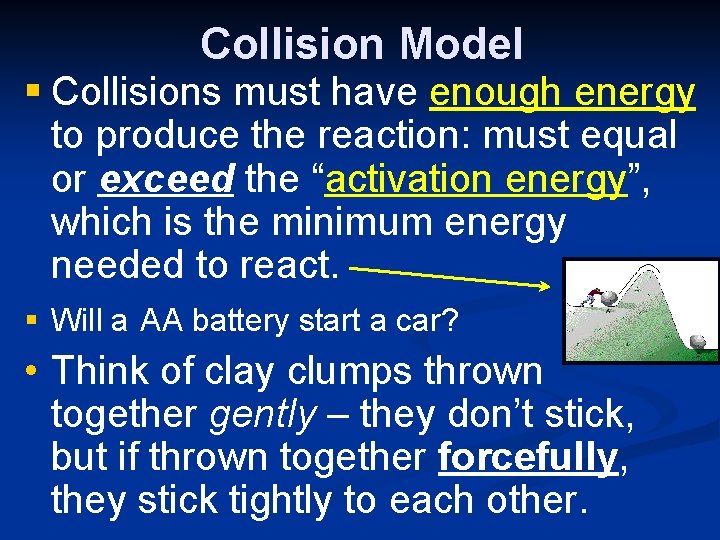
Collision Model § Collisions must have enough energy to produce the reaction: must equal or exceed the “activation energy”, which is the minimum energy needed to react. § Will a AA battery start a car? • Think of clay clumps thrown together gently – they don’t stick, but if thrown together forcefully, they stick tightly to each other.
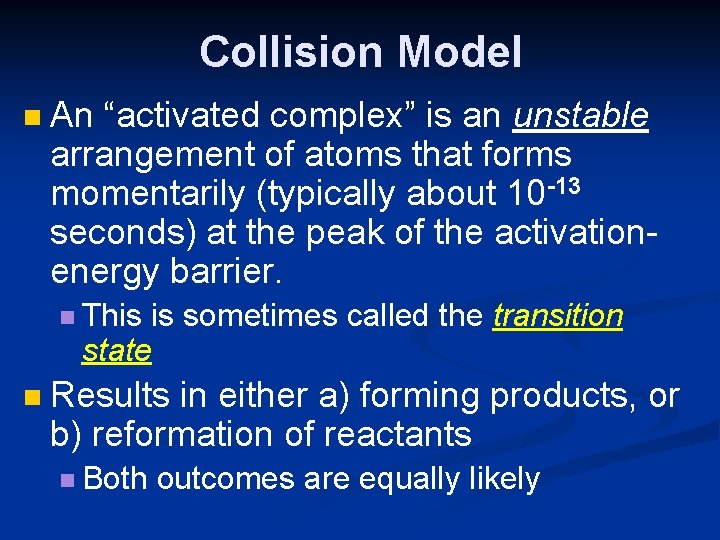
Collision Model n An “activated complex” is an unstable arrangement of atoms that forms momentarily (typically about 10 -13 seconds) at the peak of the activationenergy barrier. n This is sometimes called the transition state n Results in either a) forming products, or b) reformation of reactants n Both outcomes are equally likely
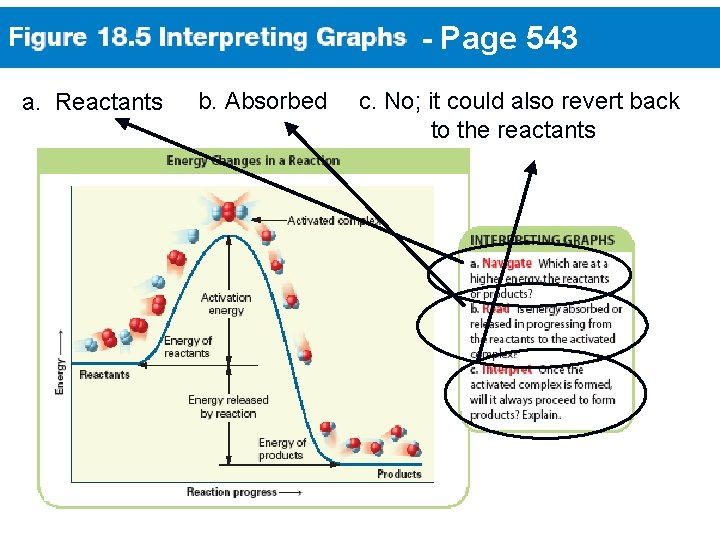
- Page 543 a. Reactants b. Absorbed c. No; it could also revert back to the reactants
Collision Model n The collision theory explains why some naturally occurring reactions are very slow n Carbon and oxygen react when charcoal burns, but this has a very high activation energy (C + O 2(g) → CO 2(g) + 393. 5 k. J) n At room temperature, the collisions between carbon and oxygen are not enough to cause a reaction
Factors Affecting Rate Temperature Increasing temperature always increases the rate of a reaction. 2) Surface Area Increasing surface area increases the rate of a reaction 3) Concentration – example page 545 Increasing concentration USUALLY increases the rate of a reaction 4) Presence of Catalyst 1)
Catalysts n. Catalyst: A substance that speeds up a reaction, without being consumed itself in the reaction n. Enzyme: A large molecule (usually a protein) that catalyzes biological reactions. n Human body temperature = 37 o C, much too low for digestion reactions without catalysts. n. Inhibitors – interfere with the action of a catalyst; reactions slow or even stop
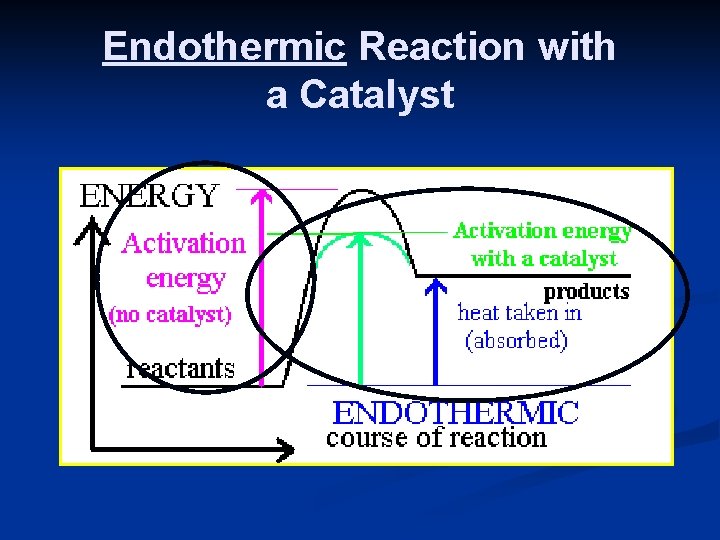
Endothermic Reaction with a Catalyst
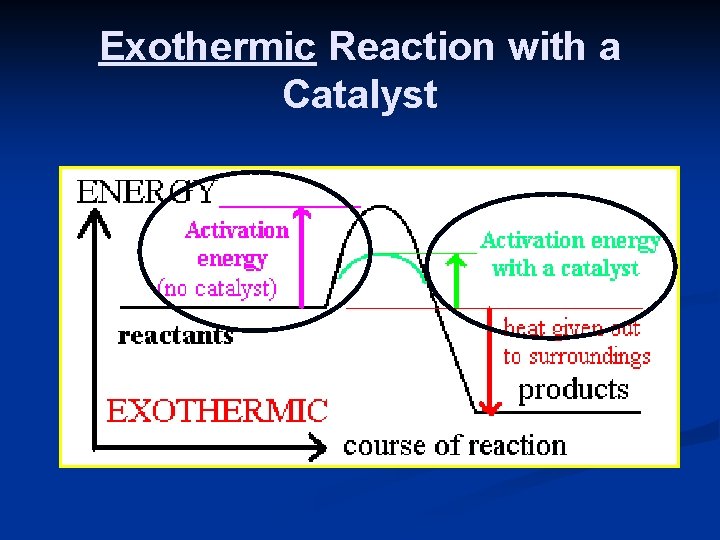
Exothermic Reaction with a Catalyst
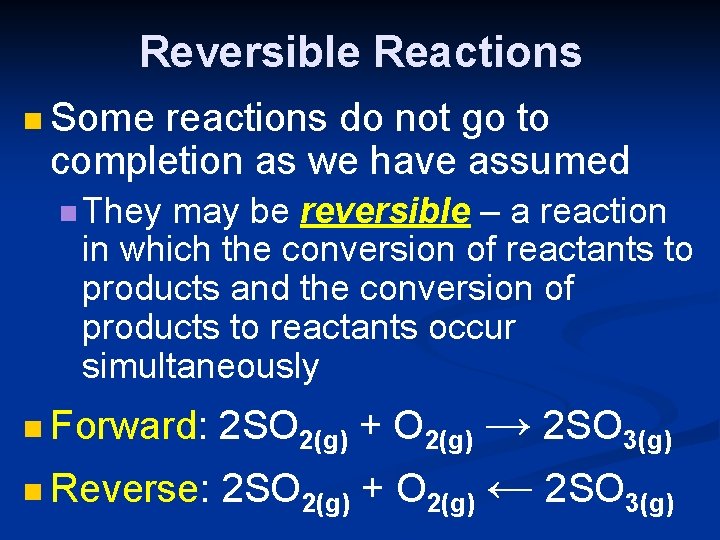
Reversible Reactions n Some reactions do not go to completion as we have assumed n They may be reversible – a reaction in which the conversion of reactants to products and the conversion of products to reactants occur simultaneously n Forward: 2 SO 2(g) + O 2(g) → 2 SO 3(g) n Reverse: 2 SO 2(g) + O 2(g) ← 2 SO 3(g)
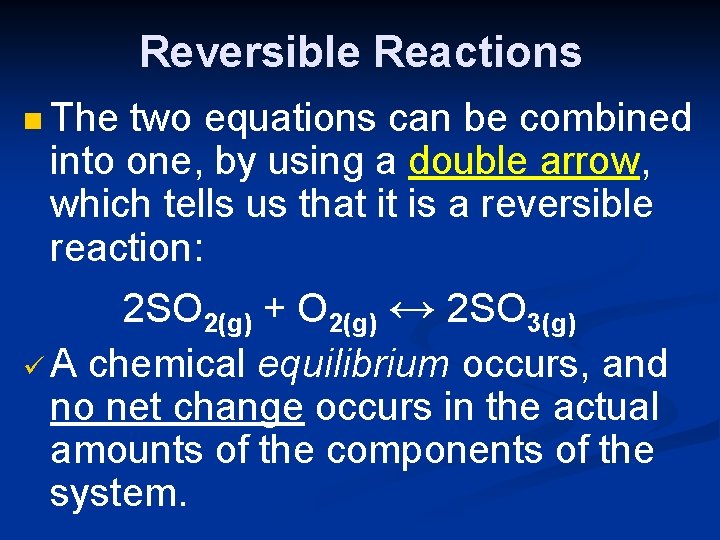
Reversible Reactions n The two equations can be combined into one, by using a double arrow, which tells us that it is a reversible reaction: 2 SO 2(g) + O 2(g) ↔ 2 SO 3(g) ü A chemical equilibrium occurs, and no net change occurs in the actual amounts of the components of the system.
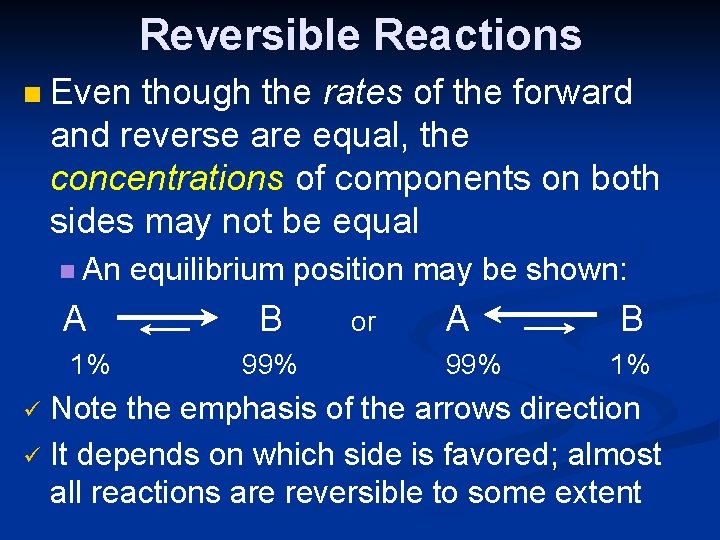
Reversible Reactions n Even though the rates of the forward and reverse are equal, the concentrations of components on both sides may not be equal n An A 1% equilibrium position may be shown: B 99% or A 99% B 1% Note the emphasis of the arrows direction ü It depends on which side is favored; almost all reactions are reversible to some extent ü
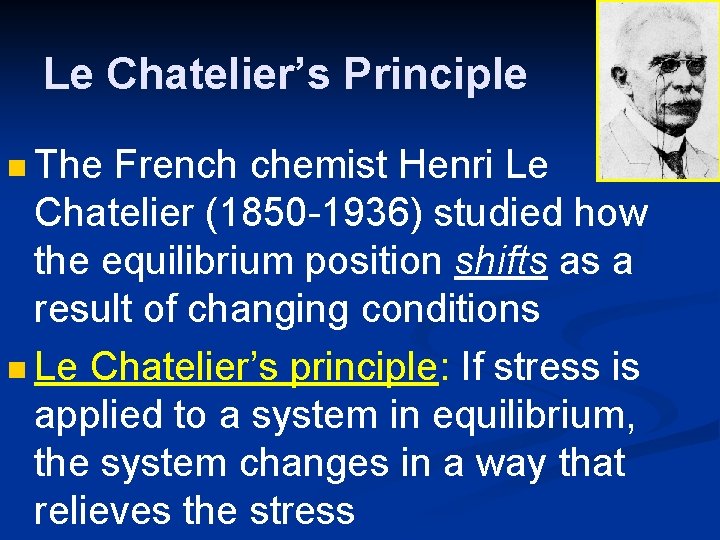
Le Chatelier’s Principle n The French chemist Henri Le Chatelier (1850 -1936) studied how the equilibrium position shifts as a result of changing conditions n Le Chatelier’s principle: If stress is applied to a system in equilibrium, the system changes in a way that relieves the stress
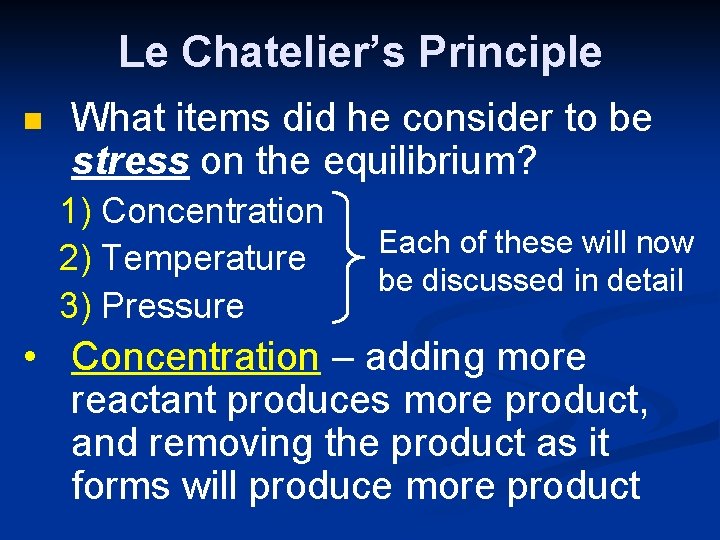
Le Chatelier’s Principle n What items did he consider to be stress on the equilibrium? 1) Concentration 2) Temperature 3) Pressure Each of these will now be discussed in detail • Concentration – adding more reactant produces more product, and removing the product as it forms will produce more product
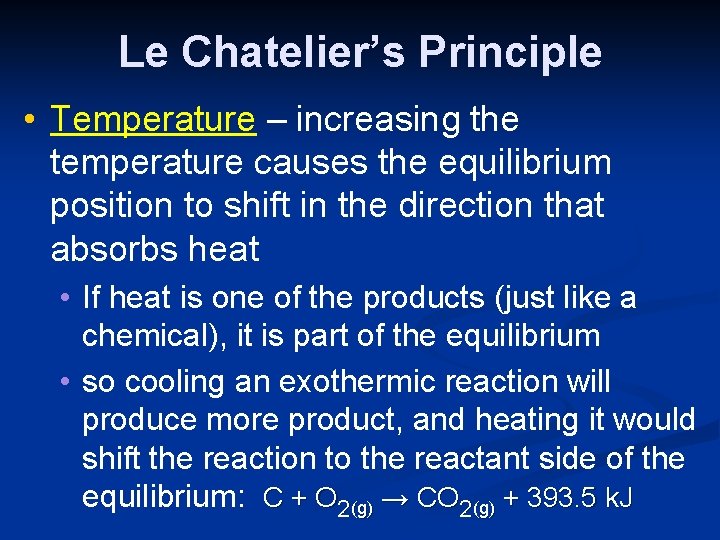
Le Chatelier’s Principle • Temperature – increasing the temperature causes the equilibrium position to shift in the direction that absorbs heat • If heat is one of the products (just like a chemical), it is part of the equilibrium • so cooling an exothermic reaction will produce more product, and heating it would shift the reaction to the reactant side of the equilibrium: C + O 2(g) → CO 2(g) + 393. 5 k. J
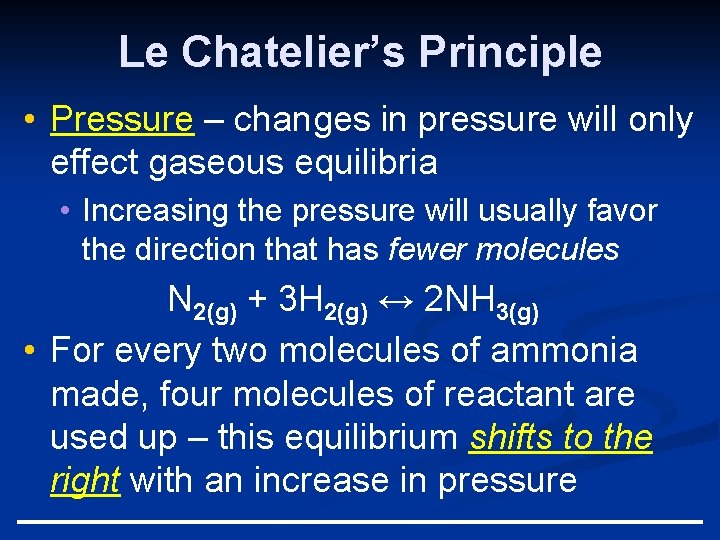
Le Chatelier’s Principle • Pressure – changes in pressure will only effect gaseous equilibria • Increasing the pressure will usually favor the direction that has fewer molecules N 2(g) + 3 H 2(g) ↔ 2 NH 3(g) • For every two molecules of ammonia made, four molecules of reactant are used up – this equilibrium shifts to the right with an increase in pressure
Equilibrium Constants: Keq • Chemists generally express the position of equilibrium in terms of numerical values, not just percent n These values relate to the amounts (Molarity) of reactants and products at equilibrium n This is called the equilibrium constant, and abbreviated Keq
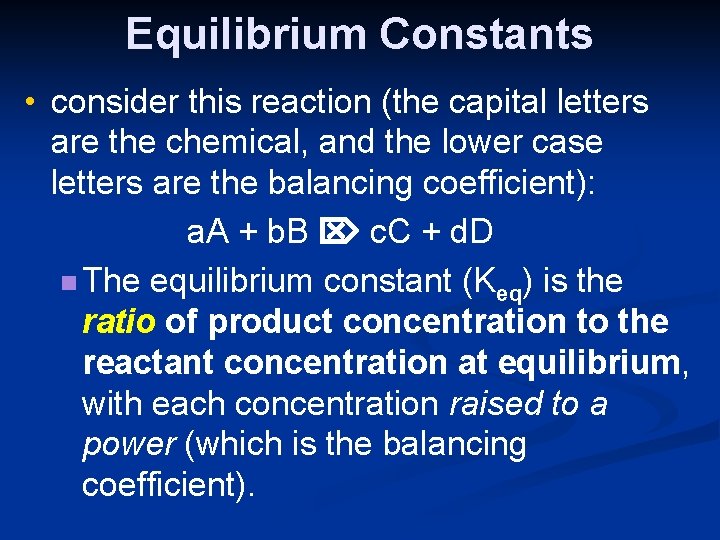
Equilibrium Constants • consider this reaction (the capital letters are the chemical, and the lower case letters are the balancing coefficient): a. A + b. B c. C + d. D n The equilibrium constant (Keq) is the ratio of product concentration to the reactant concentration at equilibrium, with each concentration raised to a power (which is the balancing coefficient).
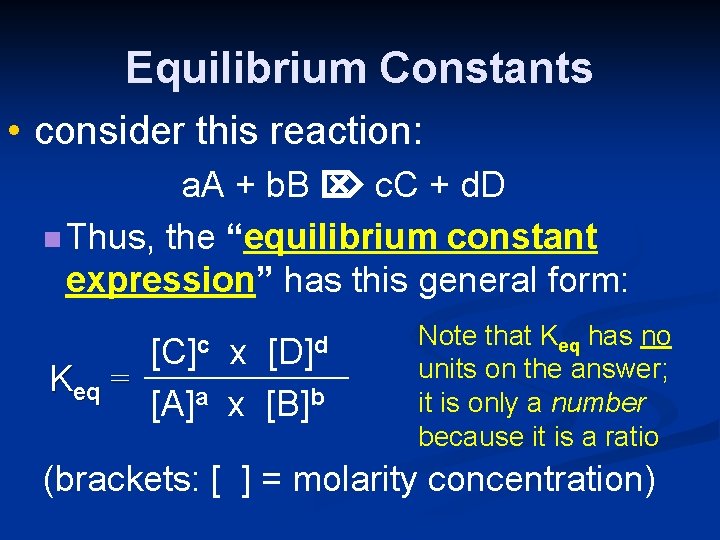
Equilibrium Constants • consider this reaction: a. A + b. B c. C + d. D n Thus, the “equilibrium constant expression” has this general form: [C]c [D]d x Keq = [A]a x [B]b Note that Keq has no units on the answer; it is only a number because it is a ratio (brackets: [ ] = molarity concentration)
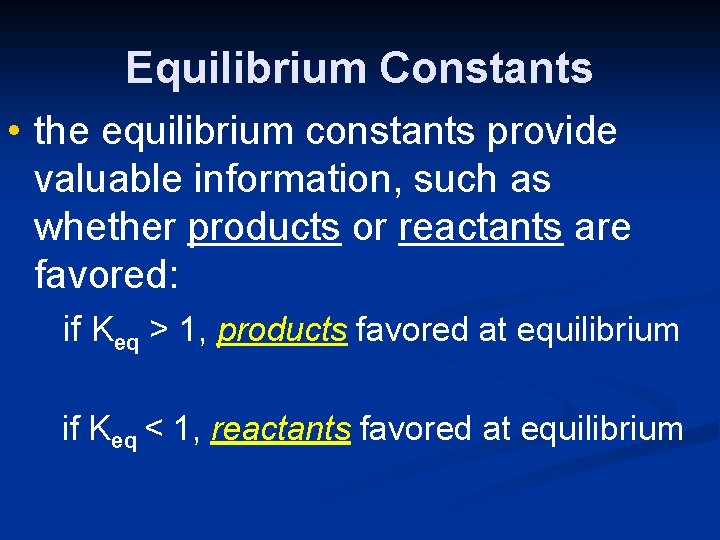
Equilibrium Constants • the equilibrium constants provide valuable information, such as whether products or reactants are favored: if Keq > 1, products favored at equilibrium if Keq < 1, reactants favored at equilibrium
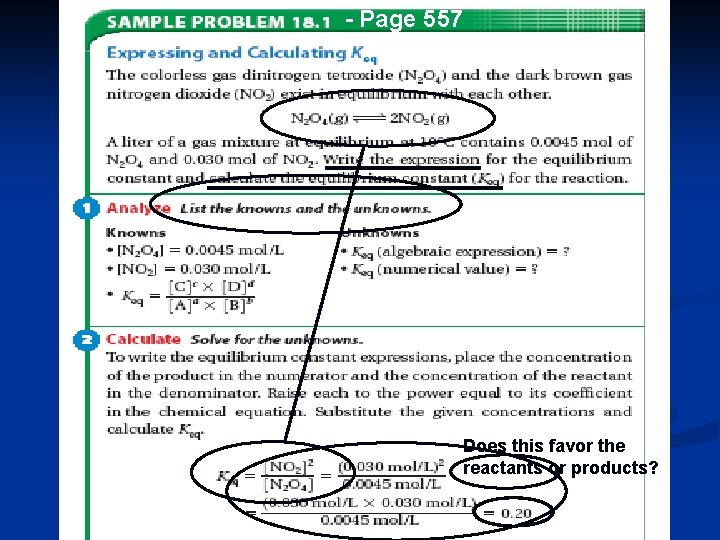
- Page 557 Does this favor the reactants or products?
- Slides: 26