
Chapter 18 RADIUS RADIUS Remote Authentication DialIn User
- Slides: 10
Chapter 18 RADIUS
RADIUS ¨ Remote Authentication Dial-In User Service ¨ Protocol used for communication between NAS and AAA server ¨ Supports authentication, authorization, and accounting ¨ Defined in RFC 2865
Features of RADIUS ¨ Client/Server model – NAS operates as a RADIUS client by passing user info to RADIUS server and acting on response from server – RADIUS server receives connection requests, authenticates user, and provides configuration settings to client – RADIUS server can act as a proxy client to other authentication servers ¨ Flexible authentication mechanisms – Can support PPP PAP or CHAP, Unix login, and other authentication mechanisms ¨ Extensible – All transactions con attribute/value tuples – New attributes can be added to existing protocol
RADIUS Architecture ¨ Defined in RFC 2865 ¨ Uses UDP port 1645 or 1812 ¨ Communication between RADIUS server and client is in clear-text except for passwords
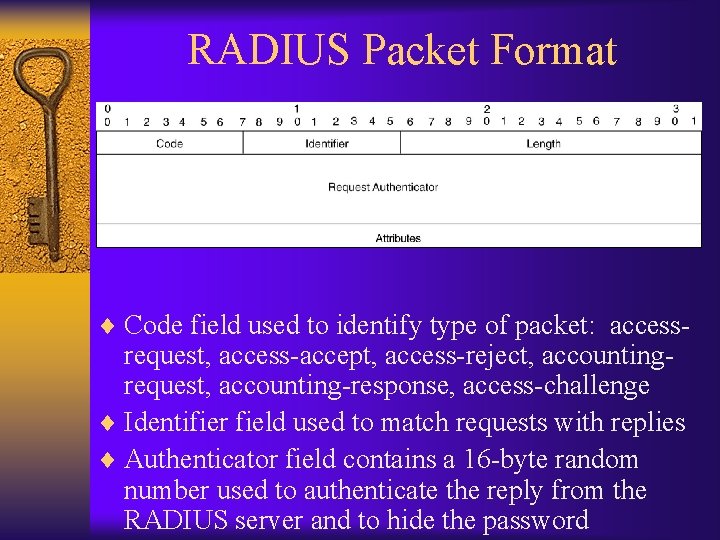
RADIUS Packet Format ¨ Code field used to identify type of packet: access- request, access-accept, access-reject, accountingrequest, accounting-response, access-challenge ¨ Identifier field used to match requests with replies ¨ Authenticator field contains a 16 -byte random number used to authenticate the reply from the RADIUS server and to hide the password
Password Encryption ¨ Encrypted password transmitted is equal to (Hash_A) XOR (padded user password) Where Hash_A = MD 5 { request authenticator, preshared secret} ¨ Receiver calculates Hash_A on its own and XORs it with the encrypted password to get the padded password back in clear-text
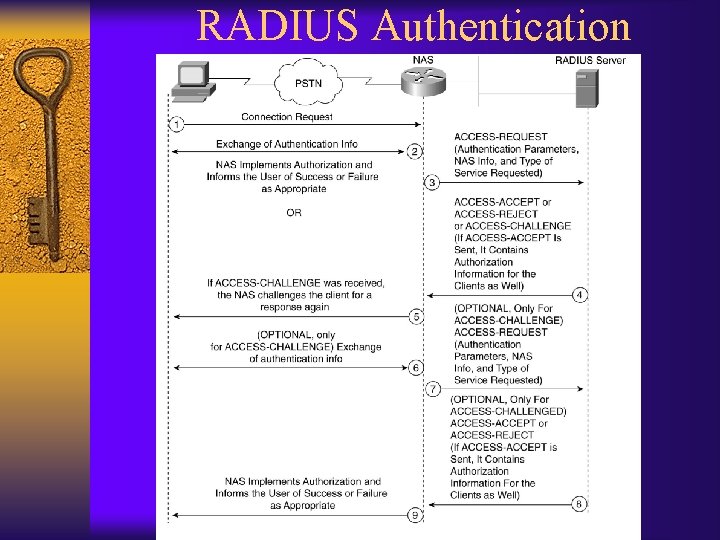
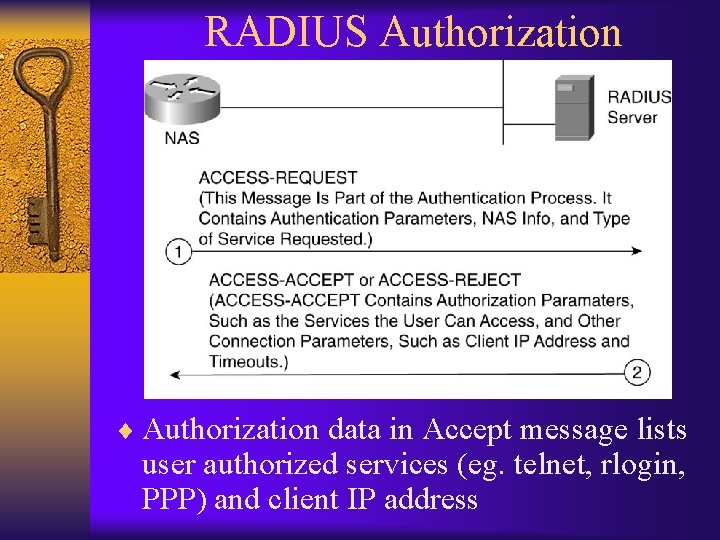
RADIUS Authentication ¨ NAS sends Access-Request message to RADIUS server containing username, encrypted password, IP address of NAS, and type of service ¨ RADIUS server replies with Access-Accept, Access-Reject, or Access-Challenge message
RADIUS Authentication
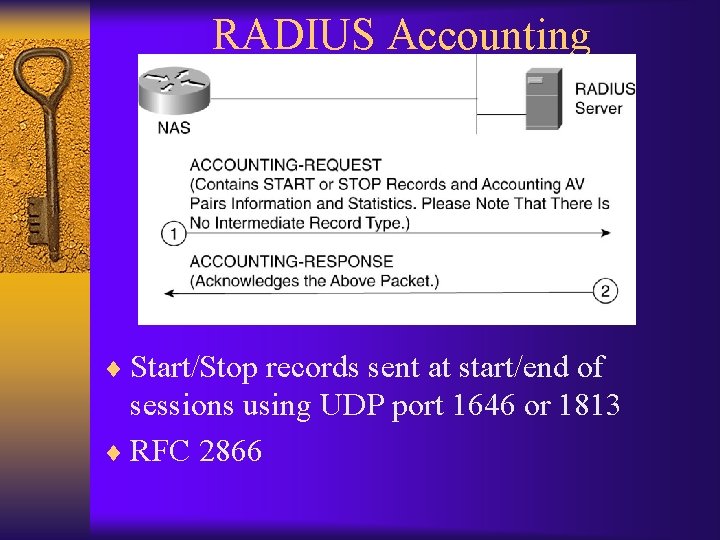
RADIUS Accounting ¨ Start/Stop records sent at start/end of sessions using UDP port 1646 or 1813 ¨ RFC 2866
RADIUS Authorization ¨ Authorization data in Accept message lists user authorized services (eg. telnet, rlogin, PPP) and client IP address