
Chapter 18 Operator Overloading Outline 18 1 18
![133 134 return ptr[ subscript ]; // reference return 135 } 136 137 //](https://slidetodoc.com/presentation_image_h/a94f121d98e972595ae9c1d4c249c1bb/image-24.jpg "133 134 return ptr[ subscript ]; // reference return 135 } 136 137 //")
- Slides: 32
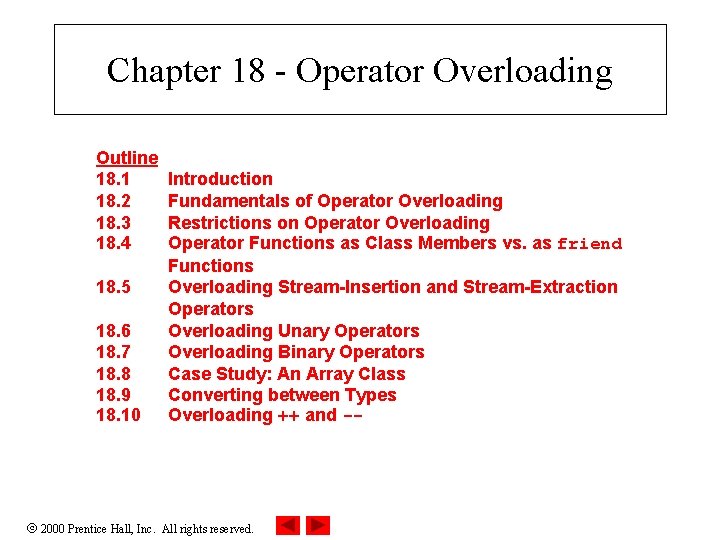
Chapter 18 - Operator Overloading Outline 18. 1 18. 2 18. 3 18. 4 18. 5 18. 6 18. 7 18. 8 18. 9 18. 10 Introduction Fundamentals of Operator Overloading Restrictions on Operator Overloading Operator Functions as Class Members vs. as friend Functions Overloading Stream-Insertion and Stream-Extraction Operators Overloading Unary Operators Overloading Binary Operators Case Study: An Array Class Converting between Types Overloading ++ and -- 2000 Prentice Hall, Inc. All rights reserved.
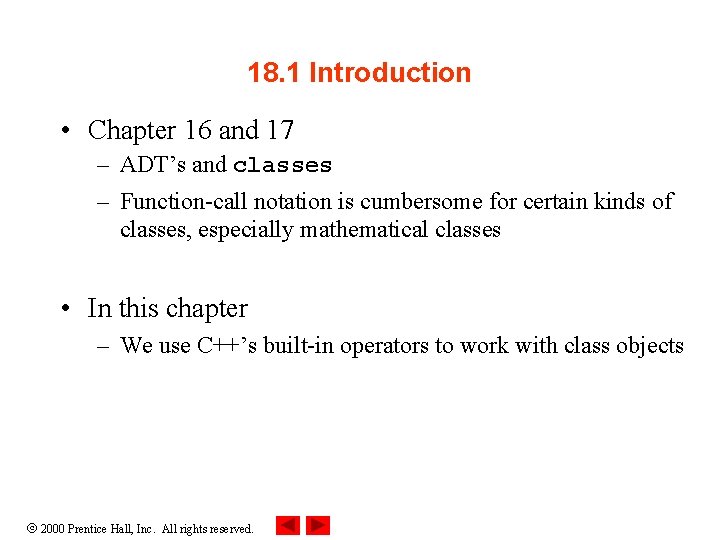
18. 1 Introduction • Chapter 16 and 17 – ADT’s and classes – Function-call notation is cumbersome for certain kinds of classes, especially mathematical classes • In this chapter – We use C++’s built-in operators to work with class objects 2000 Prentice Hall, Inc. All rights reserved.
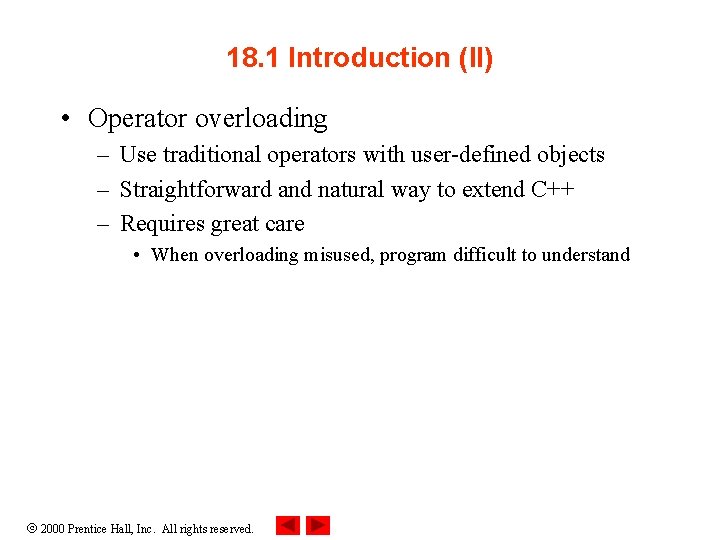
18. 1 Introduction (II) • Operator overloading – Use traditional operators with user-defined objects – Straightforward and natural way to extend C++ – Requires great care • When overloading misused, program difficult to understand 2000 Prentice Hall, Inc. All rights reserved.
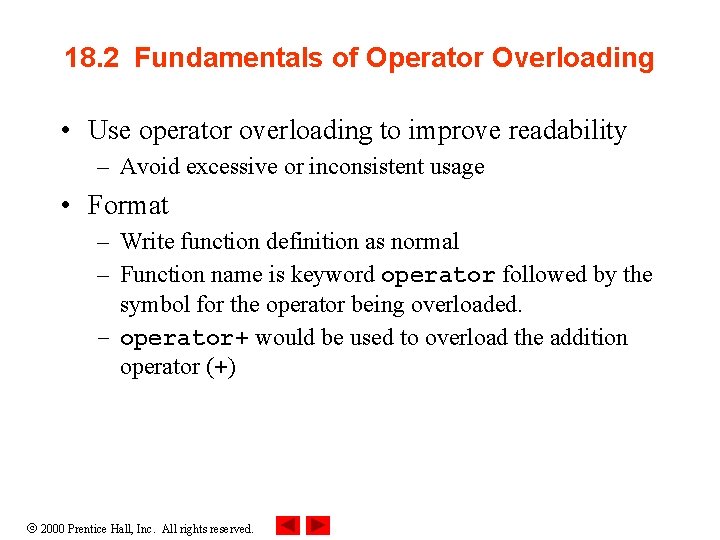
18. 2 Fundamentals of Operator Overloading • Use operator overloading to improve readability – Avoid excessive or inconsistent usage • Format – Write function definition as normal – Function name is keyword operator followed by the symbol for the operator being overloaded. – operator+ would be used to overload the addition operator (+) 2000 Prentice Hall, Inc. All rights reserved.
18. 2 Fundamentals of Operator Overloading (II) • Assignment operator (=) – may be used with every class without explicit overloading – memberwise assignment – Same is true for the address operator (&) 2000 Prentice Hall, Inc. All rights reserved.
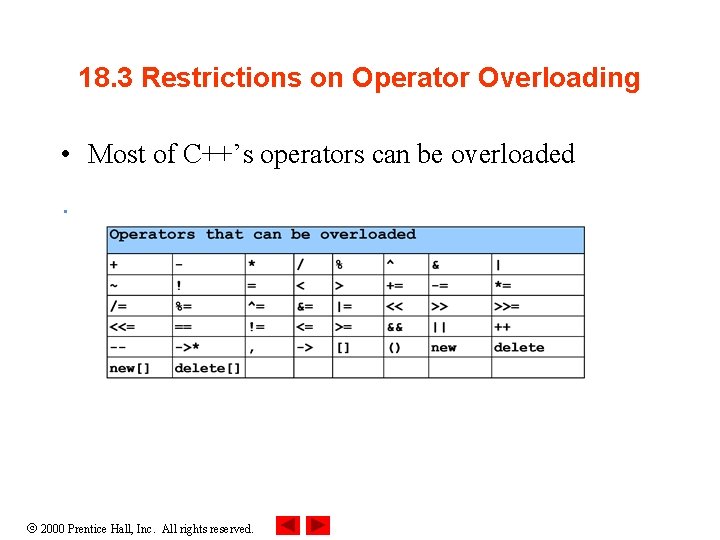
18. 3 Restrictions on Operator Overloading • Most of C++’s operators can be overloaded . 2000 Prentice Hall, Inc. All rights reserved.
18. 3 Restrictions on Operator Overloading (II) • Arity (number of operands) cannot be changed – Urnary operators remain urnary, and binary operators remain binary – Operators &, *, + and - each have unary and binary versions • Unary and binary versions can be overloaded separately 2000 Prentice Hall, Inc. All rights reserved.
18. 3 Restrictions on Operator Overloading (III) • No new operators can be created – Use only existing operators • Built-in types – Cannot overload operators – You cannot change how two integers are added 2000 Prentice Hall, Inc. All rights reserved.
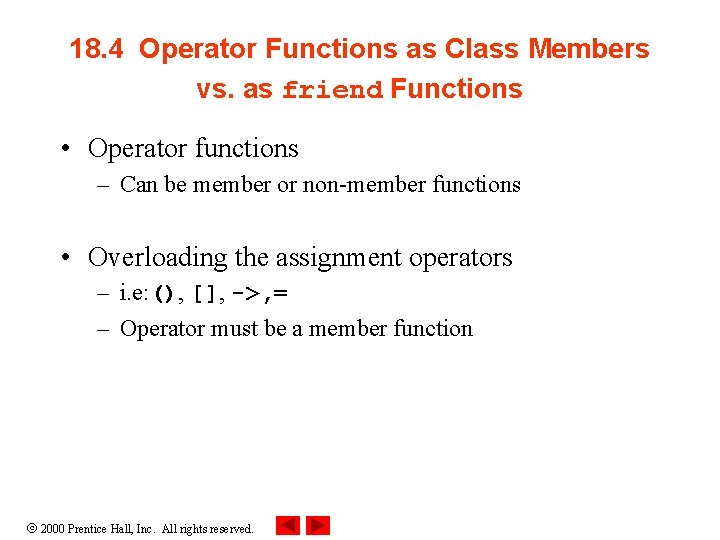
18. 4 Operator Functions as Class Members vs. as friend Functions • Operator functions – Can be member or non-member functions • Overloading the assignment operators – i. e: (), [], ->, = – Operator must be a member function 2000 Prentice Hall, Inc. All rights reserved.
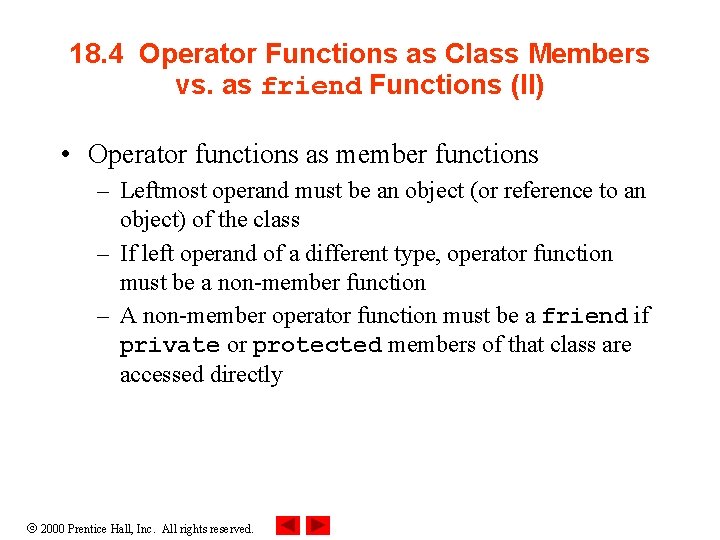
18. 4 Operator Functions as Class Members vs. as friend Functions (II) • Operator functions as member functions – Leftmost operand must be an object (or reference to an object) of the class – If left operand of a different type, operator function must be a non-member function – A non-member operator function must be a friend if private or protected members of that class are accessed directly 2000 Prentice Hall, Inc. All rights reserved.
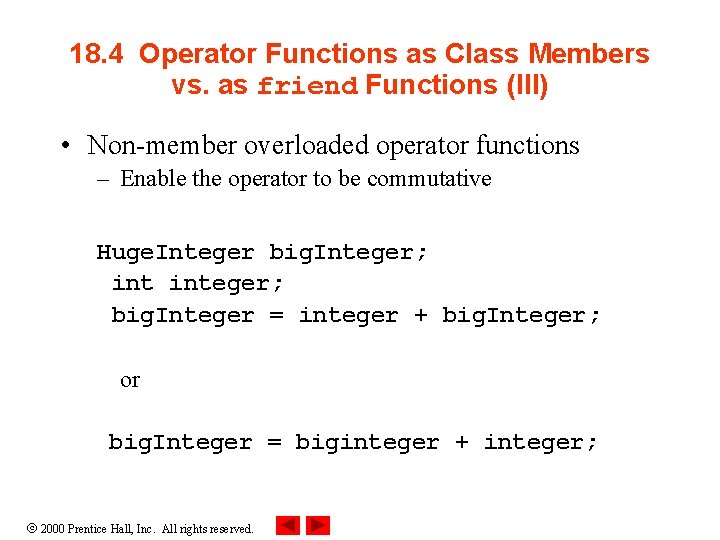
18. 4 Operator Functions as Class Members vs. as friend Functions (III) • Non-member overloaded operator functions – Enable the operator to be commutative Huge. Integer big. Integer; integer; big. Integer = integer + big. Integer; or big. Integer = biginteger + integer; 2000 Prentice Hall, Inc. All rights reserved.
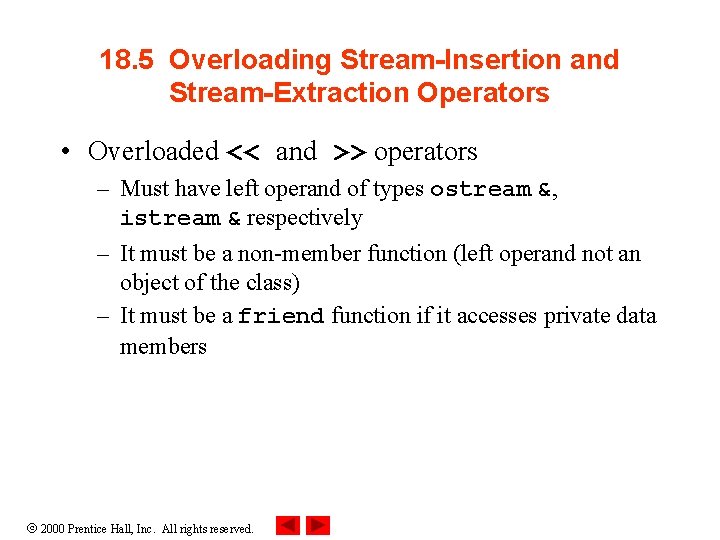
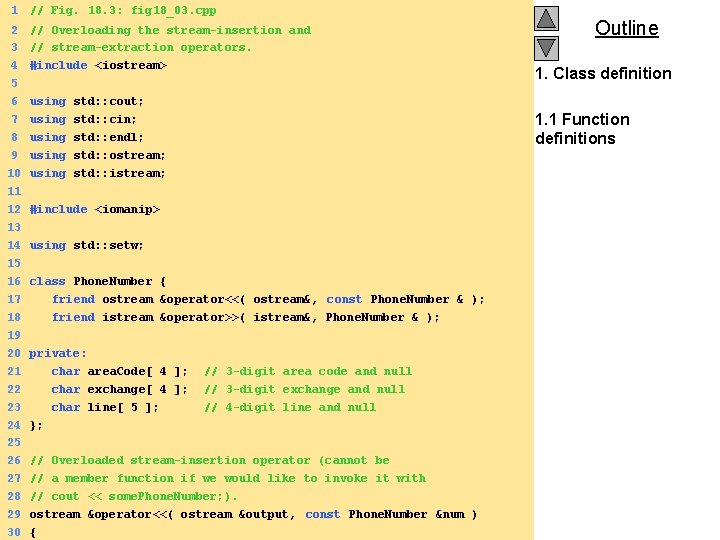
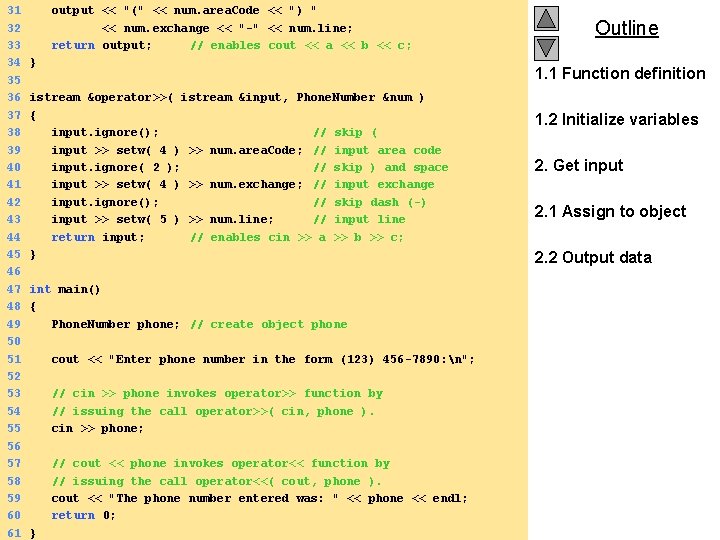
18. 5 Overloading Stream-Insertion and Stream-Extraction Operators • Overloaded << and >> operators – Must have left operand of types ostream &, istream & respectively – It must be a non-member function (left operand not an object of the class) – It must be a friend function if it accesses private data members 2000 Prentice Hall, Inc. All rights reserved.
1 2 3 4 5 6 7 8 9 10 11 12 13 14 15 16 17 18 19 20 21 22 23 24 25 26 27 28 29 30 // Fig. 18. 3: fig 18_03. cpp // Overloading the stream-insertion and // stream-extraction operators. #include <iostream> using std: : cout; using std: : cin; using std: : endl; using std: : ostream; using std: : istream; #include <iomanip> using std: : setw; class Phone. Number { friend ostream &operator<<( ostream&, const Phone. Number & ); friend istream &operator>>( istream&, Phone. Number & ); private: char area. Code[ 4 ]; // 3 -digit area code and null char exchange[ 4 ]; // 3 -digit exchange and null char line[ 5 ]; // 4 -digit line and null }; // Overloaded stream-insertion operator (cannot be // a member function if we would like to invoke it with // cout << some. Phone. Number; ). ostream &operator<<( ostream &output, const Phone. Number &num ) { 2000 Prentice Hall, Inc. All rights reserved. Outline 1. Class definition 1. 1 Function definitions
31 32 33 34 35 36 37 38 39 40 41 42 43 44 45 46 47 48 49 50 51 52 53 54 55 56 57 58 59 60 61 output << "(" << num. area. Code << ") " << num. exchange << "-" << num. line; return output; // enables cout << a << b << c; } istream &operator>>( istream &input, Phone. Number &num ) { input. ignore(); // skip ( input >> setw( 4 ) >> num. area. Code; // input area code input. ignore( 2 ); // skip ) and space input >> setw( 4 ) >> num. exchange; // input exchange input. ignore(); // skip dash (-) input >> setw( 5 ) >> num. line; // input line return input; // enables cin >> a >> b >> c; } int main() { Phone. Number phone; // create object phone cout << "Enter phone number in the form (123) 456 -7890: n"; // cin >> phone invokes operator>> function by // issuing the call operator>>( cin, phone ). cin >> phone; // cout << phone invokes operator<< function by // issuing the call operator<<( cout, phone ). cout << "The phone number entered was: " << phone << endl; return 0; } 2000 Prentice Hall, Inc. All rights reserved. Outline 1. 1 Function definition 1. 2 Initialize variables 2. Get input 2. 1 Assign to object 2. 2 Output data
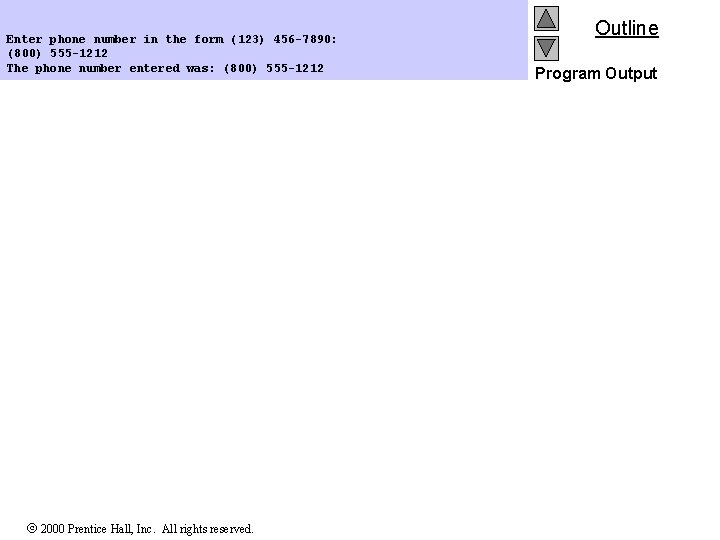
Enter phone number in the form (123) 456 -7890: (800) 555 -1212 The phone number entered was: (800) 555 -1212 2000 Prentice Hall, Inc. All rights reserved. Outline Program Output
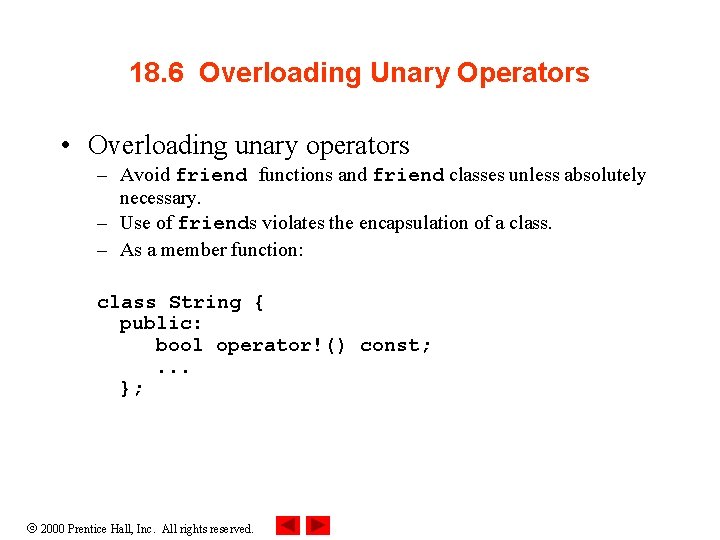
18. 6 Overloading Unary Operators • Overloading unary operators – Avoid friend functions and friend classes unless absolutely necessary. – Use of friends violates the encapsulation of a class. – As a member function: class String { public: bool operator!() const; . . . }; 2000 Prentice Hall, Inc. All rights reserved.
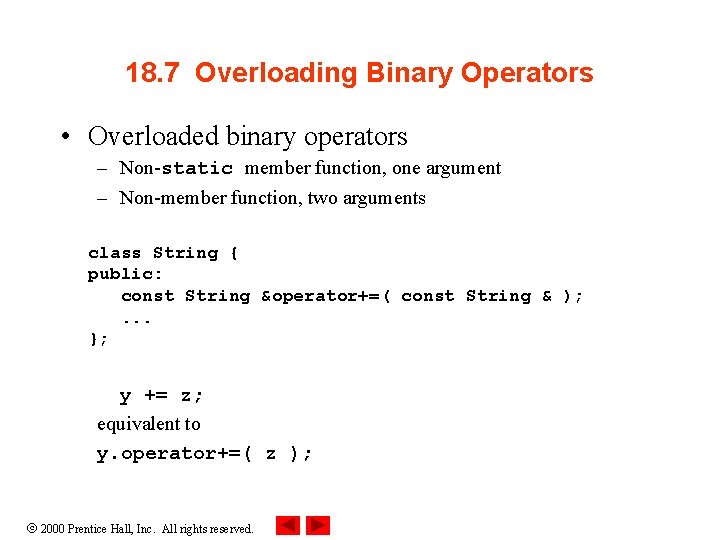
18. 7 Overloading Binary Operators • Overloaded binary operators – Non-static member function, one argument – Non-member function, two arguments class String { public: const String &operator+=( const String & ); . . . }; y += z; equivalent to y. operator+=( z ); 2000 Prentice Hall, Inc. All rights reserved.
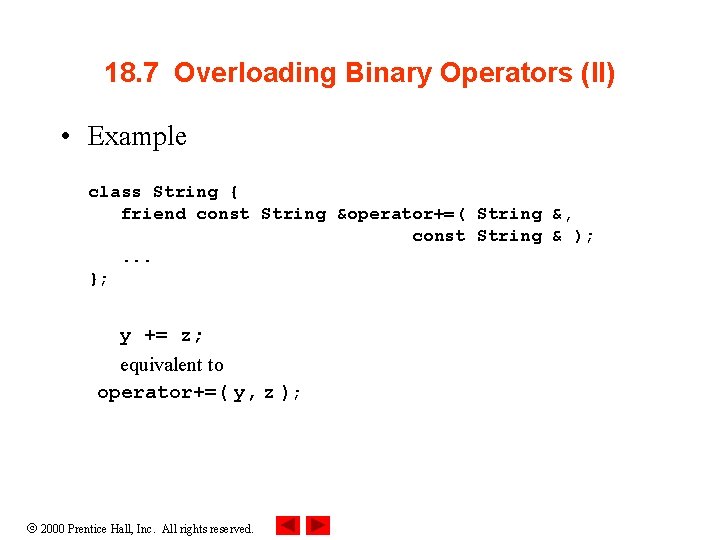
18. 7 Overloading Binary Operators (II) • Example class String { friend const String &operator+=( String &, const String & ); . . . }; y += z; equivalent to operator+=( y, z ); 2000 Prentice Hall, Inc. All rights reserved.
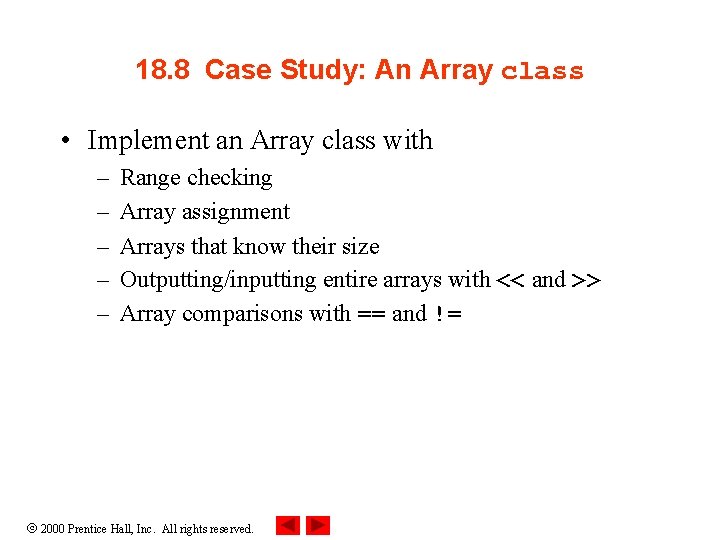
18. 8 Case Study: An Array class • Implement an Array class with – – – Range checking Array assignment Arrays that know their size Outputting/inputting entire arrays with << and >> Array comparisons with == and != 2000 Prentice Hall, Inc. All rights reserved.
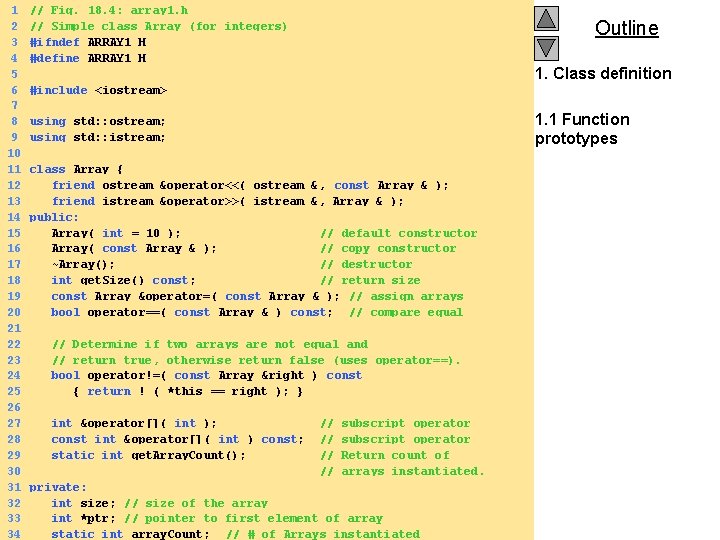
1 2 3 4 5 6 7 8 9 10 11 12 13 14 15 16 17 18 19 20 21 22 23 24 25 26 27 28 29 30 31 32 33 34 // Fig. 18. 4: array 1. h // Simple class Array (for integers) #ifndef ARRAY 1_H #define ARRAY 1_H Outline 1. Class definition #include <iostream> using std: : ostream; using std: : istream; class Array { friend ostream &operator<<( ostream &, const Array & ); friend istream &operator>>( istream &, Array & ); public: Array( int = 10 ); // default constructor Array( const Array & ); // copy constructor ~Array(); // destructor int get. Size() const; // return size const Array &operator=( const Array & ); // assign arrays bool operator==( const Array & ) const; // compare equal // Determine if two arrays are not equal and // return true, otherwise return false (uses operator==). bool operator!=( const Array &right ) const { return ! ( *this == right ); } int &operator[]( int ); // subscript operator const int &operator[]( int ) const; // subscript operator static int get. Array. Count(); // Return count of // arrays instantiated. private: int size; // size of the array int *ptr; // pointer to first element of array 2000 Prentice Hall, Inc. All rights reserved. static int array. Count; // # of Arrays instantiated 1. 1 Function prototypes
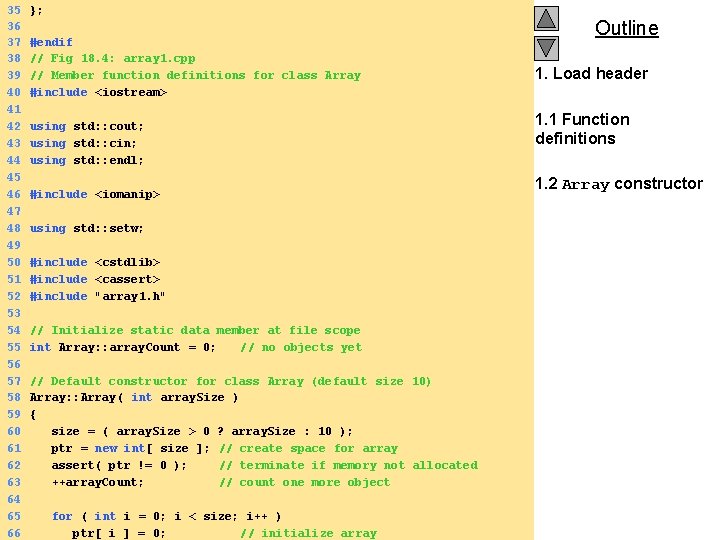
35 36 37 38 39 40 41 42 43 44 45 46 47 48 49 50 51 52 53 54 55 56 57 58 59 60 61 62 63 64 65 66 }; #endif // Fig 18. 4: array 1. cpp // Member function definitions for class Array #include <iostream> using std: : cout; using std: : cin; using std: : endl; #include <iomanip> using std: : setw; #include <cstdlib> #include <cassert> #include "array 1. h" // Initialize static data member at file scope int Array: : array. Count = 0; // no objects yet // Default constructor for class Array (default size 10) Array: : Array( int array. Size ) { size = ( array. Size > 0 ? array. Size : 10 ); ptr = new int[ size ]; // create space for array assert( ptr != 0 ); // terminate if memory not allocated ++array. Count; // count one more object for ( int i = 0; i < size; i++ ) 2000 Prentice Hall, Inc. All rights reserved. ptr[ i ] = 0; // initialize array Outline 1. Load header 1. 1 Function definitions 1. 2 Array constructor
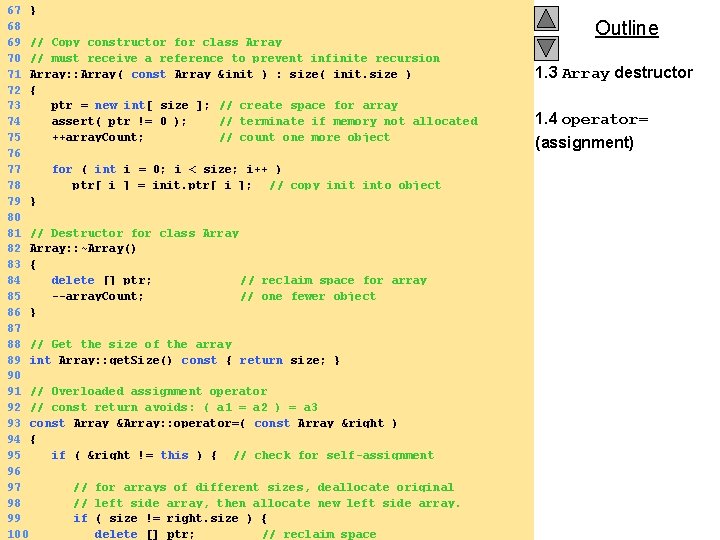
67 } 68 69 // Copy constructor for class Array 70 // must receive a reference to prevent infinite recursion 71 Array: : Array( const Array &init ) : size( init. size ) 72 { 73 ptr = new int[ size ]; // create space for array 74 assert( ptr != 0 ); // terminate if memory not allocated 75 ++array. Count; // count one more object 76 77 for ( int i = 0; i < size; i++ ) 78 ptr[ i ] = init. ptr[ i ]; // copy init into object 79 } 80 81 // Destructor for class Array 82 Array: : ~Array() 83 { 84 delete [] ptr; // reclaim space for array 85 --array. Count; // one fewer object 86 } 87 88 // Get the size of the array 89 int Array: : get. Size() const { return size; } 90 91 // Overloaded assignment operator 92 // const return avoids: ( a 1 = a 2 ) = a 3 93 const Array &Array: : operator=( const Array &right ) 94 { 95 if ( &right != this ) { // check for self-assignment 96 97 // for arrays of different sizes, deallocate original 98 // left side array, then allocate new left side array. 99 if ( size != right. size ) { 2000 Prentice Hall, Inc. All rights reserved. 100 delete [] ptr; // reclaim space Outline 1. 3 Array destructor 1. 4 operator= (assignment)
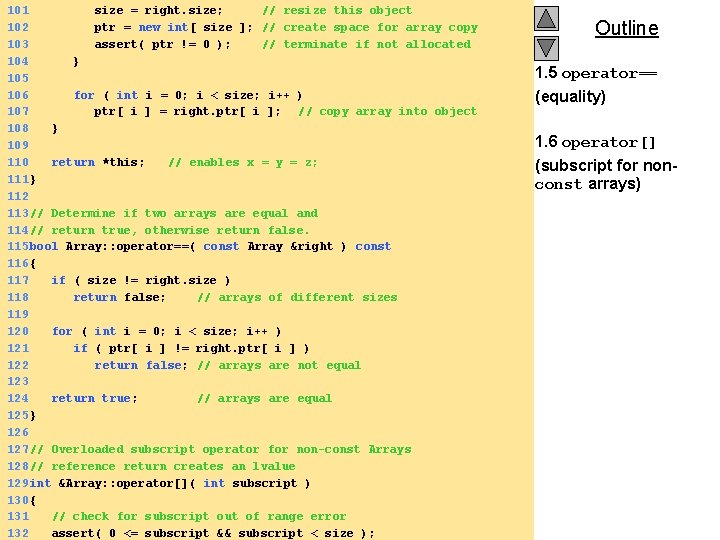
101 size = right. size; // resize this object 102 ptr = new int[ size ]; // create space for array copy 103 assert( ptr != 0 ); // terminate if not allocated 104 } 105 106 for ( int i = 0; i < size; i++ ) 107 ptr[ i ] = right. ptr[ i ]; // copy array into object 108 } 109 110 return *this; // enables x = y = z; 111 } 112 113 // Determine if two arrays are equal and 114 // return true, otherwise return false. 115 bool Array: : operator==( const Array &right ) const 116 { 117 if ( size != right. size ) 118 return false; // arrays of different sizes 119 120 for ( int i = 0; i < size; i++ ) 121 if ( ptr[ i ] != right. ptr[ i ] ) 122 return false; // arrays are not equal 123 124 return true; // arrays are equal 125 } 126 127 // Overloaded subscript operator for non-const Arrays 128 // reference return creates an lvalue 129 int &Array: : operator[]( int subscript ) 130 { 131 // check for subscript out of range error 2000 Prentice Hall, Inc. All rights reserved. 132 assert( 0 <= subscript && subscript < size ); Outline 1. 5 operator== (equality) 1. 6 operator[] (subscript for nonconst arrays)
133 134 return ptr[ subscript ]; // reference return 135 } 136 137 // Overloaded subscript operator for const Arrays 138 // const reference return creates an rvalue 139 const int &Array: : operator[]( int subscript ) const 140 { 141 // check for subscript out of range error 142 assert( 0 <= subscript && subscript < size ); 143 144 return ptr[ subscript ]; // const reference return 145 } 146 147 // Return the number of Array objects instantiated 148 // static functions cannot be const 149 int Array: : get. Array. Count() { return array. Count; } 150 151 // Overloaded input operator for class Array; 152 // inputs values for entire array. 153 istream &operator>>( istream &input, Array &a ) 154 { 155 for ( int i = 0; i < a. size; i++ ) 156 input >> a. ptr[ i ]; 157 158 return input; // enables cin >> x >> y; 159 } 160 161 // Overloaded output operator for class Array 162 ostream &operator<<( ostream &output, const Array &a ) 163 { 2000 Prentice Hall, Inc. All rights reserved. Outline 1. 6 operator[] (subscript for const arrays) 1. 7 get. Array. Count 1. 8 operator>> (input array) 1. 9 operator<< (output array)
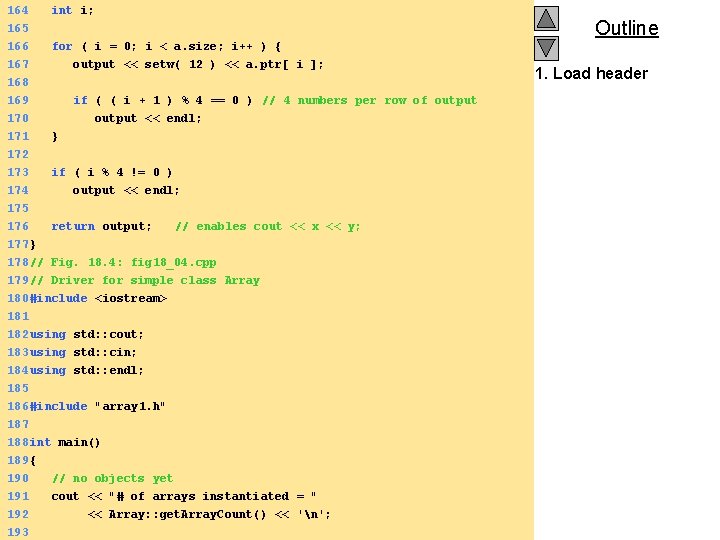
164 int i; 165 166 for ( i = 0; i < a. size; i++ ) { 167 output << setw( 12 ) << a. ptr[ i ]; 168 169 if ( ( i + 1 ) % 4 == 0 ) // 4 numbers per row of output 170 output << endl; 171 } 172 173 if ( i % 4 != 0 ) 174 output << endl; 175 176 return output; // enables cout << x << y; 177 } 178 // Fig. 18. 4: fig 18_04. cpp 179 // Driver for simple class Array 180 #include <iostream> 181 182 using std: : cout; 183 using std: : cin; 184 using std: : endl; 185 186 #include "array 1. h" 187 188 int main() 189 { 190 // no objects yet 191 cout << "# of arrays instantiated = " 192 << Array: : get. Array. Count() << 'n'; 193 2000 Prentice Hall, Inc. All rights reserved. Outline 1. Load header
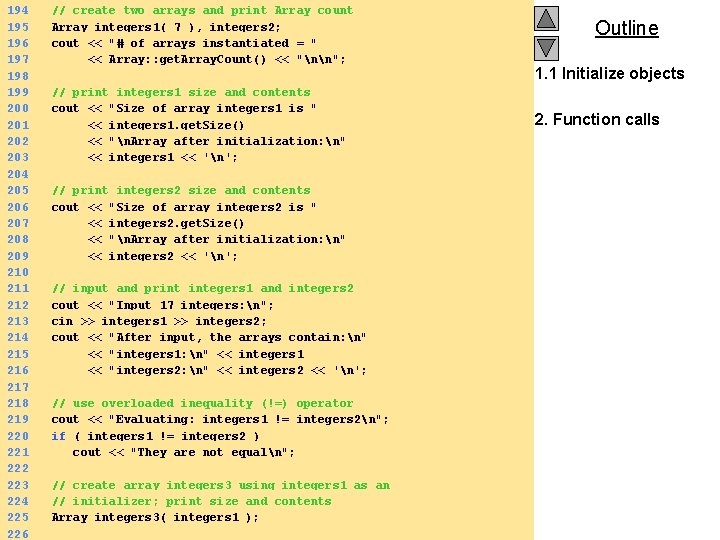
194 // create two arrays and print Array count 195 Array integers 1( 7 ), integers 2; 196 cout << "# of arrays instantiated = " 197 << Array: : get. Array. Count() << "nn"; 198 199 // print integers 1 size and contents 200 cout << "Size of array integers 1 is " 201 << integers 1. get. Size() 202 << "n. Array after initialization: n" 203 << integers 1 << 'n'; 204 205 // print integers 2 size and contents 206 cout << "Size of array integers 2 is " 207 << integers 2. get. Size() 208 << "n. Array after initialization: n" 209 << integers 2 << 'n'; 210 211 // input and print integers 1 and integers 2 212 cout << "Input 17 integers: n"; 213 cin >> integers 1 >> integers 2; 214 cout << "After input, the arrays contain: n" 215 << "integers 1: n" << integers 1 216 << "integers 2: n" << integers 2 << 'n'; 217 218 // use overloaded inequality (!=) operator 219 cout << "Evaluating: integers 1 != integers 2n"; 220 if ( integers 1 != integers 2 ) 221 cout << "They are not equaln"; 222 223 // create array integers 3 using integers 1 as an 224 // initializer; print size and contents 225 Array integers 3( integers 1 ); 226 2000 Prentice Hall, Inc. All rights reserved. Outline 1. 1 Initialize objects 2. Function calls
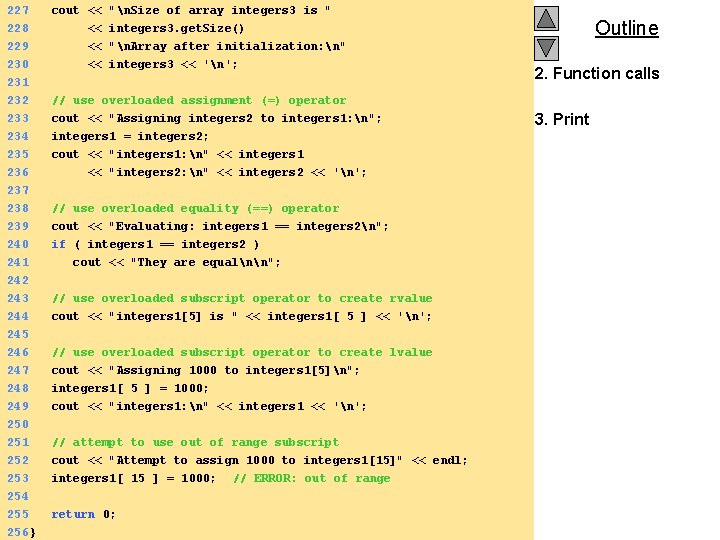
227 cout << "n. Size of array integers 3 is " 228 << integers 3. get. Size() 229 << "n. Array after initialization: n" 230 << integers 3 << 'n'; 231 232 // use overloaded assignment (=) operator 233 cout << "Assigning integers 2 to integers 1: n"; 234 integers 1 = integers 2; 235 cout << "integers 1: n" << integers 1 236 << "integers 2: n" << integers 2 << 'n'; 237 238 // use overloaded equality (==) operator 239 cout << "Evaluating: integers 1 == integers 2n"; 240 if ( integers 1 == integers 2 ) 241 cout << "They are equalnn"; 242 243 // use overloaded subscript operator to create rvalue 244 cout << "integers 1[5] is " << integers 1[ 5 ] << 'n'; 245 246 // use overloaded subscript operator to create lvalue 247 cout << "Assigning 1000 to integers 1[5]n"; 248 integers 1[ 5 ] = 1000; 249 cout << "integers 1: n" << integers 1 << 'n'; 250 251 // attempt to use out of range subscript 252 cout << "Attempt to assign 1000 to integers 1[15]" << endl; 253 integers 1[ 15 ] = 1000; // ERROR: out of range 254 255 return 0; 256 } 2000 Prentice Hall, Inc. All rights reserved. Outline 2. Function calls 3. Print
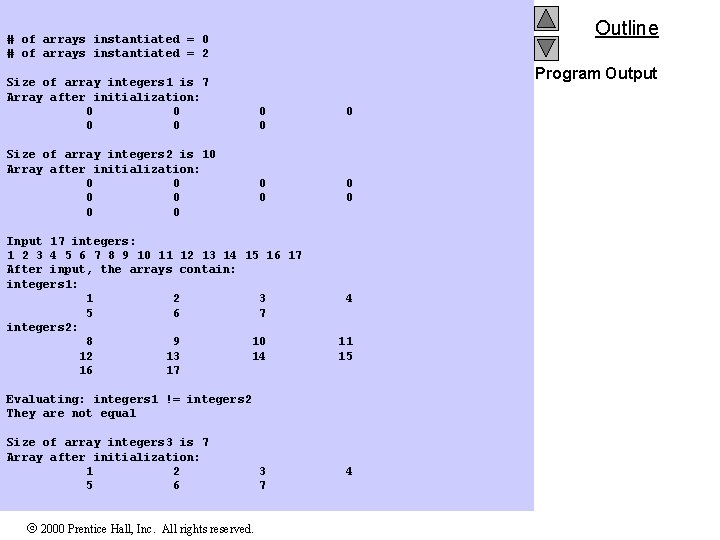
# of arrays instantiated = 0 # of arrays instantiated = 2 Size of array integers 1 is 7 Array after initialization: 0 0 Size of array integers 2 is 10 Array after initialization: 0 0 0 Input 17 integers: 1 2 3 4 5 6 7 8 9 10 11 12 13 14 15 16 17 After input, the arrays contain: integers 1: 1 2 3 4 5 6 7 integers 2: 8 9 10 11 12 13 14 15 16 17 Evaluating: integers 1 != integers 2 They are not equal Size of array integers 3 is 7 Array after initialization: 1 2 3 4 5 6 7 2000 Prentice Hall, Inc. All rights reserved. Outline Program Output
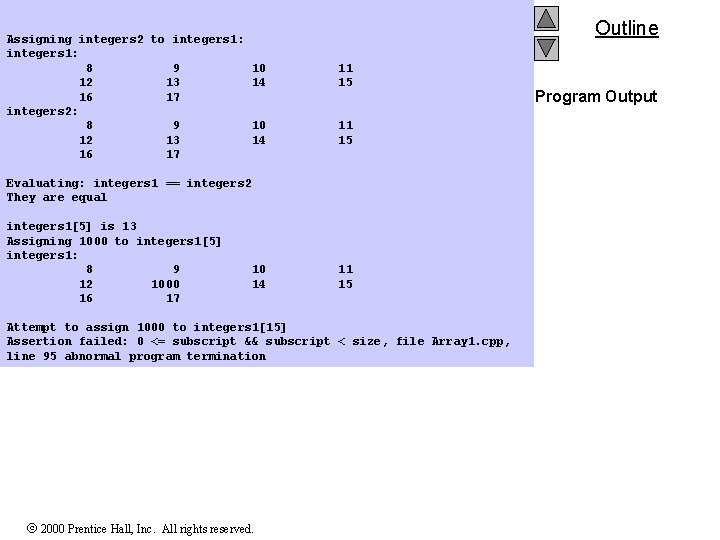
Assigning integers 2 to integers 1: 8 9 10 11 12 13 14 15 16 17 integers 2: 8 9 10 11 12 13 14 15 16 17 Evaluating: integers 1 == integers 2 They are equal integers 1[5] is 13 Assigning 1000 to integers 1[5] integers 1: 8 9 10 11 12 1000 14 15 16 17 Attempt to assign 1000 to integers 1[15] Assertion failed: 0 <= subscript && subscript < size, file Array 1. cpp, line 95 abnormal program termination 2000 Prentice Hall, Inc. All rights reserved. Outline Program Output
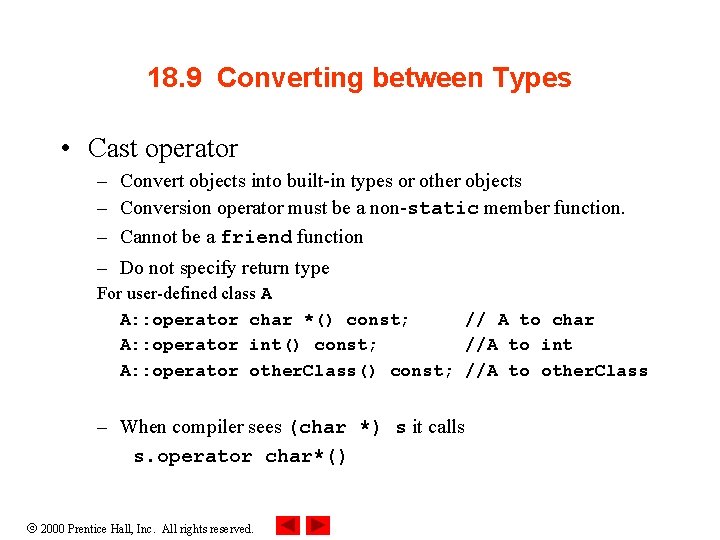
18. 9 Converting between Types • Cast operator – – Convert objects into built-in types or other objects Conversion operator must be a non-static member function. Cannot be a friend function Do not specify return type For user-defined class A A: : operator char *() const; // A to char A: : operator int() const; //A to int A: : operator other. Class() const; //A to other. Class – When compiler sees (char *) s it calls s. operator char*() 2000 Prentice Hall, Inc. All rights reserved.
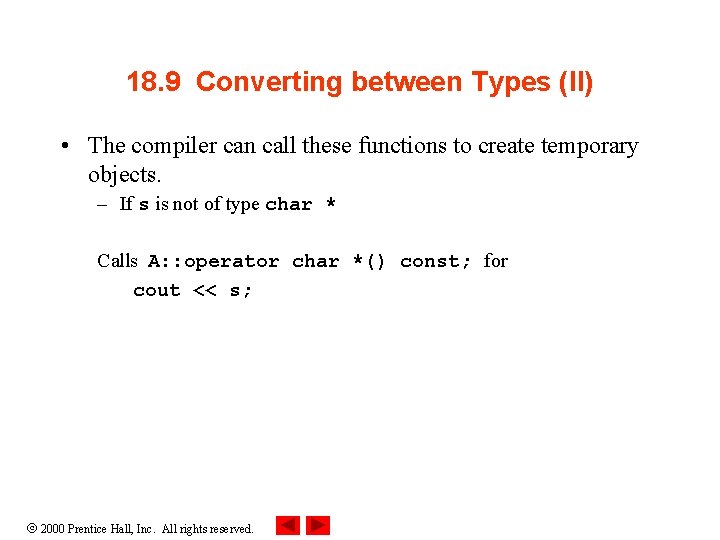
18. 9 Converting between Types (II) • The compiler can call these functions to create temporary objects. – If s is not of type char * Calls A: : operator char *() const; for cout << s; 2000 Prentice Hall, Inc. All rights reserved.
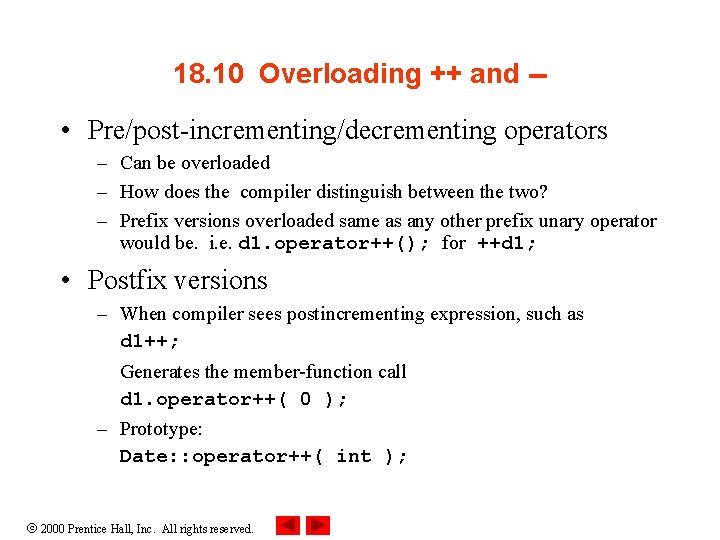
18. 10 Overloading ++ and -- • Pre/post-incrementing/decrementing operators – Can be overloaded – How does the compiler distinguish between the two? – Prefix versions overloaded same as any other prefix unary operator would be. i. e. d 1. operator++(); for ++d 1; • Postfix versions – When compiler sees postincrementing expression, such as d 1++; Generates the member-function call d 1. operator++( 0 ); – Prototype: Date: : operator++( int ); 2000 Prentice Hall, Inc. All rights reserved.