
Chapter 18 Managing Hazardous Solid Waste and Waste
- Slides: 29
Chapter 18 Managing Hazardous Solid Waste and Waste Sites © 2007 Thomson Learning/South-Western Thomas and Callan, Environmental Economics
How Serious is the Problem? n It is worldwide in scope, affecting both developed and developing nations n In the US, annual hazardous waste generation is about 36. 3 million tons per year or 0. 13 tons person n Risks are nontrivial n e. g. , Love Canal 2
Overview of Recent Policy n Resource Conservation and Recovery Act (RCRA) of 1976 (Subtitle C) Established ‘cradle-to-grave’ management; delegated nonhazardous waste control to states n Hazardous and Solid Waste Amendments of 1984 (reauthorized RCRA) n Some shift toward waste reduction and improved treatment n Strengthened standards n 3
Overall Policy Approach (RCRA) n Command-control n Primary responsibility is at federal level (EPA) n Emphasizes waste management more than source reduction (pollution prevention) 4
Components of Cradle-to-Grave Management System n Identification of hazardous waste n A waste is hazardous if it falls into one of two categories p characteristic wastes: have attributes posing substantial risk n p In the US, characteristics are: ignitability, corrosivity, reactivity, toxicity listed wastes: pre-identified by EPA as having met certain criteria, such as the presence of toxic or carcinogenic constituents. n National manifest system for tracking n Once wastes are ready for transport, generator must prepare a document, called a manifest, that identifies the hazardous material and all parties responsible for its movement 5
Components of Cradle-to-Grave Management System (continued) n Permit system n This controls waste management for transport, storage, and disposal facilities (TSDFs) n Standards for TSDFs n n General regulatory standards: apply to all types of TSDFs and control functions like inspections, emergency plans, and participation in the manifest program Technical regulatory standards: outline procedures and equipment requirements for specific types of facilities 6
Evolving To Pollution Prevention n 1984 amendments suggest some movement toward prevention and away from land disposal n Land disposal of untreated hazardous waste is essentially prohibited 7
Economic Analysis of Policy
4 Elements of the Analysis n Risk-based uniform rules of identification n Benefit-based uniform standards n Failures of the manifest system n Market implications of the 1984 land restrictions 9
Risk-Based Uniform Identification n Absence of risk-benefit analysis n Risk-based -- no consideration for balancing risk with benefits of the material before it becomes waste n Result: allocative inefficiency p All waste materials are controlled with same stringency regardless of their value to society n Identification criteria are applied uniformly n No adjustments allowed for degree of toxicity or for the amount of waste that poses a hazard n Result: allocative inefficiency p Potential for underregulation of more toxic wastes and overregulation of less toxic wastes 10
Benefit-Based Uniform Standards n Standards are benefit-based n No cost considerations p particularly problematic for long-term rulings such as post-closure procedures n Result: allocative inefficiency n Standards applied uniformly n n No consideration for site-specific differences Result: cost ineffectiveness 11
Failures of Manifest System n Strict CAC no incentives n Solely benefit-based n No consideration for costs of administration, compliance, etc. n Result: allocative inefficiency n Limited scope n only 4 - 5% of U. S. hazardous waste are moved off site and therefore subject to manifest system n High compliance costs n Potential incentive to illegally dispose 12
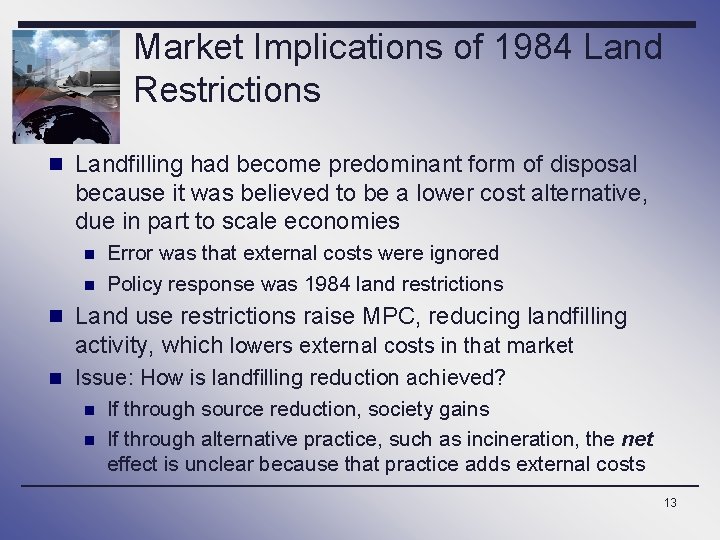
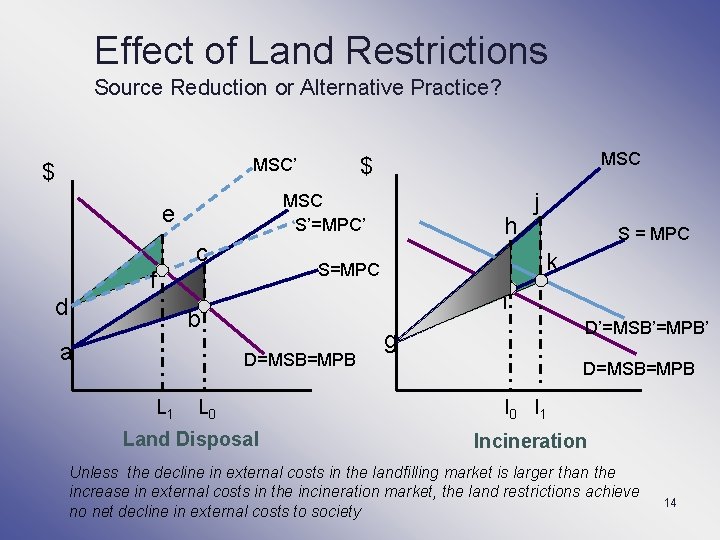
Market Implications of 1984 Land Restrictions n Landfilling had become predominant form of disposal because it was believed to be a lower cost alternative, due in part to scale economies n n Error was that external costs were ignored Policy response was 1984 land restrictions n Land use restrictions raise MPC, reducing landfilling activity, which lowers external costs in that market n Issue: How is landfilling reduction achieved? n n If through source reduction, society gains If through alternative practice, such as incineration, the net effect is unclear because that practice adds external costs 13
Effect of Land Restrictions Source Reduction or Alternative Practice? $ MSC S’=MPC’ e c D=MSB=MPB L 1 j S = MPC k i b a h S=MPC f d MSC $ MSC’ L 0 Land Disposal D’=MSB’=MPB’ g D=MSB=MPB I 0 I 1 Incineration Unless the decline in external costs in the landfilling market is larger than the increase in external costs in the incineration market, the land restrictions achieve no net decline in external costs to society 14
Market-Based Policy
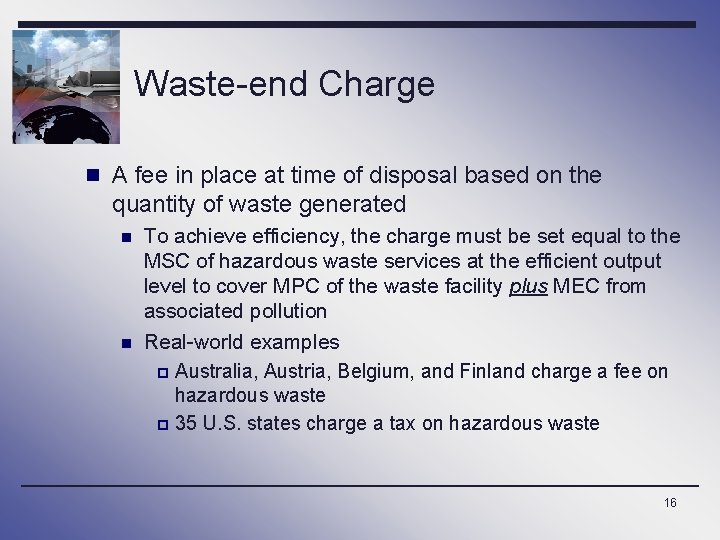
Waste-end Charge n A fee in place at time of disposal based on the quantity of waste generated n n To achieve efficiency, the charge must be set equal to the MSC of hazardous waste services at the efficient output level to cover MPC of the waste facility plus MEC from associated pollution Real-world examples p Australia, Austria, Belgium, and Finland charge a fee on hazardous waste p 35 U. S. states charge a tax on hazardous waste 16
Uncontrolled Hazardous Waste Sites Superfund
Overview of Policy n Comprehensive Environmental Response, Compensation, and Liability Act (CERCLA) 1980 (Superfund) n Established CERCLIS, a national inventory of hazardous waste sites p n CERCLIS is used to identify the worst sites and place them on National Priorities List (NPL) Established a $1. 6 billion fund to clean up and recover damage n Superfund Amendments and Reauthorization Act (SARA) 1986 n n n Reauthorized CERCLA Increased fund to $8. 5 billion Mandated federal action on 375 sites within a 5 -year period; promotes permanent clean-up 18
Overview of Policy (continued) n Small Business Liability Relief and Brownfields Revitalization Act of 2001(known as Brownfields Act) n n n Amends CERCLA Outlines exemptions from Superfund liability Authorizes grant funding of up to $200 million annually for assessment and abatement of brownfield sites p Abandoned or underutilized properties that are less contaminated than Superfund sites, but redevelopment is complicated by (potential) presence of contamination 19
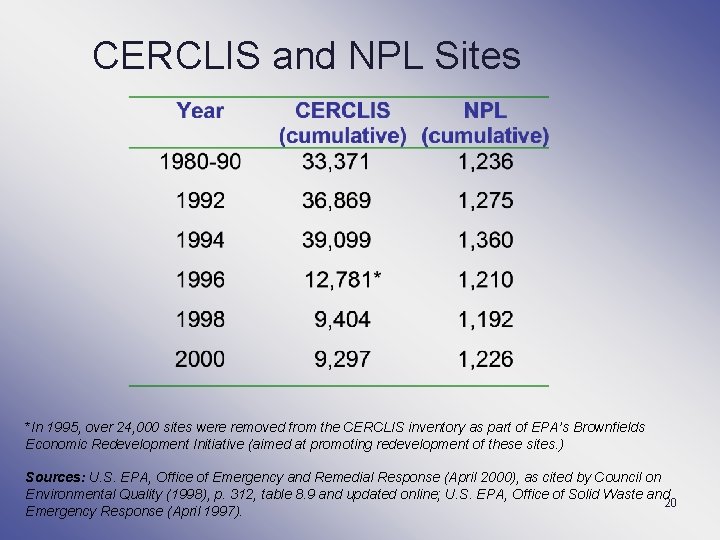
CERCLIS and NPL Sites *In 1995, over 24, 000 sites were removed from the CERCLIS inventory as part of EPA’s Brownfields Economic Redevelopment Initiative (aimed at promoting redevelopment of these sites. ) Sources: U. S. EPA, Office of Emergency and Remedial Response (April 2000), as cited by Council on Environmental Quality (1998), p. 312, table 8. 9 and updated online; U. S. EPA, Office of Solid Waste and 20 Emergency Response (April 1997).
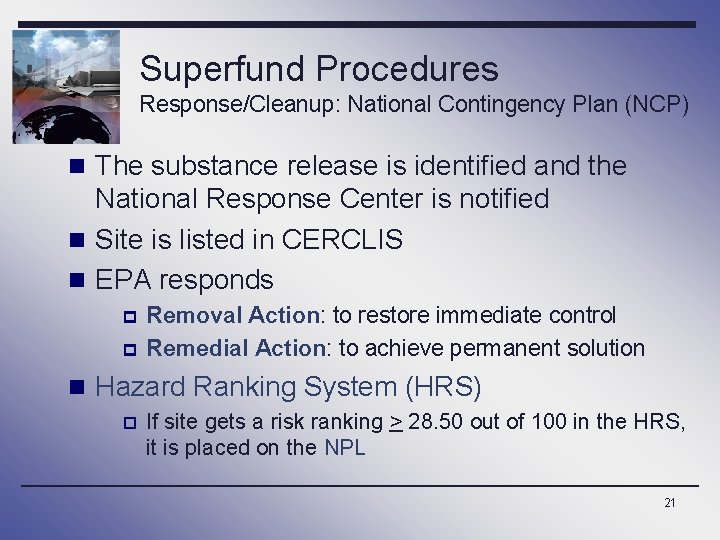
Superfund Procedures Response/Cleanup: National Contingency Plan (NCP) n The substance release is identified and the National Response Center is notified n Site is listed in CERCLIS n EPA responds p p Removal Action: to restore immediate control Remedial Action: to achieve permanent solution n Hazard Ranking System (HRS) p If site gets a risk ranking > 28. 50 out of 100 in the HRS, it is placed on the NPL 21
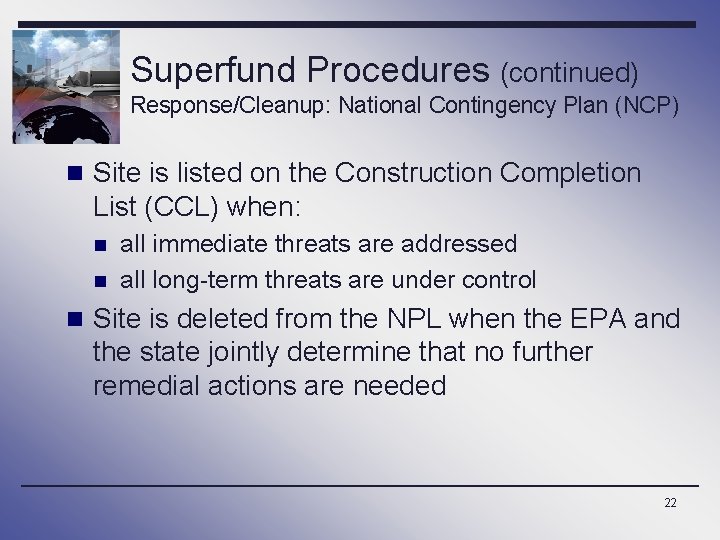
Superfund Procedures (continued) Response/Cleanup: National Contingency Plan (NCP) n Site is listed on the Construction Completion List (CCL) when: n n all immediate threats are addressed all long-term threats are under control n Site is deleted from the NPL when the EPA and the state jointly determine that no further remedial actions are needed 22
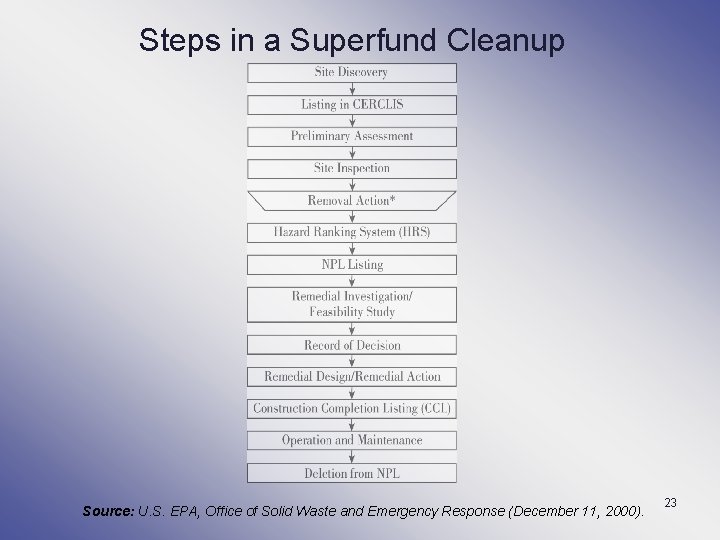
Steps in a Superfund Cleanup Source: U. S. EPA, Office of Solid Waste and Emergency Response (December 11, 2000). 23
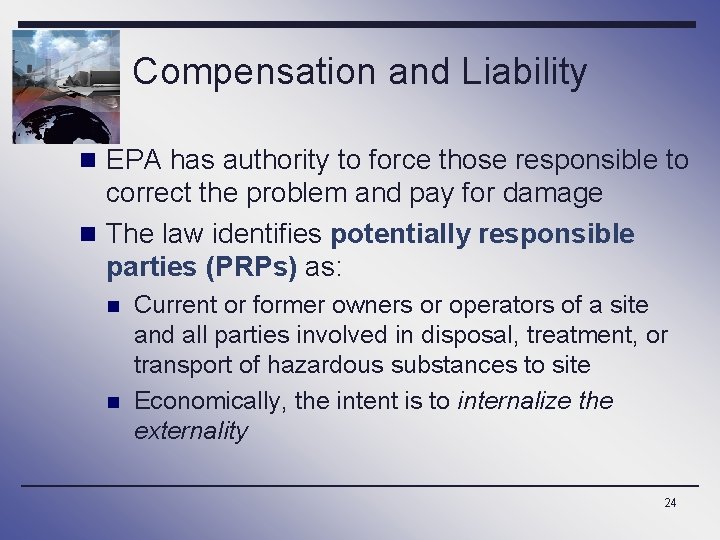
Compensation and Liability n EPA has authority to force those responsible to correct the problem and pay for damage n The law identifies potentially responsible parties (PRPs) as: n n Current or former owners or operators of a site and all parties involved in disposal, treatment, or transport of hazardous substances to site Economically, the intent is to internalize the externality 24
Emergency Planning Title III of SARA n Public must be informed of production and release of hazardous substances according to Title III of SARA n Each state sets up an emergency plan in the event of a hazardous release n Various reports about hazardous substances are required by law p Resulting data forms the Toxics Release Inventory (TRI) published annually by EPA 25
Analysis of Policy
Assessing Superfund’s Performance n CERCLA of 1980 was a national failure n $1. 6 billion cleaned up only 8 sites n Slow progress removing NPL sites n As of 2005, only 293 have officially been removed from the NPL n Average cost of remedial action is $25 million per site n Problem of “how clean is clean” n Sites are brought to a uniform level of cleanliness n Debate is whether this decision should be risk-based or benefit-cost based 27
Two Major Flaws in Superfund 1. Poor information and reporting practices n n An initial lack of awareness about the extent of the problem Inadequate knowledge of abatement technology 28
Two Major Flaws in Superfund 2. Absence of market incentives n n Feedstock taxes that financed Superfund were targeted to be revenue producing, not as an incentive to reduce use of hazardous materials Definition of PRPs’ liability is disincentive for individuals to come forward p p p Strict liability: a party is responsible even if negligence is not proven Joint and several liability: single party is responsible for all damages even if contribution is minimal Outcome is resource misallocation from cleanup to litigation procedures 29