
Chapter 18 Leasing 1 By the end of
Chapter 18 Leasing 1
By the end of this chapter, you should be able to: • understand IFRS 16 • account for leases by the lessee 2
IFRS 16 The approach taken in IFRS 16 is to define a lease based upon economic substance rather than legal form. A contract does not need to be legally established as a lease for the contract to be regarded as a lease for financial reporting purposes. 3
IFRS 16 defines a lease as • A contract, or part of a contract, that conveys the right to use an asset for a period of time in exchange for consideration’. • In order for such a contract to exist, IFRS 16 states that the customer (user of the ‘identified asset’) needs to have the right to: • Obtain substantially all of the economic benefits from the use of the asset • The right to direct the use of the asset. • 4
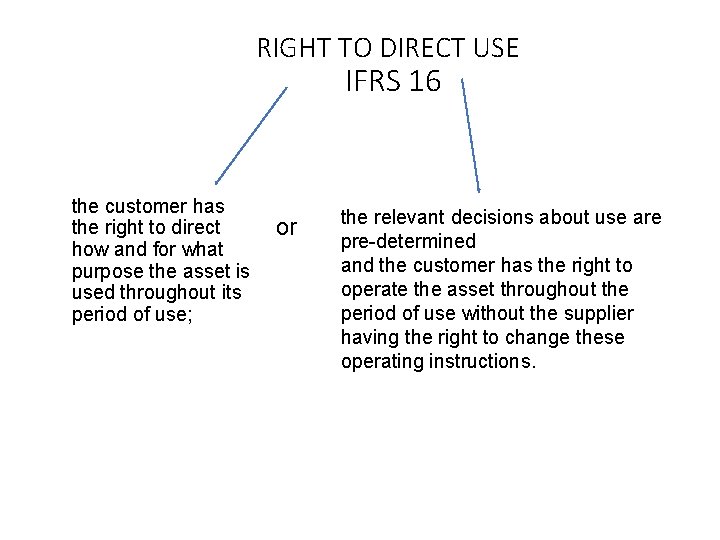
RIGHT TO DIRECT USE IFRS 16 the customer has the right to direct how and for what purpose the asset is used throughout its period of use; or the relevant decisions about use are pre-determined and the customer has the right to operate the asset throughout the period of use without the supplier having the right to change these operating instructions. 5
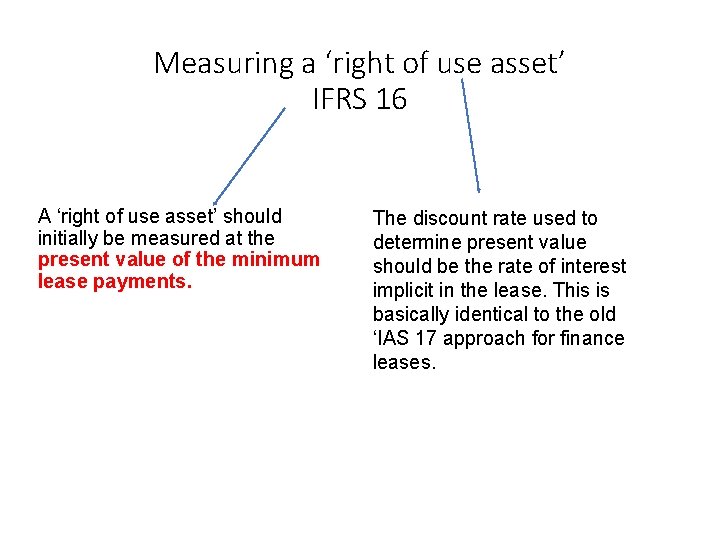
Measuring a ‘right of use asset’ IFRS 16 A ‘right of use asset’ should initially be measured at the present value of the minimum lease payments. The discount rate used to determine present value should be the rate of interest implicit in the lease. This is basically identical to the old ‘IAS 17 approach for finance leases. 6
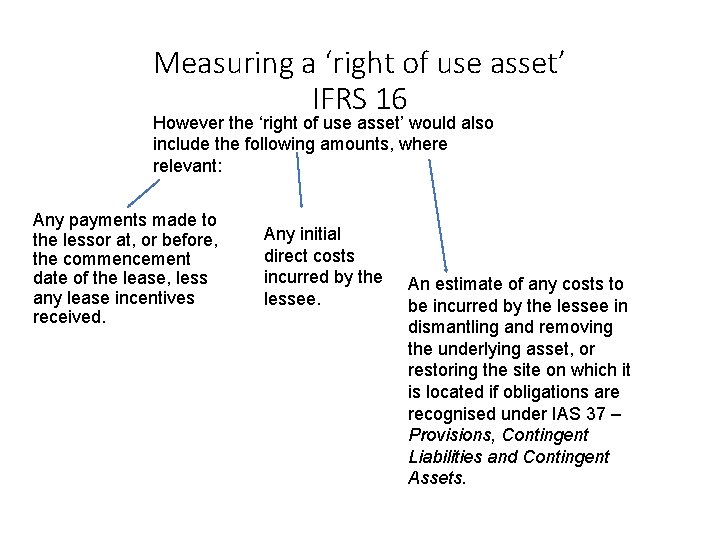
Measuring a ‘right of use asset’ IFRS 16 However the ‘right of use asset’ would also include the following amounts, where relevant: Any payments made to the lessor at, or before, the commencement date of the lease, less any lease incentives received. Any initial direct costs incurred by the lessee. An estimate of any costs to be incurred by the lessee in dismantling and removing the underlying asset, or restoring the site on which it is located if obligations are recognised under IAS 37 – Provisions, Contingent Liabilities and Contingent Assets. 7
8
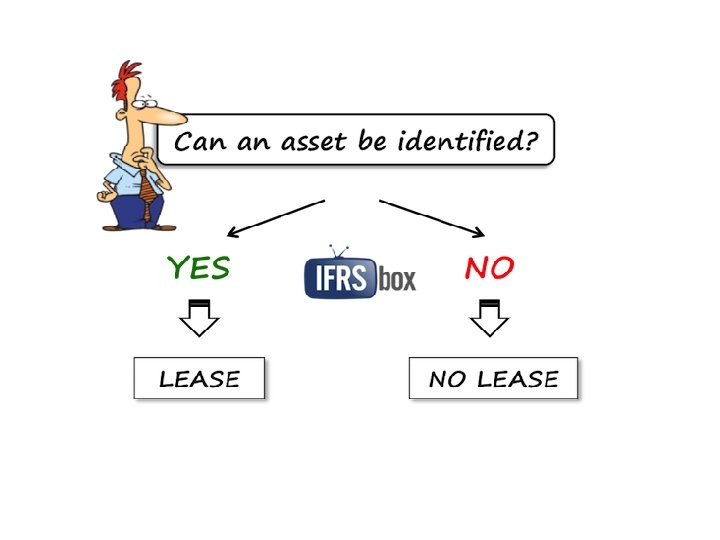
Option 1 You will occupy a certain area of XY cubic meters, but the specific place will be determined by the owner of the warehouse, based on actual usage of the warehouse and free storage. Option 1 does not contain any lease, because no asset can be identified. The reason is that the supplier (warehouse owner) can exchange one place for another and you lease only certain capacity. Therefore, you would account for rental payments as for expenses in profit or loss. 9
Option 2 You will occupy the unit no. 13 of XY cubic meters in the sector A of that warehouse. This place is assigned to you and no one can change it during the duration of the contract. Option 2 does contain a lease, because an underlying asset can be identified– you are leasing the unit no. 13 of XY cubic meters in the sector A. Therefore, you need to account for this contract as for the lease and it means recognizing some asset and a liability in your balance sheet. 10
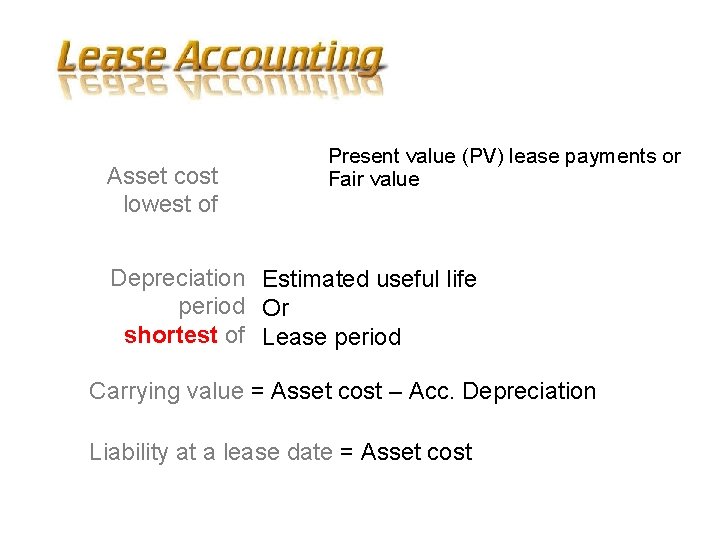
Asset cost lowest of Present value (PV) lease payments or Fair value Depreciation Estimated useful life period Or shortest of Lease period Carrying value = Asset cost – Acc. Depreciation Liability at a lease date = Asset cost 11
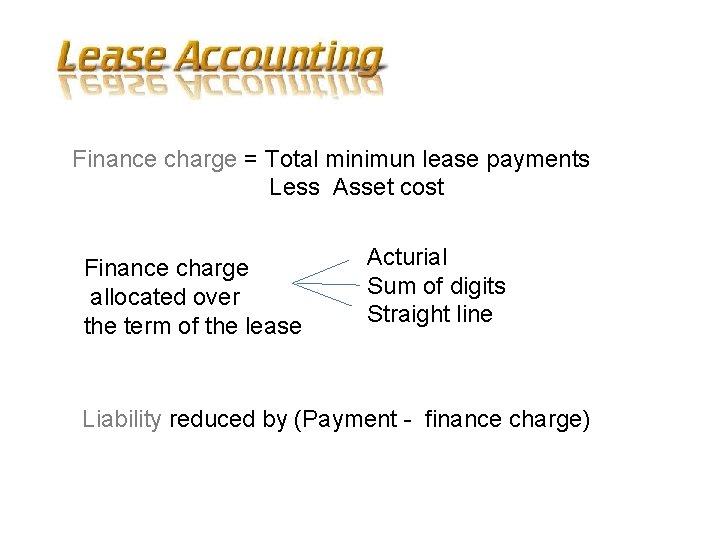
Finance charge = Total minimun lease payments Less Asset cost Finance charge allocated over the term of the lease Acturial Sum of digits Straight line Liability reduced by (Payment - finance charge) 12
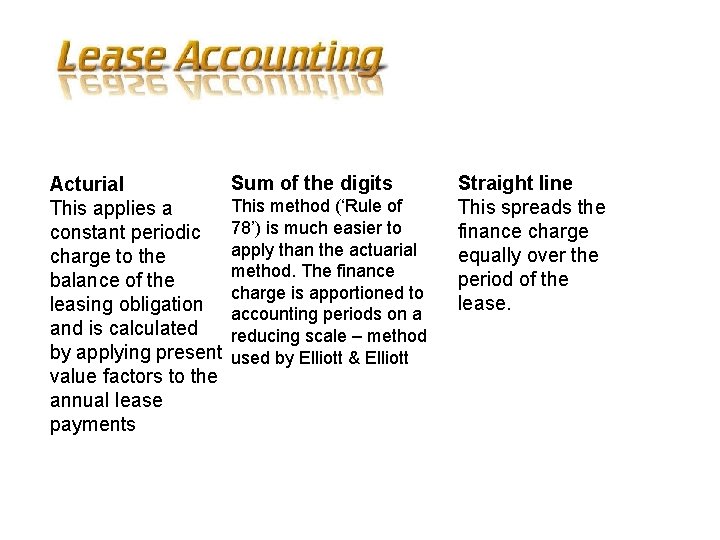
Acturial This applies a constant periodic charge to the balance of the leasing obligation and is calculated by applying present value factors to the annual lease payments Sum of the digits This method (‘Rule of 78’) is much easier to apply than the actuarial method. The finance charge is apportioned to accounting periods on a reducing scale – method used by Elliott & Elliott Straight line This spreads the finance charge equally over the period of the lease. 13
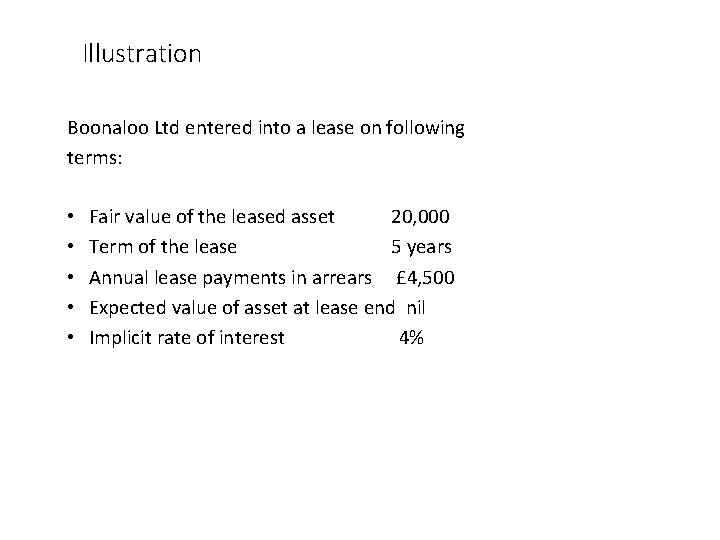
Illustration Boonaloo Ltd entered into a lease on following terms: • • • Fair value of the leased asset 20, 000 Term of the lease 5 years Annual lease payments in arrears £ 4, 500 Expected value of asset at lease end nil Implicit rate of interest 4% 14
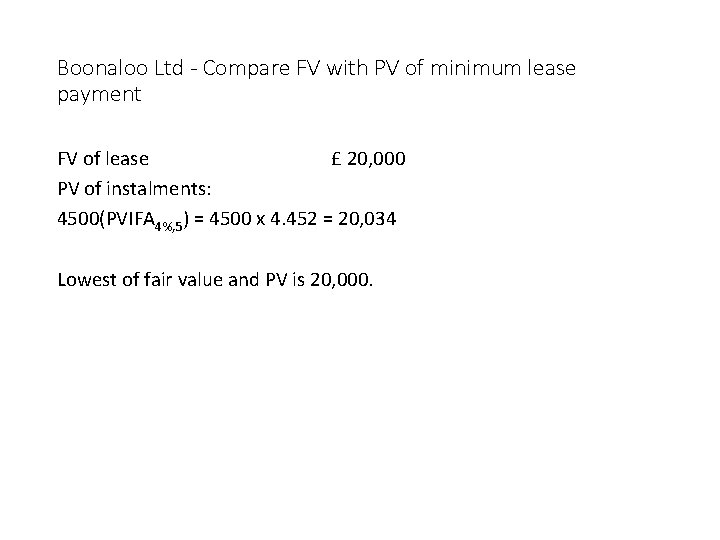
Boonaloo Ltd - Compare FV with PV of minimum lease payment Lowest of fair value and PV is 20, 000. • 15 FV of lease £ 20, 000 PV of instalments: 4500(PVIFA 4%, 5) = 4500 x 4. 452 = 20, 034
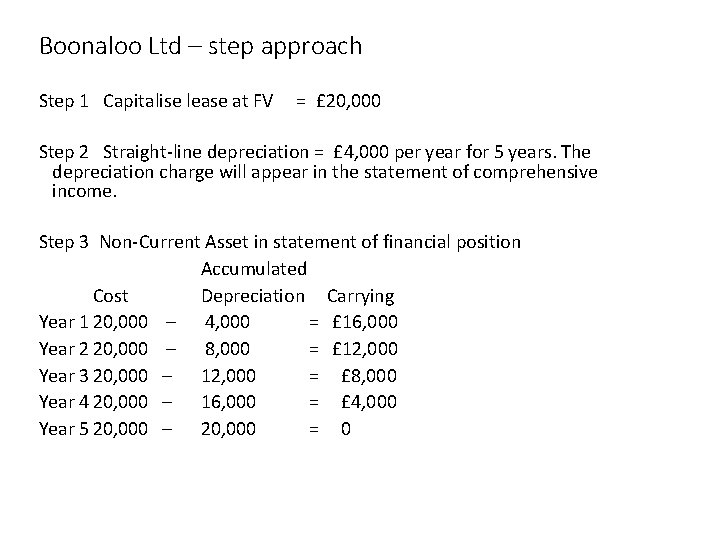
Boonaloo Ltd – step approach Step 1 Capitalise lease at FV = £ 20, 000 Step 3 Non-Current Asset in statement of financial position Accumulated Cost Depreciation Carrying Year 1 20, 000 – 4, 000 = £ 16, 000 Year 2 20, 000 – 8, 000 = £ 12, 000 Year 3 20, 000 – 12, 000 = £ 8, 000 Year 4 20, 000 – 16, 000 = £ 4, 000 Year 5 20, 000 – 20, 000 = 0 • 16 Step 2 Straight-line depreciation = £ 4, 000 per year for 5 years. The depreciation charge will appear in the statement of comprehensive income.
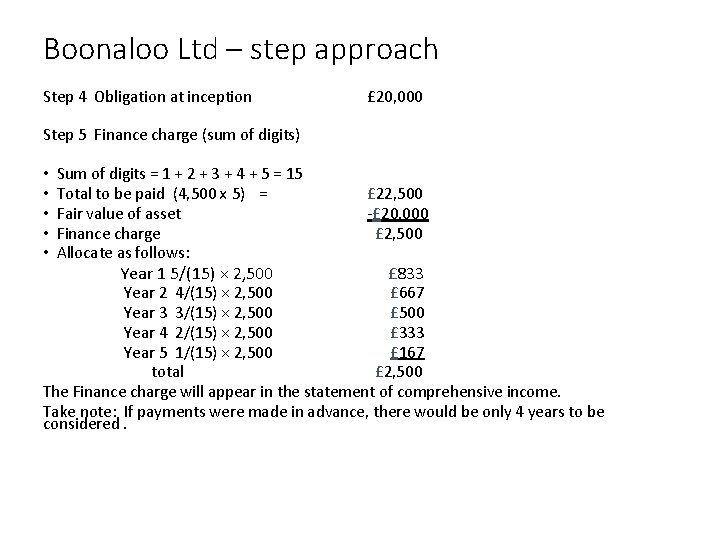
Boonaloo Ltd – step approach Step 4 Obligation at inception £ 20, 000 Step 5 Finance charge (sum of digits) Sum of digits = 1 + 2 + 3 + 4 + 5 = 15 Total to be paid (4, 500 x 5) = Fair value of asset Finance charge Allocate as follows: Year 1 5/(15) × 2, 500 £ 22, 500 -£ 20, 000 £ 2, 500 £ 833 Year 2 4/(15) × 2, 500 £ 667 Year 3 3/(15) × 2, 500 £ 500 Year 4 2/(15) × 2, 500 £ 333 Year 5 1/(15) × 2, 500 £ 167 total £ 2, 500 The Finance charge will appear in the statement of comprehensive income. Take note: If payments were made in advance, there would be only 4 years to be considered. • 17 • • •
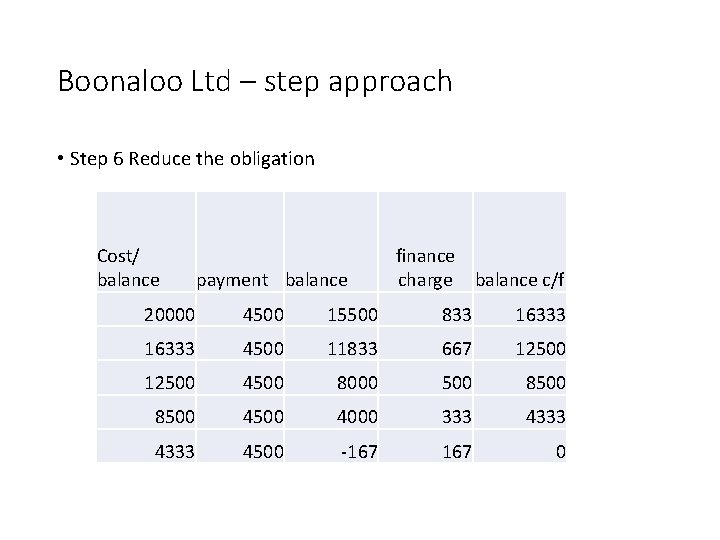
Boonaloo Ltd – step approach • Step 6 Reduce the obligation • 18 Cost/ balance payment balance finance charge balance c/f 20000 4500 15500 833 16333 4500 11833 667 12500 4500 8000 500 8500 4000 333 4333 4500 -167 0
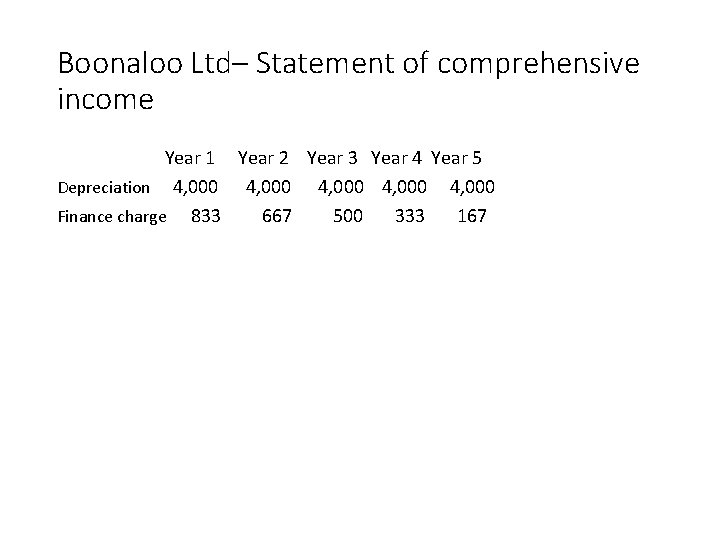
Boonaloo Ltd– Statement of comprehensive income • 19 Year 1 Year 2 Year 3 Year 4 Year 5 Depreciation 4, 000 4, 000 Finance charge 833 667 500 333 167
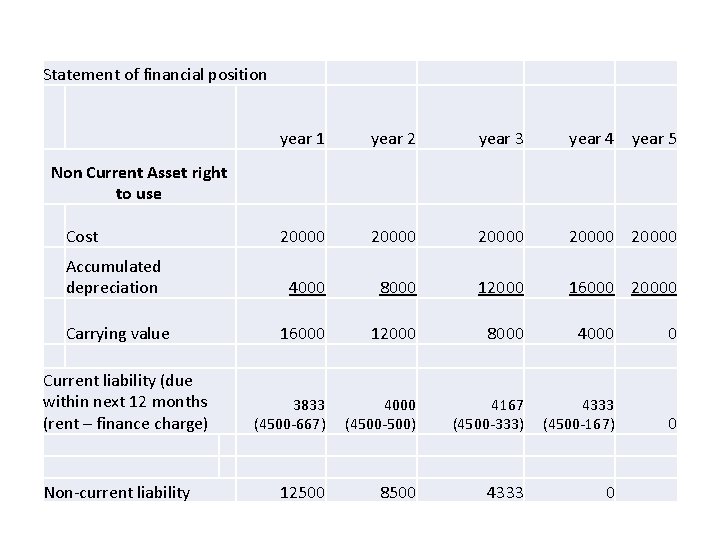
Statement of financial position year 1 year 2 year 3 year 4 year 5 20000 20000 Accumulated depreciation 4000 8000 12000 16000 20000 Carrying value 16000 12000 8000 4000 0 3833 (4500 -667) 4000 (4500 -500) 4167 (4500 -333) 4333 (4500 -167) 0 12500 8500 4333 0 Non Current Asset right to use Cost Current liability (due within next 12 months (rent – finance charge) Non-current liability 20
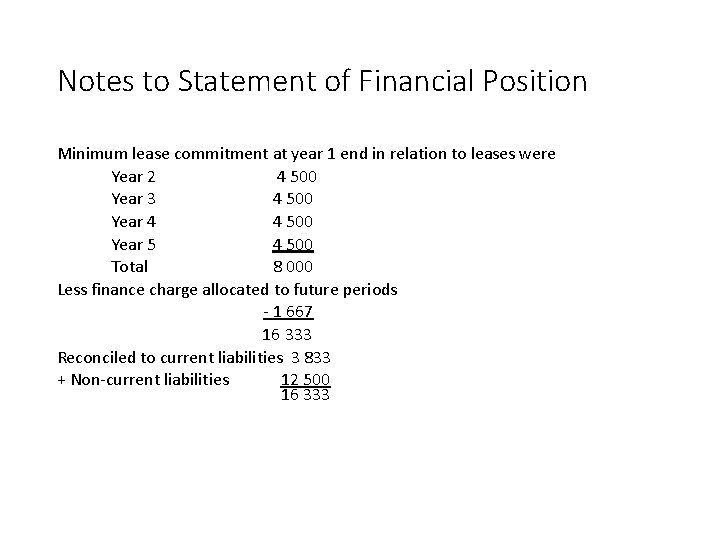
Notes to Statement of Financial Position Minimum lease commitment at year 1 end in relation to leases were Year 2 4 500 Year 3 4 500 Year 4 4 500 Year 5 4 500 Total 8 000 Less finance charge allocated to future periods - 1 667 16 333 Reconciled to current liabilities 3 833 + Non-current liabilities 12 500 16 333 21
- Slides: 21