
Chapter 18 Learning from Observations Decision tree examples
Chapter 18 Learning from Observations Decision tree examples Additional source used in preparing the slides: Jean-Claude Latombe’s CS 121 slides: robotics. stanford. edu/~latombe/cs 121 1
Decision Trees • A decision tree allows a classification of an object by testing its values for certain properties • check out the example at: www. aiinc. ca/demos/whale. html • We are trying to learn a structure that determines class membership after a sequence of questions. This structure is a decision tree. 2
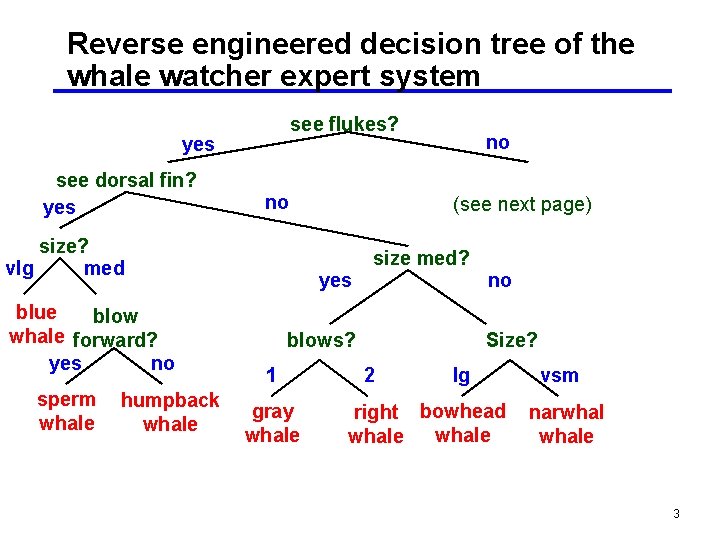
Reverse engineered decision tree of the whale watcher expert system see flukes? yes see dorsal fin? yes no size? vlg med blue blow whale forward? yes no sperm whale humpback whale no (see next page) yes size med? blows? 1 gray whale no Size? 2 lg right bowhead whale vsm narwhale 3
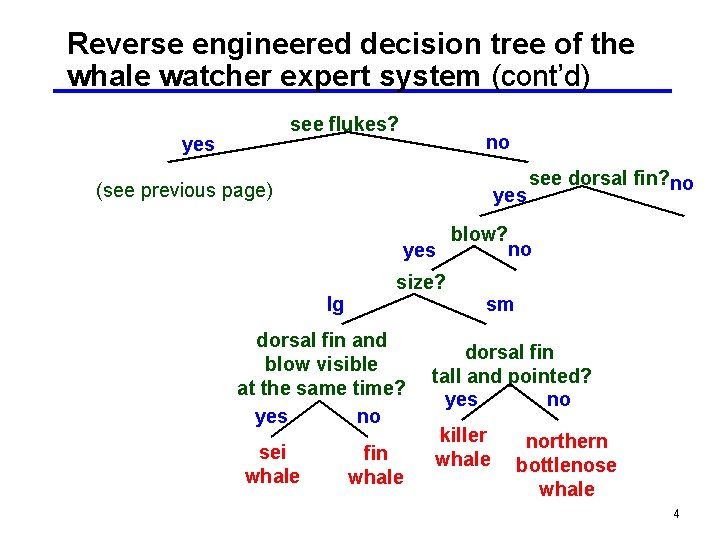
Reverse engineered decision tree of the whale watcher expert system (cont’d) see flukes? yes no (see previous page) yes see dorsal fin? no blow? no yes lg size? dorsal fin and blow visible at the same time? yes no sei whale fin whale sm dorsal fin tall and pointed? yes no killer whale northern bottlenose whale 4
What might the original data look like? 5
The search problem Given a table of observable properties, search for a decision tree that • correctly represents the data (assuming that the data is noise-free), and • is as small as possible. What does the search tree look like? 6
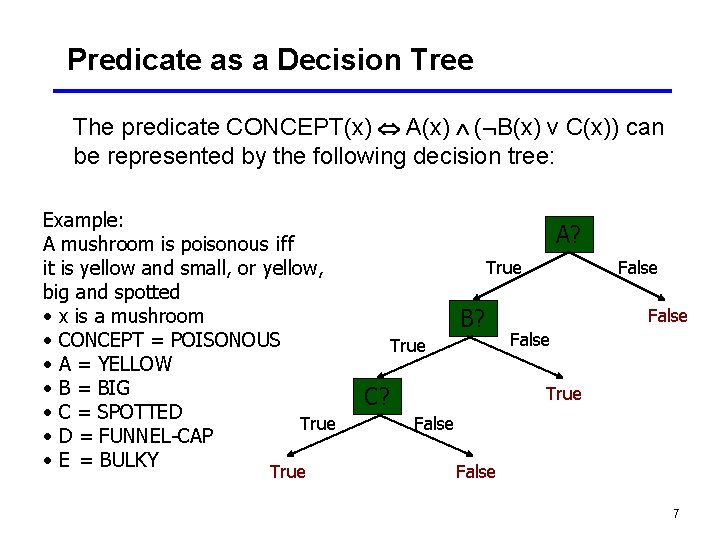
Predicate as a Decision Tree The predicate CONCEPT(x) A(x) ( B(x) v C(x)) can be represented by the following decision tree: Example: A mushroom is poisonous iff it is yellow and small, or yellow, big and spotted • x is a mushroom • CONCEPT = POISONOUS • A = YELLOW • B = BIG • C = SPOTTED True • D = FUNNEL-CAP • E = BULKY True A? True B? True C? False True False 7
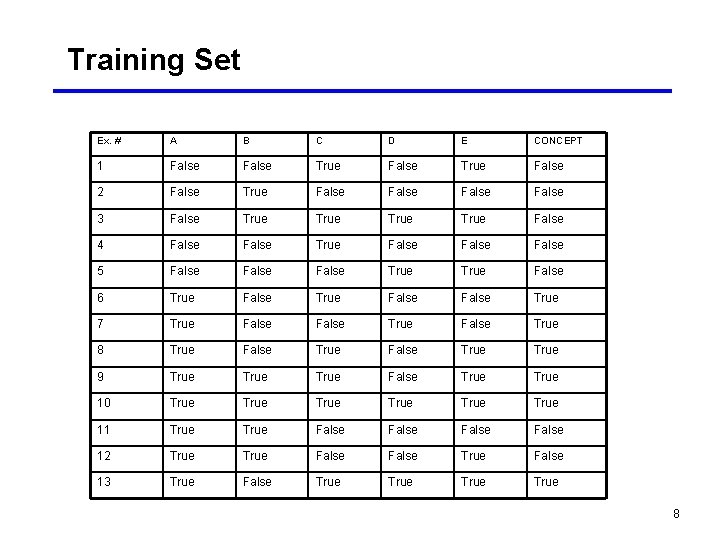
Training Set Ex. # A B C D E CONCEPT 1 False True False 2 False True False 3 False True False 4 False True False 5 False True False 6 True False True 7 True False True 8 True False True 9 True False True 10 True True 11 True False 12 True False 13 True False True 8
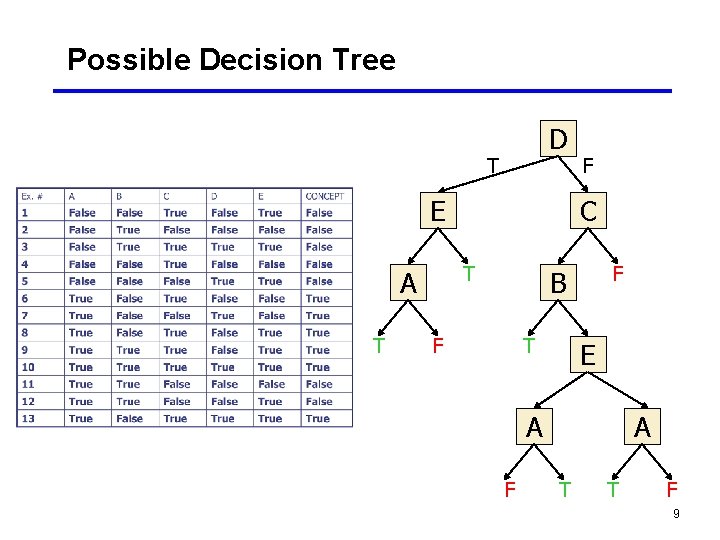
Possible Decision Tree D T E T C T A F F B F T E A A F T T F 9
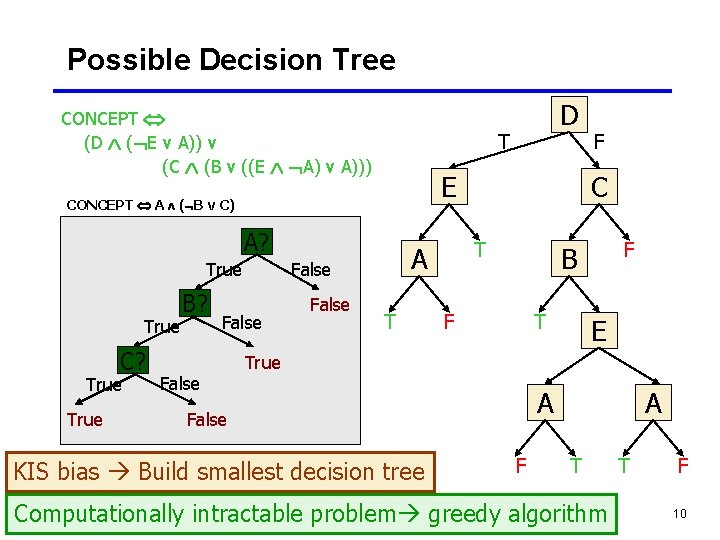
Possible Decision Tree CONCEPT (D ( E v A)) v (C (B v ((E A) v A))) T E CONCEPT A ( B v C) A? True C? True B? False T F C T A False D F B F T E True False KIS bias Build smallest decision tree A A False F T Computationally intractable problem greedy algorithm T F 10
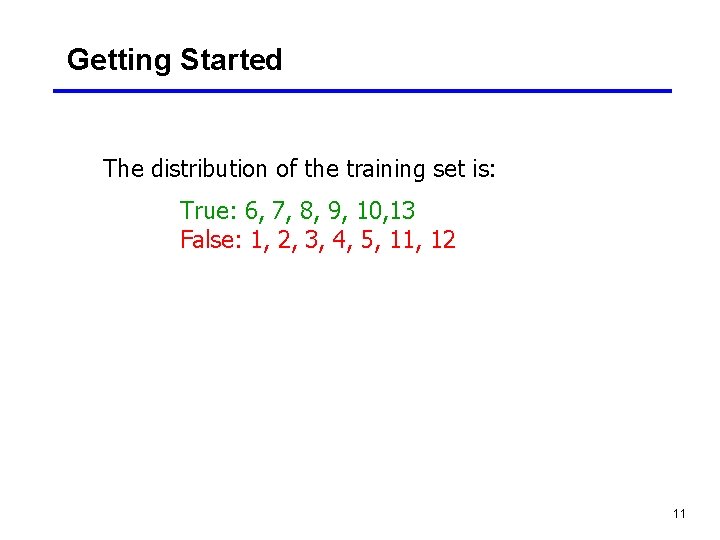
Getting Started The distribution of the training set is: True: 6, 7, 8, 9, 10, 13 False: 1, 2, 3, 4, 5, 11, 12 11
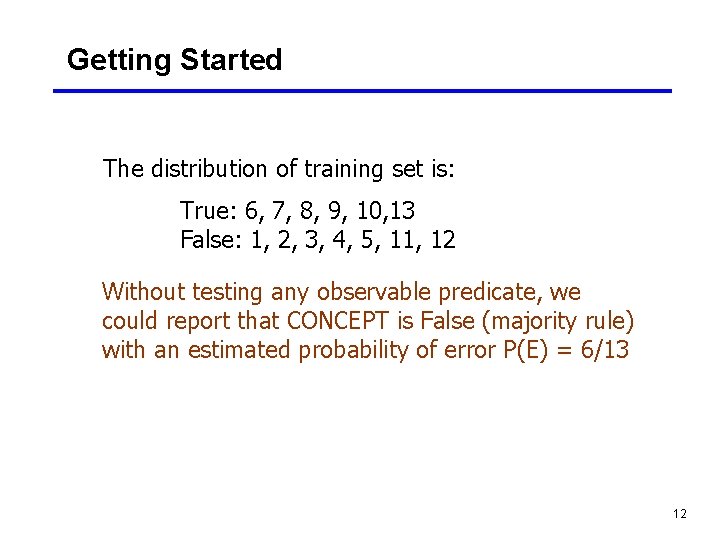
Getting Started The distribution of training set is: True: 6, 7, 8, 9, 10, 13 False: 1, 2, 3, 4, 5, 11, 12 Without testing any observable predicate, we could report that CONCEPT is False (majority rule) with an estimated probability of error P(E) = 6/13 12
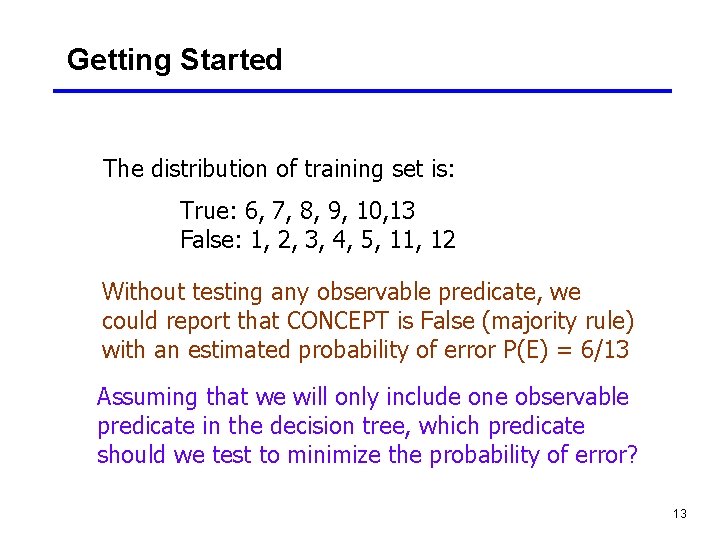
Getting Started The distribution of training set is: True: 6, 7, 8, 9, 10, 13 False: 1, 2, 3, 4, 5, 11, 12 Without testing any observable predicate, we could report that CONCEPT is False (majority rule) with an estimated probability of error P(E) = 6/13 Assuming that we will only include one observable predicate in the decision tree, which predicate should we test to minimize the probability of error? 13
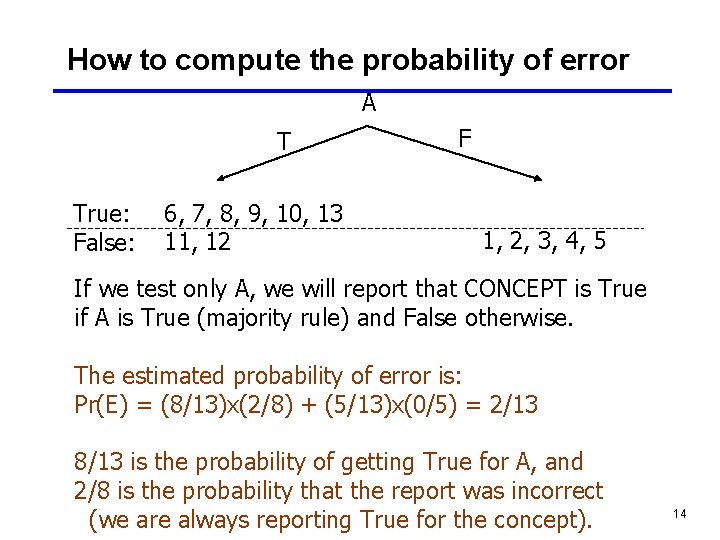
How to compute the probability of error A T True: False: 6, 7, 8, 9, 10, 13 11, 12 F 1, 2, 3, 4, 5 If we test only A, we will report that CONCEPT is True if A is True (majority rule) and False otherwise. The estimated probability of error is: Pr(E) = (8/13)x(2/8) + (5/13)x(0/5) = 2/13 8/13 is the probability of getting True for A, and 2/8 is the probability that the report was incorrect (we are always reporting True for the concept). 14
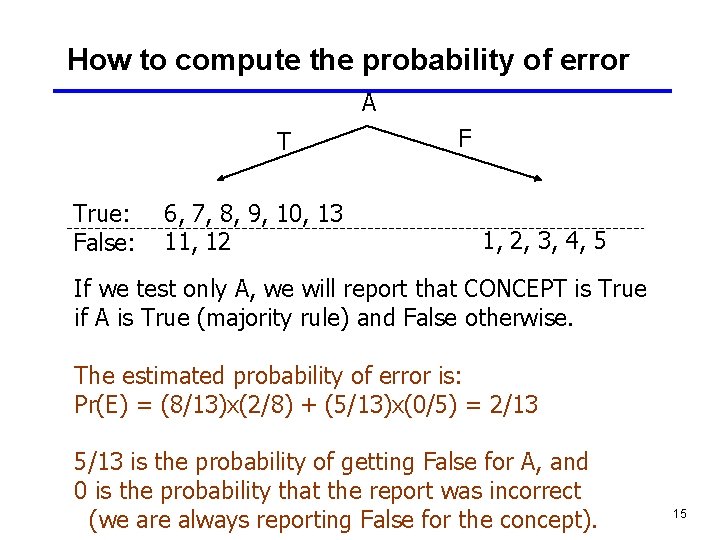
How to compute the probability of error A T True: False: 6, 7, 8, 9, 10, 13 11, 12 F 1, 2, 3, 4, 5 If we test only A, we will report that CONCEPT is True if A is True (majority rule) and False otherwise. The estimated probability of error is: Pr(E) = (8/13)x(2/8) + (5/13)x(0/5) = 2/13 5/13 is the probability of getting False for A, and 0 is the probability that the report was incorrect (we are always reporting False for the concept). 15
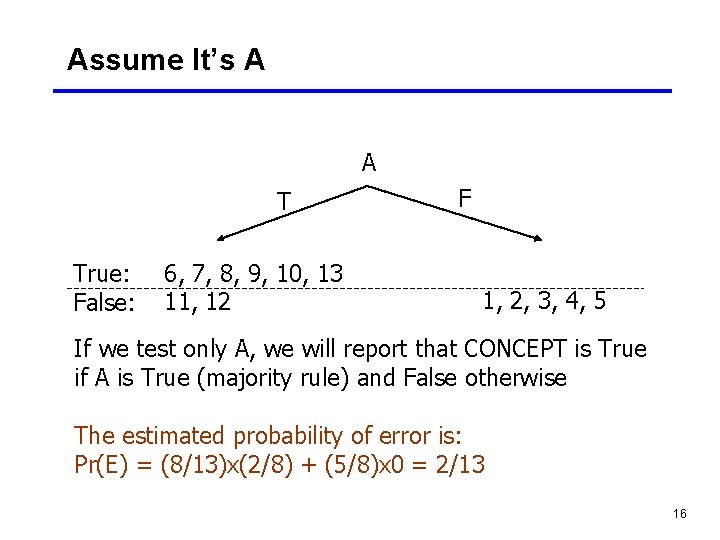
Assume It’s A A T True: False: 6, 7, 8, 9, 10, 13 11, 12 F 1, 2, 3, 4, 5 If we test only A, we will report that CONCEPT is True if A is True (majority rule) and False otherwise The estimated probability of error is: Pr(E) = (8/13)x(2/8) + (5/8)x 0 = 2/13 16
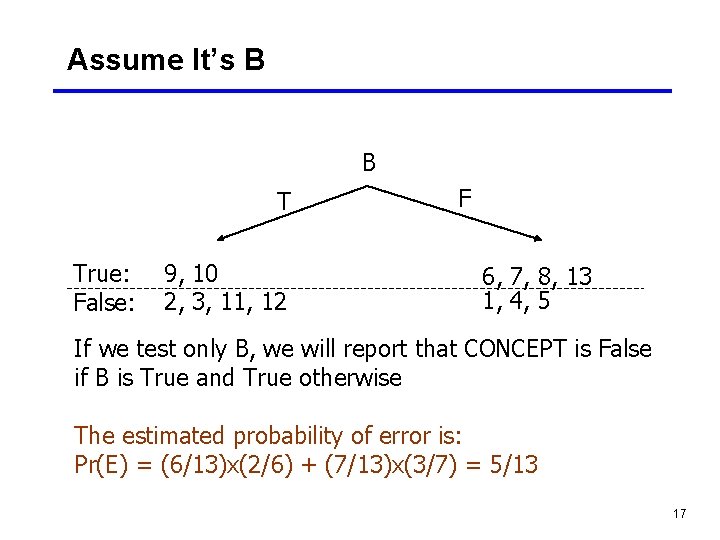
Assume It’s B B T True: False: 9, 10 2, 3, 11, 12 F 6, 7, 8, 13 1, 4, 5 If we test only B, we will report that CONCEPT is False if B is True and True otherwise The estimated probability of error is: Pr(E) = (6/13)x(2/6) + (7/13)x(3/7) = 5/13 17
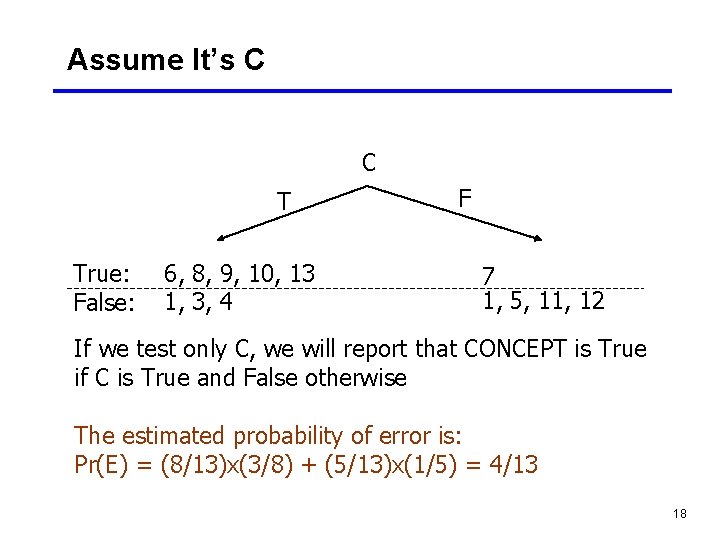
Assume It’s C C T True: False: 6, 8, 9, 10, 13 1, 3, 4 F 7 1, 5, 11, 12 If we test only C, we will report that CONCEPT is True if C is True and False otherwise The estimated probability of error is: Pr(E) = (8/13)x(3/8) + (5/13)x(1/5) = 4/13 18
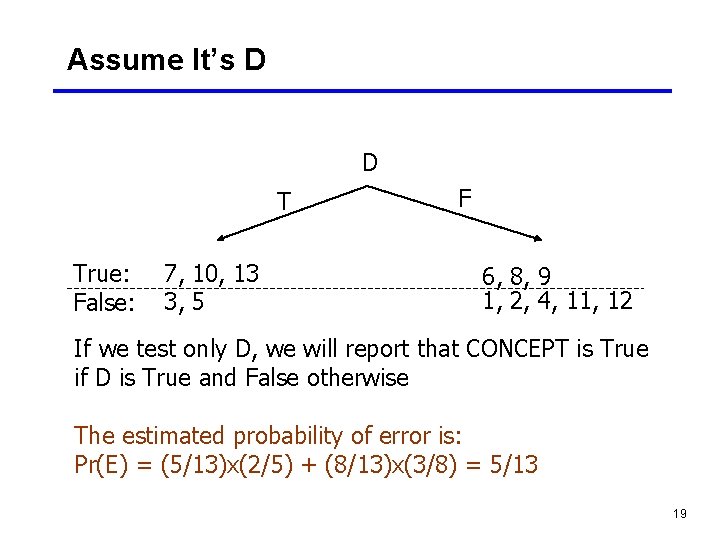
Assume It’s D D T True: False: 7, 10, 13 3, 5 F 6, 8, 9 1, 2, 4, 11, 12 If we test only D, we will report that CONCEPT is True if D is True and False otherwise The estimated probability of error is: Pr(E) = (5/13)x(2/5) + (8/13)x(3/8) = 5/13 19
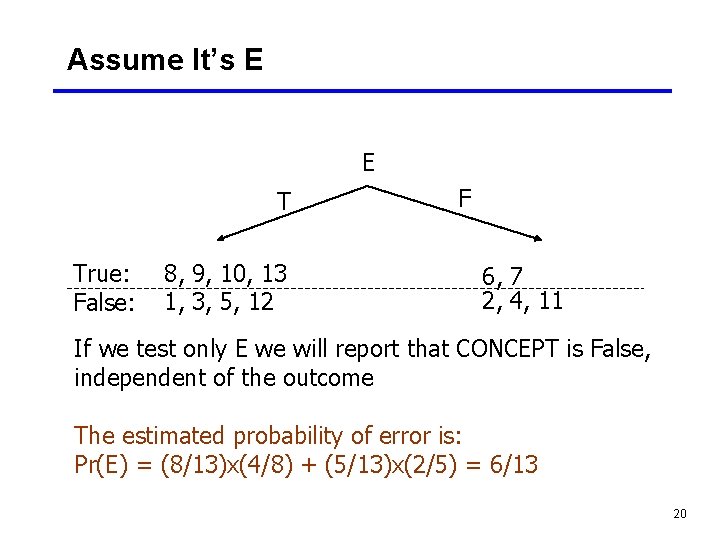
Assume It’s E E T True: False: 8, 9, 10, 13 1, 3, 5, 12 F 6, 7 2, 4, 11 If we test only E we will report that CONCEPT is False, independent of the outcome The estimated probability of error is: Pr(E) = (8/13)x(4/8) + (5/13)x(2/5) = 6/13 20
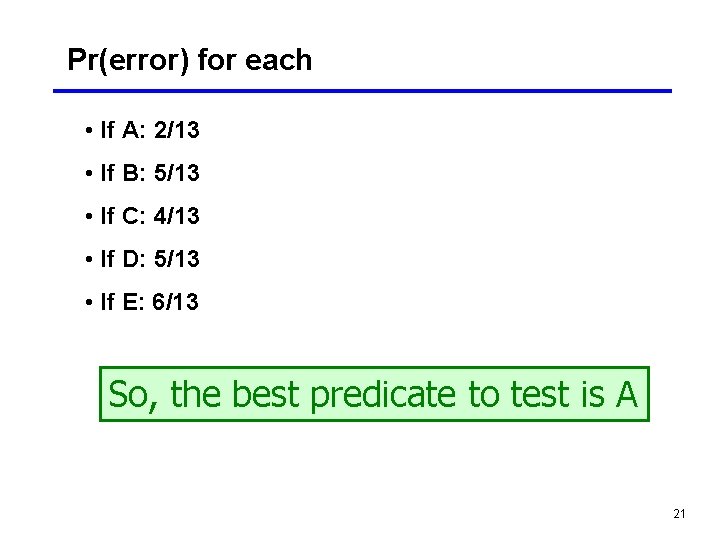
Pr(error) for each • If A: 2/13 • If B: 5/13 • If C: 4/13 • If D: 5/13 • If E: 6/13 So, the best predicate to test is A 21
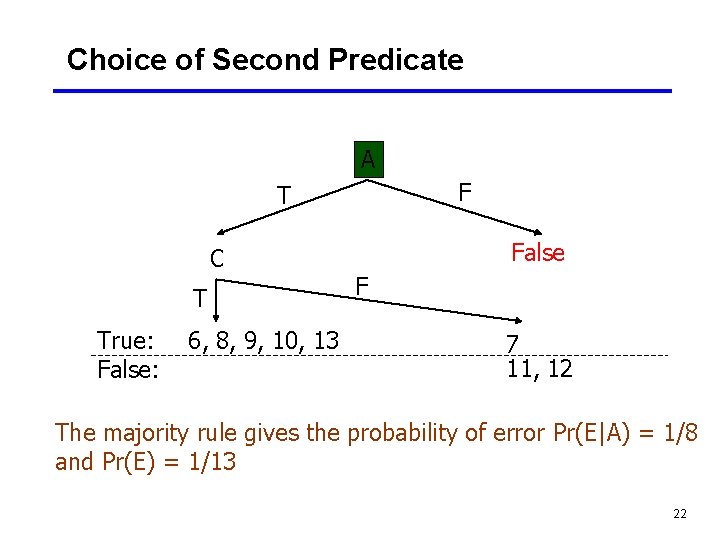
Choice of Second Predicate A F T C T True: False: 6, 8, 9, 10, 13 False F 7 11, 12 The majority rule gives the probability of error Pr(E|A) = 1/8 and Pr(E) = 1/13 22
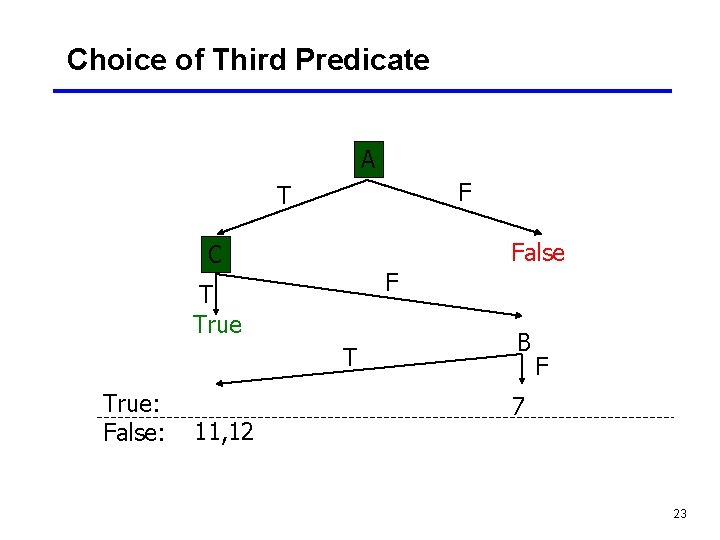
Choice of Third Predicate A F T False C F T True: False: 11, 12 B F 7 23
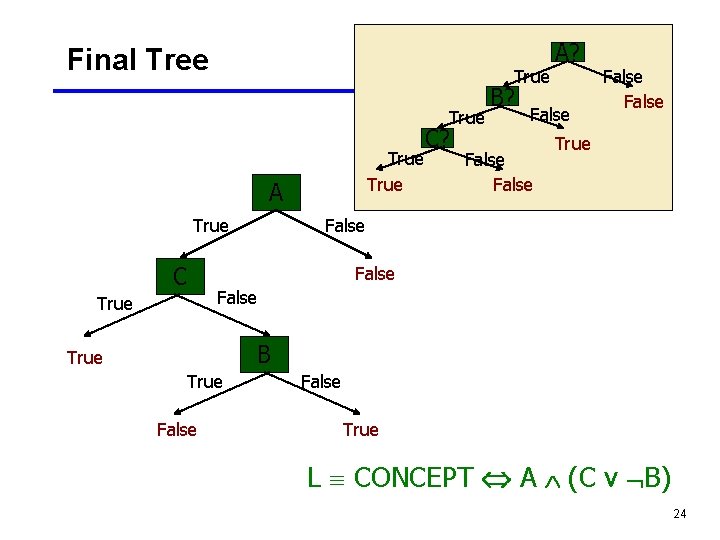
Final Tree True A True C C? B? A? False False True False True B True False True L CONCEPT A (C v B) 24
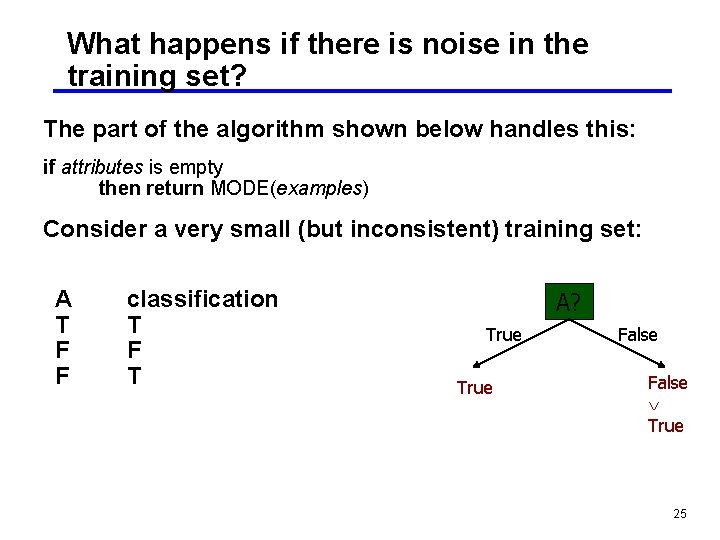
What happens if there is noise in the training set? The part of the algorithm shown below handles this: if attributes is empty then return MODE(examples) Consider a very small (but inconsistent) training set: A T F F classification T F T A? True False True 25
Using Information Theory Rather than minimizing the probability of error, learning procedures try to minimize the expected number of questions needed to decide if an object x satisfies CONCEPT. This minimization is based on a measure of the “quantity of information” that is contained in the truth value of an observable predicate. 26
Issues in learning decision trees • If data for some attribute is missing and is hard to obtain, it might be possible to extrapolate or use “unknown. ” • If some attributes have continuous values, groupings might be used. • If the data set is too large, one might use bagging to select a sample from the training set. Or, one can use boosting to assign a weight showing importance to each instance. Or, one can divide the sample set into subsets and train on one, and test on others. 27
Inductive bias • Usually the space of learning algorithms is very large • Consider learning a classification of bit strings · A classification is simply a subset of all possible bit strings · If there are n bits there are 2^n possible bit strings · If a set has m elements, it has 2^m possible subsets · Therefore there are 2^(2^n) possible classifications (if n=50, larger than the number of molecules in the universe) • We need additional heuristics (assumptions) to restrict the search space 28

Inductive bias (cont’d) • Inductive bias refers to the assumptions that a machine learning algorithm will use during the learning process • One kind of inductive bias is Occams Razor: assume that the simplest consistent hypothesis about the target function is actually the best • Another kind is syntactic bias: assume a pattern defines the class of all matching strings · “nr” for the cards · {0, 1, #} for bit strings 29
Inductive bias (cont’d) • Note that syntactic bias restricts the concepts that can be learned · If we use “nr” for card subsets, “all red cards except King of Diamonds” cannot be learned · If we use {0, 1, #} for bit strings “ 1##0” represents {1110, 1100, 1010, 1000} but a single pattern cannot represent all strings of even parity ( the number of 1 s is even, including zero) • The tradeoff between expressiveness and efficiency is typical 30

Inductive bias (cont’d) • Some representational biases include · Conjunctive bias: restrict learned knowledge to conjunction of literals · Limitations on the number of disjuncts · Feature vectors: tables of observable features · Decision trees · Horn clauses · BBNs • There is also work on programs that change their bias in response to data, but most programs assume a fixed inductive bias 31
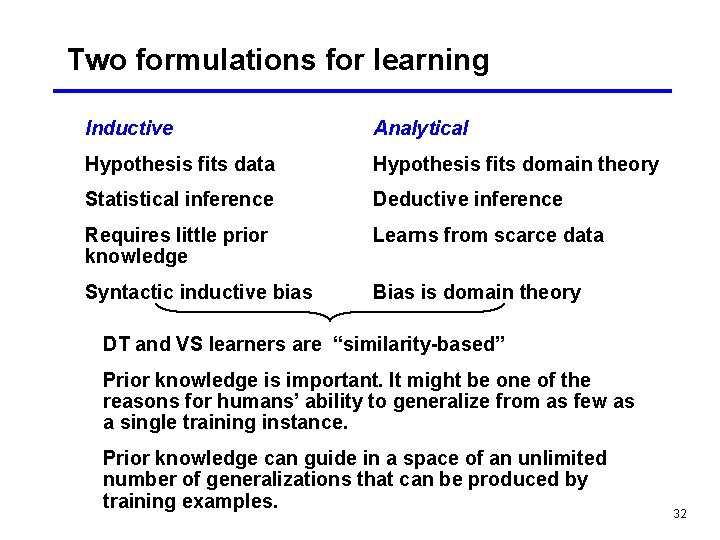
Two formulations for learning Inductive Analytical Hypothesis fits data Hypothesis fits domain theory Statistical inference Deductive inference Requires little prior knowledge Learns from scarce data Syntactic inductive bias Bias is domain theory DT and VS learners are “similarity-based” Prior knowledge is important. It might be one of the reasons for humans’ ability to generalize from as few as a single training instance. Prior knowledge can guide in a space of an unlimited number of generalizations that can be produced by training examples. 32
An example: META-DENDRAL • Learns rules for DENDRAL • Remember that DENDRAL infers structure of organic molecules from their chemical formula and mass spectrographic data. • Meta-DENDRAL constructs an explanation of the site of a cleavage using · structure of a known compound · mass and relative abundance of the fragments produced by spectrography · a “half-order” theory (e. g. , double and triple bonds do not break; only fragments larger than two carbon atoms show up in the data) • These explanations are used as examples for constructing general rules 33
- Slides: 33