
Chapter 18 Human Activities the Ecosystem The effect
- Slides: 42
Chapter 18 Human Activities & the Ecosystem
The effect of human activities on the environment is proportional to the size of the human population. The size of the human population has been rising exponentially because of the intensive forms of food production and the better medical care.
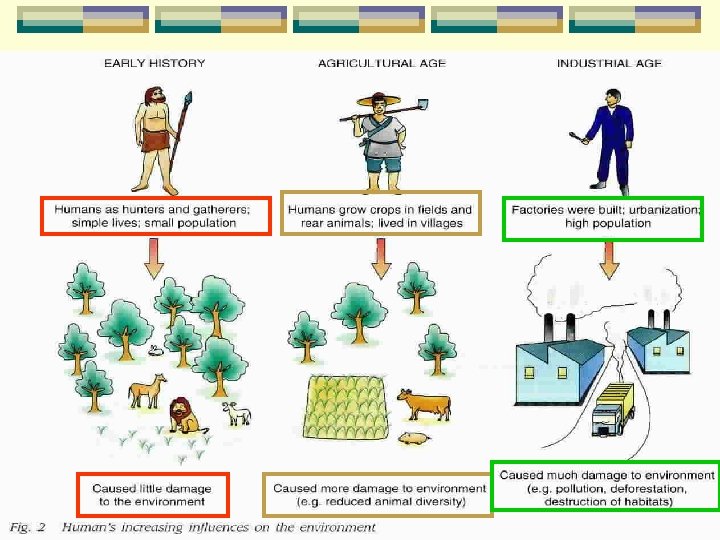
18. 1 The Impact of Pre-industrial Man on The Environment 18. 1. 1 Humans as Hunter Pre-industrial man did not have a great impact on his environment as a hunter. The natural environment recovered quickly with accidental burning of forests or created grasslands.
18. 1. 2 Humans as Shepherd Man domesticated animals such as sheep, cattle, goats, etc. Large herds would overgraze soil and led to erosion, e. g. in the Mediterranean & Near East, may have contributed to the development of many of the deserts.
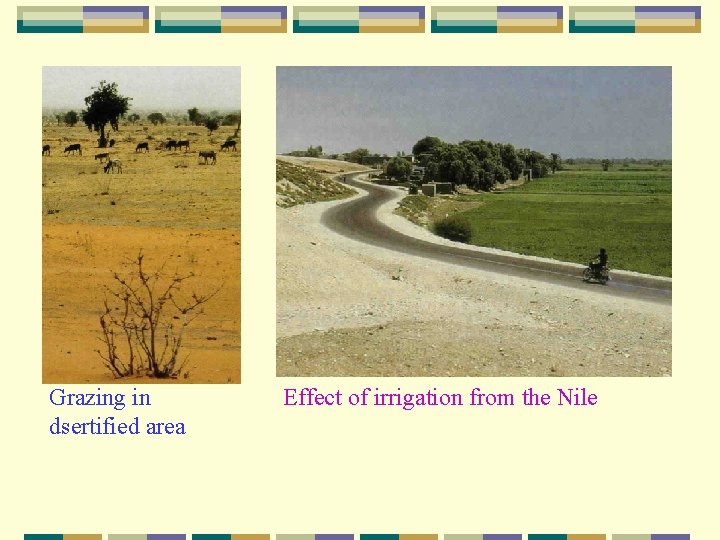
Grazing in dsertified area Effect of irrigation from the Nile
18. 1. 2 Humans as Shepherd Man domesticated animals such as sheep, cattle, goats, etc. Large herds would overgraze soil and led to erosion, e. g. in the Mediterranean & Near East, may have contributed to the development of many of the deserts. Domestication also led to the extinction of their wild ancestors.
18. 1. 3 Humans as Farmer As the farmer, man settled down. He built shelters for himself & his animals, place to store his crops. Man cleared forests for these purposes. Soil fertility exhausted when he cultivated the same crops of years on the same piece of land.
18. 2 Exploitation of Natural Resources With the industrial revolution, machines enabled more food production and a larger population with exponential rise, together with reasons like better fertilizers, better crops and pesticides. Man is dependent for his survival on the earth's resources: renewable and non-renewable.
18. 2. 1 Renewable Resources Renewable resources can be replaced. They are things which grow, and are materials based on plants and animals. Sustainable yield: the amount that is removed (yield) is equal, or less than, the rate of production. Over-fishing: when sustainable yields have exceeded the reproductive rates of fish
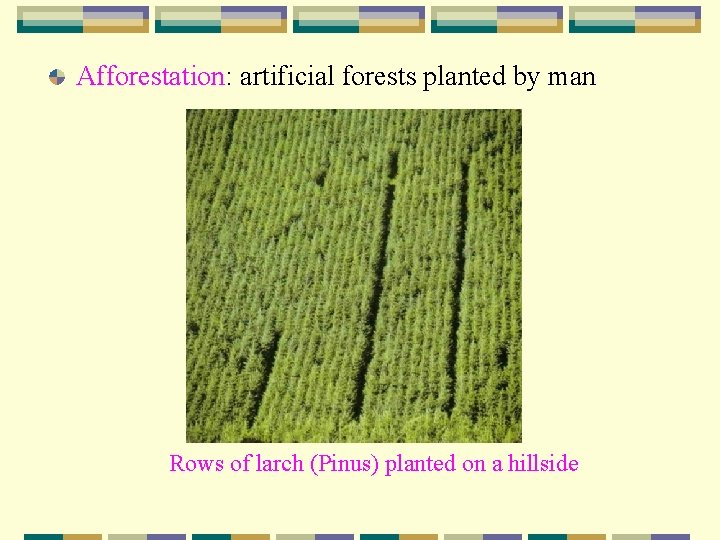
Afforestation: artificial forests planted by man Rows of larch (Pinus) planted on a hillside
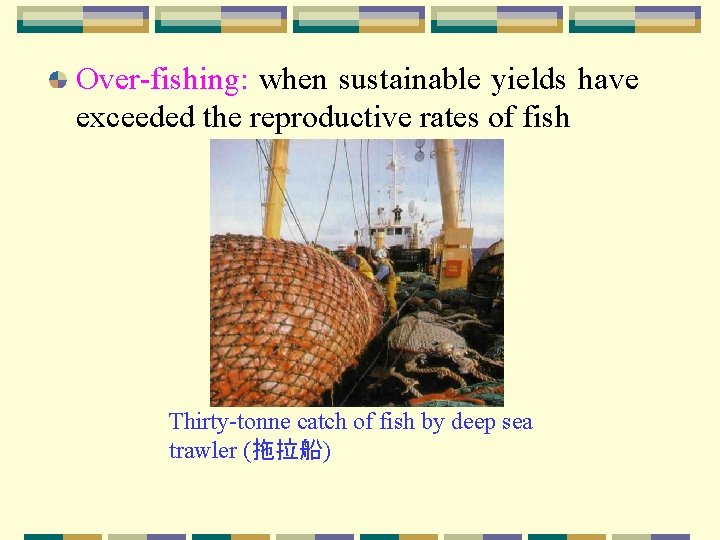
Over-fishing: when sustainable yields have exceeded the reproductive rates of fish Thirty-tonne catch of fish by deep sea trawler (拖拉船)
18. 2. 2 Non-renewable Resources Non-renewable resources are not replaced as they are used, examples: minerals (iron) and fuels (coal & oil) Metals can be recycled but impractical because: 1. Metals are easily oxidized, e. g. iron rust 2. Quantities of a metal within a material are too little to recover it for recycle, e. g. tin layer over most metal cans 3. Alloys are often difficult to separate; labour costs of separation is too high
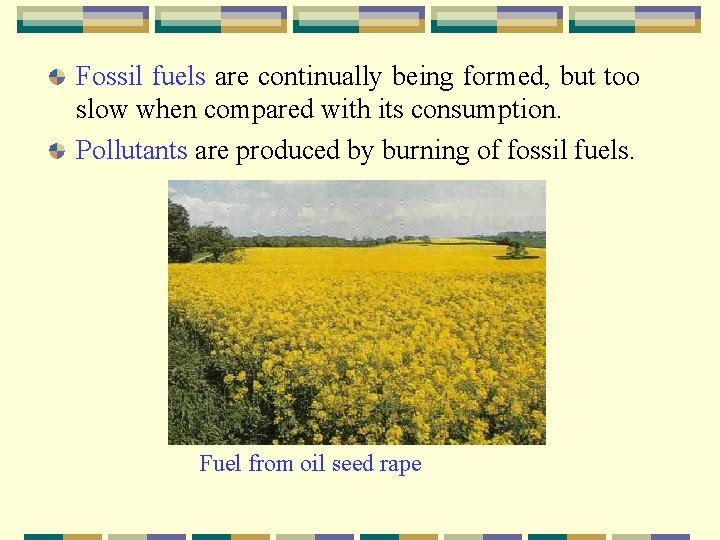
Fossil fuels are continually being formed, but too slow when compared with its consumption. Pollutants are produced by burning of fossil fuels. Fuel from oil seed rape
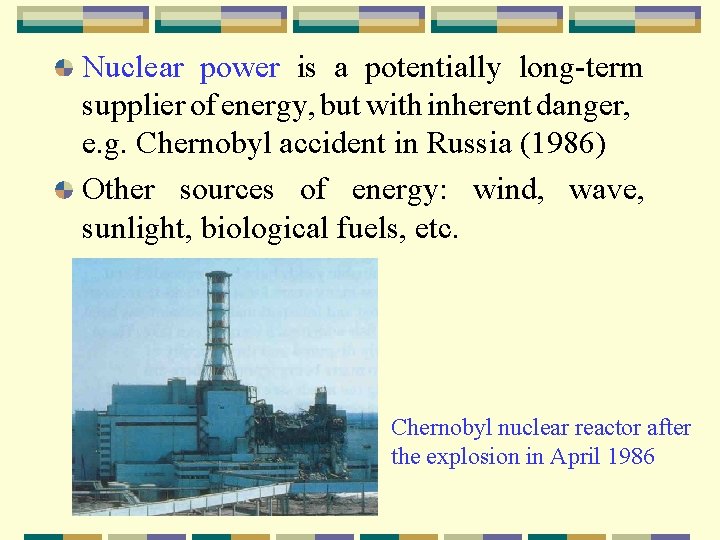
Nuclear power is a potentially long-term supplier of energy, but with inherent danger, e. g. Chernobyl accident in Russia (1986) Other sources of energy: wind, wave, sunlight, biological fuels, etc. Chernobyl nuclear reactor after the explosion in April 1986
Examples of biological fuels: 1. Cellulose from photosynthesis 2. Gasohol programme in Brazil 3. Animal manure 4. Human sewage 5. Domestic & industrial wastes
18. 3 Pollution is the harmful effect of human activities on the natural environment which make air, water and land impure. It may result from substances produced as industrial, agricultural or domestic wastes. It may also arise from some form of energy such as heat and sound. Substances that cause pollution are called pollutants.
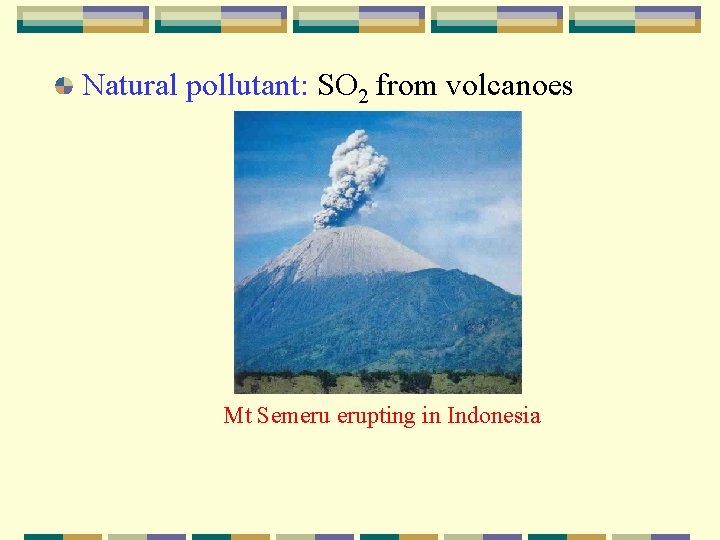
Natural pollutant: SO 2 from volcanoes Mt Semeru erupting in Indonesia
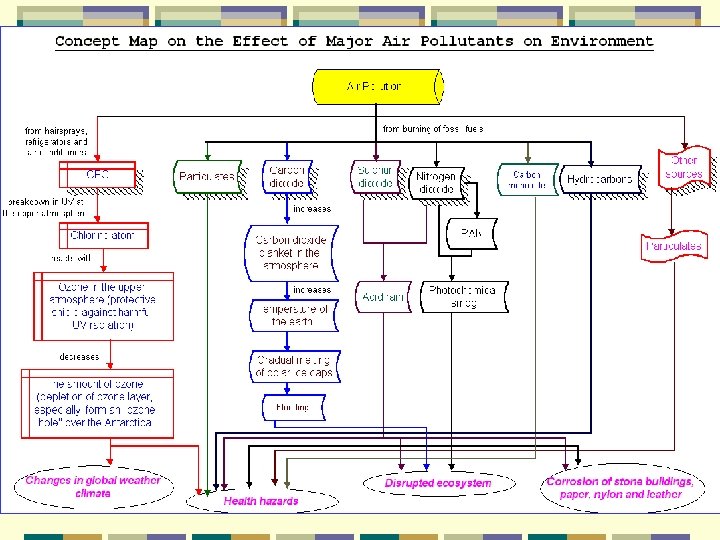
18. 4 Air Pollution - car exhausts, smokes from burning of fuels; Pollutants: carbon monoxide, carbon dioxide, oxides of nitrogen & sulphur and particles such as carbon & dust
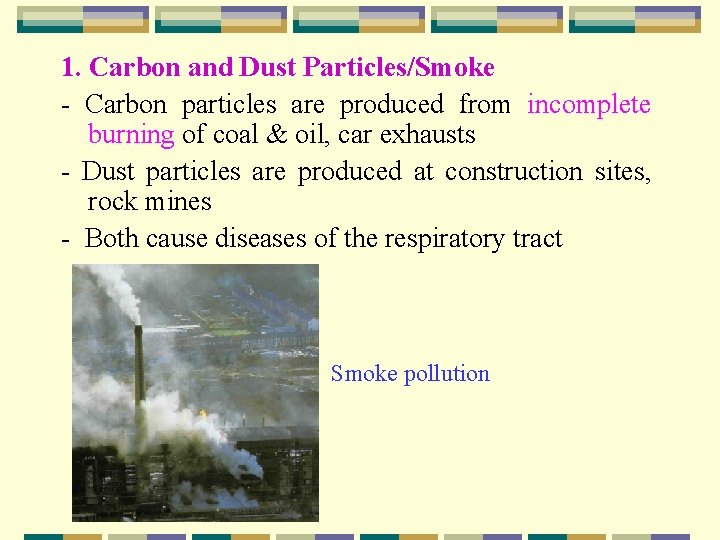
1. Carbon and Dust Particles/Smoke - Carbon particles are produced from incomplete burning of coal & oil, car exhausts - Dust particles are produced at construction sites, rock mines - Both cause diseases of the respiratory tract Smoke pollution
2. Sulphur Dioxide and Oxides of Nitrogen - acidic gases which form strong acids which are corrosive to stone buildings, - harmful to crops & irritating to man
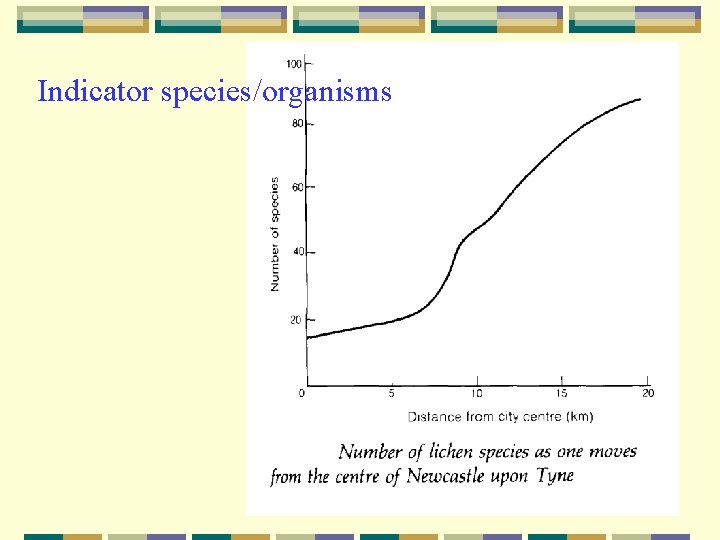
Indicator species/organisms
Indicator species/organisms: The tolerance of lichen & moss species to SO 2 is very variable and is useful for measuring SO 2 pollution. As one moves from the centre of a major industrial city, the number of species of lichen & moss increases. In the centre only the most tolerant species are found, whereas on the outskirts less tolerant ones also occur.
3. Carbon dioxide - 'Green house effect' 4. Carbon Monoxide - comes from incomplete burning of oil & fuels; - a highly toxic gas 5. Lead - Lead compounds are added to petrol to improve its combustion - 80% of lead in air - Lead causes impaired mental development in children
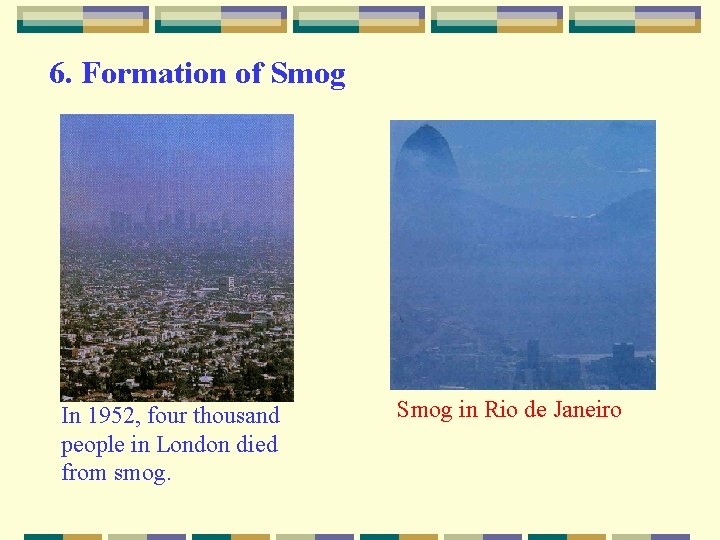
6. Formation of Smog In 1952, four thousand people in London died from smog. Smog in Rio de Janeiro
7. Ozone depletion and the greenhouse effect - by chlorofluorocarbons as propellants in aerosol sprays, in refrigerators and in plastic foams - cause 'green house effect' by CFC's; skin cancer by extra UV radiation in the southern continents
18. 5 Water Pollution 18. 5. 1 Sewage and its disposal Sewage has two main origins: from industry and home Domestic effluent is 95 -99% water, the remainder is organic and acts as food for saprophytic organisms especially bacteria. When oxygen is available, aerobic saprophytes decompose organic matter - putrefaction and uses up oxygen in water. This creates a biochemical oxygen demand (BOD).
Biochemical Oxygen Demand (BOD): - a measure of eutrophication (rich in nutrients) - BOD measures the rate of oxygen depletion by organisms. - It is assumed this primarily reflects microorganism activity in decomposing organic matter present in waters. - Standard measure: the weight of oxygen in milligrams consumed from a decimetre cuboid of sample when stored in darkness for 5 days at 20 o. C.
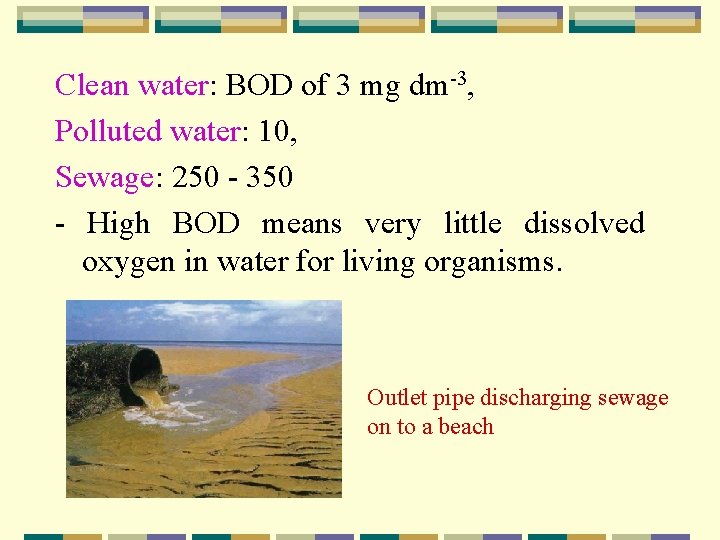
Clean water: BOD of 3 mg dm-3, Polluted water: 10, Sewage: 250 - 350 - High BOD means very little dissolved oxygen in water for living organisms. Outlet pipe discharging sewage on to a beach
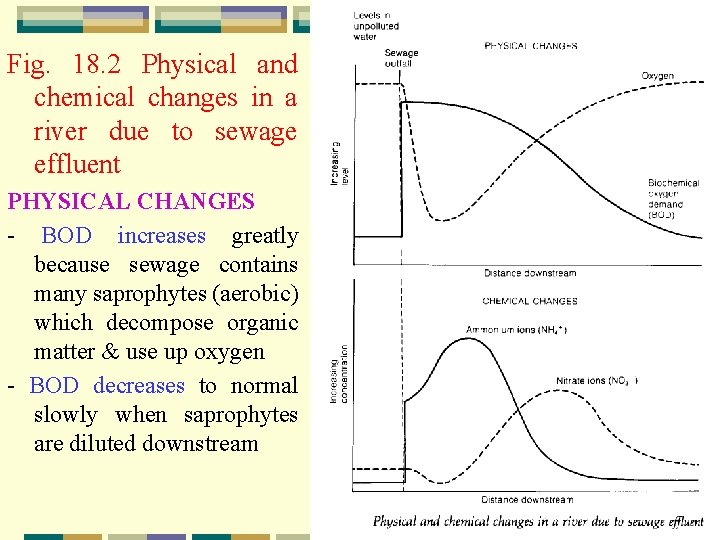
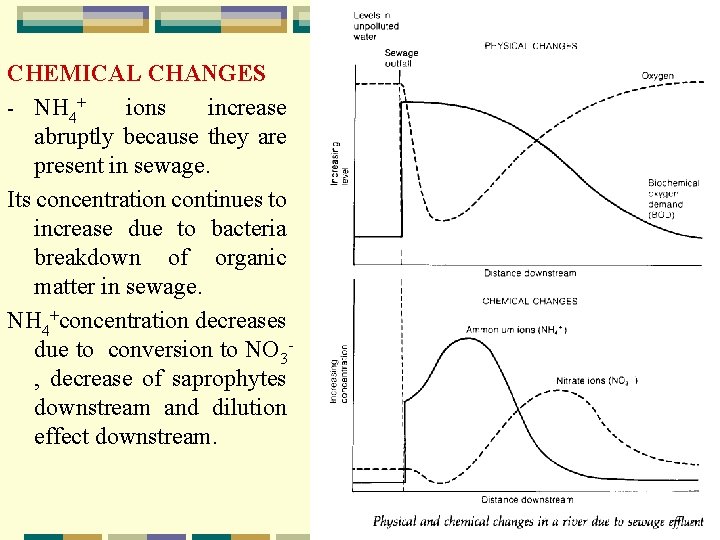
Fig. 18. 2 Physical and chemical changes in a river due to sewage effluent PHYSICAL CHANGES - BOD increases greatly because sewage contains many saprophytes (aerobic) which decompose organic matter & use up oxygen - BOD decreases to normal slowly when saprophytes are diluted downstream
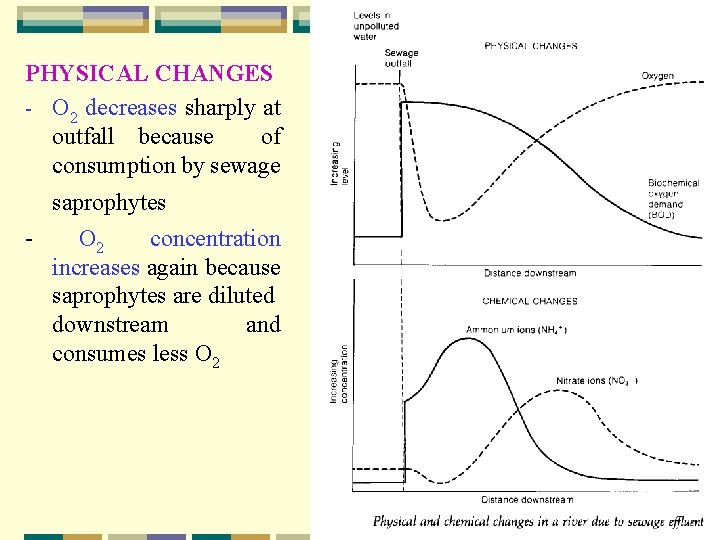
PHYSICAL CHANGES - O 2 decreases sharply at outfall because of consumption by sewage saprophytes - O 2 concentration increases again because saprophytes are diluted downstream and consumes less O 2
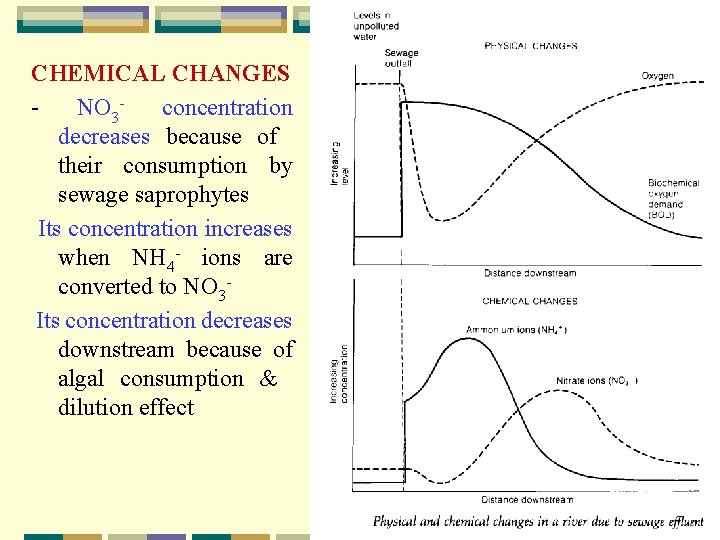
CHEMICAL CHANGES - NH 4+ ions increase abruptly because they are present in sewage. Its concentration continues to increase due to bacteria breakdown of organic matter in sewage. NH 4+concentration decreases due to conversion to NO 3, decrease of saprophytes downstream and dilution effect downstream.
CHEMICAL CHANGES NO 3 concentration decreases because of their consumption by sewage saprophytes Its concentration increases when NH 4 - ions are converted to NO 3 Its concentration decreases downstream because of algal consumption & dilution effect
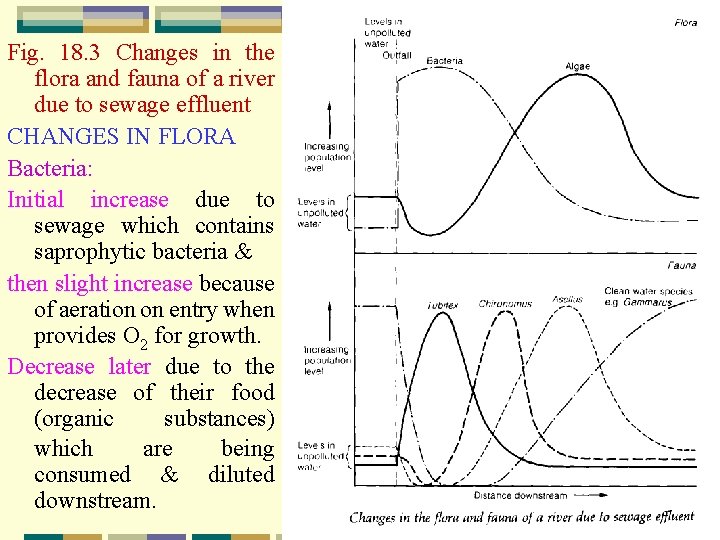
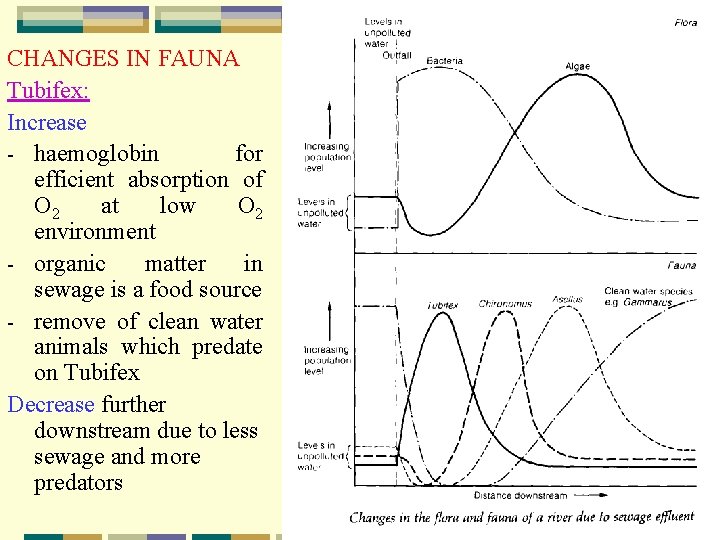
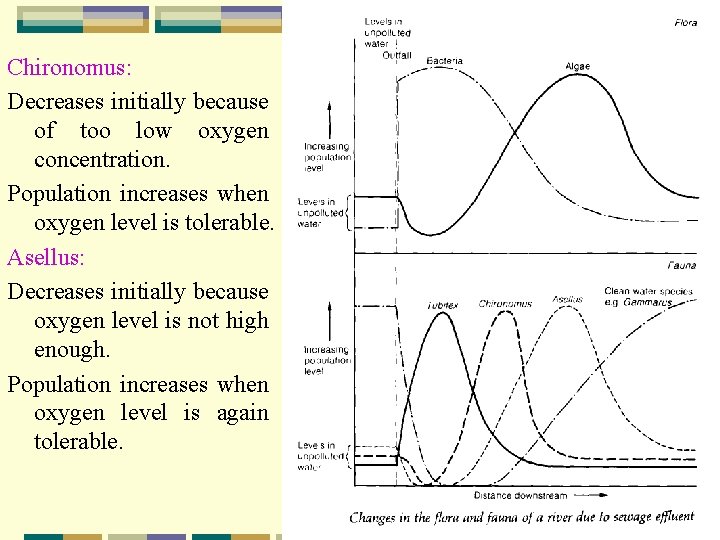
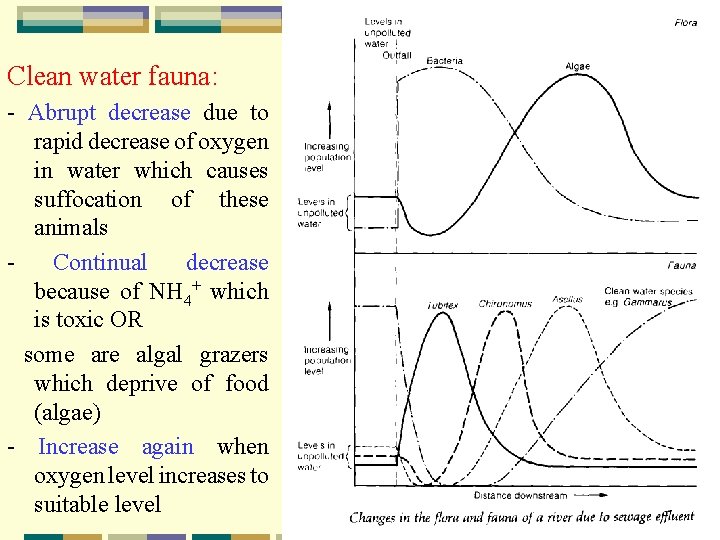
Fig. 18. 3 Changes in the flora and fauna of a river due to sewage effluent CHANGES IN FLORA Bacteria: Initial increase due to sewage which contains saprophytic bacteria & then slight increase because of aeration on entry when provides O 2 for growth. Decrease later due to the decrease of their food (organic substances) which are being consumed & diluted downstream.
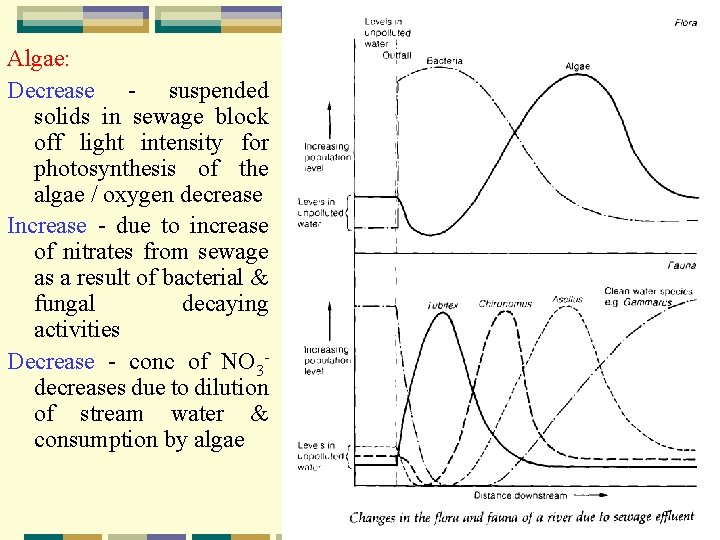
Algae: Decrease - suspended solids in sewage block off light intensity for photosynthesis of the algae / oxygen decrease Increase - due to increase of nitrates from sewage as a result of bacterial & fungal decaying activities Decrease - conc of NO 3 decreases due to dilution of stream water & consumption by algae
CHANGES IN FAUNA Tubifex: Increase - haemoglobin for efficient absorption of O 2 at low O 2 environment - organic matter in sewage is a food source - remove of clean water animals which predate on Tubifex Decrease further downstream due to less sewage and more predators
Chironomus: Decreases initially because of too low oxygen concentration. Population increases when oxygen level is tolerable. Asellus: Decreases initially because oxygen level is not high enough. Population increases when oxygen level is again tolerable.
Clean water fauna: - Abrupt decrease due to rapid decrease of oxygen in water which causes suffocation of these animals Continual decrease because of NH 4+ which is toxic OR some are algal grazers which deprive of food (algae) - Increase again when oxygen level increases to suitable level
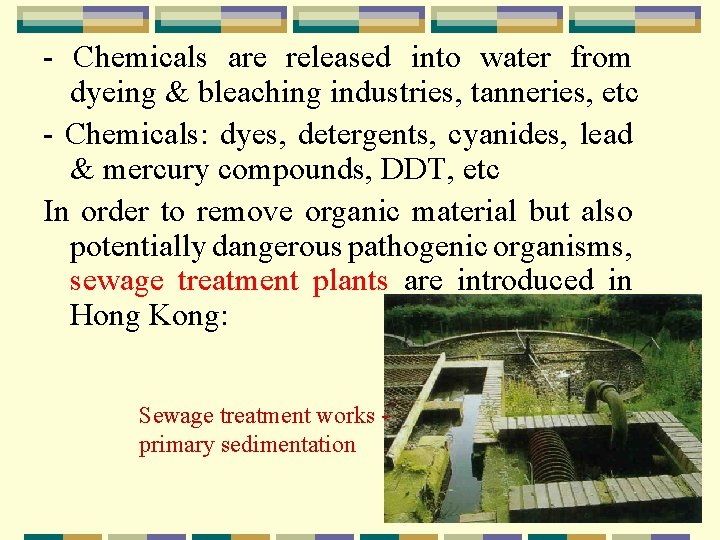
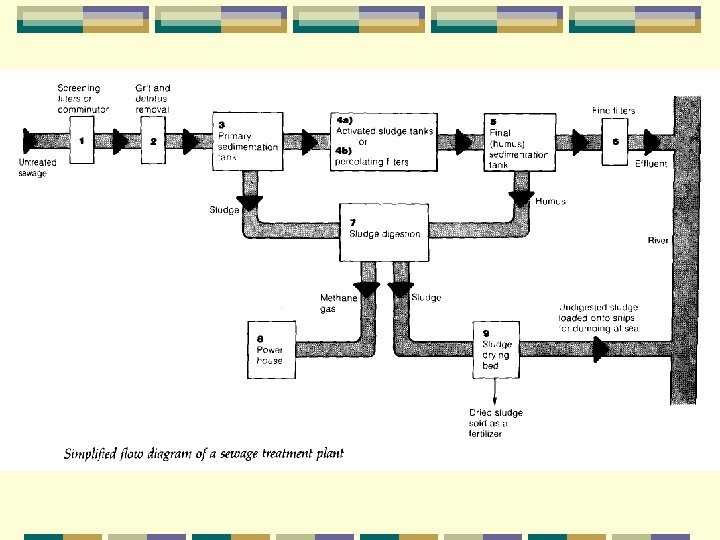
- Chemicals are released into water from dyeing & bleaching industries, tanneries, etc - Chemicals: dyes, detergents, cyanides, lead & mercury compounds, DDT, etc In order to remove organic material but also potentially dangerous pathogenic organisms, sewage treatment plants are introduced in Hong Kong: Sewage treatment works primary sedimentation
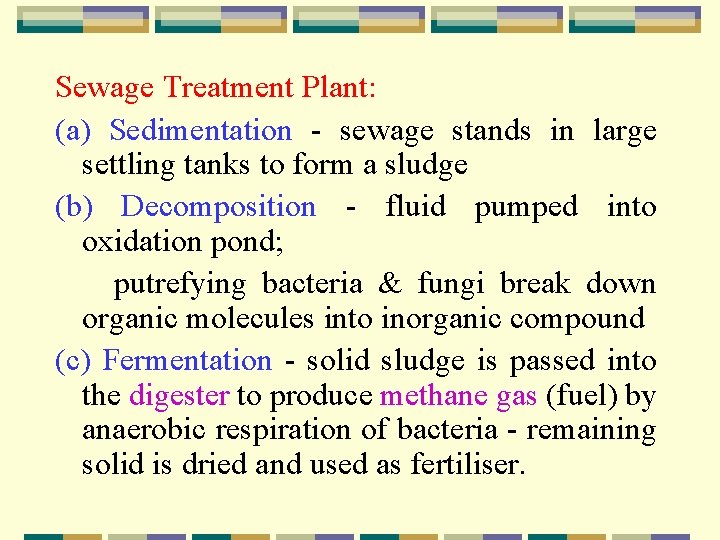
Sewage Treatment Plant: (a) Sedimentation - sewage stands in large settling tanks to form a sludge (b) Decomposition - fluid pumped into oxidation pond; putrefying bacteria & fungi break down organic molecules into inorganic compound (c) Fermentation - solid sludge is passed into the digester to produce methane gas (fuel) by anaerobic respiration of bacteria - remaining solid is dried and used as fertiliser.