
Chapter 18 Generally Accepted Accounting Principles Business entity
Chapter 18 Generally Accepted Accounting Principles
Business entity or simply called entity concept Meaning The business entity concept states that a business is treated as an entity separate from other entities, including its owner(s). It requires that the transactions of an entity be accounted for separately from the transactions of other entities, including those of its owner(s).
Business entity Applications The business entity concept is applicable to any form of business ownership: Ø a sole proprietorship Ø a partnership Ø a small limited company or Ø a large corporation. All independent operations under the same business ownership can be regarded as separate entities.
Business entity Importance The business entity concept sets the boundary for what should be recorded in the books of an entity. It allows us to measure the financial performance and position of each entity independently.
Business entity Importance Because of the entity concept, business owners are not allowed to record in the books of their businesses personal transactions and assets that have nothing to do with business operations. This ensures that the books of a business give an accurate picture of the financial results and condition of the business itself.
Business entity Shortcomings The accounting definition of a separate entity is not as clear-cut as that of the legal definition. Sometimes, it is not easy to define a separate entity, especially when there are several business segments under the same ownership.
Historical cost or simply called cost principle Meaning The historical cost principle states that assets should be valued at their original cost of purchase or cost of production. The valuation of these assets continues to be based on cost rather than current market value.
Historical cost Applications A trading company bought 20 computers of the same model from a computer wholesaler for administrative use. The original selling price was $8, 000 each. However, there was a clearance sale and a trade discount of 20% was given. These computers could be sold for $10, 000 each on the retail market. According to the historical cost principle, in the trading company’s books upon purchase, the computers should be recorded as follows: Unit cost: $6, 400 (=$8, 000 x 80%) Total: $128, 000 (=$6, 400 x 20) The actual cost incurred in acquiring the computers
Historical cost Applications p Other values such as the market value are irrelevant. p Depreciation is to be charged on the basis of the cost of purchase. p The computers are to be stated at cost less accumulated depreciation in the statement of financial position.
Historical cost Importance p The cost principle provides an objective basis for measuring the value of assets. ü Cost is a reliable measure of asset value because it is the exchange price agreed upon by both the buyer and the seller. ü Cost can be verified by objective evidence. Valuation of assets at current market value requires making an estimate which may not be accurate.
Historical cost Shortcomings p Cost is not as relevant to the decision-making needs of users of financial statements as current market value. This is because: ü When assets are recorded at historical cost, their value will likely be understated in periods of market boom while profits will be overstated. ü The opposite will happen in periods of market downturn.
Going concern Meaning Financial statements are normally prepared on the assumption that a business will continue to operate for the foreseeable future. usually regarded as for at least 12 months This assumption does not hold if management intends or needs to close the business or significantly curtail its scale of operations.
Going concern Applications When the going concern assumption is appropriate Assets that are acquired for use within the business rather than for resale should be valued on the basis of historical cost. Inventory is acquired for resale and should therefore be valued at the lower of cost and net realisable value.
Going concern Applications When the going concern assumption is appropriate It is assumed that a business will continue in operation long enough to use its assets for their intended purposes and recover the cost of those assets. Therefore, the current market value of an asset may not be relevant to users of financial statements when they make decisions.
Going concern Applications When the going concern assumption is not appropriate When a business is going to be closed down, its assets will be disposed of in the near future to pay off its liabilities. In this case, current fair value should be used to value the assets. or simply called fair value
Going concern Importance The going concern concept assumes that a business will remain in existence long enough for all of its assets to be fully utilised. It thus allows the classification of assets and liabilities into current and non-current.
Going concern *$10, 000 ÷ 5 = $2, 000 Importance Allowing the classification of assets into current and non-current assets For example, a machine was purchased for $10, 000 at the beginning of a financial year and was expected to be used for five years. Under the going concern assumption, The accountant would only write off one-fifth* of the machine’s cost in that financial year. The remaining $8, 000 would be left as a non-current asset. would provide future economic value to the business
Going concern Importance Allowing the classification of liabilities into current and non-current liabilities p Because the going concern concept assumes that a business will remain in operation and pay its obligations when due. p This classification is useful for evaluating the financial position of a business.
Going concern Importance Allowing the classification of liabilities into current and non-current liabilities p If non-current liabilities make up a large portion of a business’s total equity and liabilities, the business is considered risky. p This is because it must continue to make regular interest payments and repay the principal sums at maturity regardless of whether the business is profitable or not.
Going concern Shortcomings The going concern is not clearly defined as to the determination of a business’s ability to continue as a going concern. Therefore, it is subject to a considerable number of interpretations as to when it should be applied.
Consistency Meaning *i. e. , accounting policy or method in terms of recording and presentation The consistency principle requires that once an *accounting practice has been adopted by a business, it should be followed from period to period. A change is allowed only if the existing accounting practice is no longer appropriate. In this case, users of financial statements should be informed of the change and its effect on the reported figures.
Consistency Meaning A change in accounting practice is justified in either of the following situations: ü When it is apparent that, following a significant change in the nature of the business’s operations or a review of its financial statements, another accounting policy or method would be more appropriate. ü When there is a change in the regulatory framework of financial reporting, such as the Companies Ordinance, the Hong Kong Financial Reporting Standards or Listing Rules of the Stock Exchange of Hong Kong (SEHK), which necessitates a change in accounting policy or method.
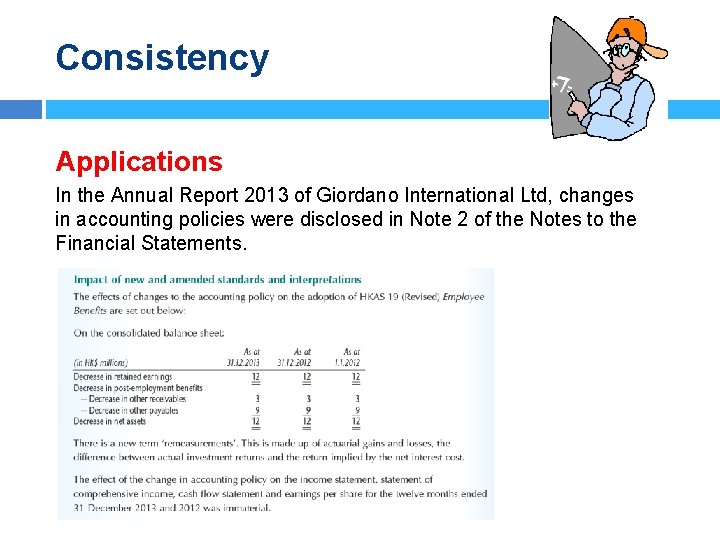
Consistency Applications In the Annual Report 2013 of Giordano International Ltd, changes in accounting policies were disclosed in Note 2 of the Notes to the Financial Statements.
Consistency Importance Helping achieve comparability in financial statements Consistent application of accounting policies and methods helps achieve comparability in financial statements. It is not fair or useful to compare the financial statements of a business in different periods when vastly different accounting policies or methods were adopted during those periods.
Consistency Importance Deterring businesses from manipulating their financial results This can be done by changing to a more favourable but unjustified accounting policy or method.
Consistency Shortcomings A change in accounting policies or methods is allowed if the existing accounting practice is no longer appropriate. This is subject to the judgement of owners or accountants, which may be biased.
Accrual Meaning The accrual concept means that revenues and expenses are recognised in the accounting books when they are earned or incurred, regardless of when the actual cash is received or paid. A revenue item is recognised when: ü all the events that establish the right to receive the revenue have occurred. ü the amount to be received is known with reasonable certainty.
Accrual Meaning p An expense item is recognised when: ü all the events that establish the obligation to pay have occurred. ü the amount to be paid is known with reasonable certainty.
Accrual Meaning p p Therefore, the relevant revenue or expense is recognised whether or not cash has been received or paid when a business: ü delivers goods to a customer, ü performs a service, or ü consumes resources provided by others. This is very different from the cash basis of accounting, where revenues and expenses are recognised when the actual cash is received or paid.
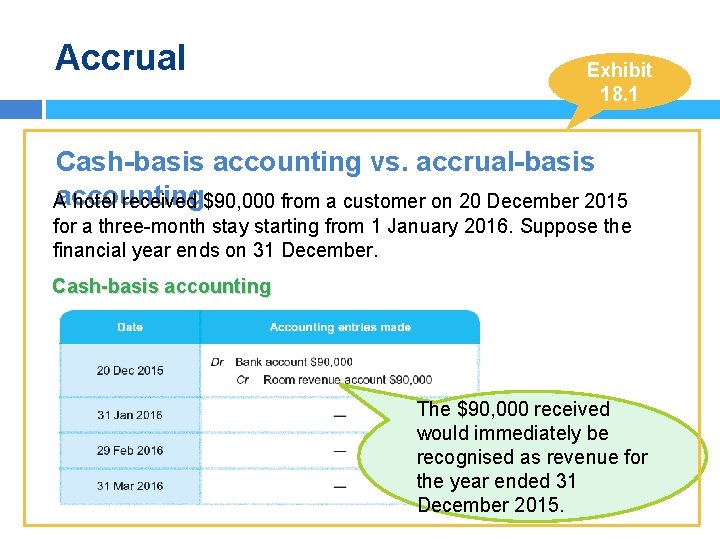
Accrual Exhibit 18. 1 Cash-basis accounting vs. accrual-basis accounting A hotel received $90, 000 from a customer on 20 December 2015 for a three-month stay starting from 1 January 2016. Suppose the financial year ends on 31 December. Cash-basis accounting The $90, 000 received would immediately be recognised as revenue for the year ended 31 December 2015.
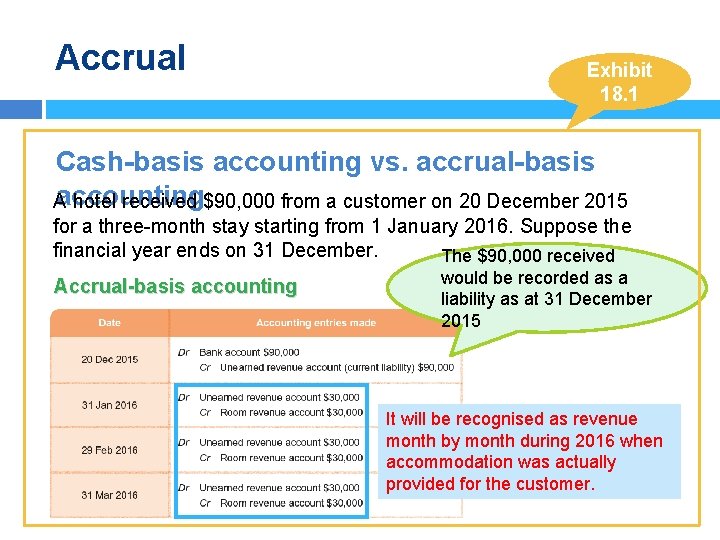
Accrual Exhibit 18. 1 Cash-basis accounting vs. accrual-basis accounting A hotel received $90, 000 from a customer on 20 December 2015 for a three-month stay starting from 1 January 2016. Suppose the financial year ends on 31 December. The $90, 000 received Accrual-basis accounting would be recorded as a liability as at 31 December 2015 It will be recognised as revenue month by month during 2016 when accommodation was actually provided for the customer.
Accrual Importance p Without the use of accrual accounting, only cash transactions are reflected in financial statements. p But cash transactions do not give information about other important business activities. such as goods purchased and sold on credit, future rights and obligations
Accrual Importance p By using the accrual concept, a business can measure what it has to pay and what it expects to receive in future. p This is why the accrual basis of accounting is more commonly used in business than cash-basis accounting.
Accrual Shortcomings p Although accrual-basis accounting provides a more accurate picture of the current condition of a business, its relative complexity makes it more costly to implement.
Accrual Shortcomings p Recording revenues before receiving payments can potentially misrepresent a firm’s financial results and lead to financial difficulties. p For example, a firm that sells substantial amounts of goods on credit may report a large profit for the current accounting period. p However, if a considerable number of trade debtors fail to pay for the goods, future earnings are likely to suffer. p The firm may be tempted to commit itself to spending a great deal of money in view of the large profit.
Realisation e nu e ev r ed ition l l ca ogn o Als rec Meaning The process of determining when revenue is earned is called realisation. Once revenue is recognised, it should be recorded in the books. Under the realisation principle, three conditions must be met before revenue is recorded: ü The seller has completed a sale or performed a service. ü The amount of revenue can be objectively determined. ü Collectibility is reasonably assured.
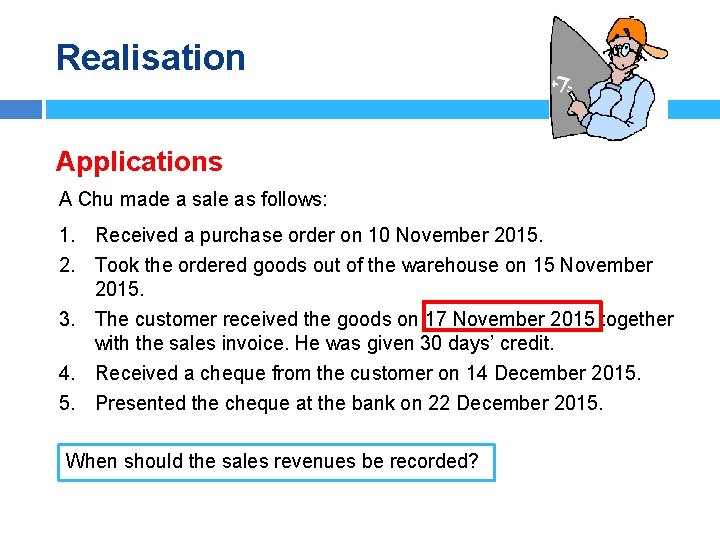
Realisation Applications A Chu made a sale as follows: 1. Received a purchase order on 10 November 2015. 2. Took the ordered goods out of the warehouse on 15 November 2015. 3. The customer received the goods on 17 November 2015 together with the sales invoice. He was given 30 days’ credit. 4. Received a cheque from the customer on 14 December 2015. 5. Presented the cheque at the bank on 22 December 2015. When should the sales revenues be recorded?
Realisation Applications According to the realisation principle, the sales revenue should be recognised on 17 November 2015. Because: ü This was the date when the goods were delivered and accepted by the customer (Condition 1). ü The sales amount was ascertained from the sales invoice (Condition 2). ü Payment would be made within the credit period under normal circumstances (Condition 3).
Realisation Applications *A payment method by which the buyer agrees to pay for the goods in regular instalments within a specific period of time. In some cases, goods have been delivered and the sales amount has been ascertained but collectibility is not reasonably assured. This usually happens with goods sold on *hire purchase basis. Profit on hire purchase sales should then be recognised when instalment payments are received. In other cases, the sales amount has been ascertained and cash has been received but the goods or services have not been delivered or provided.
Realisation Importance The realisation principle governs the recording of revenues. It affects the determination of profits for an accounting period.
Realisation Shortcomings Situations may arise in which the timing of revenue recognition cannot be easily determined. For example, the construction of a bridge or a road often extends over several years. The construction company must decide the appropriate time to recognise revenue, which may be subject to bias and errors in the estimation.
Matching Meaning p The matching concept is the basis for the recognition and recording of expenses. p This concept goes hand in hand with the realisation principle that governs the recognition of revenues.
Matching Meaning p For a given accounting period, a business would first measure its revenues by the realisation principle. p The matching concept then requires the business to identify and record all the expenses incurred in earning those revenues over that period.
Matching Applications p Some expenses can easily be matched with specific revenues. Examples are: ü Cost of goods sold: It should only relate to the goods sold in the current period and exclude the cost of goods purchased but not yet sold.
Matching Applications p Some expenses can easily be matched with specific revenues. Examples are: ü Commissions: A firm that pays commissions to its sales team would match sales commissions with sales revenues. For example, a firm whose financial year ends on 31 December completed a sale in December 2014 but paid the commissions in January 2015. Because of the matching concept, the sales commissions paid in January 2015 should be recognised as expenses in 2014.
Matching Applications p When there is no direct way to link revenues with specific expenses, accountants usually match these expenses with revenues on a time basis. For example, a building may be used for 40 years. One-fortieth of the building’s cost would be written off as depreciation each year, whatever the level of revenue.
Matching Importance p The matching concept governs the recording of expenses. p Like the realisation principle, it affects the determination of profits for an accounting period.
Matching Shortcomings p It is not easy to match certain expenses with specific revenues. p They are often charged on an arbitrary basis determined by accountants, which may be considered subjective.
Prudence Meaning Also called conservatism p The prudence concept requires that caution be used in the exercise of judgements needed when making estimates under uncertain conditions. p This is to ensure that: ü assets or revenues are not overstated. ü liabilities or expenses are not understated.
Prudence Applications p The use of the lower of cost and net realisable value method for inventory valuation. p Under this method, inventory is valued at cost or market value, whichever is lower. This results in a higher cost of goods sold and a lower net profit. i. e. , net realisable value
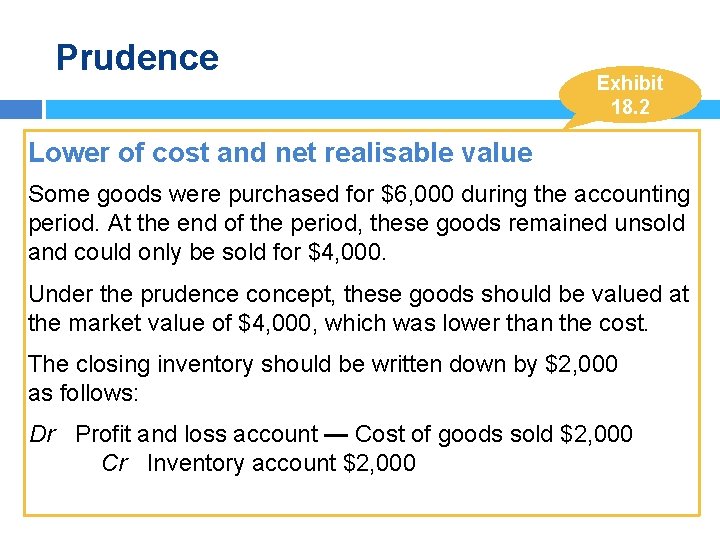
Prudence Exhibit 18. 2 Lower of cost and net realisable value Some goods were purchased for $6, 000 during the accounting period. At the end of the period, these goods remained unsold and could only be sold for $4, 000. Under the prudence concept, these goods should be valued at the market value of $4, 000, which was lower than the cost. The closing inventory should be written down by $2, 000 as follows: Dr Profit and loss account — Cost of goods sold $2, 000 Cr Inventory account $2, 000
Prudence Importance p In reality, management tends to be optimistic about the financial outcomes of a business. The prudence concept acts as a safeguard against over-optimism on the part of management. p Financial statements prepared on the basis of overly optimistic assumptions will cause more harm to users than those prepared on the basis of overly pessimistic assumptions.
Prudence Shortcomings p The prudence concept sometimes conflicts with the historical cost principle. When the market value of an inventory item is lower than its cost, that item is to be valued at market value instead of cost.
Prudence Shortcomings p Sometimes, the exercise of prudence may be abused, leading to the deliberate understatement of assets or revenues, or the deliberate overstatement of liabilities or expenses. For example, a non-current asset of a business is expensed in the period of purchase in order to understate the net profit and assets for that period.
Materiality Meaning p The relevance of information for decision making is affected by its materiality. p The term materiality refers to the relative importance of an item. p An item of information is material if its omission or misstatement could influence decisions made by users on the basis of the financial statements. p All material items should be treated and reported separately.
Materiality Applications p The materiality of an item is usually determined by relating its dollar value to a key figure in the financial statements, such as sales or total assets.
Materiality Applications p Example 1: ü A company may decide that any single expenditure on durable items that represents less than 1% of total assets should be treated as an expense and not as a purchase of non-current assets. ü In this case, depreciation would not be needed. This example shows that the materiality of an item is sometimes determined by its relative value.
Materiality Applications p Example 2: ü A clerical error of $10, 000 in the recording of an item may not be material for a large company. ü But the discovery of a $10, 000 bribe can have grave consequences and is considered material. This shows that the materiality of an item is sometimes determined by its nature instead of value.
Materiality Importance p The materiality principle frees accountants from having to compute and report every item in strict accordance with generally accepted accounting principles. Thus, it ü reduces administrative costs. ü reduces the time users have to spend on reading financial statements.
Materiality Shortcomings p There is no standard for materiality. The materiality limit is set by the business itself. p Businesses of different sizes and nature will have different standards as to what is material. p This may create problems in comparing the financial statements of different businesses whose materiality limits are quite different.
Objectivity Meaning p The objectivity principle requires that accounting information be based on facts and be verifiable. p When situations arise that require the exercise of personal judgement, accountants should follow generally accepted accounting practices without bias.
Objectivity Applications G Tam, the major shareholder of a company, wanted to put one of his buildings into the company for business use. p He believed the building was worth $220 million. p To confirm his valuation, G Tam hired two professional surveyors who appraised the building at $200 million. Which value, $220 million or $200 million, is a more objective measure?
Objectivity Applications The surveyors’ appraised value of $200 million is a more objective measure. Because the surveyor’s valuation is supported by verifiable facts and is not biased towards a particular group. The company should therefore record the value of the building at $200 million.
Objectivity Importance p Without the objectivity principle, accounting information would be biased and cannot be relied upon by users.
Objectivity Shortcomings p The objectivity principle sometimes conflicts with the relevance of information for decision making. p For example, historical cost is regarded as an objective measure of the value of assets. However, it is not as relevant as current market value in evaluating the current and future financial results of a business.
Timeliness Meaning p To be relevant, accounting information must be timely. It should be provided soon after the occurrence of an event.
Timeliness Applications p According to the Listing Rules of the SEHK, companies listed on the Main Board are required to ü publish their annual financial results within three months after the end of the financial year. ü publish the half-year results within two months after the end of the half-year period.
Timeliness Importance p Financial statements prepared on a timely basis provide relevant and useful information for users.
Timeliness Shortcomings p Management needs to strike a balance between timely reporting and the provision of reliable information.
Money Measurement Also called quantifiability Meaning p The money measurement concept states that transactions and events are recorded in monetary terms. p Items that cannot be objectively measured in monetary terms should not be recorded.
Money Measurement Applications p The cost of goods produced or sold can be objectively measured in monetary terms but their quality cannot. This information should not be shown in the accounting books.
Money Measurement Importance p Money is the only factor that is common to all business transactions. p Thus, it is the only practical unit of measure that can produce comparable accounting information.
Money Measurement Shortcomings p A great deal of important information about a business is not provided in its financial statements, such as ü the quality of its management ü staff morale ü relationships with customers and suppliers. This is because these information cannot be objectively measured in monetary terms.
Three common types of questions on accounting concepts or principles Learning Tips Type 1 Questions To explain accounting concepts or principles and provide examples of their applications. Type 2 Questions To state the accounting concept or principle that has been applied or violated in a given accounting scenario and give an explanation. Type 3 Questions To identify the incorrect accounting treatment in a given scenario and suggest a correct treatment based on a relevant accounting concept or principle.
Three common types of questions on accounting concepts or principles Learning Tips Hint To gain high marks in public examinations, candidates should not only memorise the meaning of each accounting concept or principle. They should be able to apply such concepts or principles to different accounting scenarios.
- Slides: 75