
Chapter 18 Forensic Footwear Evidence 1 What information


- Slides: 19
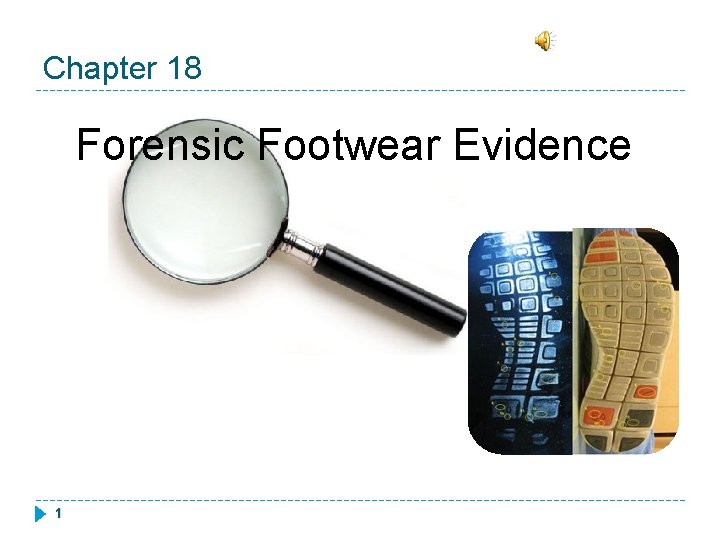
Chapter 18 Forensic Footwear Evidence 1
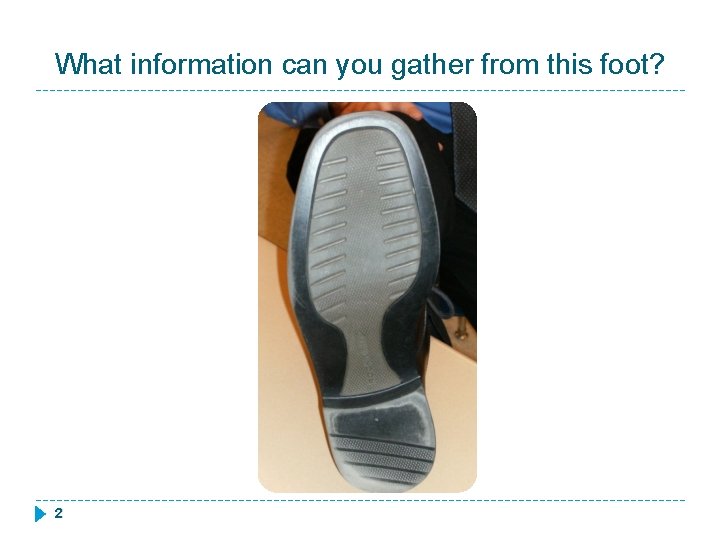
What information can you gather from this foot? 2
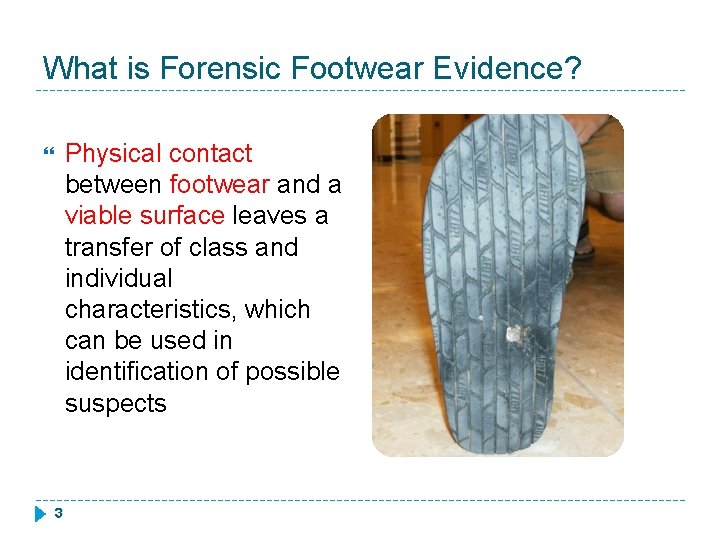
What is Forensic Footwear Evidence? Physical contact between footwear and a viable surface leaves a transfer of class and individual characteristics, which can be used in identification of possible suspects 3
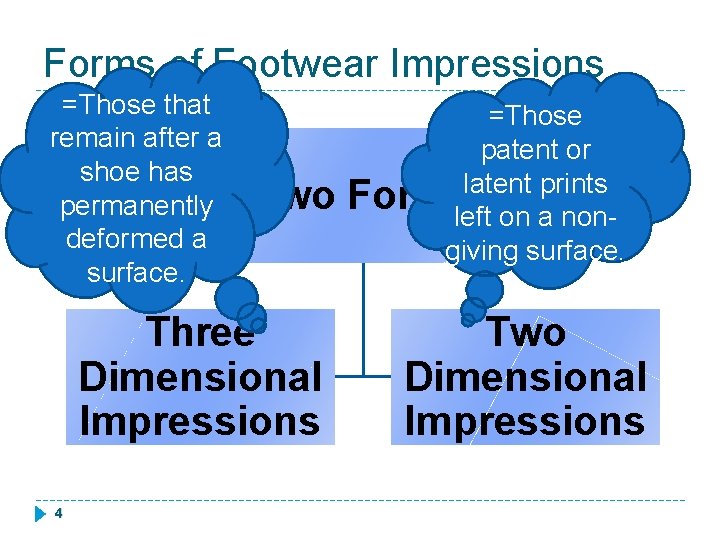
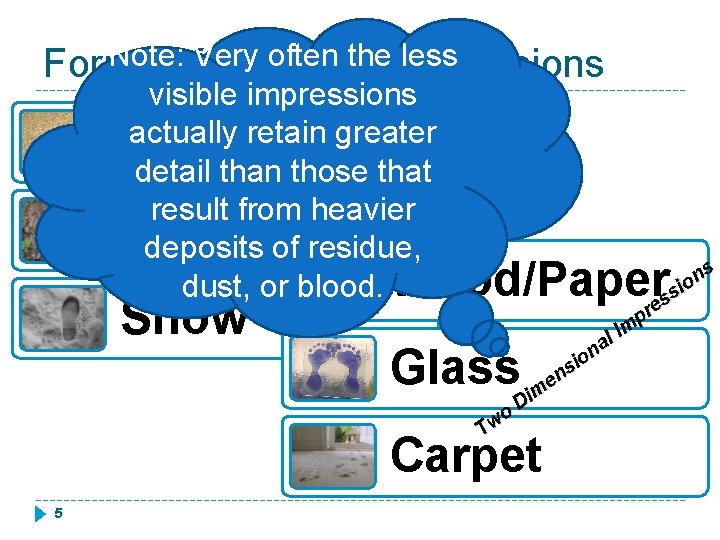
Forms of Footwear Impressions =Those that remain after a shoe has permanently deformed a surface. =Those patent or latent prints Two Formsleft on a nongiving surface. Three Dimensional Impressions 4 Two Dimensional Impressions
Note: often the. Impressions less Forms of. Very Footwear visible impressions s n actually retain greater io s Sand es r p that detail than those m I l a n heavier o result from i ns e Mud im of residue, deposits D s ee n r o h or blood. Wood/Paperssi Tdust, Snow e pr Im l a n io s en m Di Glass o w T Carpet 5
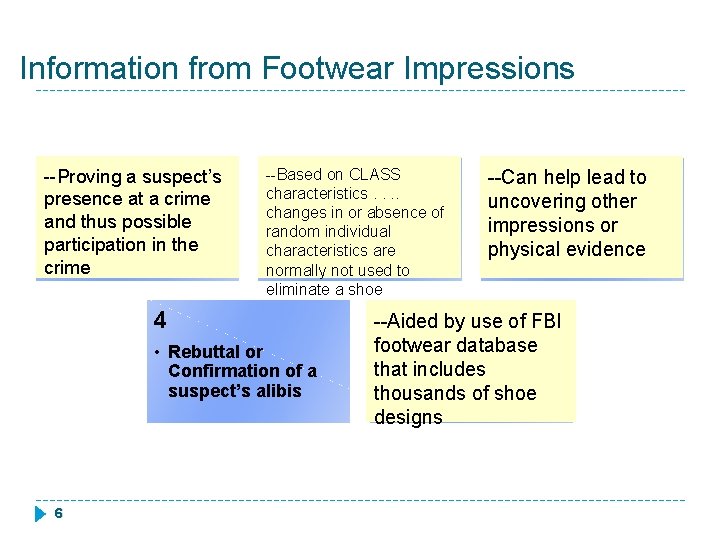
Information from Footwear Impressions --Proving a suspect’s 1 presence at a crime • Positive ID of and thus possible footwear participation in the crime --Based on CLASS 2 characteristics. . • changes Elimination of in or absence of Footwear random individual characteristics are normally not used to eliminate a shoe 4 • Rebuttal or Confirmation of a suspect’s alibis 6 --Can help lead to 3 uncovering other • Location of impressions or Impressions and association with physical evidence other evidence 5 --Aided by use of FBI footwear database • Determination of that includes shoe brand/manufacturer thousands of shoe designs
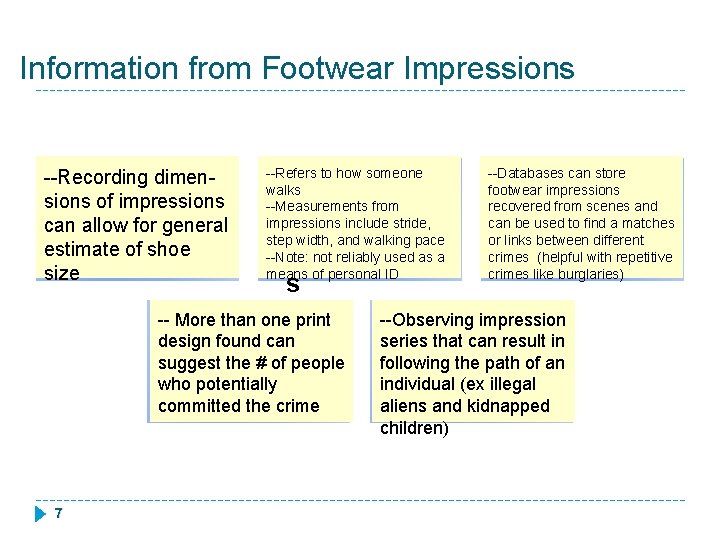
Information from Footwear Impressions --Recording dimen 6 sions of impressions can allow for general Determination of shoe size estimate of shoe size 7 --Refers to how someone walks --Measurements from impressions include stride, step width, and walking pace --Note: not reliably used as a means of personal ID 7 • Gait characteristic s --Databases can store footwear impressions recovered from scenes and can be used to find a matches or links between different crimes (helpful with repetitive crimes like burglaries) 8 • Linking of crime scenes -- More than one print 9 design found can --Observing impression 10 series that can result in the # of people • suggest Number of who potentially perpetrators committed the crime the path of an • following Tracking individual (ex illegal aliens and kidnapped children)
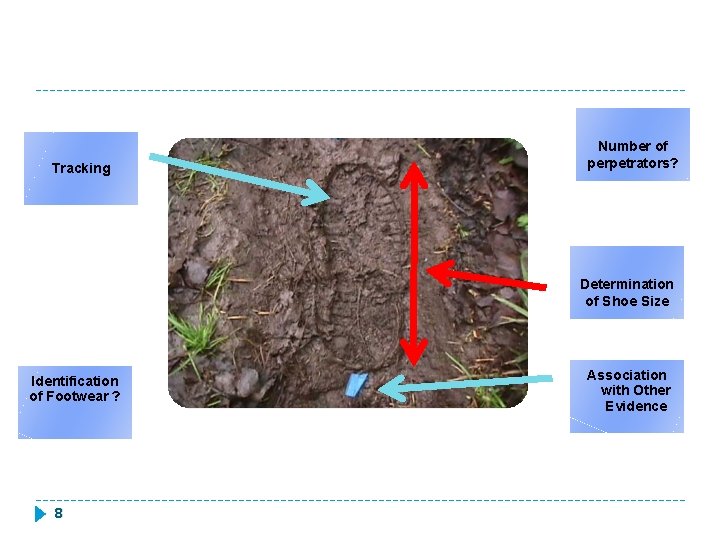
Tracking Number of perpetrators? Determination of Shoe Size Identification of Footwear ? 8 Association with Other Evidence
Video 9 Duration~1: 28
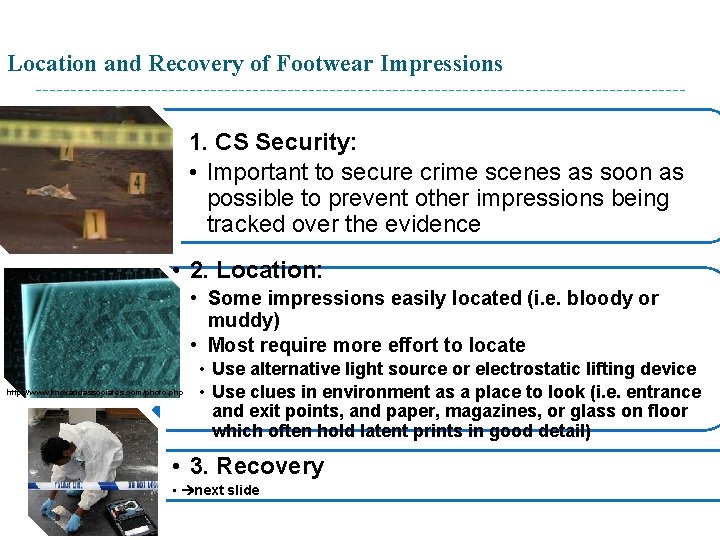
Location and Recovery of Footwear Impressions • 1. CS Security: • Important to secure crime scenes as soon as possible to prevent other impressions being tracked over the evidence • 2. Location: • Some impressions easily located (i. e. bloody or muddy) • Most require more effort to locate http: //www. knoxandassociates. com/photo. php • Use alternative light source or electrostatic lifting device • Use clues in environment as a place to look (i. e. entrance and exit points, and paper, magazines, or glass on floor which often hold latent prints in good detail) • 3. Recovery • next slide 10
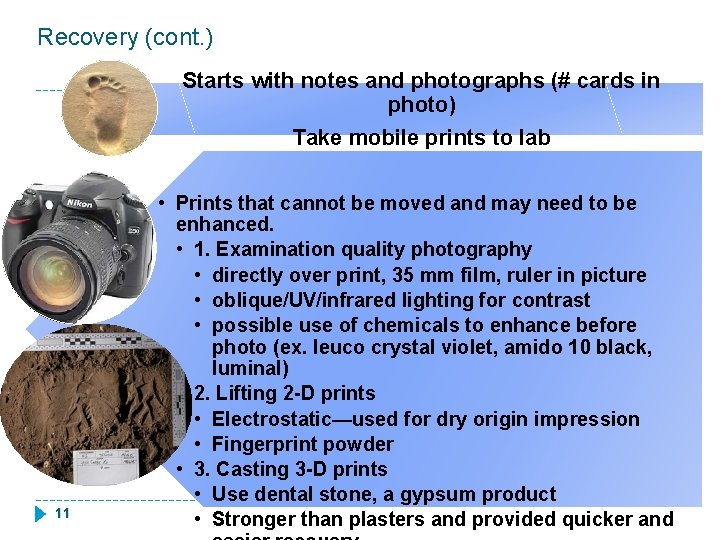
Recovery (cont. ) Starts with notes and photographs (# cards in photo) Take mobile prints to lab 11 • Prints that cannot be moved and may need to be enhanced. • 1. Examination quality photography • directly over print, 35 mm film, ruler in picture • oblique/UV/infrared lighting for contrast • possible use of chemicals to enhance before photo (ex. leuco crystal violet, amido 10 black, luminal) • 2. Lifting 2 -D prints • Electrostatic—used for dry origin impression • Fingerprint powder • 3. Casting 3 -D prints • Use dental stone, a gypsum product • Stronger than plasters and provided quicker and
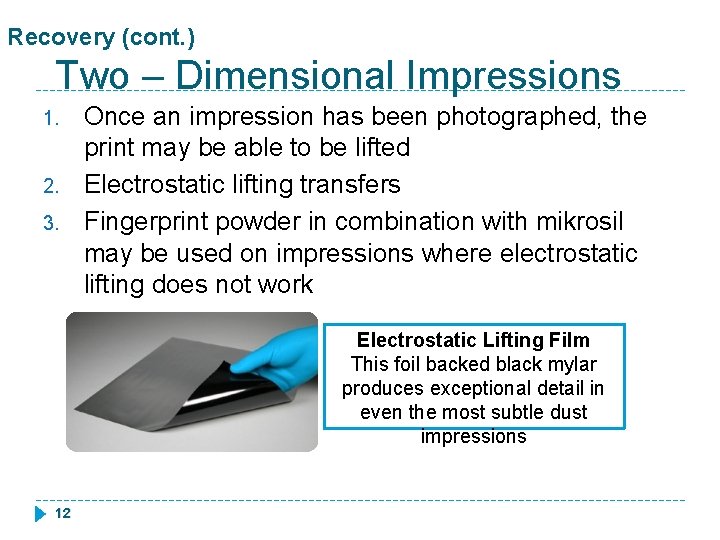
Recovery (cont. ) Two – Dimensional Impressions 1. 2. 3. Once an impression has been photographed, the print may be able to be lifted Electrostatic lifting transfers Fingerprint powder in combination with mikrosil may be used on impressions where electrostatic lifting does not work Electrostatic Lifting Film This foil backed black mylar produces exceptional detail in even the most subtle dust impressions 12
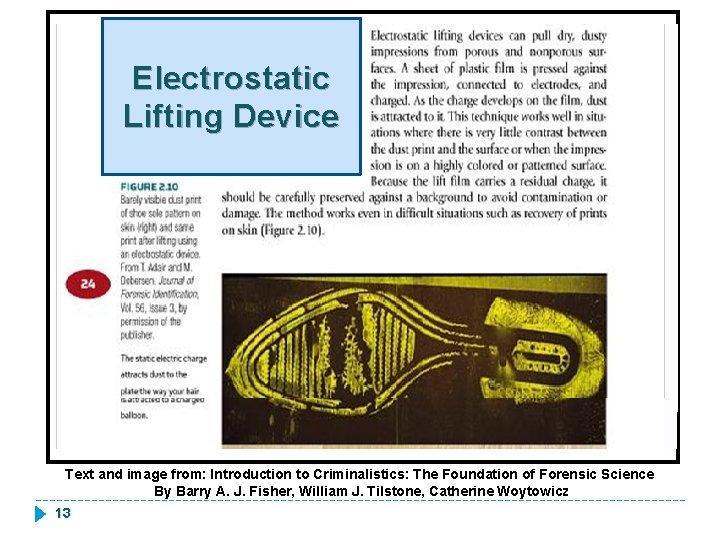
Electrostatic Lifting Device Text and image from: Introduction to Criminalistics: The Foundation of Forensic Science By Barry A. J. Fisher, William J. Tilstone, Catherine Woytowicz 13
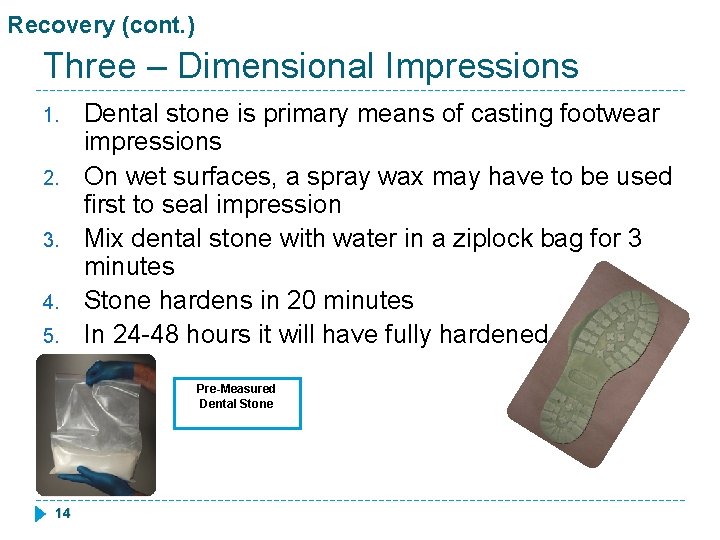
Recovery (cont. ) Three – Dimensional Impressions 1. 2. 3. 4. 5. Dental stone is primary means of casting footwear impressions On wet surfaces, a spray wax may have to be used first to seal impression Mix dental stone with water in a ziplock bag for 3 minutes Stone hardens in 20 minutes In 24 -48 hours it will have fully hardened Pre-Measured Dental Stone 14
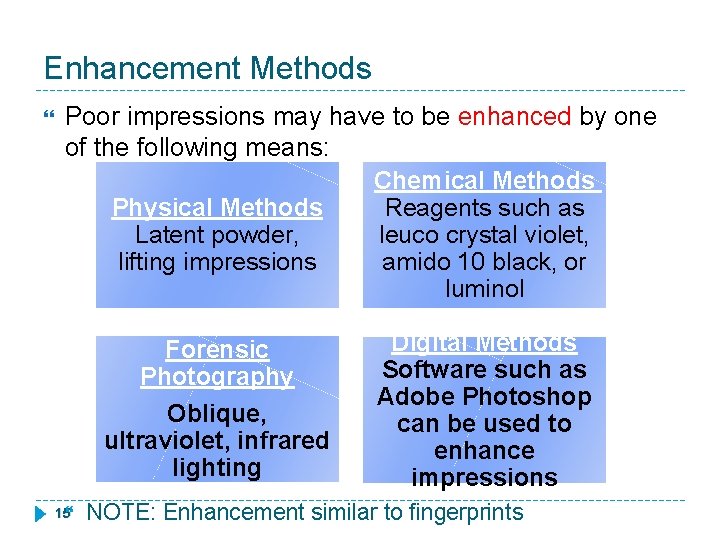
Enhancement Methods Poor impressions may have to be enhanced by one of the following means: Chemical Methods Physical Methods Reagents such as Latent powder, leuco crystal violet, lifting impressions amido 10 black, or luminol Forensic Photography Oblique, ultraviolet, infrared lighting 15 Digital Methods Software such as Adobe Photoshop can be used to enhance impressions NOTE: Enhancement similar to fingerprints
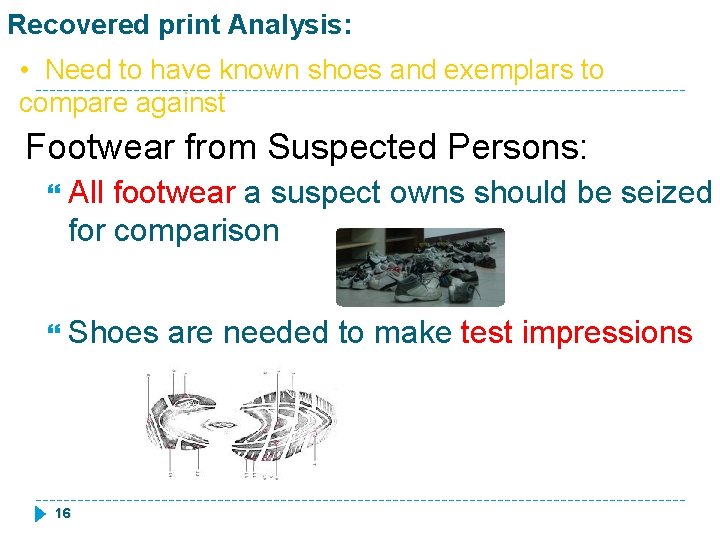
Recovered print Analysis: • Need to have known shoes and exemplars to compare against Footwear from Suspected Persons: All footwear a suspect owns should be seized for comparison Shoes are needed to make test impressions 16
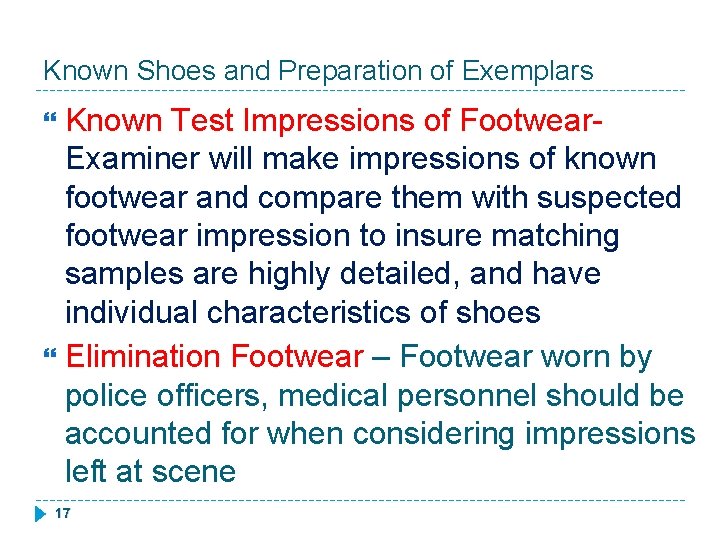
Known Shoes and Preparation of Exemplars Known Test Impressions of Footwear. Examiner will make impressions of known footwear and compare them with suspected footwear impression to insure matching samples are highly detailed, and have individual characteristics of shoes Elimination Footwear – Footwear worn by police officers, medical personnel should be accounted for when considering impressions left at scene 17
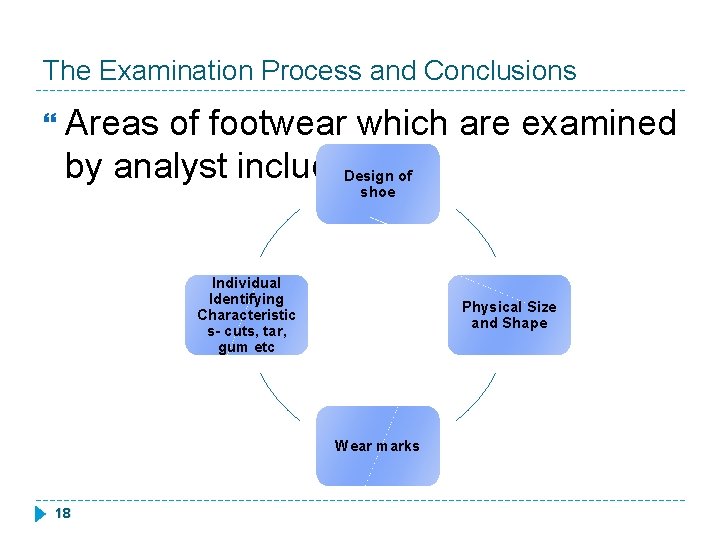
The Examination Process and Conclusions Areas of footwear which are examined by analyst include: Design of shoe Individual Identifying Characteristic s- cuts, tar, gum etc Physical Size and Shape Wear marks 18
Quia Quiz http: //www. quia. com/quiz/1371545. html 19