
Chapter 18 Examines handwriting typescript to ascertain the
- Slides: 14
Chapter 18
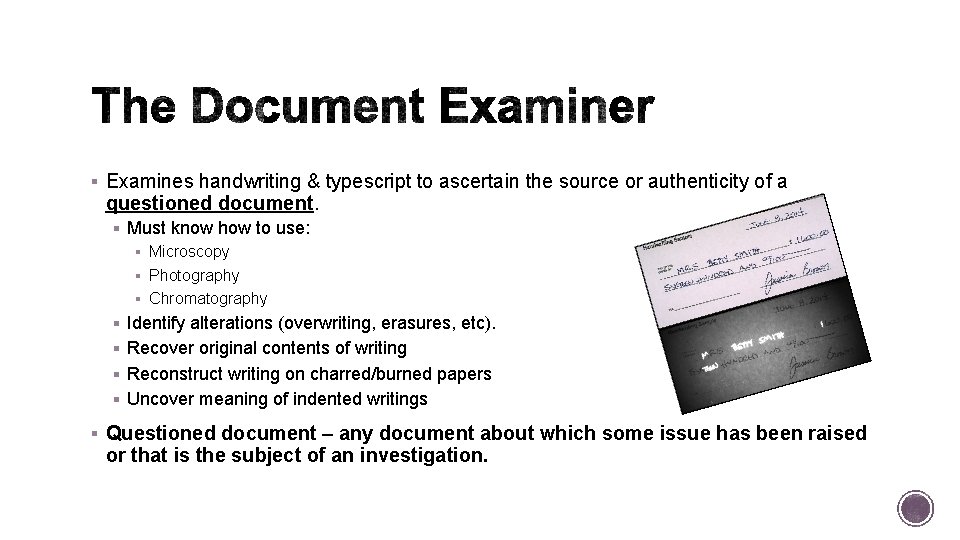
§ Examines handwriting & typescript to ascertain the source or authenticity of a questioned document. § Must know how to use: § Microscopy § Photography § Chromatography § Identify alterations (overwriting, erasures, etc). § Recover original contents of writing § Reconstruct writing on charred/burned papers § Uncover meaning of indented writings § Questioned document – any document about which some issue has been raised or that is the subject of an investigation.
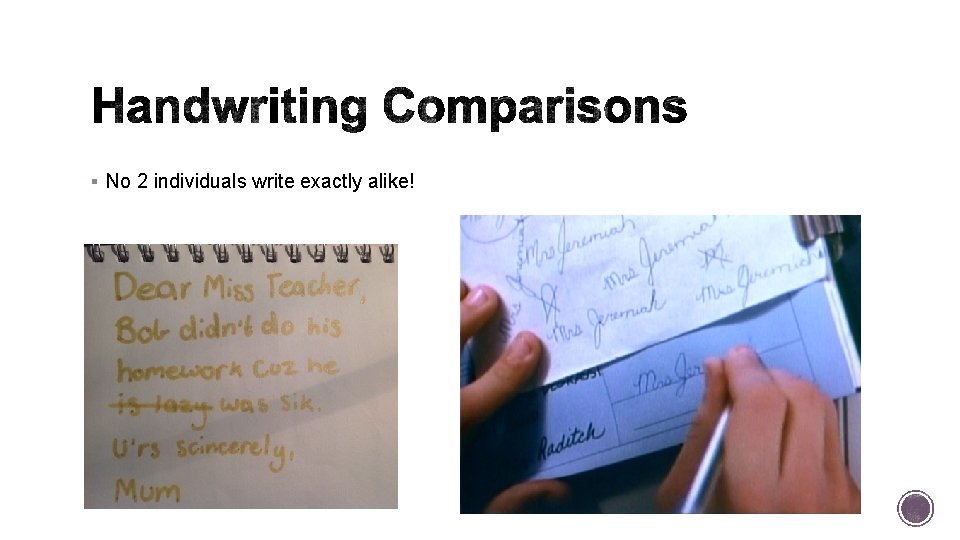
§ No 2 individuals write exactly alike!
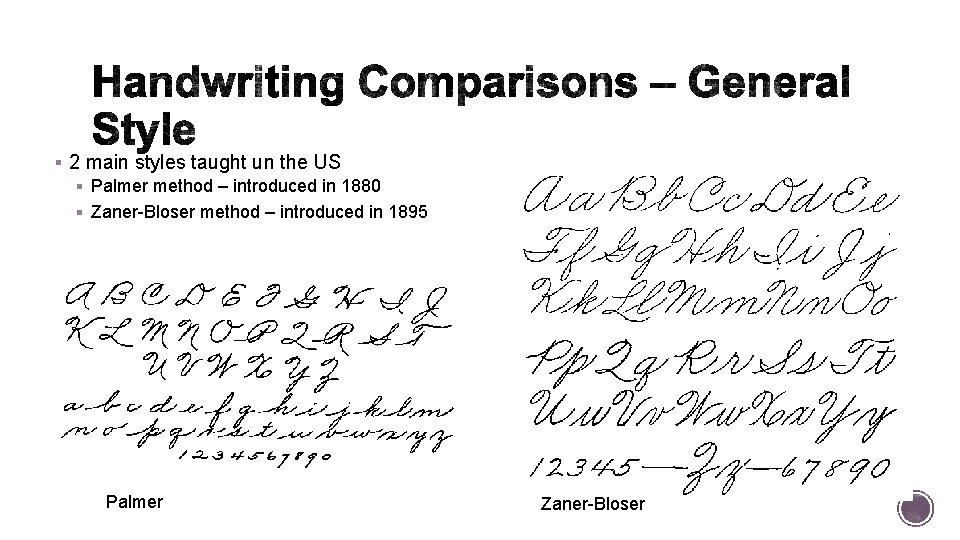
§ 2 main styles taught un the US § Palmer method – introduced in 1880 § Zaner-Bloser method – introduced in 1895 Palmer Zaner-Bloser
§ Early Learning – Learning to write is a conscious effort in copying letter forms, many young children have very similar handwriting. § Unconscious writing - As we get older, our handwriting becomes an unconscious act, handwriting takes on innumerable habitual shapes that make it unique. This is what document examiners look for.
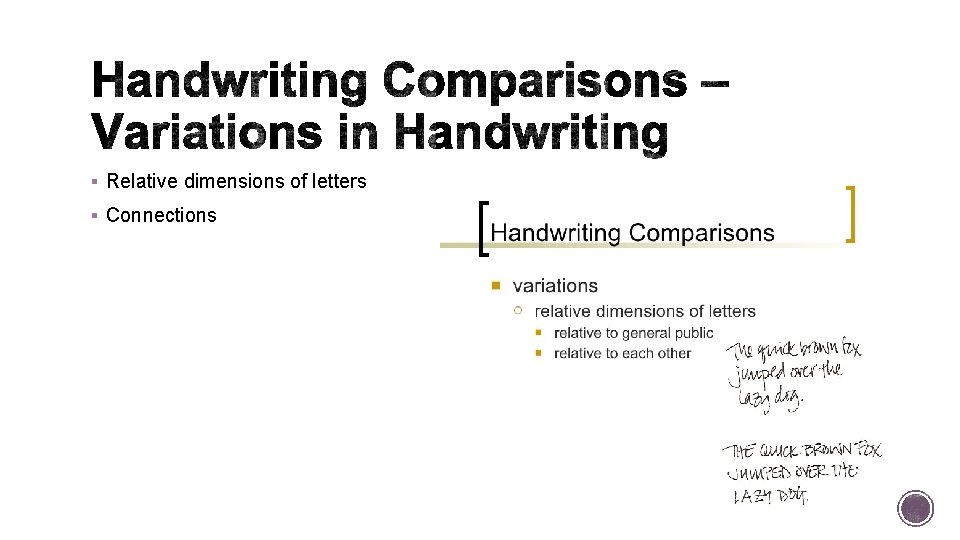
§ Individual variations are associated with the mechanical, physical, and mental functions of the individual, makes it extremely unlikely that a person’s handwriting can be reproduced by another. § § § § § Angularity Slope Speed Pressure Letter and word spacing Relative dimensions of letters Connections Pen movement Writing skill Finger dexterity
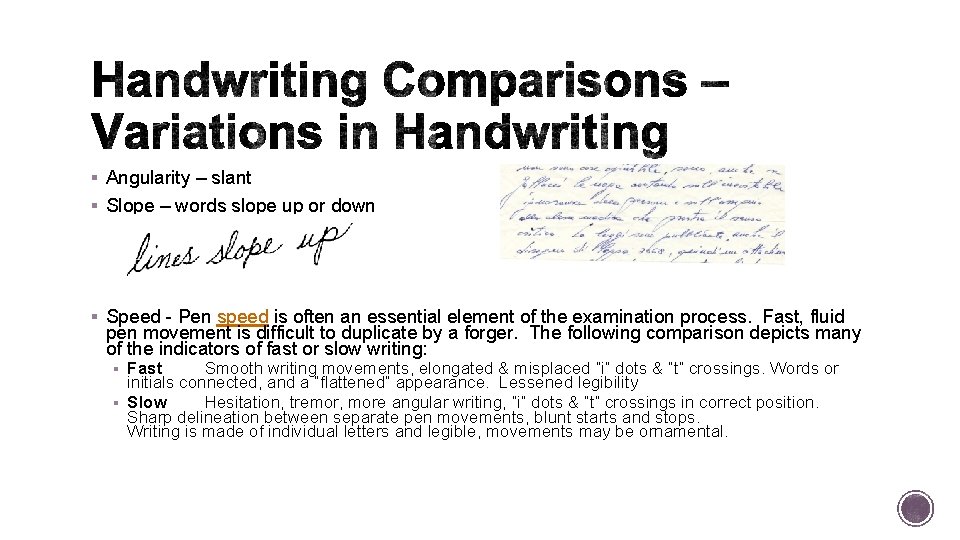
§ Angularity – slant § Slope – words slope up or down § Speed - Pen speed is often an essential element of the examination process. Fast, fluid pen movement is difficult to duplicate by a forger. The following comparison depicts many of the indicators of fast or slow writing: § Fast Smooth writing movements, elongated & misplaced “i” dots & “t” crossings. Words or initials connected, and a “flattened” appearance. Lessened legibility § Slow Hesitation, tremor, more angular writing, “i” dots & “t” crossings in correct position. Sharp delineation between separate pen movements, blunt starts and stops. Writing is made of individual letters and legible, movements may be ornamental.
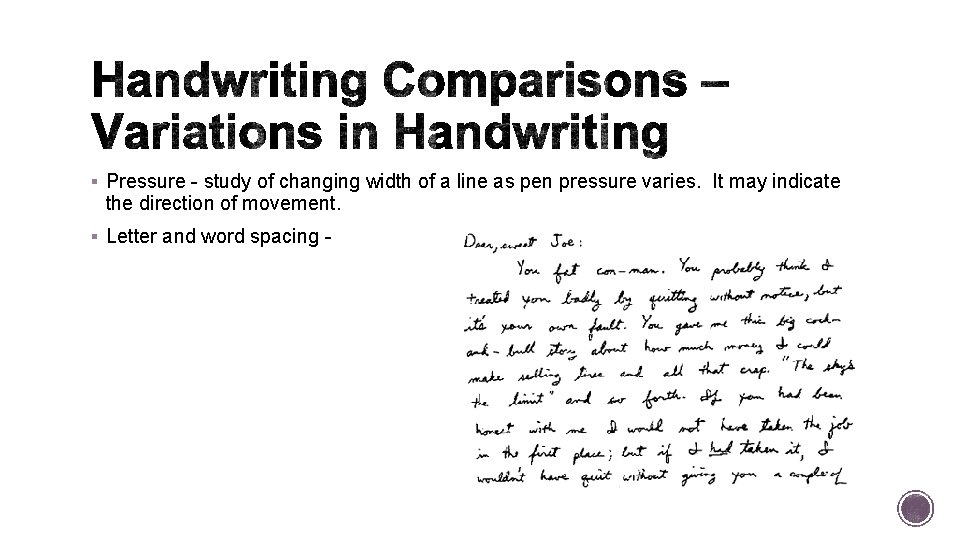
§ Pressure - study of changing width of a line as pen pressure varies. It may indicate the direction of movement. § Letter and word spacing -
§ Relative dimensions of letters § Connections
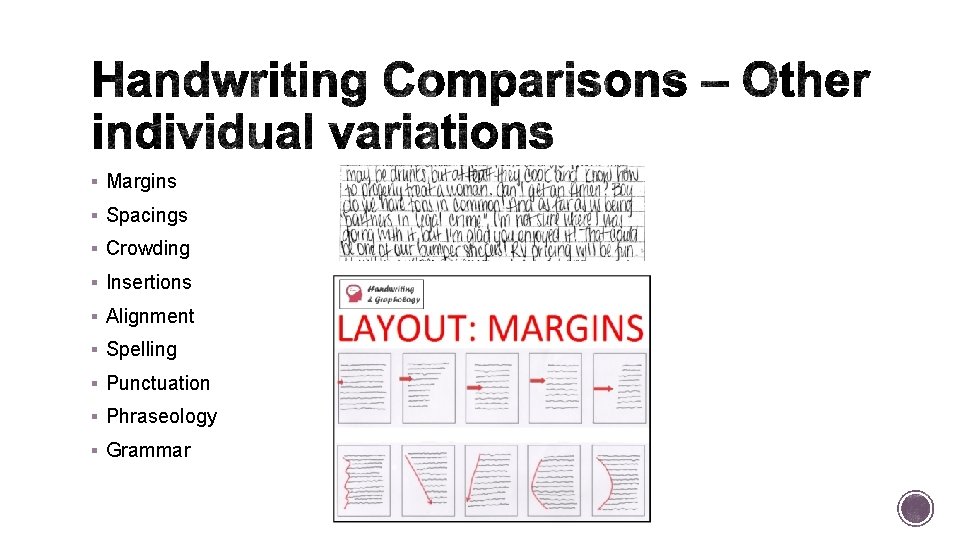
§ Margins § Spacings § Crowding § Insertions § Alignment § Spelling § Punctuation § Phraseology § Grammar
§ All characteristics of both the known and the questioned documents must be considered and compared. § Final conclusion must be based on multiple numbers of common characteristics – based on the judgment of the examiner. § Challenges to handwriting comparison § Insufficient number of known writings available for comparison § Questioned document contains only a few words written either § In a crude, unnatural way or § Very carefully written and thought out to disguise the writer’s natural style § Hard to maintain for more than a few words or sentences.
§ Exemplar – an authentic sample used for comparison purposes § a collection of an adequate number of exemplars is critical for a comparison § Exemplars should be as similar to the questioned document as possible § Same or similar writing implement and paper § show a range of natural variations in suspect’s writing § Natural variations – normal deviations found between repeated specimens of an individual’s handwriting § Important to find standards that date closely in time of the questioned document (2 -3 years for adults)
§ Can be obtained voluntarily or by court order § Gilbert v. California – Supreme Court upheld taking exemplars before appointment of counsel and that it lies outside the protection privileges of the 5 th amendment (self-incrimination) § United States v. Mara – Supreme Court states that getting a handwriting sample did not constitute an unreasonable search and seizure of a person (4 th amendment)
§ To avoid conscious changes in handwriting by an unwilling suspect: § Several pages of writing are required § Writing by dictation best represents the subconscious style of the suspect § Be allowed to write sitting comfortably at a table/desk § Should never be shown the questioned document § Should not be told how to spell the words or the punctuation to use § Use similar pen and paper § Dictated text should be similar in content to questioned document or at least contain many of the same words, phrases, and letter combinations § Dictation should occur 3 times § Signatures are best when combined with other writings § Show questioned document and consult with a document examiner 1 st.