
Chapter 18 Entropy Free Energy and Equilibrium Copyright
Chapter 18 Entropy, Free Energy and Equilibrium Copyright Mc. Graw-Hill 2009
18. 1 Spontaneous Processes • Spontaneous: process that does occur under a specific set of conditions • Nonspontaneous: process that does not occur under a specific set of conditions Copyright Mc. Graw-Hill 2009
Spontaneous Processes • Often spontaneous processes are exothermic, but not always…. • Methane gas burns spontaneously and is exothermic • Ice melts spontaneously but this is an endothermic process… • There is another quantity! Copyright Mc. Graw-Hill 2009
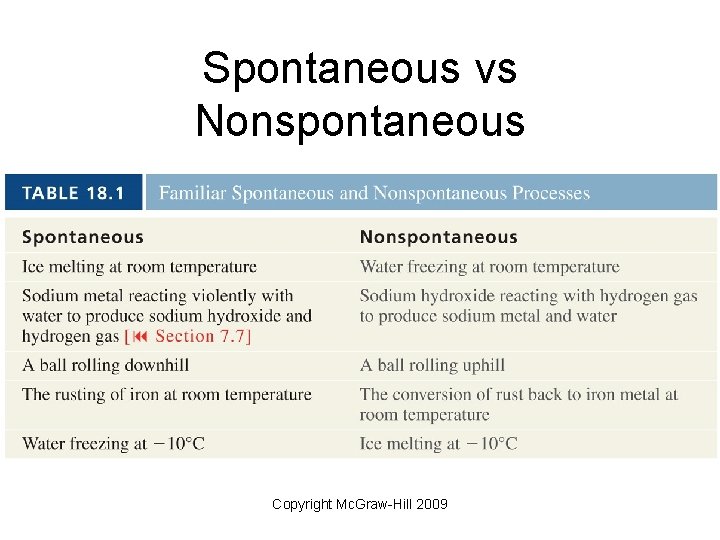
Spontaneous vs Nonspontaneous Copyright Mc. Graw-Hill 2009
18. 2 Entropy • Entropy (S): Can be thought of as a measure of the disorder of a system • In general, greater disorder means greater entropy Copyright Mc. Graw-Hill 2009

Probability- what is the chance that the order of the cards can be restored by reshuffling? Copyright Mc. Graw-Hill 2009
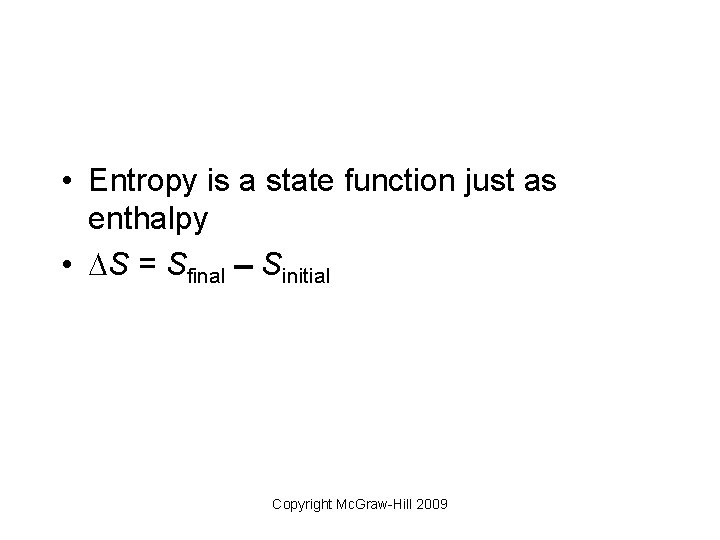
• Entropy is a state function just as enthalpy • S = Sfinal Sinitial Copyright Mc. Graw-Hill 2009
Standard Entropy • Standard entropy: absolute entropy of a substance at 1 atm (typically at 25 C) • Complete list in Appendix 2 of text What do you notice about entropy values for elements and compounds? • Units: J/K·mol Copyright Mc. Graw-Hill 2009
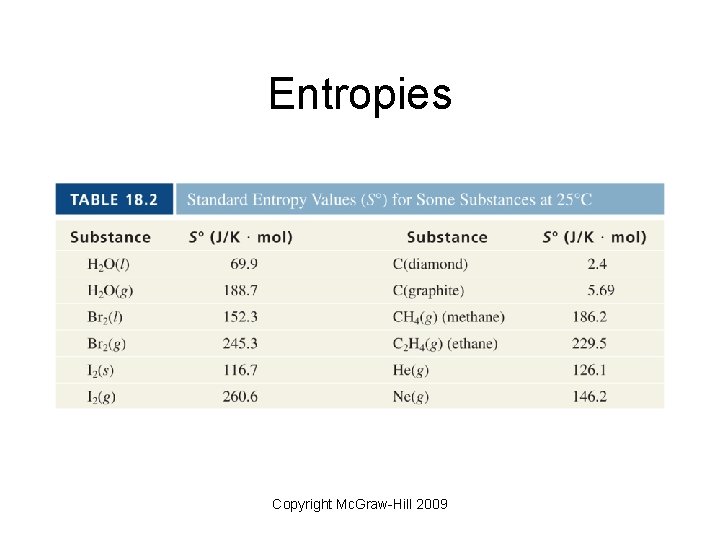
Entropies Copyright Mc. Graw-Hill 2009
Trends in Entropy • Entropy for gas phase is greater than that of liquid or solid of same substance – I 2 (g) has greater entropy than I 2 (s) • More complex structures have greater entropy – C 2 H 6 (g) has greater entropy than CH 4 (g) • Allotropes - more ordered forms have lower entropy – Diamond has lower entropy than graphite Copyright Mc. Graw-Hill 2009
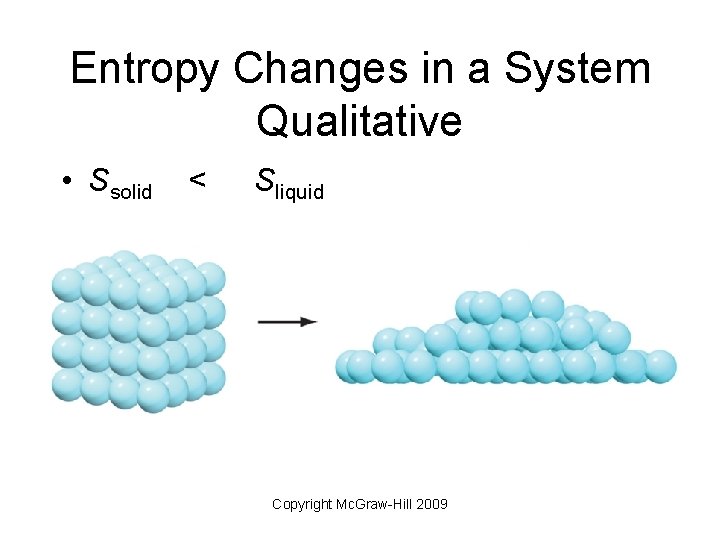
Entropy Changes in a System Qualitative • Ssolid < Sliquid Copyright Mc. Graw-Hill 2009
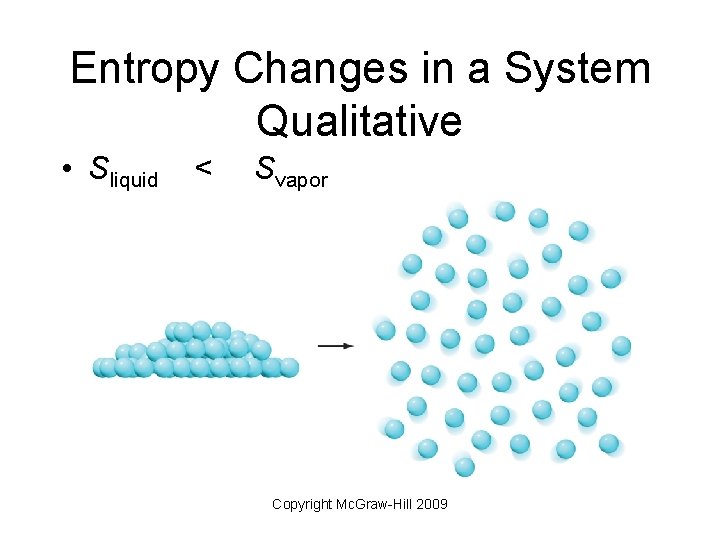
Entropy Changes in a System Qualitative • Sliquid < Svapor Copyright Mc. Graw-Hill 2009
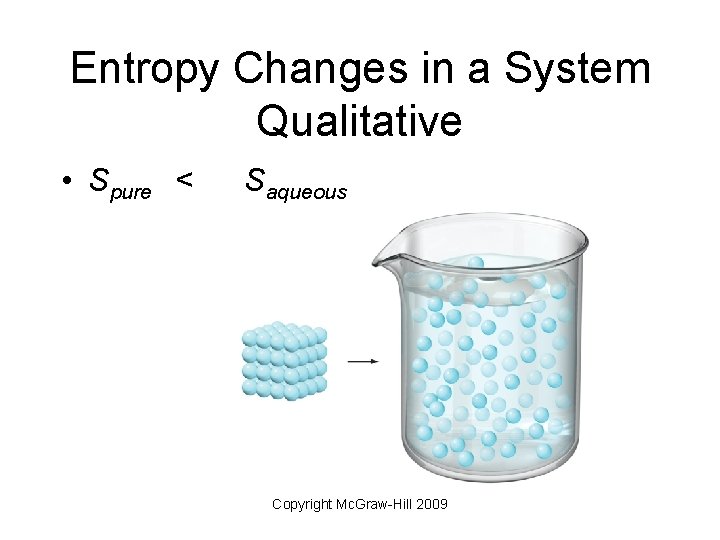
Entropy Changes in a System Qualitative • Spure < Saqueous Copyright Mc. Graw-Hill 2009
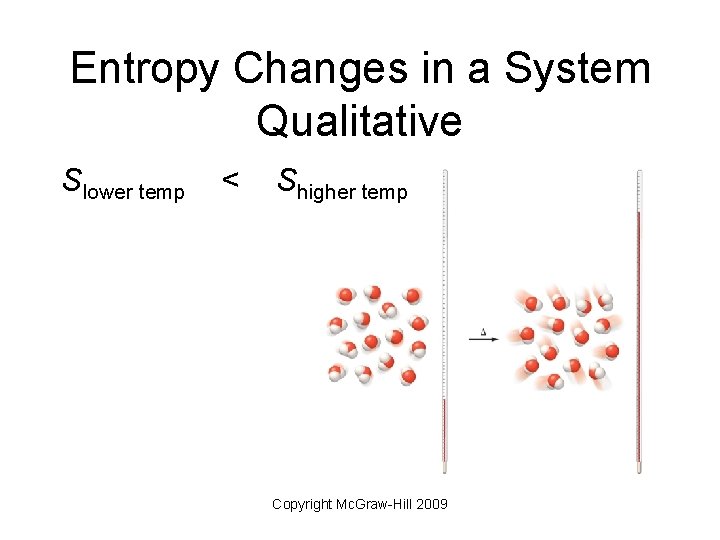
Entropy Changes in a System Qualitative Slower temp < Shigher temp Copyright Mc. Graw-Hill 2009
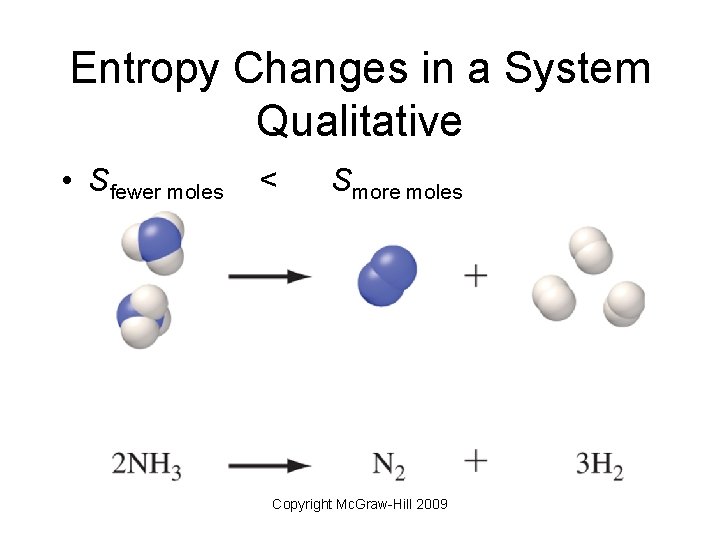
Entropy Changes in a System Qualitative • Sfewer moles < Smore moles Copyright Mc. Graw-Hill 2009
Entropy Changes in a System Qualitative Determine the sign of S for the following (qualitatively) 1. Liquid nitrogen evaporates 2. Two clear liquids are mixed and a solid yellow precipitate forms 3. Liquid water is heated from 22. 5 C to 55. 8 C Copyright Mc. Graw-Hill 2009
18. 3 The Second and Third Laws of Thermodynamics • System: the reaction • Surroundings: everything else • Both undergo changes in entropy during physical and chemical processes Copyright Mc. Graw-Hill 2009
Second Law of Thermodynamics • Entropy of the universe increases in a spontaneous process and remains unchanged in an equilibrium process. • Equilibrium process: caused to occur by adding or removing energy from a system that is at equilibrium Copyright Mc. Graw-Hill 2009
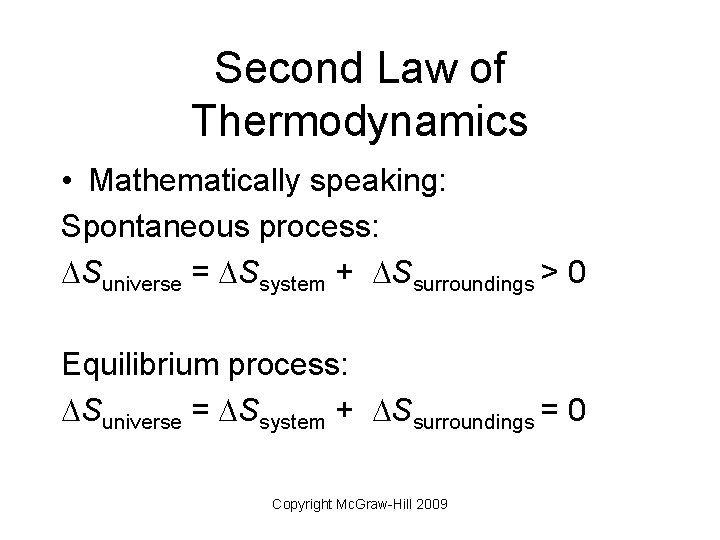
Second Law of Thermodynamics • Mathematically speaking: Spontaneous process: Suniverse = Ssystem + Ssurroundings > 0 Equilibrium process: Suniverse = Ssystem + Ssurroundings = 0 Copyright Mc. Graw-Hill 2009
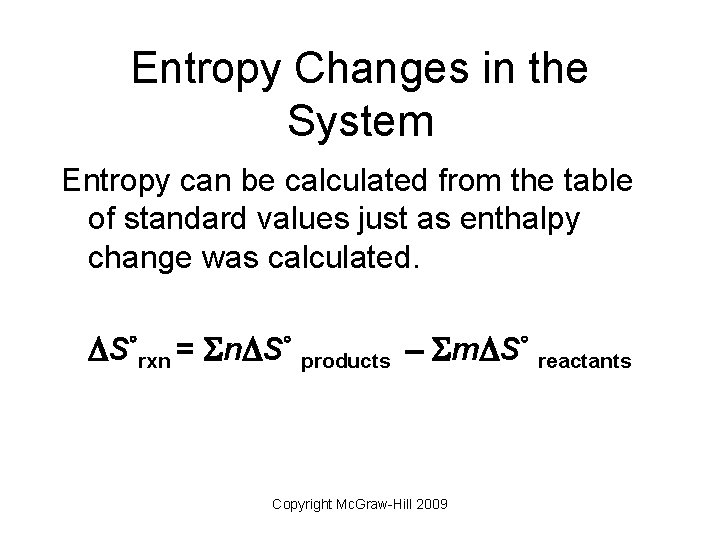
Entropy Changes in the System Entropy can be calculated from the table of standard values just as enthalpy change was calculated. S rxn = n S products m S reactants Copyright Mc. Graw-Hill 2009
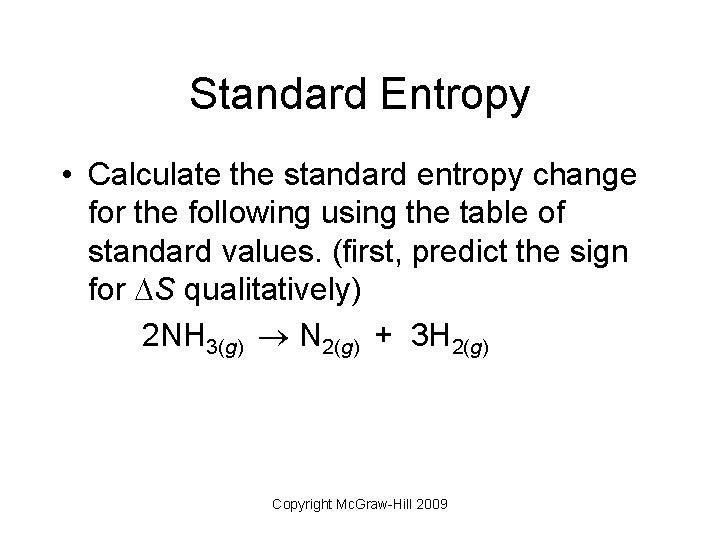
Standard Entropy • Calculate the standard entropy change for the following using the table of standard values. (first, predict the sign for S qualitatively) 2 NH 3(g) N 2(g) + 3 H 2(g) Copyright Mc. Graw-Hill 2009
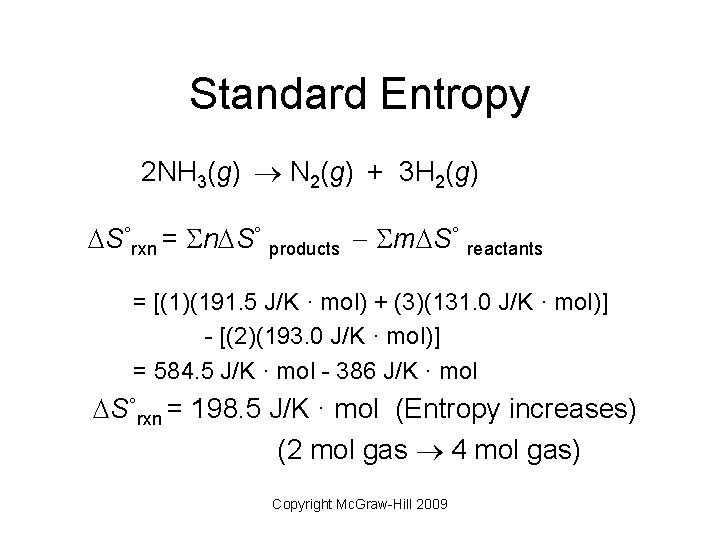
Standard Entropy 2 NH 3(g) N 2(g) + 3 H 2(g) S rxn = n S products m S reactants = [(1)(191. 5 J/K · mol) + (3)(131. 0 J/K · mol)] - [(2)(193. 0 J/K · mol)] = 584. 5 J/K · mol - 386 J/K · mol S rxn = 198. 5 J/K · mol (Entropy increases) (2 mol gas 4 mol gas) Copyright Mc. Graw-Hill 2009
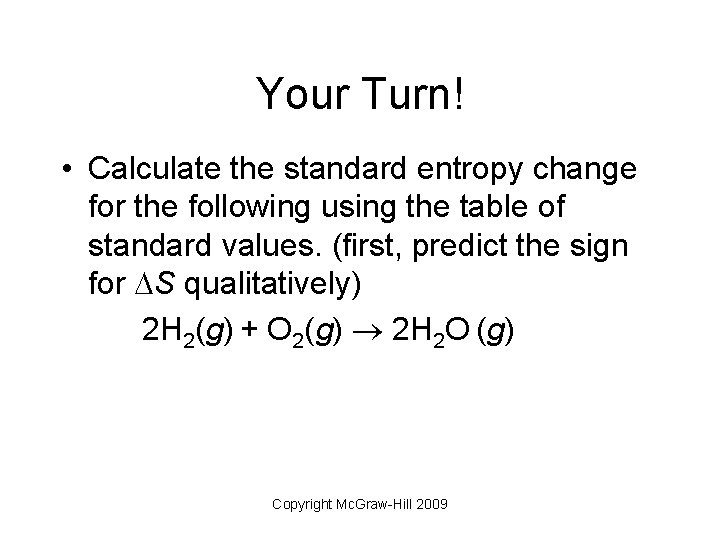
Your Turn! • Calculate the standard entropy change for the following using the table of standard values. (first, predict the sign for S qualitatively) 2 H 2(g) + O 2(g) 2 H 2 O (g) Copyright Mc. Graw-Hill 2009
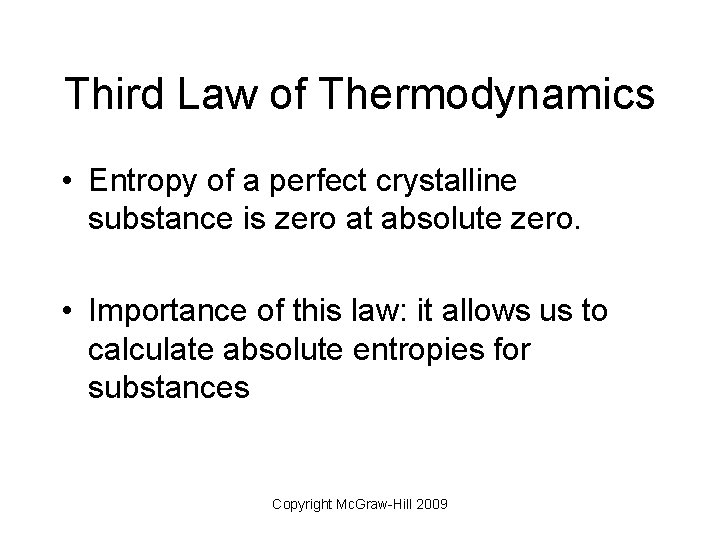
Third Law of Thermodynamics • Entropy of a perfect crystalline substance is zero at absolute zero. • Importance of this law: it allows us to calculate absolute entropies for substances Copyright Mc. Graw-Hill 2009
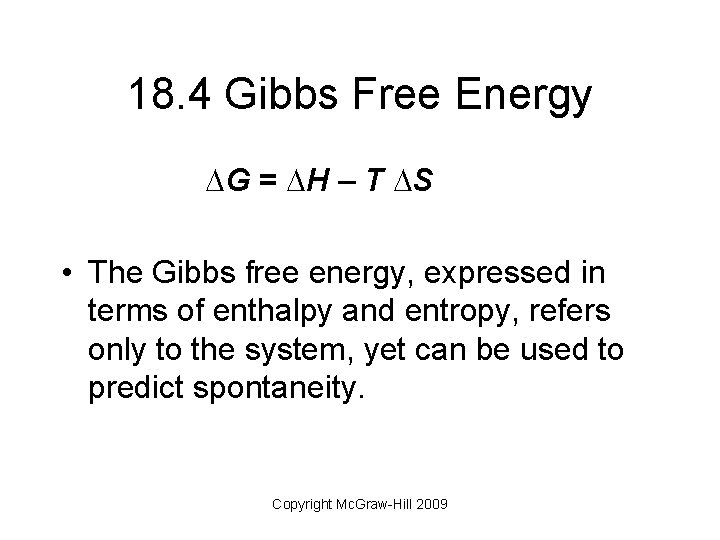
18. 4 Gibbs Free Energy G = H – T S • The Gibbs free energy, expressed in terms of enthalpy and entropy, refers only to the system, yet can be used to predict spontaneity. Copyright Mc. Graw-Hill 2009
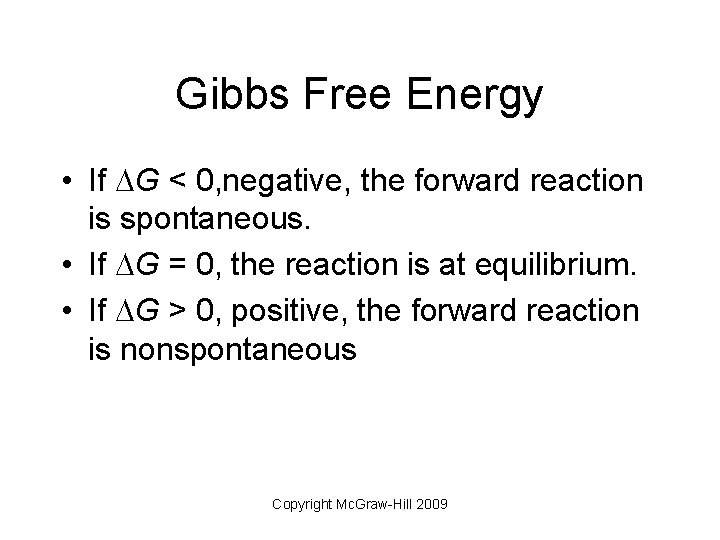
Gibbs Free Energy • If G < 0, negative, the forward reaction is spontaneous. • If G = 0, the reaction is at equilibrium. • If G > 0, positive, the forward reaction is nonspontaneous Copyright Mc. Graw-Hill 2009
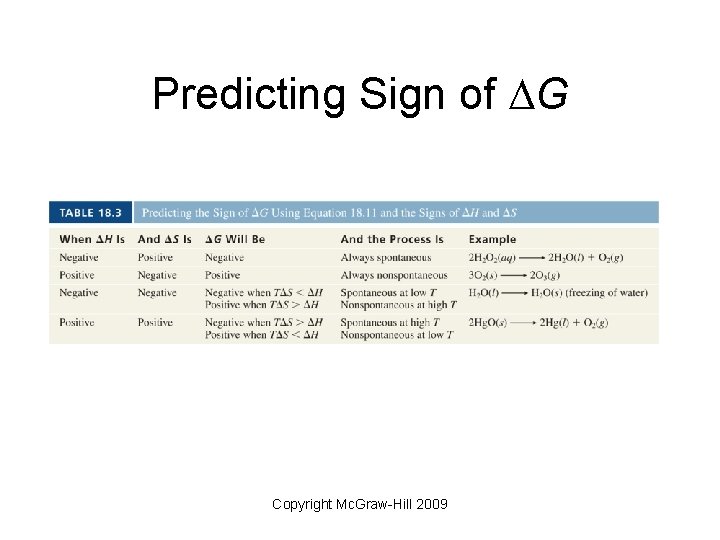
Predicting Sign of G Copyright Mc. Graw-Hill 2009
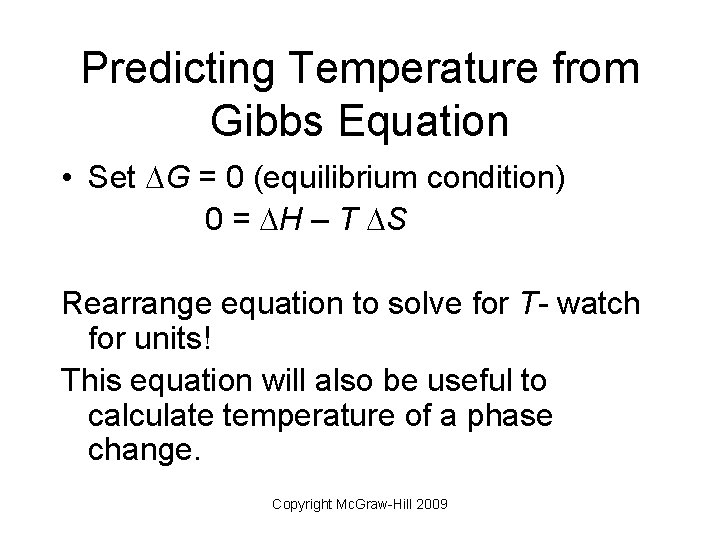
Predicting Temperature from Gibbs Equation • Set G = 0 (equilibrium condition) 0 = H – T S Rearrange equation to solve for T- watch for units! This equation will also be useful to calculate temperature of a phase change. Copyright Mc. Graw-Hill 2009
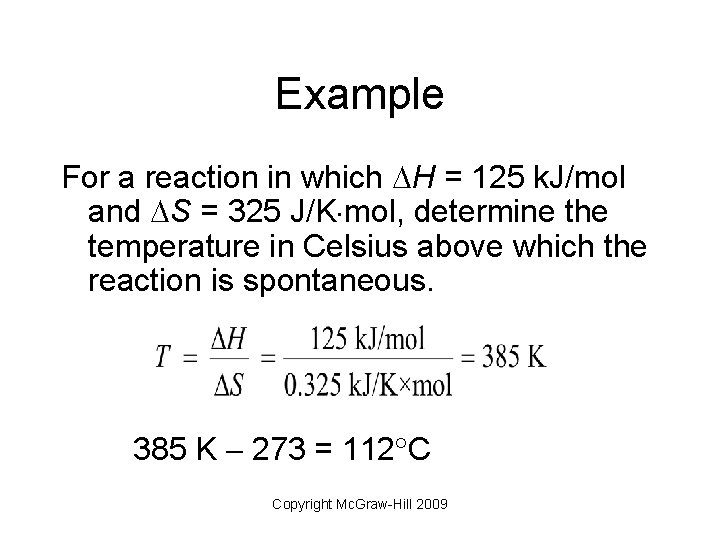
Example For a reaction in which H = 125 k. J/mol and S = 325 J/K mol, determine the temperature in Celsius above which the reaction is spontaneous. 385 K 273 = 112 C Copyright Mc. Graw-Hill 2009
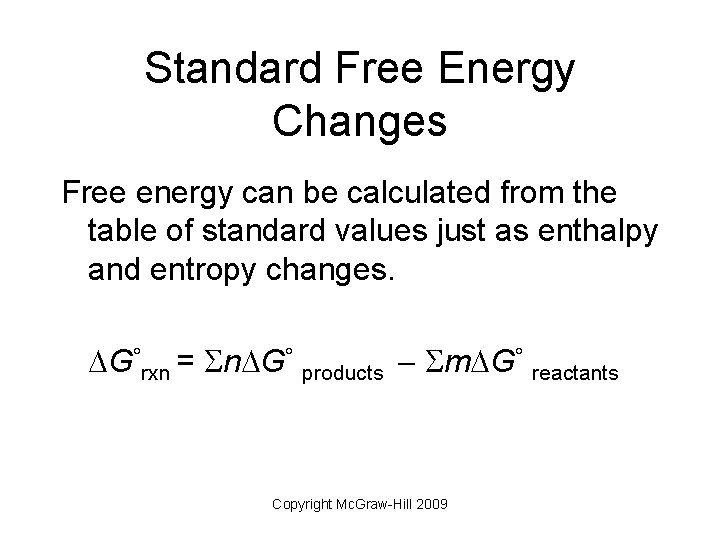
Standard Free Energy Changes Free energy can be calculated from the table of standard values just as enthalpy and entropy changes. G rxn = n G products m G reactants Copyright Mc. Graw-Hill 2009

Standard Free Energy Changes Calculate the standard free-energy change for the following reaction. 2 KCl. O 3(s) 2 KCl(s) + 3 O 2(g) G rxn = n G products m G reactants = [2( 408. 3 k. J/mol) + 3(0)] [2( 289. 9 k. J/mol)] = 816. 6 ( 579. 8) = 236. 8 k. J/mol (spont) Copyright Mc. Graw-Hill 2009
18. 5 Free Energy and Chemical Equilibrium • Reactions are almost always in something other than their standard states. • Free energy is needed to determine if a reaction is spontaneous or not. • How does free energy change with changes in concentration? Copyright Mc. Graw-Hill 2009
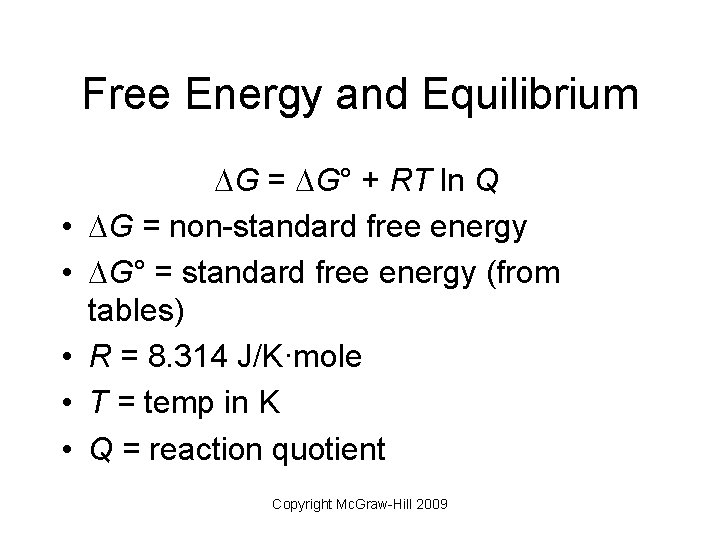
Free Energy and Equilibrium • • • G = G° + RT ln Q G = non-standard free energy G° = standard free energy (from tables) R = 8. 314 J/K·mole T = temp in K Q = reaction quotient Copyright Mc. Graw-Hill 2009
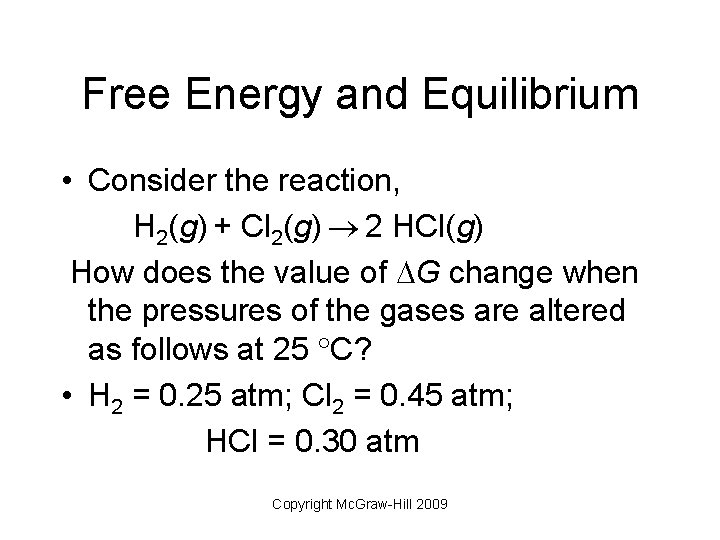
Free Energy and Equilibrium • Consider the reaction, H 2(g) + Cl 2(g) 2 HCl(g) How does the value of G change when the pressures of the gases are altered as follows at 25 C? • H 2 = 0. 25 atm; Cl 2 = 0. 45 atm; HCl = 0. 30 atm Copyright Mc. Graw-Hill 2009
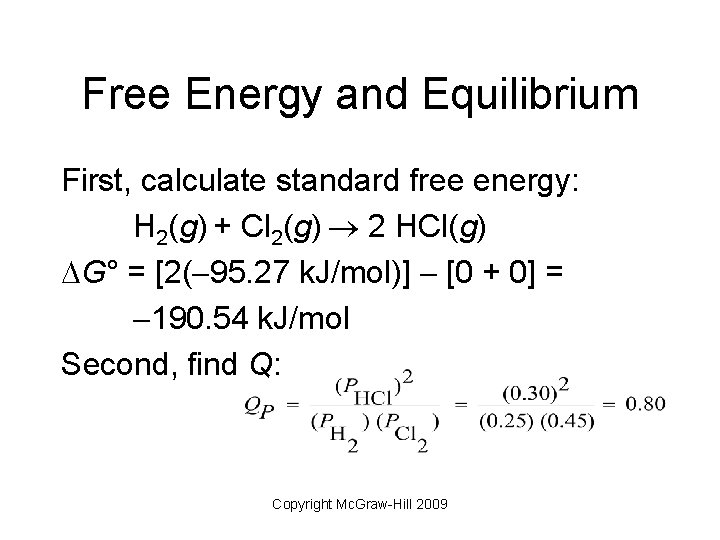
Free Energy and Equilibrium First, calculate standard free energy: H 2(g) + Cl 2(g) 2 HCl(g) G° = [2( 95. 27 k. J/mol)] [0 + 0] = 190. 54 k. J/mol Second, find Q: Copyright Mc. Graw-Hill 2009
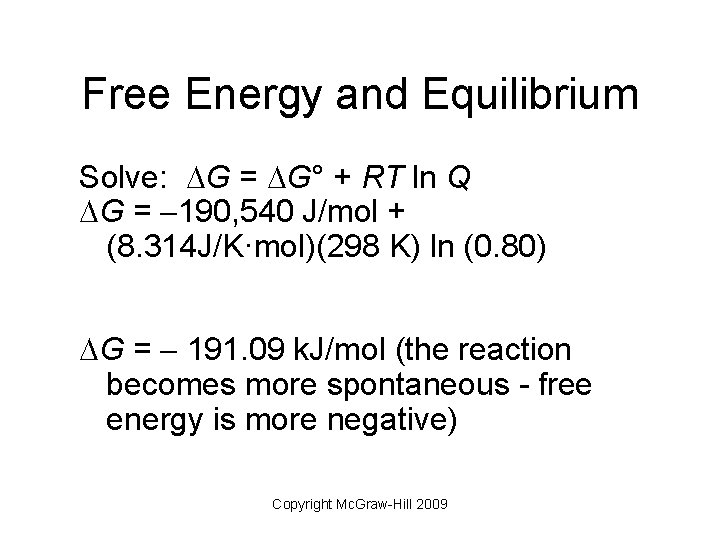
Free Energy and Equilibrium Solve: G = G° + RT ln Q G = 190, 540 J/mol + (8. 314 J/K·mol)(298 K) ln (0. 80) G = 191. 09 k. J/mol (the reaction becomes more spontaneous - free energy is more negative) Copyright Mc. Graw-Hill 2009
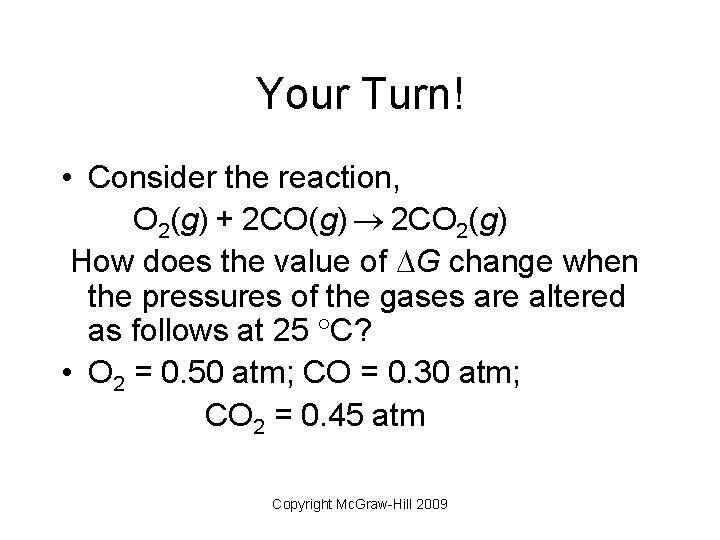
Your Turn! • Consider the reaction, O 2(g) + 2 CO(g) 2 CO 2(g) How does the value of G change when the pressures of the gases are altered as follows at 25 C? • O 2 = 0. 50 atm; CO = 0. 30 atm; CO 2 = 0. 45 atm Copyright Mc. Graw-Hill 2009
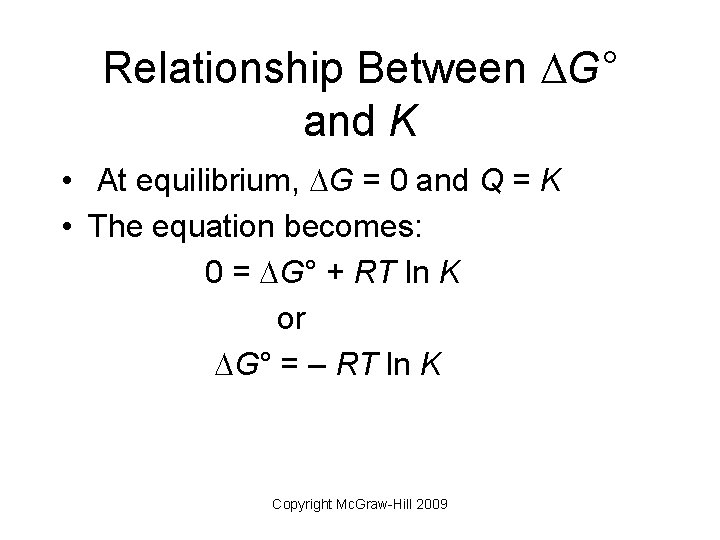
Relationship Between G° and K • At equilibrium, G = 0 and Q = K • The equation becomes: 0 = G° + RT ln K or G° = – RT ln K Copyright Mc. Graw-Hill 2009
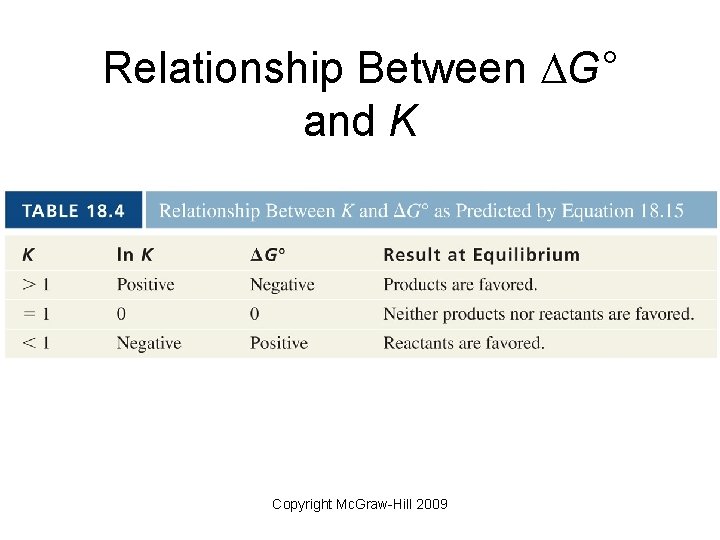
Relationship Between G° and K Copyright Mc. Graw-Hill 2009
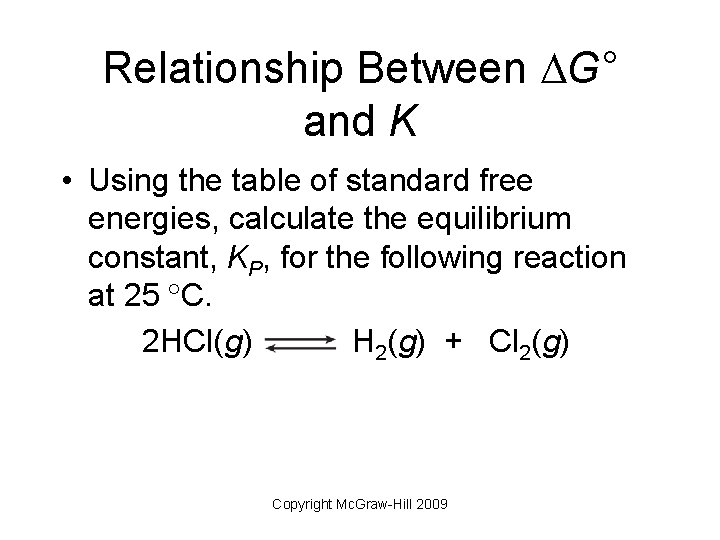
Relationship Between G° and K • Using the table of standard free energies, calculate the equilibrium constant, KP, for the following reaction at 25 C. 2 HCl(g) H 2(g) + Cl 2(g) Copyright Mc. Graw-Hill 2009
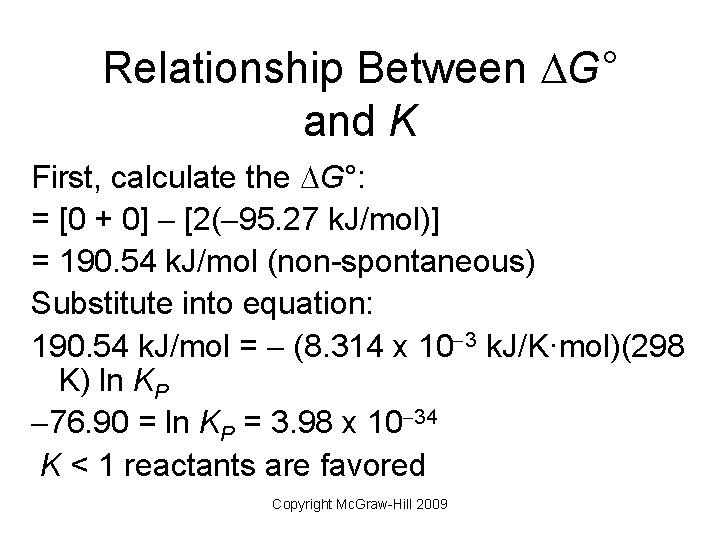
Relationship Between G° and K First, calculate the G°: = [0 + 0] [2( 95. 27 k. J/mol)] = 190. 54 k. J/mol (non-spontaneous) Substitute into equation: 190. 54 k. J/mol = (8. 314 x 10 3 k. J/K·mol)(298 K) ln KP 76. 90 = ln KP = 3. 98 x 10 34 K < 1 reactants are favored Copyright Mc. Graw-Hill 2009
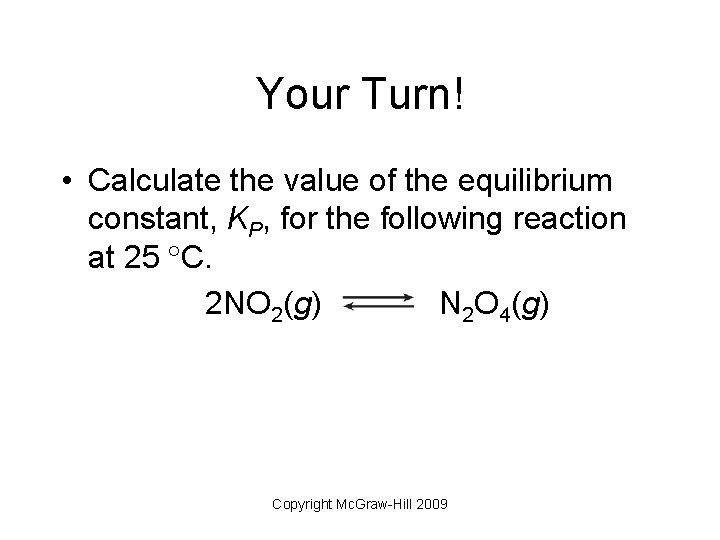
Your Turn! • Calculate the value of the equilibrium constant, KP, for the following reaction at 25 C. 2 NO 2(g) N 2 O 4(g) Copyright Mc. Graw-Hill 2009
18. 6 Thermodynamics in Living Systems • Coupled reactions • Thermodynamically favorable reactions drives an unfavorable one • Enzymes facilitate many nonspontaneous reactions Copyright Mc. Graw-Hill 2009
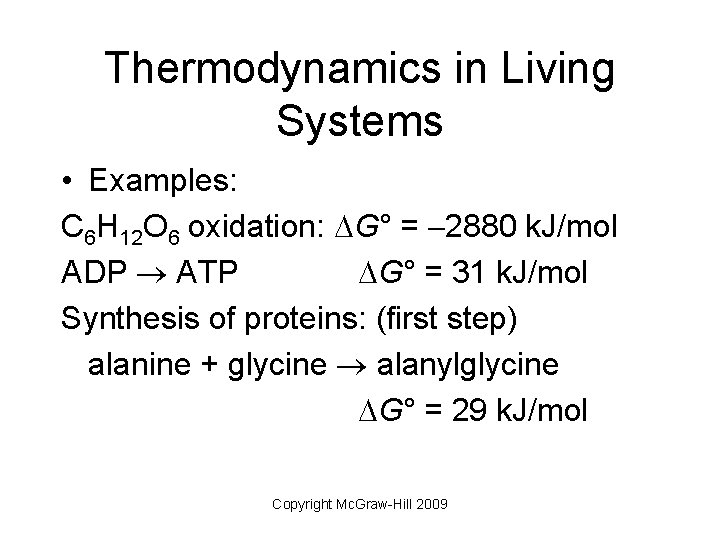
Thermodynamics in Living Systems • Examples: C 6 H 12 O 6 oxidation: G° = 2880 k. J/mol ADP ATP G° = 31 k. J/mol Synthesis of proteins: (first step) alanine + glycine alanylglycine G° = 29 k. J/mol Copyright Mc. Graw-Hill 2009
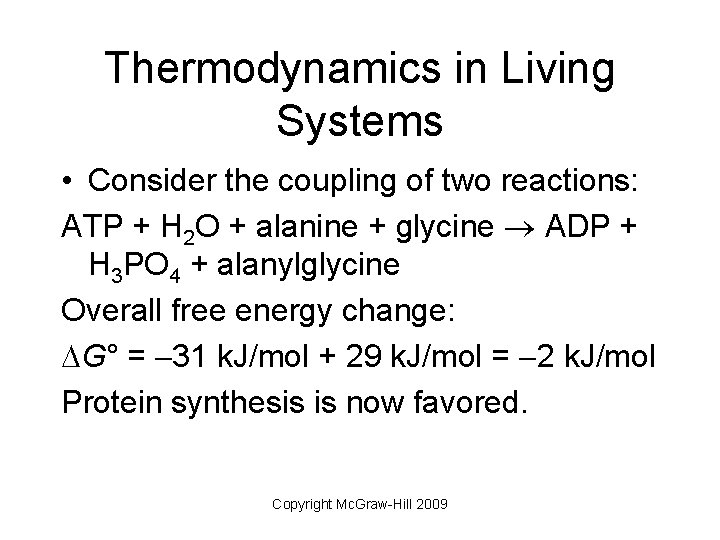
Thermodynamics in Living Systems • Consider the coupling of two reactions: ATP + H 2 O + alanine + glycine ADP + H 3 PO 4 + alanylglycine Overall free energy change: G° = 31 k. J/mol + 29 k. J/mol = 2 k. J/mol Protein synthesis is now favored. Copyright Mc. Graw-Hill 2009
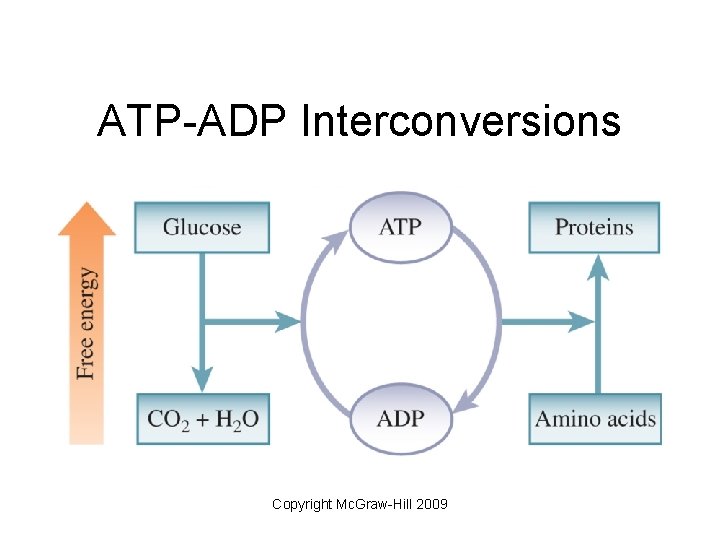
ATP-ADP Interconversions Copyright Mc. Graw-Hill 2009
Key Points • Spontaneous vs nonspontaneous • Relate enthalpy, entropy and free energy • Entropy – Predict qualitatively – Calculate from table of standard values – Calculate entropy for universe Copyright Mc. Graw-Hill 2009

Key Points • Free energy – Calculate from table of standard values – Calculate from Gibbs equation – Calculate non-standard conditions – Calculate in relationship to equilibrium constant Copyright Mc. Graw-Hill 2009
- Slides: 48