
Chapter 18 Enlightenment and Revolution Age of Exploration
- Slides: 26
Chapter 18 Enlightenment and Revolution Age of Exploration The Scientific Revolution The Enlightenment The American Revolution
Standard 7 -1: The student will demonstrate an understanding of the colonial expansion of European powers and their impact on world government in the seventeenth and eighteenth centuries. 7 -1. 1 Use a map or series of maps to identify the colonial expansion of European powers in Africa, Asia, Oceania, and the Americas through 1770. (G, H, P) 7 -1. 2 Explain how technological and scientific advances, including navigational advances and the use of gunpowder, affected various parts of the world politically, socially, and economically and contributed to the power of European nations. (H, G, P, E) The Age of Exploration Pages 658 -669 Europe Gets Ready to Explore Pages 659 -660 In the 1400 s and 1500 s nations of _______ began exploring the world. • The opportunity to make money drove this exploration. –Europeans wanted to go to _____ for ______ from India, and ___ from China and they wanted them fast. • These goods normally came by pack animal or by walking; a faster allwater route was wanted and needed. –New _____ would allow for these water routes to become possible. » Eventually, European countries would begin to dominate the world, as ____ were founded in North and South America, Africa and Asia.
Trade With Asia Page 659 • During the Middle Ages, Europeans began buying vast amounts of _____, and other goods from ___. Why? – The Mongol empire had kept the ____ open and protected until their empire ended. • When the Mongols fell, local rulers and robbers started to tax or steal the goods coming to Europe making the goods expensive. • The _______, then blocked trade using the Black Sea so prices of goods continued to rise. • Regardless of price ____ still wanted the spices and silks. – Food without spices tasted: (3 S’s) _______, or _______, cloth was made from _______ or plant fibers, so clothing was scratchy. Why? – Anyone who could find a way to get goods cheaply to Europe would become very wealthy very quickly. • Merchants began looking for a ___ route to _____.
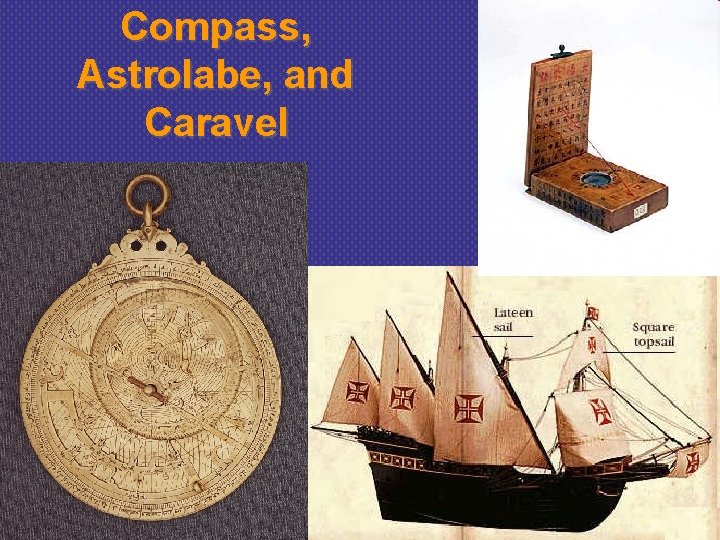
New Technology Pages 659 -660 • Without the right ____, Europeans would not find this new all water route. – The _______ Ocean was very dangerous. • By the 1400 s Europeans learned about the ____ from ____ and the ______ from ____ to help them navigate. • They also started using lateen or _______ that allowed them to sail into the wind. • They also changed the design of their ships adding many _____ and smaller lateen _____, and using a new type of ______ that made steering easier. – The ____ from ____? built a ship called the ____ and Europeans began exploring the world.
Compass, Astrolabe, and Caravel
The Rise of Strong Nations Page 660 • At the end of the Middle Ages most of the kingdoms of Europe were too poor and weak to ______ the world. • Kings and queens could tax ____ and use the money to build their political and military strength. • By the end of the 1400 s, four kingdoms: ____, ______, and _______ were wealth and strong enough to begin looking for a sea route to ___.
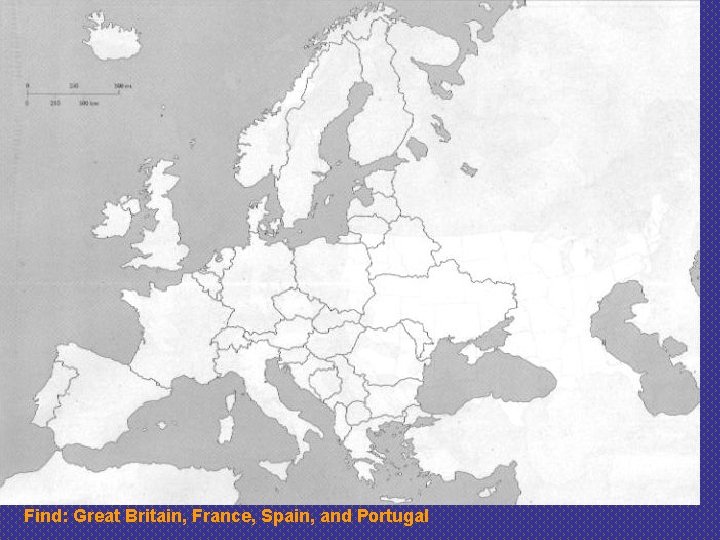
Find: Great Britain, France, Spain, and Portugal
Did Maps Encourage Exploration? Page 660 • By the 1400 s, most educated people in _____ knew the world was ______. – Europeans had few maps and they did not know much about rest of the world. • Most of the maps that Europeans possessed were based on those by Egyptian geographer ________. • Ptolemy’s ideas about _____ were influential because of his system of _____ and ____; that is still used today. • Europeans also used the maps of Arabian geographer ____. – Using the maps of ____ and ____ Europeans learned the geography of ______ and the ______. • Europeans knew that if they could find a way around ______, they could get to ____.
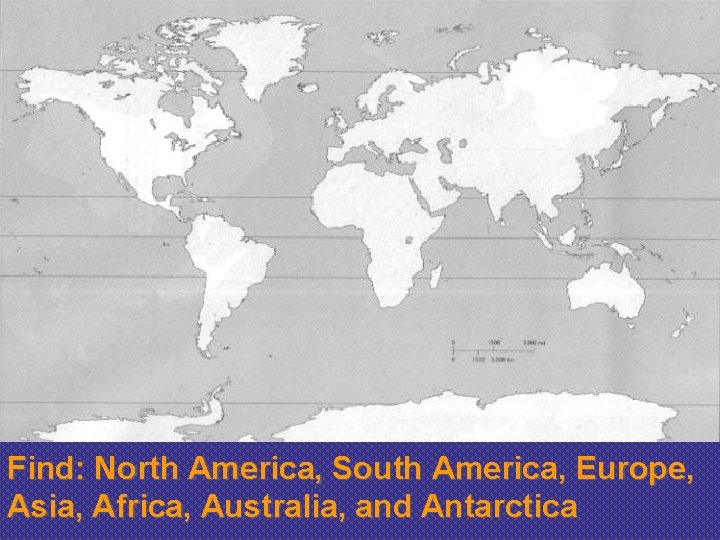
Find: North America, South America, Europe, Asia, Africa, Australia, and Antarctica
Standard 7 -1: The student will demonstrate an understanding of the colonial expansion of European powers and their impact on world government in the seventeenth and eighteenth centuries. 7 -1. 1 Use a map or series of maps to identify the colonial expansion of European powers in Africa, Asia, Oceania, and the Americas through 1770. (G, H, P) 7 -1. 2 Explain how technological and scientific advances, including navigational advances and the use of gunpowder, affected various parts of the world politically, socially, and economically and contributed to the power of European nations. (H, G, P, E) Exploring the World Pages 661 -664 Because the France, Great Britain, and Spain were fighting wars, _____ had the opportunity to explore the world first.
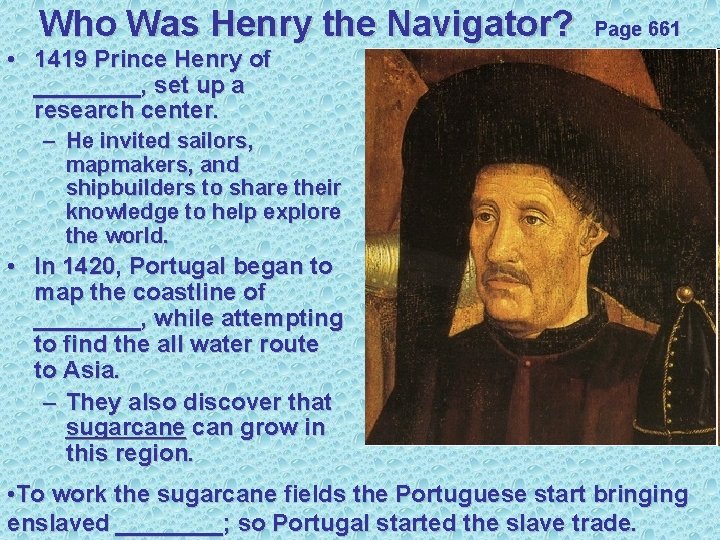
Who Was Henry the Navigator? Page 661 • 1419 Prince Henry of ____, set up a research center. – He invited sailors, mapmakers, and shipbuilders to share their knowledge to help explore the world. • In 1420, Portugal began to map the coastline of ____, while attempting to find the all water route to Asia. – They also discover that sugarcane can grow in this region. • To work the sugarcane fields the Portuguese start bringing enslaved ____; so Portugal started the slave trade.
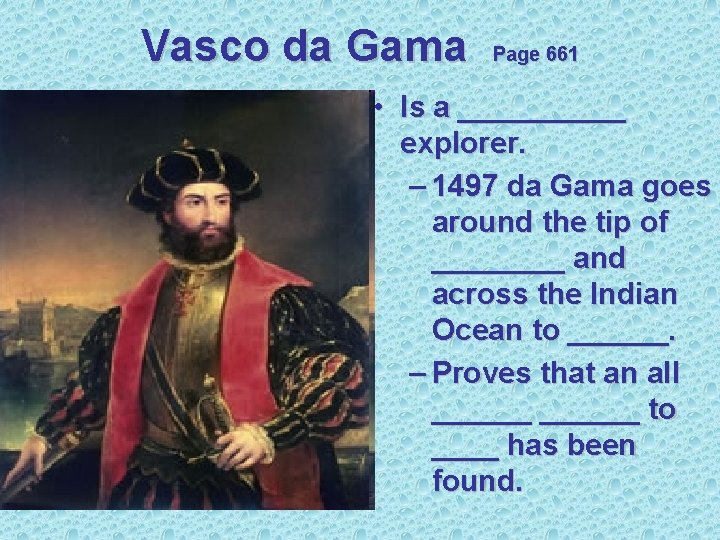
Vasco da Gama Page 661 • Is a _____ explorer. – 1497 da Gama goes around the tip of ____ and across the Indian Ocean to ______. – Proves that an all ______ to ____ has been found.
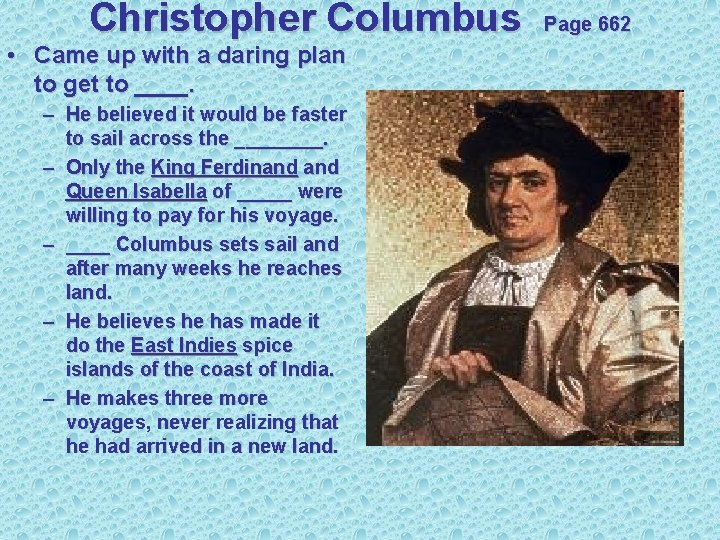
Christopher Columbus • Came up with a daring plan to get to ____. – He believed it would be faster to sail across the ____. – Only the King Ferdinand Queen Isabella of _____ were willing to pay for his voyage. – ____ Columbus sets sail and after many weeks he reaches land. – He believes he has made it do the East Indies spice islands of the coast of India. – He makes three more voyages, never realizing that he had arrived in a new land. Page 662
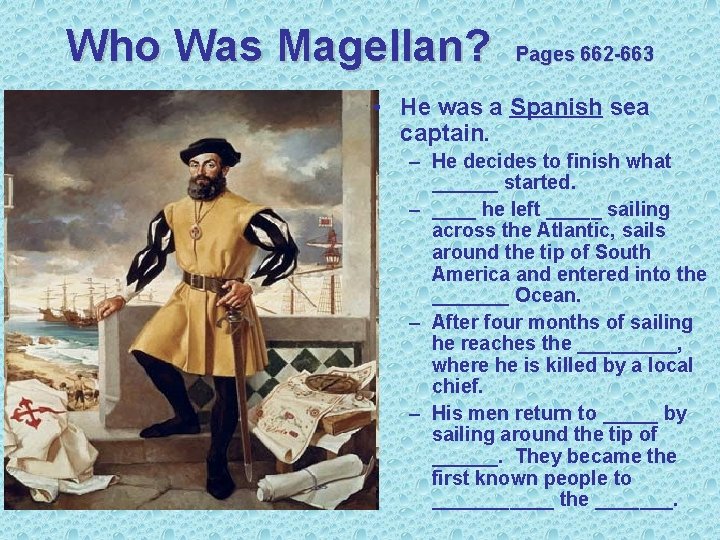
Who Was Magellan? Pages 662 -663 • He was a Spanish sea captain. – He decides to finish what ______ started. – ____ he left _____ sailing across the Atlantic, sails around the tip of South America and entered into the _______ Ocean. – After four months of sailing he reaches the _____, where he is killed by a local chief. – His men return to _____ by sailing around the tip of ______. They became the first known people to ______ the _______.
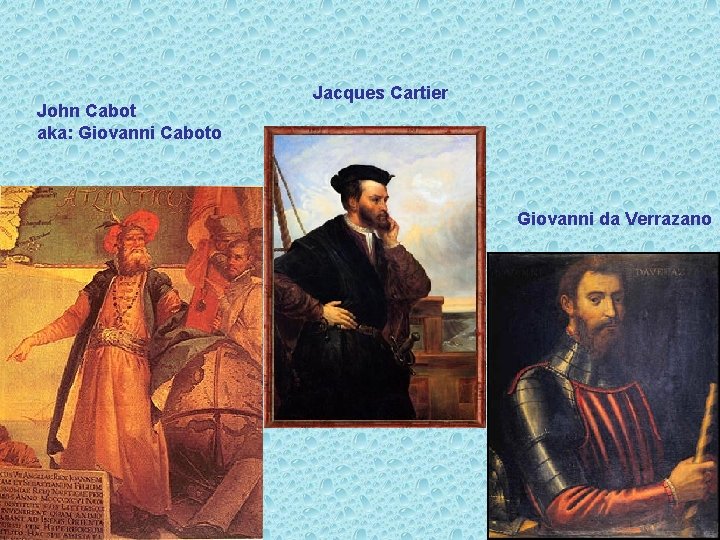
The First English and French Explorers Pages 663 -664 • As news about Columbus spread throughout Europe, ____ decided to find a northern route to ___. – In 1497, John Cabot sailed from England arrived on the coast of Canada to an island he named _______. • He continued south but never found a path to _____. • In 1524, ______ sent Giovanni da Verrazano to map America’s coast. – He mapped from _______ to ______ but did not find a Northwest passage to ____. • 1534 ______ sailed past Newfoundland entered the __ _____ River. – He too did not find a Northwest passage. – These would be the last voyages of exploration for _______; a religious civil war broke out between Protestants and Catholics.
John Cabot aka: Giovanni Caboto Jacques Cartier Giovanni da Verrazano
Spain Fights England Page 664 • In 1588, war broke out between ____ and ______ (Great Britain) over religion. • England’s Queen ____ allowed English pirates to attack Spain’s colonies in the New World. • The English attacks angered Spain’s King ____ and in 1588 he sent a huge fleet of ships, known as the ______, to invade England. – English ships moved faster and forced the Armada to flee north, where many of the ships were sunk by storms. • The Spanish defeat was an important event. – While ____ was still strong, ______ now had the power to stand up to ____. • This encourages the ______ and _____ to start exploring the world.
7 -1. 3 Compare how European nations exercised political and economic influence differently in the Americas, including trading-post empires, plantation colonies, and settler colonies. (H, G, P, E) 7 -1. 4 Summarize the characteristics of European colonial power and explain its effects on the society and culture of African nations, including instances of participation in and resistance to the slave trade. (H, G, P, E) A Global Exchange Pages 668 -669 • After the Age of Exploration, the economies in Europe changed the economies of Africa, Asia, and America. –Europe traded with the world creating a _______ of good things like food, goods, and technology but they also did bad things like spread diseases and start the slave trade. • This global transfer is called the ___________ named after Christopher Columbus.
A Global Exchange Page 668 • The Columbian Exchange brought two very important foods to Europe from North America: ____ and ____. – Corn helped improve the health of ____ resulting in more meat and ____. – Potatoes were important for _______ because four times as many people could be fed off the same amount of land. • Other American goods such as squash, beans and tomatoes changed the food and cooking of Europe. – Imagine spaghetti without tomato sauce. • Some American foods such as chili peppers and peanuts also became important foods in Asia and Africa. – One of the most harmful American goods was _____, as Europeans, Asians, and Africans became and still are addicted to it. • Europe exchanged wheat and other grains for coffee and other tropical fruits such as _____.
A Global Exchange Page 669 • Important animals were brought from Europe: pigs, sheep, cattle, chickens, and most important the _______. – _______ would both help defeat the Native Americans and help them move faster and start hunting animals such as the ____. • Another harmful effect will be a huge movement of people after Europeans started growing sugarcane in the _______. – To plant and harvest sugarcane Europeans enslaved millions of _____ and moved them to the _____.
A Global Exchange Page 669 • Europeans also changed ______ society. – They started using gunpowder, which was originally invented in Asia, guns, cannons, and powerful ships to easily defeat Arab fleets and Indian princes. • They also used these weapons to force open Asian ports for trade. – Within two hundred years England took over all of India » The ______ East India Company built an empire in Indonesia. • Europeans also changed the society of _______, using European guns and cannons the country was reunited. • The most dangerous thing that Europeans brought to the Americas was ____. – Native Americans did not have immunity to European diseases such as small pox, measles, and malaria. • The germ was mightier than the sword, as a result, millions of Native Americans died.
7 -1. 5 Summarize the characteristics of European colonial powers in Asia and their effects on the society and culture of Asia, including global trade patterns and the spread of various religions. (H, G, P, E) 7 -1. 6 Explain the emergence of capitalism, including the significance of mercantilism, a developing market economy, an expanding international trade, and the rise of the middle class. (E, H, P) The Commercial Revolution Read Pages 666 -667 • _____ built its empire in America. –At the same time _____ began building its empire in ____. –To dominate trade in Asia, the _____ fought a war against _______ merchants. • The Portuguese defeated the Muslims they controlled trade and built ______ in India, China, Japan, the Persian Gulf, and the ______ of Southeast Asia.
What is Mercantilism? Page 666 • As Spain and Portugal built their empires other European countries wanted to become as ___. – The way to build their wealth was through the idea of _____. • The idea is for countries to increase their amount of gold and silver through their “Balance of _____”. – The goal to ______ more than ______. • Countries that use Mercantilism are ______; they believed that countries should set up ______. – The country that sets up the colony sends people, or ____, to produce goods not available at home. • This way allows the _______ to no have to import those goods thus lowering its “____ __ ______”.
Trade Empires in Asia Page 666 • Mercantilism encouraged Europeans to set up trading posts and colonies in Asia and ________. – Spain controlled the Americas but the set up a colony in the _____. • The Spanish shipped Peruvian ______ to the Philippines to buy ______ and ____ to sell in Europe. • In the 1600 s, trying to catch up to Spain and Portugal, the _______ and _______ began trading with ____. • England France would eventually fight a war over control of India. – In 1619, the ______ built a trading post in ____ and they slowly pushed the ______ out of the _____ trade. • This is the beginning of the end of Portuguese power.
What Are Joint-Stock Companies? Pages 666 -667 • Trading overseas was very expensive, Europeans developed new ways of doing business in ______. – This is the beginning of the _________, countries move away from barter to buying and selling large amounts of goods world wide. • Worldwide trade was expensive, money is needed for ships, warehouses, and buying the goods. • To get the money needed for trade they contacted wealthy individuals to ______ money, these individuals are called ______. – The goal is to have a higher “Balance of ______”. • Some trading projects were so large that to raise enough money many ______ had to come together to sell shares of ______. – These joining of entrepreneurs are called ______ companies.
What is the Cottage Industry Page 667 • To trade goods world wide, ____ needed a large supply of goods. – They needed these goods cheaply so they could maximize their profits by selling them for higher prices elsewhere. • By the 1600 s, merchants had become frustrated with the artisans and _______ that controlled the production of goods in Europe. – To avoid the guilds, the merchants began asking _____ to make goods for them in their cottages. • The peasants were happy for the extra money and work they could do in their _____. • The system of producing wool goods in peasant homes is called the ________. – ***This will lead to the start of the Industrial Revolution***