
Chapter 18 Electromagnetic Waves Electromagnetic Waves Transverse waves

- Slides: 43
Chapter 18 Electromagnetic Waves
Electromagnetic Waves Transverse waves consisting of changing electric & magnetic fields
Electromagnetic Waves Carry energy
Electromagnetic Waves Do not need a medium (can travel through empty space or through matter) Called electromagnetic radiation
Speed of Light Represented by c 8 3. 00 x 10 m/s 300, 000 m/s Recorded in 1926 by Albert Michelson
Speed of Electromagnetic Waves Wavelength x frequency= speed Wavelength and frequency are inversely proportional (as one goes up the other goes down) Speed is a constant (3. 00 x 108 m/s) You will solve for either wavelength or frequency
Speed of Electromagnetic Waves Frequency = speed ÷ wavelength Wavelength = speed ÷ frequency
Intensity Photons (light particles) travel outward from a light source in all directions Intensity decreases as photons travel farther from the source Intensity is the rate at which a wave’s energy flows through a given unit of area
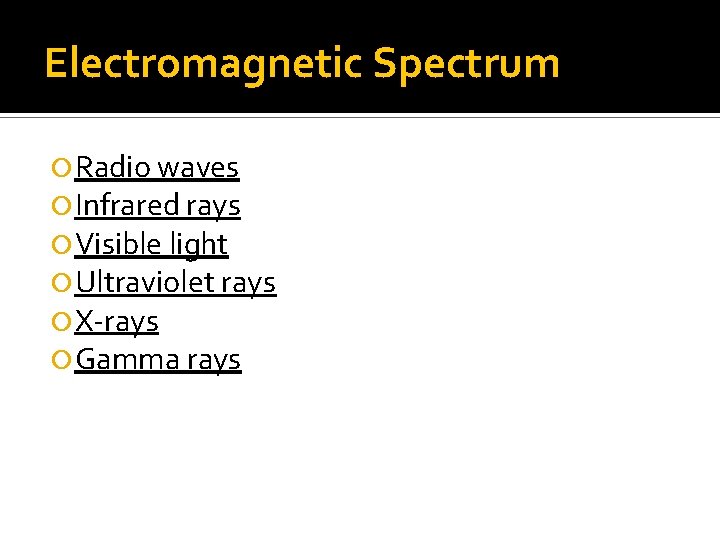
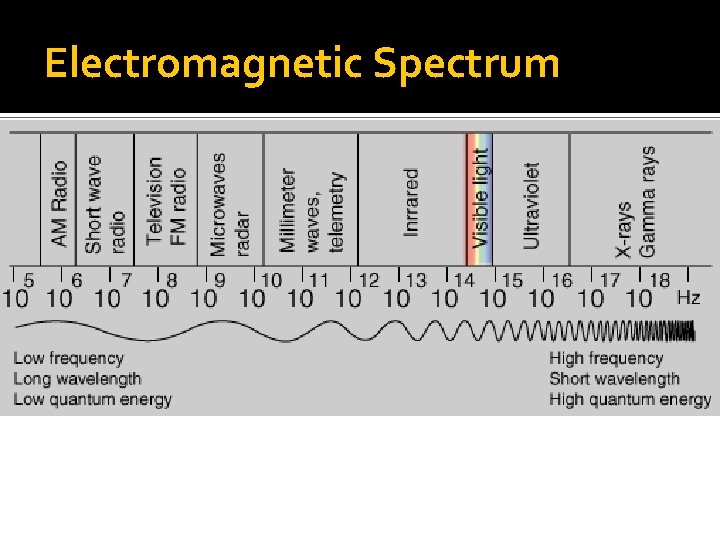
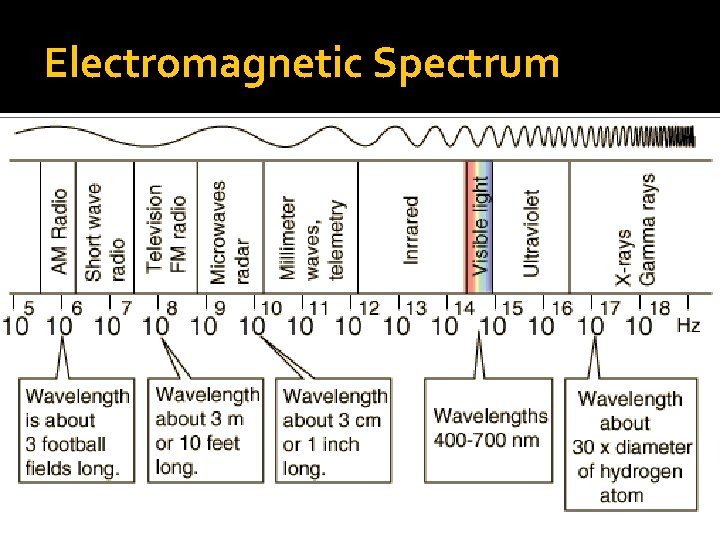
Electromagnetic Spectrum Radio waves Infrared rays Visible light Ultraviolet rays X-rays Gamma rays
Electromagnetic Spectrum
Electromagnetic Spectrum
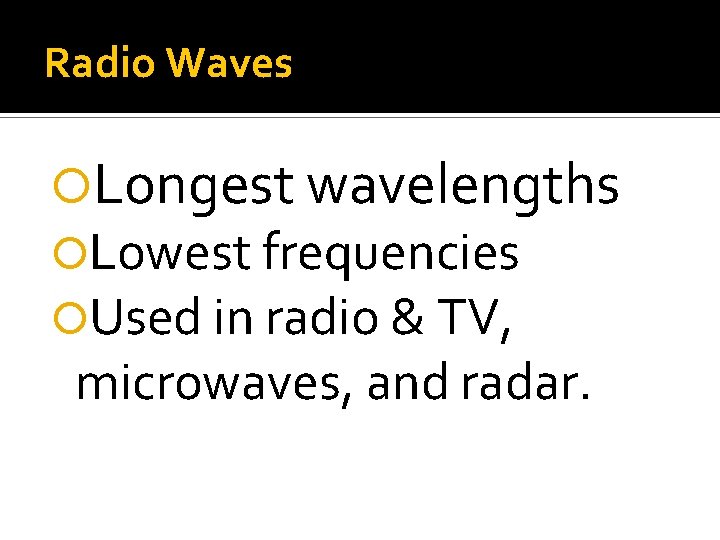
Radio Waves Longest wavelengths Lowest frequencies Used in radio & TV, microwaves, and radar.
Visible Light Can be seen by the human eye Each wavelength has a specific frequency and a particular color
Visible Light From highest wavelength & lowest frequency to lowest wavelength & highest frequency Red Orange Yellow Green Blue Indigo Violet ROY G BIV= way to remember
Ultraviolet Rays Higher frequencies than violet light Helps you skin produce vitamin D in moderation Excess causes sunburn, wrinkles, and skin cancer Kills microorganisms Used in plant nurseries during the winter Can cause eye damage
X-rays Can penetrate matter that light cannot In medicine-soft tissue looks dark, bones appear white Excess can kill tissue Used to inspect seals on cans Used to identify contents of large trucks, packages, and suitcases.
Gamma Rays Shortest wavelengths Highest frequencies Most energy Greatest penetration Overexposure is deadly Kills cancer cells Used to create images of the brain and to inspect pipelines
Chapter 18 Part 2 Light
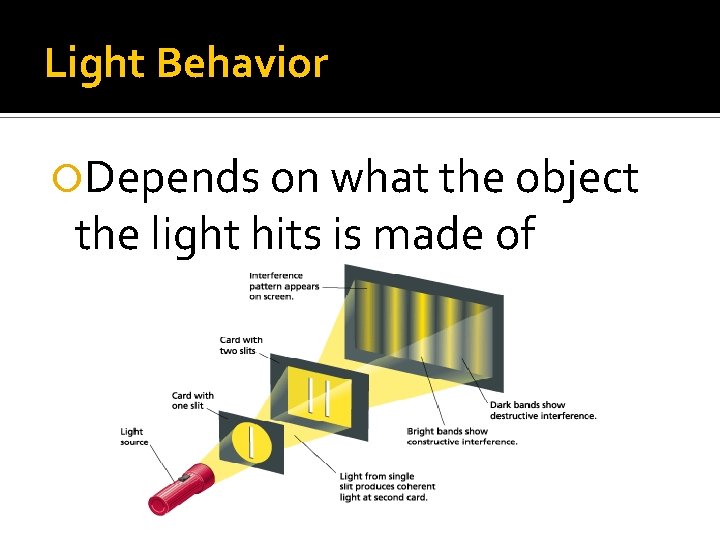
Light Behavior Depends on what the object the light hits is made of
Materials Transparent Translucent Opaque
Transparent Material You can see through this. Transmits light- allows light to pass through it
Translucent Material You can see through this but it is blurry. Scatters light
Opaque Material You cannot see through this. Absorbs or reflects all light
Light Interactions When light strikes a new medium, the light can be reflected, absorbed, or transmitted.
Light Interactions When light is transmitted, it can be refracted, polarized, or scattered.
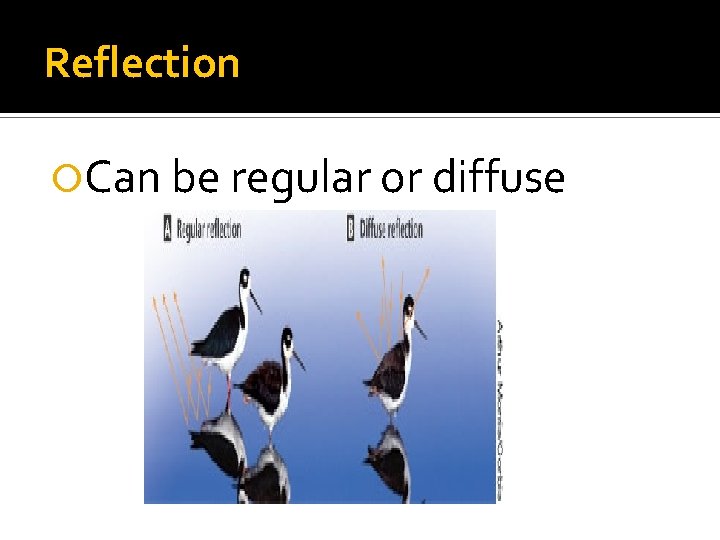
Reflection Can be regular or diffuse
Regular Reflection Parallel light waves hit a smooth surface and all reflect in the same direction
Diffuse Reflection Parallel light waves hit a rough surface and reflect in many different directions
Refraction Light waves are bent Causes mirages- false/distorted images
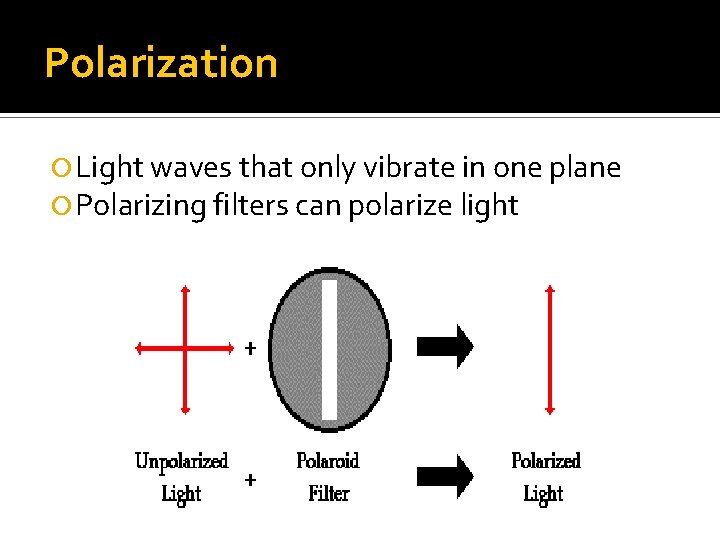
Polarization Light waves that only vibrate in one plane Polarizing filters can polarize light
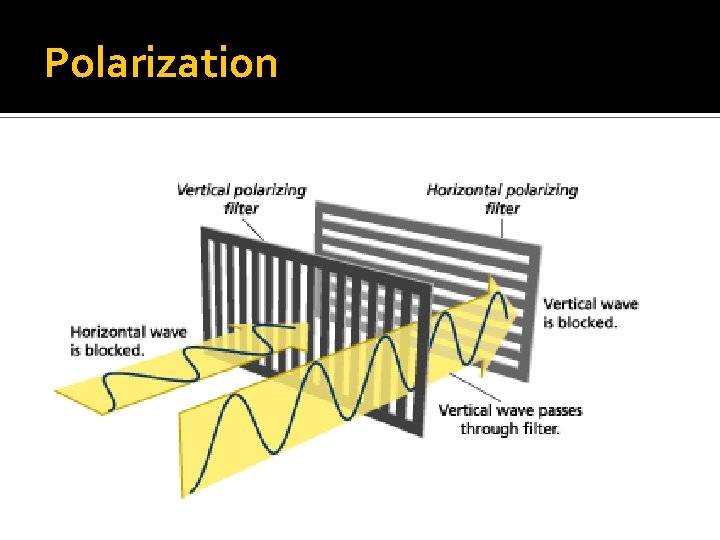
Polarization
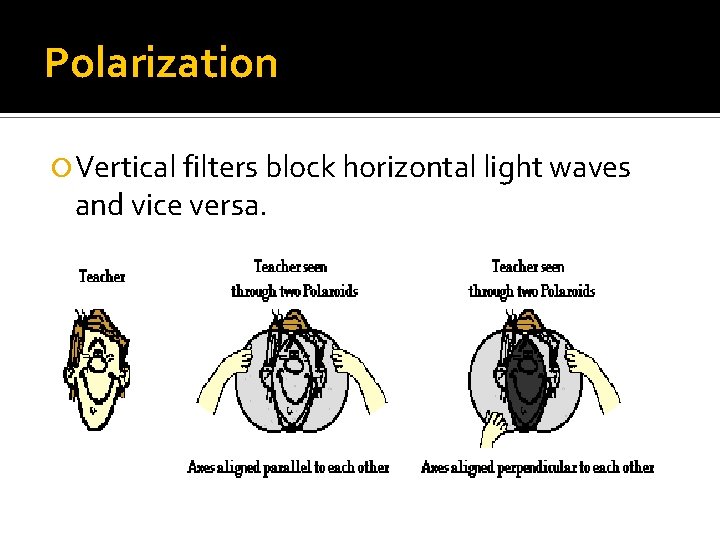
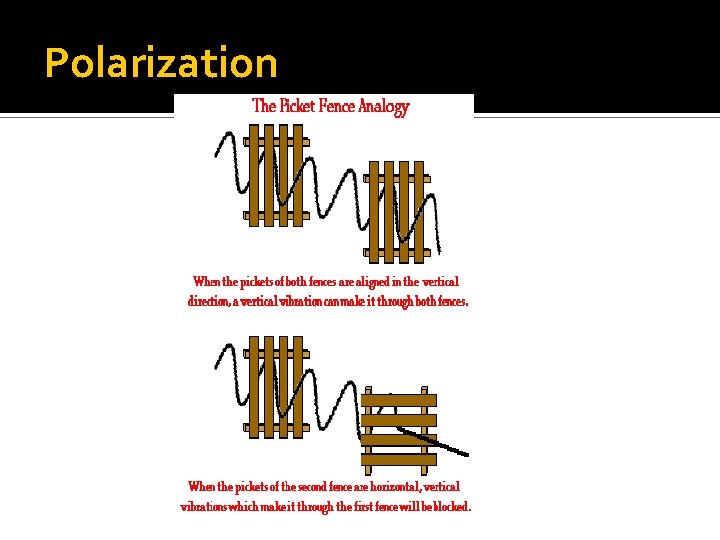
Polarization Vertical filters block horizontal light waves and vice versa.
Polarization
Scattering Light is redirected when it passes through a medium
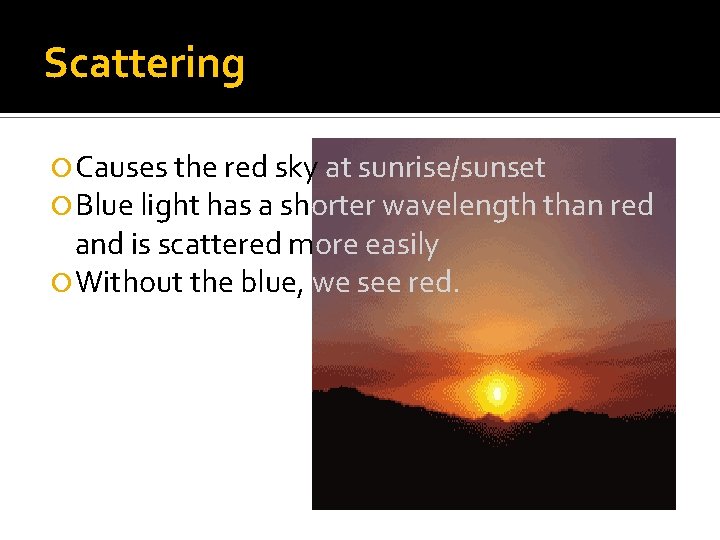
Scattering Causes the red sky at sunrise/sunset Blue light has a shorter wavelength than red and is scattered more easily Without the blue, we see red.
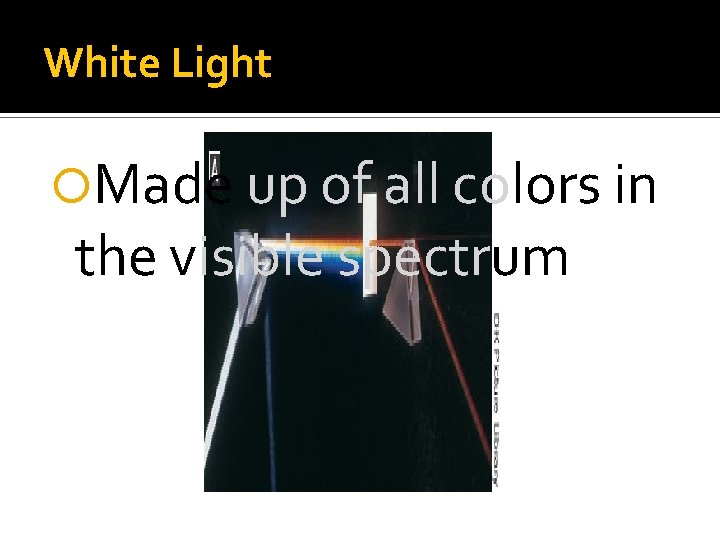
White Light Made up of all colors in the visible spectrum
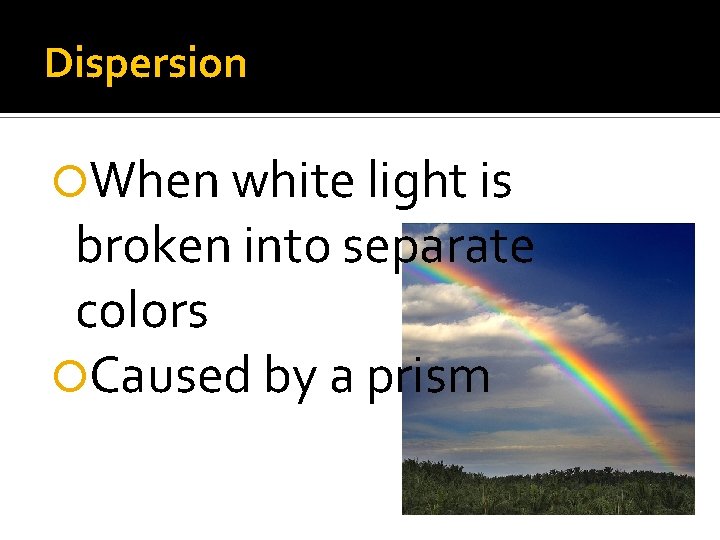
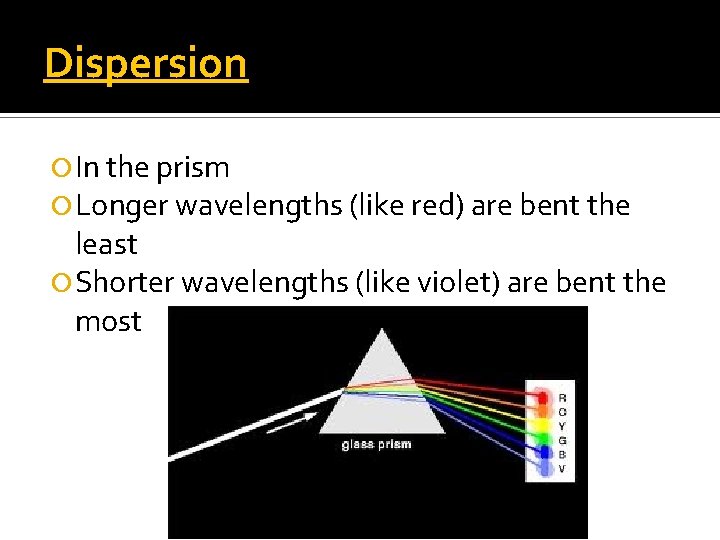
Dispersion When white light is broken into separate colors Caused by a prism
Dispersion In the prism Longer wavelengths (like red) are bent the least Shorter wavelengths (like violet) are bent the most
Color The color of any object depends on what the object is made of and on the color of light that strikes the object.
Color The color that we see is the color of light that an object does not absorb.
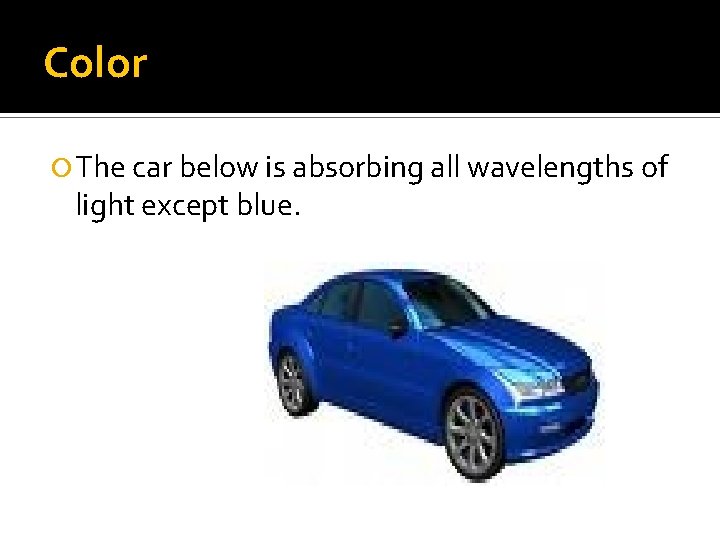
Color The car below is absorbing all wavelengths of light except blue.
Black and White- all light is reflected Black- all light is absorbed
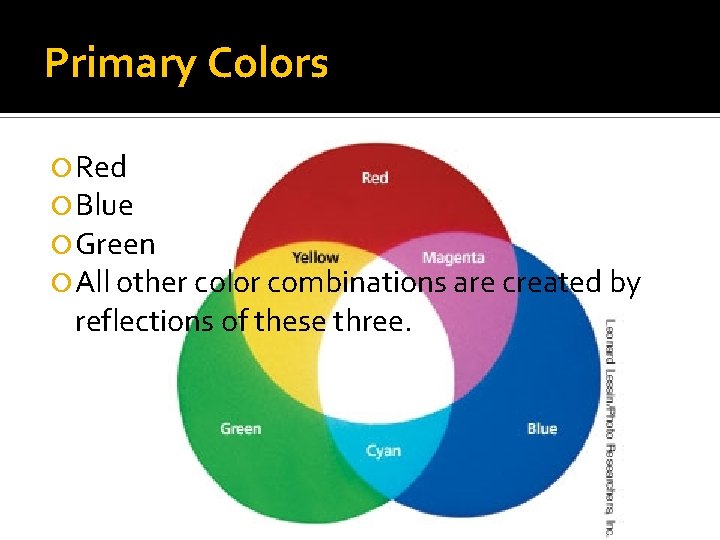
Primary Colors Red Blue Green All other color combinations are created by reflections of these three.