
Chapter 18 Electrochemistry Electrochemical Reactions In electrochemical reactions















- Slides: 55
Chapter 18 Electrochemistry
Electrochemical Reactions In electrochemical reactions, electrons are transferred from one species to another. Electrochemistry
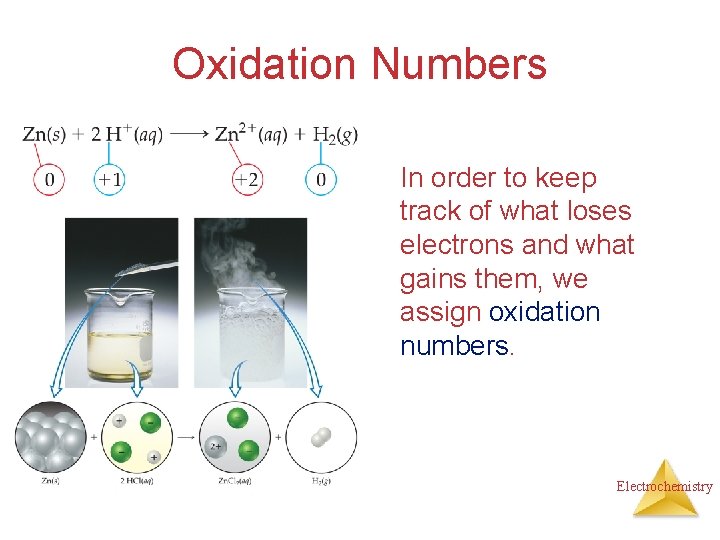
Oxidation Numbers In order to keep track of what loses electrons and what gains them, we assign oxidation numbers. Electrochemistry
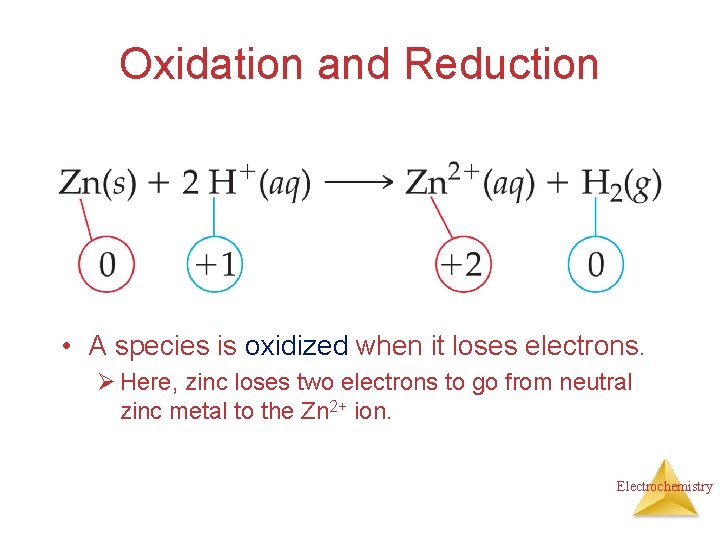
Oxidation and Reduction • A species is oxidized when it loses electrons. Ø Here, zinc loses two electrons to go from neutral zinc metal to the Zn 2+ ion. Electrochemistry
Oxidation and Reduction • A species is reduced when it gains electrons. Ø Here, each of the H+ gains an electron and they combine to form H 2. Electrochemistry
Oxidation and Reduction • What is reduced is the oxidizing agent. Ø H+ oxidizes Zn by taking electrons from it. • What is oxidized is the reducing agent. Ø Zn reduces H+ by giving it electrons. Electrochemistry
Assigning Oxidation Numbers 1. Elements in their elemental form have an oxidation number of 0. 2. The oxidation number of a monatomic ion is the same as its charge. Electrochemistry
Assigning Oxidation Numbers 3. Nonmetals tend to have negative oxidation numbers, although some are positive in certain compounds or ions. Ø Oxygen has an oxidation number of − 2, except in the peroxide ion in which it has an oxidation number of − 1. Ø Hydrogen is − 1 when bonded to a metal, +1 when bonded to a nonmetal. Electrochemistry
Assigning Oxidation Numbers 3. Nonmetals tend to have negative oxidation numbers, although some are positive in certain compounds or ions. Ø Fluorine always has an oxidation number of − 1. Ø The other halogens have an oxidation number of − 1 when they are negative; they can have positive oxidation numbers, however, most notably in oxyanions. Electrochemistry
Assigning Oxidation Numbers 4. The sum of the oxidation numbers in a neutral compound is 0. 5. The sum of the oxidation numbers in a polyatomic ion is the charge on the ion. Electrochemistry
Balancing Oxidation-Reduction Equations Perhaps the easiest way to balance the equation of an oxidation-reduction reaction is via the half-reaction method. Electrochemistry
Balancing Oxidation-Reduction Equations This involves treating (on paper only) the oxidation and reduction as two separate processes, balancing these half reactions, and then combining them to attain the balanced equation for the overall reaction. Electrochemistry
Half-Reaction Method 1. Assign oxidation numbers to determine what is oxidized and what is reduced. 2. Write the oxidation and reduction halfreactions. Electrochemistry
Half-Reaction Method 3. Balance each half-reaction. a. b. c. d. Balance elements other than H and O. Balance O by adding H 2 O. Balance H by adding H+. Balance charge by adding electrons. 4. Multiply the half-reactions by integers so that the electrons gained and lost are the same. Electrochemistry
Half-Reaction Method 5. Add the half-reactions, subtracting things that appear on both sides. 6. Make sure the equation is balanced according to mass. 7. Make sure the equation is balanced according to charge. Electrochemistry
Half-Reaction Method Consider the reaction between Mn. O 4− and C 2 O 42− : Mn. O 4−(aq) + C 2 O 42−(aq) Mn 2+(aq) + CO 2(aq) Electrochemistry
Half-Reaction Method First, we assign oxidation numbers. +7 +3 +2 +4 Mn. O 4− + C 2 O 42 - Mn 2+ + CO 2 Since the manganese goes from +7 to +2, it is reduced. Since the carbon goes from +3 to +4, it is oxidized. Electrochemistry
Oxidation Half-Reaction C 2 O 42− CO 2 To balance the carbon, we add a coefficient of 2: C 2 O 42− 2 CO 2 Electrochemistry
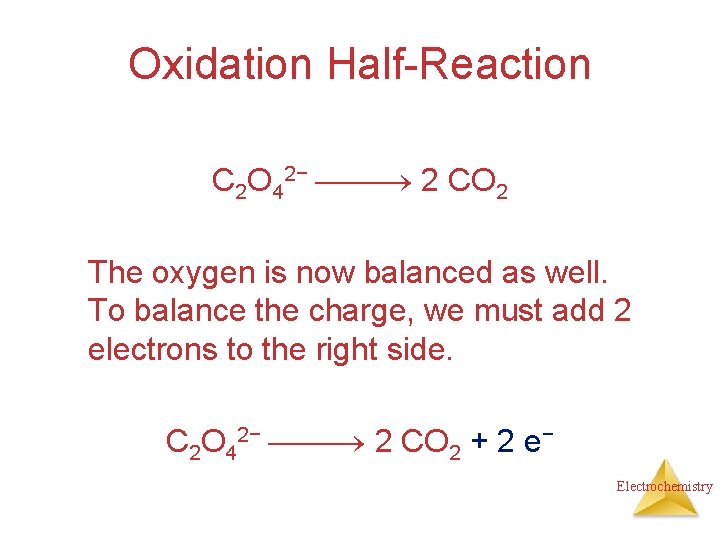
Oxidation Half-Reaction C 2 O 42− 2 CO 2 The oxygen is now balanced as well. To balance the charge, we must add 2 electrons to the right side. C 2 O 42− 2 CO 2 + 2 e− Electrochemistry
Reduction Half-Reaction Mn. O 4− Mn 2+ The manganese is balanced; to balance the oxygen, we must add 4 waters to the right side. Mn. O 4− Mn 2+ + 4 H 2 O Electrochemistry
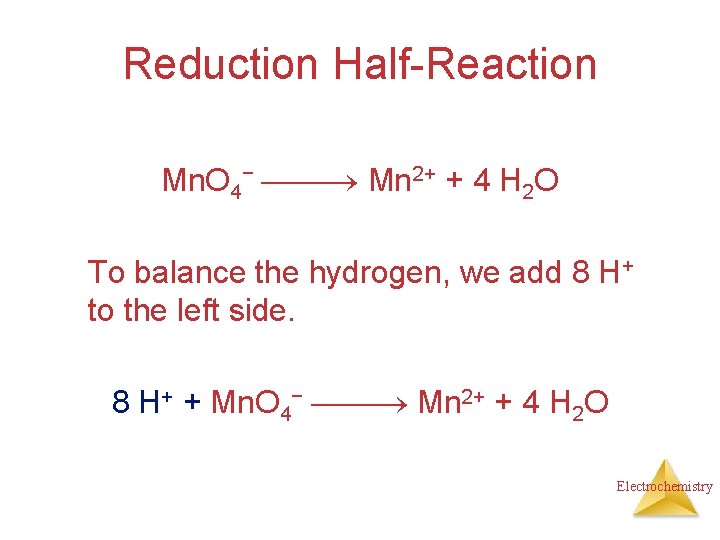
Reduction Half-Reaction Mn. O 4− Mn 2+ + 4 H 2 O To balance the hydrogen, we add 8 H+ to the left side. 8 H+ + Mn. O 4− Mn 2+ + 4 H 2 O Electrochemistry
Reduction Half-Reaction 8 H+ + Mn. O 4− Mn 2+ + 4 H 2 O To balance the charge, we add 5 e− to the left side. 5 e− + 8 H+ + Mn. O 4− Mn 2+ + 4 H 2 O Electrochemistry
Combining the Half-Reactions Now we evaluate the two half-reactions together: C 2 O 42− 2 CO 2 + 2 e− 5 e− + 8 H+ + Mn. O 4− Mn 2+ + 4 H 2 O To attain the same number of electrons on each side, we will multiply the first reaction by 5 and the second by 2. Electrochemistry
Combining the Half-Reactions 5 C 2 O 42− 10 CO 2 + 10 e− + 16 H+ + 2 Mn. O 4− 2 Mn 2+ + 8 H 2 O When we add these together, we get: 10 e− + 16 H+ + 2 Mn. O 4− + 5 C 2 O 42− 2 Mn 2+ + 8 H 2 O + 10 CO 2 +10 e− Electrochemistry
Combining the Half-Reactions 10 e− + 16 H+ + 2 Mn. O 4− + 5 C 2 O 42− 2 Mn 2+ + 8 H 2 O + 10 CO 2 +10 e− The only thing that appears on both sides are the electrons. Subtracting them, we are left with: 16 H+ + 2 Mn. O 4− + 5 C 2 O 42− 2 Mn 2+ + 8 H 2 O + 10 CO 2 Electrochemistry
Balancing in Basic Solution • If a reaction occurs in basic solution, one can balance it as if it occurred in acid. • Once the equation is balanced, add OH− to each side to “neutralize” the H+ in the equation and create water in its place. • If this produces water on both sides, you might have to subtract water from each side. Electrochemistry
Voltaic Cells In spontaneous oxidation-reduction (redox) reactions, electrons are transferred and energy is released. Electrochemistry
Voltaic Cells • We can use that energy to do work if we make the electrons flow through an external device. • We call such a setup a voltaic cell. Electrochemistry
Voltaic Cells • A typical cell looks like this. • The oxidation occurs at the anode. • The reduction occurs at the cathode. Electrochemistry
Voltaic Cells Once even one electron flows from the anode to the cathode, the charges in each beaker would not be balanced and the flow of electrons would stop. Electrochemistry
Voltaic Cells • Therefore, we use a salt bridge, usually a U-shaped tube that contains a salt solution, to keep the charges balanced. Ø Cations move toward the cathode. Ø Anions move toward the anode. Electrochemistry
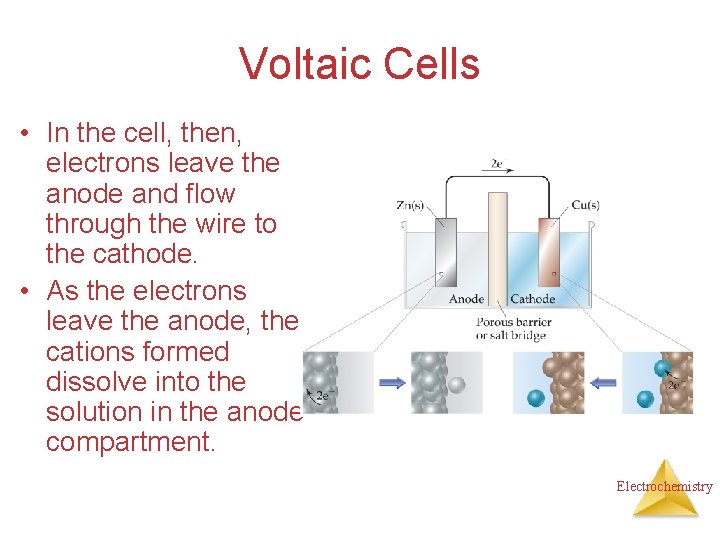
Voltaic Cells • In the cell, then, electrons leave the anode and flow through the wire to the cathode. • As the electrons leave the anode, the cations formed dissolve into the solution in the anode compartment. Electrochemistry
Voltaic Cells • As the electrons reach the cathode, cations in the cathode are attracted to the now negative cathode. • The electrons are taken by the cation, and the neutral metal is deposited on the cathode. Electrochemistry
Electromotive Force (emf) • Water only spontaneously flows one way in a waterfall. • Likewise, electrons only spontaneously flow one way in a redox reaction—from higher to lower potential energy. Electrochemistry
Electromotive Force (emf) • The potential difference between the anode and cathode in a cell is called the electromotive force (emf). • It is also called the cell potential, and is designated Ecell. Electrochemistry
Cell Potential Cell potential is measured in volts (V). J 1 V=1 C Electrochemistry
Standard Reduction Potentials Reduction potentials for many electrodes have been measured and tabulated. Electrochemistry
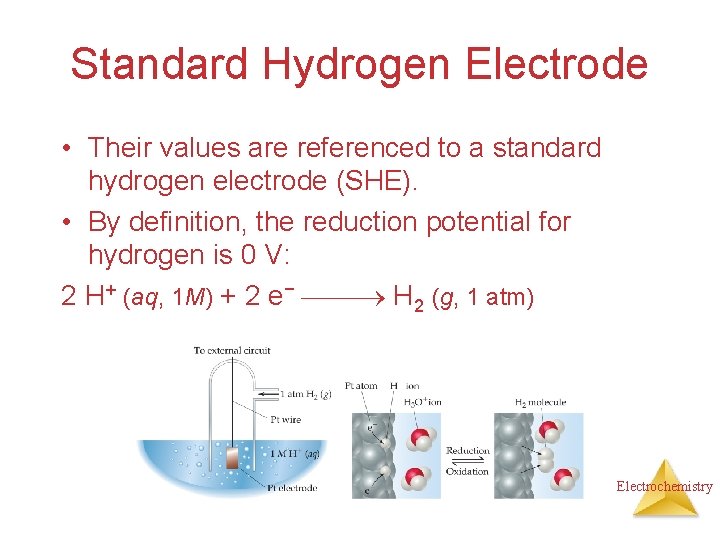
Standard Hydrogen Electrode • Their values are referenced to a standard hydrogen electrode (SHE). • By definition, the reduction potential for hydrogen is 0 V: 2 H+ (aq, 1 M) + 2 e− H 2 (g, 1 atm) Electrochemistry
Standard Cell Potentials The cell potential at standard conditions can be found through this equation: Ecell (cathode) − Ered (anode) = Ered Because cell potential is based on the potential energy per unit of charge, it is an intensive property. Electrochemistry
Cell Potentials • For the oxidation in this cell, Ered = − 0. 76 V • For the reduction, Ered = +0. 34 V Electrochemistry
Cell Potentials Ecell = Ered (cathode) − Ered (anode) = +0. 34 V − (− 0. 76 V) = +1. 10 V Electrochemistry
Oxidizing and Reducing Agents • The strongest oxidizers have the most positive reduction potentials. • The strongest reducers have the most negative reduction potentials. Electrochemistry
Oxidizing and Reducing Agents The greater the difference between the two, the greater the voltage of the cell. Electrochemistry
Free Energy G for a redox reaction can be found by using the equation G = −n. FE where n is the number of moles of electrons transferred, and F is a constant, the Faraday. 1 F = 96, 485 C/mol = 96, 485 J/V-mol Electrochemistry
Free Energy Under standard conditions, G = −n. FE Electrochemistry
Nernst Equation • Remember that G = G + RT ln Q • This means −n. FE = −n. FE + RT ln Q Electrochemistry
Nernst Equation Dividing both sides by −n. F, we get the Nernst equation: RT ln Q E = E − n. F or, using base-10 logarithms, 2. 303 RT ln Q E = E − n. F Electrochemistry
Nernst Equation At room temperature (298 K), 2. 303 RT = 0. 0592 V F Thus the equation becomes 0. 0592 ln Q E = E − n Electrochemistry
Concentration Cells • Notice that the Nernst equation implies that a cell could be created that has the same substance at both electrodes. would be 0, but Q would not. • For such a cell, Ecell • Therefore, as long as the concentrations are different, E will not be 0. Electrochemistry
Applications of Oxidation-Reduction Reactions Electrochemistry
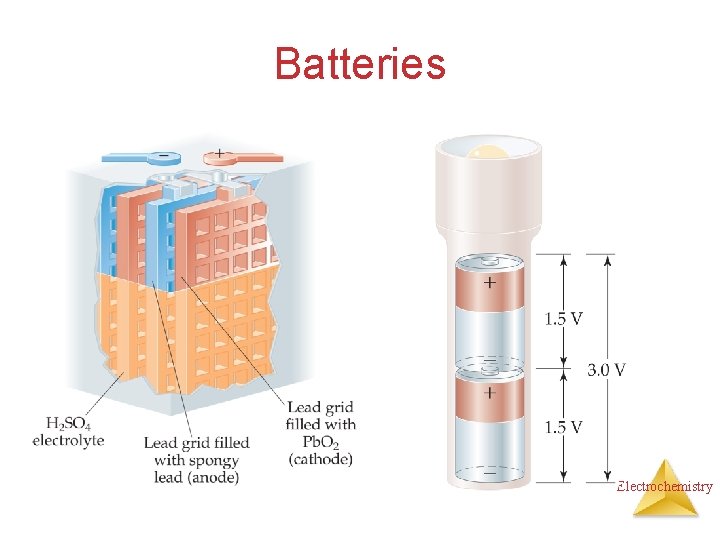
Batteries Electrochemistry
Alkaline Batteries Electrochemistry
Hydrogen Fuel Cells Electrochemistry
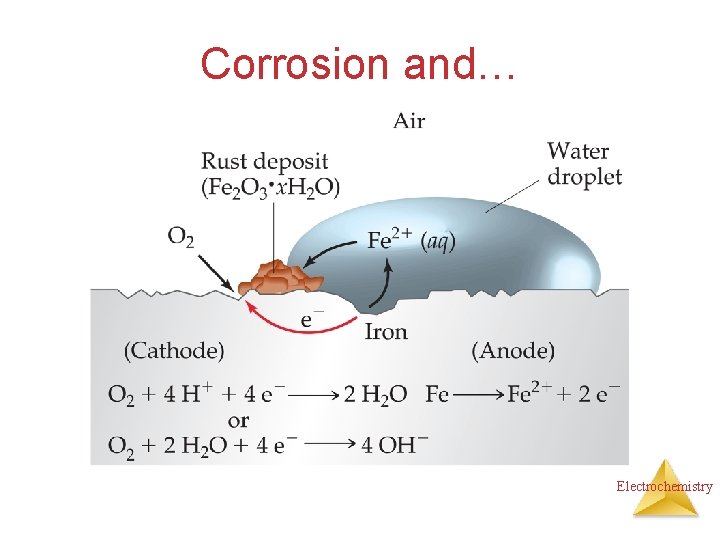
Corrosion and… Electrochemistry
…Corrosion Prevention Electrochemistry