
Chapter 18 Electric Currents 2014 Pearson Education Inc
- Slides: 35
Chapter 18 Electric Currents © 2014 Pearson Education, Inc.
Contents of Chapter 18 • The Electric Battery • Electric Current • Ohm’s Law: Resistance and Resistors • Resistivity • Electric Power © 2014 Pearson Education, Inc.
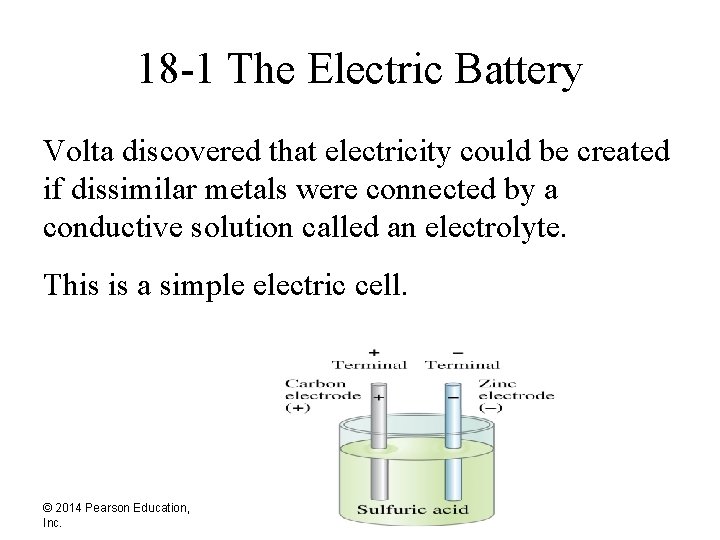
18 -1 The Electric Battery Volta discovered that electricity could be created if dissimilar metals were connected by a conductive solution called an electrolyte. This is a simple electric cell. © 2014 Pearson Education, Inc.
18 -1 The Electric Battery A battery transforms chemical energy into electrical energy. Chemical reactions within the cell create a potential difference between the terminals by slowly dissolving them. This potential difference can be maintained even if a current is kept flowing, until one or the other terminal is completely dissolved. © 2014 Pearson Education, Inc.
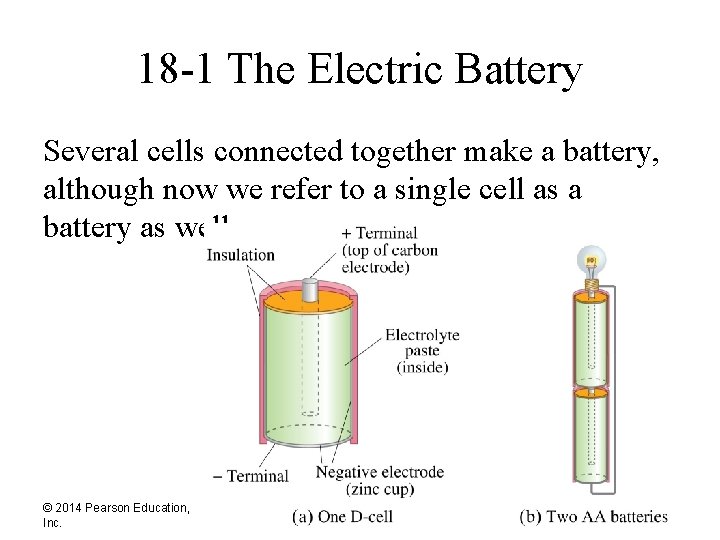
18 -1 The Electric Battery Several cells connected together make a battery, although now we refer to a single cell as a battery as well. © 2014 Pearson Education, Inc.
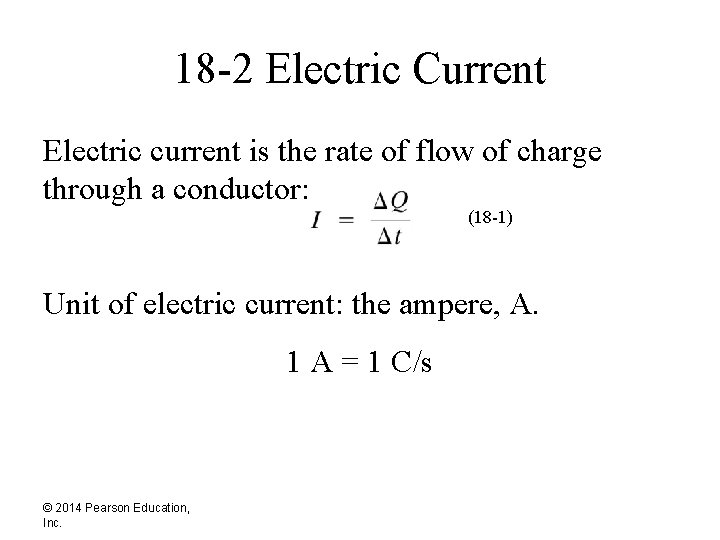
18 -2 Electric Current Electric current is the rate of flow of charge through a conductor: (18 -1) Unit of electric current: the ampere, A. 1 A = 1 C/s © 2014 Pearson Education, Inc.
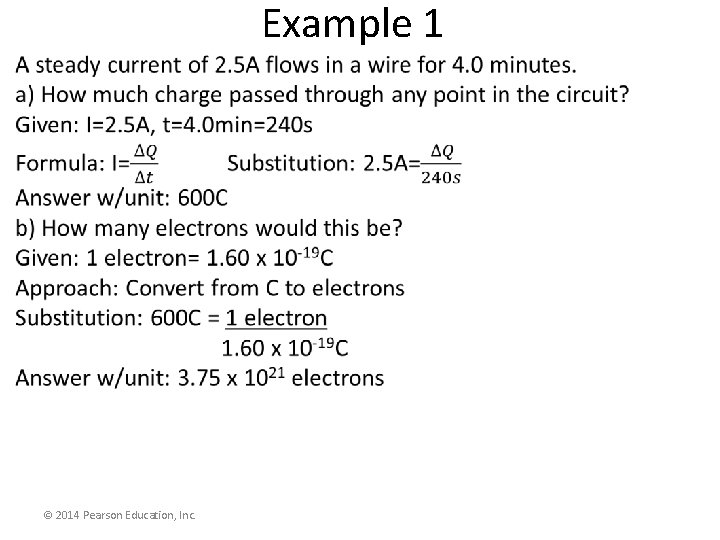
Example 1 • © 2014 Pearson Education, Inc.
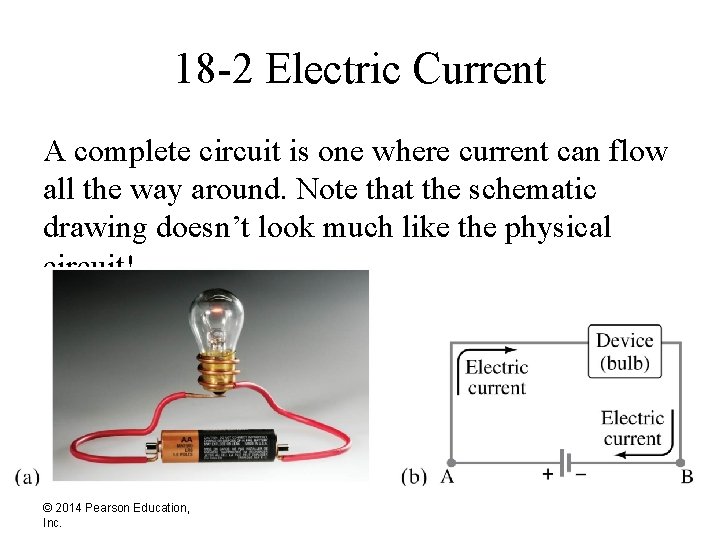
18 -2 Electric Current A complete circuit is one where current can flow all the way around. Note that the schematic drawing doesn’t look much like the physical circuit! © 2014 Pearson Education, Inc.
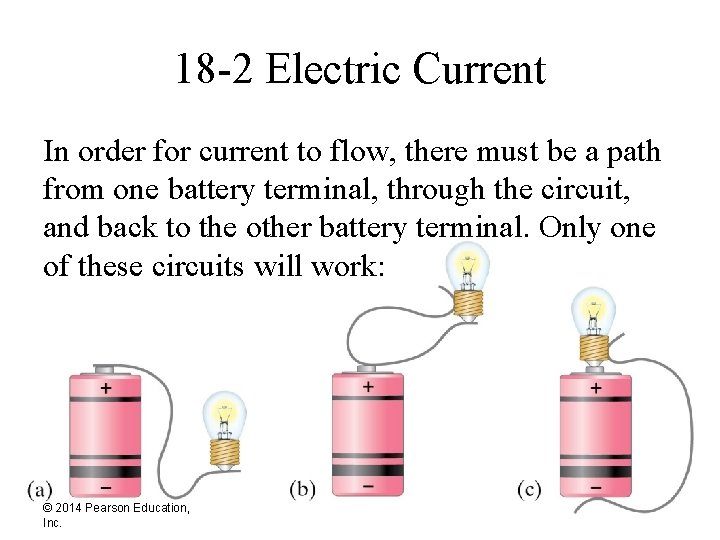
18 -2 Electric Current In order for current to flow, there must be a path from one battery terminal, through the circuit, and back to the other battery terminal. Only one of these circuits will work: © 2014 Pearson Education, Inc.
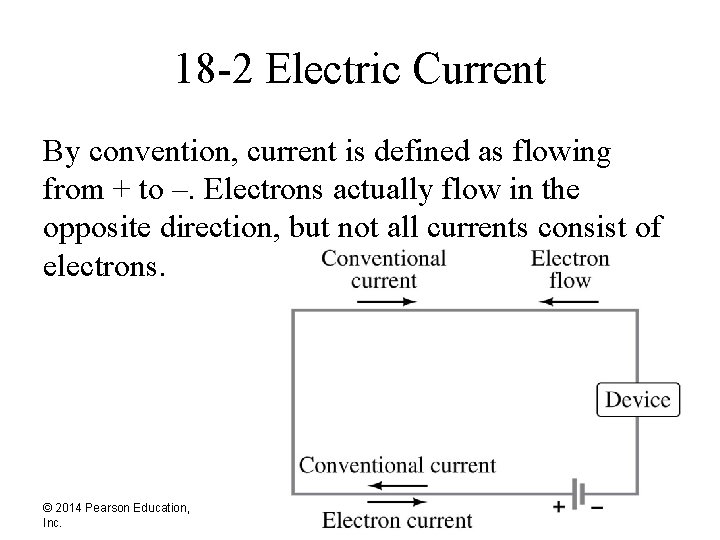
18 -2 Electric Current By convention, current is defined as flowing from + to –. Electrons actually flow in the opposite direction, but not all currents consist of electrons. © 2014 Pearson Education, Inc.
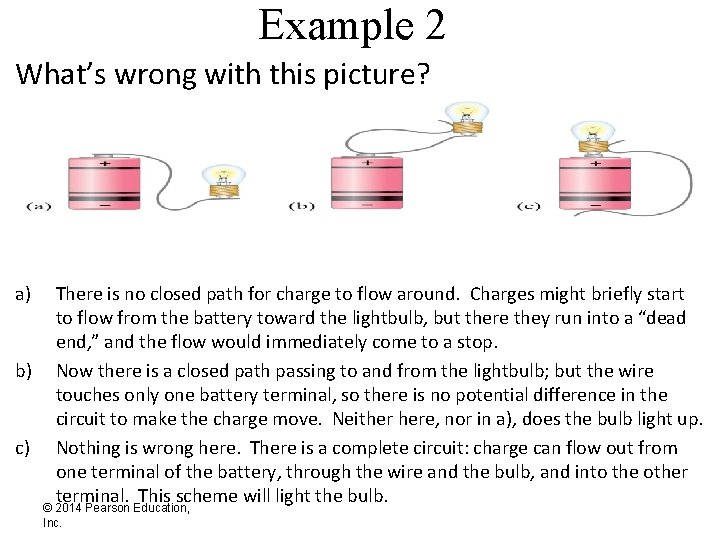
Example 2 What’s wrong with this picture? a) b) c) There is no closed path for charge to flow around. Charges might briefly start to flow from the battery toward the lightbulb, but there they run into a “dead end, ” and the flow would immediately come to a stop. Now there is a closed path passing to and from the lightbulb; but the wire touches only one battery terminal, so there is no potential difference in the circuit to make the charge move. Neither here, nor in a), does the bulb light up. Nothing is wrong here. There is a complete circuit: charge can flow out from one terminal of the battery, through the wire and the bulb, and into the other terminal. This scheme will light the bulb. © 2014 Pearson Education, Inc.
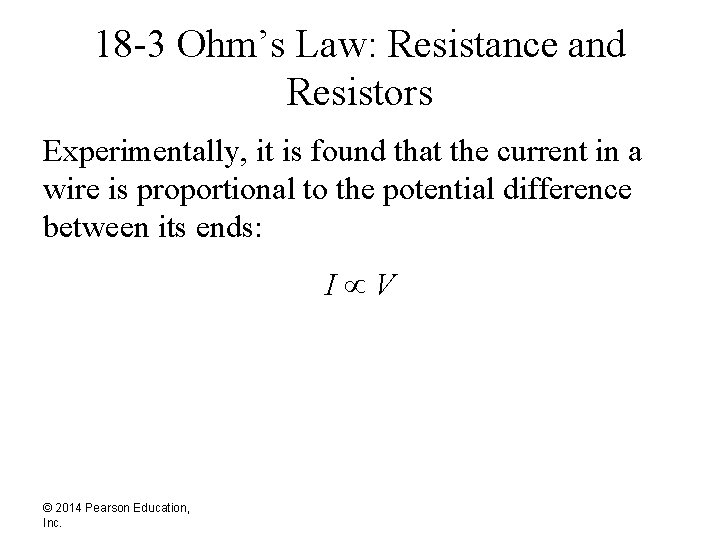
18 -3 Ohm’s Law: Resistance and Resistors Experimentally, it is found that the current in a wire is proportional to the potential difference between its ends: I V © 2014 Pearson Education, Inc.
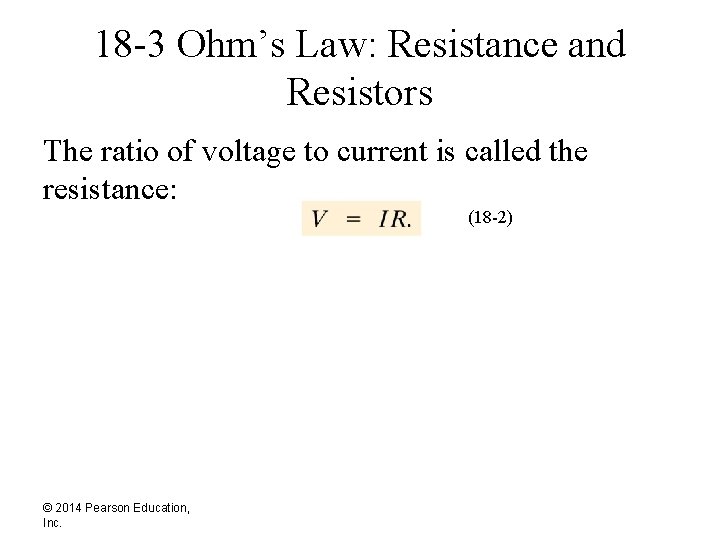
18 -3 Ohm’s Law: Resistance and Resistors The ratio of voltage to current is called the resistance: (18 -2) © 2014 Pearson Education, Inc.
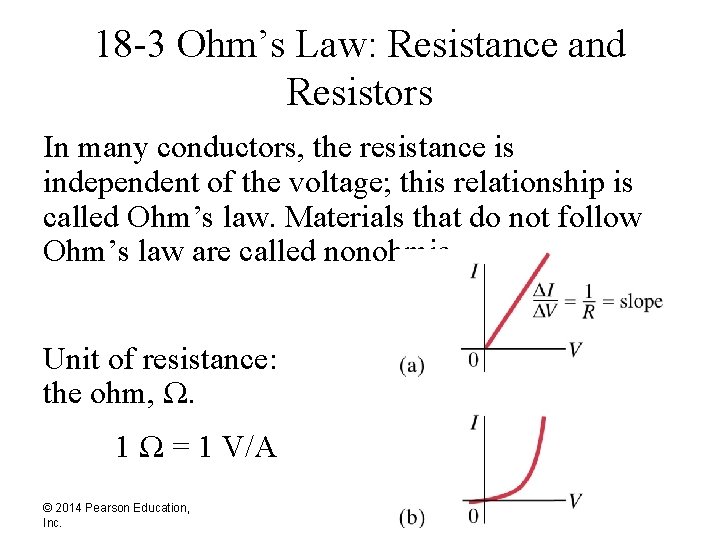
18 -3 Ohm’s Law: Resistance and Resistors In many conductors, the resistance is independent of the voltage; this relationship is called Ohm’s law. Materials that do not follow Ohm’s law are called nonohmic. Unit of resistance: the ohm, Ω. 1 Ω = 1 V/A © 2014 Pearson Education, Inc.
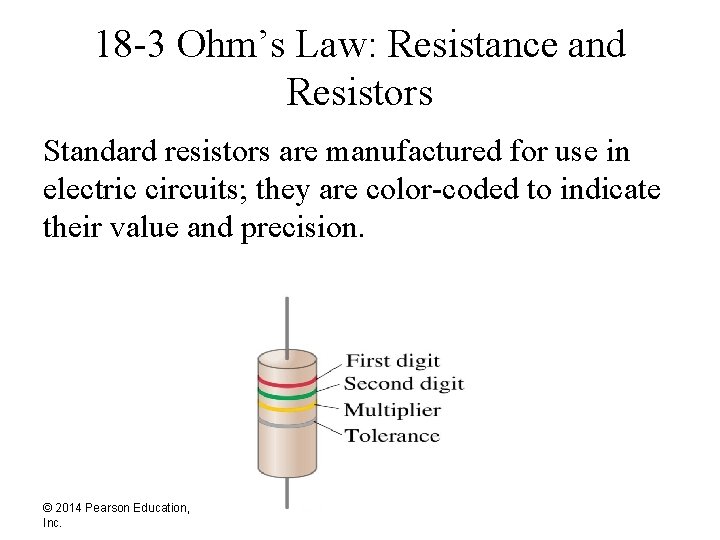
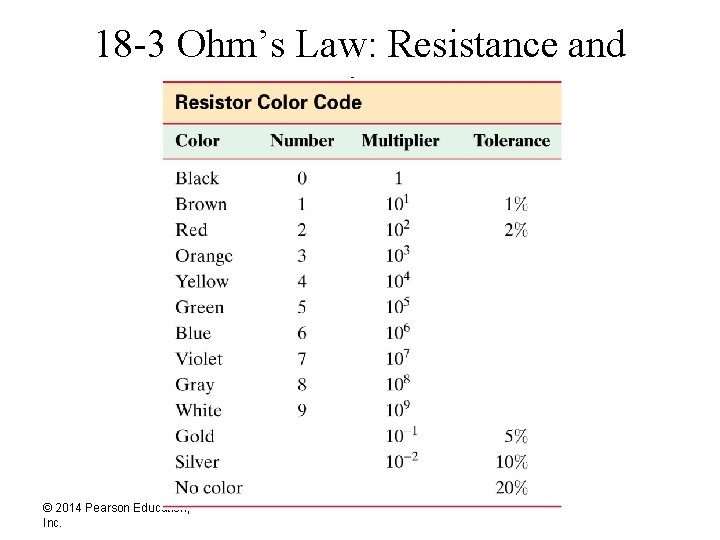
18 -3 Ohm’s Law: Resistance and Resistors Standard resistors are manufactured for use in electric circuits; they are color-coded to indicate their value and precision. © 2014 Pearson Education, Inc.
18 -3 Ohm’s Law: Resistance and Resistors © 2014 Pearson Education, Inc.
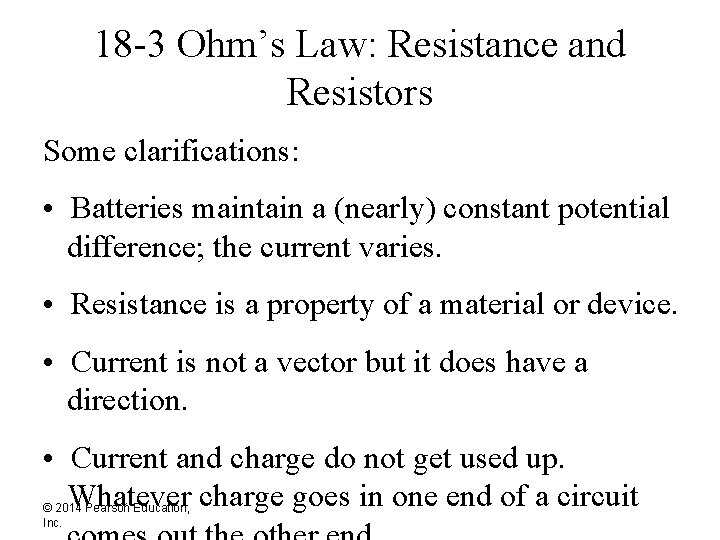
18 -3 Ohm’s Law: Resistance and Resistors Some clarifications: • Batteries maintain a (nearly) constant potential difference; the current varies. • Resistance is a property of a material or device. • Current is not a vector but it does have a direction. • Current and charge do not get used up. Whatever charge goes in one end of a circuit © 2014 Pearson Education, Inc.
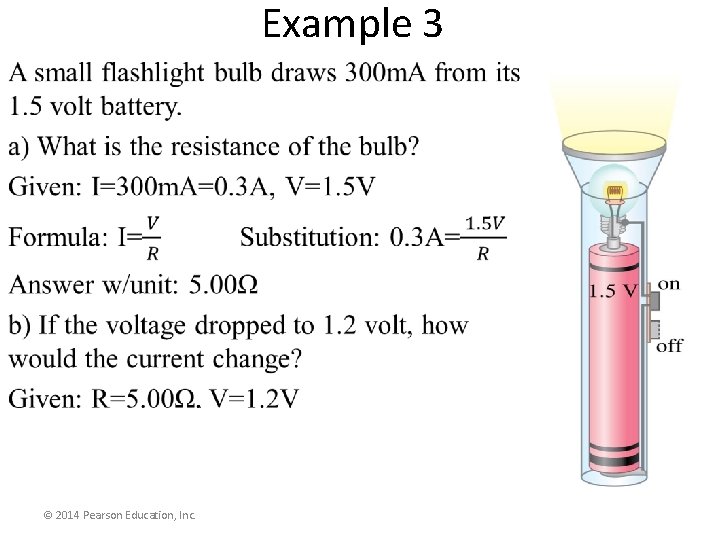
Example 3 • © 2014 Pearson Education, Inc.
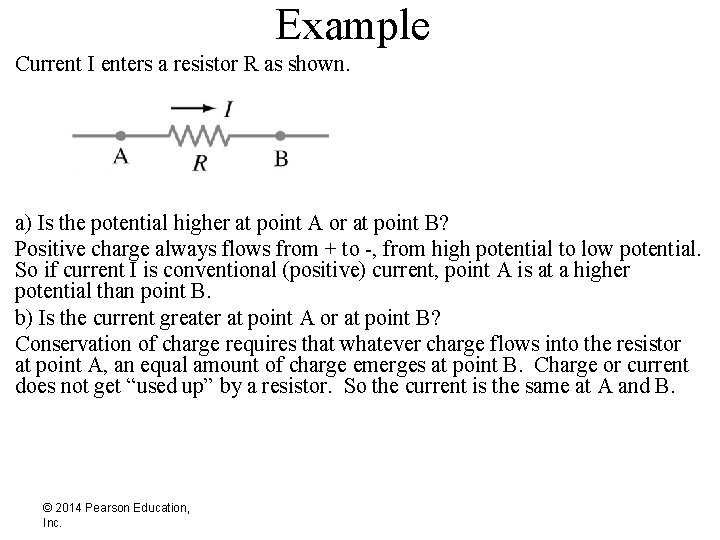
Example Current I enters a resistor R as shown. a) Is the potential higher at point A or at point B? Positive charge always flows from + to -, from high potential to low potential. So if current I is conventional (positive) current, point A is at a higher potential than point B. b) Is the current greater at point A or at point B? Conservation of charge requires that whatever charge flows into the resistor at point A, an equal amount of charge emerges at point B. Charge or current does not get “used up” by a resistor. So the current is the same at A and B. © 2014 Pearson Education, Inc.
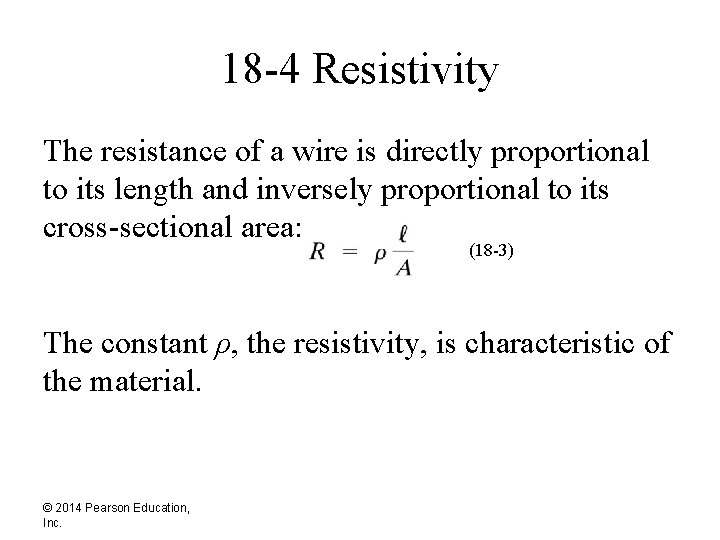
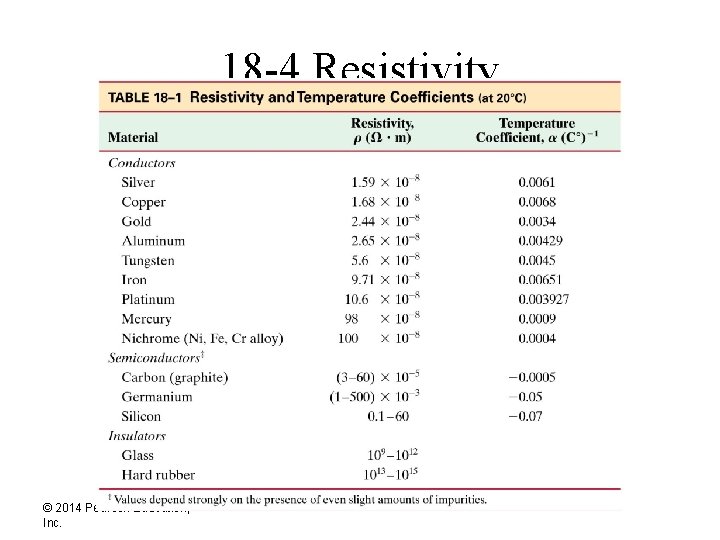
18 -4 Resistivity The resistance of a wire is directly proportional to its length and inversely proportional to its cross-sectional area: (18 -3) The constant ρ, the resistivity, is characteristic of the material. © 2014 Pearson Education, Inc.
18 -4 Resistivity © 2014 Pearson Education, Inc.
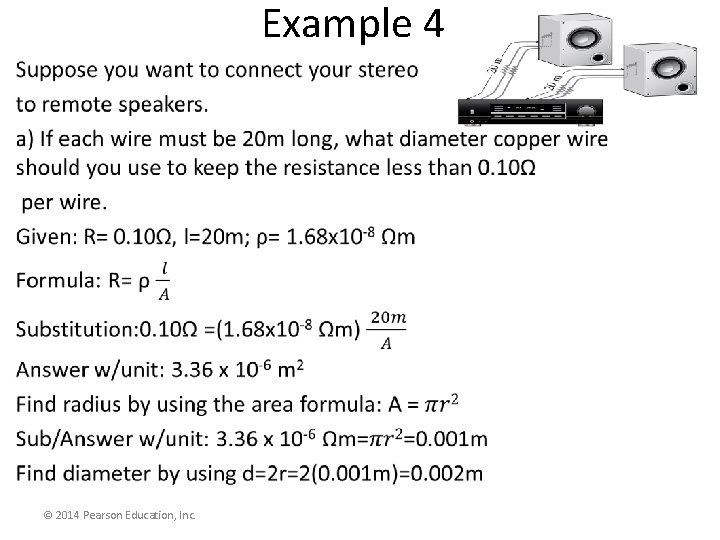
Example 4 • © 2014 Pearson Education, Inc.
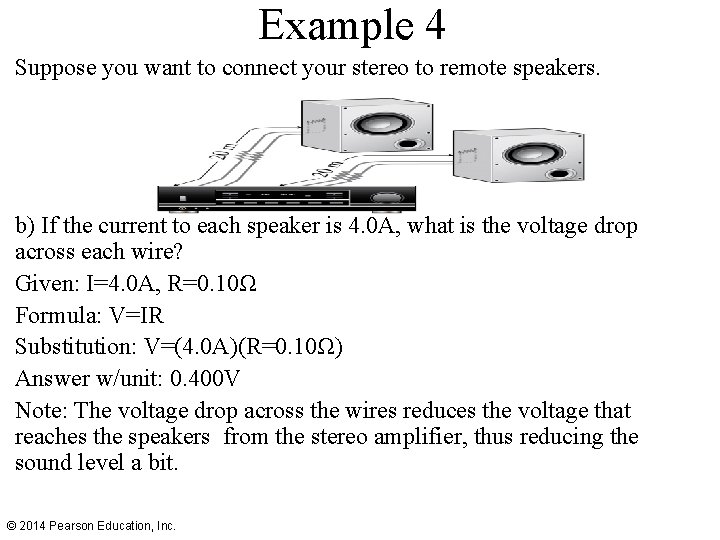
Example 4 Suppose you want to connect your stereo to remote speakers. b) If the current to each speaker is 4. 0 A, what is the voltage drop across each wire? Given: I=4. 0 A, R=0. 10Ω Formula: V=IR Substitution: V=(4. 0 A)(R=0. 10Ω) Answer w/unit: 0. 400 V Note: The voltage drop across the wires reduces the voltage that reaches the speakers from the stereo amplifier, thus reducing the sound level a bit. © 2014 Pearson Education, Inc.
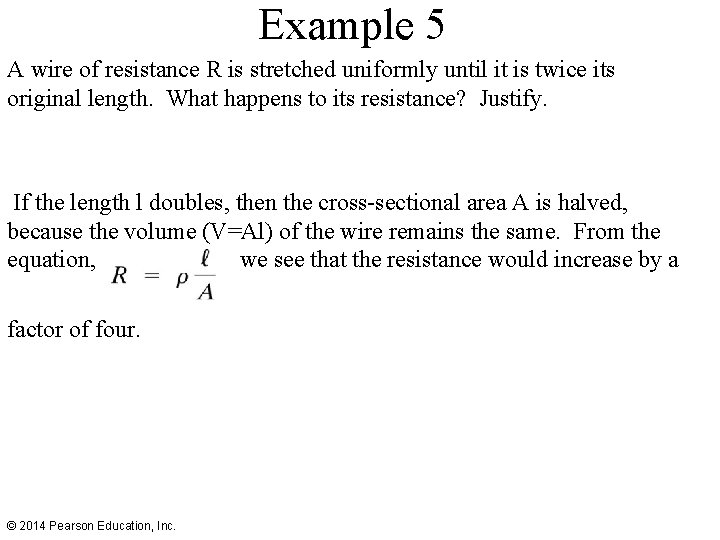
Example 5 A wire of resistance R is stretched uniformly until it is twice its original length. What happens to its resistance? Justify. If the length l doubles, then the cross-sectional area A is halved, because the volume (V=Al) of the wire remains the same. From the equation, we see that the resistance would increase by a factor of four. © 2014 Pearson Education, Inc.
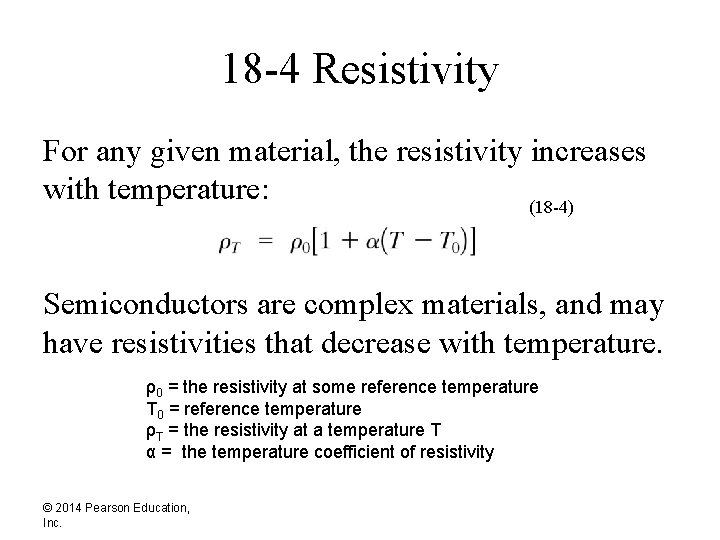
18 -4 Resistivity For any given material, the resistivity increases with temperature: (18 -4) Semiconductors are complex materials, and may have resistivities that decrease with temperature. ρ0 = the resistivity at some reference temperature T 0 = reference temperature ρT = the resistivity at a temperature T α = the temperature coefficient of resistivity © 2014 Pearson Education, Inc.
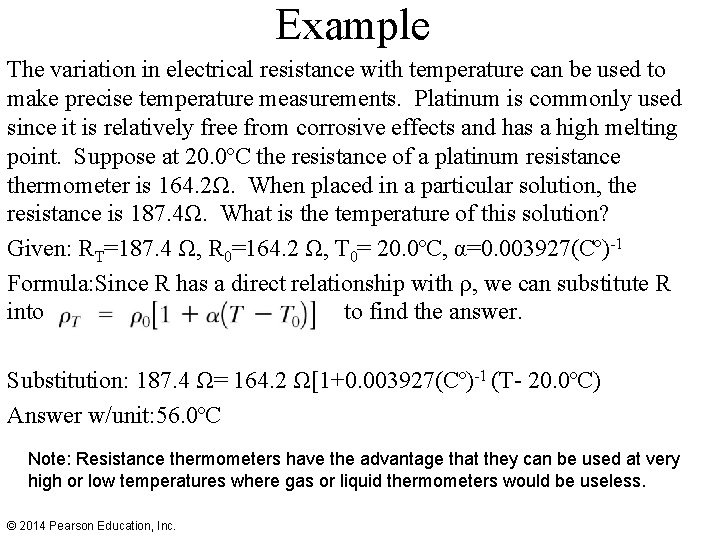
Example The variation in electrical resistance with temperature can be used to make precise temperature measurements. Platinum is commonly used since it is relatively free from corrosive effects and has a high melting point. Suppose at 20. 0ºC the resistance of a platinum resistance thermometer is 164. 2Ω. When placed in a particular solution, the resistance is 187. 4Ω. What is the temperature of this solution? Given: RT=187. 4 Ω, R 0=164. 2 Ω, T 0= 20. 0ºC, α=0. 003927(Cº)-1 Formula: Since R has a direct relationship with ρ, we can substitute R into to find the answer. Substitution: 187. 4 Ω= 164. 2 Ω[1+0. 003927(Cº)-1 (T- 20. 0ºC) Answer w/unit: 56. 0ºC Note: Resistance thermometers have the advantage that they can be used at very high or low temperatures where gas or liquid thermometers would be useless. © 2014 Pearson Education, Inc.
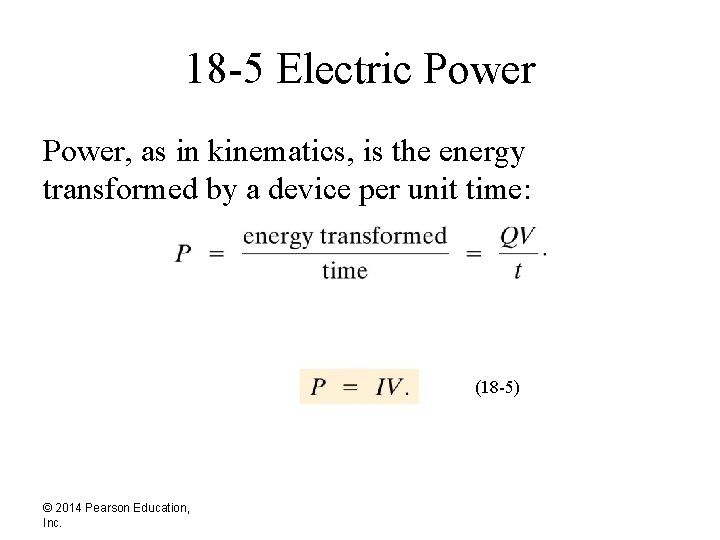
18 -5 Electric Power, as in kinematics, is the energy transformed by a device per unit time: (18 -5) © 2014 Pearson Education, Inc.
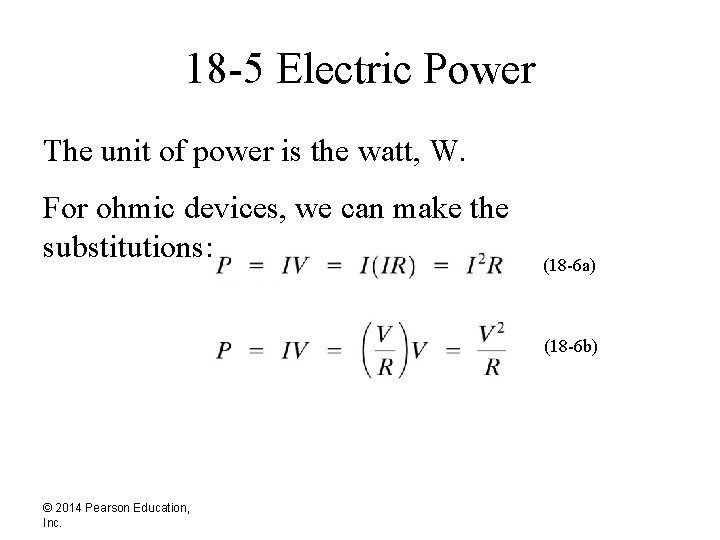
18 -5 Electric Power The unit of power is the watt, W. For ohmic devices, we can make the substitutions: (18 -6 a) (18 -6 b) © 2014 Pearson Education, Inc.
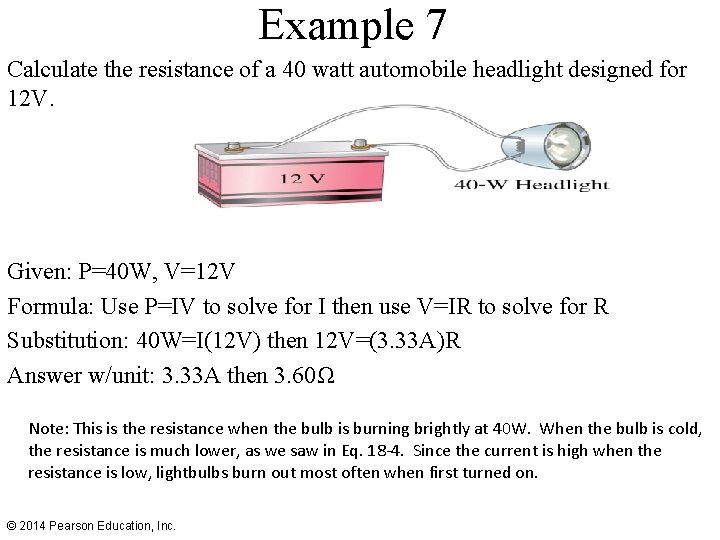
Example 7 Calculate the resistance of a 40 watt automobile headlight designed for 12 V. Given: P=40 W, V=12 V Formula: Use P=IV to solve for I then use V=IR to solve for R Substitution: 40 W=I(12 V) then 12 V=(3. 33 A)R Answer w/unit: 3. 33 A then 3. 60Ω Note: This is the resistance when the bulb is burning brightly at 40 W. When the bulb is cold, the resistance is much lower, as we saw in Eq. 18 -4. Since the current is high when the resistance is low, lightbulbs burn out most often when first turned on. © 2014 Pearson Education, Inc.
18 -5 Electric Power What you pay for on your electric bill is not power, but energy—the power consumption multiplied by the time. We have been measuring energy in joules, but the electric company measures it in kilowatthours, k. Wh. One k. Wh = (1000 W)(3600 s) = 3. 60 x 106 J © 2014 Pearson Education, Inc.
Example 8 An electric heater draws 15. 0 A on a 120 V line. How much power does it use and how much does it cost per month (30 days) if it operates 3. 0 h per day and the electric company charges 10. 5 cents per k. Wh? Given: I-15. 0 A, V=120 V, t=30 days(3 h/day)=90 h, cost 10. 5 cents/k. Wh=$0. 105/k. Wh Approach: Use P=IV to solve for power, convert power to k. W. Use E=Pt to solve for energy used then multiply by cost. Substitution: P=15. 0 A (120 V) Answer w/unit: 1800 W=1. 80 k. W Substitution: E=(1. 80 k. W)(90 h)(0. 105/k. Wh) Answer w/unit: $17. 01 Note: Household current is actually alternating (ac), but our solution is still valid assuming the given values for V and I are the proper averages. © 2014 Pearson Education, Inc.
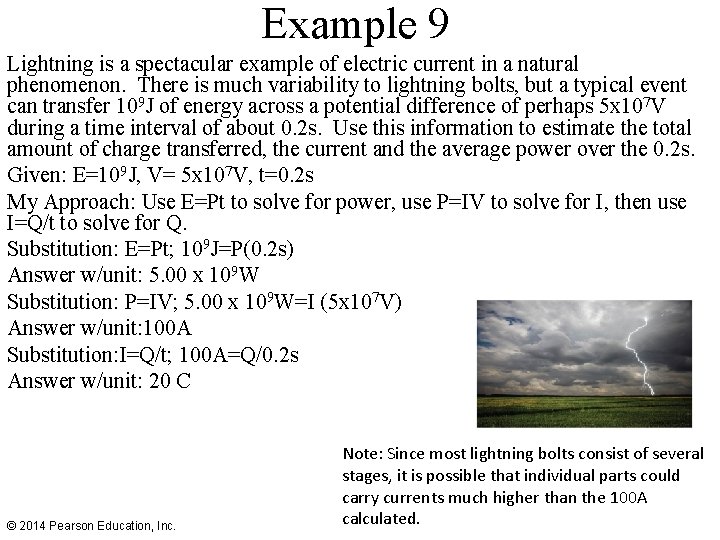
Example 9 Lightning is a spectacular example of electric current in a natural phenomenon. There is much variability to lightning bolts, but a typical event can transfer 109 J of energy across a potential difference of perhaps 5 x 10⁷ V during a time interval of about 0. 2 s. Use this information to estimate the total amount of charge transferred, the current and the average power over the 0. 2 s. Given: E=109 J, V= 5 x 10⁷ V, t=0. 2 s My Approach: Use E=Pt to solve for power, use P=IV to solve for I, then use I=Q/t to solve for Q. Substitution: E=Pt; 109 J=P(0. 2 s) Answer w/unit: 5. 00 x 109 W Substitution: P=IV; 5. 00 x 109 W=I (5 x 10⁷ V) Answer w/unit: 100 A Substitution: I=Q/t; 100 A=Q/0. 2 s Answer w/unit: 20 C © 2014 Pearson Education, Inc. Note: Since most lightning bolts consist of several stages, it is possible that individual parts could carry currents much higher than the 100 A calculated.
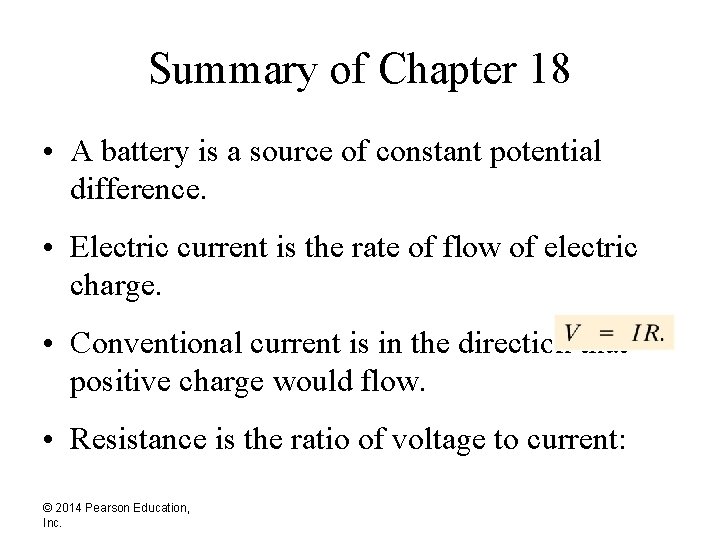
Summary of Chapter 18 • A battery is a source of constant potential difference. • Electric current is the rate of flow of electric charge. • Conventional current is in the direction that positive charge would flow. • Resistance is the ratio of voltage to current: © 2014 Pearson Education, Inc.
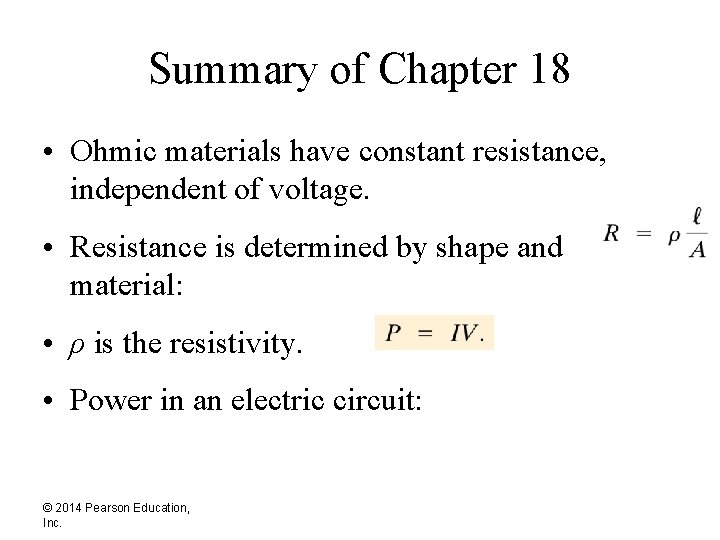
Summary of Chapter 18 • Ohmic materials have constant resistance, independent of voltage. • Resistance is determined by shape and material: • ρ is the resistivity. • Power in an electric circuit: © 2014 Pearson Education, Inc.
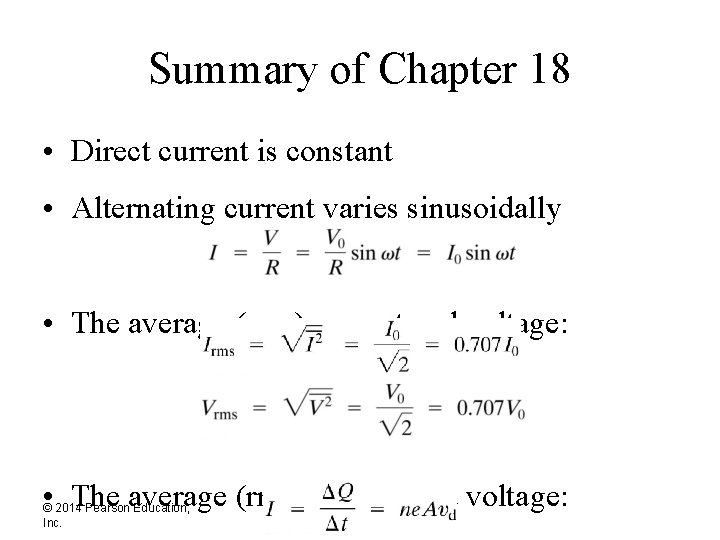
Summary of Chapter 18 • Direct current is constant • Alternating current varies sinusoidally • The average (rms) current and voltage: © 2014 Pearson Education, Inc.