
Chapter 18 Classification 18 1 I Classification A
- Slides: 33
Chapter 18 Classification
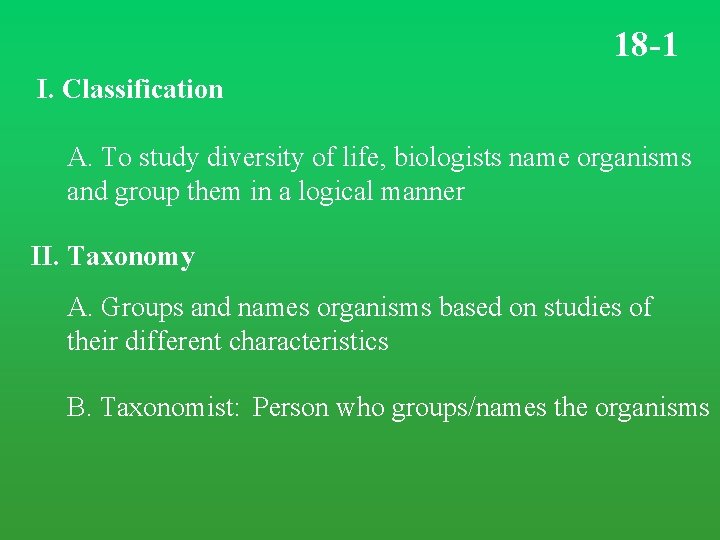
18 -1 I. Classification A. To study diversity of life, biologists name organisms and group them in a logical manner II. Taxonomy A. Groups and names organisms based on studies of their different characteristics B. Taxonomist: Person who groups/names the organisms
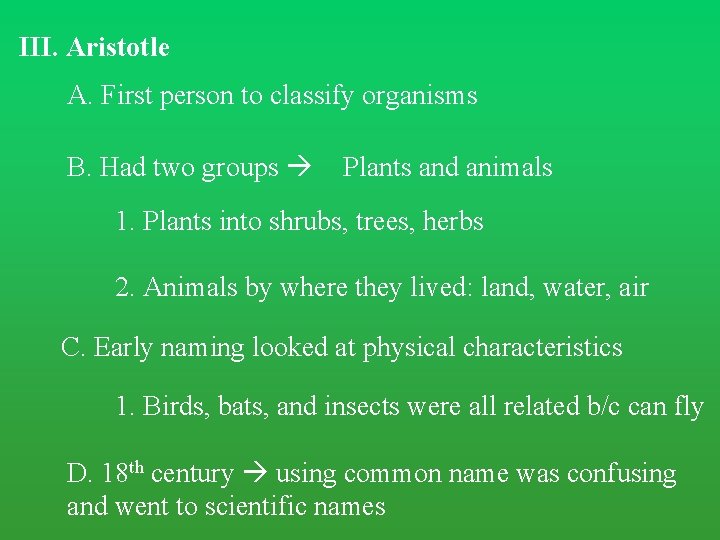
III. Aristotle A. First person to classify organisms B. Had two groups Plants and animals 1. Plants into shrubs, trees, herbs 2. Animals by where they lived: land, water, air C. Early naming looked at physical characteristics 1. Birds, bats, and insects were all related b/c can fly D. 18 th century using common name was confusing and went to scientific names
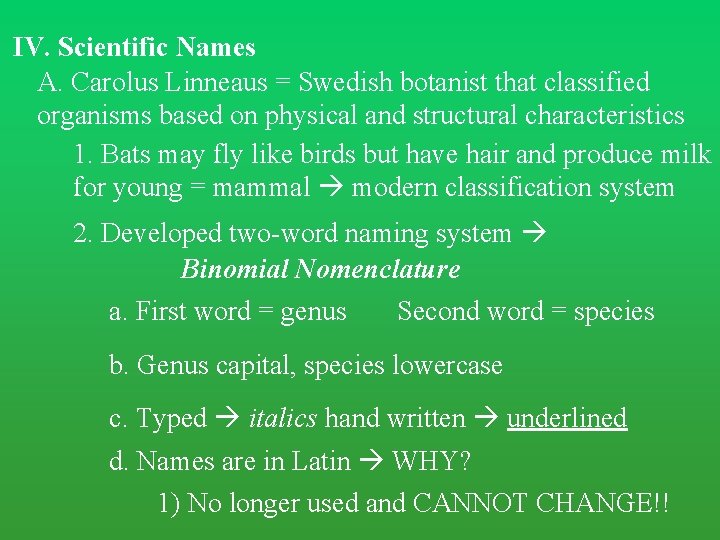
IV. Scientific Names A. Carolus Linneaus = Swedish botanist that classified organisms based on physical and structural characteristics 1. Bats may fly like birds but have hair and produce milk for young = mammal modern classification system 2. Developed two-word naming system Binomial Nomenclature a. First word = genus Second word = species b. Genus capital, species lowercase c. Typed italics hand written underlined d. Names are in Latin WHY? 1) No longer used and CANNOT CHANGE!!
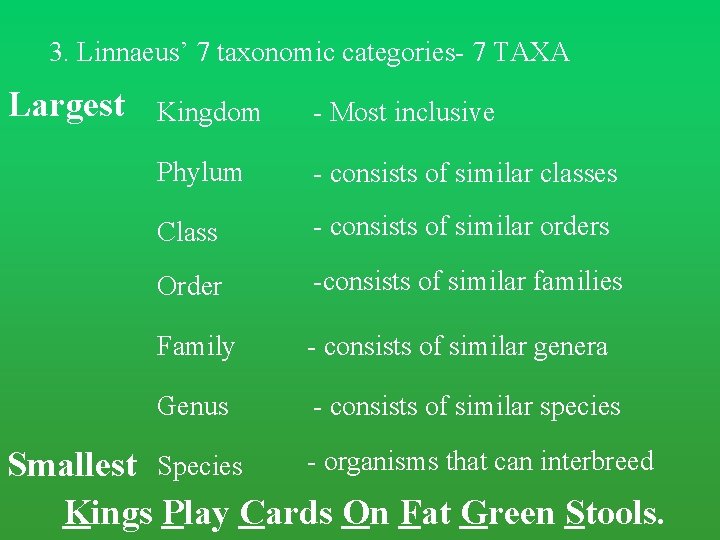
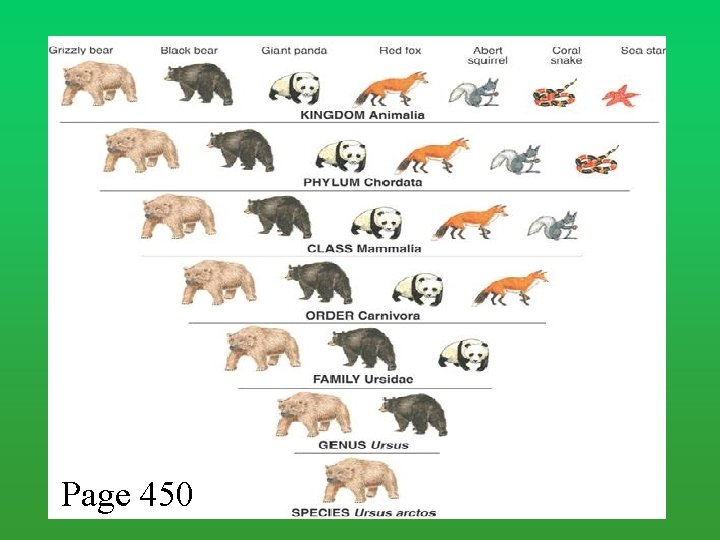
3. Linnaeus’ 7 taxonomic categories- 7 TAXA Largest Kingdom - Most inclusive Phylum - consists of similar classes Class - consists of similar orders Order -consists of similar families Family - consists of similar genera Genus - consists of similar species - organisms that can interbreed Smallest Species Kings Play Cards On Fat Green Stools.
Page 450
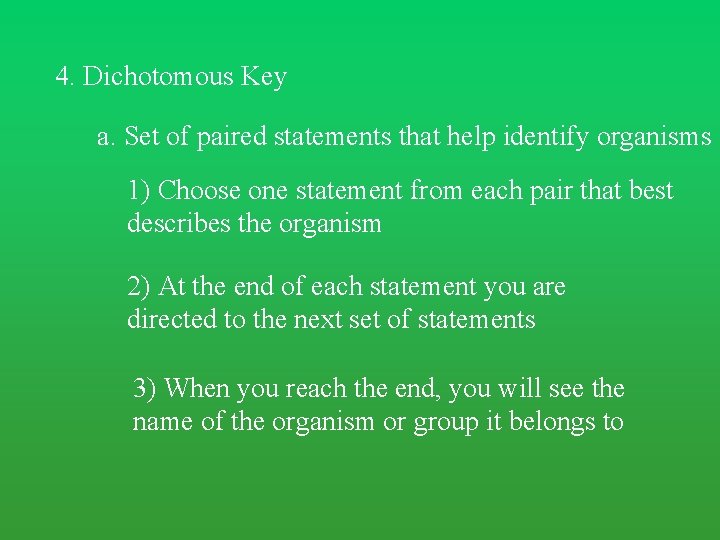
4. Dichotomous Key a. Set of paired statements that help identify organisms 1) Choose one statement from each pair that best describes the organism 2) At the end of each statement you are directed to the next set of statements 3) When you reach the end, you will see the name of the organism or group it belongs to
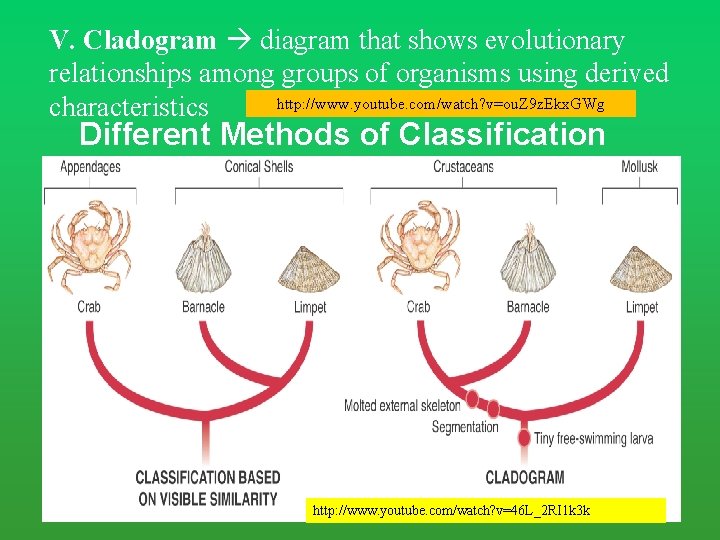
V. Cladogram diagram that shows evolutionary relationships among groups of organisms using derived http: //www. youtube. com/watch? v=ou. Z 9 z. Ekx. GWg characteristics Different Methods of Classification http: //www. youtube. com/watch? v=46 L_2 RI 1 k 3 k
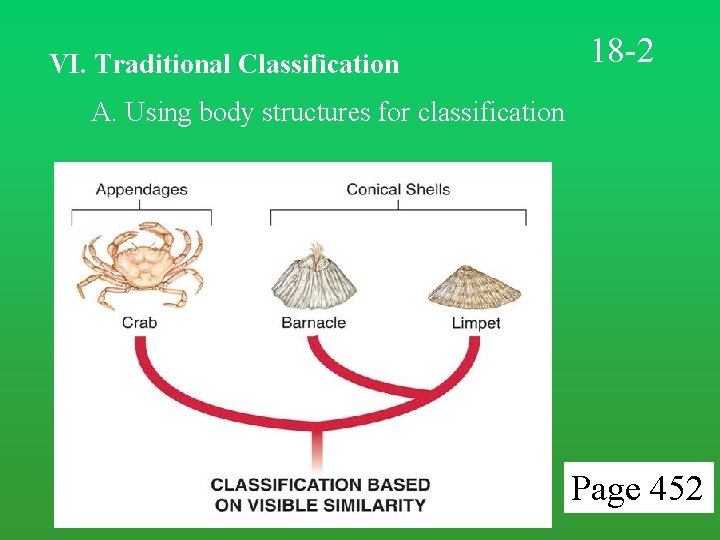
VI. Traditional Classification 18 -2 A. Using body structures for classification Page 452
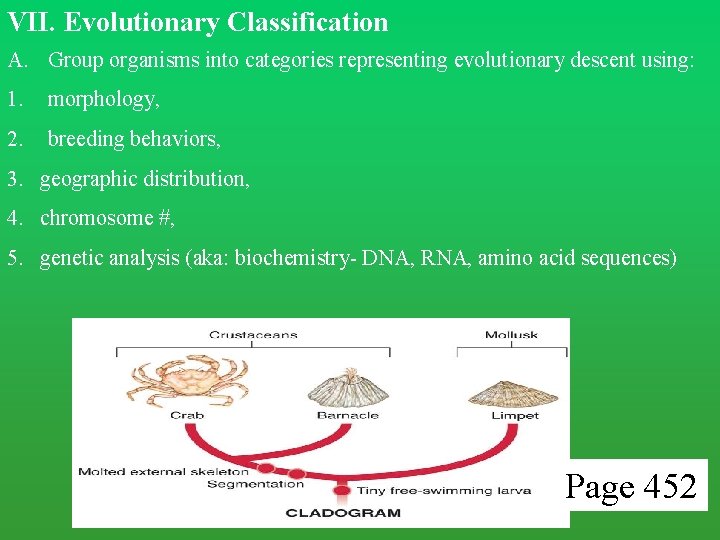
VII. Evolutionary Classification A. Group organisms into categories representing evolutionary descent using: 1. morphology, 2. breeding behaviors, 3. geographic distribution, 4. chromosome #, 5. genetic analysis (aka: biochemistry- DNA, RNA, amino acid sequences) Page 452
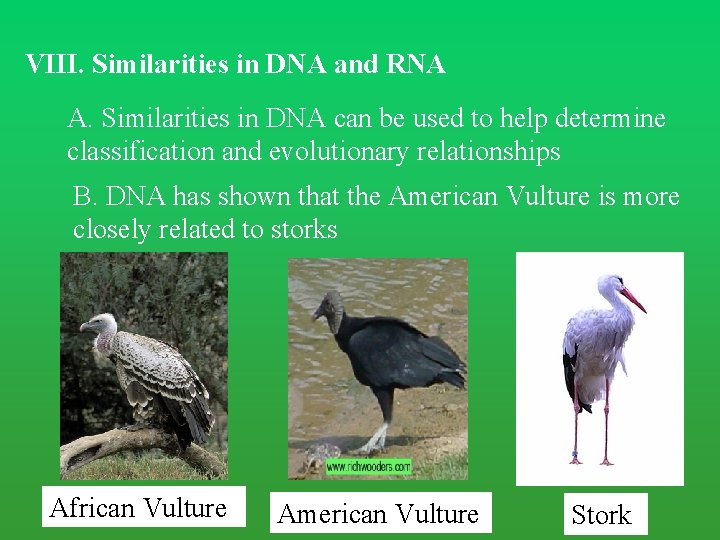
VIII. Similarities in DNA and RNA A. Similarities in DNA can be used to help determine classification and evolutionary relationships B. DNA has shown that the American Vulture is more closely related to storks African Vulture American Vulture Stork
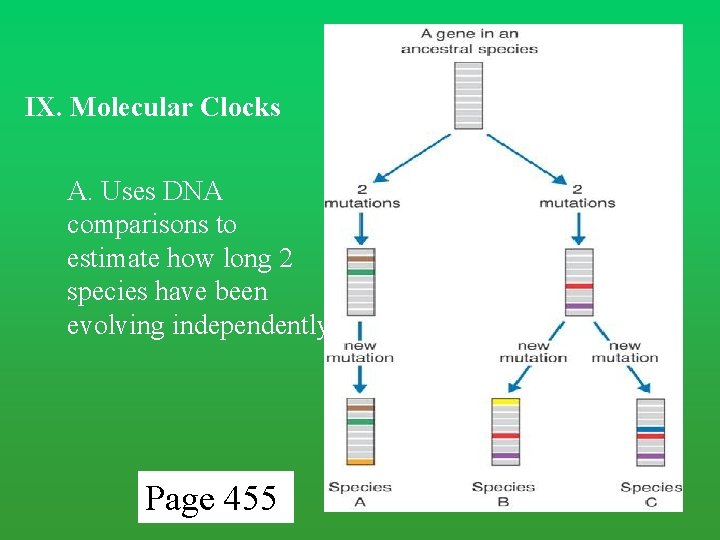
IX. Molecular Clocks A. Uses DNA comparisons to estimate how long 2 species have been evolving independently Page 455
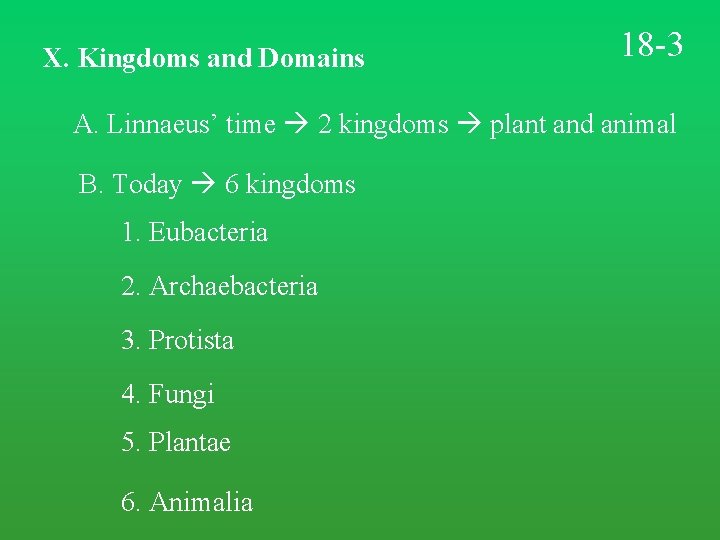
X. Kingdoms and Domains 18 -3 A. Linnaeus’ time 2 kingdoms plant and animal B. Today 6 kingdoms 1. Eubacteria 2. Archaebacteria 3. Protista 4. Fungi 5. Plantae 6. Animalia
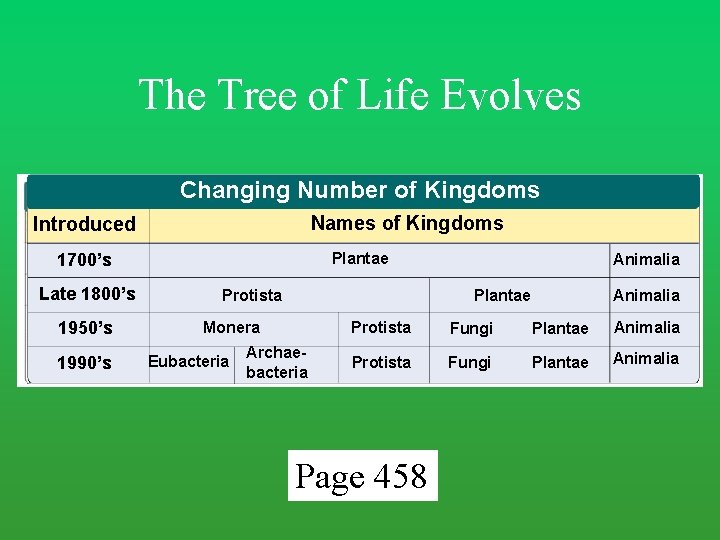
The Tree of Life Evolves Changing Number of Kingdoms Names of Kingdoms Introduced 1700’s Late 1800’s 1950’s 1990’s Plantae Protista Monera Eubacteria Animalia Archaebacteria Animalia Protista Fungi Plantae Animalia Page 458
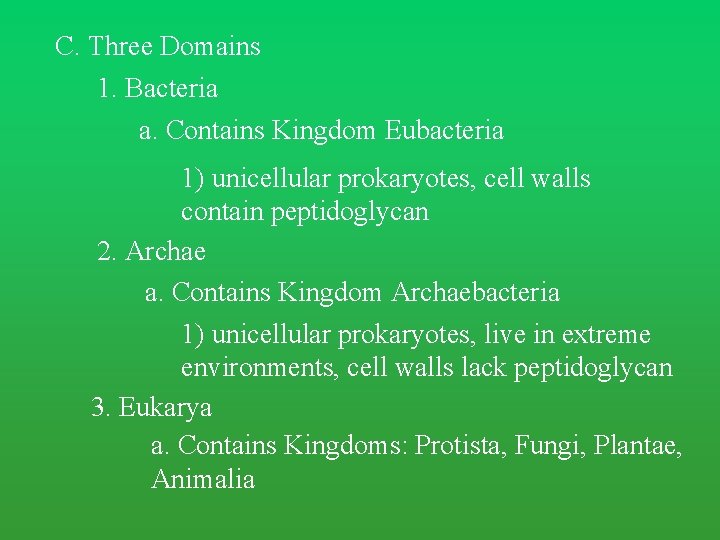
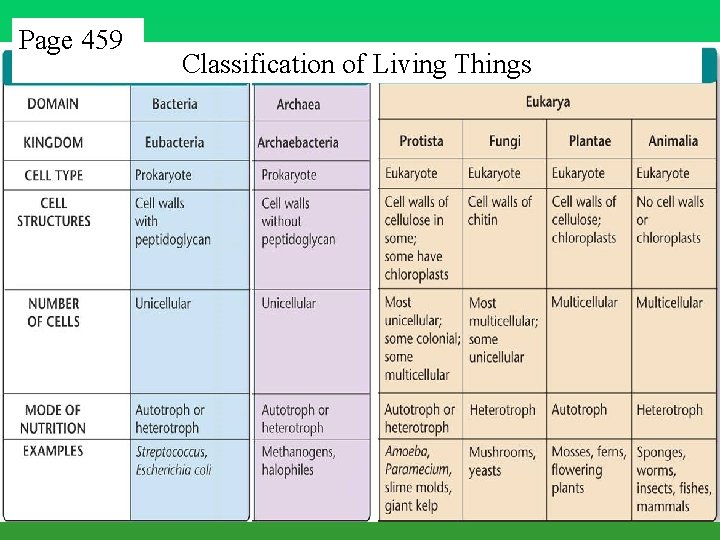
C. Three Domains 1. Bacteria a. Contains Kingdom Eubacteria 1) unicellular prokaryotes, cell walls contain peptidoglycan 2. Archae a. Contains Kingdom Archaebacteria 1) unicellular prokaryotes, live in extreme environments, cell walls lack peptidoglycan 3. Eukarya a. Contains Kingdoms: Protista, Fungi, Plantae, Animalia
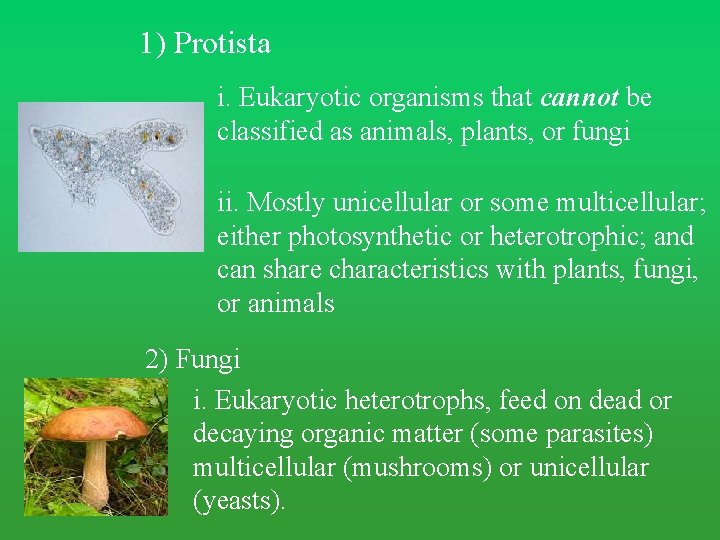
1) Protista i. Eukaryotic organisms that cannot be classified as animals, plants, or fungi ii. Mostly unicellular or some multicellular; either photosynthetic or heterotrophic; and can share characteristics with plants, fungi, or animals 2) Fungi i. Eukaryotic heterotrophs, feed on dead or decaying organic matter (some parasites) multicellular (mushrooms) or unicellular (yeasts).
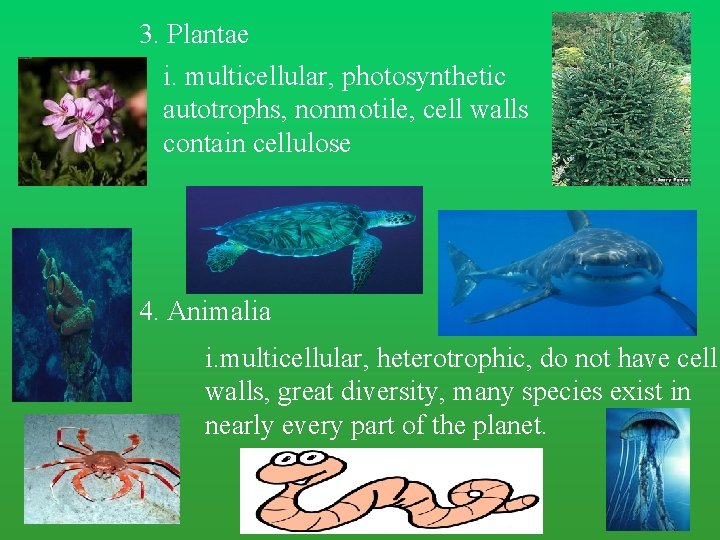
3. Plantae i. multicellular, photosynthetic autotrophs, nonmotile, cell walls contain cellulose 4. Animalia i. multicellular, heterotrophic, do not have cell walls, great diversity, many species exist in nearly every part of the planet.
Page 459 Classification of Living Things
18 -1 Which statement about classification is true? A. Biologists use regional names for organisms. B. Biologists use a common classification system based on similarities that have scientific significance. C. Biologists have identified and named most species found on Earth. D. Taxonomy uses a combination of common and scientific names to make the system more useful.
18 -1 Linnaeus's two-word naming system is called A. binomial nomenclature. B. taxonomy. C. trinomial nomenclature. D. classification.
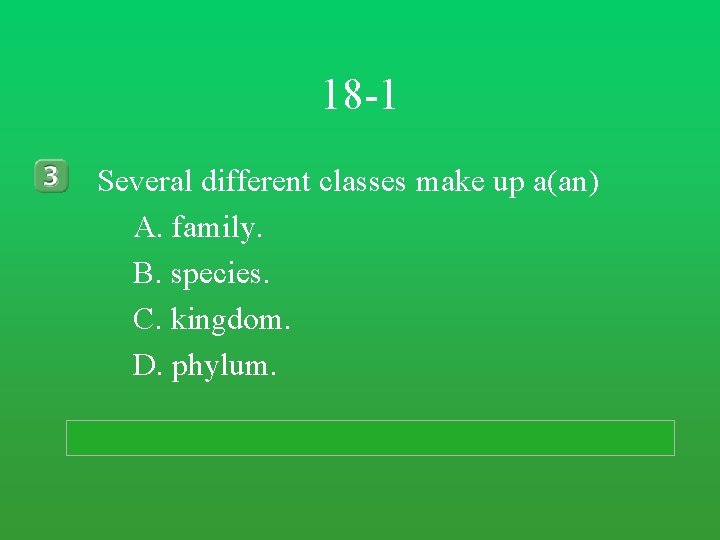
18 -1 Several different classes make up a(an) A. family. B. species. C. kingdom. D. phylum.
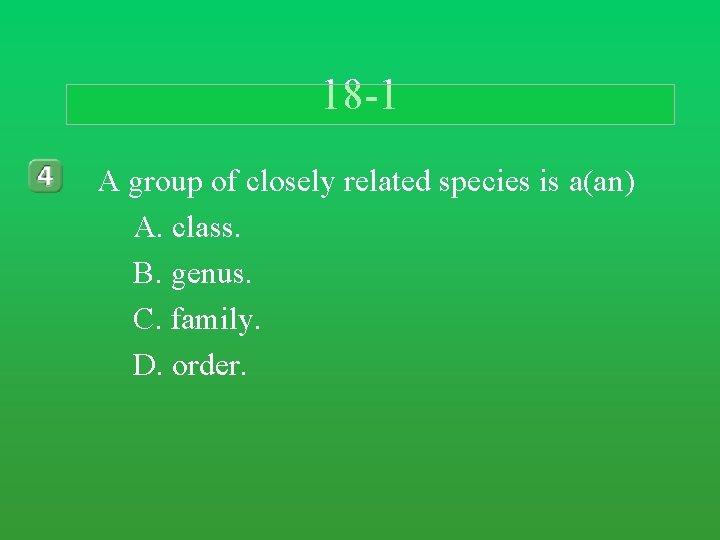
18 -1 A group of closely related species is a(an) A. class. B. genus. C. family. D. order.
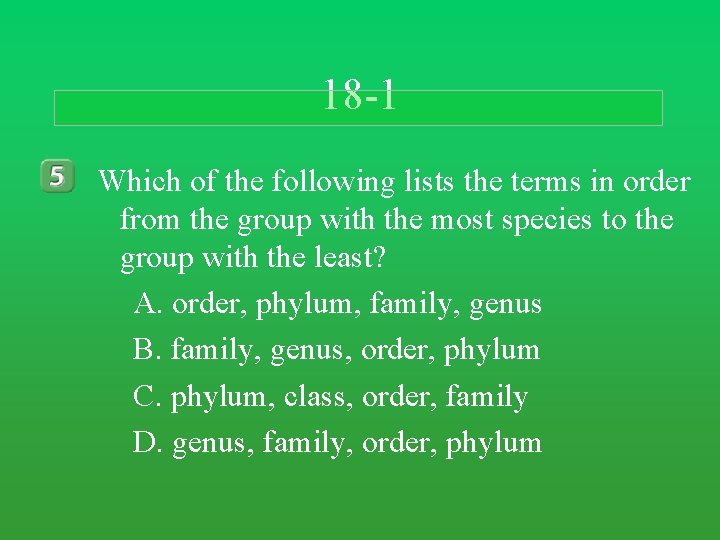
18 -1 Which of the following lists the terms in order from the group with the most species to the group with the least? A. order, phylum, family, genus B. family, genus, order, phylum C. phylum, class, order, family D. genus, family, order, phylum
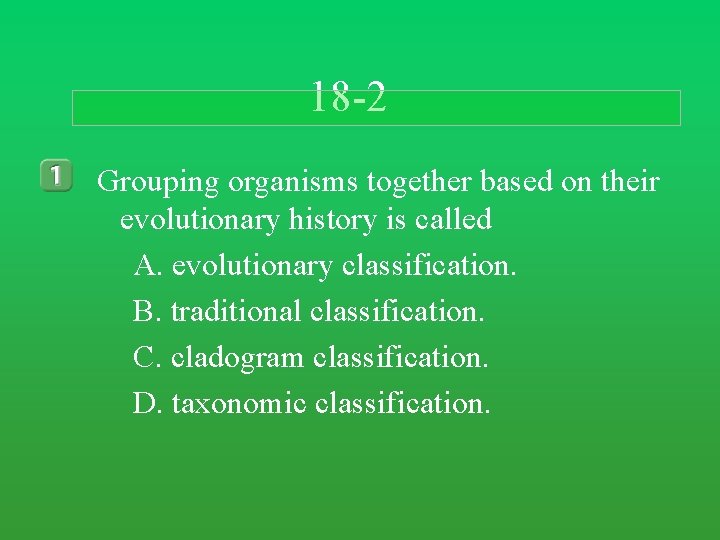
18 -2 Grouping organisms together based on their evolutionary history is called A. evolutionary classification. B. traditional classification. C. cladogram classification. D. taxonomic classification.
18 -2 Traditional classification groups organisms together based on A. derived characters. B. similarities in appearance. C. DNA and RNA similarities. D. molecular clocks.
18 -2 In an evolutionary classification system, the higher the taxon level, A. the more similar the members of the taxon become. B. the more common ancestors would be found in recent time. C. the fewer the number of species in the taxon. D. the farther back in time the common ancestors would be.
18 -2 Classifying organisms using a cladogram depends on identifying A. external and internal structural similarities. B. new characteristics that have appeared most recently as lineages evolve. C. characteristics that have been present in the group for the longest time. D. individual variations within the group.
18 -2 To compare traits of very different organisms, you would use A. anatomical similarities. B. anatomical differences. C. DNA and RNA. D. proteins and carbohydrates.
18 -3 Organisms whose cell walls contain peptidoglycan belong in the kingdom A. Fungi. B. Eubacteria. C. Plantae. D. Archaebacteria.
18 -3 Multicellular organisms with no cell walls or chloroplasts are members of the kingdom A. Animalia. B. Protista. C. Plantae. D. Fungi.
18 -3 Organisms that have cell walls containing cellulose are found in A. Eubacteria and Plantae. B. Fungi and Plantae. C. Plantae and Protista. D. Plantae only.
18 -3 Molecular analyses have given rise to a new taxonomic classification that includes A. three domains. B. seven kingdoms. C. two domains. D. five kingdoms.
18 -3 Which of the following contain more than one kingdom? A. only Archaea B. only Bacteria C. only Eukarya D. both Eukarya and Archaea