
Chapter 18 Classification 1 18 1 Finding Order

- Slides: 31
Chapter 18: Classification 1
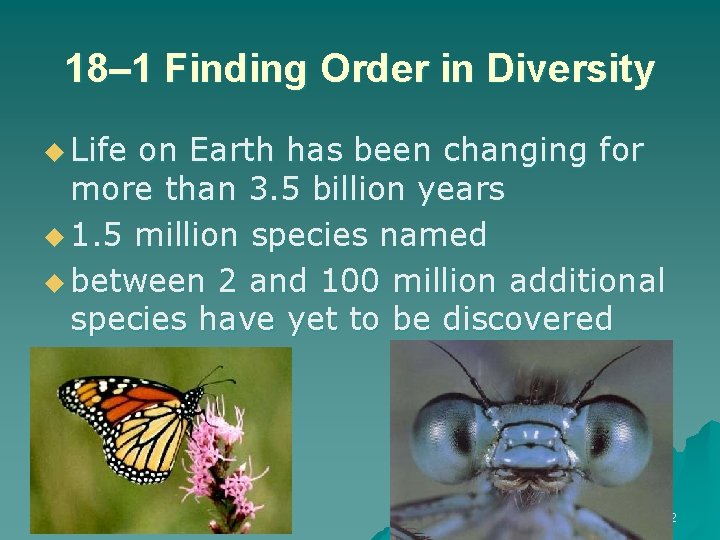
18– 1 Finding Order in Diversity u Life on Earth has been changing for more than 3. 5 billion years u 1. 5 million species named u between 2 and 100 million additional species have yet to be discovered 2
Why Classify? u organize living things into groups that have biological meaning u Taxonomy = discipline of classifying organisms and assigning each organism a universally accepted name 3
Assigning Scientific Names u Common names are confusing and vary among languages or even regions – Ex: cougar, mountain lion, panther, puma – different species sometimes share a single common name u Ex: buzzard: hawk? Vulture? u Scientists have agreed to a single name for each species u Use Latin & Greek 4
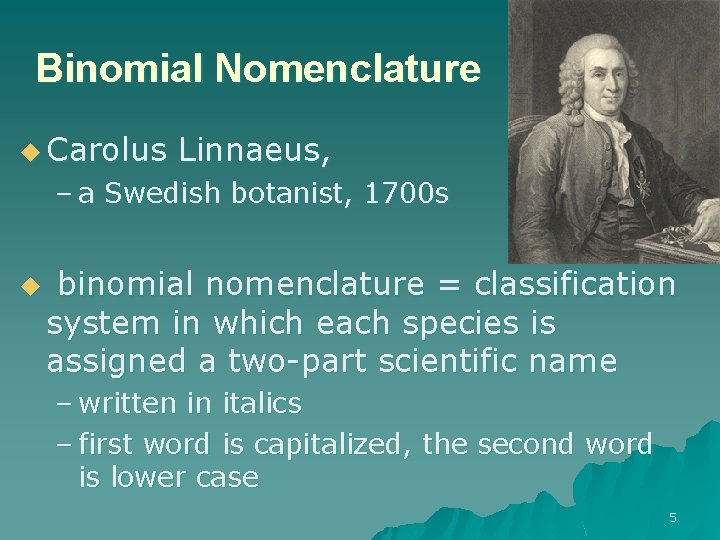
Binomial Nomenclature u Carolus Linnaeus, – a Swedish botanist, 1700 s u binomial nomenclature = classification system in which each species is assigned a two-part scientific name – written in italics – first word is capitalized, the second word is lower case 5
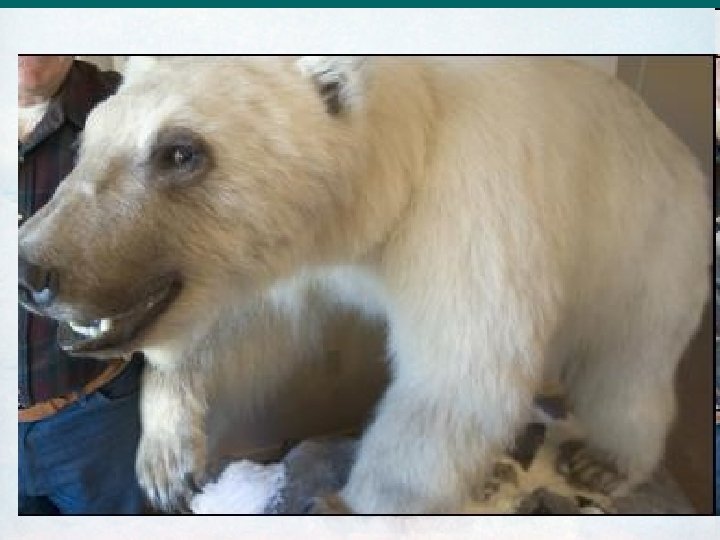
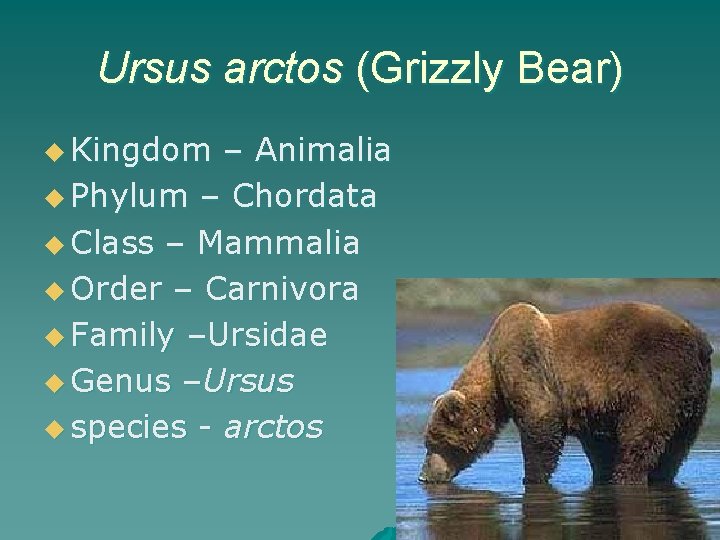
Scientific Names u grizzly bear is called Ursus arctos – Ursus — is the genus u Genus = group of closely related species – arctos – is the species u unique to each species within the genus u Often a Latinized description of some important trait of the organism or an indication of where the organism lives – Ursus maritimus, the polar bear u maritimus, referring to the sea 6
7
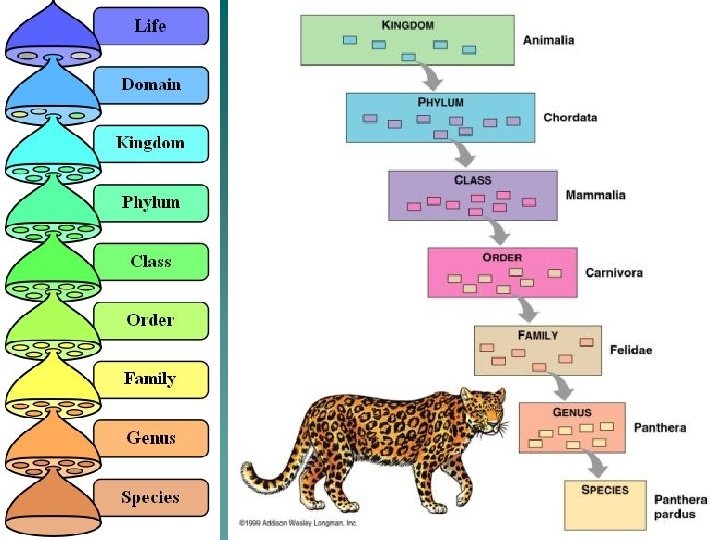
Linnaeus's System of Classification u Hierarchical - it consists of levels u includes seven levels – from smallest to largest—species, genus, family, order, class, phylum, and kingdom. – Each level is called a taxon or taxonomic category 8
9
Ursus arctos (Grizzly Bear) u Kingdom – Animalia u Phylum – Chordata u Class – Mammalia u Order – Carnivora u Family –Ursidae u Genus –Ursus u species - arctos 10
Humans u Kingdom = Animalia u Phylum (Division for plants) = Chordata u Class = Mammalia u Order = Primates u Family = Hominidae u Genus = Homo u species = sapiens 11
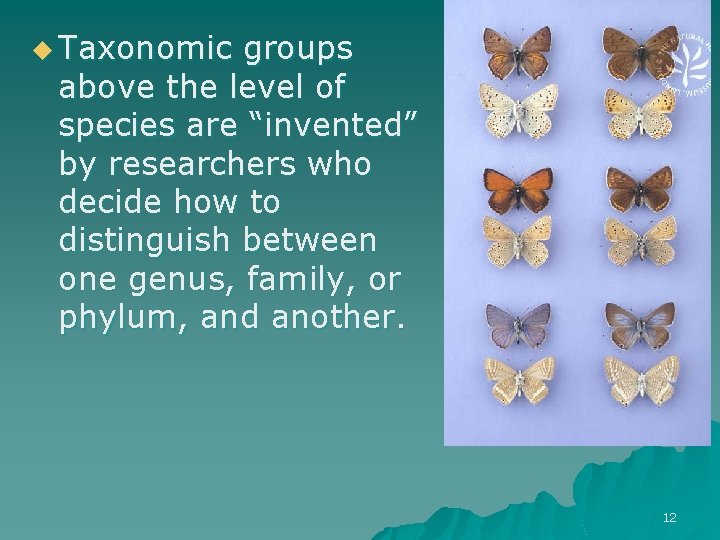
u Taxonomic groups above the level of species are “invented” by researchers who decide how to distinguish between one genus, family, or phylum, and another. 12
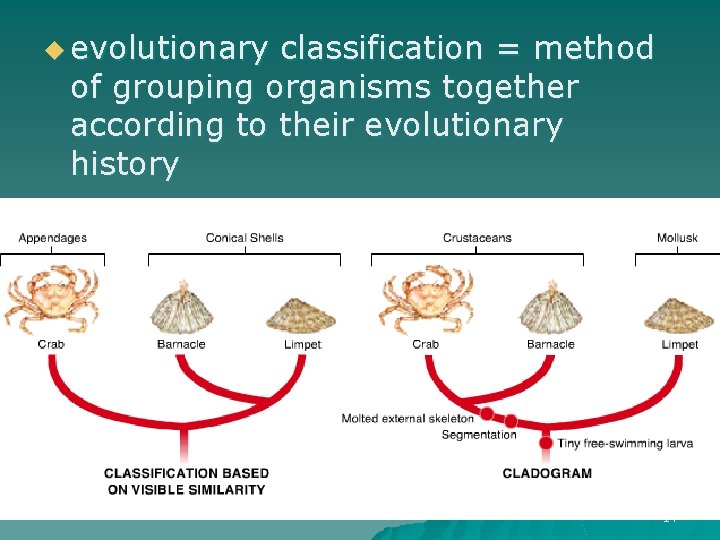
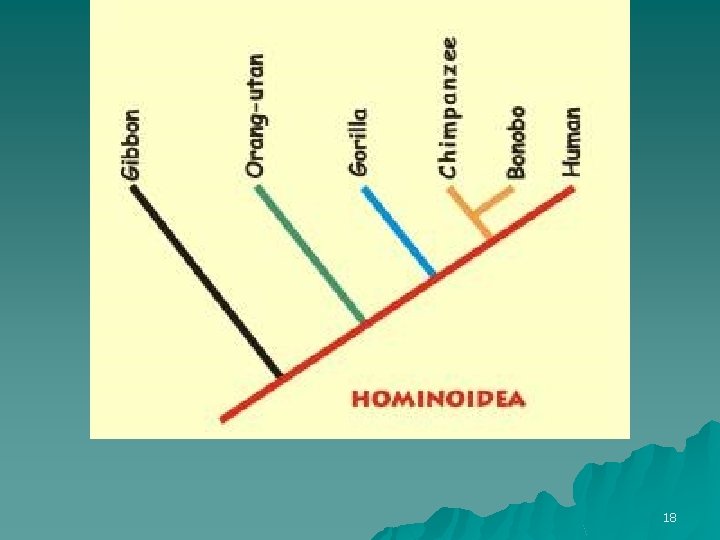
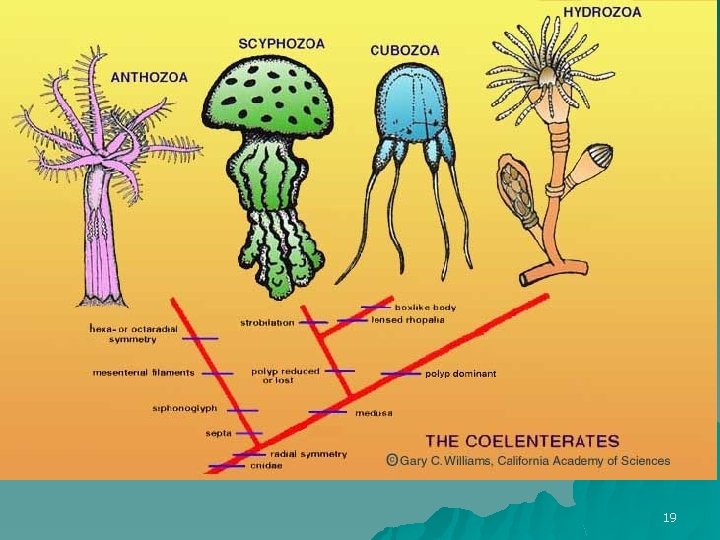
u Phylogeny = the study of evolutionary relationships among organisms u Biologists now group organisms into categories that represent lines of evolutionary descent, or phylogeny, not just physical similarities. 13
u evolutionary classification = method of grouping organisms together according to their evolutionary history 14
u The higher the level of the taxon, the farther back in time is the common ancestor of all the organisms in the taxon. 15
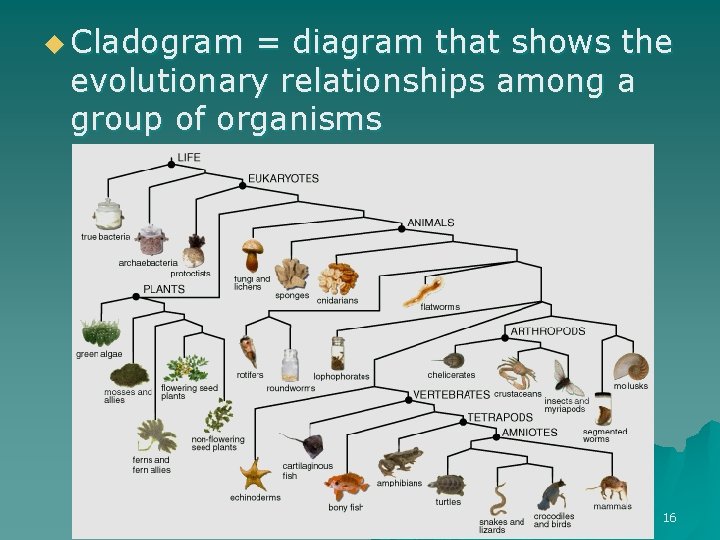
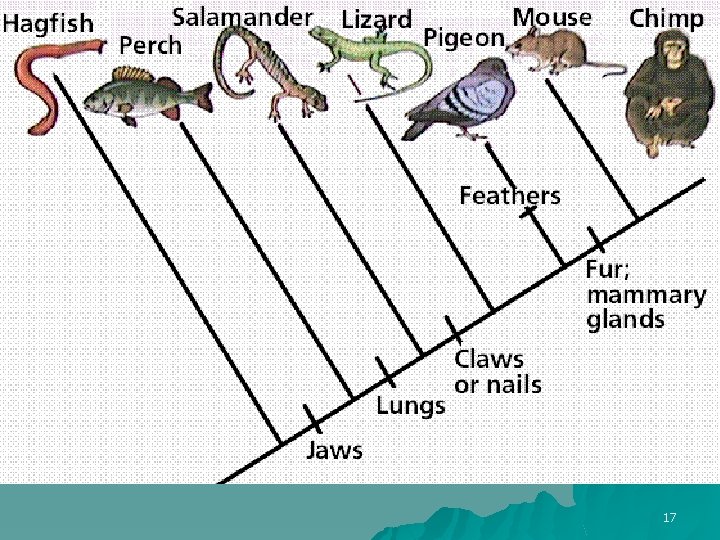
u Cladogram = diagram that shows the evolutionary relationships among a group of organisms 16
17
18
19
u The genes of many organisms show important similarities at the molecular level. u Similarities in DNA can be used to help determine classification and evolutionary relationships. u The more similar the DNA sequences of two species, the more recently they shared a common ancestor, and the more closely they are related in evolutionary terms. 20
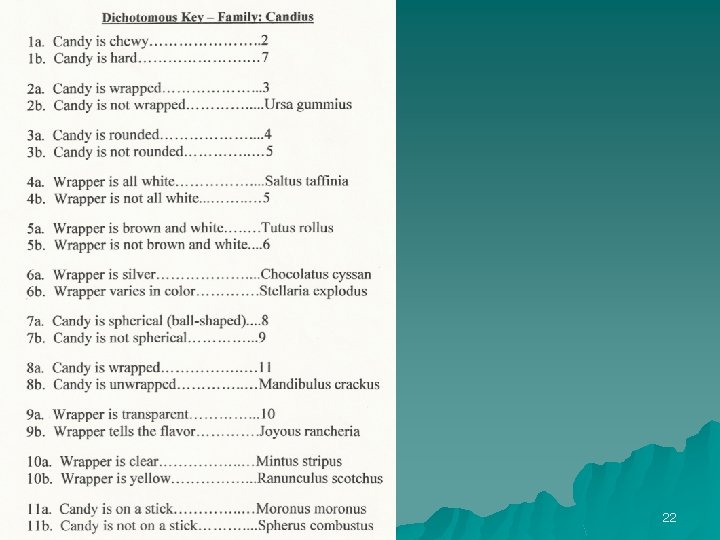
Dichotomous Key A dichotomous key is a tool that allows the user to determine the identity of items in the natural world, such as trees, wildflowers, mammals, reptiles, rocks, and fish. u Keys consist of a series of choices that lead the user to the correct name of a given item. u "Dichotomous" means "divided into two parts". Therefore, dichotomous keys always give two choices in each step. 21 u 21
22
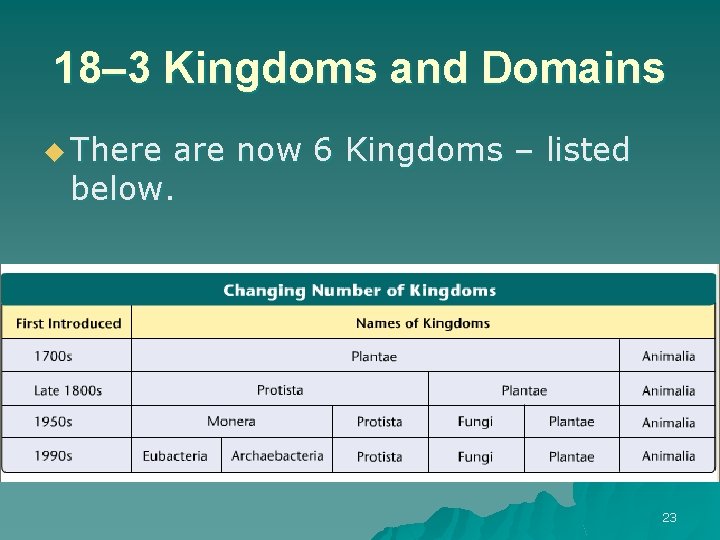
18– 3 Kingdoms and Domains u There are now 6 Kingdoms – listed below. 23
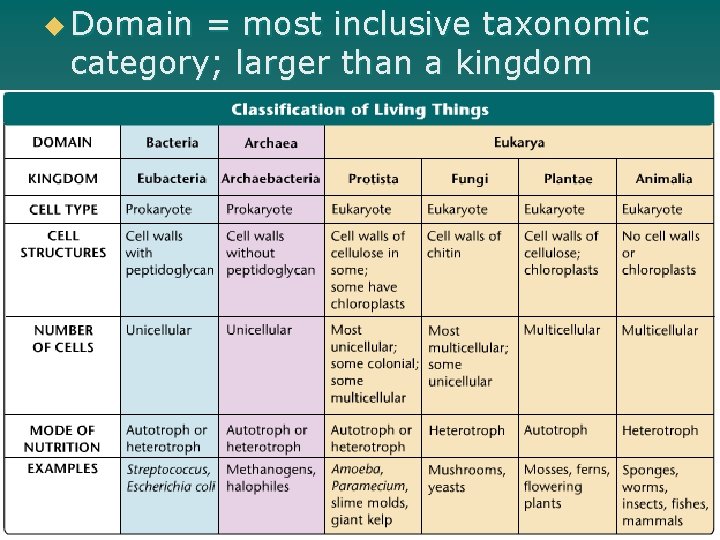
u Domain = most inclusive taxonomic category; larger than a kingdom 24
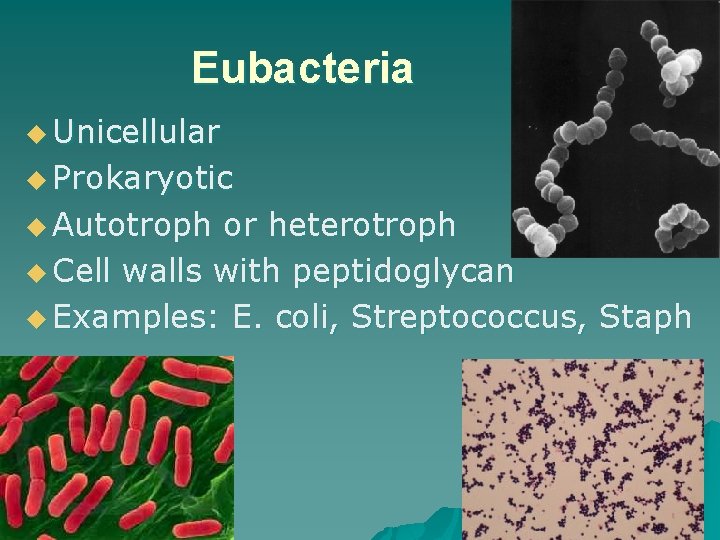
Eubacteria u Unicellular u Prokaryotic u Autotroph or heterotroph u Cell walls with peptidoglycan u Examples: E. coli, Streptococcus, Staph 25
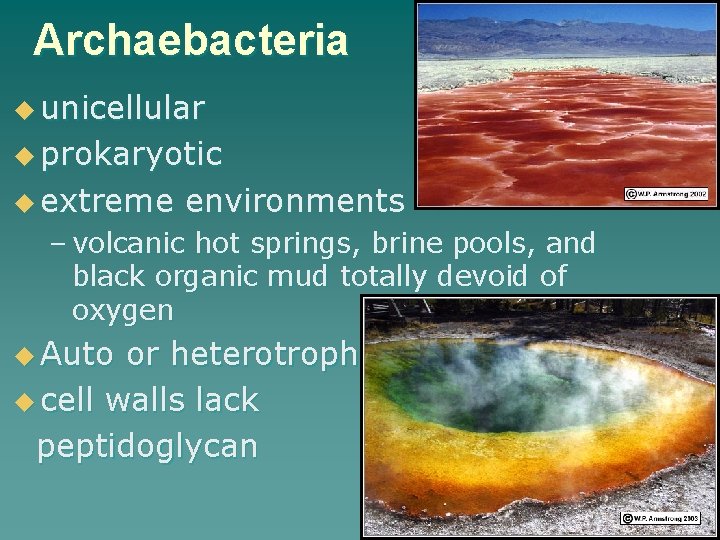
Archaebacteria u unicellular u prokaryotic u extreme environments – volcanic hot springs, brine pools, and black organic mud totally devoid of oxygen u Auto or heterotroph u cell walls lack peptidoglycan 26
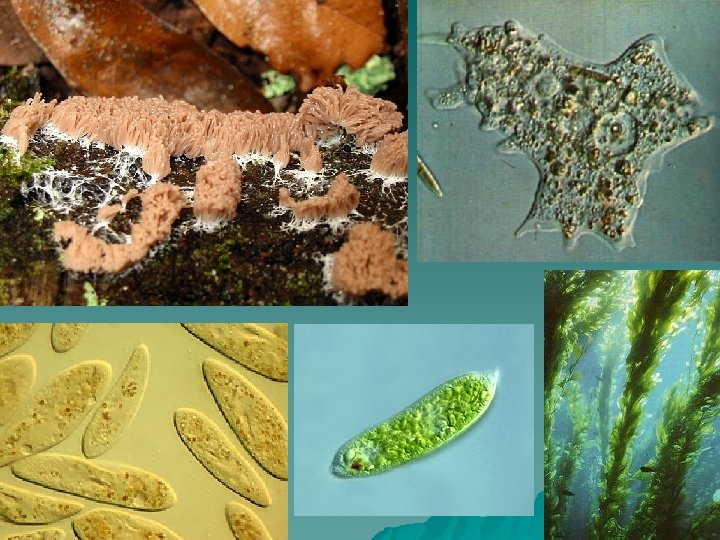
Protista u eukaryotic u greatest variety u Most single-celled, some multi u photosynthetic or heterotrophic u Ex: kelp, amoebas, slime mold, paramecium, euglena 27
28
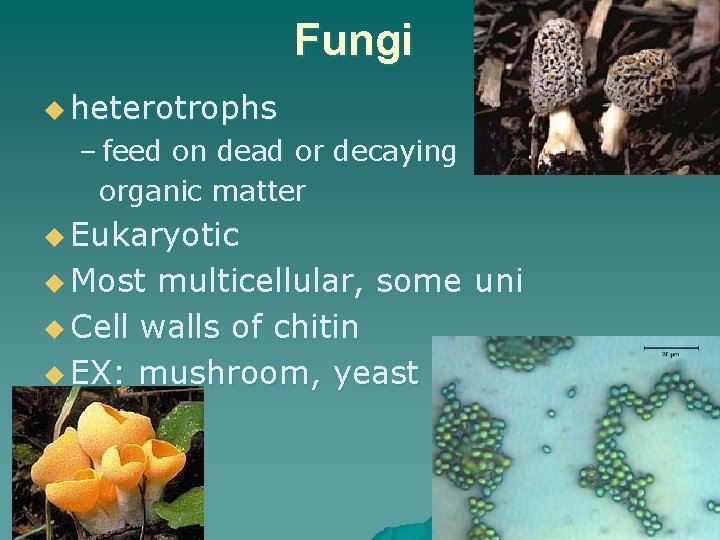
Fungi u heterotrophs – feed on dead or decaying organic matter u Eukaryotic u Most multicellular, some uni u Cell walls of chitin u EX: mushroom, yeast 29
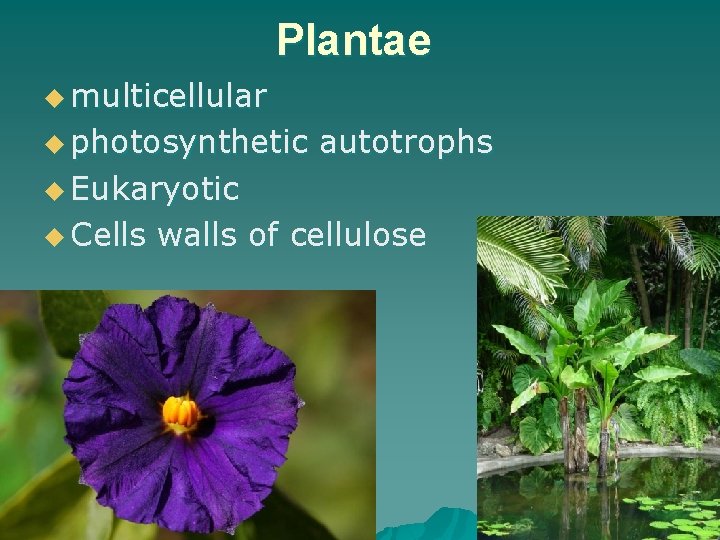
Plantae u multicellular u photosynthetic autotrophs u Eukaryotic u Cells walls of cellulose 30
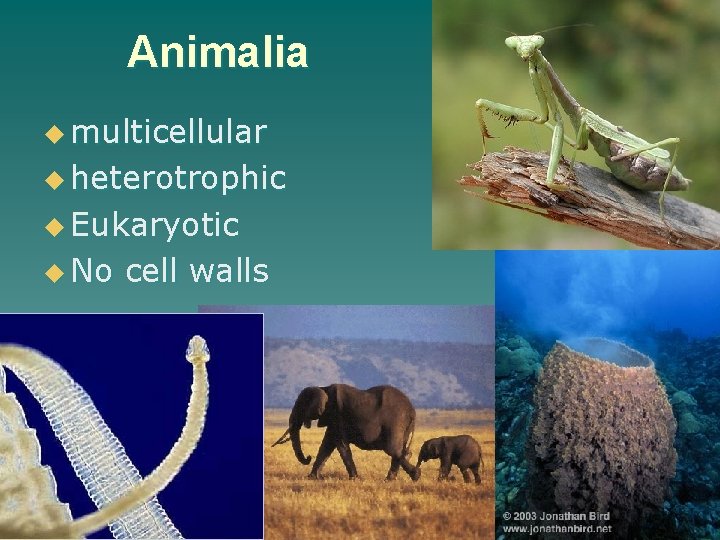
Animalia u multicellular u heterotrophic u Eukaryotic u No cell walls 31