
Chapter 18 AcidBase Equilibria 18 1 AcidBase Equilibria
Chapter 18 Acid-Base Equilibria 18 -1
Acid-Base Equilibria 18. 1 Acids and bases in water 18. 2 Auto-ionization of water and the p. H scale 18. 3 Proton transfer and the Brønsted-Lowry acid-base definition 18. 4 Solving problems involving weak acid equilibria 18. 5 Weak bases and their relationships to weak acids 18. 6 Molecular properties and acid strength 18. 7 Acid-base properties of salt solutions 18. 8 Generalizing the Brønsted-Lowry concept: The Leveling Effect 18. 9 Electron-pair donations and the Lewis acid-base definition 18 -2
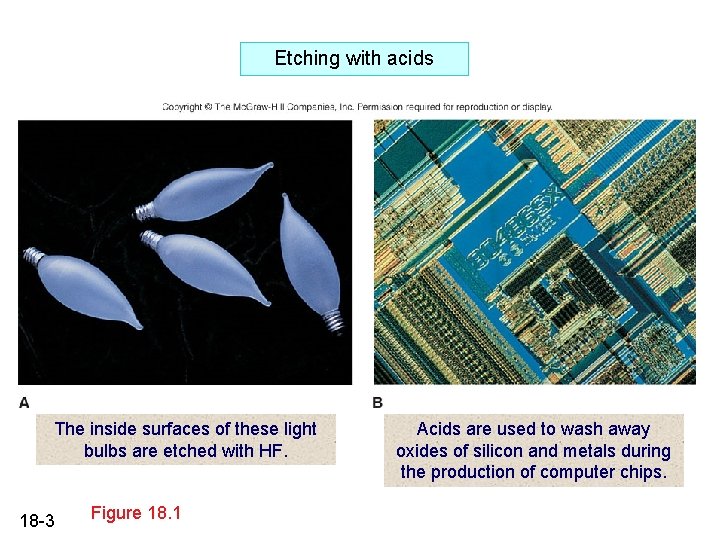
Etching with acids The inside surfaces of these light bulbs are etched with HF. 18 -3 Figure 18. 1 Acids are used to wash away oxides of silicon and metals during the production of computer chips.

18 -4
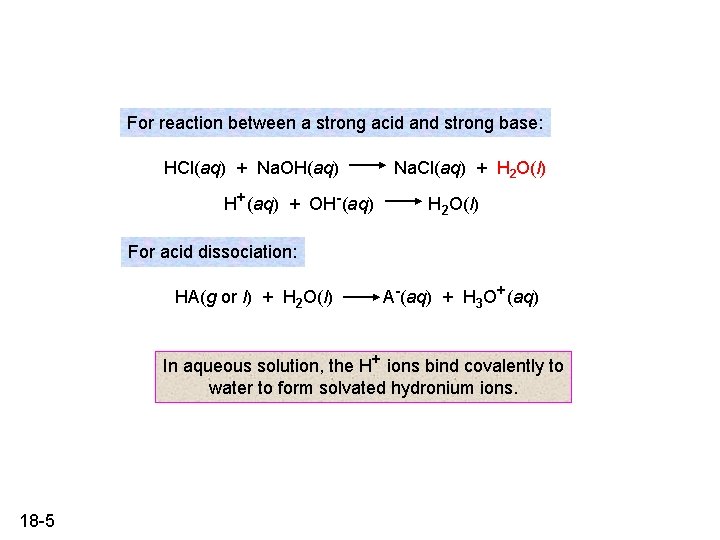
For reaction between a strong acid and strong base: HCl(aq) + Na. OH(aq) H+(aq) + OH-(aq) Na. Cl(aq) + H 2 O(l) For acid dissociation: HA(g or l) + H 2 O(l) A-(aq) + H 3 O+(aq) In aqueous solution, the H+ ions bind covalently to water to form solvated hydronium ions. 18 -5
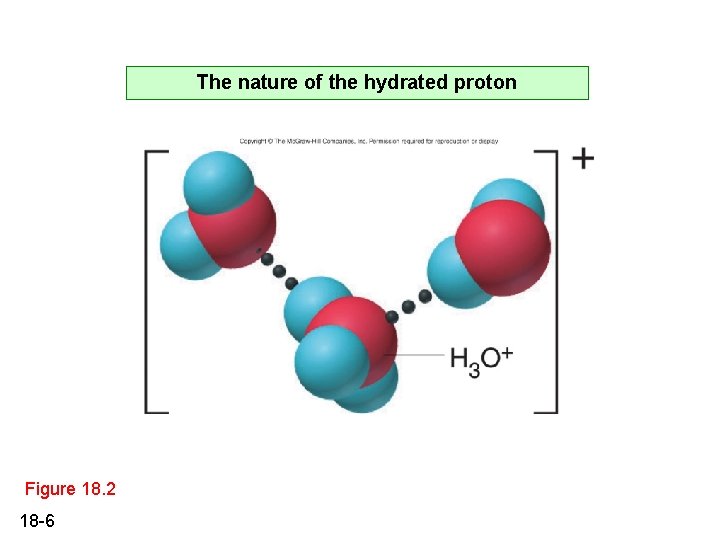
The nature of the hydrated proton Figure 18. 2 18 -6
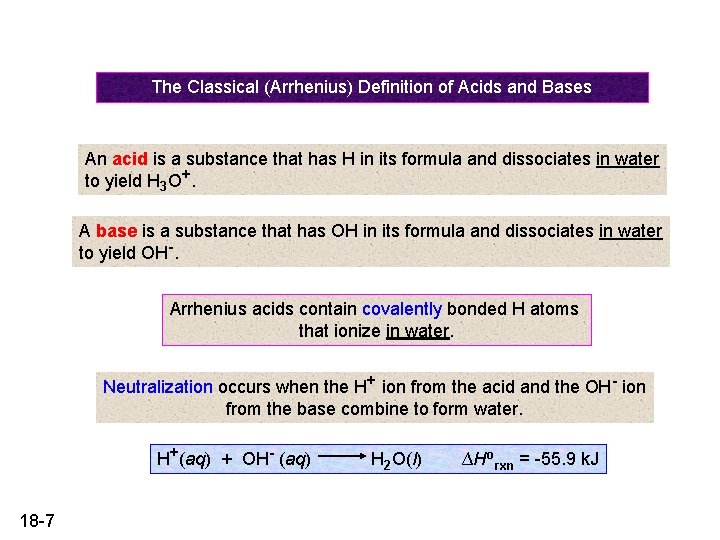
The Classical (Arrhenius) Definition of Acids and Bases An acid is a substance that has H in its formula and dissociates in water to yield H 3 O+. A base is a substance that has OH in its formula and dissociates in water to yield OH-. Arrhenius acids contain covalently bonded H atoms that ionize in water. Neutralization occurs when the H+ ion from the acid and the OH- ion from the base combine to form water. H+(aq) + OH- (aq) 18 -7 H 2 O(l) ∆Horxn = -55. 9 k. J
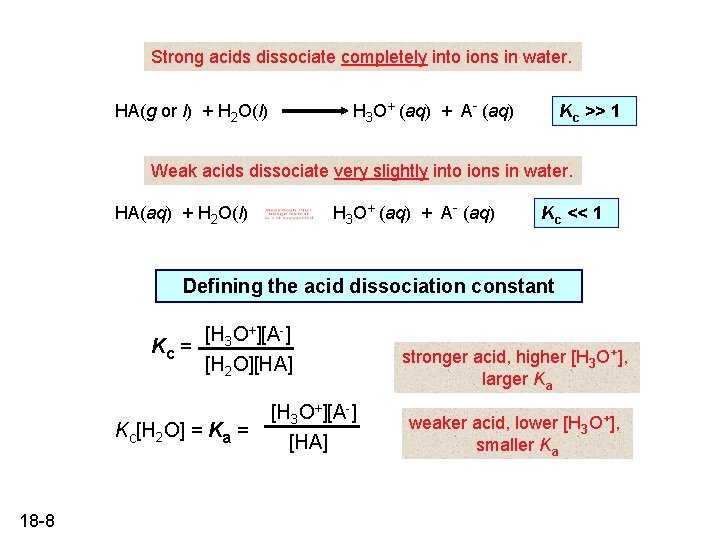
Strong acids dissociate completely into ions in water. H 3 O+ (aq) + A- (aq) HA(g or l) + H 2 O(l) Kc >> 1 Weak acids dissociate very slightly into ions in water. H 3 O+ (aq) + A- (aq) HA(aq) + H 2 O(l) Kc << 1 Defining the acid dissociation constant [H 3 O+][A-] Kc = [H 2 O][HA] Kc[H 2 O] = Ka = 18 -8 [H 3 O+][A-] [HA] stronger acid, higher [H 3 O+], larger Ka weaker acid, lower [H 3 O+], smaller Ka
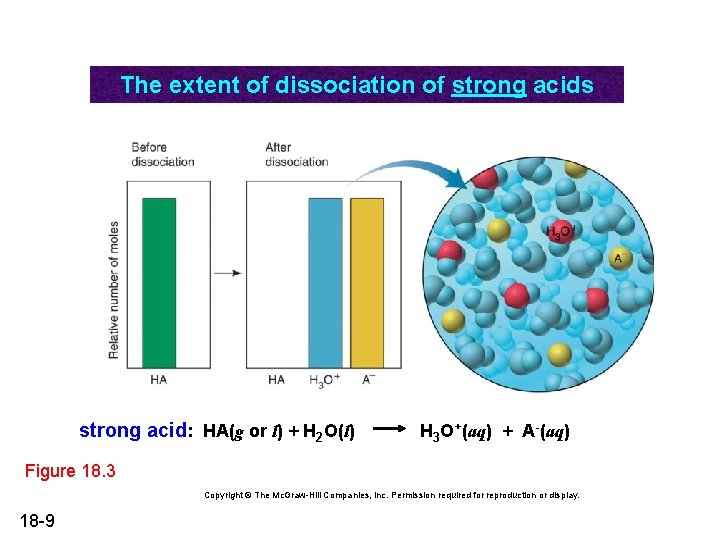
The extent of dissociation of strong acids strong acid: HA(g or l) + H 2 O(l) H 3 O+(aq) + A-(aq) Figure 18. 3 Copyright © The Mc. Graw-Hill Companies, Inc. Permission required for reproduction or display. 18 -9
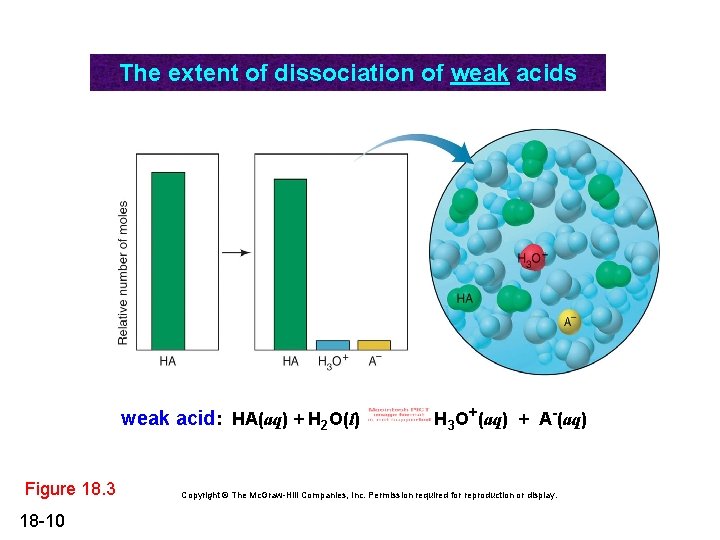
The extent of dissociation of weak acids weak acid: HA(aq) + H 2 O(l) Figure 18. 3 18 -10 H 3 O+(aq) + A-(aq) Copyright © The Mc. Graw-Hill Companies, Inc. Permission required for reproduction or display.
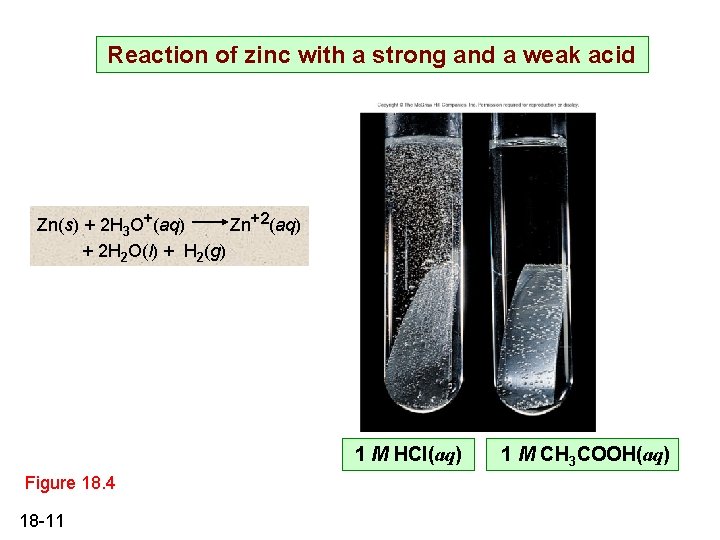
Reaction of zinc with a strong and a weak acid Zn(s) + 2 H 3 O+(aq) Zn+2(aq) + 2 H 2 O(l) + H 2(g) 1 M HCl(aq) Figure 18. 4 18 -11 1 M CH 3 COOH(aq)
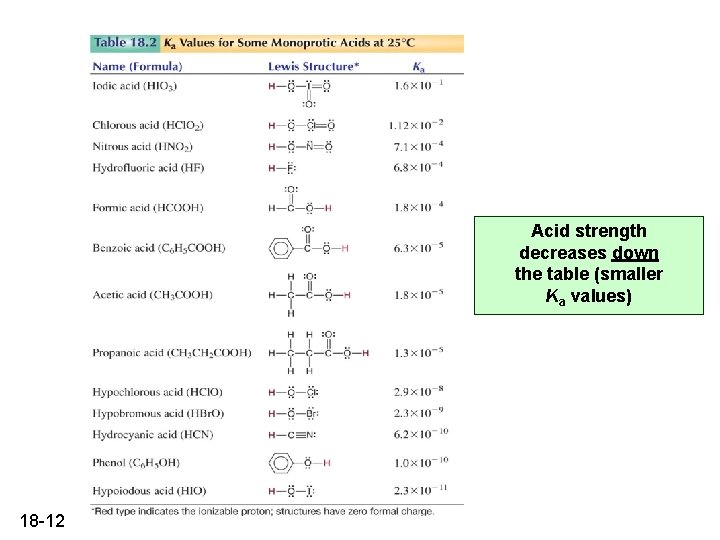
Acid strength decreases down the table (smaller Ka values) 18 -12
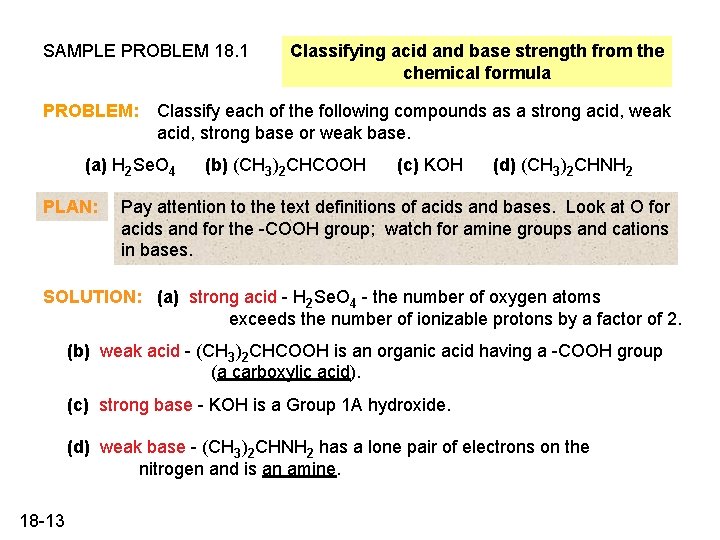
SAMPLE PROBLEM 18. 1 PROBLEM: Classify each of the following compounds as a strong acid, weak acid, strong base or weak base. (a) H 2 Se. O 4 PLAN: Classifying acid and base strength from the chemical formula (b) (CH 3)2 CHCOOH (c) KOH (d) (CH 3)2 CHNH 2 Pay attention to the text definitions of acids and bases. Look at O for acids and for the -COOH group; watch for amine groups and cations in bases. SOLUTION: (a) strong acid - H 2 Se. O 4 - the number of oxygen atoms exceeds the number of ionizable protons by a factor of 2. (b) weak acid - (CH 3)2 CHCOOH is an organic acid having a -COOH group (a carboxylic acid). (c) strong base - KOH is a Group 1 A hydroxide. (d) weak base - (CH 3)2 CHNH 2 has a lone pair of electrons on the nitrogen and is an amine. 18 -13
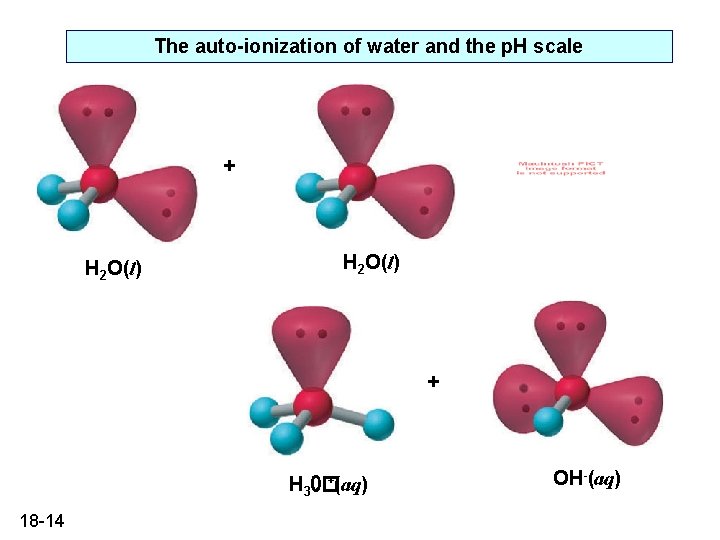
The auto-ionization of water and the p. H scale + H 2 O(l) + +(aq) H 3 O� 18 -14 OH-(aq)
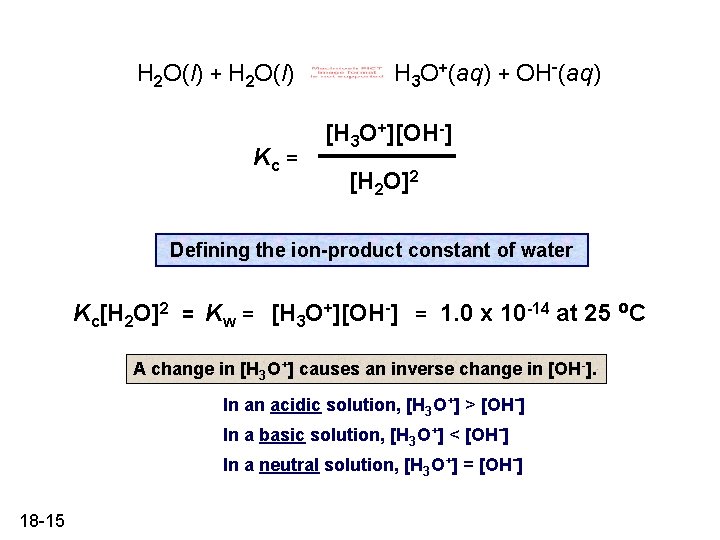
H 2 O(l) + H 2 O(l) Kc = H 3 O+(aq) + OH-(aq) [H 3 O+][OH-] [H 2 O]2 Defining the ion-product constant of water Kc[H 2 O]2 = Kw = [H 3 O+][OH-] = 1. 0 x 10 -14 at 25 o. C A change in [H 3 O+] causes an inverse change in [OH-]. In an acidic solution, [H 3 O+] > [OH-] In a basic solution, [H 3 O+] < [OH-] In a neutral solution, [H 3 O+] = [OH-] 18 -15
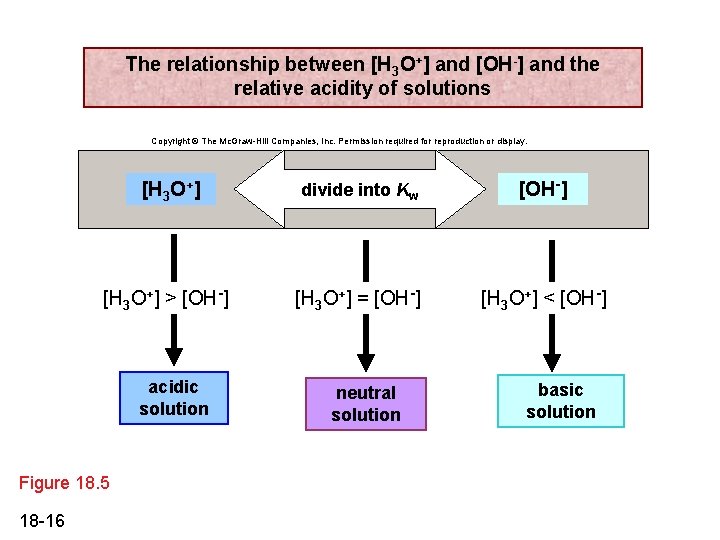
The relationship between [H 3 O+] and [OH-] and the relative acidity of solutions Copyright © The Mc. Graw-Hill Companies, Inc. Permission required for reproduction or display. [H 3 O+] divide into Kw [OH-] [H 3 O+] > [OH-] [H 3 O+] = [OH-] [H 3 O+] < [OH-] acidic solution Figure 18. 5 18 -16 neutral solution basic solution
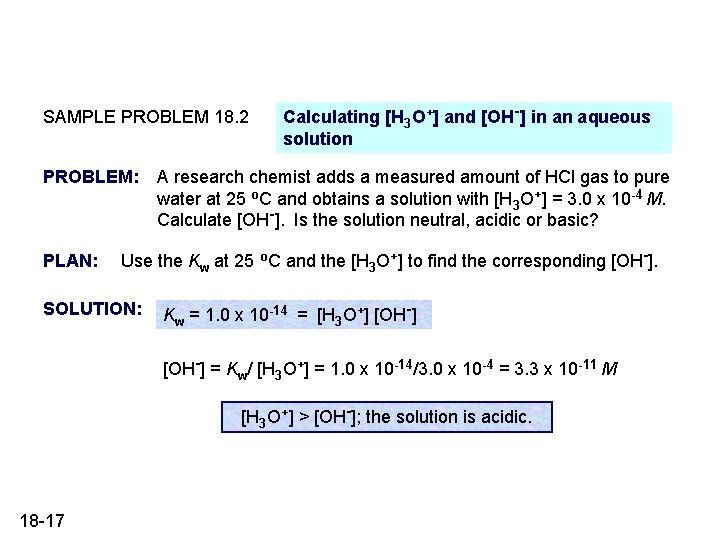
SAMPLE PROBLEM 18. 2 PROBLEM: PLAN: Calculating [H 3 O+] and [OH-] in an aqueous solution A research chemist adds a measured amount of HCl gas to pure water at 25 o. C and obtains a solution with [H 3 O+] = 3. 0 x 10 -4 M. Calculate [OH-]. Is the solution neutral, acidic or basic? Use the Kw at 25 o. C and the [H 3 O+] to find the corresponding [OH-]. SOLUTION: Kw = 1. 0 x 10 -14 = [H 3 O+] [OH-] = Kw/ [H 3 O+] = 1. 0 x 10 -14/3. 0 x 10 -4 = 3. 3 x 10 -11 M [H 3 O+] > [OH-]; the solution is acidic. 18 -17
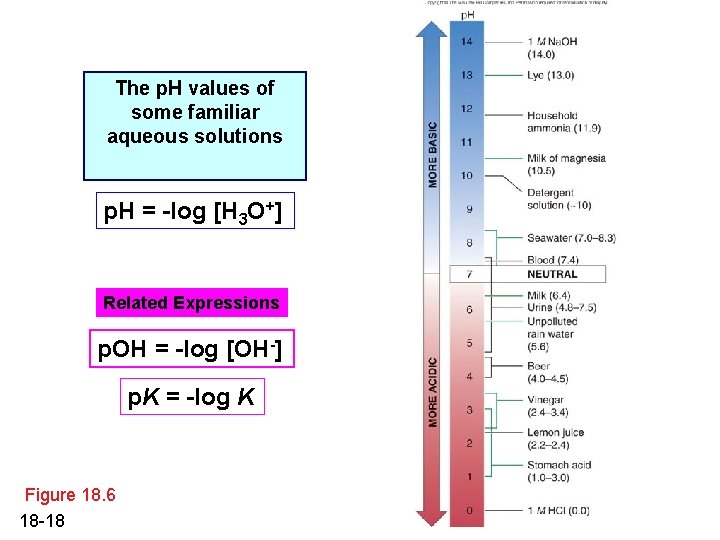
The p. H values of some familiar aqueous solutions p. H = -log [H 3 O+] Related Expressions p. OH = -log [OH-] p. K = -log K Figure 18. 6 18 -18
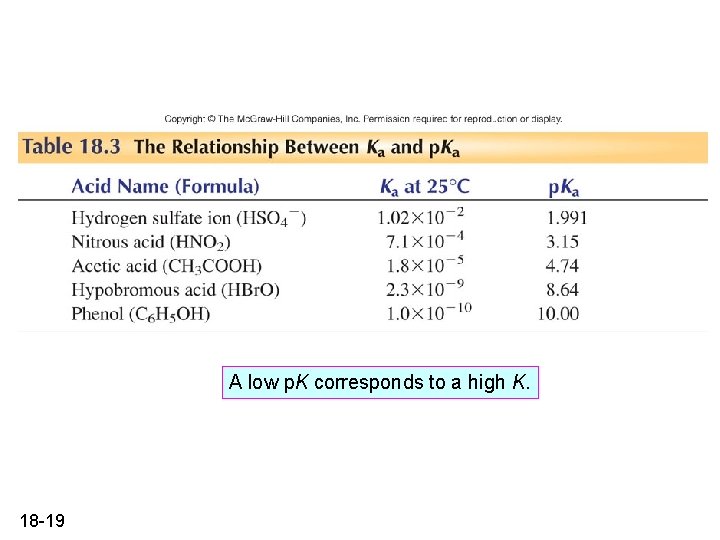
A low p. K corresponds to a high K. 18 -19

Relationships between [H 3 O+], p. H, [OH-] and p. OH Figure 18. 7 18 -20
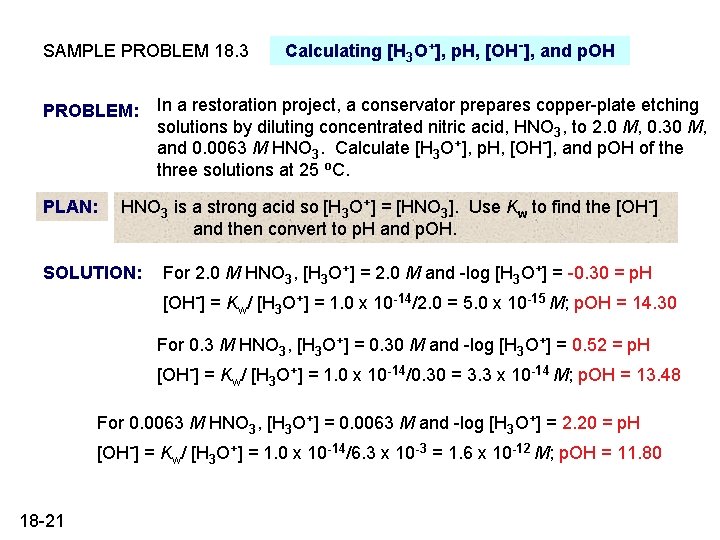
SAMPLE PROBLEM 18. 3 PROBLEM: PLAN: Calculating [H 3 O+], p. H, [OH-], and p. OH In a restoration project, a conservator prepares copper-plate etching solutions by diluting concentrated nitric acid, HNO 3, to 2. 0 M, 0. 30 M, and 0. 0063 M HNO 3. Calculate [H 3 O+], p. H, [OH-], and p. OH of the three solutions at 25 o. C. HNO 3 is a strong acid so [H 3 O+] = [HNO 3]. Use Kw to find the [OH-] and then convert to p. H and p. OH. SOLUTION: For 2. 0 M HNO 3, [H 3 O+] = 2. 0 M and -log [H 3 O+] = -0. 30 = p. H [OH-] = Kw/ [H 3 O+] = 1. 0 x 10 -14/2. 0 = 5. 0 x 10 -15 M; p. OH = 14. 30 For 0. 3 M HNO 3, [H 3 O+] = 0. 30 M and -log [H 3 O+] = 0. 52 = p. H [OH-] = Kw/ [H 3 O+] = 1. 0 x 10 -14/0. 30 = 3. 3 x 10 -14 M; p. OH = 13. 48 For 0. 0063 M HNO 3, [H 3 O+] = 0. 0063 M and -log [H 3 O+] = 2. 20 = p. H [OH-] = Kw/ [H 3 O+] = 1. 0 x 10 -14/6. 3 x 10 -3 = 1. 6 x 10 -12 M; p. OH = 11. 80 18 -21
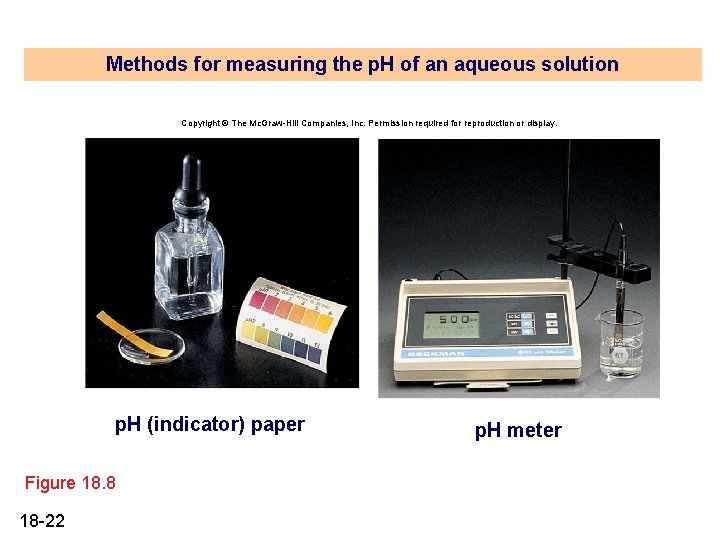
Methods for measuring the p. H of an aqueous solution Copyright © The Mc. Graw-Hill Companies, Inc. Permission required for reproduction or display. p. H (indicator) paper Figure 18. 8 18 -22 p. H meter
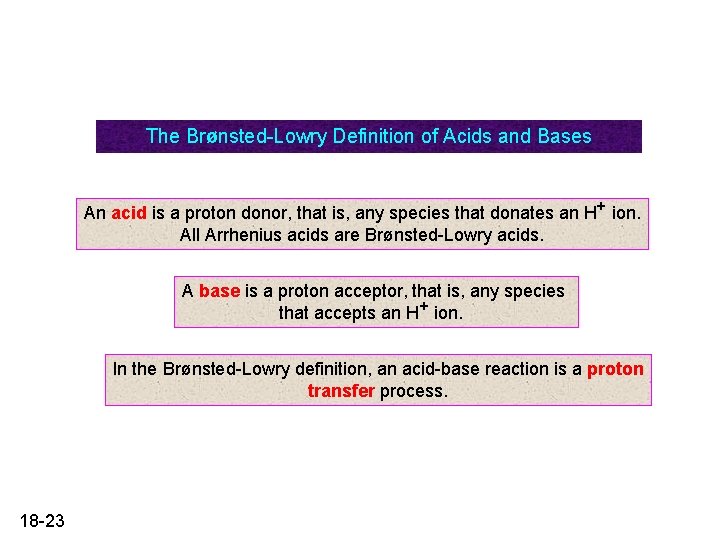
The Brønsted-Lowry Definition of Acids and Bases An acid is a proton donor, that is, any species that donates an H+ ion. All Arrhenius acids are Brønsted-Lowry acids. A base is a proton acceptor, that is, any species that accepts an H+ ion. In the Brønsted-Lowry definition, an acid-base reaction is a proton transfer process. 18 -23
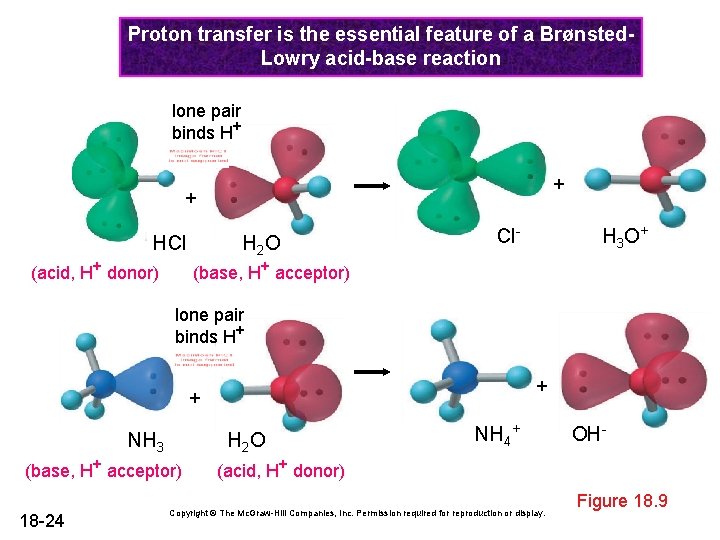
Proton transfer is the essential feature of a Brønsted. Lowry acid-base reaction lone pair binds H+ + + HCl (acid, H+ donor) H 2 O Cl- H 3 O + (base, H+ acceptor) lone pair binds H+ + + NH 3 H 2 O (base, H+ acceptor) 18 -24 NH 4+ OH- (acid, H+ donor) Copyright © The Mc. Graw-Hill Companies, Inc. Permission required for reproduction or display. Figure 18. 9
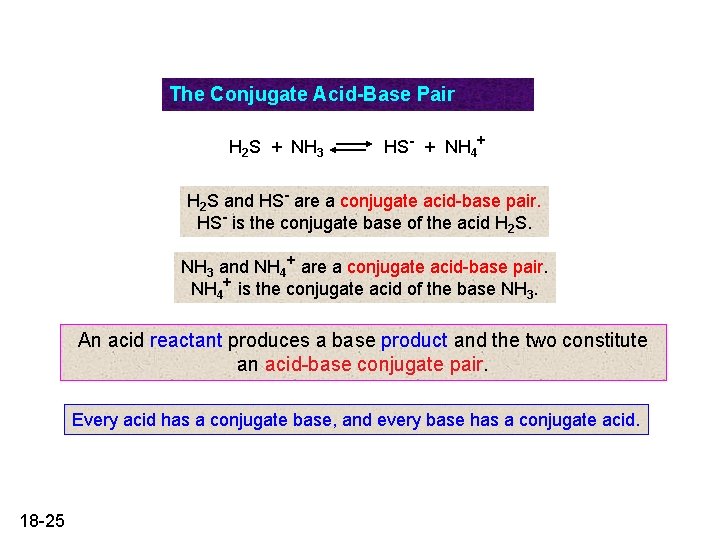
The Conjugate Acid-Base Pair H 2 S + NH 3 HS- + NH 4+ H 2 S and HS- are a conjugate acid-base pair. HS- is the conjugate base of the acid H 2 S. NH 3 and NH 4+ are a conjugate acid-base pair. NH 4+ is the conjugate acid of the base NH 3. An acid reactant produces a base product and the two constitute an acid-base conjugate pair. Every acid has a conjugate base, and every base has a conjugate acid. 18 -25
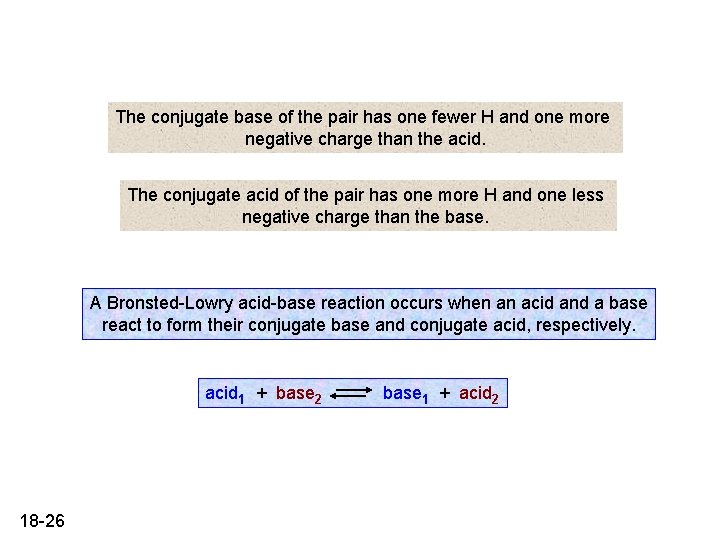
The conjugate base of the pair has one fewer H and one more negative charge than the acid. The conjugate acid of the pair has one more H and one less negative charge than the base. A Bronsted-Lowry acid-base reaction occurs when an acid and a base react to form their conjugate base and conjugate acid, respectively. acid 1 + base 2 18 -26 base 1 + acid 2
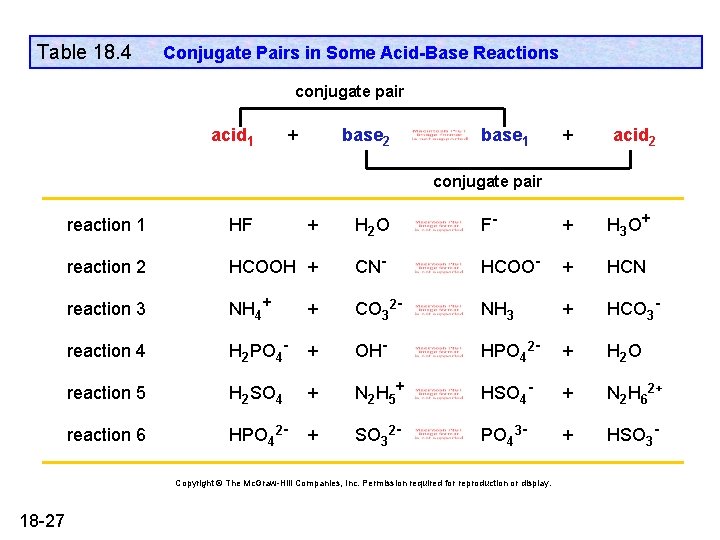
Table 18. 4 Conjugate Pairs in Some Acid-Base Reactions conjugate pair acid 1 + base 2 base 1 + acid 2 conjugate pair reaction 1 HF + H 2 O F- + H 3 O + reaction 2 HCOOH + CN- HCOO- + HCN reaction 3 NH 4+ + CO 32 - NH 3 + HCO 3 - reaction 4 H 2 PO 4 - + OH- HPO 42 - + H 2 O reaction 5 H 2 SO 4 + N 2 H 5 + HSO 4 - + N 2 H 62+ reaction 6 HPO 42 - + SO 32 - PO 43 - + HSO 3 - Copyright © The Mc. Graw-Hill Companies, Inc. Permission required for reproduction or display. 18 -27
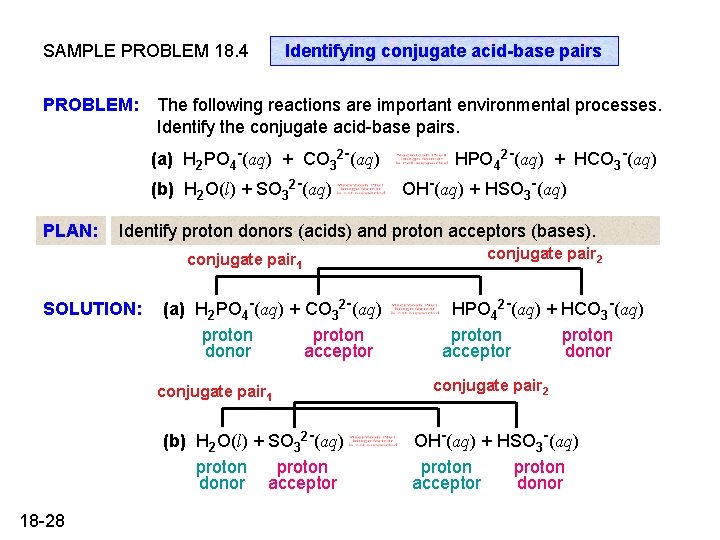
SAMPLE PROBLEM 18. 4 PROBLEM: Identifying conjugate acid-base pairs The following reactions are important environmental processes. Identify the conjugate acid-base pairs. (a) H 2 PO 4 -(aq) + CO 32 -(aq) (b) H 2 O(l) + SO 32 -(aq) PLAN: OH-(aq) + HSO 3 -(aq) Identify proton donors (acids) and proton acceptors (bases). conjugate pair 1 SOLUTION: (a) H 2 PO 4 -(aq) + CO 32 -(aq) proton donor acceptor conjugate pair 1 (b) H 2 O(l) + SO 32 -(aq) proton donor acceptor 18 -28 HPO 42 -(aq) + HCO 3 -(aq) conjugate pair 2 HPO 42 -(aq) + HCO 3 -(aq) proton acceptor donor conjugate pair 2 OH-(aq) + HSO 3 -(aq) proton acceptor donor
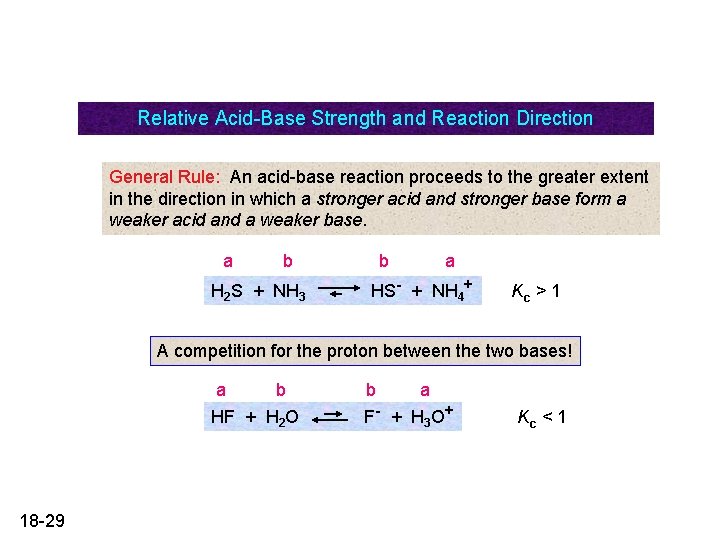
Relative Acid-Base Strength and Reaction Direction General Rule: An acid-base reaction proceeds to the greater extent in the direction in which a stronger acid and stronger base form a weaker acid and a weaker base. a b H 2 S + NH 3 b a HS- + NH 4+ Kc > 1 A competition for the proton between the two bases! a b HF + H 2 O 18 -29 b a F - + H 3 O+ Kc < 1
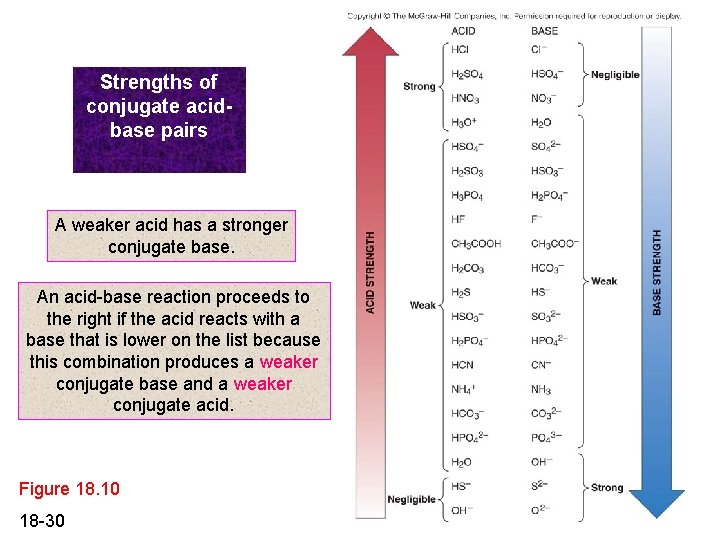
Strengths of conjugate acidbase pairs A weaker acid has a stronger conjugate base. An acid-base reaction proceeds to the right if the acid reacts with a base that is lower on the list because this combination produces a weaker conjugate base and a weaker conjugate acid. Figure 18. 10 18 -30
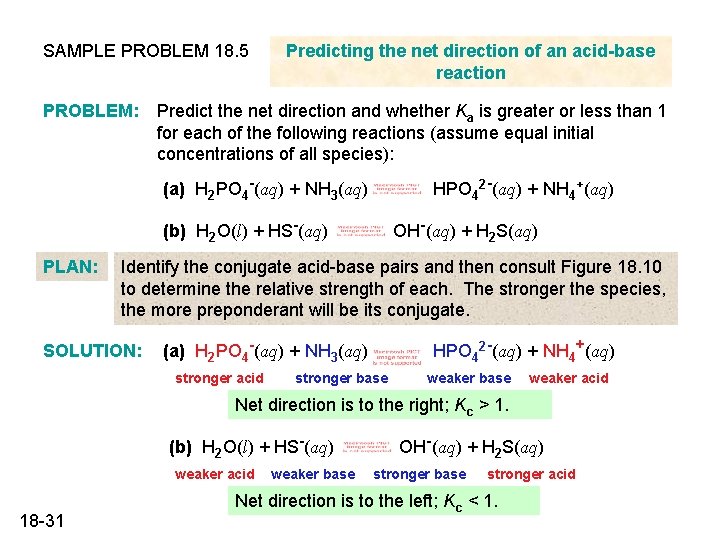
SAMPLE PROBLEM 18. 5 PROBLEM: Predicting the net direction of an acid-base reaction Predict the net direction and whether Ka is greater or less than 1 for each of the following reactions (assume equal initial concentrations of all species): (a) H 2 PO 4 -(aq) + NH 3(aq) HPO 42 -(aq) + NH 4+(aq) (b) H 2 O(l) + HS-(aq) PLAN: OH-(aq) + H 2 S(aq) Identify the conjugate acid-base pairs and then consult Figure 18. 10 to determine the relative strength of each. The stronger the species, the more preponderant will be its conjugate. SOLUTION: (a) H 2 PO 4 -(aq) + NH 3(aq) stronger acid HPO 42 -(aq) + NH 4+(aq) stronger base weaker acid Net direction is to the right; Kc > 1. (b) H 2 O(l) + HS-(aq) weaker acid 18 -31 weaker base OH-(aq) + H 2 S(aq) stronger base stronger acid Net direction is to the left; Kc < 1.
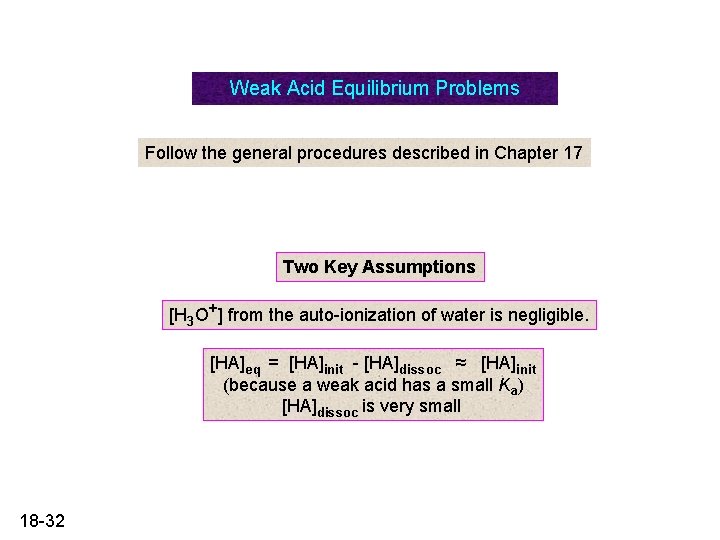
Weak Acid Equilibrium Problems Follow the general procedures described in Chapter 17 Two Key Assumptions [H 3 O+] from the auto-ionization of water is negligible. [HA]eq = [HA]init - [HA]dissoc ≈ [HA]init (because a weak acid has a small Ka) [HA]dissoc is very small 18 -32
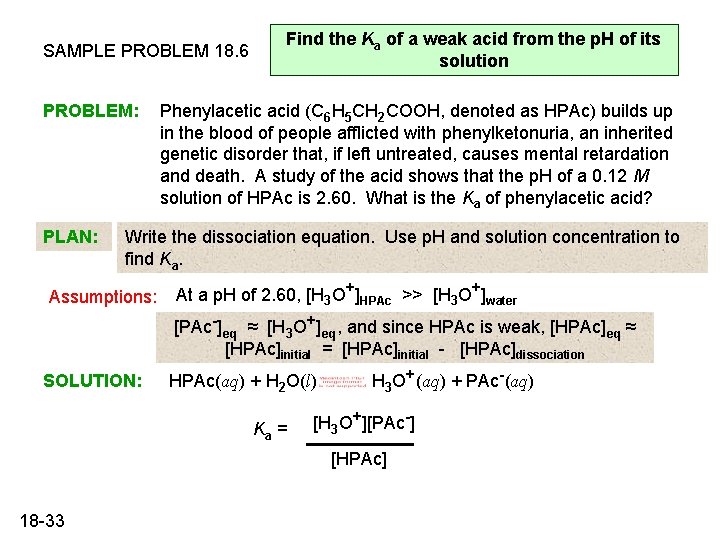
SAMPLE PROBLEM 18. 6 PROBLEM: PLAN: Find the Ka of a weak acid from the p. H of its solution Phenylacetic acid (C 6 H 5 CH 2 COOH, denoted as HPAc) builds up in the blood of people afflicted with phenylketonuria, an inherited genetic disorder that, if left untreated, causes mental retardation and death. A study of the acid shows that the p. H of a 0. 12 M solution of HPAc is 2. 60. What is the Ka of phenylacetic acid? Write the dissociation equation. Use p. H and solution concentration to find Ka. Assumptions: At a p. H of 2. 60, [H 3 O+]HPAc >> [H 3 O+]water [PAc-]eq ≈ [H 3 O+]eq, and since HPAc is weak, [HPAc]eq ≈ [HPAc]initial = [HPAc]initial - [HPAc]dissociation SOLUTION: HPAc(aq) + H 2 O(l) Ka = H 3 O+(aq) + PAc-(aq) [H 3 O+][PAc-] [HPAc] 18 -33
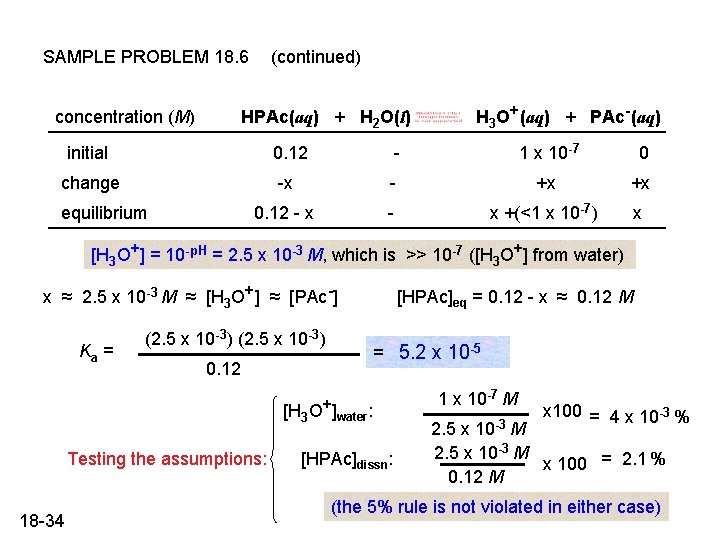
SAMPLE PROBLEM 18. 6 concentration (M) (continued) HPAc(aq) + H 2 O(l) H 3 O+(aq) + PAc-(aq) initial 0. 12 - 1 x 10 -7 0 change -x - +x +x 0. 12 - x +(<1 x 10 -7) x equilibrium [H 3 O+] = 10 -p. H = 2. 5 x 10 -3 M, which is >> 10 -7 ([H 3 O+] from water) x ≈ 2. 5 x 10 -3 M ≈ [H 3 O+] ≈ [PAc-] Ka = (2. 5 x 10 -3) [HPAc]eq = 0. 12 - x ≈ 0. 12 M = 5. 2 x 10 -5 0. 12 [H 3 O+]water: Testing the assumptions: 18 -34 [HPAc]dissn: 1 x 10 -7 M 10 -3 M x 100 = 4 x 10 -3 % 2. 5 x 10 -3 M x 100 = 2. 1 % 0. 12 M (the 5% rule is not violated in either case)
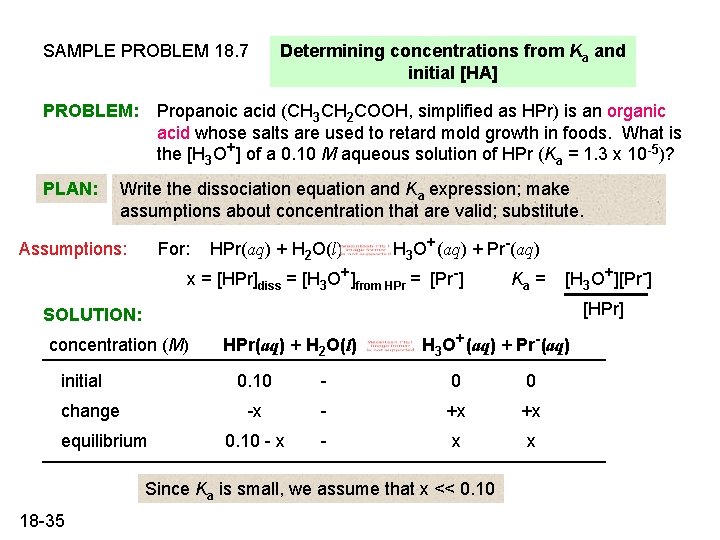
SAMPLE PROBLEM 18. 7 PROBLEM: PLAN: Determining concentrations from Ka and initial [HA] Propanoic acid (CH 3 CH 2 COOH, simplified as HPr) is an organic acid whose salts are used to retard mold growth in foods. What is the [H 3 O+] of a 0. 10 M aqueous solution of HPr (Ka = 1. 3 x 10 -5)? Write the dissociation equation and Ka expression; make assumptions about concentration that are valid; substitute. For: Assumptions: HPr(aq) + H 2 O(l) H 3 O+(aq) + Pr-(aq) x = [HPr]diss = [H 3 O+]from HPr = [Pr-] Ka = [H 3 O+][Pr-] [HPr] SOLUTION: concentration (M) initial change equilibrium HPr(aq) + H 2 O(l) H 3 O+(aq) + Pr-(aq) 0. 10 - 0 0 -x - +x +x 0. 10 - x x Since Ka is small, we assume that x << 0. 10 18 -35
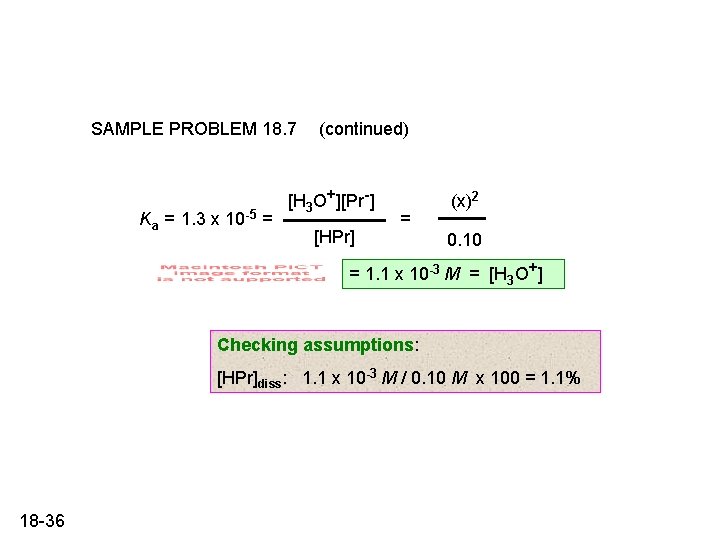
SAMPLE PROBLEM 18. 7 Ka = 1. 3 x 10 -5 = (continued) [H 3 O+][Pr-] [HPr] = (x)2 0. 10 = 1. 1 x 10 -3 M = [H 3 O+] Checking assumptions: [HPr]diss: 1. 1 x 10 -3 M / 0. 10 M x 100 = 1. 1% 18 -36
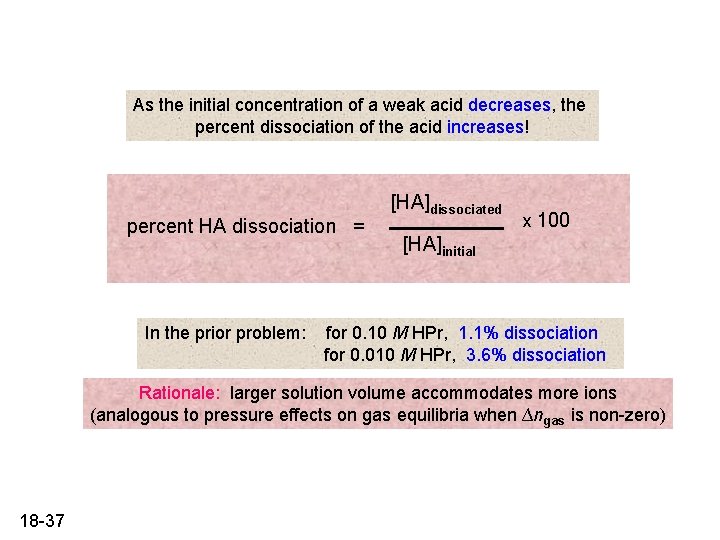
As the initial concentration of a weak acid decreases, the percent dissociation of the acid increases! percent HA dissociation = In the prior problem: [HA]dissociated x 100 [HA]initial for 0. 10 M HPr, 1. 1% dissociation for 0. 010 M HPr, 3. 6% dissociation Rationale: larger solution volume accommodates more ions (analogous to pressure effects on gas equilibria when ∆ngas is non-zero) 18 -37
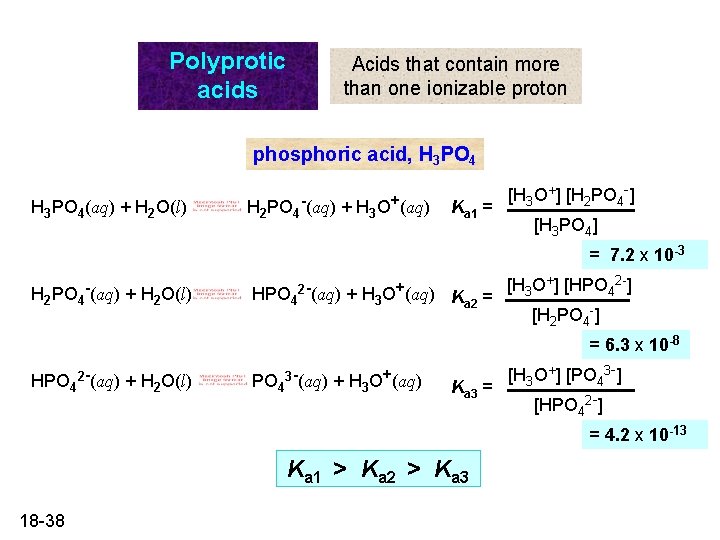
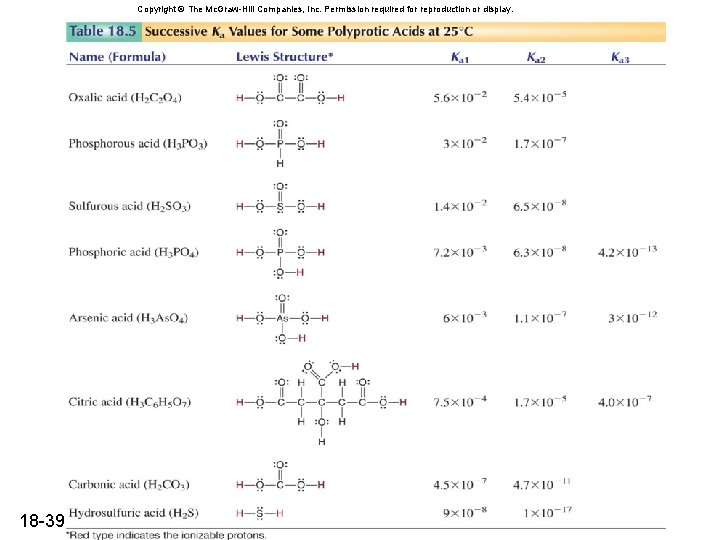
Polyprotic acids Acids that contain more than one ionizable proton phosphoric acid, H 3 PO 4(aq) + H 2 O(l) H 2 PO 4 -(aq) + H 3 O+(aq) Ka 1 = [H 3 O+] [H 2 PO 4 -] [H 3 PO 4] = 7. 2 x 10 -3 H 2 PO 4 -(aq) + H 2 O(l) + 2 HPO 42 -(aq) + H 3 O+(aq) Ka 2 = [H 3 O ] [HPO 4 ] [H 2 PO 4 -] = 6. 3 x 10 -8 HPO 42 -(aq) + H 2 O(l) PO 43 -(aq) + H 3 O+(aq) Ka 3 = [H 3 O+] [PO 43 -] [HPO 42 -] = 4. 2 x 10 -13 Ka 1 > Ka 2 > Ka 3 18 -38
Copyright © The Mc. Graw-Hill Companies, Inc. Permission required for reproduction or display. 18 -39
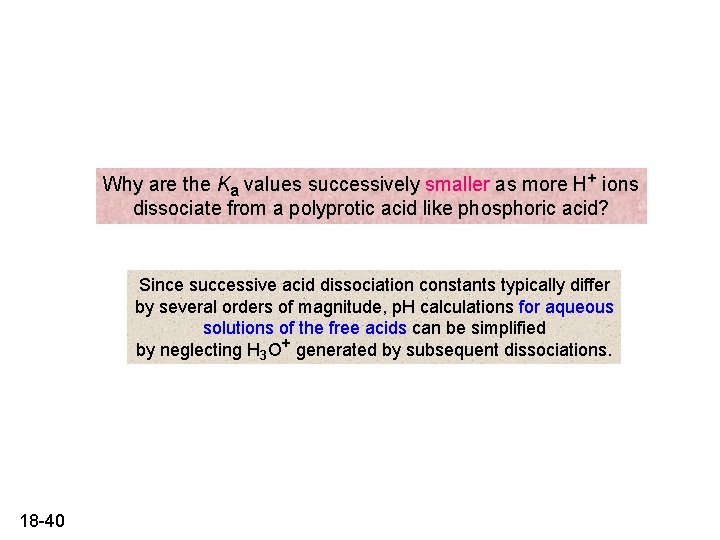
Why are the Ka values successively smaller as more H+ ions dissociate from a polyprotic acid like phosphoric acid? Since successive acid dissociation constants typically differ by several orders of magnitude, p. H calculations for aqueous solutions of the free acids can be simplified by neglecting H 3 O+ generated by subsequent dissociations. 18 -40
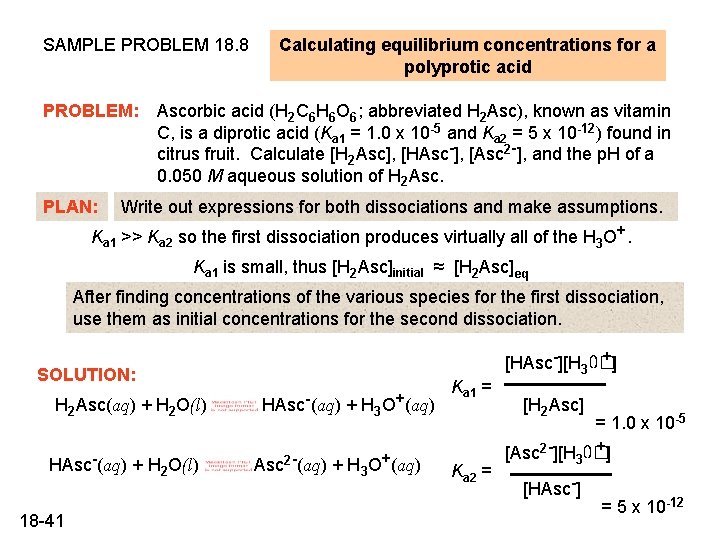
SAMPLE PROBLEM 18. 8 PROBLEM: PLAN: Calculating equilibrium concentrations for a polyprotic acid Ascorbic acid (H 2 C 6 H 6 O 6; abbreviated H 2 Asc), known as vitamin C, is a diprotic acid (Ka 1 = 1. 0 x 10 -5 and Ka 2 = 5 x 10 -12) found in citrus fruit. Calculate [H 2 Asc], [HAsc-], [Asc 2 -], and the p. H of a 0. 050 M aqueous solution of H 2 Asc. Write out expressions for both dissociations and make assumptions. Ka 1 >> Ka 2 so the first dissociation produces virtually all of the H 3 O+. Ka 1 is small, thus [H 2 Asc]initial ≈ [H 2 Asc]eq After finding concentrations of the various species for the first dissociation, use them as initial concentrations for the second dissociation. +] [HAsc-][H 3 O� SOLUTION: H 2 Asc(aq) + H 2 O(l) HAsc-(aq) + H 2 O(l) 18 -41 HAsc-(aq) + H 3 O+(aq) Asc 2 -(aq) + H 3 O+(aq) Ka 1 = Ka 2 = [H 2 Asc] = 1. 0 x 10 -5 +] [Asc 2 -][H 3 O� [HAsc-] = 5 x 10 -12
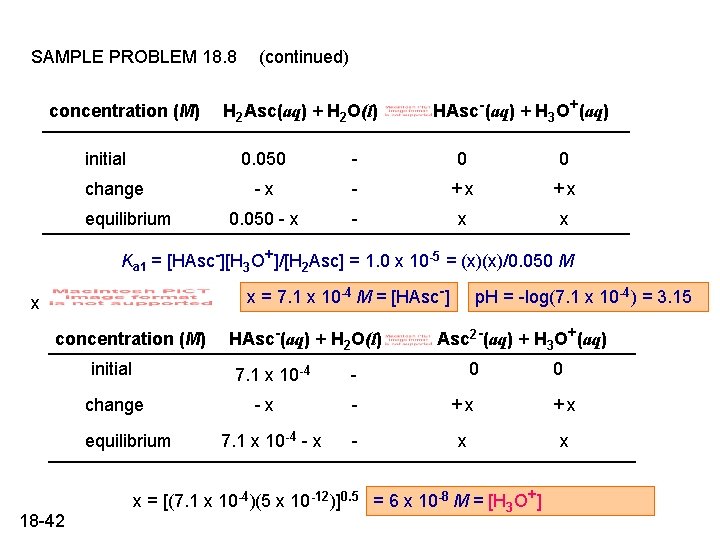
SAMPLE PROBLEM 18. 8 concentration (M) initial change equilibrium (continued) H 2 Asc(aq) + H 2 O(l) HAsc-(aq) + H 3 O+(aq) 0. 050 - 0 0 -x - +x +x 0. 050 - x x Ka 1 = [HAsc-][H 3 O+]/[H 2 Asc] = 1. 0 x 10 -5 = (x)(x)/0. 050 M x = 7. 1 x 10 -4 M = [HAsc-] x concentration (M) initial 7. 1 x 10 -4 change equilibrium 18 -42 HAsc-(aq) + H 2 O(l) -x 7. 1 x 10 -4 - x p. H = -log(7. 1 x 10 -4) = 3. 15 Asc 2 -(aq) + H 3 O+(aq) - 0 - +x +x - x x x = [(7. 1 x 10 -4)(5 x 10 -12)]0. 5 = 6 x 10 -8 M = [H 3 O+] 0
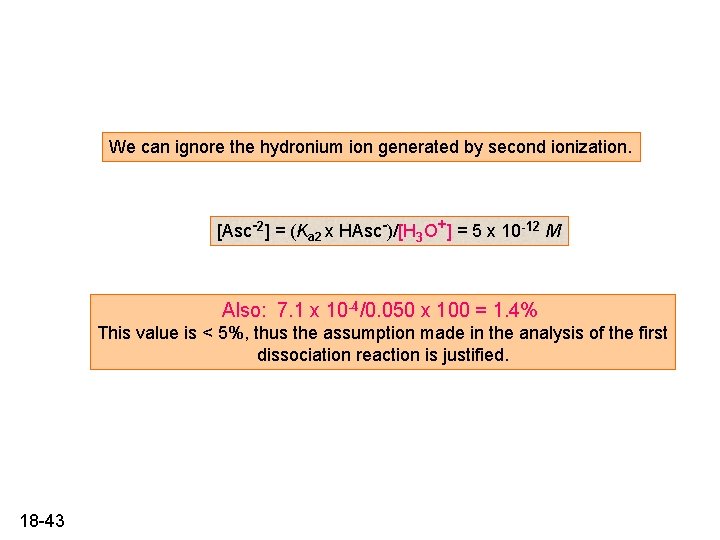
We can ignore the hydronium ion generated by second ionization. [Asc-2] = (Ka 2 x HAsc-)/[H 3 O+] = 5 x 10 -12 M Also: 7. 1 x 10 -4/0. 050 x 100 = 1. 4% This value is < 5%, thus the assumption made in the analysis of the first dissociation reaction is justified. 18 -43
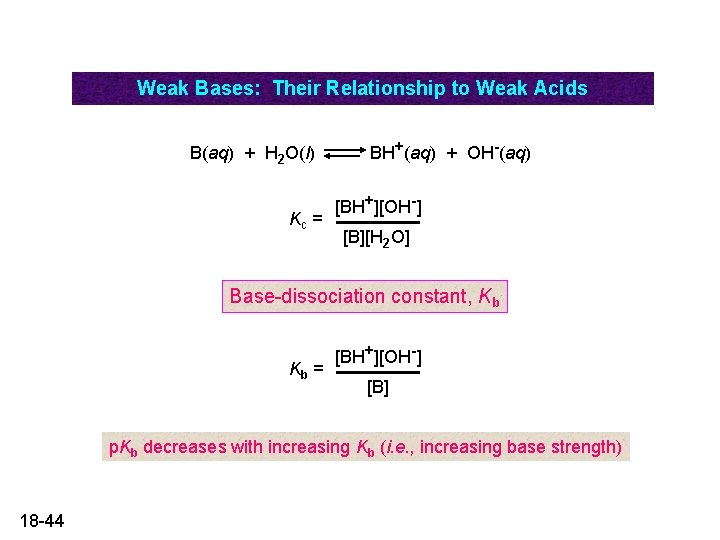
Weak Bases: Their Relationship to Weak Acids B(aq) + H 2 O(l) Kc = BH+(aq) + OH-(aq) [BH+][OH-] [B][H 2 O] Base-dissociation constant, Kb Kb = [BH+][OH-] [B] p. Kb decreases with increasing Kb (i. e. , increasing base strength) 18 -44
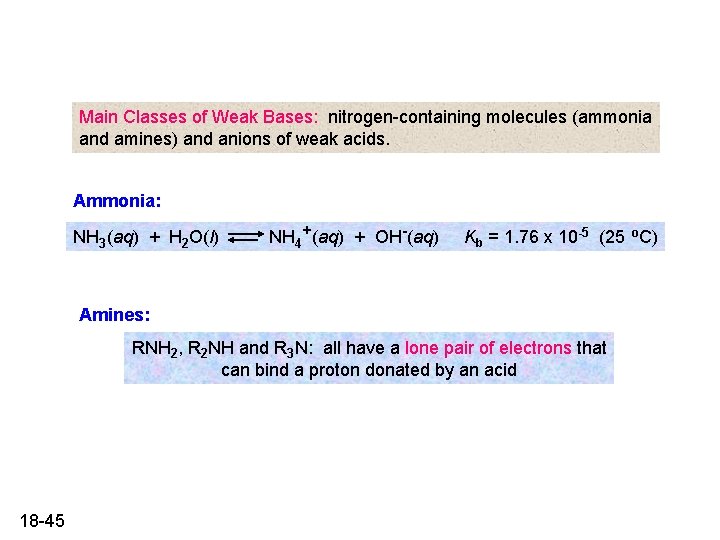
Main Classes of Weak Bases: nitrogen-containing molecules (ammonia and amines) and anions of weak acids. Ammonia: NH 3(aq) + H 2 O(l) NH 4+(aq) + OH-(aq) Kb = 1. 76 x 10 -5 (25 o. C) Amines: RNH 2, R 2 NH and R 3 N: all have a lone pair of electrons that can bind a proton donated by an acid 18 -45
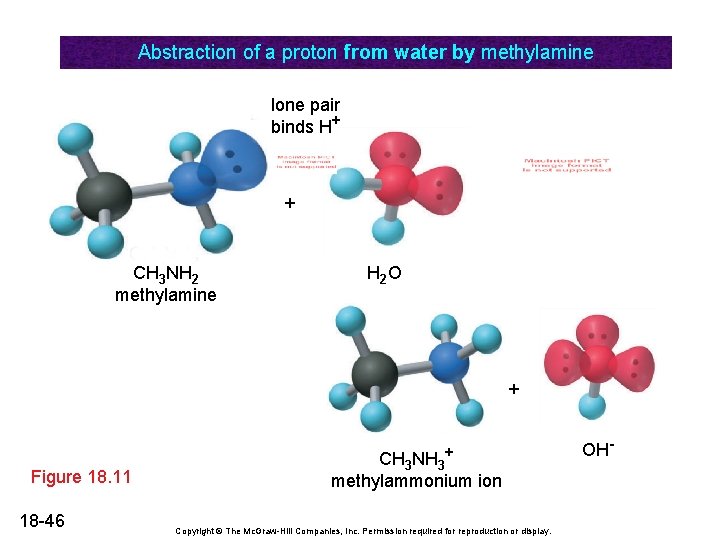
Abstraction of a proton from water by methylamine lone pair binds H+ + CH 3 NH 2 methylamine H 2 O + Figure 18. 11 18 -46 CH 3 NH 3+ methylammonium ion Copyright © The Mc. Graw-Hill Companies, Inc. Permission required for reproduction or display. OH-
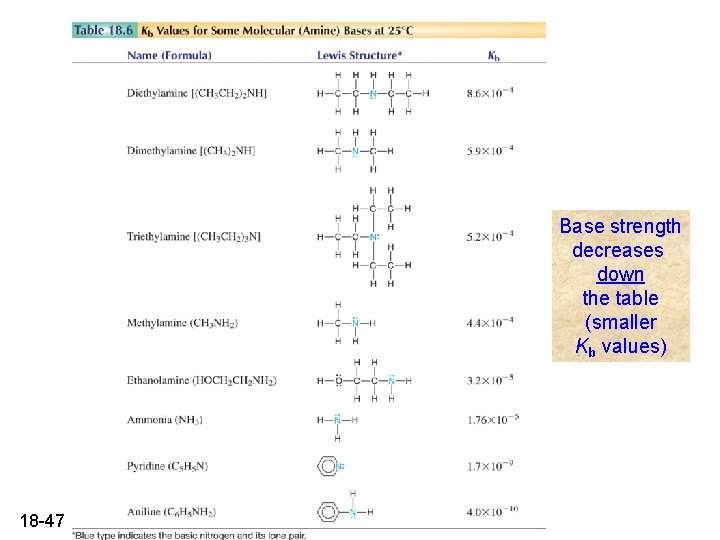
Base strength decreases down the table (smaller Kb values) 18 -47
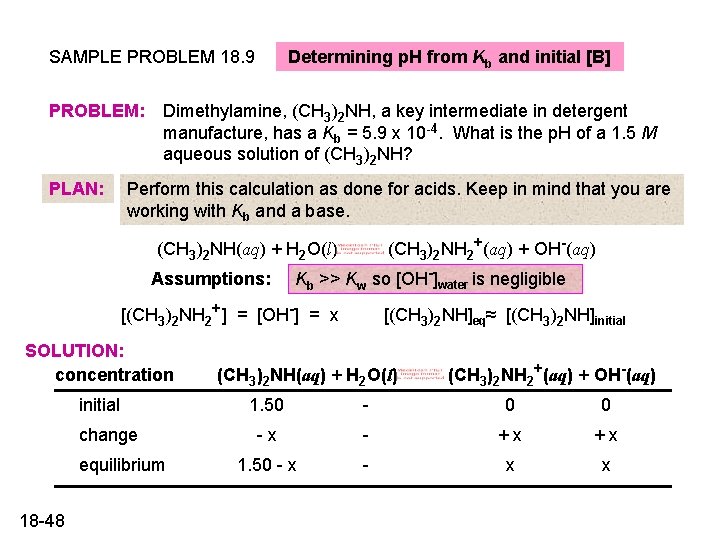
SAMPLE PROBLEM 18. 9 PROBLEM: PLAN: Determining p. H from Kb and initial [B] Dimethylamine, (CH 3)2 NH, a key intermediate in detergent manufacture, has a Kb = 5. 9 x 10 -4. What is the p. H of a 1. 5 M aqueous solution of (CH 3)2 NH? Perform this calculation as done for acids. Keep in mind that you are working with Kb and a base. (CH 3)2 NH 2+(aq) + OH-(aq) (CH 3)2 NH(aq) + H 2 O(l) Assumptions: Kb >> Kw so [OH-]water is negligible [(CH 3)2 NH 2+] = [OH-] = x SOLUTION: concentration initial change equilibrium 18 -48 [(CH 3)2 NH]eq≈ [(CH 3)2 NH]initial (CH 3)2 NH(aq) + H 2 O(l) (CH 3)2 NH 2+(aq) + OH-(aq) 1. 50 - 0 0 -x - +x +x 1. 50 - x x
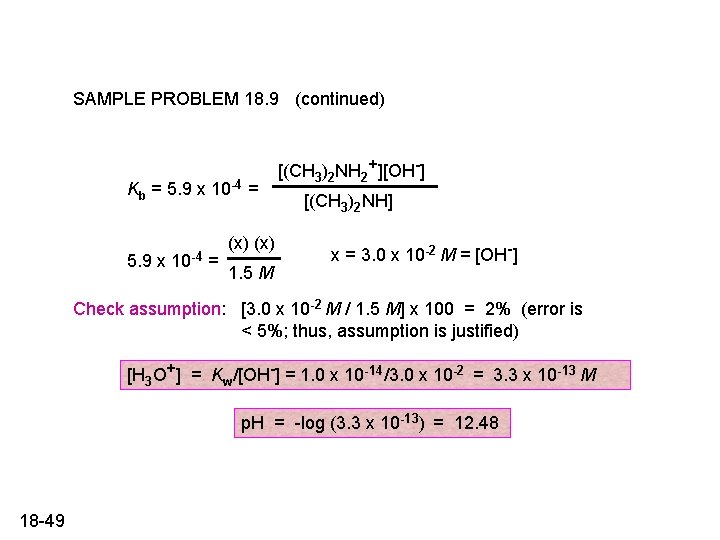
SAMPLE PROBLEM 18. 9 (continued) Kb = 5. 9 x 10 -4 = (x) 1. 5 M [(CH 3)2 NH 2+][OH-] [(CH 3)2 NH] x = 3. 0 x 10 -2 M = [OH-] Check assumption: [3. 0 x 10 -2 M / 1. 5 M] x 100 = 2% (error is < 5%; thus, assumption is justified) [H 3 O+] = Kw/[OH-] = 1. 0 x 10 -14/3. 0 x 10 -2 = 3. 3 x 10 -13 M p. H = -log (3. 3 x 10 -13) = 12. 48 18 -49
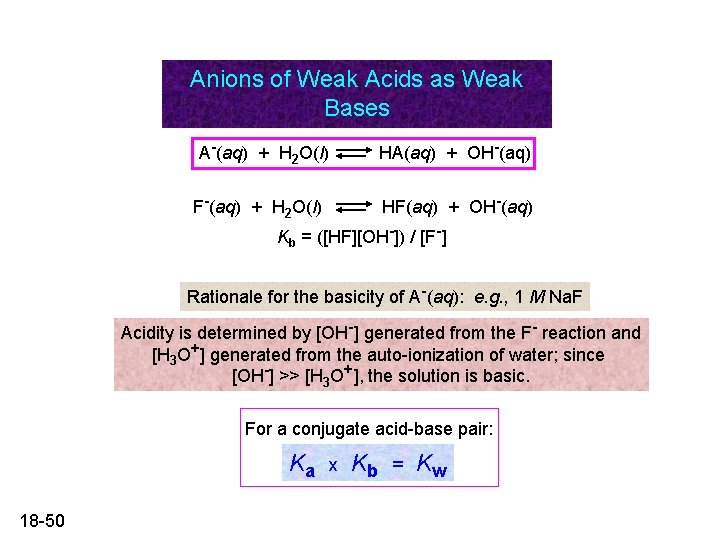
Anions of Weak Acids as Weak Bases A-(aq) + H 2 O(l) F-(aq) + H 2 O(l) HA(aq) + OH-(aq) HF(aq) + OH-(aq) Kb = ([HF][OH-]) / [F-] Rationale for the basicity of A-(aq): e. g. , 1 M Na. F Acidity is determined by [OH-] generated from the F- reaction and [H 3 O+] generated from the auto-ionization of water; since [OH-] >> [H 3 O+], the solution is basic. For a conjugate acid-base pair: Ka 18 -50 x Kb = Kw
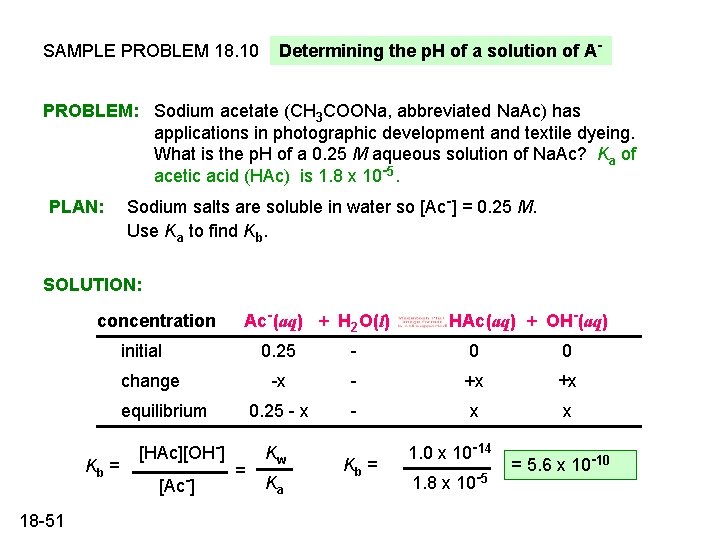
SAMPLE PROBLEM 18. 10 Determining the p. H of a solution of A- PROBLEM: Sodium acetate (CH 3 COONa, abbreviated Na. Ac) has applications in photographic development and textile dyeing. What is the p. H of a 0. 25 M aqueous solution of Na. Ac? Ka of acetic acid (HAc) is 1. 8 x 10 -5. PLAN: Sodium salts are soluble in water so [Ac-] = 0. 25 M. Use Ka to find Kb. SOLUTION: concentration Ac-(aq) + H 2 O(l) initial change equilibrium Kb = 18 -51 [HAc][OH-] [Ac-] = HAc(aq) + OH-(aq) 0. 25 - 0 0 -x - +x +x 0. 25 - x x Kw Ka Kb = 1. 0 x 10 -14 1. 8 x 10 -5 = 5. 6 x 10 -10
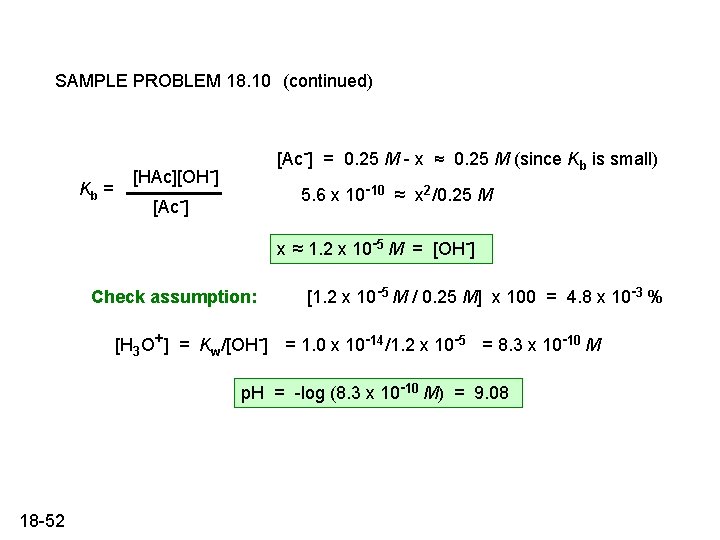
SAMPLE PROBLEM 18. 10 (continued) Kb = [Ac-] = 0. 25 M - x ≈ 0. 25 M (since Kb is small) [HAc][OH-] 5. 6 x 10 -10 ≈ x 2/0. 25 M [Ac-] x ≈ 1. 2 x 10 -5 M = [OH-] Check assumption: [1. 2 x 10 -5 M / 0. 25 M] x 100 = 4. 8 x 10 -3 % [H 3 O+] = Kw/[OH-] = 1. 0 x 10 -14/1. 2 x 10 -5 = 8. 3 x 10 -10 M p. H = -log (8. 3 x 10 -10 M) = 9. 08 18 -52
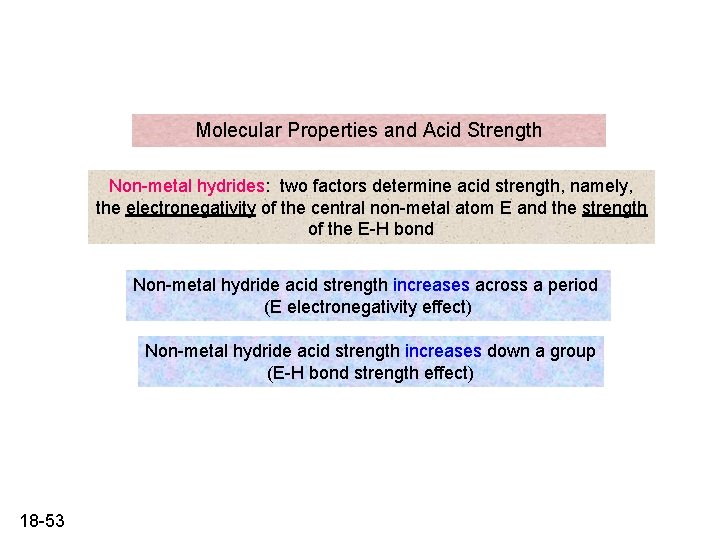
Molecular Properties and Acid Strength Non-metal hydrides: two factors determine acid strength, namely, the electronegativity of the central non-metal atom E and the strength of the E-H bond Non-metal hydride acid strength increases across a period (E electronegativity effect) Non-metal hydride acid strength increases down a group (E-H bond strength effect) 18 -53
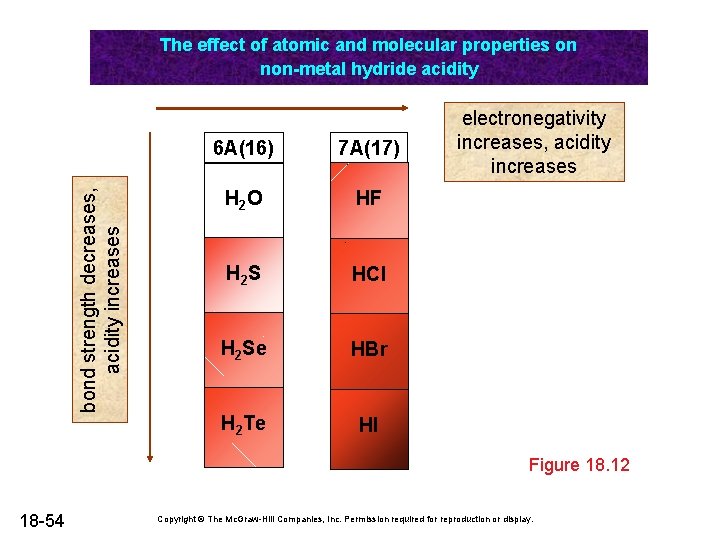
bond strength decreases, acidity increases The effect of atomic and molecular properties on non-metal hydride acidity 6 A(16) 7 A(17) H 2 O HF H 2 S HCl H 2 Se HBr H 2 Te HI electronegativity increases, acidity increases Figure 18. 12 18 -54 Copyright © The Mc. Graw-Hill Companies, Inc. Permission required for reproduction or display.
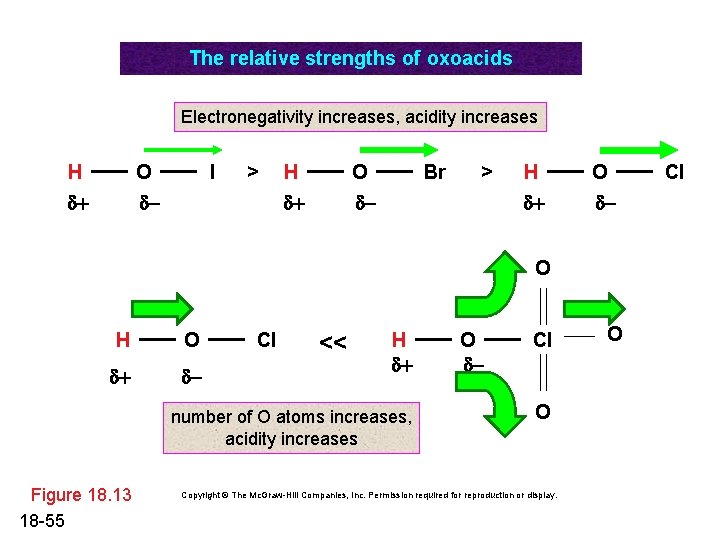
The relative strengths of oxoacids Electronegativity increases, acidity increases H O I > H O Br > H O O H O Cl << H number of O atoms increases, acidity increases Figure 18. 13 18 -55 O Cl O Copyright © The Mc. Graw-Hill Companies, Inc. Permission required for reproduction or display. O Cl
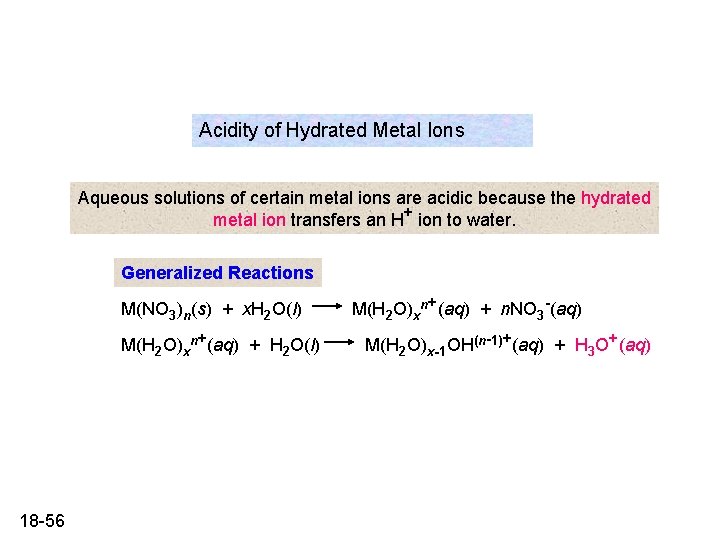
Acidity of Hydrated Metal Ions Aqueous solutions of certain metal ions are acidic because the hydrated metal ion transfers an H+ ion to water. Generalized Reactions M(NO 3)n(s) + x. H 2 O(l) M(H 2 O)xn+(aq) + H 2 O(l) 18 -56 M(H 2 O)xn+(aq) + n. NO 3 -(aq) M(H 2 O)x-1 OH(n-1)+(aq) + H 3 O+(aq)
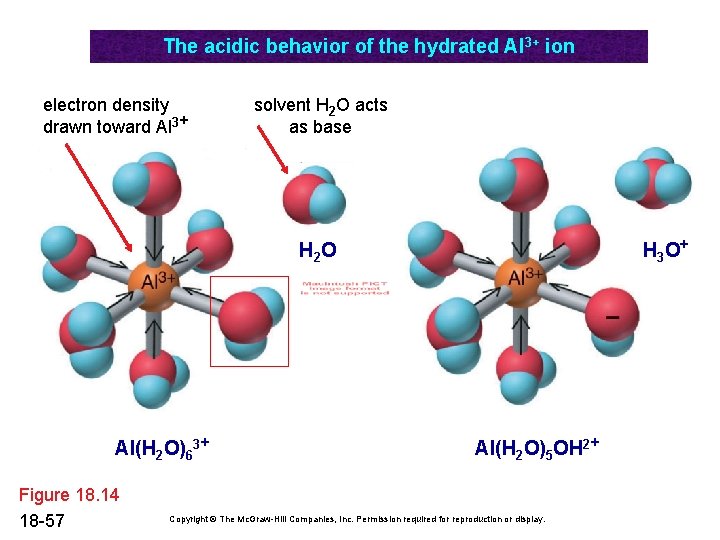
The acidic behavior of the hydrated Al 3+ ion electron density drawn toward Al 3+ solvent H 2 O acts as base H 3 O + H 2 O Al(H 2 O)63+ Figure 18. 14 18 -57 Al(H 2 O)5 OH 2+ Copyright © The Mc. Graw-Hill Companies, Inc. Permission required for reproduction or display.

high charge and small size enhance acidity 18 -58
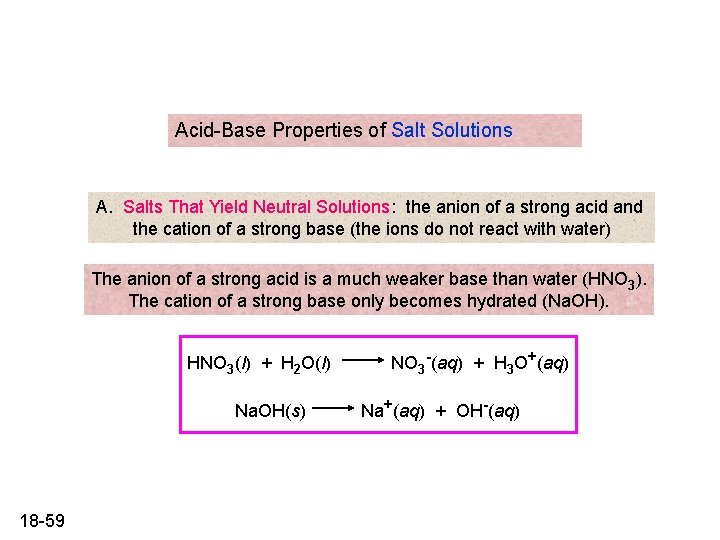
Acid-Base Properties of Salt Solutions A. Salts That Yield Neutral Solutions: the anion of a strong acid and the cation of a strong base (the ions do not react with water) The anion of a strong acid is a much weaker base than water (HNO 3). The cation of a strong base only becomes hydrated (Na. OH). HNO 3(l) + H 2 O(l) Na. OH(s) 18 -59 NO 3 -(aq) + H 3 O+(aq) Na+(aq) + OH-(aq)
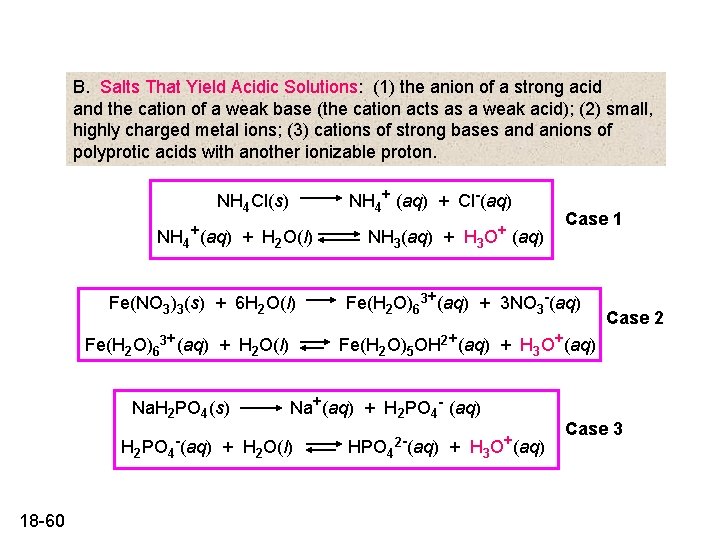
B. Salts That Yield Acidic Solutions: (1) the anion of a strong acid and the cation of a weak base (the cation acts as a weak acid); (2) small, highly charged metal ions; (3) cations of strong bases and anions of polyprotic acids with another ionizable proton. NH 4+ (aq) + Cl-(aq) NH 4 Cl(s) NH 4+(aq) + H 2 O(l) Fe(NO 3)3(s) + 6 H 2 O(l) Fe(H 2 O)63+(aq) + H 2 O(l) Na. H 2 PO 4(s) Case 1 Fe(H 2 O)63+(aq) + 3 NO 3 -(aq) Case 2 Fe(H 2 O)5 OH 2+(aq) + H 3 O+(aq) Na+(aq) + H 2 PO 4 - (aq) H 2 PO 4 -(aq) + H 2 O(l) 18 -60 NH 3(aq) + H 3 O+ (aq) HPO 4 2 -(aq) + H 3 O+(aq) Case 3
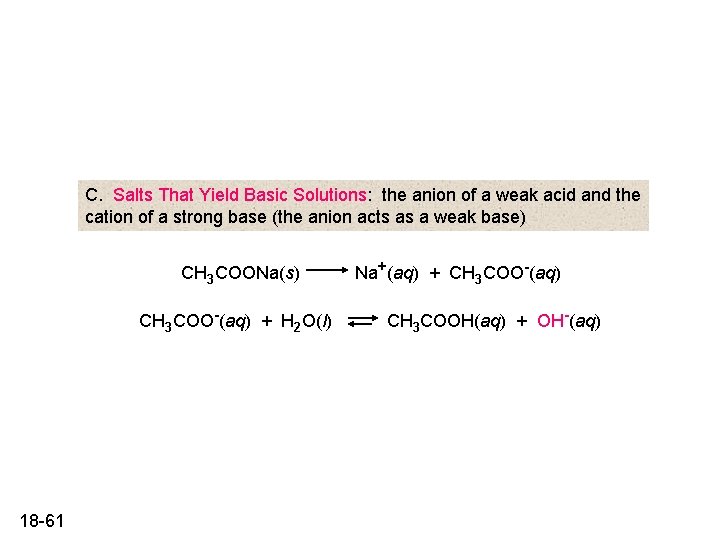
C. Salts That Yield Basic Solutions: the anion of a weak acid and the cation of a strong base (the anion acts as a weak base) CH 3 COONa(s) CH 3 COO-(aq) + H 2 O(l) 18 -61 Na+(aq) + CH 3 COO-(aq) CH 3 COOH(aq) + OH-(aq)
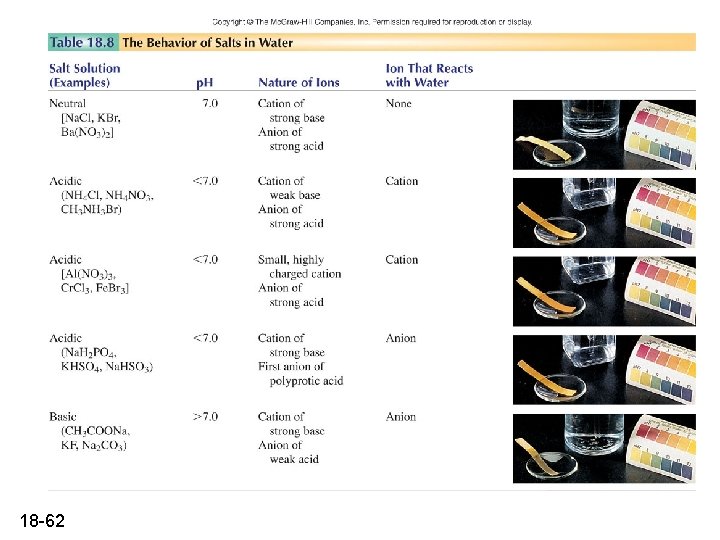
18 -62
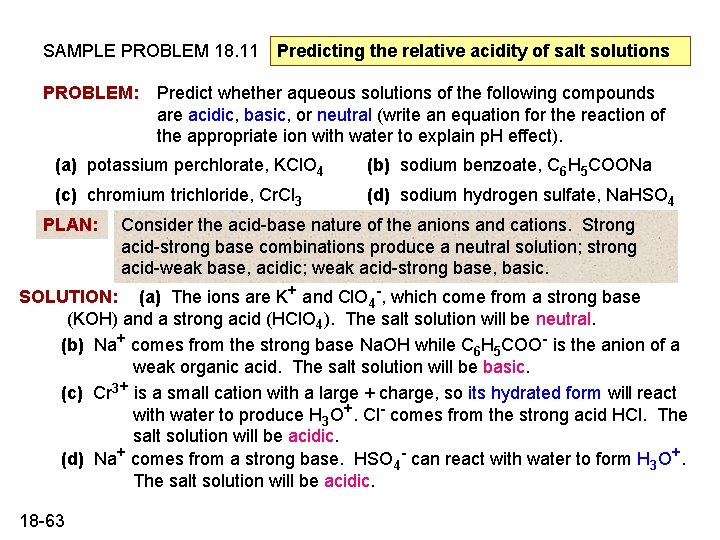
SAMPLE PROBLEM 18. 11 PROBLEM: Predicting the relative acidity of salt solutions Predict whether aqueous solutions of the following compounds are acidic, basic, or neutral (write an equation for the reaction of the appropriate ion with water to explain p. H effect). (a) potassium perchlorate, KCl. O 4 (b) sodium benzoate, C 6 H 5 COONa (c) chromium trichloride, Cr. Cl 3 (d) sodium hydrogen sulfate, Na. HSO 4 PLAN: Consider the acid-base nature of the anions and cations. Strong acid-strong base combinations produce a neutral solution; strong acid-weak base, acidic; weak acid-strong base, basic. SOLUTION: (a) The ions are K+ and Cl. O 4 -, which come from a strong base (KOH) and a strong acid (HCl. O 4). The salt solution will be neutral. (b) Na+ comes from the strong base Na. OH while C 6 H 5 COO- is the anion of a weak organic acid. The salt solution will be basic. (c) Cr 3+ is a small cation with a large + charge, so its hydrated form will react with water to produce H 3 O+. Cl- comes from the strong acid HCl. The salt solution will be acidic. (d) Na+ comes from a strong base. HSO 4 - can react with water to form H 3 O+. The salt solution will be acidic. 18 -63
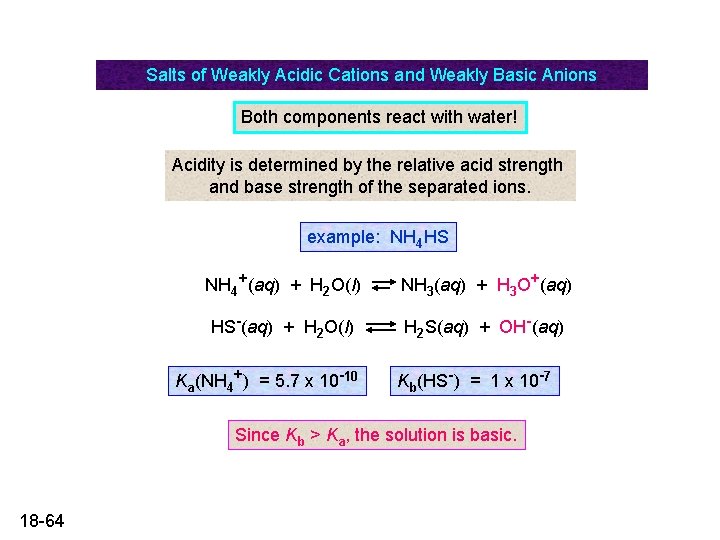
Salts of Weakly Acidic Cations and Weakly Basic Anions Both components react with water! Acidity is determined by the relative acid strength and base strength of the separated ions. example: NH 4 HS NH 4+(aq) + H 2 O(l) NH 3(aq) + H 3 O+(aq) HS-(aq) + H 2 O(l) H 2 S(aq) + OH-(aq) Ka(NH 4+) = 5. 7 x 10 -10 Kb(HS-) = 1 x 10 -7 Since Kb > Ka, the solution is basic. 18 -64
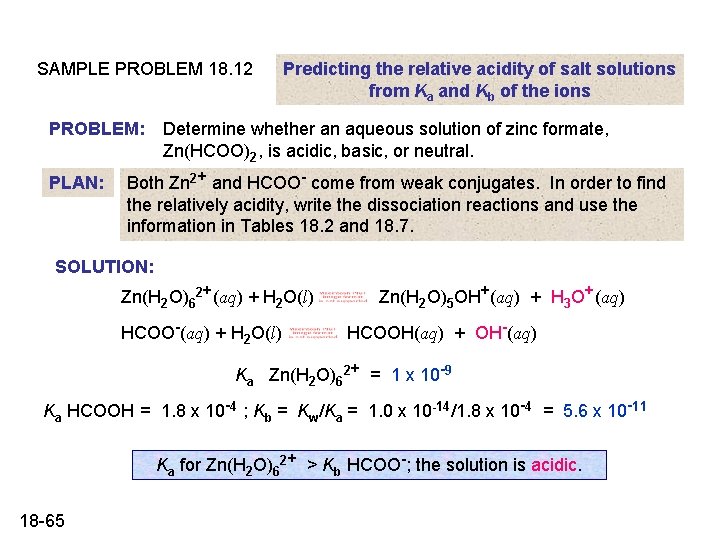
SAMPLE PROBLEM 18. 12 PROBLEM: PLAN: Predicting the relative acidity of salt solutions from Ka and Kb of the ions Determine whether an aqueous solution of zinc formate, Zn(HCOO)2, is acidic, basic, or neutral. Both Zn 2+ and HCOO- come from weak conjugates. In order to find the relatively acidity, write the dissociation reactions and use the information in Tables 18. 2 and 18. 7. SOLUTION: Zn(H 2 O)62+(aq) + H 2 O(l) HCOO-(aq) + H 2 O(l) Zn(H 2 O)5 OH+(aq) + H 3 O+(aq) HCOOH(aq) + OH-(aq) Ka Zn(H 2 O)62+ = 1 x 10 -9 Ka HCOOH = 1. 8 x 10 -4 ; Kb = Kw/Ka = 1. 0 x 10 -14/1. 8 x 10 -4 = 5. 6 x 10 -11 Ka for Zn(H 2 O)62+ > Kb HCOO-; the solution is acidic. 18 -65
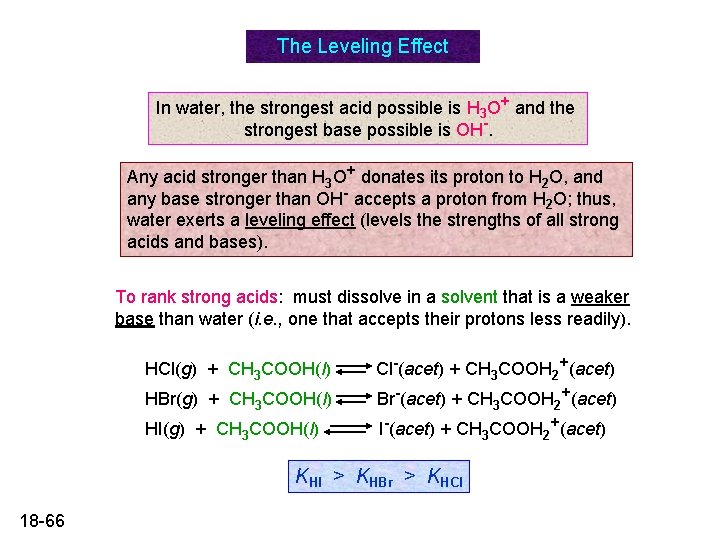
The Leveling Effect In water, the strongest acid possible is H 3 O+ and the strongest base possible is OH-. Any acid stronger than H 3 O+ donates its proton to H 2 O, and any base stronger than OH- accepts a proton from H 2 O; thus, water exerts a leveling effect (levels the strengths of all strong acids and bases). To rank strong acids: must dissolve in a solvent that is a weaker base than water (i. e. , one that accepts their protons less readily). HCl(g) + CH 3 COOH(l) Cl-(acet) + CH 3 COOH 2+(acet) HBr(g) + CH 3 COOH(l) Br-(acet) + CH 3 COOH 2+(acet) HI(g) + CH 3 COOH(l) I-(acet) + CH 3 COOH 2+(acet) KHI > KHBr > KHCl 18 -66
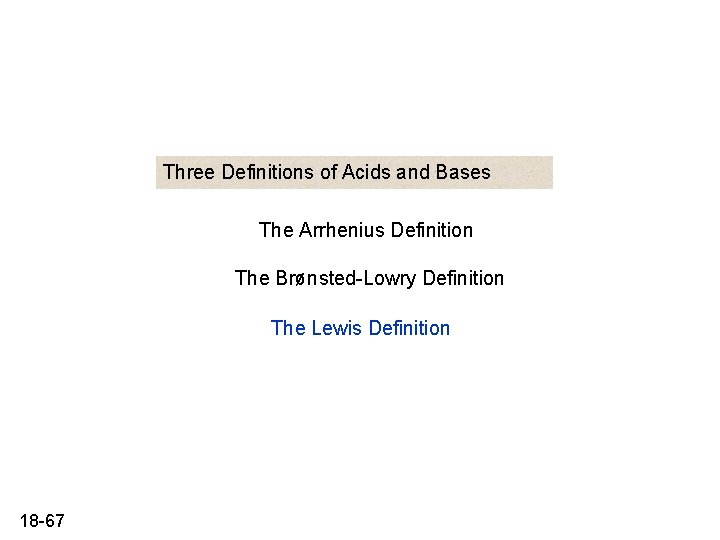
Three Definitions of Acids and Bases The Arrhenius Definition The Brønsted-Lowry Definition The Lewis Definition 18 -67
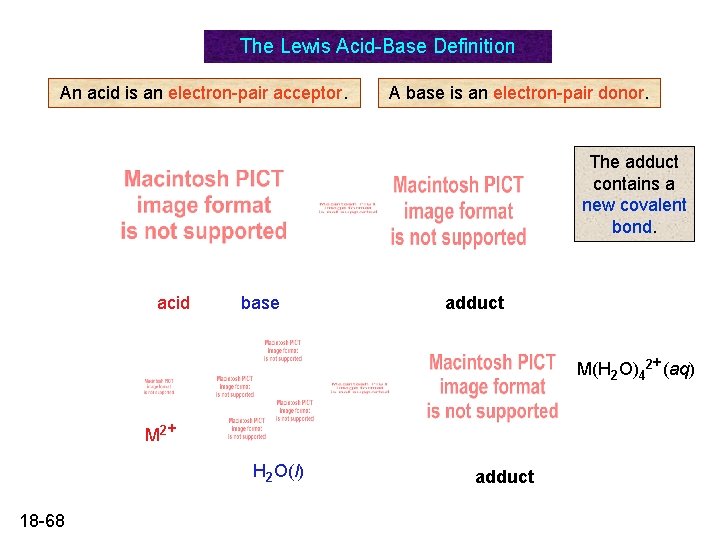
The Lewis Acid-Base Definition An acid is an electron-pair acceptor. A base is an electron-pair donor. The adduct contains a new covalent bond. acid base adduct M(H 2 O)42+(aq) M 2 + H 2 O(l) 18 -68 adduct
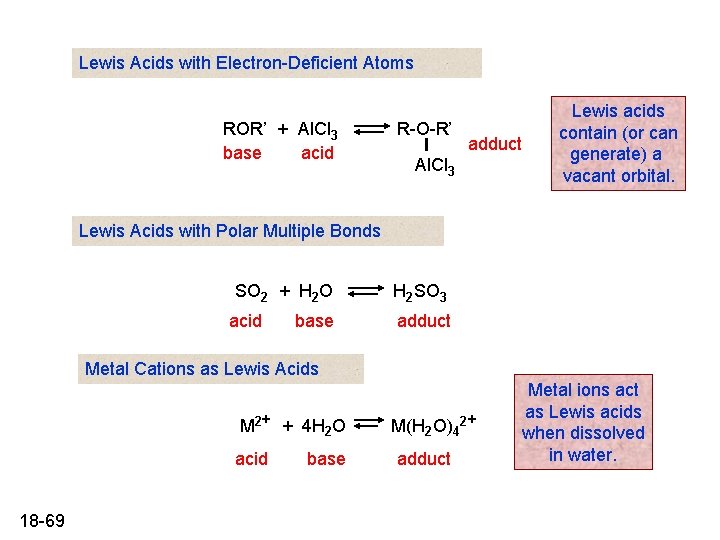
Lewis Acids with Electron-Deficient Atoms ROR’ + Al. Cl 3 base acid R-O-R’ adduct Al. Cl 3 Lewis acids contain (or can generate) a vacant orbital. Lewis Acids with Polar Multiple Bonds SO 2 + H 2 O acid base H 2 SO 3 adduct Metal Cations as Lewis Acids M 2+ + 4 H 2 O acid 18 -69 base M(H 2 O)42+ adduct Metal ions act as Lewis acids when dissolved in water.
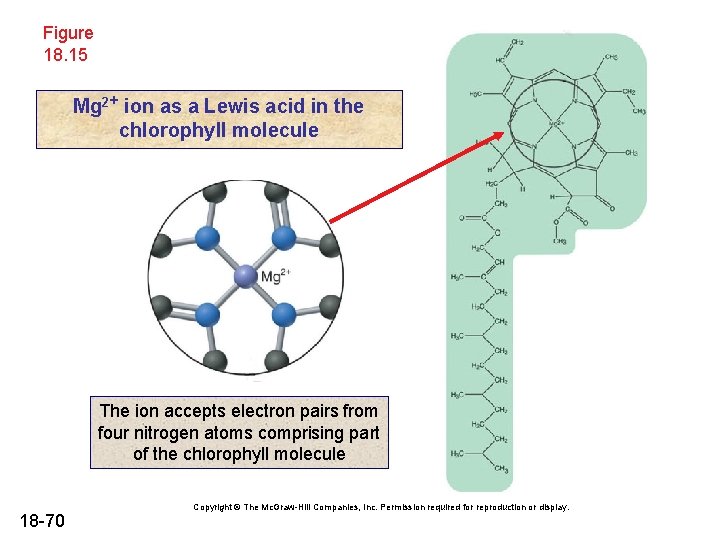
Figure 18. 15 Mg 2+ ion as a Lewis acid in the chlorophyll molecule The ion accepts electron pairs from four nitrogen atoms comprising part of the chlorophyll molecule 18 -70 Copyright © The Mc. Graw-Hill Companies, Inc. Permission required for reproduction or display.
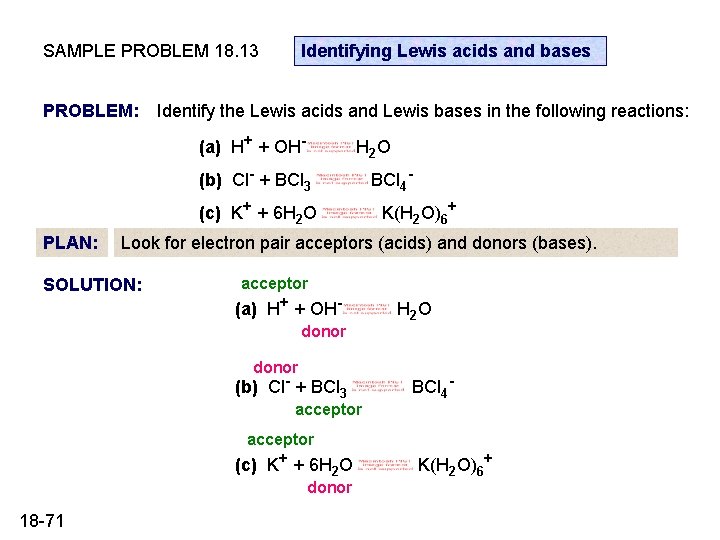
SAMPLE PROBLEM 18. 13 PROBLEM: Identifying Lewis acids and bases Identify the Lewis acids and Lewis bases in the following reactions: (a) H+ + OH- H 2 O (b) Cl- + BCl 3 (c) K+ + 6 H 2 O PLAN: K(H 2 O)6+ Look for electron pair acceptors (acids) and donors (bases). SOLUTION: acceptor (a) H+ + OHdonor (b) Cl- + BCl 3 acceptor (c) K+ + 6 H 2 O donor 18 -71 BCl 4 - H 2 O BCl 4 - K(H 2 O)6+
- Slides: 71