
Chapter 17 Tuberculosis A B C D Figure
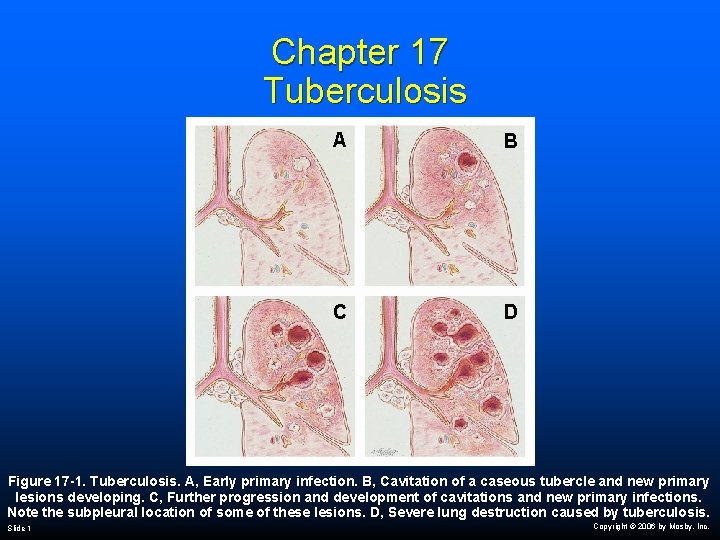
Chapter 17 Tuberculosis A B C D Figure 17 -1. Tuberculosis. A, Early primary infection. B, Cavitation of a caseous tubercle and new primary lesions developing. C, Further progression and development of cavitations and new primary infections. Note the subpleural location of some of these lesions. D, Severe lung destruction caused by tuberculosis. Slide 1 Copyright © 2006 by Mosby, Inc.
Anatomic Alterations of the Lungs (Three categories) Primary tuberculosis Ø Postprimary tuberculosis Ø Secondary or reinfection TB Disseminated tuberculosis Ø Slide 2 Primary infection stage Extrapulmonary TB Copyright © 2006 by Mosby, Inc.
Anatomic Alterations of the Lungs (Mainly Primary TB) Alveolar consolidation Alveolar-capillary destruction Caseous tubercles or granulomas Slide 3 Fibrosis and secondary calcification of the lung parenchyma Distortion and dilation of the bronchi Increased bronchial airway secretions Copyright © 2006 by Mosby, Inc.
Etiology Slide 4 In human, TB primarily caused by Mycobacterium tuberculosis Others Ø Mycobacterium bovis Ø Mycobacterium ulcerans Ø Mycobacterium kansasii Ø Mycobacterium avium-intracellulare Highly aerobic organisms Copyright © 2006 by Mosby, Inc.

Diagnosis Slide 5 Intradermal tuberculin skin testing Ø Mantoux test Ø Injection of purified protein derivative (PPD) • Wheal <5 mm: negative • Wheal 5 mm to 9 mm: considered suspicious • Wheal 10 mm or greater: positive Copyright © 2006 by Mosby, Inc.
Diagnosis Acid-fast stain and sputum culture Ø Ziehl-Neelsen stain • Reveals bright red acid-fast bacilli against a blue background Ø Fluorescent acid-fast stain • Reveals luminescent yellow-green bacilli against a dark brown background Ø Slide 6 A culture is necessary to differentiate M. tuberculosis form other acid-fast organisms • Results take as long as 6 to 8 weeks Copyright © 2006 by Mosby, Inc.
Diagnosis Identification of Mycobacterium species Ø Polymerase chain reaction (PCR) • Quick identification of organisms in expectorated or bronchoscopically obtained sputum Slide 7 Deoxyribonucleic acid (DNA) probe Copyright © 2006 by Mosby, Inc.
Nontuberculosis Mycobacteria Slide 8 Mycobacterial infection caused by species other than M. tuberculosis are called nontuberculosis mycobacteria (NTM)—also called: Ø Mycobacteria other than tuberculosis (MOTT) Ø Atypical mycobacterial infection Found in soil and water Copyright © 2006 by Mosby, Inc.
Overview of the Cardiopulmonary Clinical Manifestations Associated with TUBERCULOSIS The following clinical manifestations result from the pathophysiologic mechanisms caused (or activated) by Alveolar Consolidation (see Figure 9 -8), and Increased Alveolar-Capillary Membrane Thickness (see Figure 9 -9)—the major anatomic alterations of the lungs associated with tuberculosis (see Figure 17 -1). Slide 9 Copyright © 2006 by Mosby, Inc.
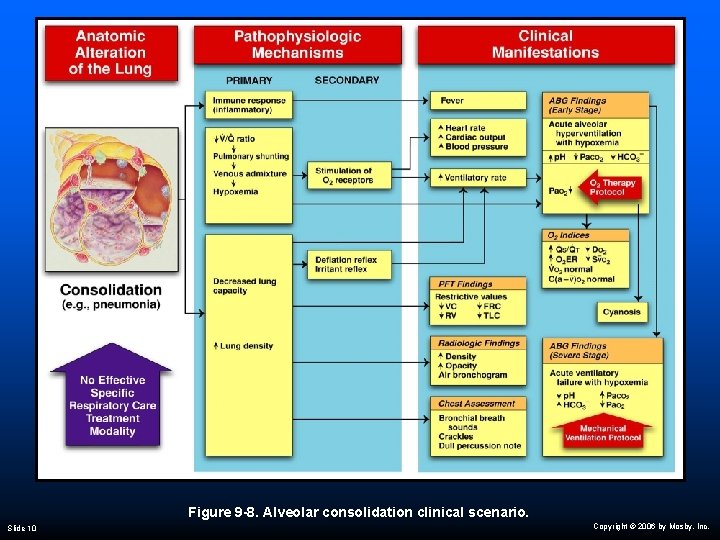
Figure 9 -8. Alveolar consolidation clinical scenario. Slide 10 Copyright © 2006 by Mosby, Inc.
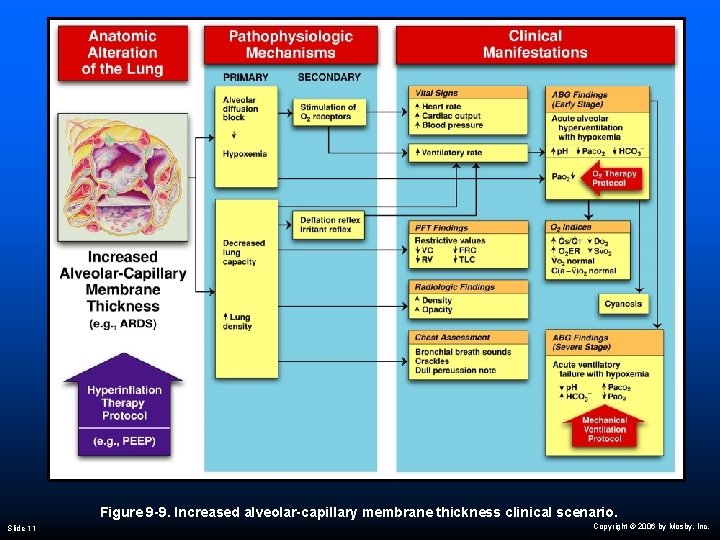
Figure 9 -9. Increased alveolar-capillary membrane thickness clinical scenario. Slide 11 Copyright © 2006 by Mosby, Inc.
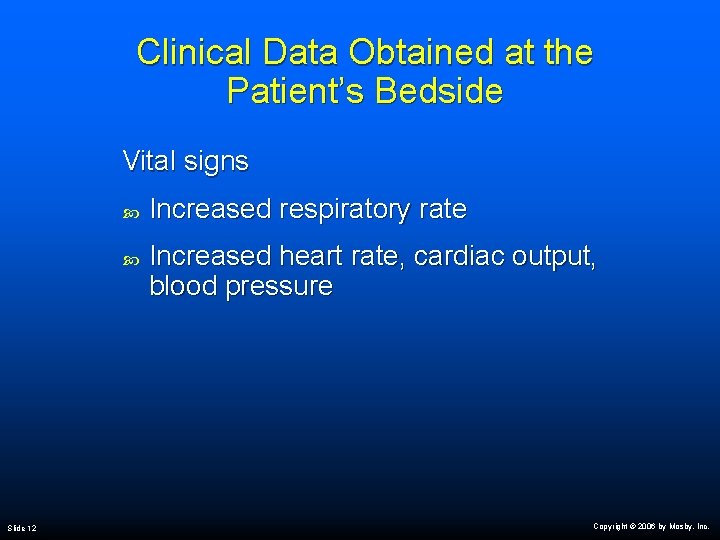
Clinical Data Obtained at the Patient’s Bedside Vital signs Slide 12 Increased respiratory rate Increased heart rate, cardiac output, blood pressure Copyright © 2006 by Mosby, Inc.
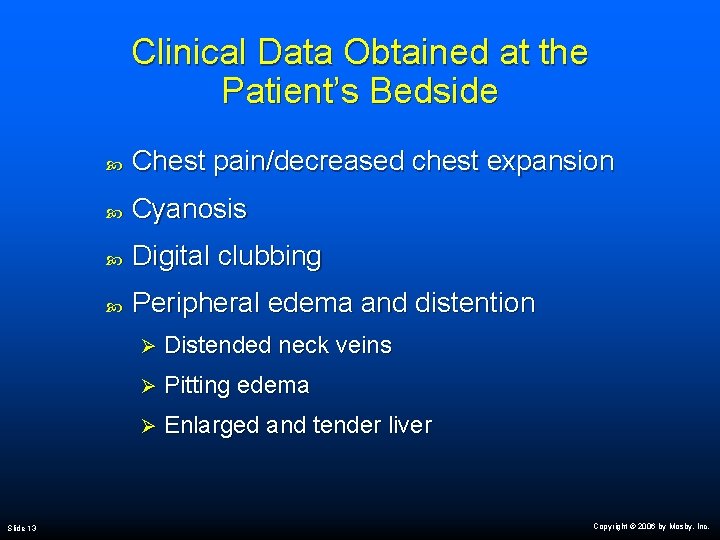
Clinical Data Obtained at the Patient’s Bedside Slide 13 Chest pain/decreased chest expansion Cyanosis Digital clubbing Peripheral edema and distention Ø Distended neck veins Ø Pitting edema Ø Enlarged and tender liver Copyright © 2006 by Mosby, Inc.
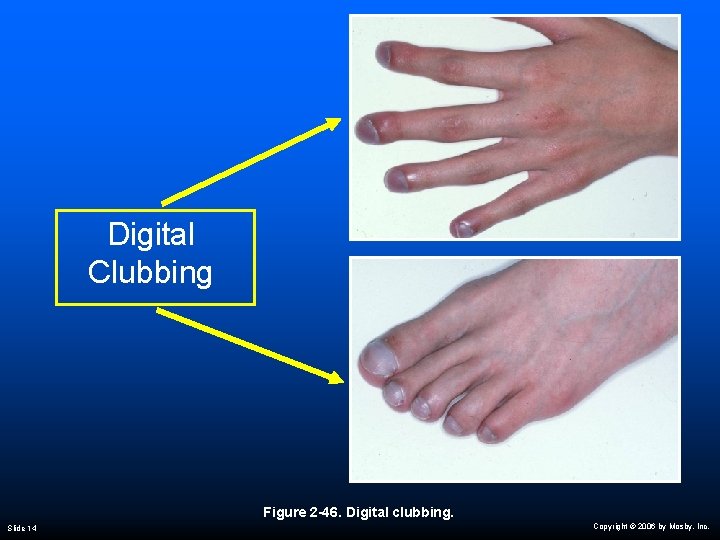
Digital Clubbing Figure 2 -46. Digital clubbing. Slide 14 Copyright © 2006 by Mosby, Inc.
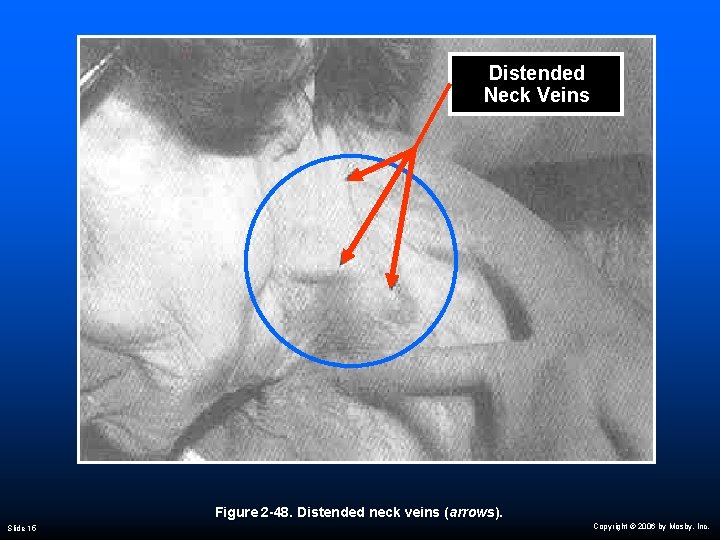
Distended Neck Veins Figure 2 -48. Distended neck veins (arrows). Slide 15 Copyright © 2006 by Mosby, Inc.
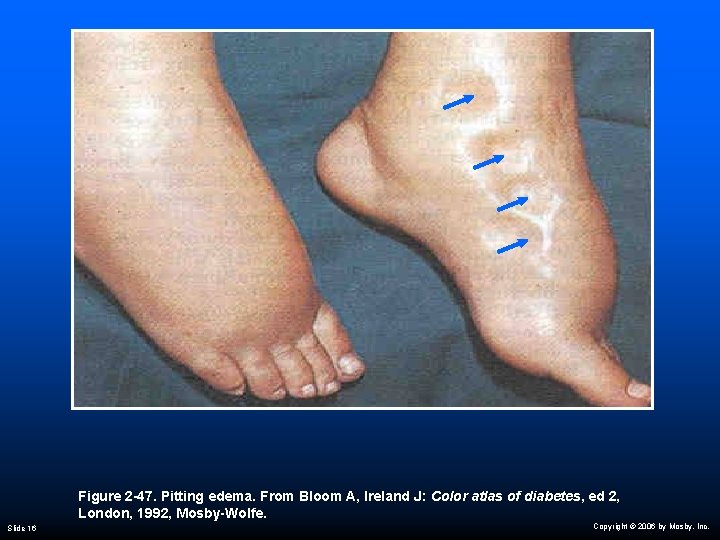
Figure 2 -47. Pitting edema. From Bloom A, Ireland J: Color atlas of diabetes, ed 2, London, 1992, Mosby-Wolfe. Slide 16 Copyright © 2006 by Mosby, Inc.
Clinical Data Obtained at the Patient’s Bedside Slide 17 Cough, sputum production, and hemoptysis Chest assessment findings Ø Increased tactile and vocal fremitus Ø Dull percussion note Ø Bronchial breath sounds Ø Crackles, rhonchi, and wheezing Ø Pleural friction rub Ø Whispered pectoriloquy Copyright © 2006 by Mosby, Inc.
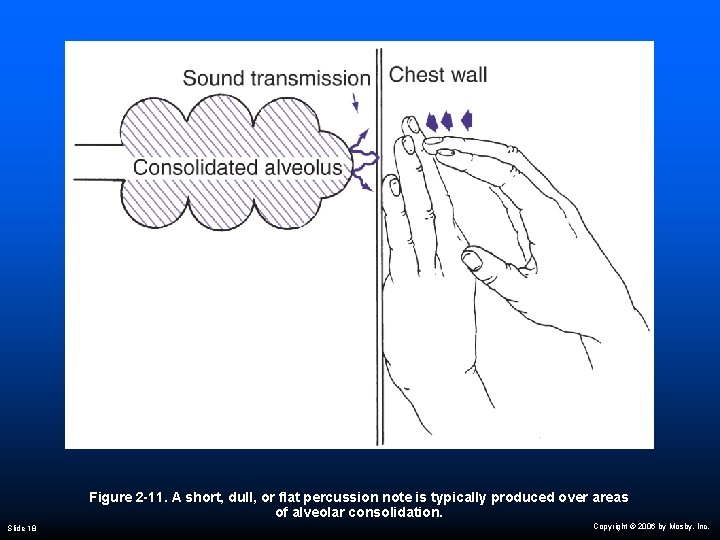
Figure 2 -11. A short, dull, or flat percussion note is typically produced over areas of alveolar consolidation. Slide 18 Copyright © 2006 by Mosby, Inc.
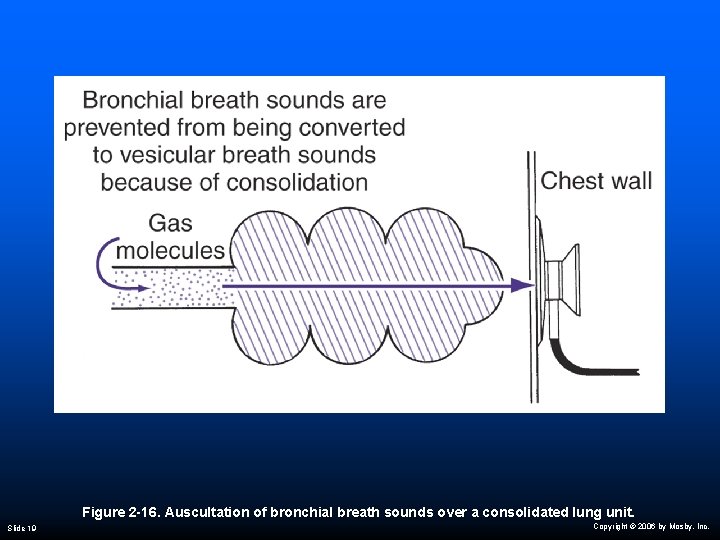
Figure 2 -16. Auscultation of bronchial breath sounds over a consolidated lung unit. Slide 19 Copyright © 2006 by Mosby, Inc.
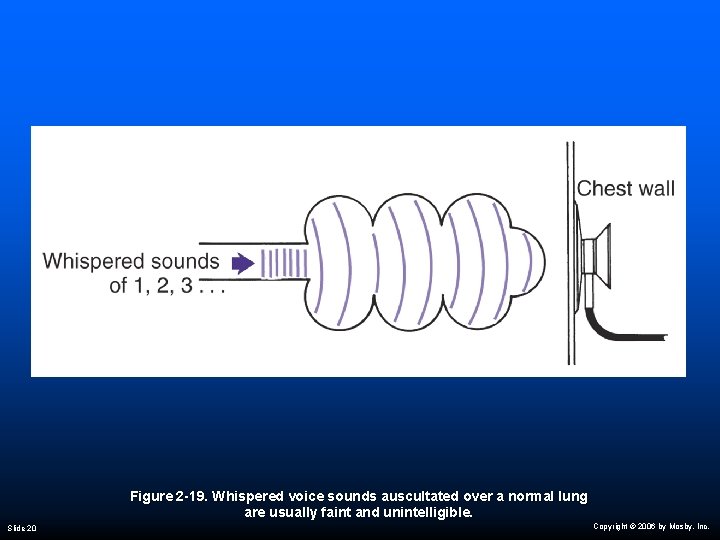
Figure 2 -19. Whispered voice sounds auscultated over a normal lung are usually faint and unintelligible. Slide 20 Copyright © 2006 by Mosby, Inc.

Clinical Data Obtained from Laboratory Tests and Special Procedures Slide 21 Copyright © 2006 by Mosby, Inc.
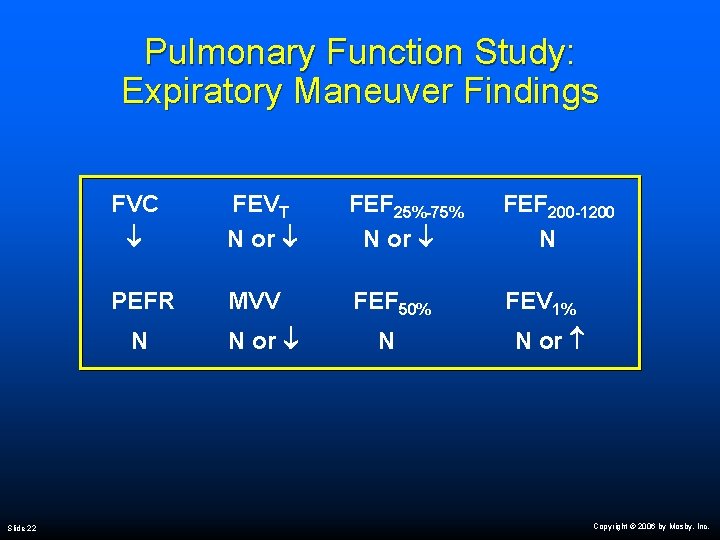
Pulmonary Function Study: Expiratory Maneuver Findings FVC FEVT FEF 25%-75% FEF 200 -1200 N or N PEFR MVV FEF 50% FEV 1% N N or Slide 22 Copyright © 2006 by Mosby, Inc.
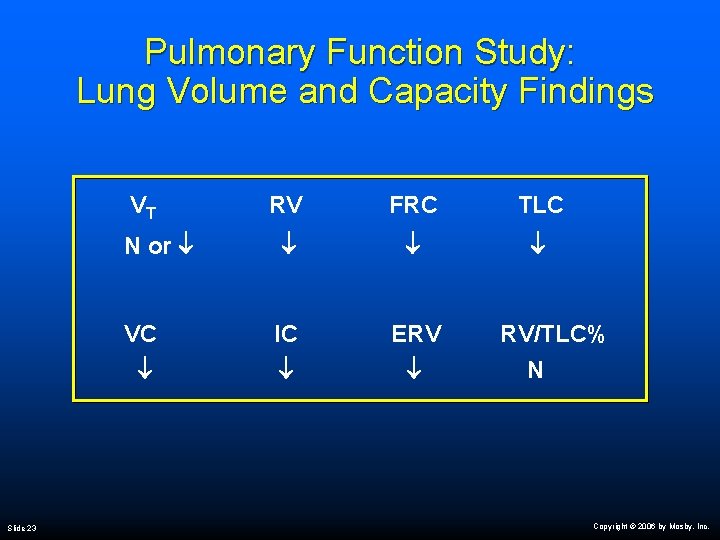
Pulmonary Function Study: Lung Volume and Capacity Findings VT RV FRC TLC N or VC IC ERV RV/TLC% N Slide 23 Copyright © 2006 by Mosby, Inc.
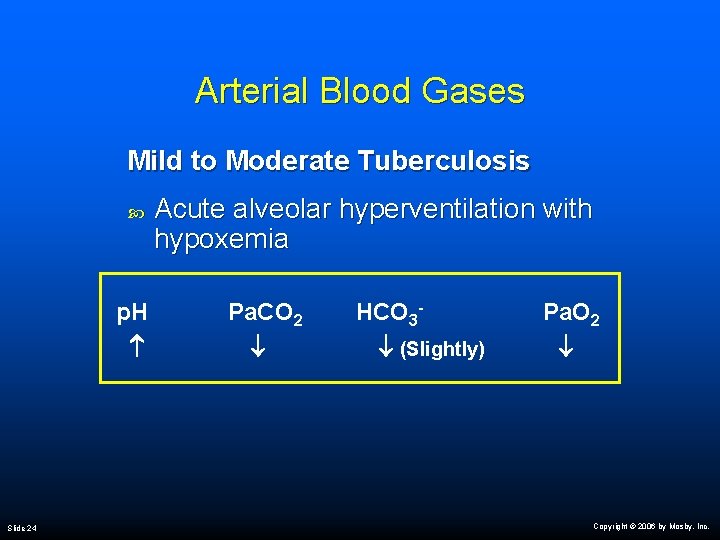
Arterial Blood Gases Mild to Moderate Tuberculosis Acute alveolar hyperventilation with hypoxemia p. H Pa. CO 2 HCO 3 - Pa. O 2 (Slightly) Slide 24 Copyright © 2006 by Mosby, Inc.
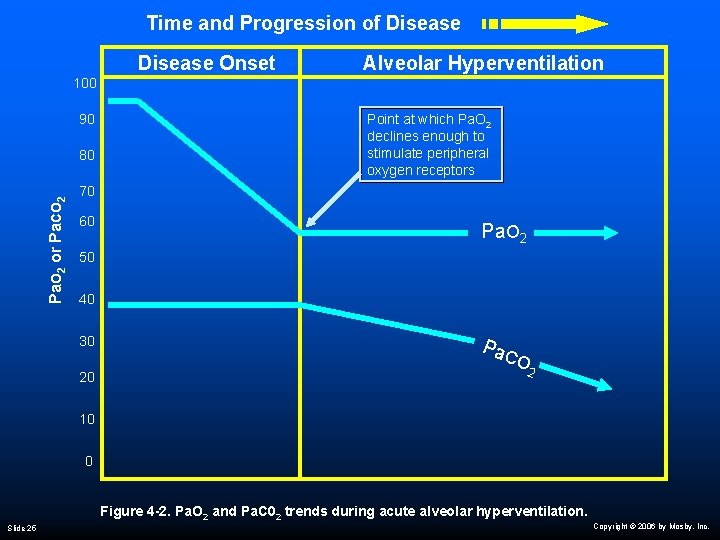
Time and Progression of Disease Onset Alveolar Hyperventilation 100 90 Pa. O 2 or Pa. CO 2 80 Point at which Pa. O 2 declines enough to stimulate peripheral oxygen receptors 70 60 Pa. O 2 50 40 30 20 Pa. C O 2 10 0 Figure 4 -2. Pa. O 2 and Pa. C 02 trends during acute alveolar hyperventilation. Slide 25 Copyright © 2006 by Mosby, Inc.
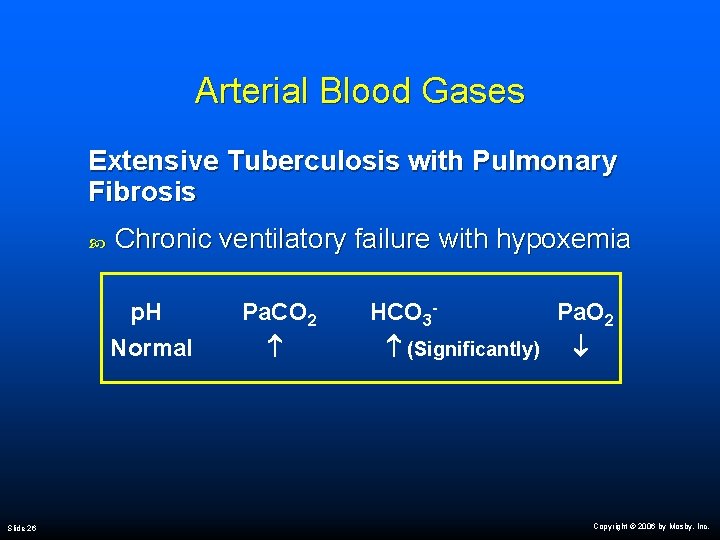
Arterial Blood Gases Extensive Tuberculosis with Pulmonary Fibrosis Chronic ventilatory failure with hypoxemia p. H Pa. CO 2 HCO 3 - Pa. O 2 Normal (Significantly) Slide 26 Copyright © 2006 by Mosby, Inc.
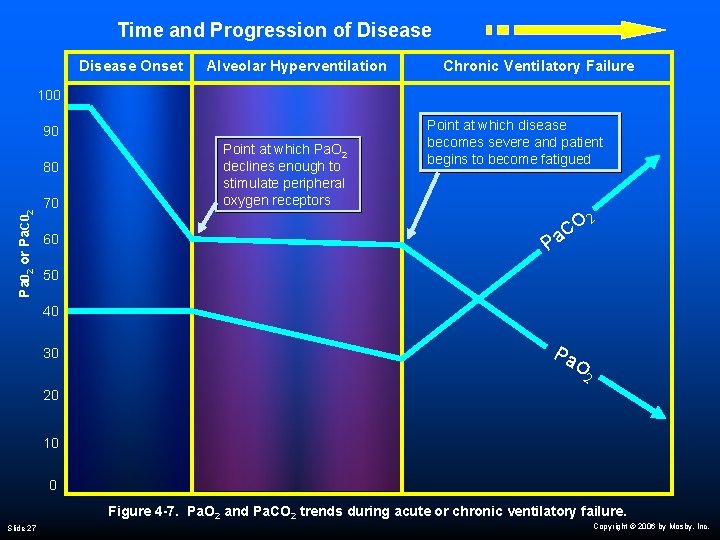
Time and Progression of Disease Onset Alveolar Hyperventilation Chronic Ventilatory Failure 100 90 Pa 02 or Pa. C 02 80 70 60 Point at which Pa. O 2 declines enough to stimulate peripheral oxygen receptors Point at which disease becomes severe and patient begins to become fatigued O a. C 2 P 50 40 30 Pa O 2 20 10 0 Figure 4 -7. Pa. O 2 and Pa. CO 2 trends during acute or chronic ventilatory failure. Slide 27 Copyright © 2006 by Mosby, Inc.
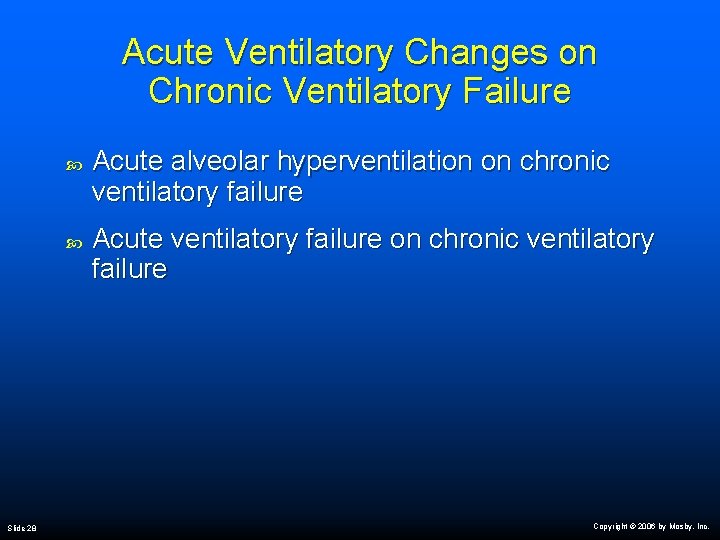
Acute Ventilatory Changes on Chronic Ventilatory Failure Slide 28 Acute alveolar hyperventilation on chronic ventilatory failure Acute ventilatory failure on chronic ventilatory failure Copyright © 2006 by Mosby, Inc.
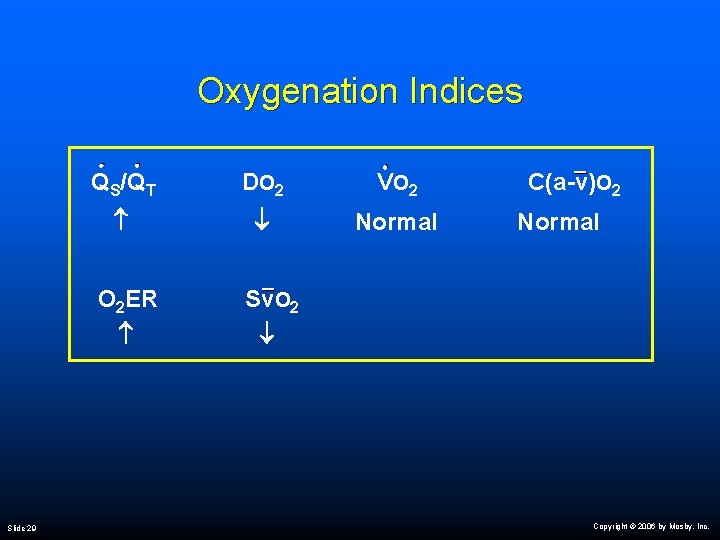
Oxygenation Indices QS/QT DO 2 VO 2 C(a-v)O 2 Normal O 2 ER Sv. O 2 Slide 29 Copyright © 2006 by Mosby, Inc.

Hemodynamic Indices (Severe Tuberculosis) Slide 30 CVP RAP PA PCWP Normal CO SV SVI CI Normal RVSWI LVSWI PVR SVR Normal Copyright © 2006 by Mosby, Inc.
Abnormal Laboratory Tests and Procedures Slide 31 Positive tuberculosis skin test (PPD) Positive acid-fast bacillus stain of sputum and sputum culture Copyright © 2006 by Mosby, Inc.
Radiologic Findings Chest radiograph Slide 32 Increased opacity Ghon’s complex Cavity formation Pleural effusion Calcification and fibrosis Retraction of lung segments or lobe Right ventricular enlargement Copyright © 2006 by Mosby, Inc.
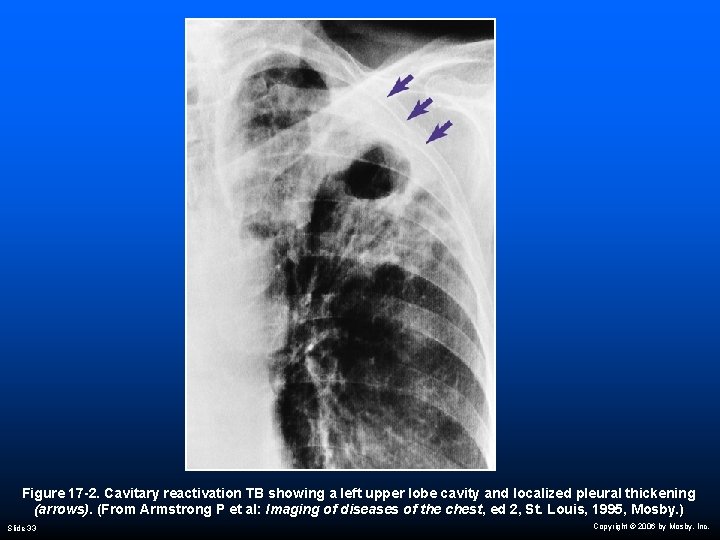
Figure 17 -2. Cavitary reactivation TB showing a left upper lobe cavity and localized pleural thickening (arrows). (From Armstrong P et al: Imaging of diseases of the chest, ed 2, St. Louis, 1995, Mosby. ) Slide 33 Copyright © 2006 by Mosby, Inc.
General Management of Tuberculosis Pharmacologic agents Slide 34 Consists of 2 to 4 drugs for 6 to 12 months Ø First-line agents (first 9 months) • Isoniazid (INH) and rifampin (Rifadin) • INH most effective Ø Often supplemented with: • Ethambutol • Streptomycin • Pyrazinamide Copyright © 2006 by Mosby, Inc.
General Management of Tuberculosis Slide 35 Respiratory care treatment protocols Ø Oxygen therapy protocol Ø Bronchopulmonary hygiene therapy protocol Ø Hyperinflation therapy protocol Ø Mechanical ventilation protocol Copyright © 2006 by Mosby, Inc.
Review The protective cell wall that surrounds and encases the TB bacilli is called -? Ø What is primary TB? Ø Slide 36 Tubercle or granuloma Reaction following first exposure to pathogen • Inflammation leading to alveolar consolidation • Formation of tubercle • Fibrosis and calcification, development of bronchiectasis Copyright © 2006 by Mosby, Inc.
What is postprimary TB? Ø What is dissemminated TB? Ø Infection that spreads to sites outside the lung via pulmonary lymphatic system or bloodstream The presence of numerous small tubercles scattered throughout the body is called - ? Ø Slide 37 Reactivation of TB after initial infection has been controlled Miliary tuberculosis Copyright © 2006 by Mosby, Inc.
How long can TB bacillus remain suspended in the air after a sneeze or a cough? Ø What is a Ghon’s complex? Ø Combination of tubercles and hilar lymphadenopathy seen on CXR Typical ABG’s from a patient with extensive TB and fibrosis would be describe as - ? Ø Slide 38 Several hours Chronic Ventilatory failure and hypoxemia Copyright © 2006 by Mosby, Inc.
Slide 39 What hemodynamic indices reflect right-side heart failure in a patient with advanced TB? Ø Increased CVP Ø Increased RAP Ø Increased mean PA Ø Increased PVR Ø Increased RVSWI What respiratory care treatments/protocols are used for TB? Ø O 2 Therapy Ø BHT Ø Hyperinflation Therapy Copyright © 2006 by Mosby, Inc.
True or False Pleural space complications such as empyema and pneumothorax are common in patients with tuberculosis. Ø A positive reaction to the tuberculin skin test confirms that a patient has active tuberculosis Ø False Tuberculosis commonly develops in the apices of the lungs Ø Slide 40 True Copyright © 2006 by Mosby, Inc.

Classroom Discussion Case Study: Tuberculosis Slide 41 Copyright © 2006 by Mosby, Inc.
- Slides: 41