
Chapter 17 Thermodynamics Spontaneity Entropy and Free Energy
- Slides: 35
Chapter 17 Thermodynamics: Spontaneity, Entropy, and Free Energy
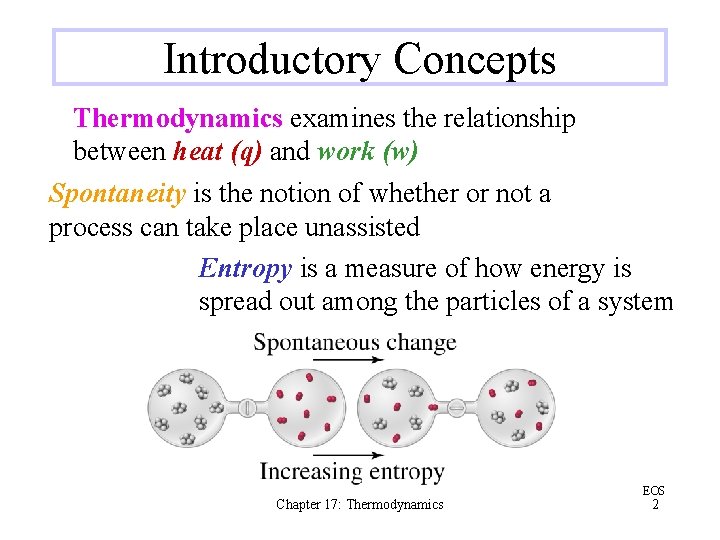
Introductory Concepts Thermodynamics examines the relationship between heat (q) and work (w) Spontaneity is the notion of whether or not a process can take place unassisted Entropy is a measure of how energy is spread out among the particles of a system Chapter 17: Thermodynamics EOS 2
Introductory Concepts Free energy is a thermodynamic function that relates enthalpy and entropy to spontaneity Free energy is connected with the ability to do work e. g. , the chemical reaction in a battery generates electricity to light a flashlight bulb Chapter 17: Thermodynamics EOS 3
Spontaneous Change A spontaneous process is one that can occur in a system left to itself; no action from outside the system is necessary to bring the change about Example: spontaneous combustion of damp hay or silo explosions from gases evolved from decomposing grain If a process is spontaneous, the reverse process is nonspontaneous and vice versa Chapter 17: Thermodynamics EOS 4
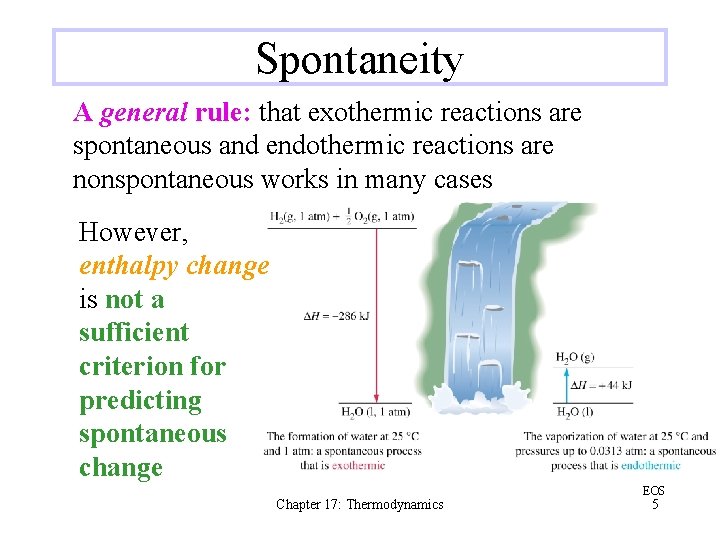
Spontaneity A general rule: that exothermic reactions are spontaneous and endothermic reactions are nonspontaneous works in many cases However, enthalpy change is not a sufficient criterion for predicting spontaneous change Chapter 17: Thermodynamics EOS 5
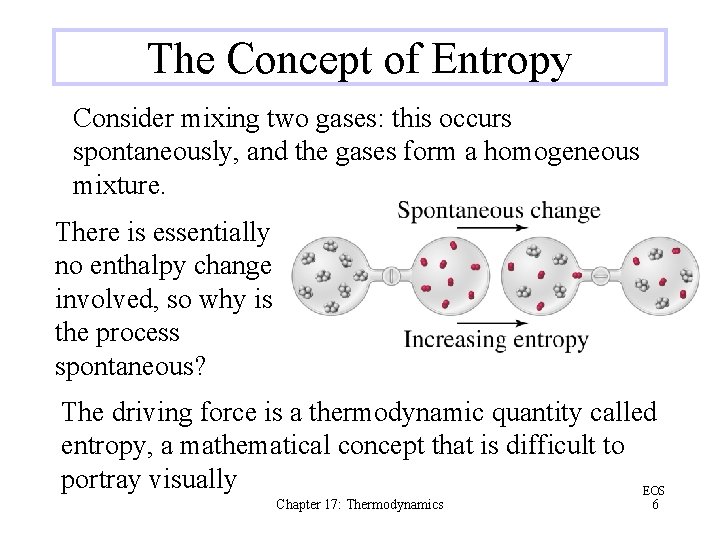
The Concept of Entropy Consider mixing two gases: this occurs spontaneously, and the gases form a homogeneous mixture. There is essentially no enthalpy change involved, so why is the process spontaneous? The driving force is a thermodynamic quantity called entropy, a mathematical concept that is difficult to portray visually EOS Chapter 17: Thermodynamics 6
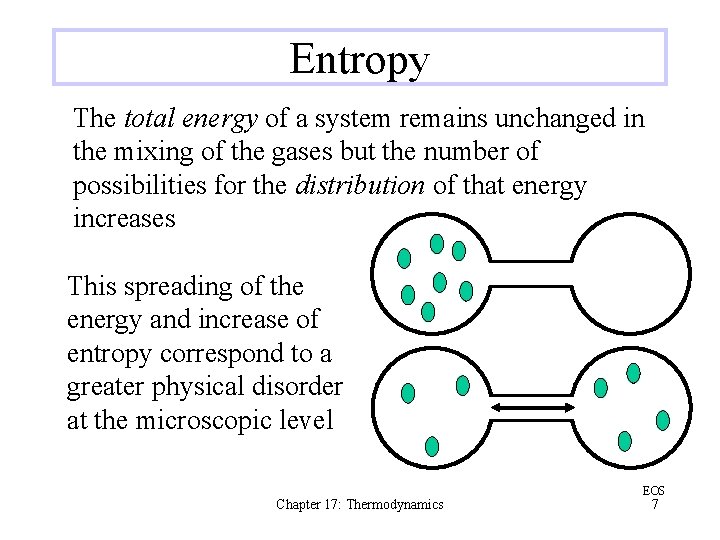
Entropy The total energy of a system remains unchanged in the mixing of the gases but the number of possibilities for the distribution of that energy increases This spreading of the energy and increase of entropy correspond to a greater physical disorder at the microscopic level Chapter 17: Thermodynamics EOS 7
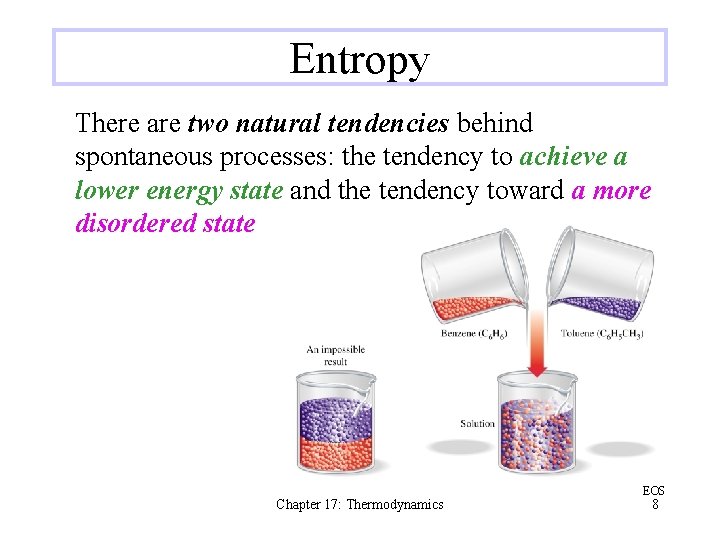
Entropy There are two natural tendencies behind spontaneous processes: the tendency to achieve a lower energy state and the tendency toward a more disordered state Chapter 17: Thermodynamics EOS 8
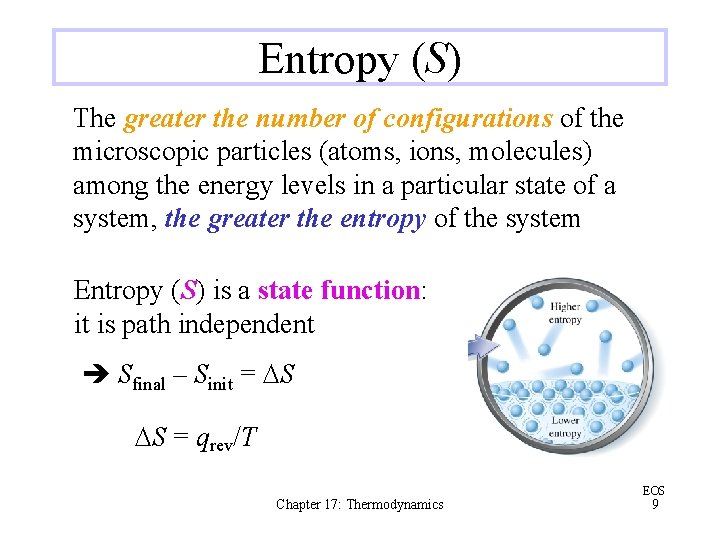
Entropy (S) The greater the number of configurations of the microscopic particles (atoms, ions, molecules) among the energy levels in a particular state of a system, the greater the entropy of the system Entropy (S) is a state function: it is path independent Sfinal – Sinit = DS DS = qrev/T Chapter 17: Thermodynamics EOS 9
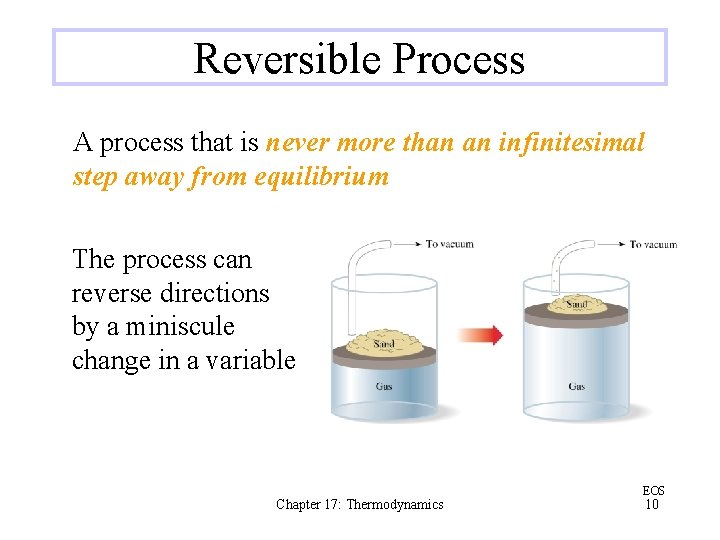
Reversible Process A process that is never more than an infinitesimal step away from equilibrium The process can reverse directions by a miniscule change in a variable Chapter 17: Thermodynamics EOS 10
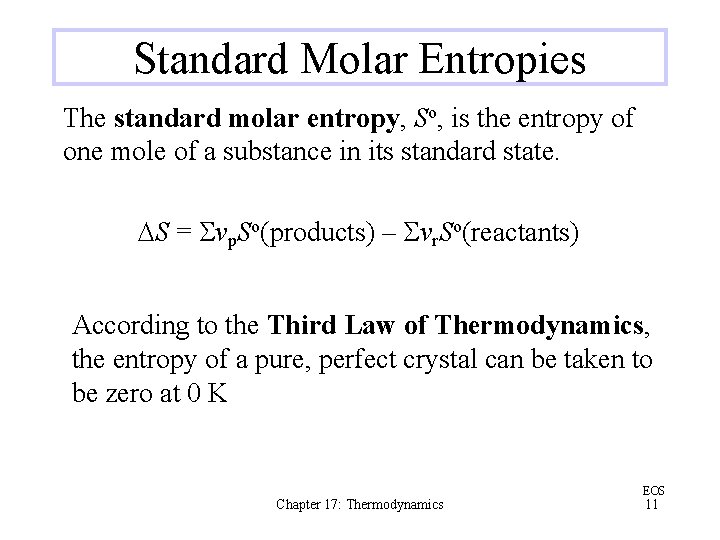
Standard Molar Entropies The standard molar entropy, So, is the entropy of one mole of a substance in its standard state. DS = Svp. So(products) – Svr. So(reactants) According to the Third Law of Thermodynamics, the entropy of a pure, perfect crystal can be taken to be zero at 0 K Chapter 17: Thermodynamics EOS 11
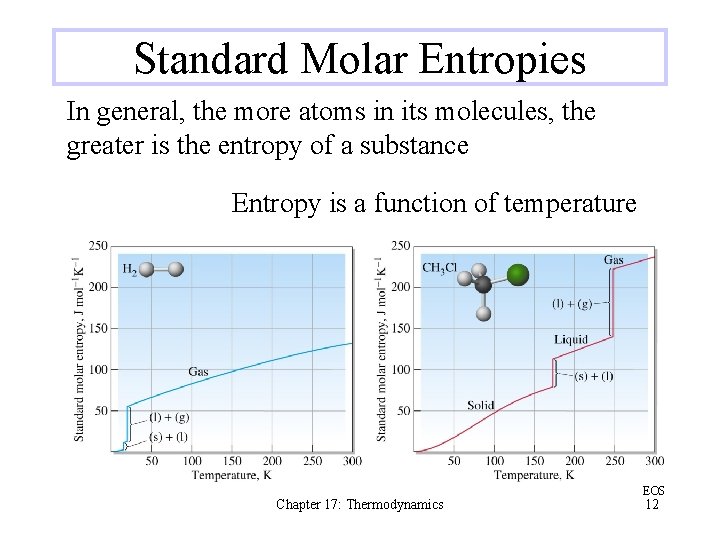
Standard Molar Entropies In general, the more atoms in its molecules, the greater is the entropy of a substance Entropy is a function of temperature Chapter 17: Thermodynamics EOS 12
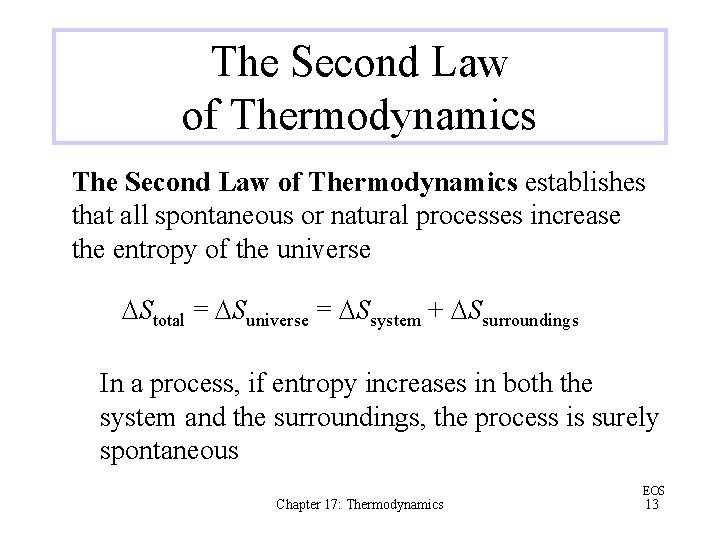
The Second Law of Thermodynamics establishes that all spontaneous or natural processes increase the entropy of the universe DStotal = DSuniverse = DSsystem + DSsurroundings In a process, if entropy increases in both the system and the surroundings, the process is surely spontaneous Chapter 17: Thermodynamics EOS 13
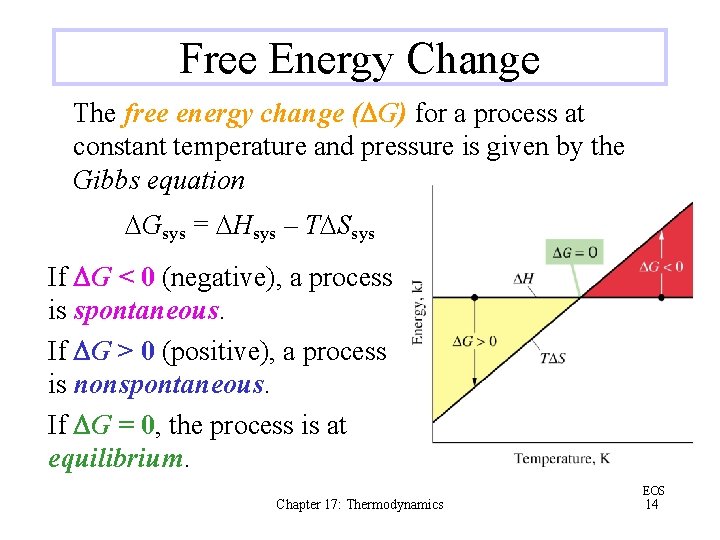
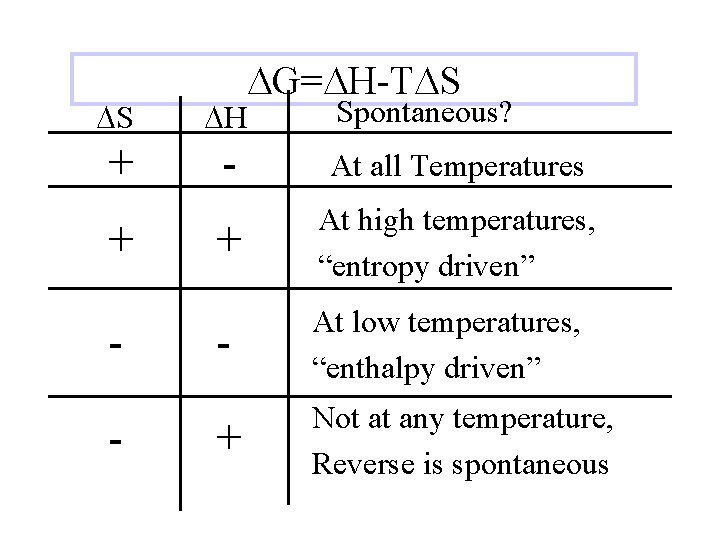
Free Energy Change The free energy change (DG) for a process at constant temperature and pressure is given by the Gibbs equation DGsys = DHsys – TDSsys If DG < 0 (negative), a process is spontaneous. If DG > 0 (positive), a process is nonspontaneous. If DG = 0, the process is at equilibrium. Chapter 17: Thermodynamics EOS 14
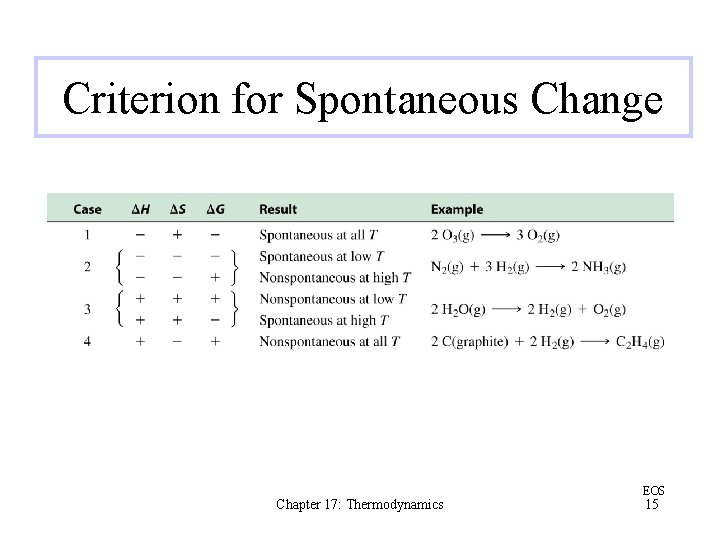
Criterion for Spontaneous Change Chapter 17: Thermodynamics EOS 15
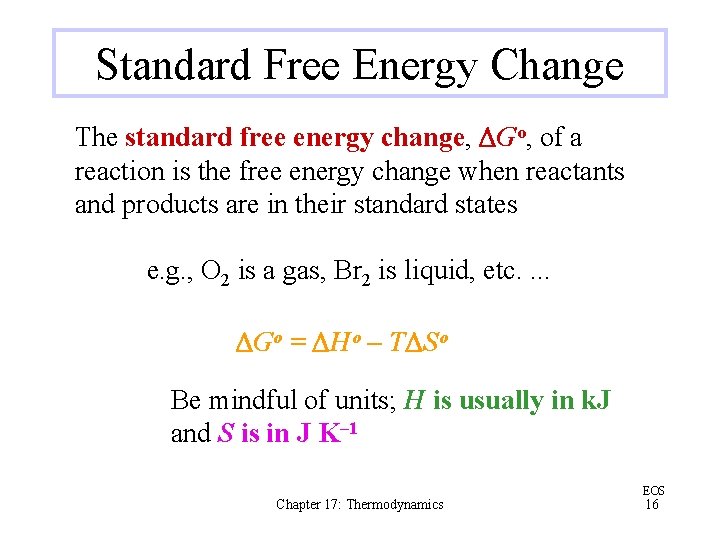
Standard Free Energy Change The standard free energy change, DGo, of a reaction is the free energy change when reactants and products are in their standard states e. g. , O 2 is a gas, Br 2 is liquid, etc. . DGo = DHo – TDSo Be mindful of units; H is usually in k. J and S is in J K– 1 Chapter 17: Thermodynamics EOS 16
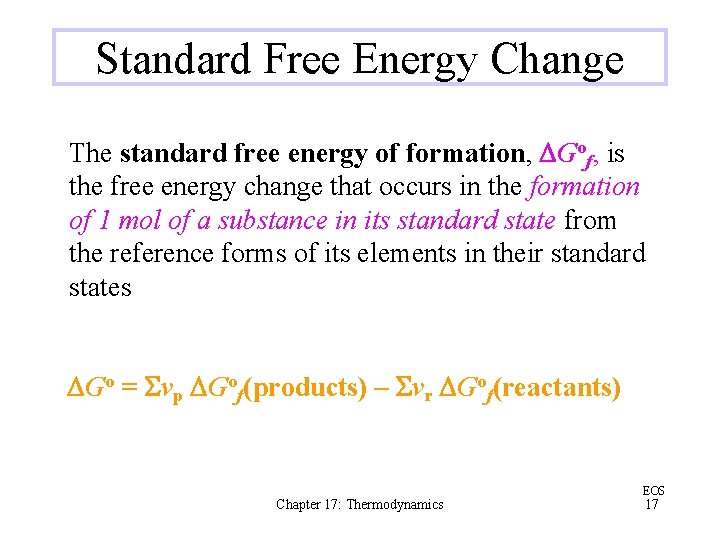
Standard Free Energy Change The standard free energy of formation, DGof, is the free energy change that occurs in the formation of 1 mol of a substance in its standard state from the reference forms of its elements in their standard states DGo = Svp DGof(products) – Svr DGof(reactants) Chapter 17: Thermodynamics EOS 17
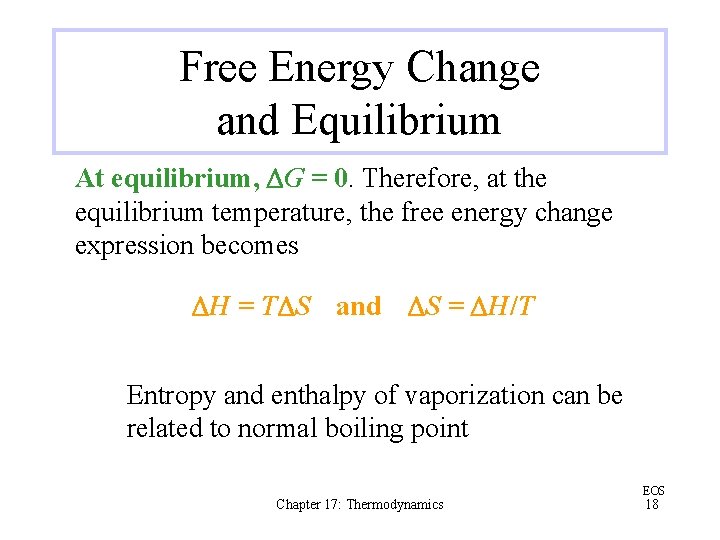
Free Energy Change and Equilibrium At equilibrium, DG = 0. Therefore, at the equilibrium temperature, the free energy change expression becomes DH = TDS and DS = DH/T Entropy and enthalpy of vaporization can be related to normal boiling point Chapter 17: Thermodynamics EOS 18
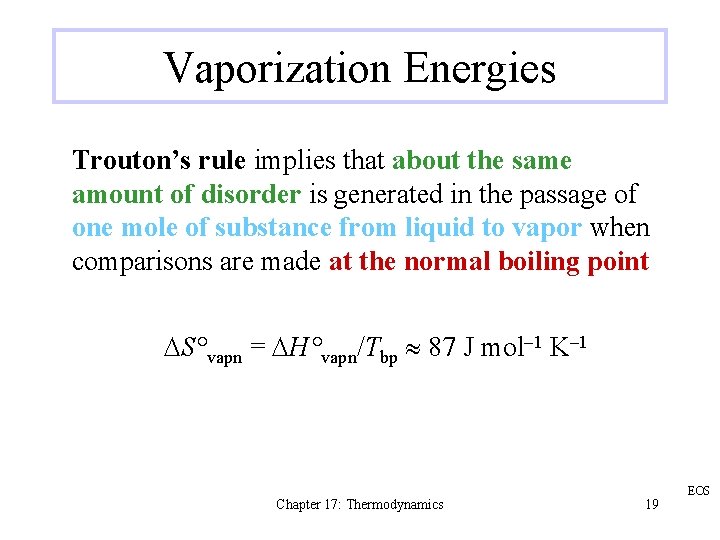
Vaporization Energies Trouton’s rule implies that about the same amount of disorder is generated in the passage of one mole of substance from liquid to vapor when comparisons are made at the normal boiling point DS°vapn = DH°vapn/Tbp 87 J mol– 1 K– 1 Chapter 17: Thermodynamics 19 EOS
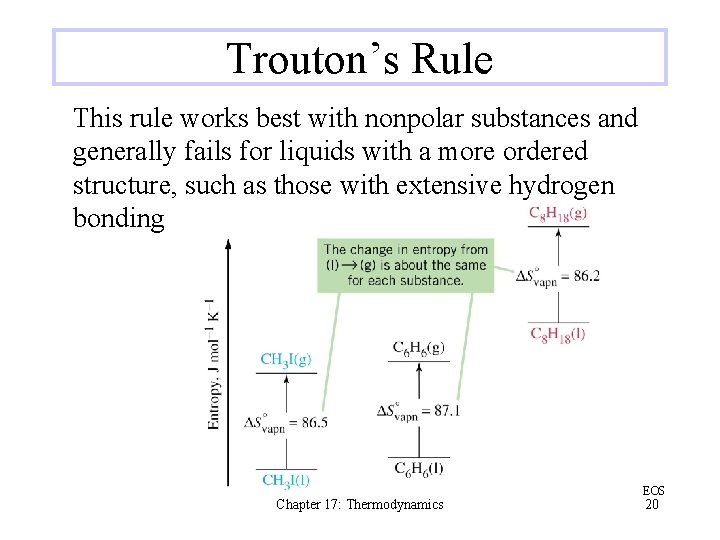
Trouton’s Rule This rule works best with nonpolar substances and generally fails for liquids with a more ordered structure, such as those with extensive hydrogen bonding Chapter 17: Thermodynamics EOS 20
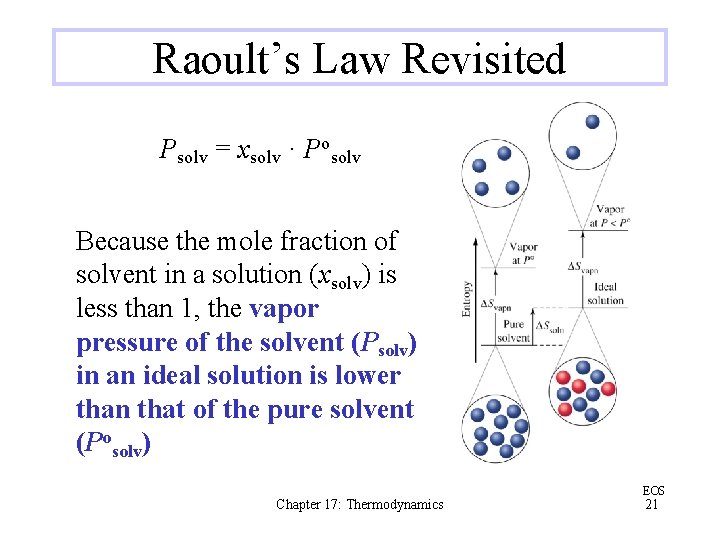
Raoult’s Law Revisited Psolv = xsolv · Posolv Because the mole fraction of solvent in a solution (xsolv) is less than 1, the vapor pressure of the solvent (Psolv) in an ideal solution is lower than that of the pure solvent (Posolv) Chapter 17: Thermodynamics EOS 21
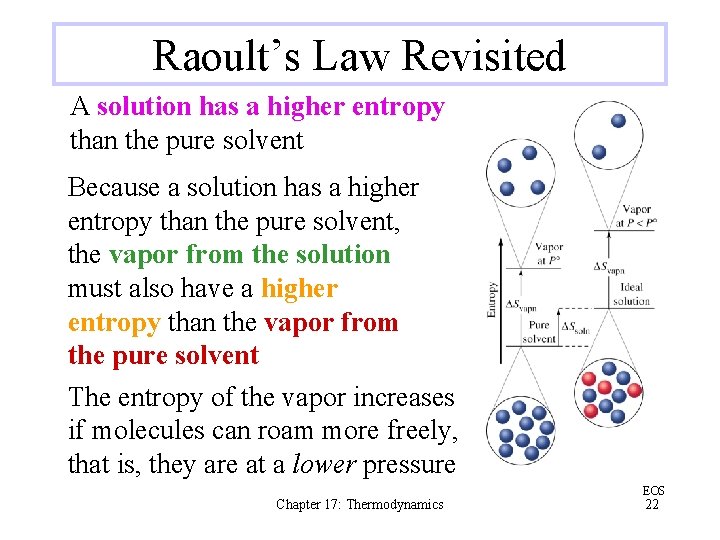
Raoult’s Law Revisited A solution has a higher entropy than the pure solvent Because a solution has a higher entropy than the pure solvent, the vapor from the solution must also have a higher entropy than the vapor from the pure solvent The entropy of the vapor increases if molecules can roam more freely, that is, they are at a lower pressure Chapter 17: Thermodynamics EOS 22
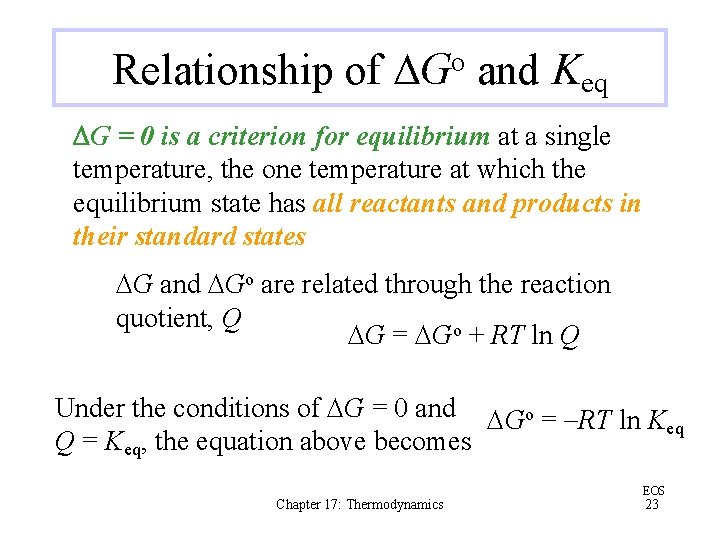
Relationship of DGo and Keq DG = 0 is a criterion for equilibrium at a single temperature, the one temperature at which the equilibrium state has all reactants and products in their standard states DG and DGo are related through the reaction quotient, Q DG = DGo + RT ln Q Under the conditions of DG = 0 and DGo = -RT ln K eq Q = Keq, the equation above becomes Chapter 17: Thermodynamics EOS 23
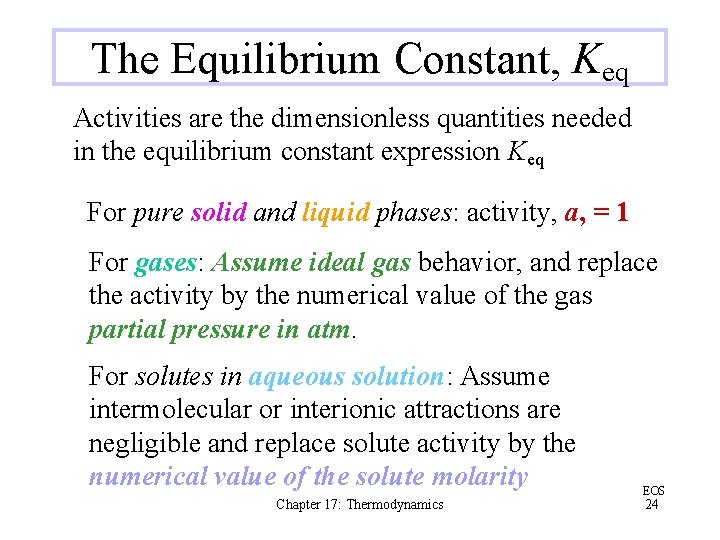
The Equilibrium Constant, Keq Activities are the dimensionless quantities needed in the equilibrium constant expression Keq For pure solid and liquid phases: activity, a, = 1 For gases: Assume ideal gas behavior, and replace the activity by the numerical value of the gas partial pressure in atm. For solutes in aqueous solution: Assume intermolecular or interionic attractions are negligible and replace solute activity by the numerical value of the solute molarity Chapter 17: Thermodynamics EOS 24
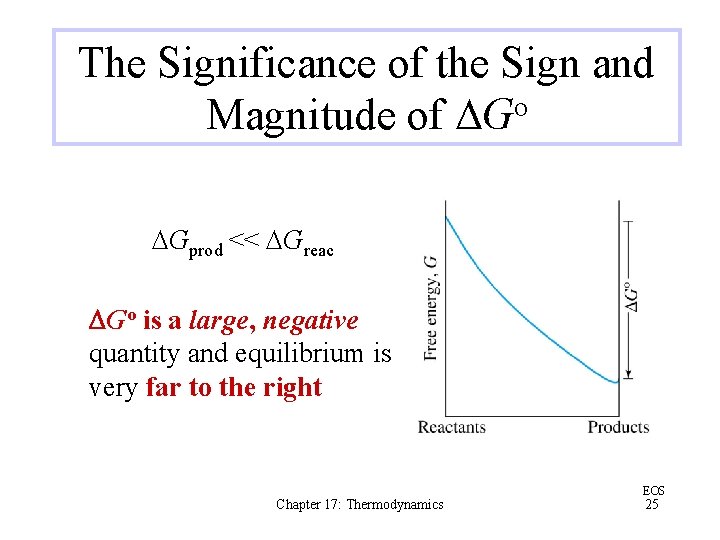
The Significance of the Sign and Magnitude of DGo DGprod << DGreac DGo is a large, negative quantity and equilibrium is very far to the right Chapter 17: Thermodynamics EOS 25
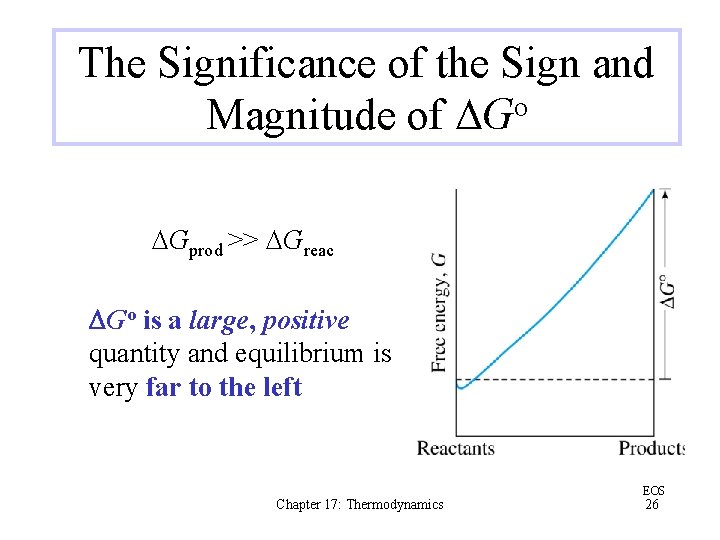
The Significance of the Sign and Magnitude of DGo DGprod >> DGreac DGo is a large, positive quantity and equilibrium is very far to the left Chapter 17: Thermodynamics EOS 26
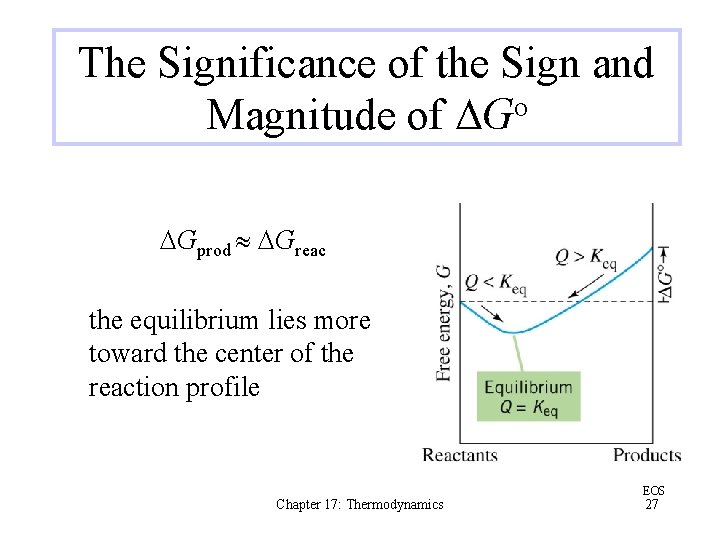
The Significance of the Sign and Magnitude of DGo DGprod DGreac the equilibrium lies more toward the center of the reaction profile Chapter 17: Thermodynamics EOS 27
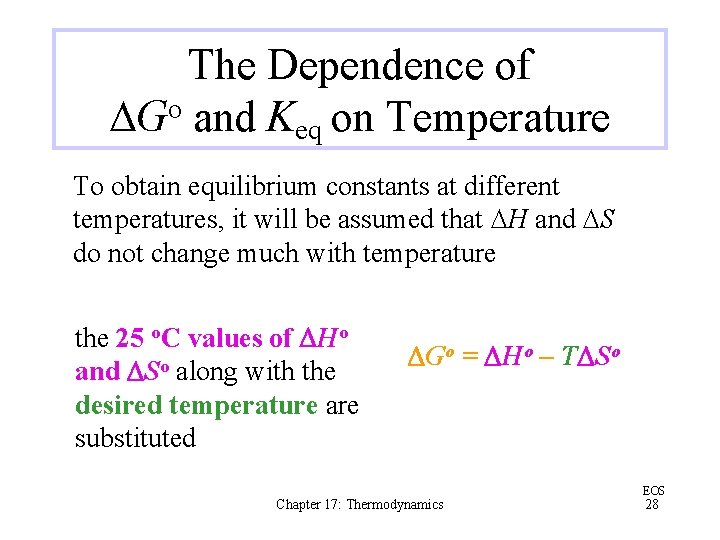
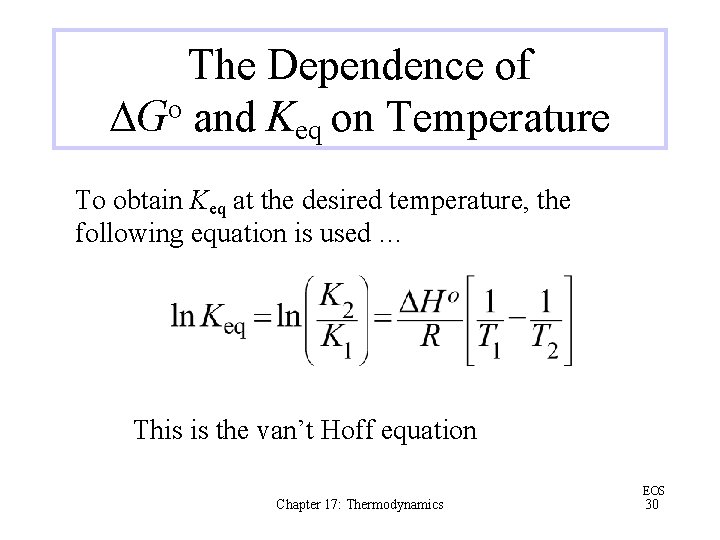
The Dependence of DGo and Keq on Temperature To obtain equilibrium constants at different temperatures, it will be assumed that DH and DS do not change much with temperature the 25 o. C values of DHo and DSo along with the desired temperature are substituted DGo = DHo – TDSo Chapter 17: Thermodynamics EOS 28
DG=DH-TDS Spontaneous? DS DH + - At all Temperatures + At high temperatures, “entropy driven” - At low temperatures, “enthalpy driven” + Not at any temperature, Reverse is spontaneous + -
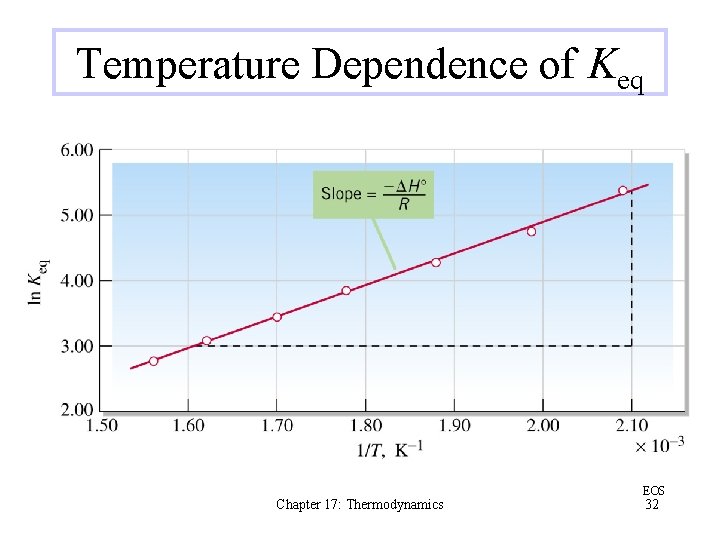
The Dependence of DGo and Keq on Temperature To obtain Keq at the desired temperature, the following equation is used … This is the van’t Hoff equation Chapter 17: Thermodynamics EOS 30
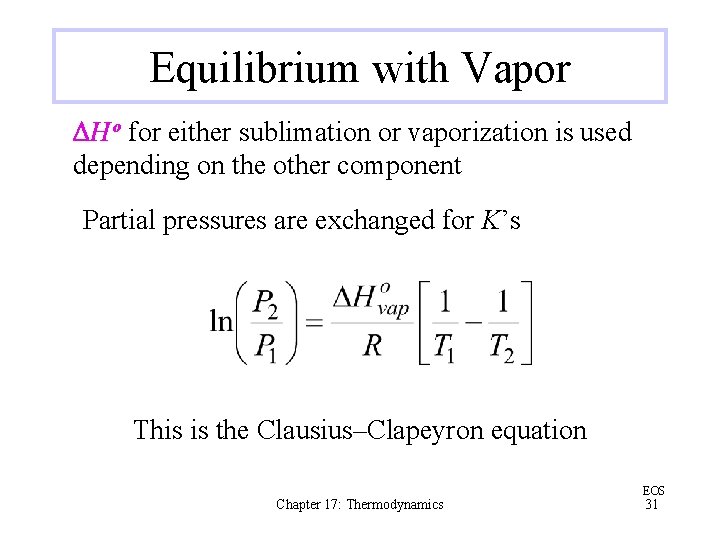
Equilibrium with Vapor DHo for either sublimation or vaporization is used depending on the other component Partial pressures are exchanged for K’s This is the Clausius–Clapeyron equation Chapter 17: Thermodynamics EOS 31
Temperature Dependence of Keq Chapter 17: Thermodynamics EOS 32
Summary of Concepts • A spontaneous change is one that occurs by itself without outside intervention • The third law of thermodynamics states that the entropy of a pure, perfect crystal at 0 K can be taken to be zero • The direction of spontaneous change is that in which total entropy increases • The free energy change, DG, is equal to –TDS, and it applies just to the system itself Chapter 17: Thermodynamics EOS 33
Summary (cont’d) • The standard free energy change, DGo, can be calculated by substituting standard enthalpies and entropies of reaction and a Kelvin temperature into the Gibbs equation, or, by combining standard free energies of formation • The condition of equilibrium is one for which DG =0 Chapter 17: Thermodynamics EOS 34
Summary (cont’d) • The value of DGo is in itself often sufficient to determine how a reaction will proceed • Values of DGof, DHof, and DS are generally tabulated for 25 o. C. To obtain values of Keq at other temperatures, the van’t Hoff equation must be used • The Clausius–Clapeyron equation connects solid/vapor or liquid/vapor equilibria to varying temperature Chapter 17: Thermodynamics EOS 35