
Chapter 17 Thermochemistry 17 1 The Flow of

- Slides: 106
Chapter 17: Thermochemistry 17. 1 The Flow of Energy – Heat and Work
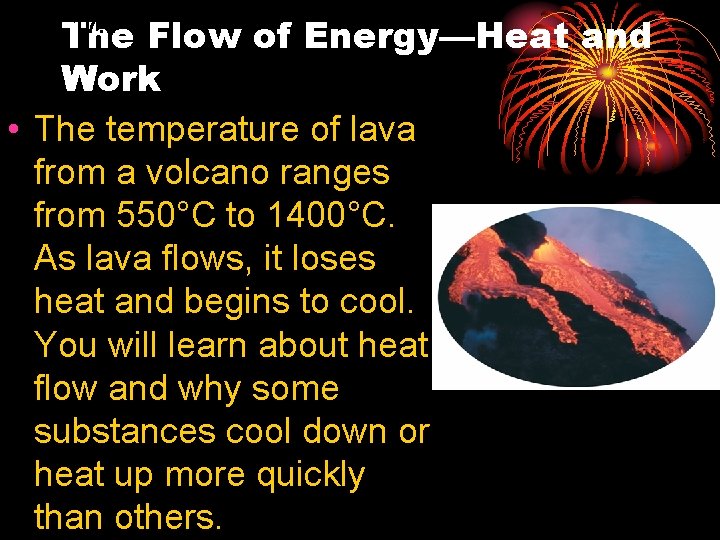
The Flow of Energy—Heat and Work • The temperature of lava from a volcano ranges from 550°C to 1400°C. As lava flows, it loses heat and begins to cool. You will learn about heat flow and why some substances cool down or heat up more quickly than others. 17. 1
Energy Transformations 17. 1 • Heat, q, - energy that transfers from one object to another because of a temperature difference −Flows from warmer to cooler
17. 1 Energy Transformations • Thermochemistry - study of energy changes that occur during chemical reactions and changes in state. • Energy stored in the chemical bonds of a substance is called chemical potential energy.
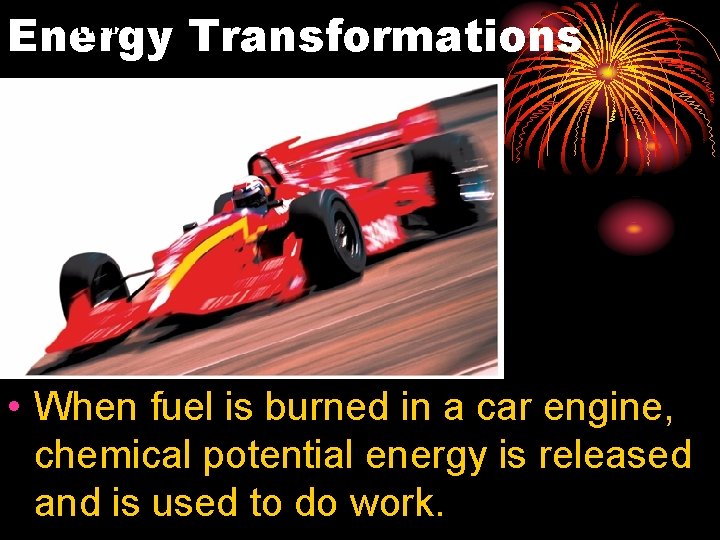
Energy Transformations 17. 1 • When fuel is burned in a car engine, chemical potential energy is released and is used to do work.
17. 1 Exothermic and Endothermic Processes • System - part of the universe on which you focus your attention • Surroundings - everything else in the universe. • Law of conservation of energy - in any chemical or physical process, energy is neither created nor destroyed.
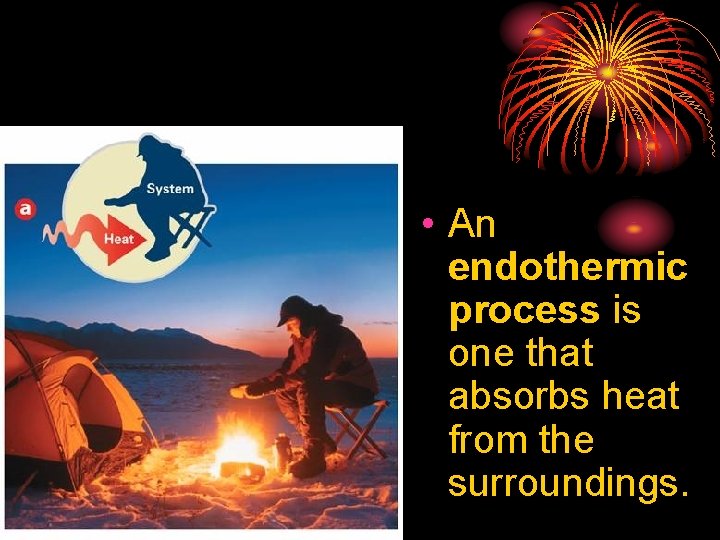
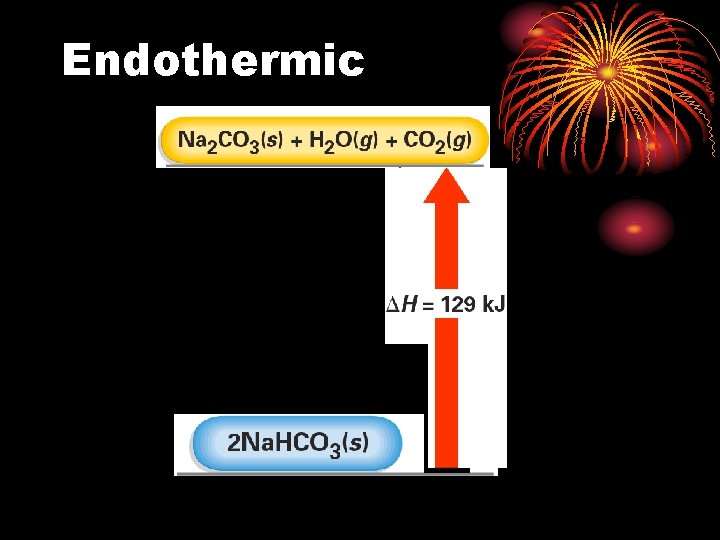
17. 1 • An endothermic process is one that absorbs heat from the surroundings.
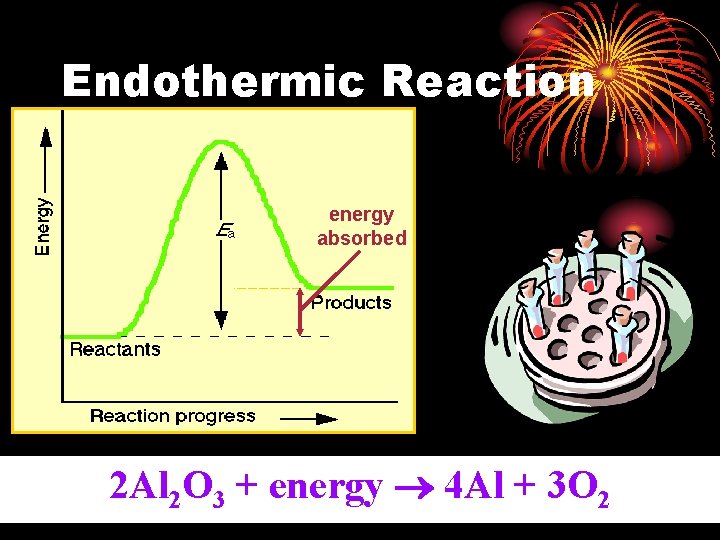
Endothermic Reaction energy absorbed 2 Al 2 O 3 + energy 4 Al + 3 O 2
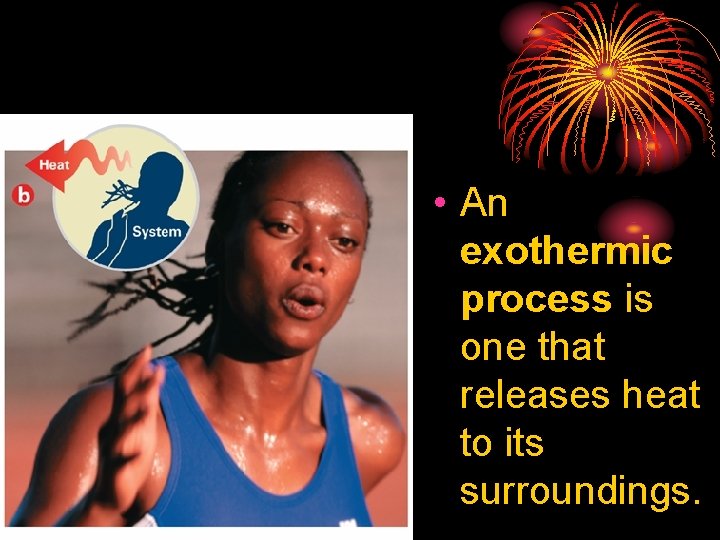
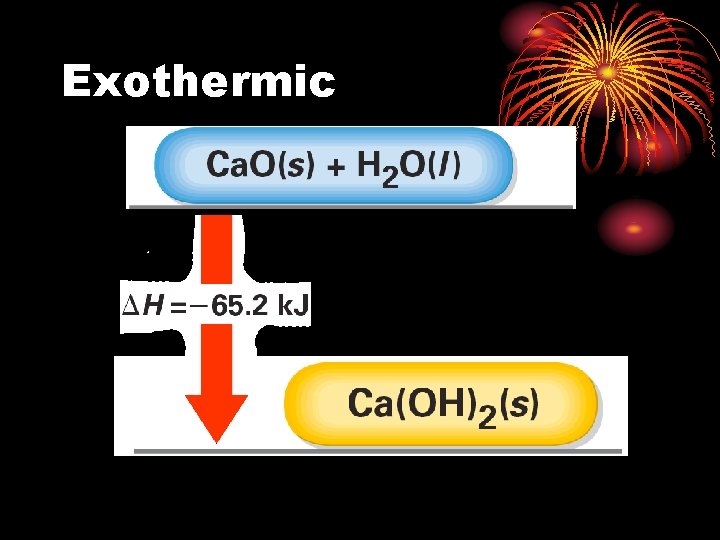
17. 1 • An exothermic process is one that releases heat to its surroundings.
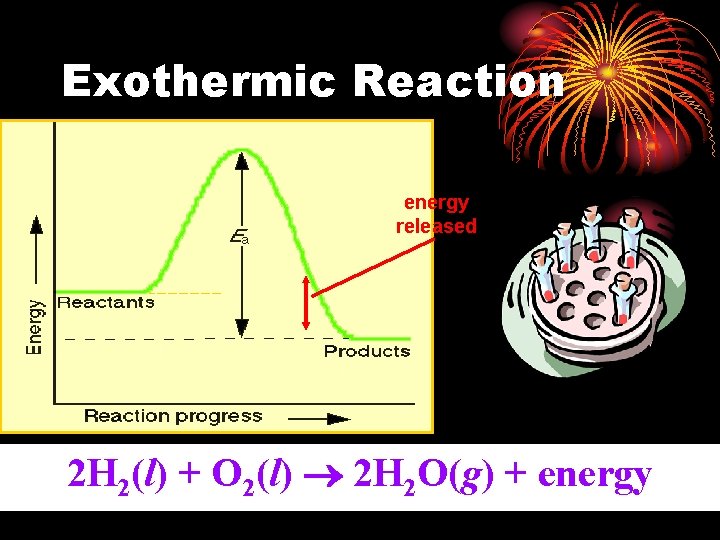
Exothermic Reaction energy released 2 H 2(l) + O 2(l) 2 H 2 O(g) + energy
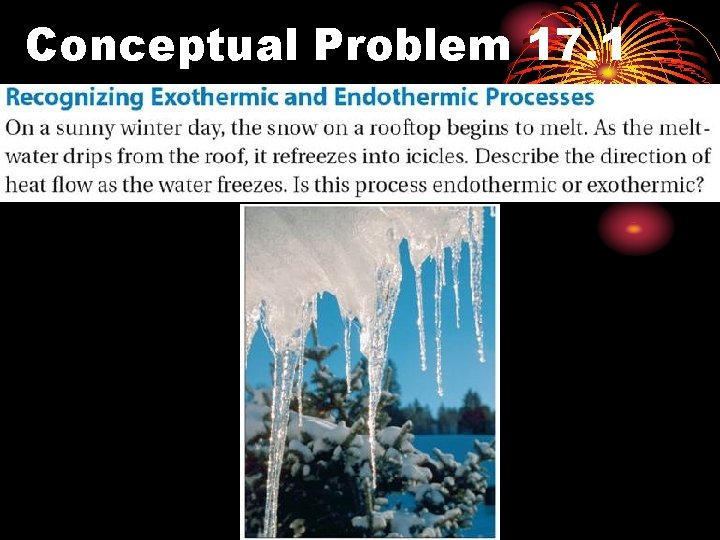
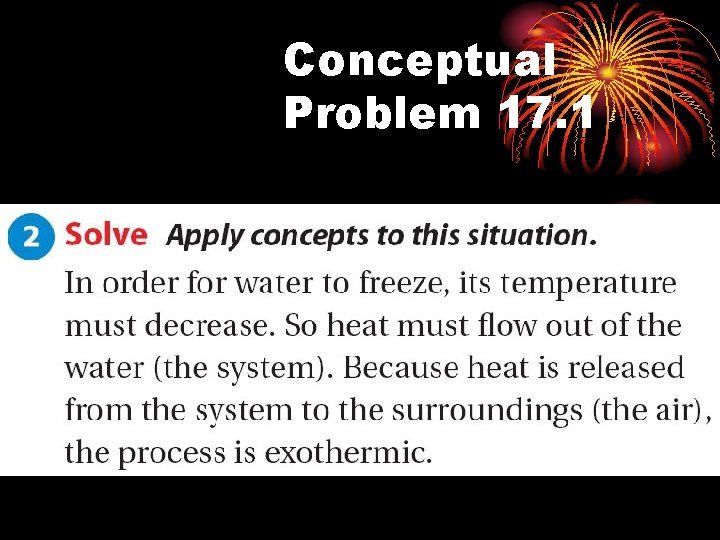
Conceptual Problem 17. 1
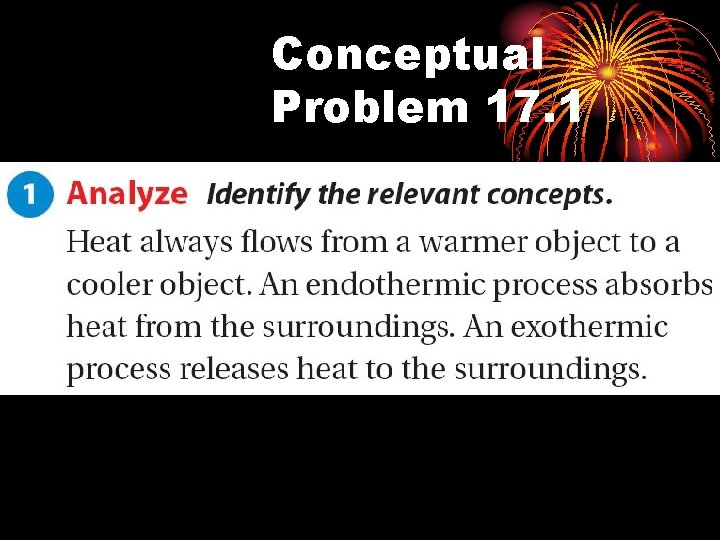
Conceptual Problem 17. 1
Conceptual Problem 17. 1
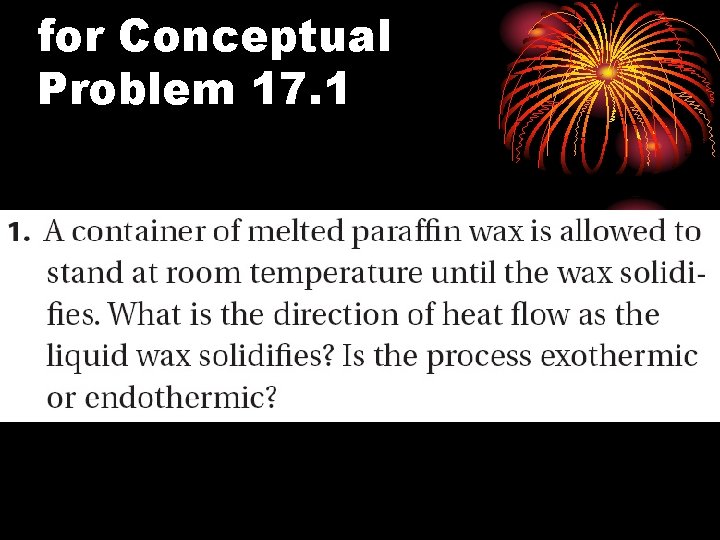
for Conceptual Problem 17. 1
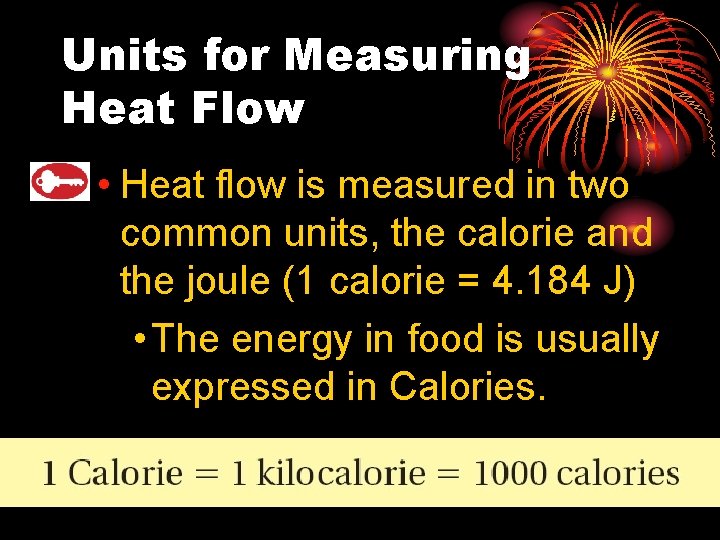
17. 1 Units for Measuring Heat Flow • Heat flow is measured in two common units, the calorie and the joule (1 calorie = 4. 184 J) • The energy in food is usually expressed in Calories.
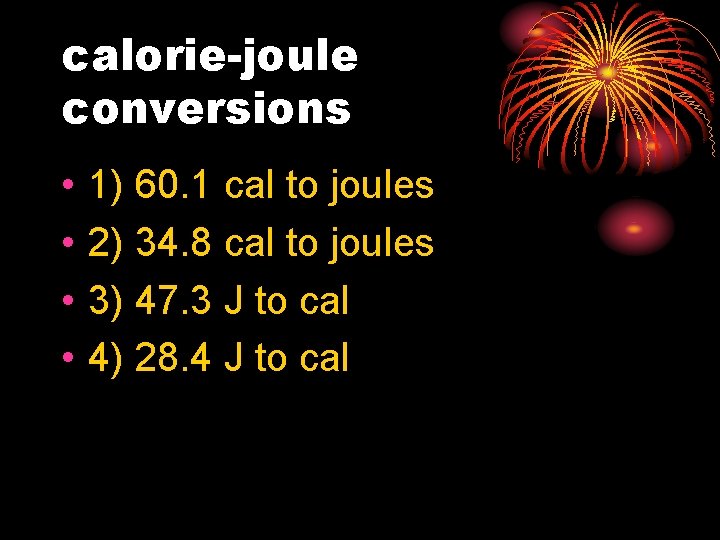
calorie-joule conversions • • 1) 60. 1 cal to joules 2) 34. 8 cal to joules 3) 47. 3 J to cal 4) 28. 4 J to cal
17. 1 Heat Capacity and Specific Heat • The amount of heat needed to increase the temperature of an object exactly 1°C is the heat capacity of that object. −Depends on mass and chemical composition
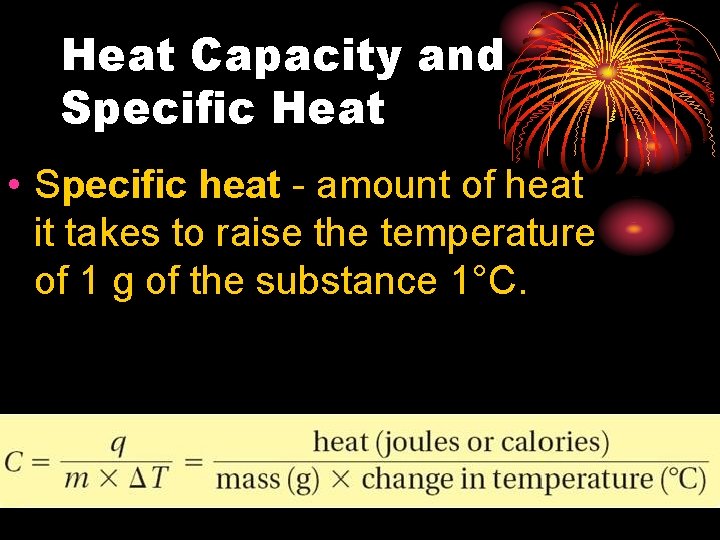
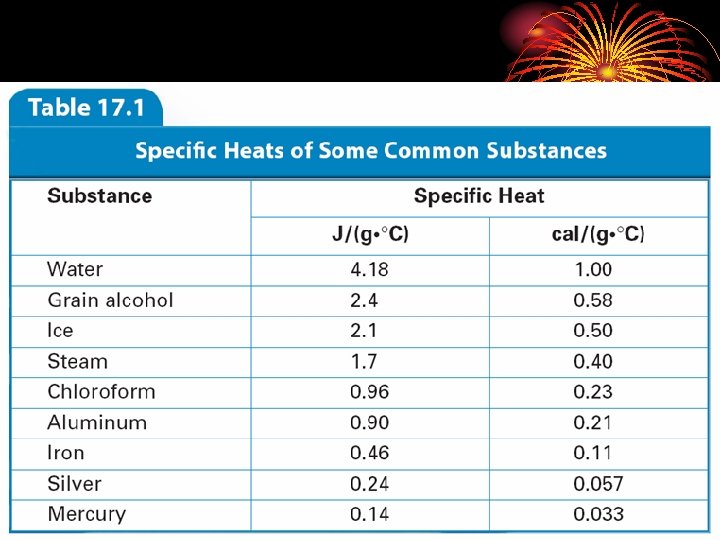
17. 1 Heat Capacity and Specific Heat • Specific heat - amount of heat it takes to raise the temperature of 1 g of the substance 1°C.
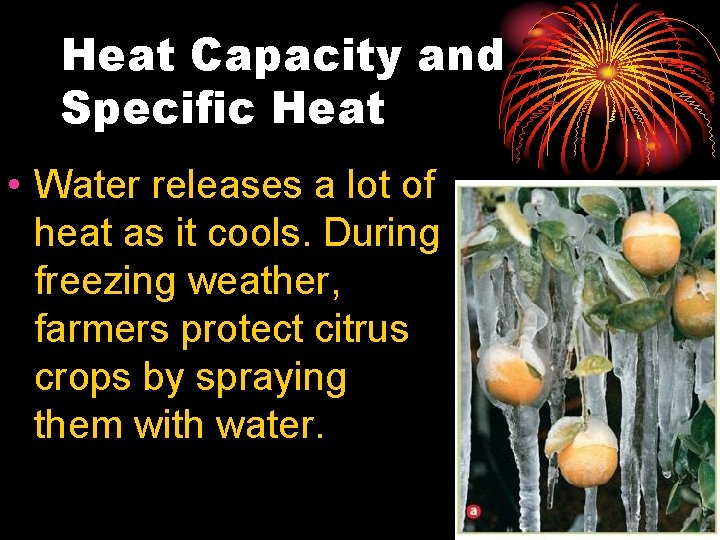
17. 1 Heat Capacity and Specific Heat • Water releases a lot of heat as it cools. During freezing weather, farmers protect citrus crops by spraying them with water.
17. 1
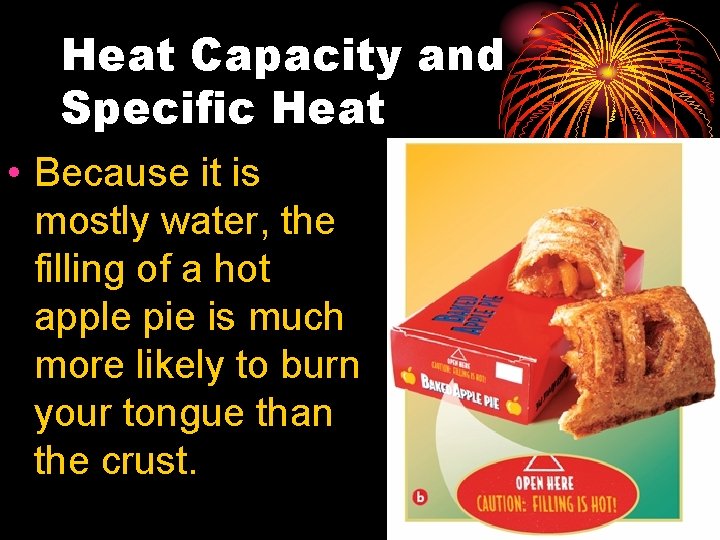
17. 1 Heat Capacity and Specific Heat • Because it is mostly water, the filling of a hot apple pie is much more likely to burn your tongue than the crust.
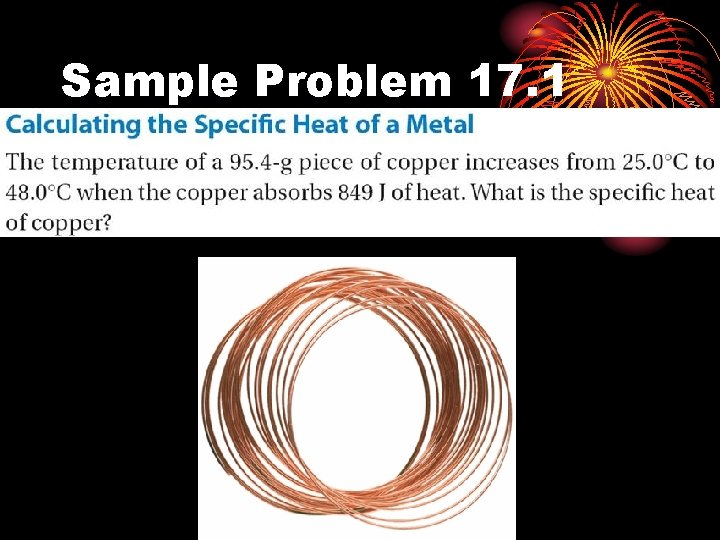
Sample Problem 17. 1
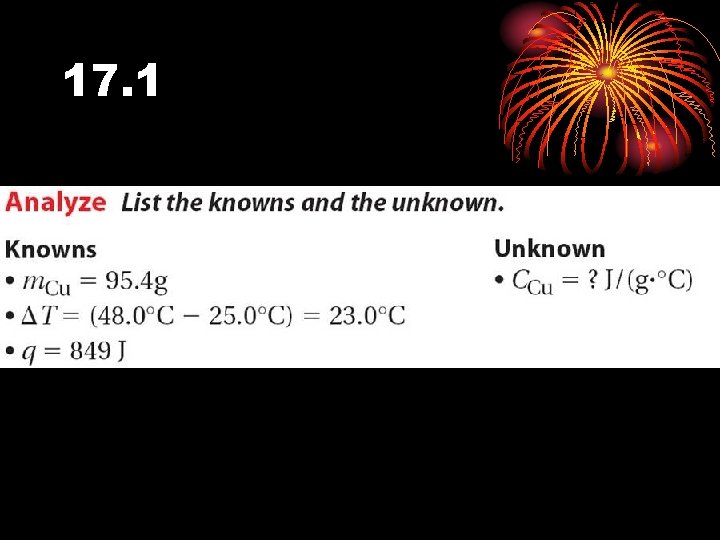
17. 1
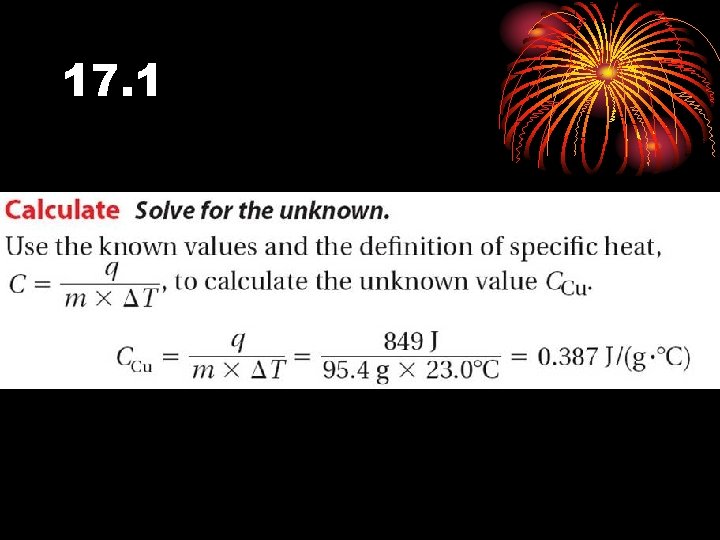
17. 1
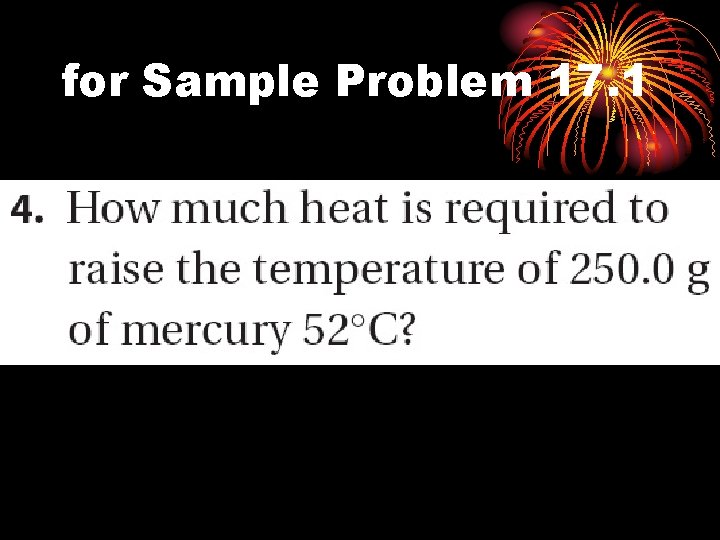
for Sample Problem 17. 1
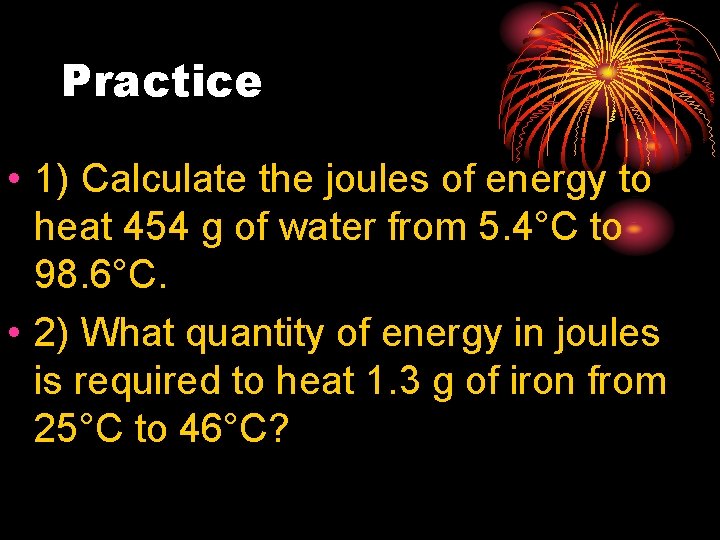
Practice • 1) Calculate the joules of energy to heat 454 g of water from 5. 4°C to 98. 6°C. • 2) What quantity of energy in joules is required to heat 1. 3 g of iron from 25°C to 46°C?
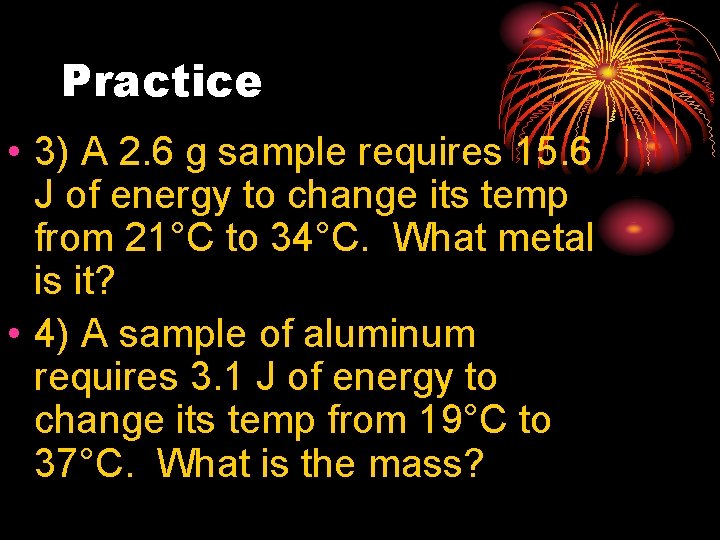
Practice • 3) A 2. 6 g sample requires 15. 6 J of energy to change its temp from 21°C to 34°C. What metal is it? • 4) A sample of aluminum requires 3. 1 J of energy to change its temp from 19°C to 37°C. What is the mass?
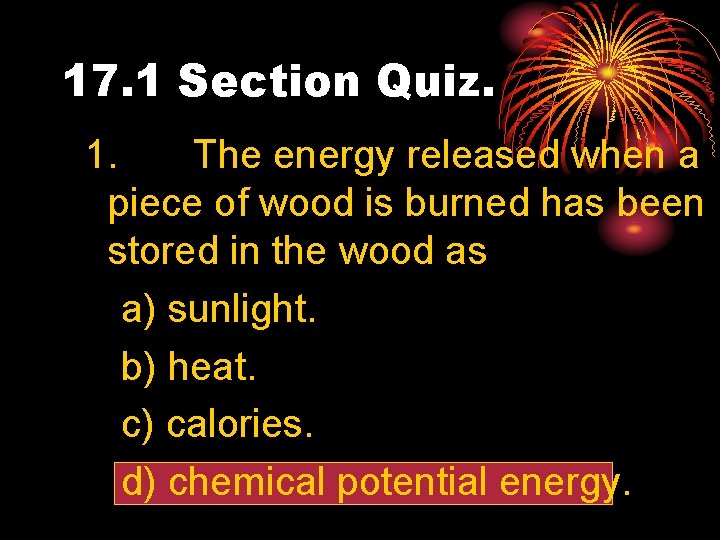
17. 1 Section Quiz. 1. The energy released when a piece of wood is burned has been stored in the wood as a) sunlight. b) heat. c) calories. d) chemical potential energy.
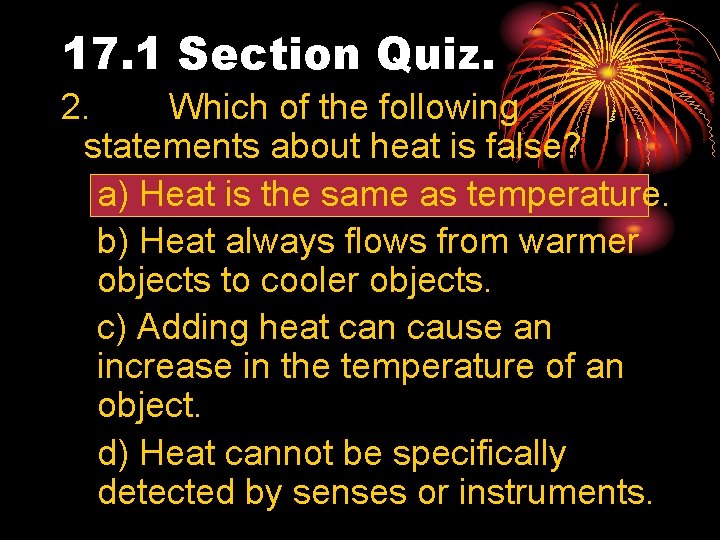
17. 1 Section Quiz. 2. Which of the following statements about heat is false? a) Heat is the same as temperature. b) Heat always flows from warmer objects to cooler objects. c) Adding heat can cause an increase in the temperature of an object. d) Heat cannot be specifically detected by senses or instruments.
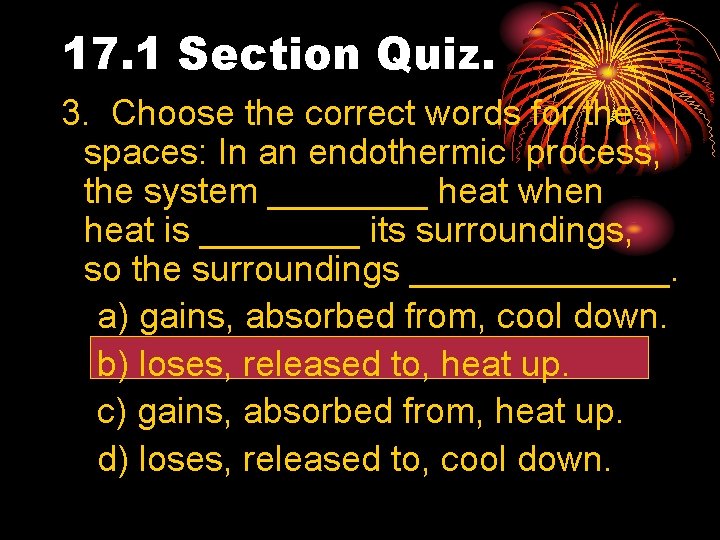
17. 1 Section Quiz. 3. Choose the correct words for the spaces: In an endothermic process, the system ____ heat when heat is ____ its surroundings, so the surroundings _______. a) gains, absorbed from, cool down. b) loses, released to, heat up. c) gains, absorbed from, heat up. d) loses, released to, cool down.
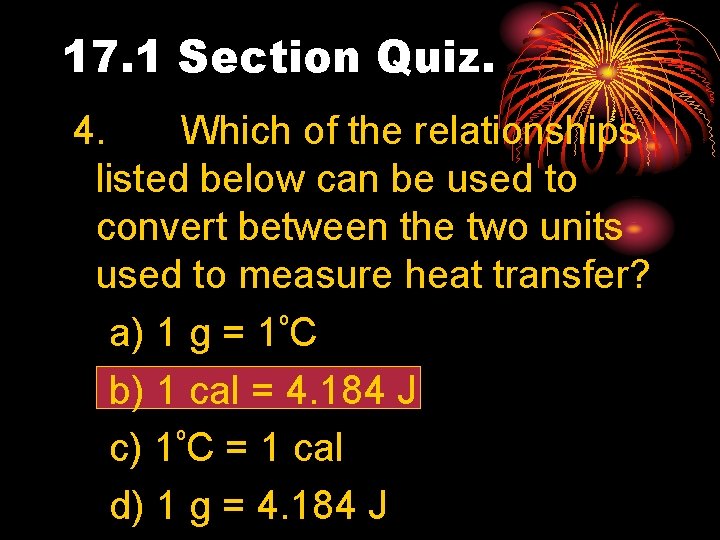
17. 1 Section Quiz. 4. Which of the relationships listed below can be used to convert between the two units used to measure heat transfer? a) 1 g = 1ºC b) 1 cal = 4. 184 J c) 1ºC = 1 cal d) 1 g = 4. 184 J
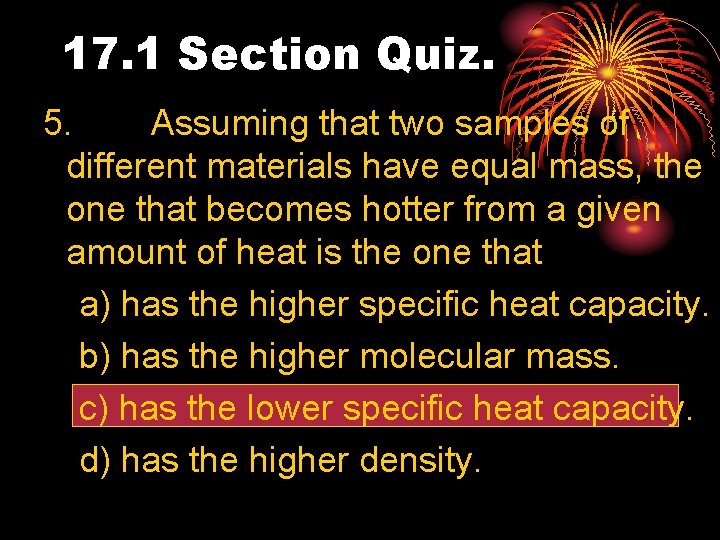
17. 1 Section Quiz. 5. Assuming that two samples of different materials have equal mass, the one that becomes hotter from a given amount of heat is the one that a) has the higher specific heat capacity. b) has the higher molecular mass. c) has the lower specific heat capacity. d) has the higher density.
17. 2 Measuring and Expressing Enthalpy Changes
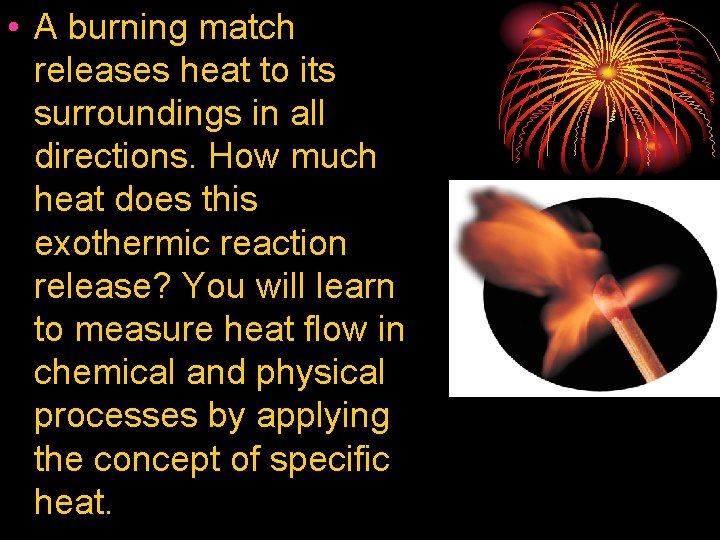
• A burning match releases heat to its surroundings in all directions. How much heat does this exothermic reaction release? You will learn to measure heat flow in chemical and physical processes by applying the concept of specific heat.
17. 2 Calorimetry • Calorimetry - precise measurement of the heat flow into or out of a system for chemical and physical processes.
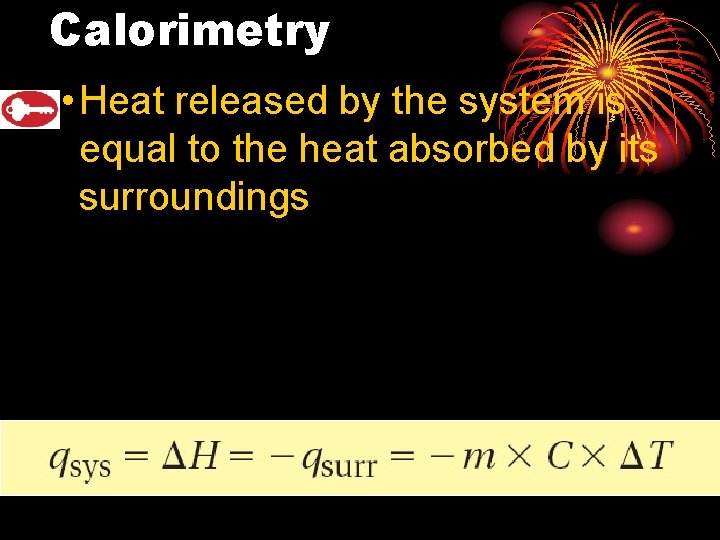
Calorimetry • Heat released by the system is equal to the heat absorbed by its surroundings
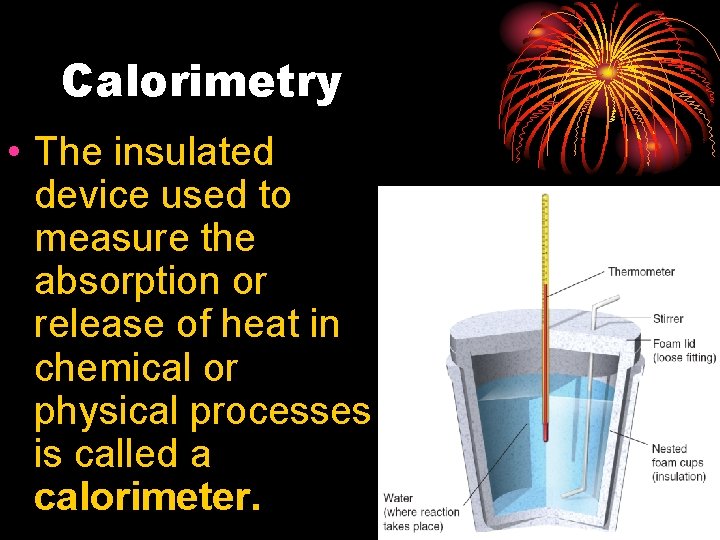
17. 2 Calorimetry • The insulated device used to measure the absorption or release of heat in chemical or physical processes is called a calorimeter.
17. 2 Calorimetry • The heat content of a system at constant pressure is called the enthalpy (H) of the system.
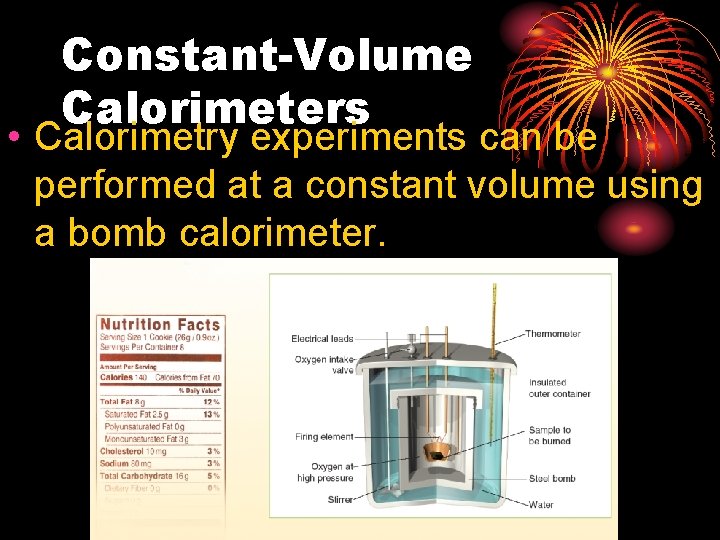
17. 2 Constant-Volume Calorimeters • Calorimetry experiments can be performed at a constant volume using a bomb calorimeter.
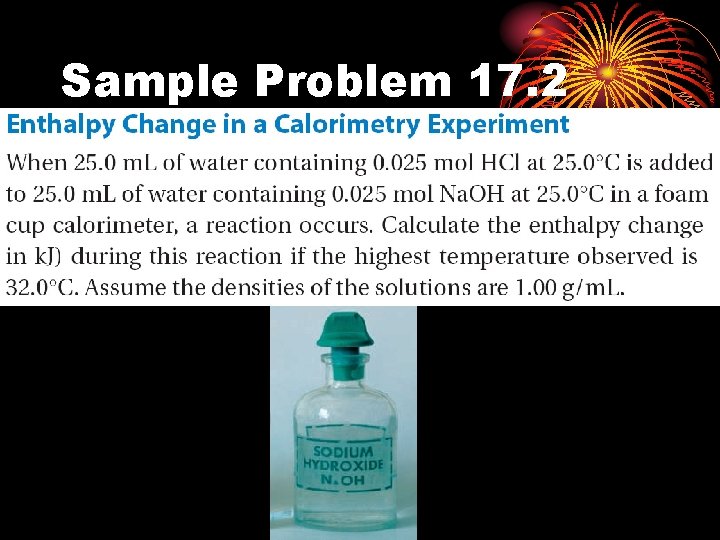
Sample Problem 17. 2
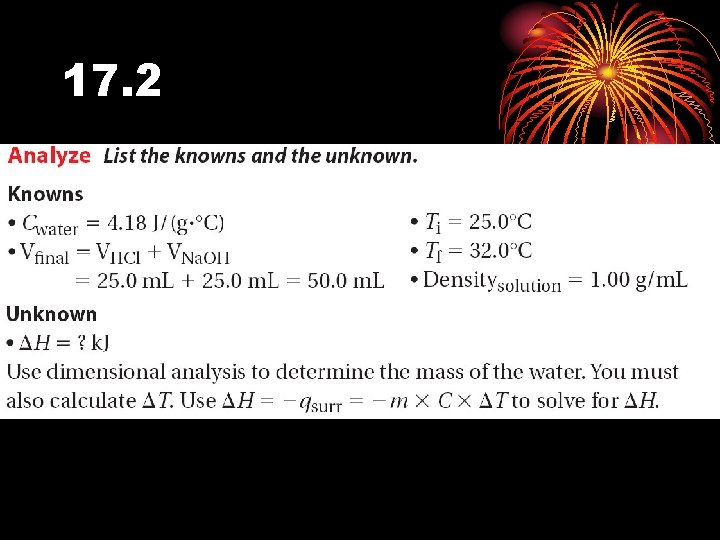
17. 2
17. 2
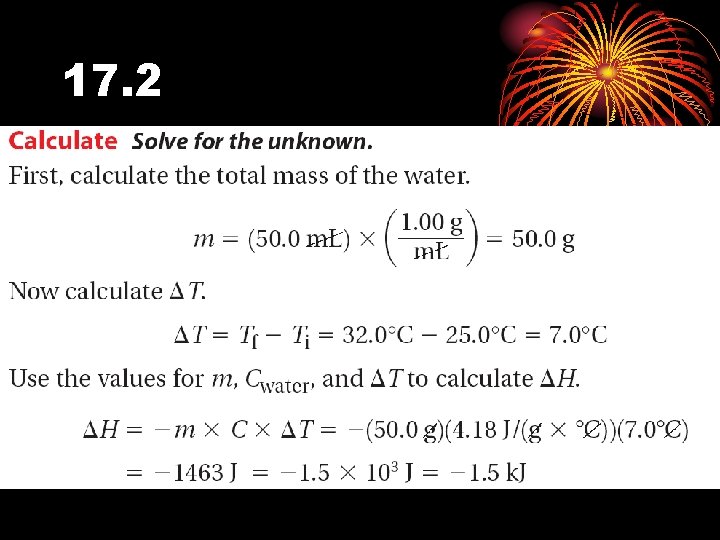
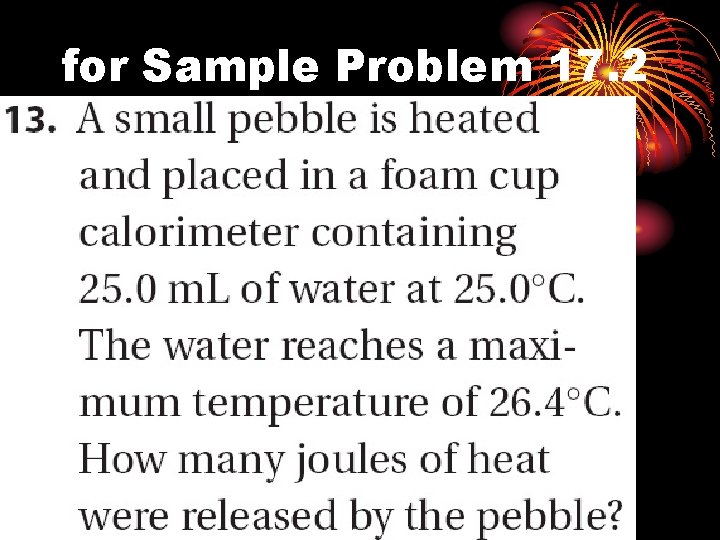
for Sample Problem 17. 2
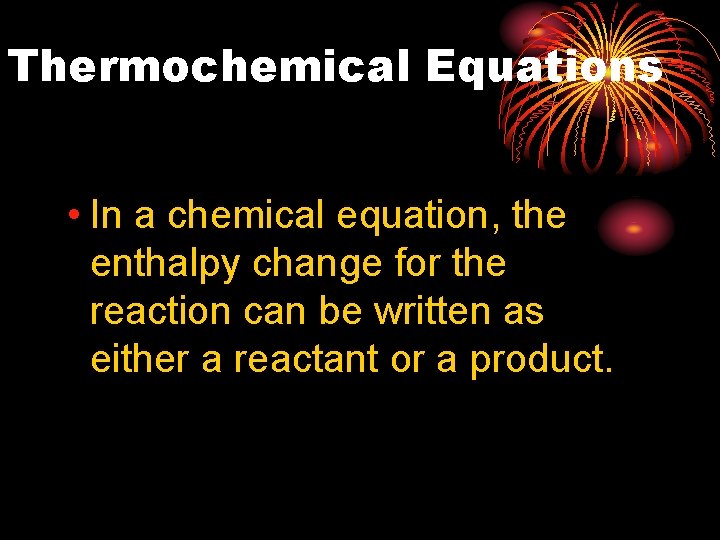
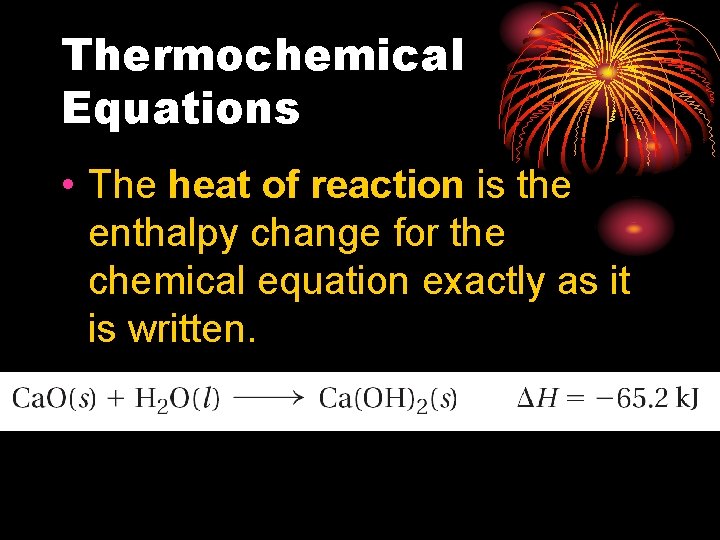
17. 2 Thermochemical Equations • In a chemical equation, the enthalpy change for the reaction can be written as either a reactant or a product.
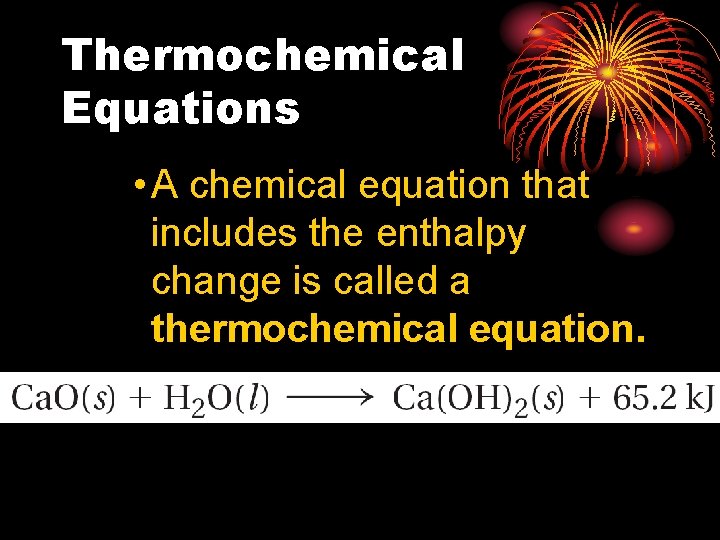
17. 2 Thermochemical Equations • A chemical equation that includes the enthalpy change is called a thermochemical equation.
17. 2 Thermochemical Equations • The heat of reaction is the enthalpy change for the chemical equation exactly as it is written.
17. 2 Exothermic
17. 2 Endothermic
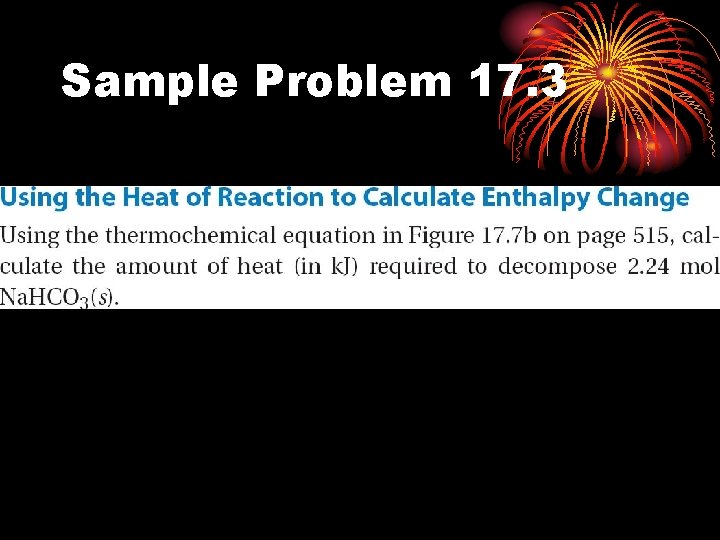
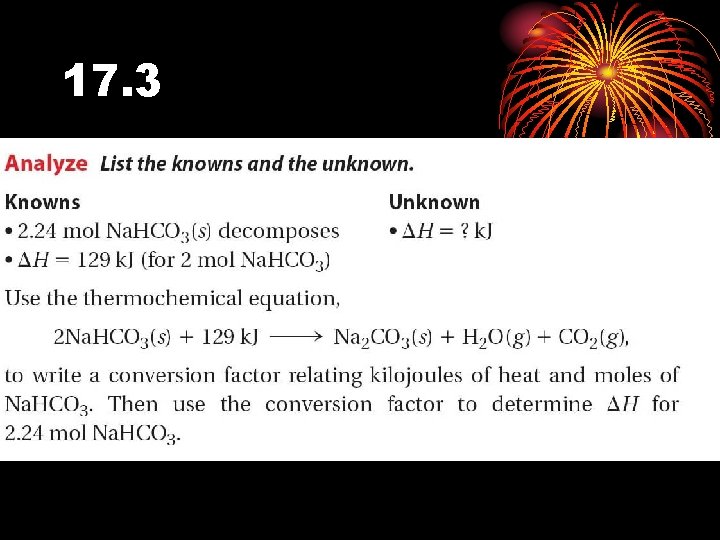
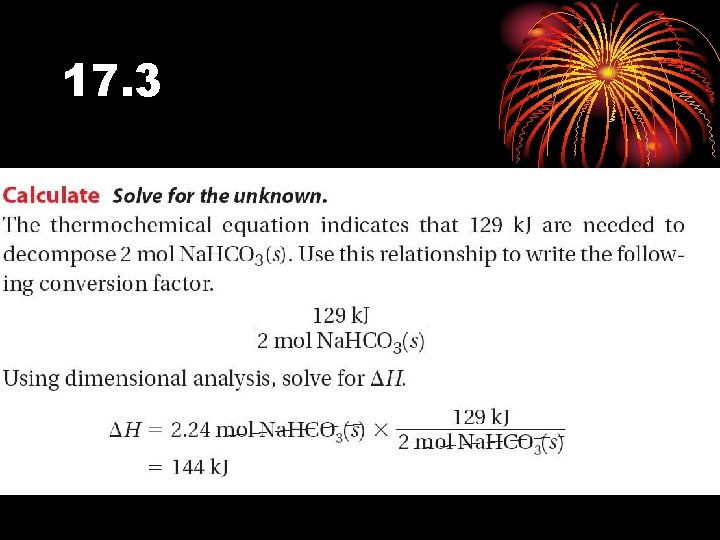
Sample Problem 17. 3
17. 3
17. 3
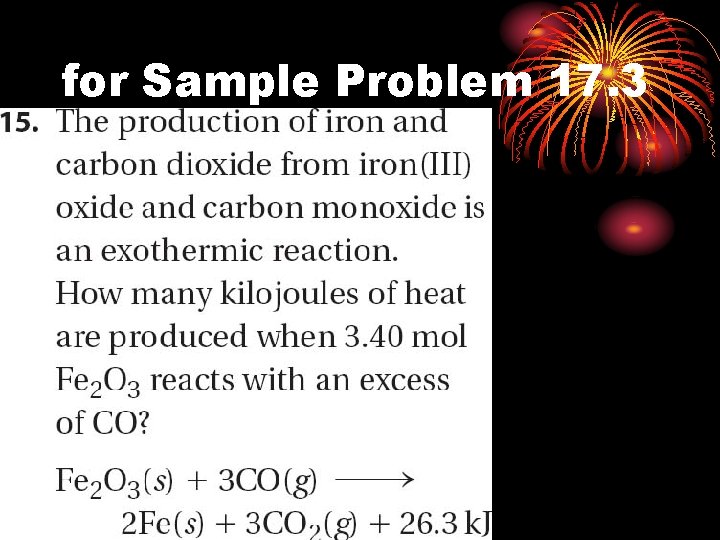
for Sample Problem 17. 3
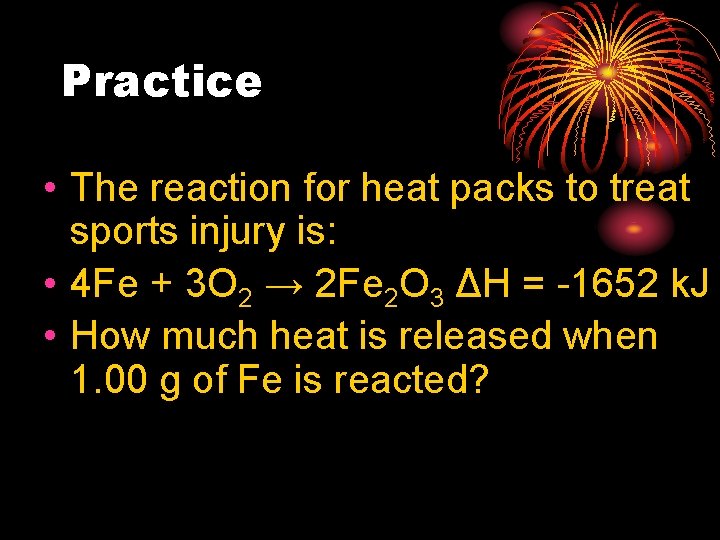
Practice • The reaction for heat packs to treat sports injury is: • 4 Fe + 3 O 2 → 2 Fe 2 O 3 ΔH = -1652 k. J • How much heat is released when 1. 00 g of Fe is reacted?
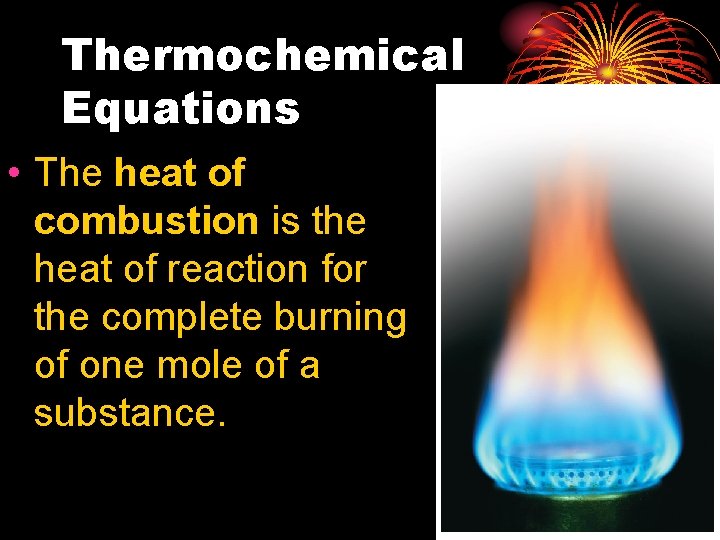
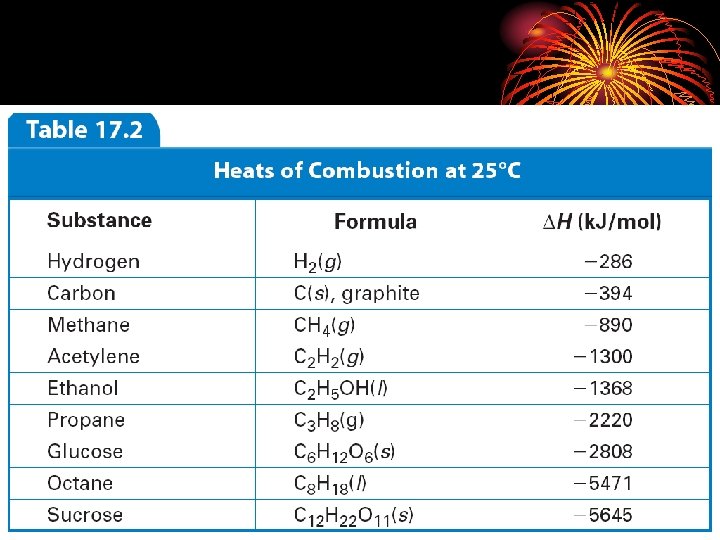
17. 2 Thermochemical Equations • The heat of combustion is the heat of reaction for the complete burning of one mole of a substance.
17. 2
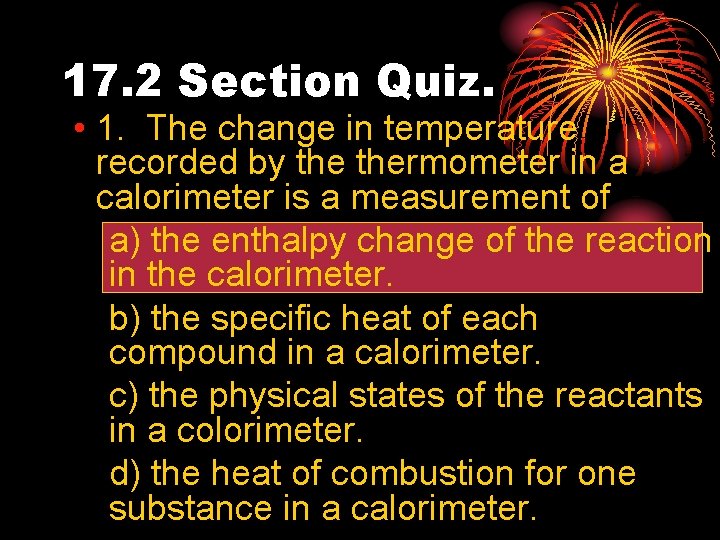
17. 2 Section Quiz. • 1. The change in temperature recorded by thermometer in a calorimeter is a measurement of a) the enthalpy change of the reaction in the calorimeter. b) the specific heat of each compound in a calorimeter. c) the physical states of the reactants in a colorimeter. d) the heat of combustion for one substance in a calorimeter.
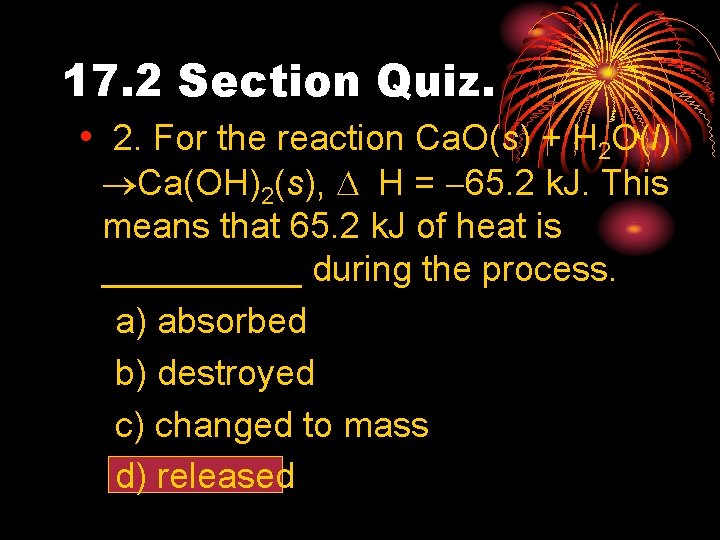
17. 2 Section Quiz. • 2. For the reaction Ca. O(s) + H 2 O(l) Ca(OH)2(s), H = 65. 2 k. J. This means that 65. 2 k. J of heat is _____ during the process. a) absorbed b) destroyed c) changed to mass d) released
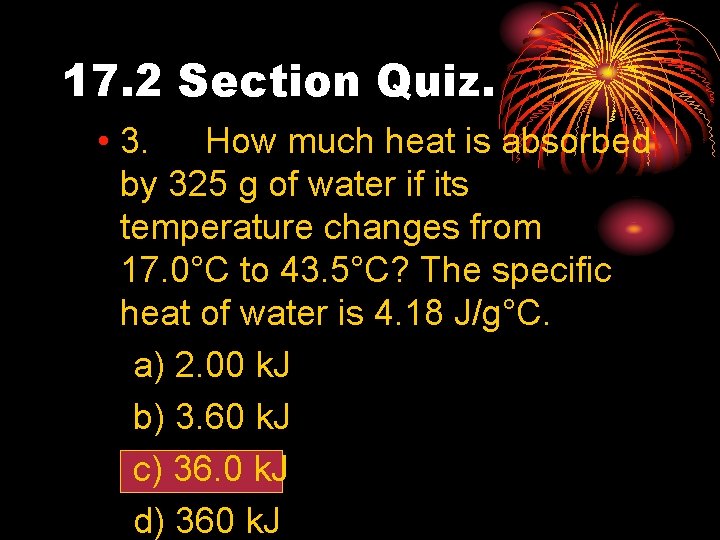
17. 2 Section Quiz. • 3. How much heat is absorbed by 325 g of water if its temperature changes from 17. 0°C to 43. 5°C? The specific heat of water is 4. 18 J/g°C. a) 2. 00 k. J b) 3. 60 k. J c) 36. 0 k. J d) 360 k. J
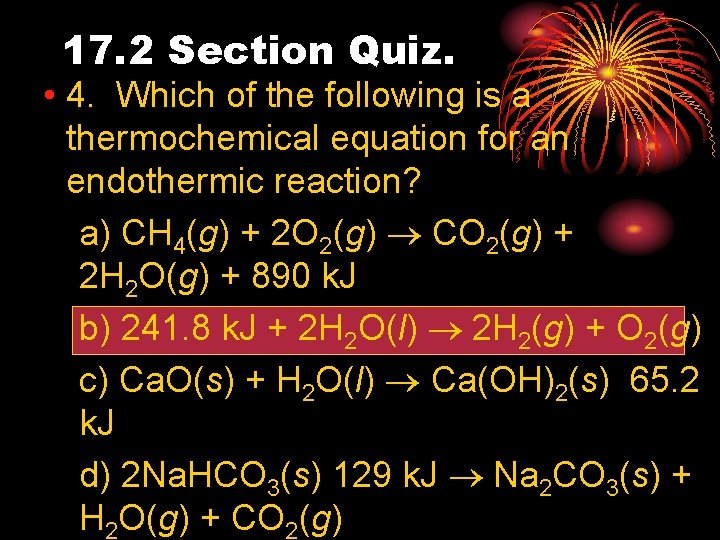
17. 2 Section Quiz. • 4. Which of the following is a thermochemical equation for an endothermic reaction? a) CH 4(g) + 2 O 2(g) CO 2(g) + 2 H 2 O(g) + 890 k. J b) 241. 8 k. J + 2 H 2 O(l) 2 H 2(g) + O 2(g) c) Ca. O(s) + H 2 O(l) Ca(OH)2(s) 65. 2 k. J d) 2 Na. HCO 3(s) 129 k. J Na 2 CO 3(s) + H 2 O(g) + CO 2(g)
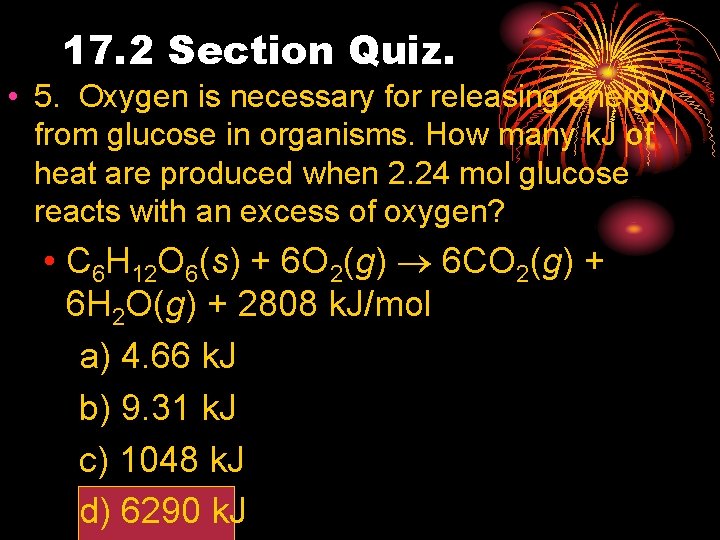
17. 2 Section Quiz. • 5. Oxygen is necessary for releasing energy from glucose in organisms. How many k. J of heat are produced when 2. 24 mol glucose reacts with an excess of oxygen? • C 6 H 12 O 6(s) + 6 O 2(g) 6 CO 2(g) + 6 H 2 O(g) + 2808 k. J/mol a) 4. 66 k. J b) 9. 31 k. J c) 1048 k. J d) 6290 k. J
17. 3 Heat in Changes of State
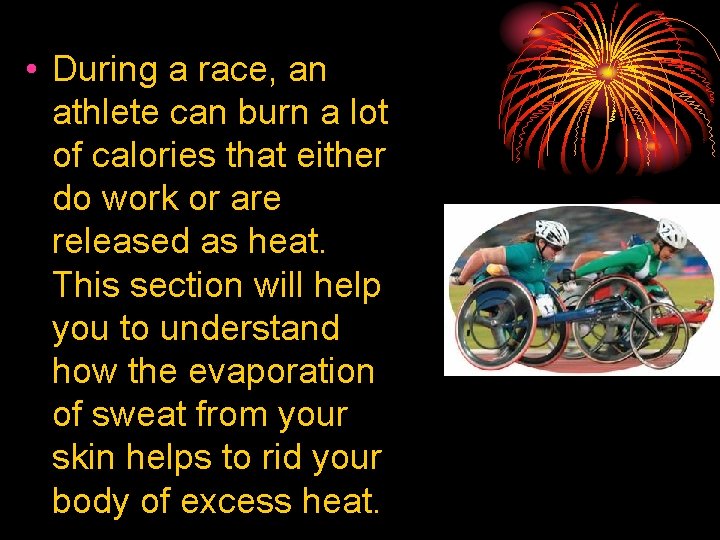
17. 3 • During a race, an athlete can burn a lot of calories that either do work or are released as heat. This section will help you to understand how the evaporation of sweat from your skin helps to rid your body of excess heat.
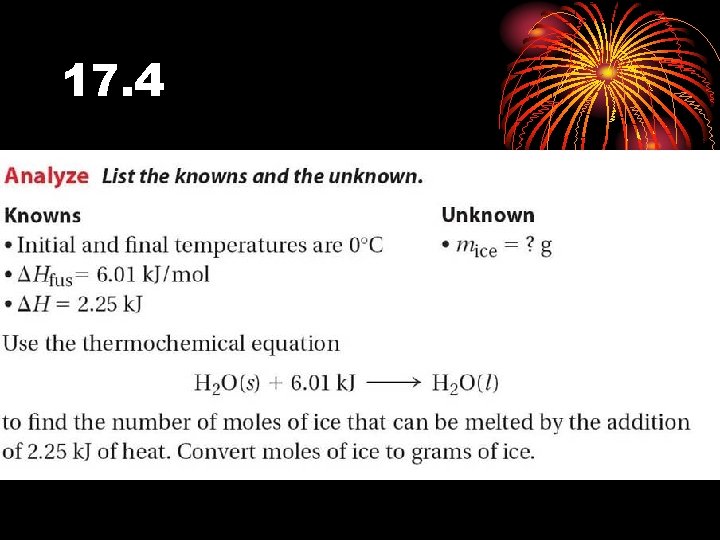
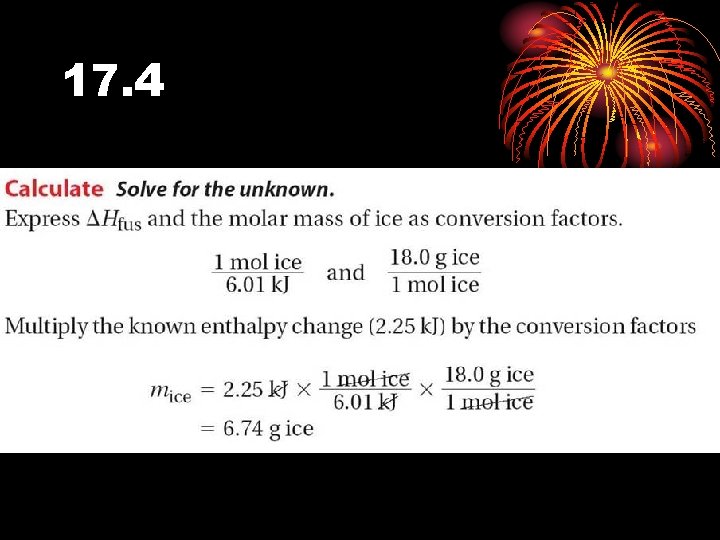
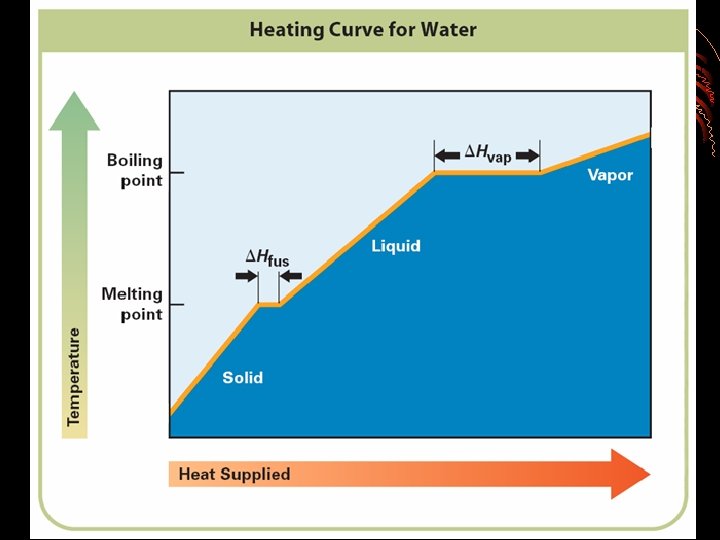
Heats of Fusion and Solidification • The molar heat of fusion (∆Hfus) is the heat absorbed by one mole of a solid substance as it melts to a liquid at a constant temperature. • The molar heat of solidification (∆Hsolid) is the heat lost when one mole of a liquid solidifies at a constant temperature.
Heats of Fusion and Solidification 17. 3 • The quantity of heat absorbed by a melting solid is exactly the same as the quantity of heat released when the liquid solidifies; that is, ∆Hfus = – ∆Hsolid.
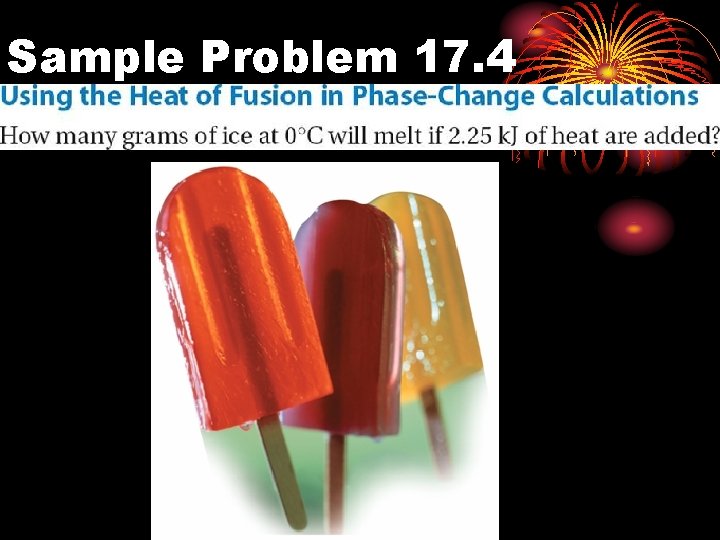
Sample Problem 17. 4
17. 4
17. 4
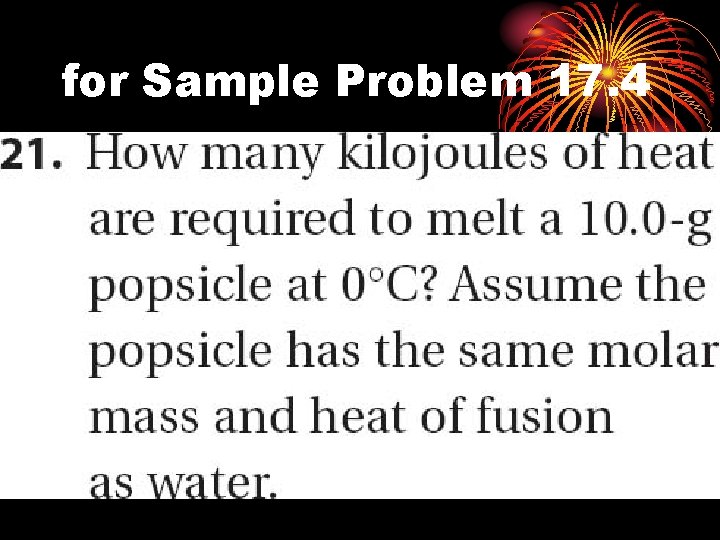
for Sample Problem 17. 4
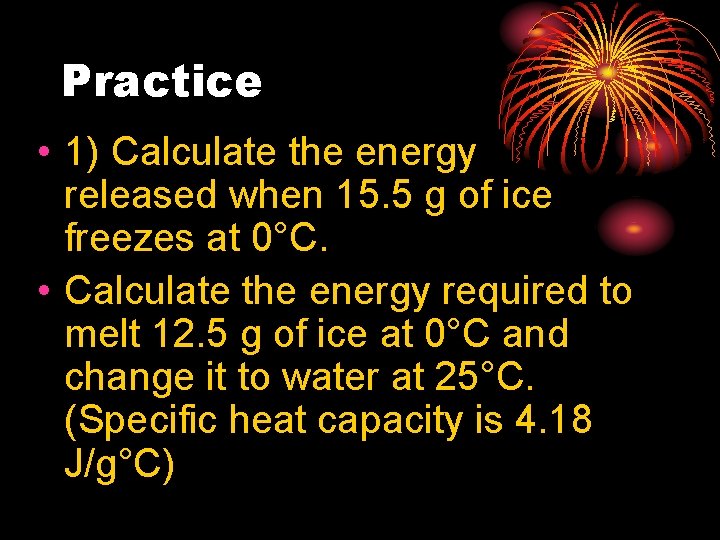
Practice • 1) Calculate the energy released when 15. 5 g of ice freezes at 0°C. • Calculate the energy required to melt 12. 5 g of ice at 0°C and change it to water at 25°C. (Specific heat capacity is 4. 18 J/g°C)
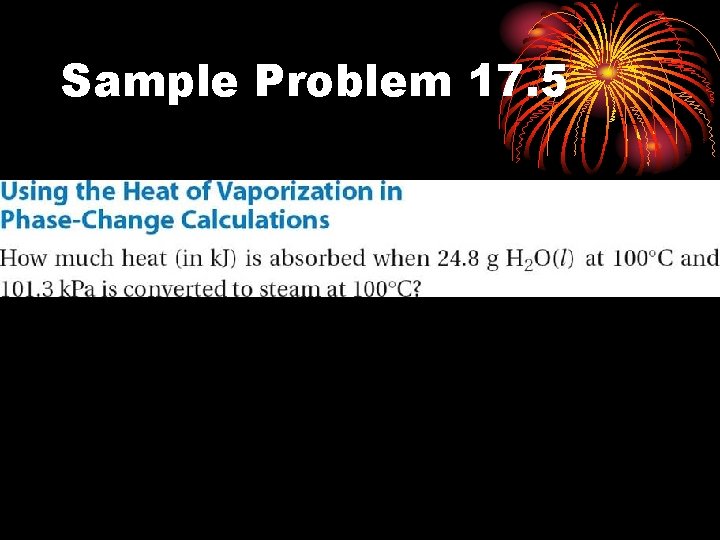
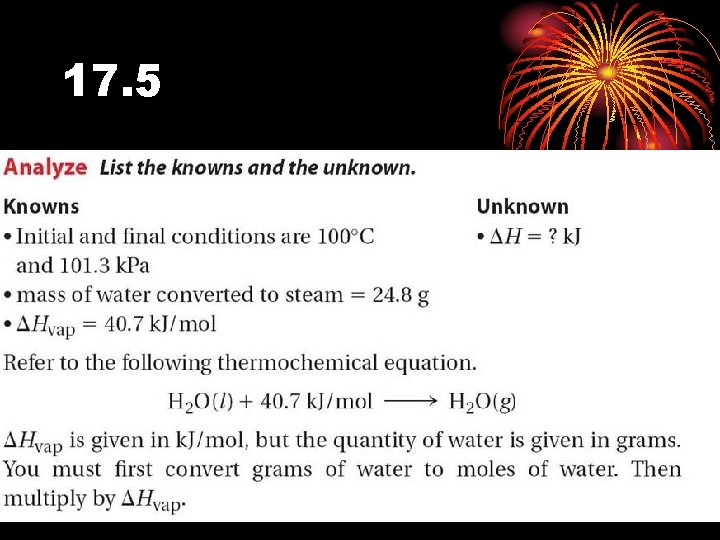
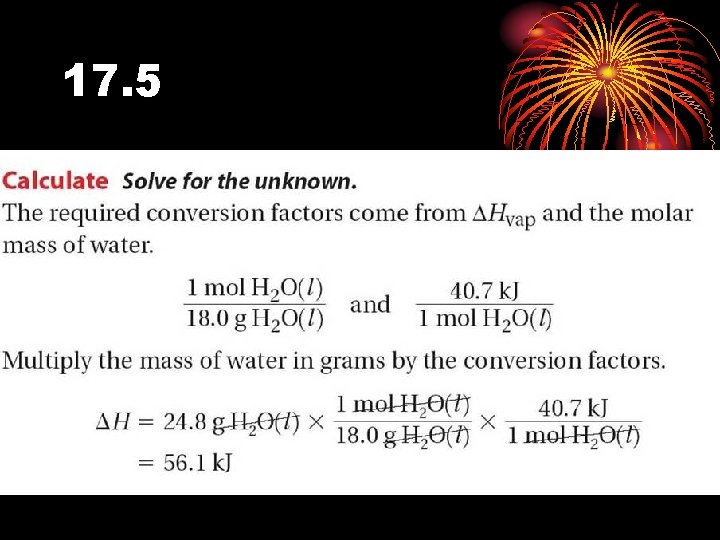
Heats of Vaporization and Condensation • The amount of heat necessary to vaporize one mole of a given liquid is called its molar heat of vaporization (∆Hvap). • The amount of heat released when 1 mol of vapor condenses at the normal boiling point is called its molar heat of condensation (∆Hcond).
Heats of Vaporization and Condensation • The quantity of heat absorbed by a vaporizing liquid is exactly the same as the quantity of heat released when the vapor condenses; that is, ∆Hvap = – ∆Hcond.
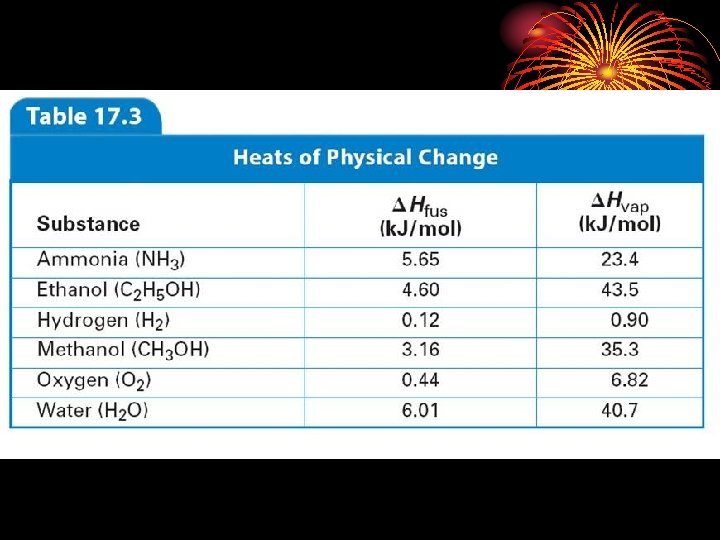
17. 3
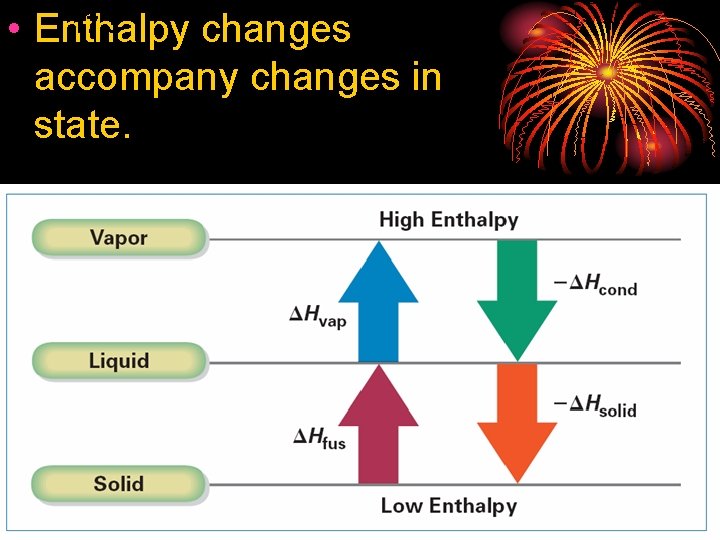
17. 3 • Enthalpy changes accompany changes in state.
17. 3
Sample Problem 17. 5
17. 5
17. 5
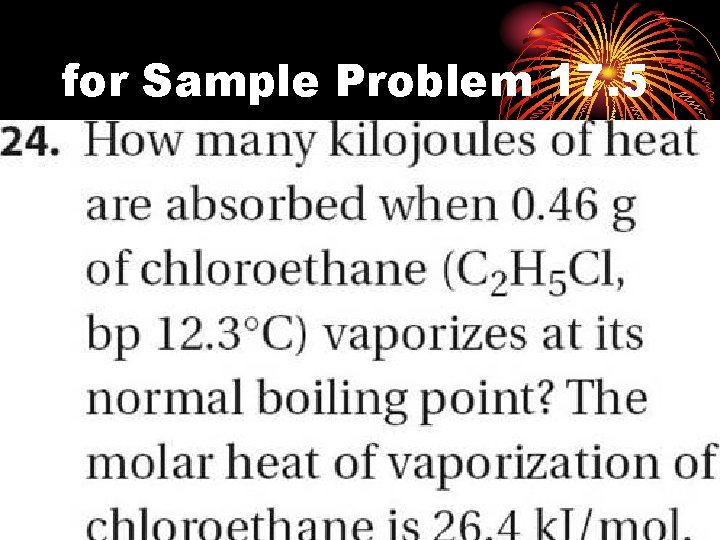
for Sample Problem 17. 5
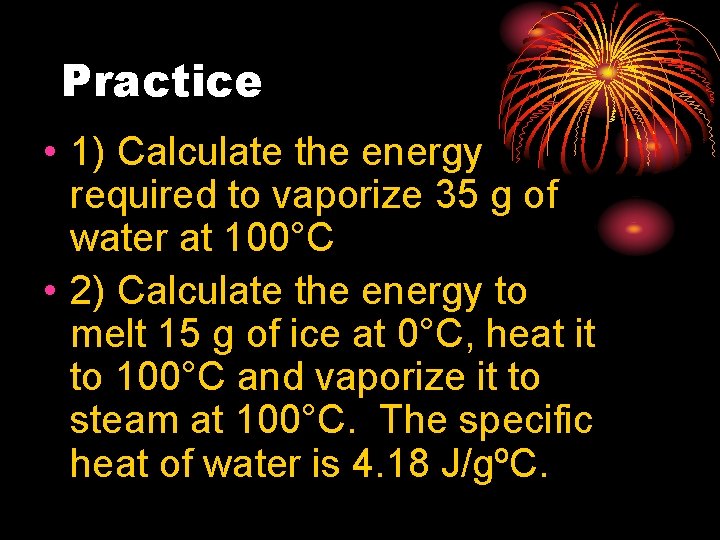
Practice • 1) Calculate the energy required to vaporize 35 g of water at 100°C • 2) Calculate the energy to melt 15 g of ice at 0°C, heat it to 100°C and vaporize it to steam at 100°C. The specific heat of water is 4. 18 J/gºC.
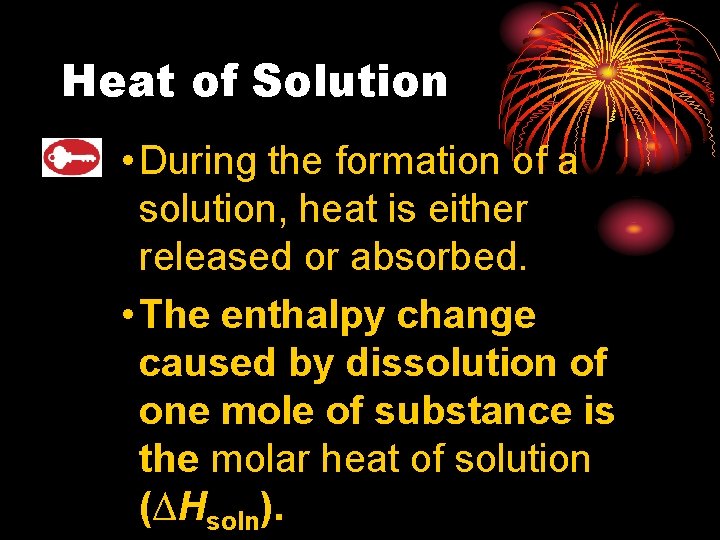
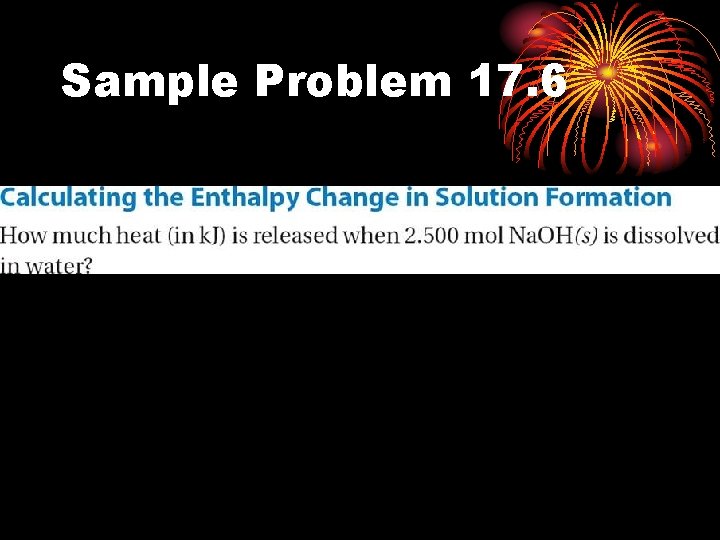
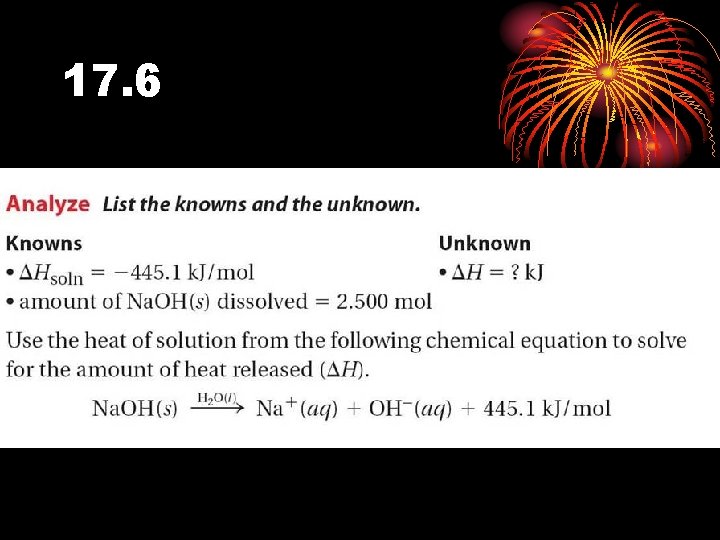
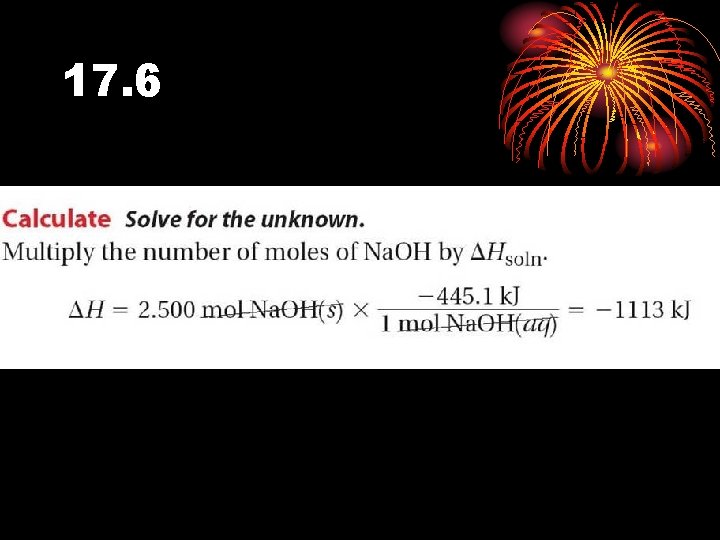
17. 3 Heat of Solution • During the formation of a solution, heat is either released or absorbed. • The enthalpy change caused by dissolution of one mole of substance is the molar heat of solution (∆Hsoln).
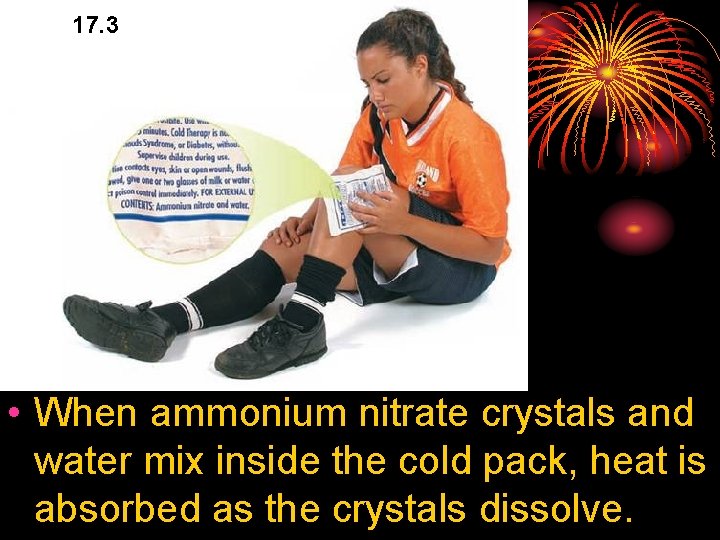
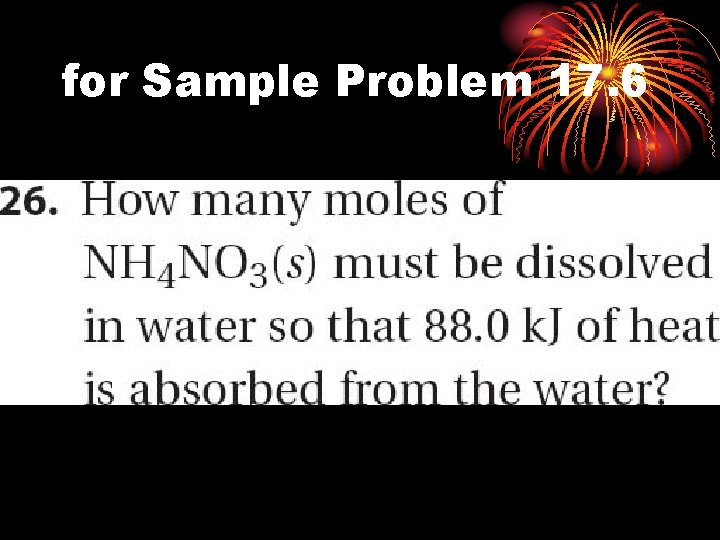
17. 3 • When ammonium nitrate crystals and water mix inside the cold pack, heat is absorbed as the crystals dissolve.
Sample Problem 17. 6
17. 6
17. 6
for Sample Problem 17. 6
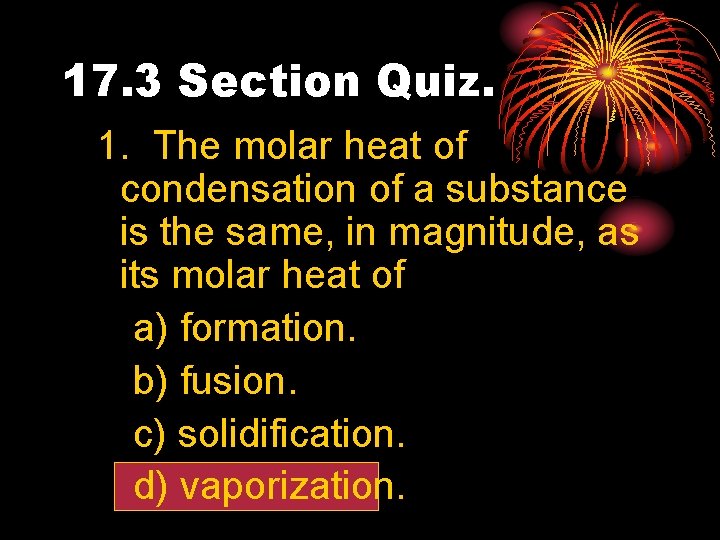
17. 3 Section Quiz. 1. The molar heat of condensation of a substance is the same, in magnitude, as its molar heat of a) formation. b) fusion. c) solidification. d) vaporization.
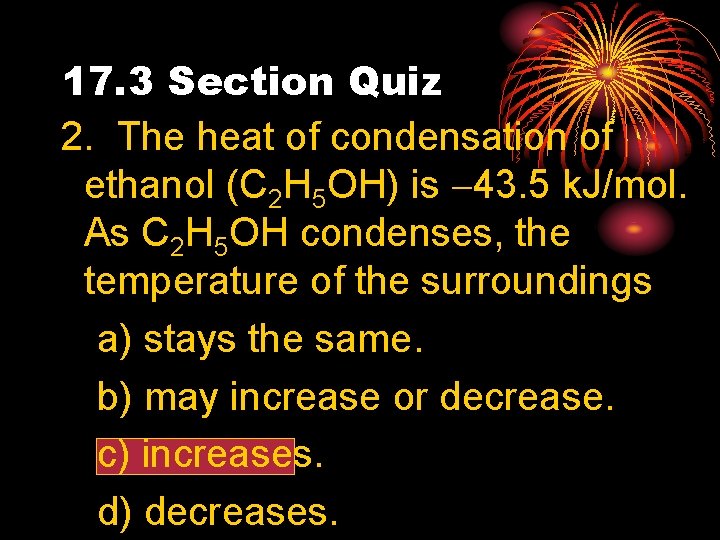
17. 3 Section Quiz 2. The heat of condensation of ethanol (C 2 H 5 OH) is 43. 5 k. J/mol. As C 2 H 5 OH condenses, the temperature of the surroundings a) stays the same. b) may increase or decrease. c) increases. d) decreases.
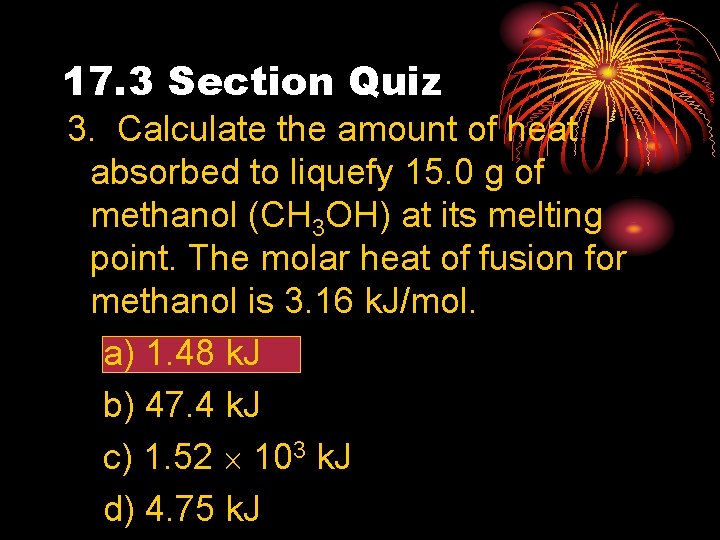
17. 3 Section Quiz 3. Calculate the amount of heat absorbed to liquefy 15. 0 g of methanol (CH 3 OH) at its melting point. The molar heat of fusion for methanol is 3. 16 k. J/mol. a) 1. 48 k. J b) 47. 4 k. J c) 1. 52 103 k. J d) 4. 75 k. J
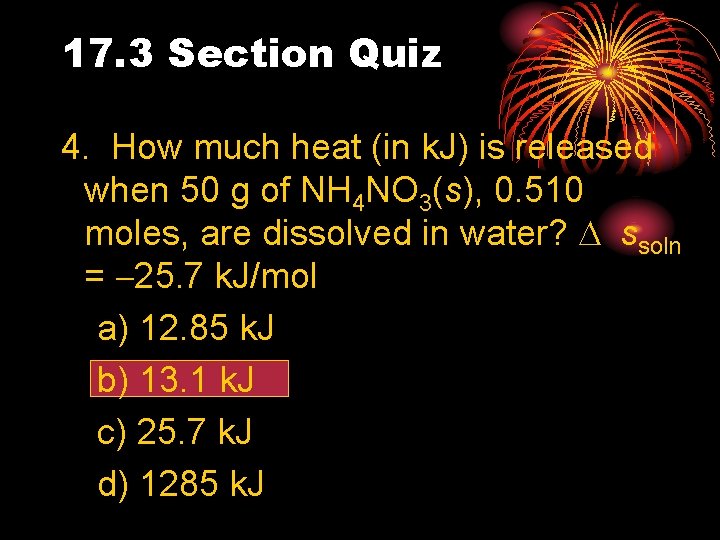
17. 3 Section Quiz 4. How much heat (in k. J) is released when 50 g of NH 4 NO 3(s), 0. 510 moles, are dissolved in water? ssoln = 25. 7 k. J/mol a) 12. 85 k. J b) 13. 1 k. J c) 25. 7 k. J d) 1285 k. J
17. 4 Calculating Heats of Reaction
• Emeralds are composed of the elements chromium, aluminum, silicon, oxygen, and beryllium. What if you wanted to determine the heat of reaction without actually breaking the gems down to their component elements? You will see how you can calculate heats of reaction from known thermochemical equations and enthalpy data.
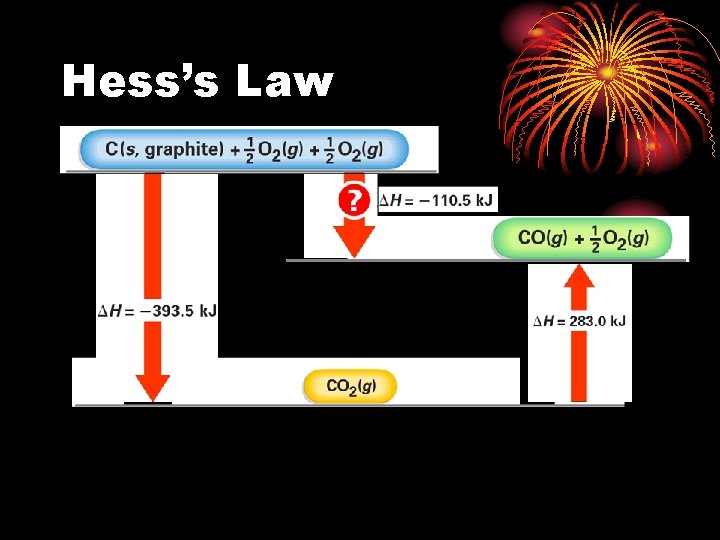
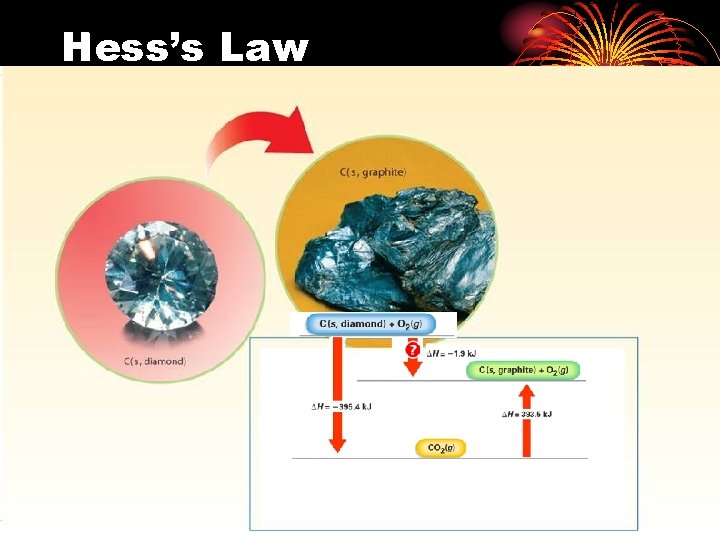
17. 4 Hess’s Law • Hess’s law allows you to determine the heat of reaction indirectly. • Hess’s law of heat summation states that if you add two or more thermochemical equations to give a final equation, then you can also add the heats of reaction to give the final heat of reaction.
17. 4 Hess’s Law
17. 4 Hess’s Law
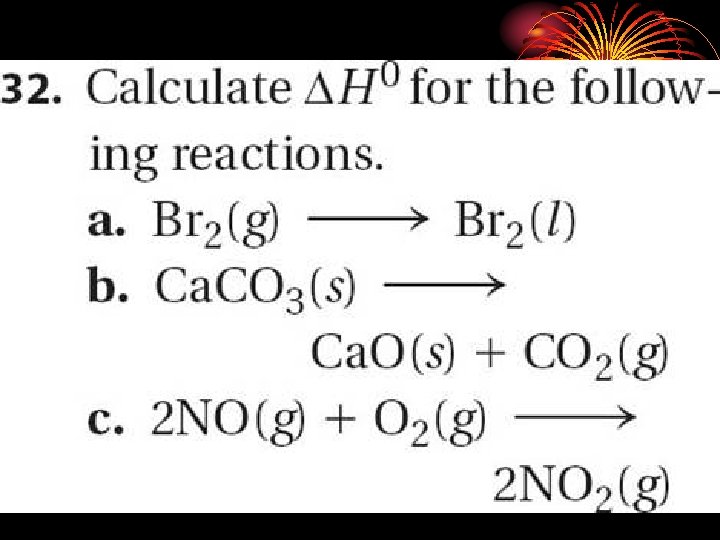
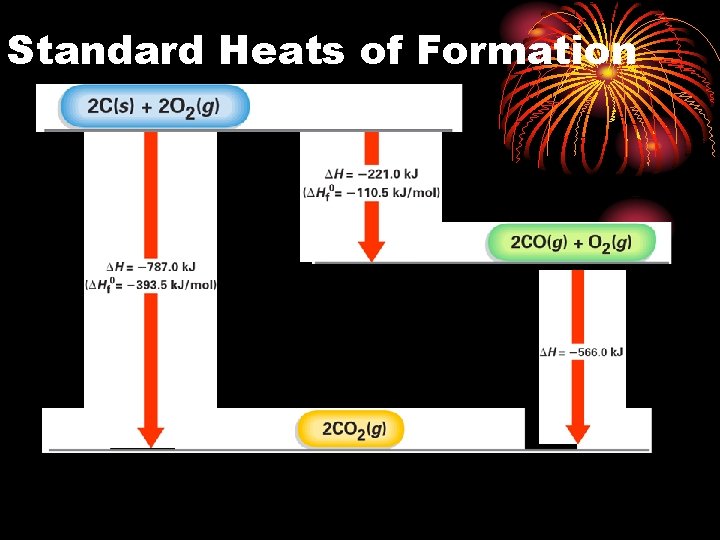
17. 4 Standard Heats of Formation • For a reaction that occurs at standard conditions, you can calculate the heat of reaction by using standard heats of formation.
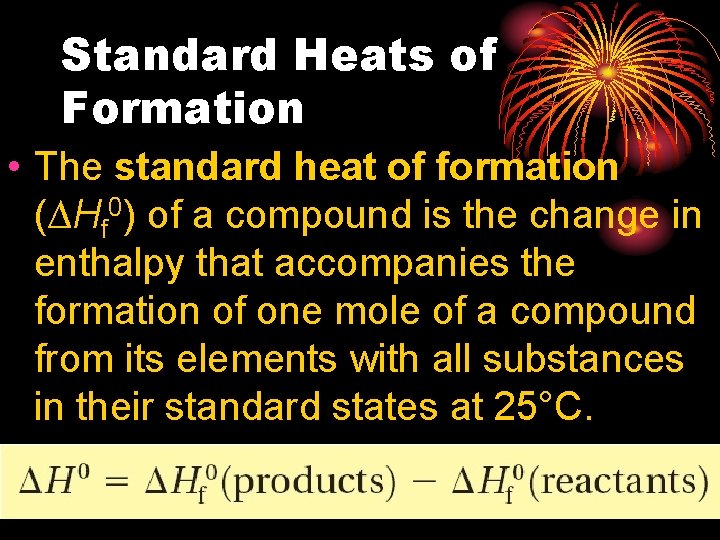
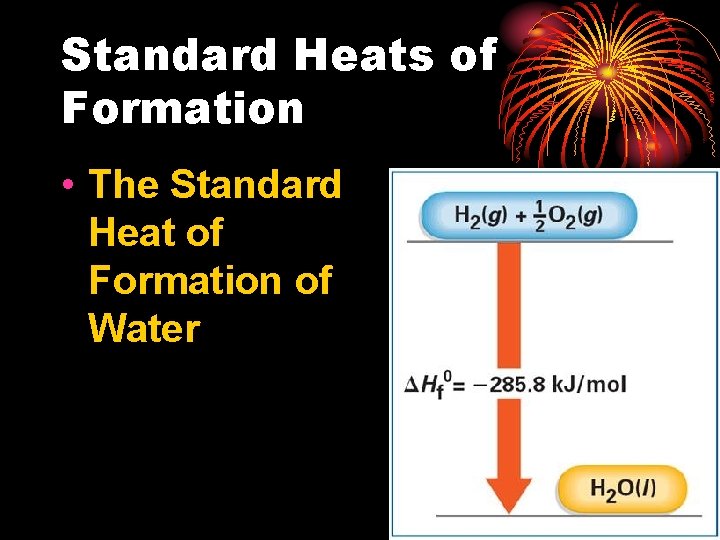
17. 4 Standard Heats of Formation • The standard heat of formation (∆Hf 0) of a compound is the change in enthalpy that accompanies the formation of one mole of a compound from its elements with all substances in their standard states at 25°C.
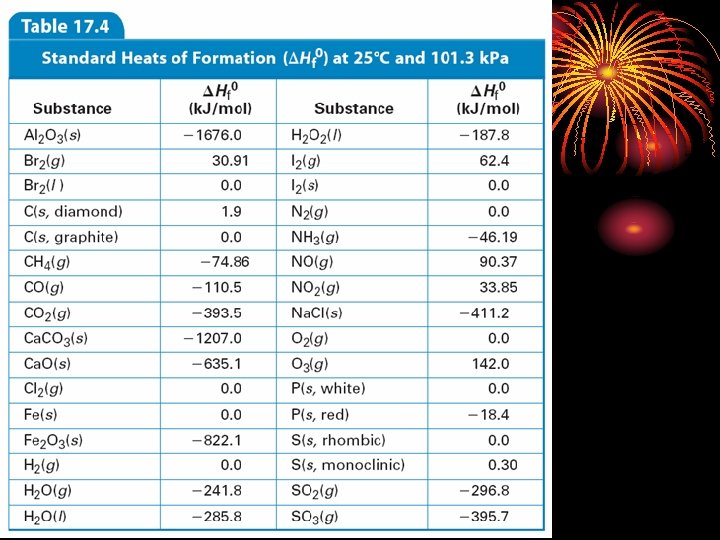
17. 4
17. 4 Standard Heats of Formation • The Standard Heat of Formation of Water
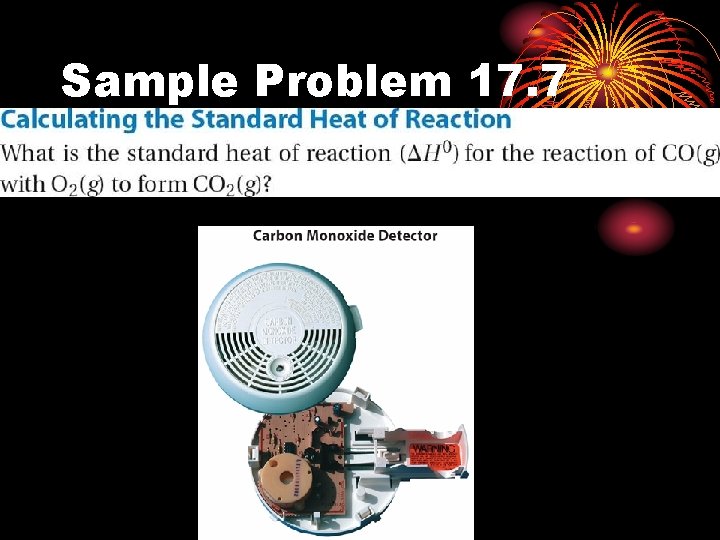
Sample Problem 17. 7
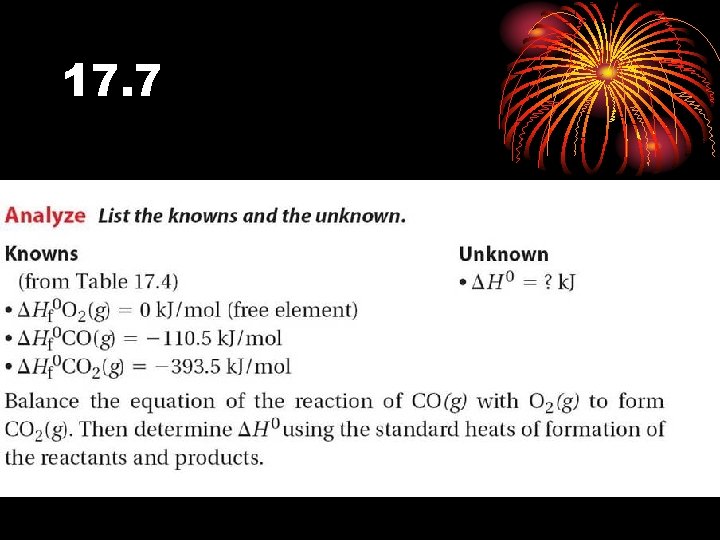
17. 7
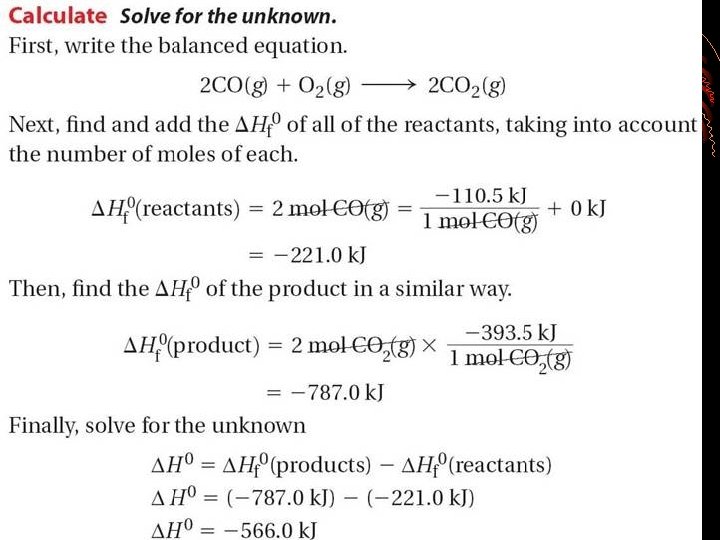
17. 7
17. 4 Standard Heats of Formation
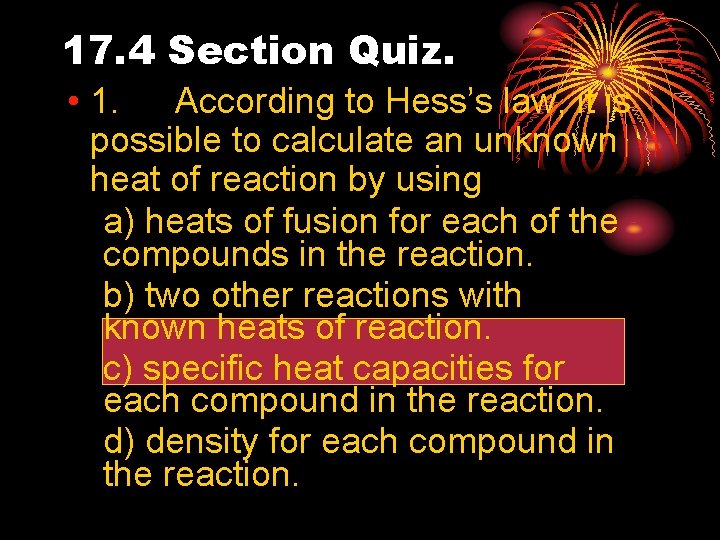
17. 4 Section Quiz. • 1. According to Hess’s law, it is possible to calculate an unknown heat of reaction by using a) heats of fusion for each of the compounds in the reaction. b) two other reactions with known heats of reaction. c) specific heat capacities for each compound in the reaction. d) density for each compound in the reaction.
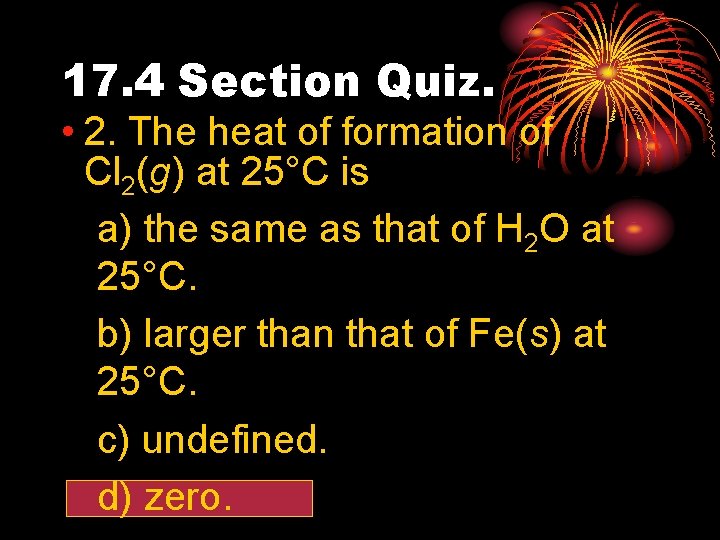
17. 4 Section Quiz. • 2. The heat of formation of Cl 2(g) at 25°C is a) the same as that of H 2 O at 25°C. b) larger than that of Fe(s) at 25°C. c) undefined. d) zero.
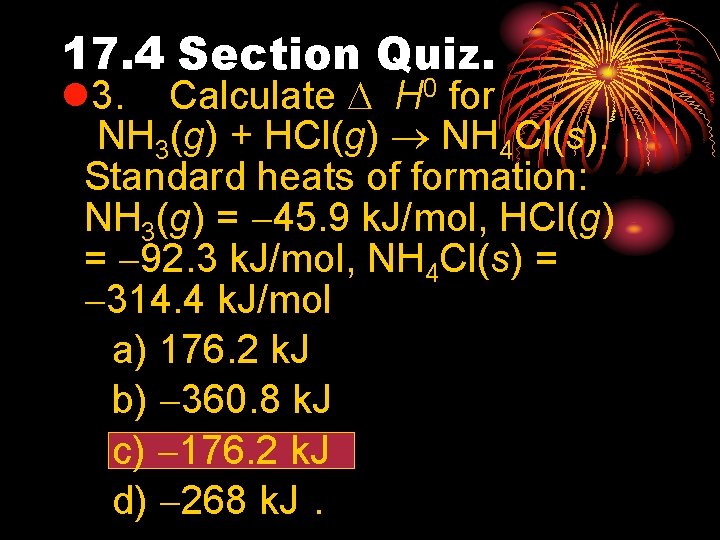
17. 4 Section Quiz. l 3. Calculate H 0 for NH 3(g) + HCl(g) NH 4 Cl(s). Standard heats of formation: NH 3(g) = 45. 9 k. J/mol, HCl(g) = 92. 3 k. J/mol, NH 4 Cl(s) = 314. 4 k. J/mol a) 176. 2 k. J b) 360. 8 k. J c) 176. 2 k. J d) 268 k. J.