
Chapter 17 The Special Senses Clicker Questions 2015

- Slides: 53
Chapter 17 The Special Senses Clicker Questions © 2015 Pearson Education, Inc.
Which type of lingual papillae DOES NOT contain taste buds? What is their function? a. circumvallate papillae; perception of water molecules b. umami papillae; perception of glutamate c. filiform papillae; provide friction d. fungiform papillae; appreciation of texture © 2015 Pearson Education, Inc.
Which type of lingual papillae DOES NOT contain taste buds? What is their function? a. circumvallate papillae; perception of water molecules b. umami papillae; perception of glutamate c. filiform papillae; provide friction d. fungiform papillae; appreciation of texture © 2015 Pearson Education, Inc.
What is unique about the sense of smell when compared to other special senses? a. Olfaction travels along only one large cranial nerve. b. Olfactory stimulation is the only type of sensory information that reaches the cerebral cortex directly. c. Olfactory postganglionic nerve fibers run through the cribriform plate of the ethmoid bone. d. Both B and C are correct. © 2015 Pearson Education, Inc.
What is unique about the sense of smell when compared to other special senses? a. Olfaction travels along only one large cranial nerve. b. Olfactory stimulation is the only type of sensory information that reaches the cerebral cortex directly. c. Olfactory postganglionic nerve fibers run through the cribriform plate of the ethmoid bone. d. Both B and C are correct. © 2015 Pearson Education, Inc.
One of the few examples of neuronal replacement of cells in the adult is found in the a. olfactory receptor population b. olfactory glands c. mucous layer of the olfactory epithelium d. none of the above © 2015 Pearson Education, Inc.
One of the few examples of neuronal replacement of cells in the adult is found in the a. olfactory receptor population b. olfactory glands c. mucous layer of the olfactory epithelium d. none of the above © 2015 Pearson Education, Inc.
Why does the smell of formaldehyde seem to dissipate during the time you spend in the dissection lab, yet you are able to detect the cologne of someone who just entered the lab? a. Olfactory receptors are destroyed by formaldehyde. b. Olfactory receptors adapt to the smell of formaldehyde. c. Central adaptation has occurred, though olfactory receptors retain sensitivity to other smells. d. None of the above is correct. © 2015 Pearson Education, Inc.
Why does the smell of formaldehyde seem to dissipate during the time you spend in the dissection lab, yet you are able to detect the cologne of someone who just entered the lab? a. Olfactory receptors are destroyed by formaldehyde. b. Olfactory receptors adapt to the smell of formaldehyde. c. Central adaptation has occurred, though olfactory receptors retain sensitivity to other smells. d. None of the above is correct. © 2015 Pearson Education, Inc.
Which of these correctly describes the pathway taste sensations would take, starting at the tongue? a. CNs VII, IX, and X ➔ synapse in medulla ➔ synapse in thalamus ➔ primary sensory cortex b. Synapse in medulla ➔ CNs VII, IX, X ➔ medial lemniscus ➔ gustatory cortex ➔ synapse in thalamus c. Tongue ➔ CNs VII and IX ➔ synapse in pons ➔ CN V synapse in thalamus ➔ primary sensory cortex d. None of the above is correct. © 2015 Pearson Education, Inc.
Which of these correctly describes the pathway taste sensations would take, starting at the tongue? a. CNs VII, IX, and X ➔ synapse in medulla ➔ synapse in thalamus ➔ primary sensory cortex b. Synapse in medulla ➔ CNs VII, IX, X ➔ medial lemniscus ➔ gustatory cortex ➔ synapse in thalamus c. Tongue ➔ CNs VII and IX ➔ synapse in pons ➔ CN V synapse in thalamus ➔ primary sensory cortex d. None of the above is correct. © 2015 Pearson Education, Inc.
Visual information from the left half of the combined field of vision arrives at the a. visual cortex of the right occipital lobe b. superior colliculus on the right side c. visual cortex of the left occipital lobe d. superior colliculus on the left side © 2015 Pearson Education, Inc.
Visual information from the left half of the combined field of vision arrives at the a. visual cortex of the right occipital lobe b. superior colliculus on the right side c. visual cortex of the left occipital lobe d. superior colliculus on the left side © 2015 Pearson Education, Inc.
A loss of transparency in the _____ would result in ______. a. cornea; conjunctivitis b. iris; glaucoma c. lens; cataract d. none of the above © 2015 Pearson Education, Inc.
A loss of transparency in the _____ would result in ______. a. cornea; conjunctivitis b. iris; glaucoma c. lens; cataract d. none of the above © 2015 Pearson Education, Inc.
Why are rods best suited for night vision? a. Rods have a low threshold for activation. b. Rods are primarily located within the fovea. c. Rods participate in converging pathways. d. Rods contain several visual pigments. © 2015 Pearson Education, Inc.
Why are rods best suited for night vision? a. Rods have a low threshold for activation. b. Rods are primarily located within the fovea. c. Rods participate in converging pathways. d. Rods contain several visual pigments. © 2015 Pearson Education, Inc.
What processes take place for the lens of your eye to become rounder to focus on nearby objects? a. Ciliary muscles relax, and suspensory ligaments pull at the circumference of the lens. b. New fibers are added to the lens, increasing its refractive power. c. Ciliary muscles contract, which reduces tension on the suspensory ligaments. d. The distance between the lens and the macula lutea changes, which keeps focal length constant. © 2015 Pearson Education, Inc.
What processes take place for the lens of your eye to become rounder to focus on nearby objects? a. Ciliary muscles relax, and suspensory ligaments pull at the circumference of the lens. b. New fibers are added to the lens, increasing its refractive power. c. Ciliary muscles contract, which reduces tension on the suspensory ligaments. d. The distance between the lens and the macula lutea changes, which keeps focal length constant. © 2015 Pearson Education, Inc.
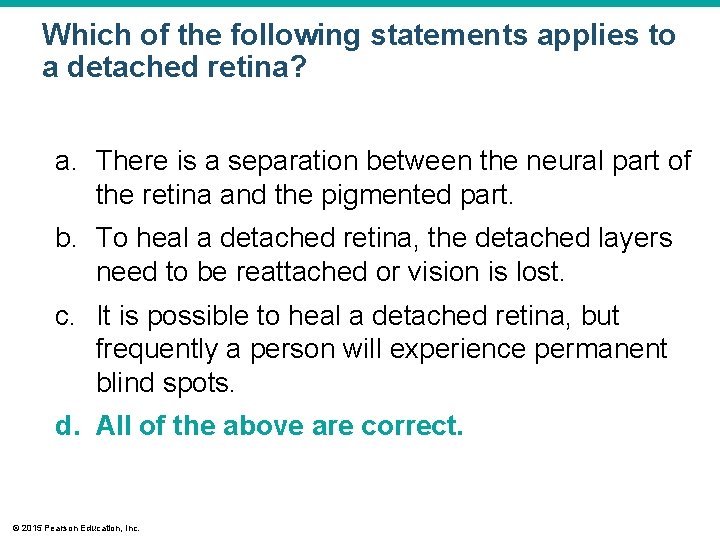
Which of the following statements applies to a detached retina? a. There is a separation between the neural part of the retina and the pigmented part. b. To heal a detached retina, the detached layers need to be reattached or vision is lost. c. It is possible to heal a detached retina, but frequently a person will experience permanent blind spots. d. All of the above are correct. © 2015 Pearson Education, Inc.
Which of the following statements applies to a detached retina? a. There is a separation between the neural part of the retina and the pigmented part. b. To heal a detached retina, the detached layers need to be reattached or vision is lost. c. It is possible to heal a detached retina, but frequently a person will experience permanent blind spots. d. All of the above are correct. © 2015 Pearson Education, Inc.
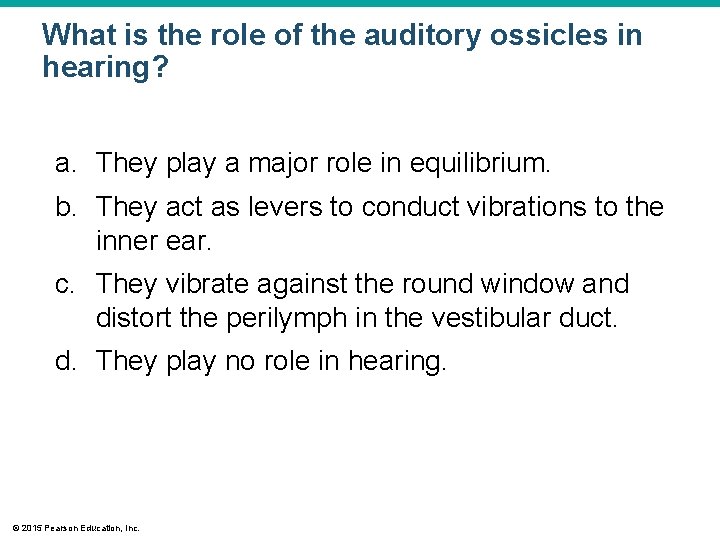
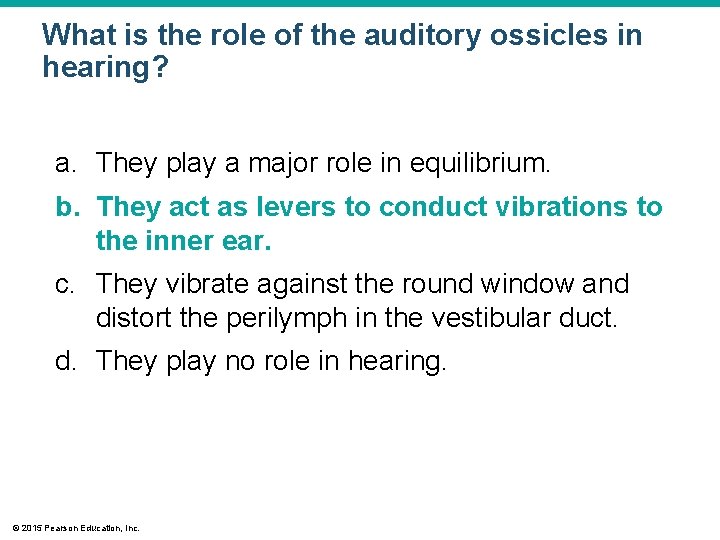
What is the role of the auditory ossicles in hearing? a. They play a major role in equilibrium. b. They act as levers to conduct vibrations to the inner ear. c. They vibrate against the round window and distort the perilymph in the vestibular duct. d. They play no role in hearing. © 2015 Pearson Education, Inc.
What is the role of the auditory ossicles in hearing? a. They play a major role in equilibrium. b. They act as levers to conduct vibrations to the inner ear. c. They vibrate against the round window and distort the perilymph in the vestibular duct. d. They play no role in hearing. © 2015 Pearson Education, Inc.
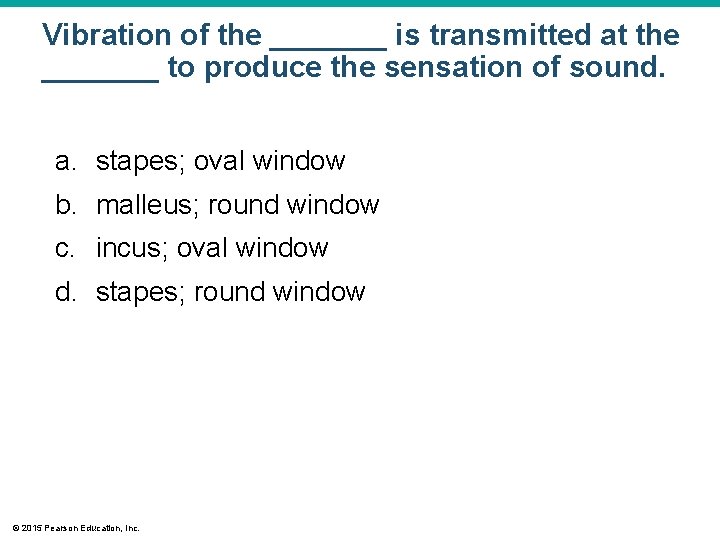
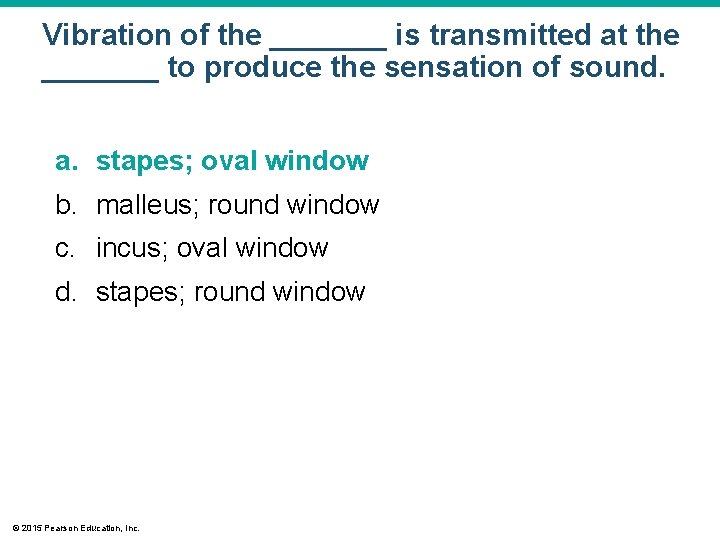
Vibration of the _______ is transmitted at the _______ to produce the sensation of sound. a. stapes; oval window b. malleus; round window c. incus; oval window d. stapes; round window © 2015 Pearson Education, Inc.
Vibration of the _______ is transmitted at the _______ to produce the sensation of sound. a. stapes; oval window b. malleus; round window c. incus; oval window d. stapes; round window © 2015 Pearson Education, Inc.
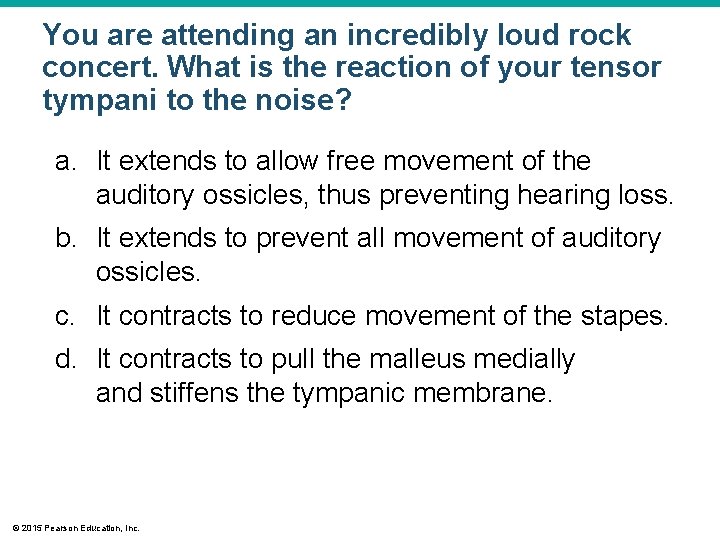
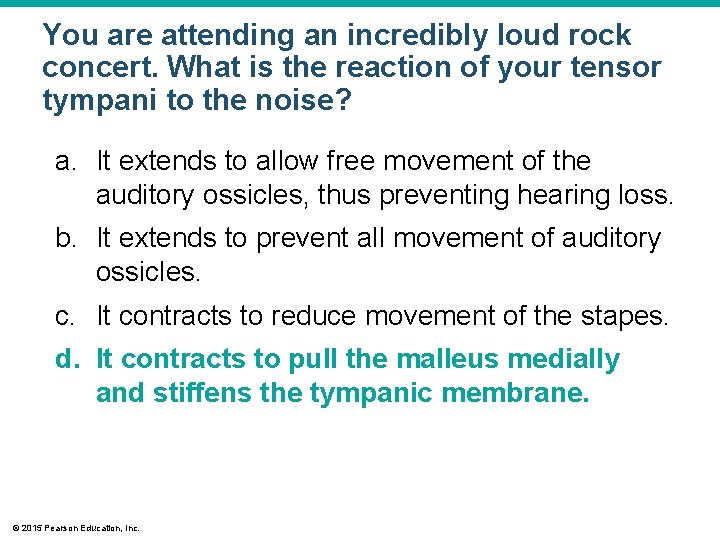
You are attending an incredibly loud rock concert. What is the reaction of your tensor tympani to the noise? a. It extends to allow free movement of the auditory ossicles, thus preventing hearing loss. b. It extends to prevent all movement of auditory ossicles. c. It contracts to reduce movement of the stapes. d. It contracts to pull the malleus medially and stiffens the tympanic membrane. © 2015 Pearson Education, Inc.
You are attending an incredibly loud rock concert. What is the reaction of your tensor tympani to the noise? a. It extends to allow free movement of the auditory ossicles, thus preventing hearing loss. b. It extends to prevent all movement of auditory ossicles. c. It contracts to reduce movement of the stapes. d. It contracts to pull the malleus medially and stiffens the tympanic membrane. © 2015 Pearson Education, Inc.
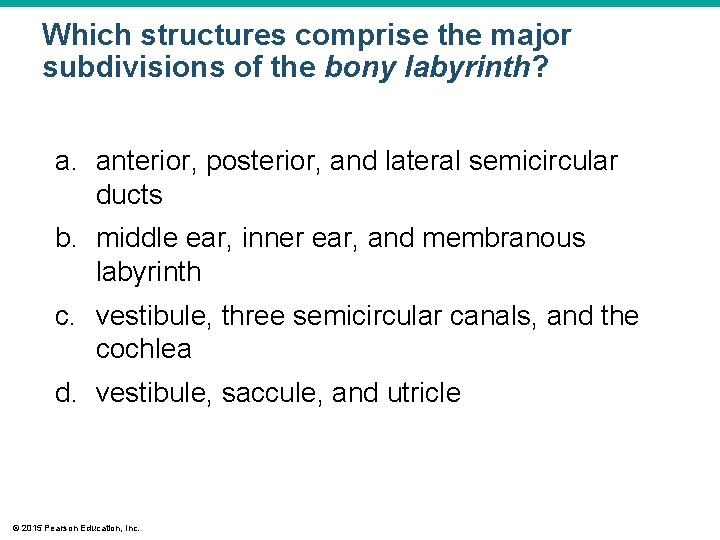
Which structures comprise the major subdivisions of the bony labyrinth? a. anterior, posterior, and lateral semicircular ducts b. middle ear, inner ear, and membranous labyrinth c. vestibule, three semicircular canals, and the cochlea d. vestibule, saccule, and utricle © 2015 Pearson Education, Inc.
Which structures comprise the major subdivisions of the bony labyrinth? a. anterior, posterior, and lateral semicircular ducts b. middle ear, inner ear, and membranous labyrinth c. vestibule, three semicircular canals, and the cochlea d. vestibule, saccule, and utricle © 2015 Pearson Education, Inc.
Where are the sensory receptors that respond to rotational movements of the head? a. in the utricle and saccule b. in the anterior, posterior, and lateral semicircular ducts c. in the cochlear duct d. in the vestibular duct and tympanic duct © 2015 Pearson Education, Inc.
Where are the sensory receptors that respond to rotational movements of the head? a. in the utricle and saccule b. in the anterior, posterior, and lateral semicircular ducts c. in the cochlear duct d. in the vestibular duct and tympanic duct © 2015 Pearson Education, Inc.
Which of the following is correct concerning the function of the uvea (vascular layer)? a. It stabilizes the shape of the eye and produces collagen fibers. b. It provides the route for the optic nerve and blood vessels to the eye itself. c. It regulates the amount of light entering the eye. d. It secretes and reabsorbs vitreous humor. © 2015 Pearson Education, Inc.
Which of the following is correct concerning the function of the uvea (vascular layer)? a. It stabilizes the shape of the eye and produces collagen fibers. b. It provides the route for the optic nerve and blood vessels to the eye itself. c. It regulates the amount of light entering the eye. d. It secretes and reabsorbs vitreous humor. © 2015 Pearson Education, Inc.
Which of the following statements correctly describes the location of rods and cones on the retina? a. Rods are located in the macula lutea, but only cones are located in the fovea. b. Cones are located at the periphery of the retina, rods at the center. c. Rods and cones are evenly distributed on the retina. d. Cones are located at the center of the retina, rods at the periphery. © 2015 Pearson Education, Inc.
Which of the following statements correctly describes the location of rods and cones on the retina? a. Rods are located in the macula lutea, but only cones are located in the fovea. b. Cones are located at the periphery of the retina, rods at the center. c. Rods and cones are evenly distributed on the retina. d. Cones are located at the center of the retina, rods at the periphery. © 2015 Pearson Education, Inc.
Vitamin A is used to synthesize which component of rhodopsin? a. opsin b. retinal c. beta-carotene d. retinoic acid © 2015 Pearson Education, Inc.
Vitamin A is used to synthesize which component of rhodopsin? a. opsin b. retinal c. beta-carotene d. retinoic acid © 2015 Pearson Education, Inc.
At which interface in the human eye is refraction the greatest? a. between air and the cornea b. between aqueous humor and the lens c. between the lens and the vitreous body d. between the vitreous body and the retina © 2015 Pearson Education, Inc.
At which interface in the human eye is refraction the greatest? a. between air and the cornea b. between aqueous humor and the lens c. between the lens and the vitreous body d. between the vitreous body and the retina © 2015 Pearson Education, Inc.
Why can corneal transplant surgeries be performed between unrelated individuals without the risk of rejection? a. White blood cells rush to the new cornea to fight off infection. b. There are no blood vessels in the cornea, so white blood cells cannot attack the foreign tissue. c. Aqueous humor contains powerful antibiotics. d. None of the above is correct. © 2015 Pearson Education, Inc.
Why can corneal transplant surgeries be performed between unrelated individuals without the risk of rejection? a. White blood cells rush to the new cornea to fight off infection. b. There are no blood vessels in the cornea, so white blood cells cannot attack the foreign tissue. c. Aqueous humor contains powerful antibiotics. d. None of the above is correct. © 2015 Pearson Education, Inc.
The sensation of flavor is due primarily to a. gustatory sensation b. olfactory sensation c. auditory sensation d. none of the above © 2015 Pearson Education, Inc.
The sensation of flavor is due primarily to a. gustatory sensation b. olfactory sensation c. auditory sensation d. none of the above © 2015 Pearson Education, Inc.
Which of the following describes the intensity of a sound? a. voltage b. pitch c. frequency d. amplitude © 2015 Pearson Education, Inc.
Which of the following describes the intensity of a sound? a. voltage b. pitch c. frequency d. amplitude © 2015 Pearson Education, Inc.
When aqueous humor cannot drain into the scleral venous sinus, _______ results. a. retinitis pigmentosa b. age-related macular degeneration c. glaucoma d. loss of depth perception © 2015 Pearson Education, Inc.
When aqueous humor cannot drain into the scleral venous sinus, _______ results. a. retinitis pigmentosa b. age-related macular degeneration c. glaucoma d. loss of depth perception © 2015 Pearson Education, Inc.
How does vitamin A deficiency affect vision? a. Photoreceptors are destroyed causing blindness within a few years. b. The amount of visual pigment in photoreceptors declines, causing poor night vision. c. The ability of the eyes to accommodate for distance vision decreases. d. Pupillary reflexes and reflexive eye movement are lost. © 2015 Pearson Education, Inc.
How does vitamin A deficiency affect vision? a. Photoreceptors are destroyed causing blindness within a few years. b. The amount of visual pigment in photoreceptors declines, causing poor night vision. c. The ability of the eyes to accommodate for distance vision decreases. d. Pupillary reflexes and reflexive eye movement are lost. © 2015 Pearson Education, Inc.
Low-frequency sounds vibrate the basilar membrane _____ because _____. a. near the round window; perilymph is incompressible b. near the oval window; of shorter wavelength c. far from the oval window; of longer wavelength d. against the tectorial membrane; pressure waves are created in endolymph of the vestibular duct © 2015 Pearson Education, Inc.
Low-frequency sounds vibrate the basilar membrane _____ because _____. a. near the round window; perilymph is incompressible b. near the oval window; of shorter wavelength c. far from the oval window; of longer wavelength d. against the tectorial membrane; pressure waves are created in endolymph of the vestibular duct © 2015 Pearson Education, Inc.
What is the survival value of being more sensitive to sour and bitter tastes than to sweet and salty ones? a. Sour acids can damage mucous membranes. b. Many potent toxins have a bitter taste. c. Sweet and salty tastes are pleasant, and therefore good for you. d. A and B are correct. © 2015 Pearson Education, Inc.
What is the survival value of being more sensitive to sour and bitter tastes than to sweet and salty ones? a. Sour acids can damage mucous membranes. b. Many potent toxins have a bitter taste. c. Sweet and salty tastes are pleasant, and therefore good for you. d. A and B are correct. © 2015 Pearson Education, Inc.