
Chapter 17 The Neuromuscular System Joseph E Muscolino
- Slides: 58
Chapter 17: The Neuromuscular System Joseph E. Muscolino, DC Copyright © 2011, 2007 by Mosby, Inc. , an affiliate of Elsevier Inc. All rights reserved. 1
Reflection • http: //www. bing. com/videos/search? q=pinky%20 and%20 the %20 brain%20 neuroanatomy&FORM=HDRSC 3&adlt=strict#vie w=detail&mid=507 E 8427 FEF 1 BEA 18 E 99 2 Copyright © 2011, 2007 by Mosby, Inc. , an affiliate of Elsevier Inc. All rights reserved. 2
Lesson 17. 1 Objectives • Define the key terms of this chapter and state the meanings of the word origins of this chapter. • Compare and contrast sensory, integrative, and motor neurons. • Describe the structural and functional classifications of the nervous system. Copyright © 2011, 2007 by Mosby, Inc. , an affiliate of Elsevier Inc. All rights reserved. 3
Lesson 17. 1 Objectives (cont’d. ) • Compare and contrast the neuronal pathways for the initiation of voluntary movement and a spinal cord reflex. • Describe the difference between true reflexive behavior and learned/patterned behavior. • Describe the relationship between neural facilitation and resting muscle tone. Copyright © 2011, 2007 by Mosby, Inc. , an affiliate of Elsevier Inc. All rights reserved. 4
Lesson 17. 1 Objectives (cont’d. ) • Describe the neuronal pathways for and the purpose of reciprocal inhibition. • Describe how reciprocal inhibition can be used to aid muscle palpation and muscle stretching. Copyright © 2011, 2007 by Mosby, Inc. , an affiliate of Elsevier Inc. All rights reserved. 5
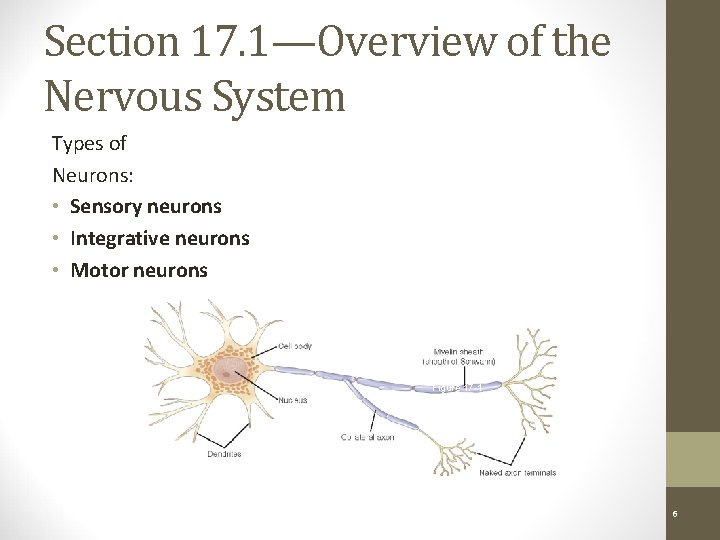
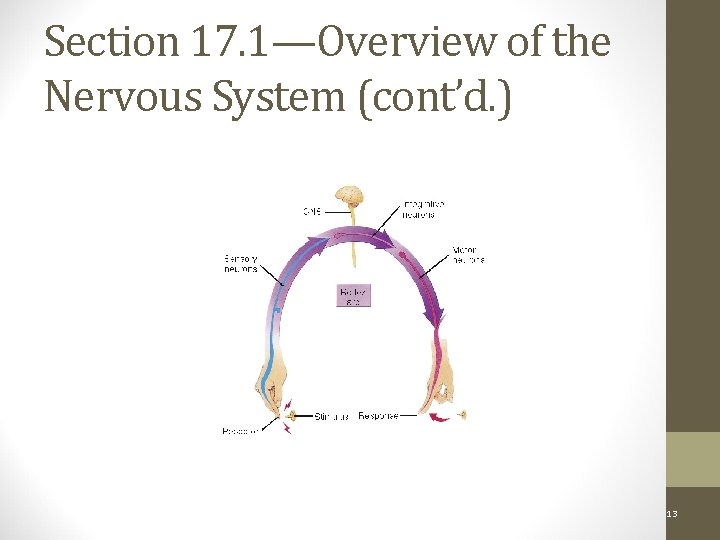
Section 17. 1—Overview of the Nervous System Types of Neurons: • Sensory neurons • Integrative neurons • Motor neurons Figure 17 -1 Copyright © 2011, 2007 by Mosby, Inc. , an affiliate of Elsevier Inc. All rights reserved. 6
• Neuron- carries nerve impulse (electrical signal) • = dendrites, cell body, axon • Dendrites- carry nerve impulse toward cell body • Axon- carries nerve impulses away from the cell body • Sensory Neuron (afferent neurons)- carries sensory stimulus • Integrative neuron- integrates/processes the sensory stimuli received from sensory neurons • Motor neuron (efferent neurons)- carries a message that directs a muscle to contract 7 Copyright © 2011, 2007 by Mosby, Inc. , an affiliate of Elsevier Inc. All rights reserved. 7
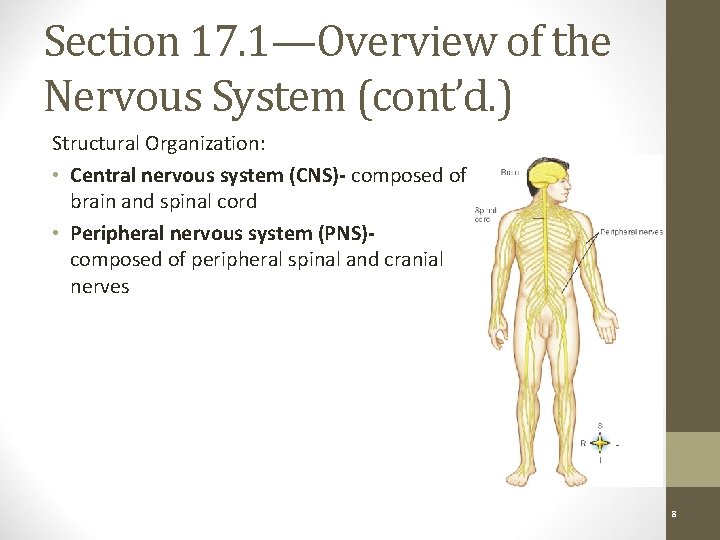
Section 17. 1—Overview of the Nervous System (cont’d. ) Structural Organization: • Central nervous system (CNS)- composed of brain and spinal cord • Peripheral nervous system (PNS)composed of peripheral spinal and cranial nerves Figure 17 -2 Modified from Patton KT, Thibodeau GA: Anatomy and physiology, ed 7, St Louis, 2010, Mosby Copyright © 2011, 2007 by Mosby, Inc. , an affiliate of Elsevier Inc. All rights reserved. 8
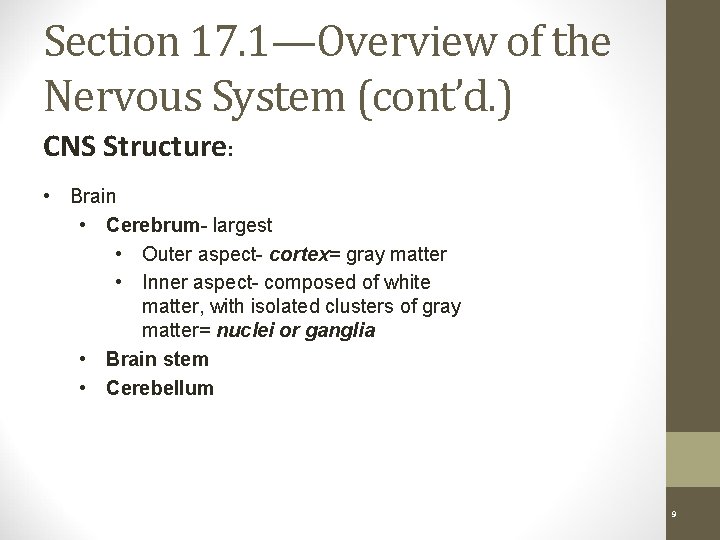
Section 17. 1—Overview of the Nervous System (cont’d. ) CNS Structure: • Brain • Spinal cord • Cerebrum- largest – White matter • Outer aspect- cortex= gray matter • Inner aspect- composed of white – Gray matter, with isolated clusters of gray matter= nuclei or ganglia • Brain stem • Cerebellum Copyright © 2011, 2007 by Mosby, Inc. , an affiliate of Elsevier Inc. All rights reserved. 9
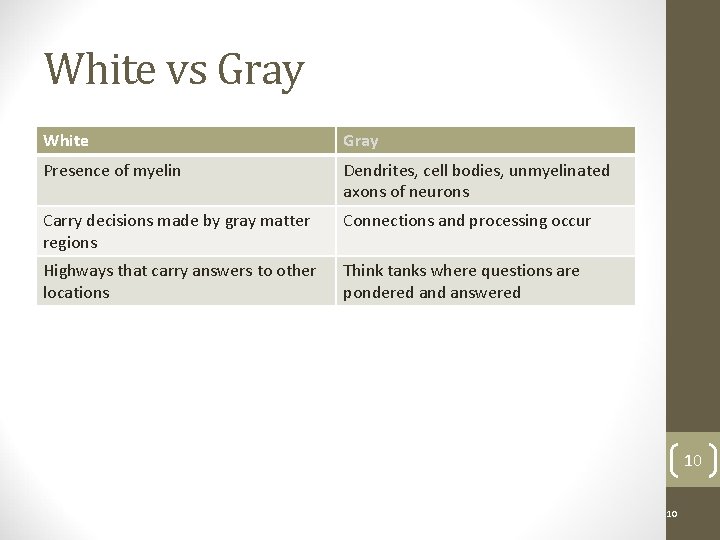
White vs Gray White Gray Presence of myelin Dendrites, cell bodies, unmyelinated axons of neurons Carry decisions made by gray matter regions Connections and processing occur Highways that carry answers to other locations Think tanks where questions are pondered answered 10 Copyright © 2011, 2007 by Mosby, Inc. , an affiliate of Elsevier Inc. All rights reserved. 10
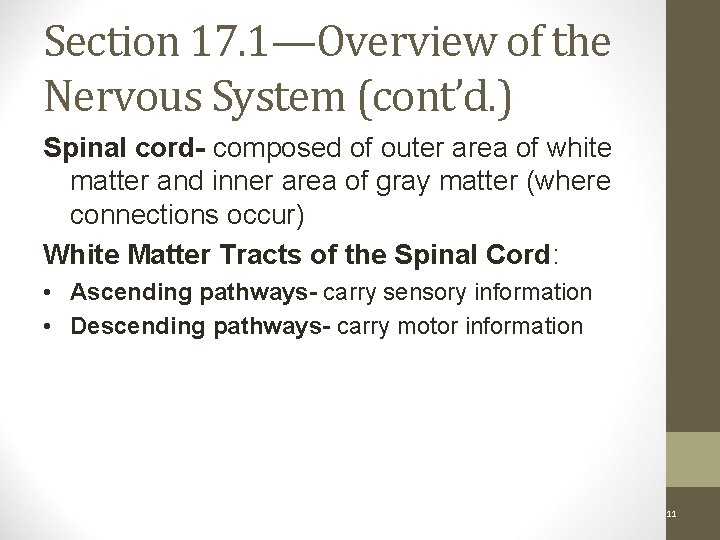
Section 17. 1—Overview of the Nervous System (cont’d. ) Spinal cord- composed of outer area of white matter and inner area of gray matter (where connections occur) White Matter Tracts of the Spinal Cord: • Ascending pathways- carry sensory information • Descending pathways- carry motor information Copyright © 2011, 2007 by Mosby, Inc. , an affiliate of Elsevier Inc. All rights reserved. 11
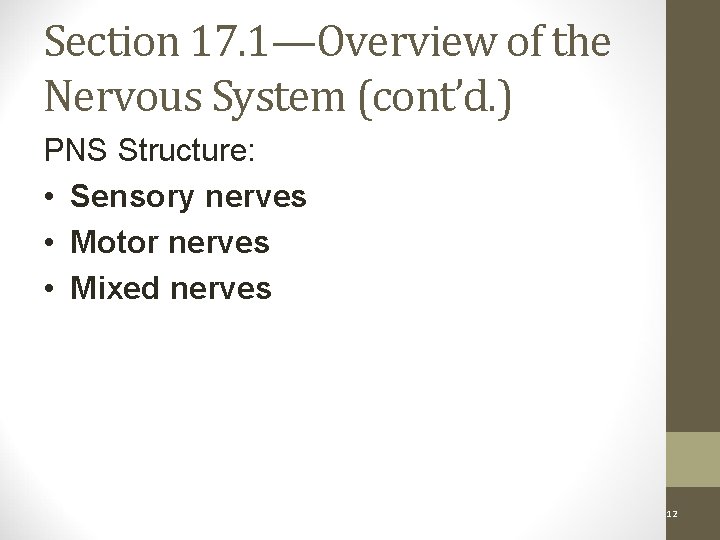
Section 17. 1—Overview of the Nervous System (cont’d. ) PNS Structure: • Sensory nerves • Motor nerves • Mixed nerves Copyright © 2011, 2007 by Mosby, Inc. , an affiliate of Elsevier Inc. All rights reserved. 12
Section 17. 1—Overview of the Nervous System (cont’d. ) Function of the Nervous System: Figure 17 -3 Modified from Patton KT, Thibodeau GA: Anatomy and physiology, ed 7, St Louis, 2010, Mosby Copyright © 2011, 2007 by Mosby, Inc. , an affiliate of Elsevier Inc. All rights reserved. 13
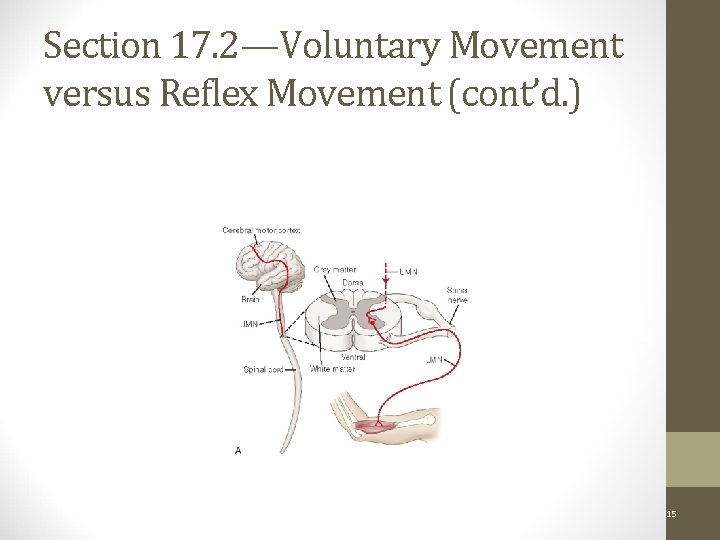
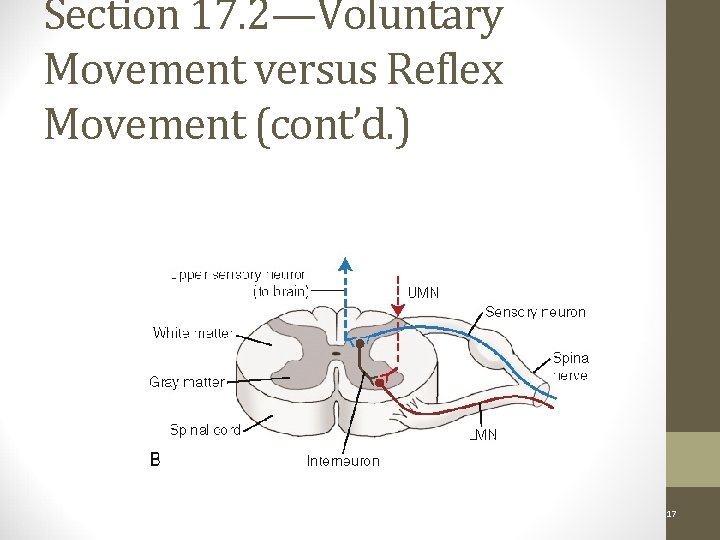
Section 17. 2—Voluntary Movement versus Reflex Movement Voluntary Movement: • Cerebral motor cortex- receives decision that joint action will be made. Initiated from integration and processing of sensory stimuli. • Upper motor neuron (UMN)- travels down in a descending white matter tract • Lower motor neuron (LMN)- within gray matter of spinal cord Copyright © 2011, 2007 by Mosby, Inc. , an affiliate of Elsevier Inc. All rights reserved. 14
Section 17. 2—Voluntary Movement versus Reflex Movement (cont’d. ) Voluntary Movement Pathways: Figure 17 -2 Copyright © 2011, 2007 by Mosby, Inc. , an affiliate of Elsevier Inc. All rights reserved. 15
Section 17. 2—Voluntary Movement versus Reflex Movement (cont’d. ) Reflex Movement: • Sensory neuron- entry of sensory stimulus • Interneuron • Lower motor neuron (LMN)- synapses directly with LMN or interneuron first • Pathway of reflex is called reflex arc • Reflexes are innate- protective in nature • Ex: startle reflex causes a child to turn toward the source of any loud noise which brings attention to potentially dangerous stimuli Copyright © 2011, 2007 by Mosby, Inc. , an affiliate of Elsevier Inc. All rights reserved. 16
Section 17. 2—Voluntary Movement versus Reflex Movement (cont’d. ) Simple Reflex Arc: Figure 17 -4 Copyright © 2011, 2007 by Mosby, Inc. , an affiliate of Elsevier Inc. All rights reserved. 17
Section 17. 2—Voluntary Movement versus Reflex Movement (cont’d. ) Learned/Patterned Behavior: • No reflex arc • Association within brain between certain stimulus and certain response • Involves many repetitions Copyright © 2011, 2007 by Mosby, Inc. , an affiliate of Elsevier Inc. All rights reserved. 18
Section 17. 2—Voluntary Movement versus Reflex Movement (cont’d. ) Neural Facilitation- why learned behaviors become so rooted in our nervous system • Due to physical changes in pathways of neurons • Can affect resting tone of muscles • Client’s resting tone may increase in stressful circumstances- we must help client’s nervous system unlearn a certain pattern of response. Copyright © 2011, 2007 by Mosby, Inc. , an affiliate of Elsevier Inc. All rights reserved. 19
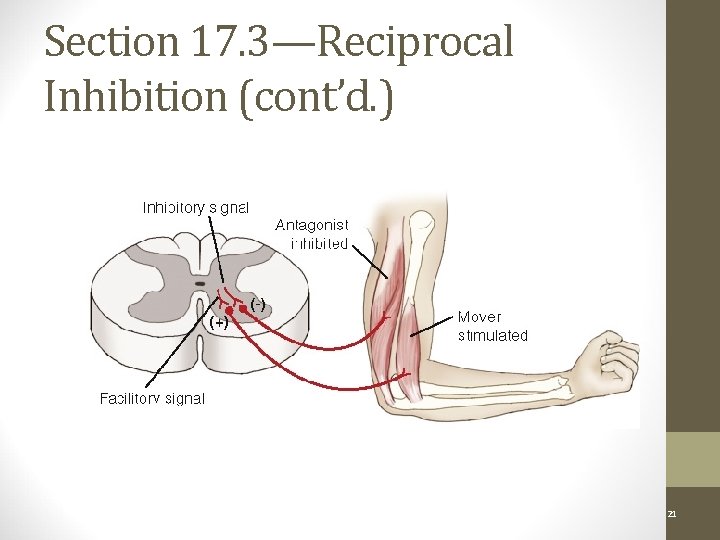
Section 17. 3—Reciprocal Inhibition Name given to the neurological reflex that causes the antagonist to a joint action to relax when the mover of that joint action is directed to contract. • Facilitory impulses (to mover) • Inhibitory impulses (to antagonist) • Both impulses are sent to LMNs of movers and antagonists Copyright © 2011, 2007 by Mosby, Inc. , an affiliate of Elsevier Inc. All rights reserved. 20
Section 17. 3—Reciprocal Inhibition (cont’d. ) Neuronal Pathways: Figure 17 -5 Copyright © 2011, 2007 by Mosby, Inc. , an affiliate of Elsevier Inc. All rights reserved. 21
Section 17. 3—Reciprocal Inhibition (cont’d. ) Muscle Palpation: • Involves identifying target muscle • Reciprocal inhibition useful in isolating target muscle Muscle Stretching: • Active isolated stretching-client contracts the movers, which relaxes the antagonistsagonist contract stretching • Reciprocal inhibition increases effectiveness Copyright © 2011, 2007 by Mosby, Inc. , an affiliate of Elsevier Inc. All rights reserved. 22
Lesson 17. 2 Objectives • Define and discuss proprioception. • List the three major categories of proprioceptors and the specific proprioceptors found in each major category. • Compare and contrast the function of Pacini’s corpuscles and Ruffini’s endings. Copyright © 2011, 2007 by Mosby, Inc. , an affiliate of Elsevier Inc. All rights reserved. 23
Lesson 17. 2 Objectives (cont’d. ) • Discuss the concept of muscle facilitation and muscle inhibition. • Discuss the differences (including implications for treatment) between trigger points and global tightening of a muscle. Copyright © 2011, 2007 by Mosby, Inc. , an affiliate of Elsevier Inc. All rights reserved. 24
Lesson 17. 2 Objectives (cont’d. ) • Compare and contrast the neuronal pathway mechanism and the function of muscle spindles and Golgi tendon organs. • Discuss the relationship between muscle spindles, Golgi tendon organs, and muscle stretching. Copyright © 2011, 2007 by Mosby, Inc. , an affiliate of Elsevier Inc. All rights reserved. 25
Section 17. 4—Overview of Proprioception: The 6 th sense • Ability of nervous system to know the body’s position in space and body’s movement through space • Information provided by proprioceptors- receptor cell that is sensitive to a stimulus • Most proprioceptor receptors are called mechanoreceptors because they are sensitive to mechanical pressure stimuli Copyright © 2011, 2007 by Mosby, Inc. , an affiliate of Elsevier Inc. All rights reserved. 26
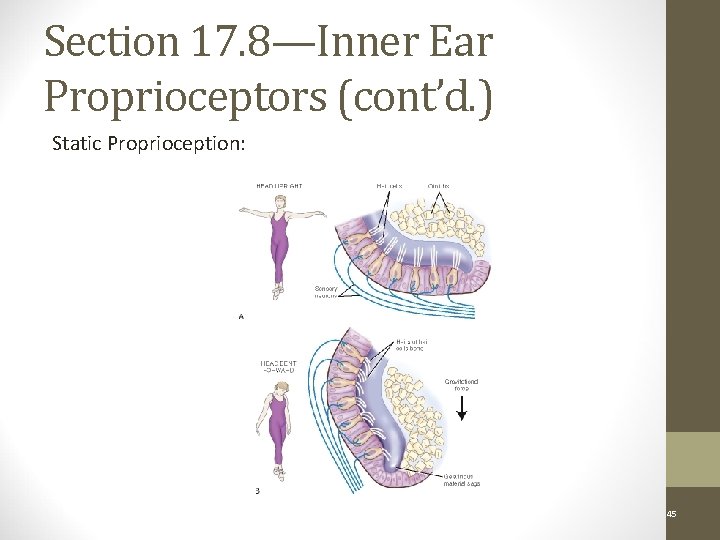
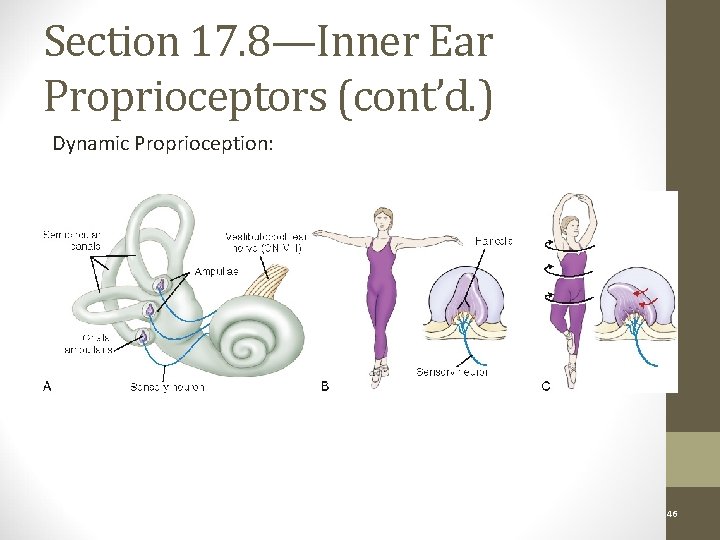
Section 17. 4—Overview of Proprioception (cont’d. ) Types of Proprioceptors: • Fascial/joint proprioceptors- provide info about joint’s static position and dynamic movement- Pacini’s corpuscles and Ruffini’s endings • Muscle proprioceptors- located within the muscle- provide awareness of the position and movement of the body and create reflexes that protect muscles and tendons from injury • Inner ear proprioceptors- provide information about the static position and dynamic movement of the head- equilibrium • Static proprioceptors for head position located in vestibule of inner ear • Dynamic proprioceptors for movement are located in semicircular canals of the inner ear Copyright © 2011, 2007 by Mosby, Inc. , an affiliate of Elsevier Inc. All rights reserved. 27
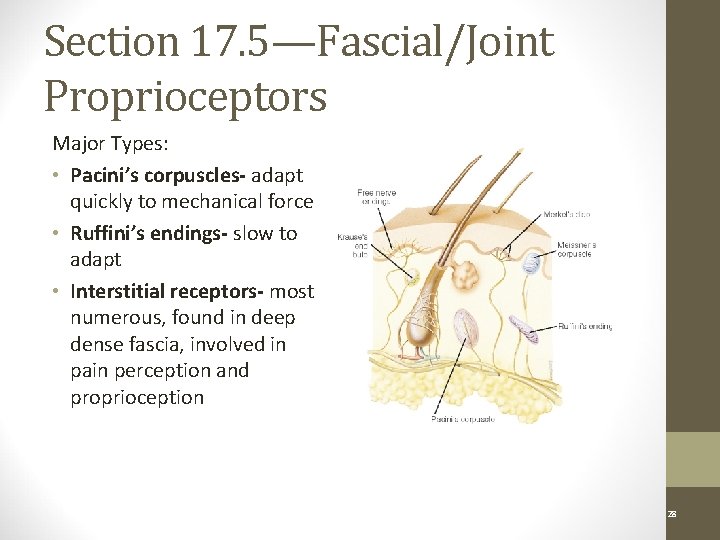
Section 17. 5—Fascial/Joint Proprioceptors Major Types: • Pacini’s corpuscles- adapt quickly to mechanical force • Ruffini’s endings- slow to adapt • Interstitial receptors- most numerous, found in deep dense fascia, involved in pain perception and proprioception Modified from Patton KT, Thibodeau GA: Anatomy and physiology, ed 7, St Louis, 2010, Mosby Copyright © 2011, 2007 by Mosby, Inc. , an affiliate of Elsevier Inc. All rights reserved. 28
Section 17. 6—Muscle Spindles Muscle Proprioceptors: • Muscle spindles- located within a muscle, sensitive to stretch • Sensitive to two aspects of the stretch: • Amount of stretch • Rate and speed of stretch • Golgi tendon organs- located within a tendon of a muscle and is sensitive to a pulling force that is placed on the tendon Copyright © 2011, 2007 by Mosby, Inc. , an affiliate of Elsevier Inc. All rights reserved. 29
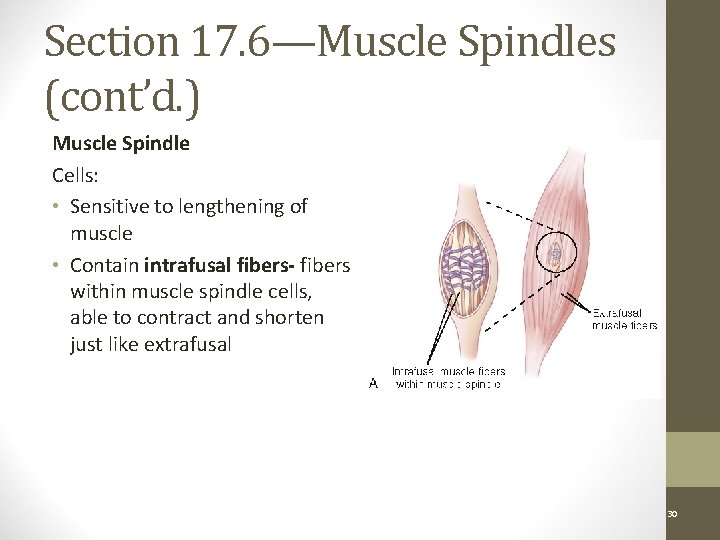
Section 17. 6—Muscle Spindles (cont’d. ) Muscle Spindle Cells: • Sensitive to lengthening of muscle • Contain intrafusal fibers- fibers within muscle spindle cells, able to contract and shorten just like extrafusal Figure 17 -7 Copyright © 2011, 2007 by Mosby, Inc. , an affiliate of Elsevier Inc. All rights reserved. 30
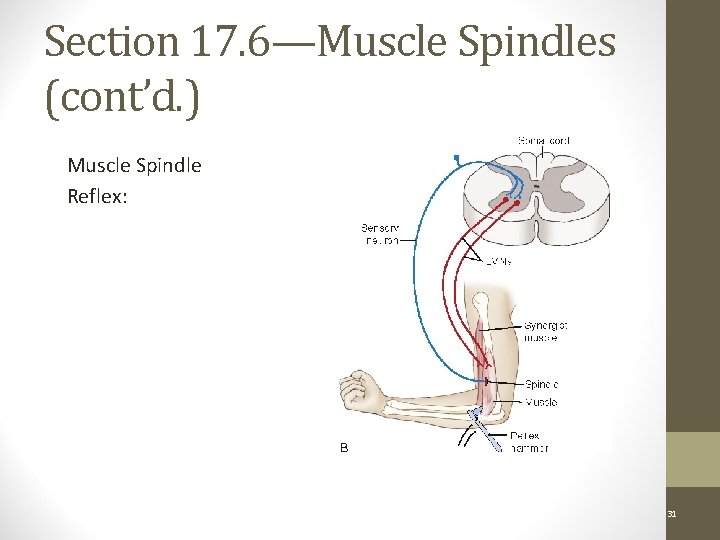
Section 17. 6—Muscle Spindles (cont’d. ) Muscle Spindle Reflex: Figure 17 -7 Copyright © 2011, 2007 by Mosby, Inc. , an affiliate of Elsevier Inc. All rights reserved. 31
Section 17. 6—Muscle Spindles (cont’d. ) Muscle Stretching: • Muscle spindle stretch reflex- protective in nature, prevents a muscle from being overly stretched and torn • Plyometric training- stretch of a muscle immediately followed by a contraction of the same muscle- increases strength of contraction Copyright © 2011, 2007 by Mosby, Inc. , an affiliate of Elsevier Inc. All rights reserved. 32
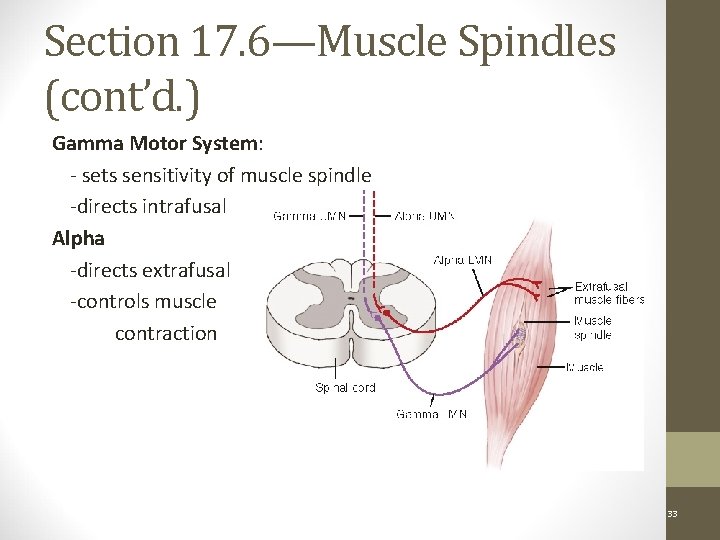
Section 17. 6—Muscle Spindles (cont’d. ) Gamma Motor System: - sets sensitivity of muscle spindle -directs intrafusal Alpha -directs extrafusal -controls muscle contraction Figure 17 -8 Copyright © 2011, 2007 by Mosby, Inc. , an affiliate of Elsevier Inc. All rights reserved. 33
Section 17. 6—Muscle Spindles (cont’d. ) Gamma Motor System and Muscle Tone: • Muscle facilitation- tone is set high, responds and contracts more quickly, muscle tightens more easily • Muscle inhibition- tone is set low, relaxed, less likely to tighten quickly and efficiently when needed Copyright © 2011, 2007 by Mosby, Inc. , an affiliate of Elsevier Inc. All rights reserved. 34
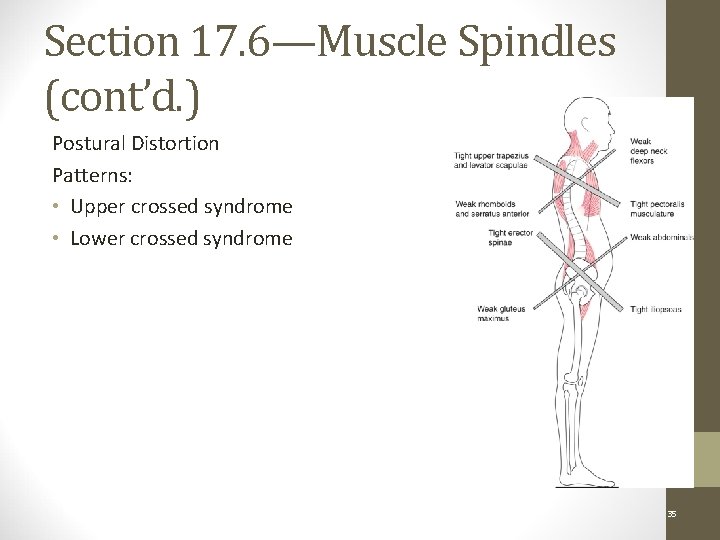
Section 17. 6—Muscle Spindles (cont’d. ) Postural Distortion Patterns: • Upper crossed syndrome • Lower crossed syndrome Modifi ed from Chaitow L, De. Lany JW: Clinical application of neuromuscular techniques, vol 2: The lower body, Edinburgh, 2002, Churchill Livingstone. Copyright © 2011, 2007 by Mosby, Inc. , an affiliate of Elsevier Inc. All rights reserved. 35
Section 17. 6—Muscle Spindles (cont’d. ) Types of Muscle Tightness: • Trigger points- local small areas of hypertonicity • Global tightening- entire muscle Copyright © 2011, 2007 by Mosby, Inc. , an affiliate of Elsevier Inc. All rights reserved. 36
Section 17. 7—Golgi Tendon Organs • • Type of muscle proprioceptor Located within muscle tendons Sensitive to muscle contractions Attached in series to muscle fibers Copyright © 2011, 2007 by Mosby, Inc. , an affiliate of Elsevier Inc. All rights reserved. 37
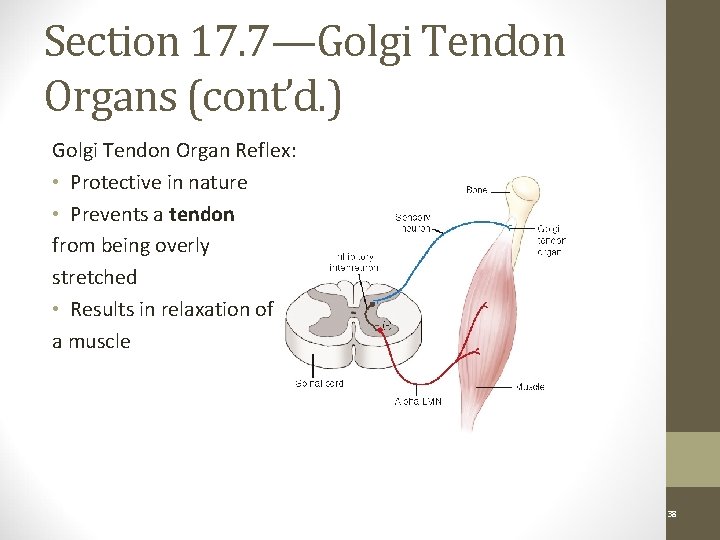
Section 17. 7—Golgi Tendon Organs (cont’d. ) Golgi Tendon Organ Reflex: • Protective in nature • Prevents a tendon from being overly stretched • Results in relaxation of a muscle Figure 17 -8 Copyright © 2011, 2007 by Mosby, Inc. , an affiliate of Elsevier Inc. All rights reserved. 38
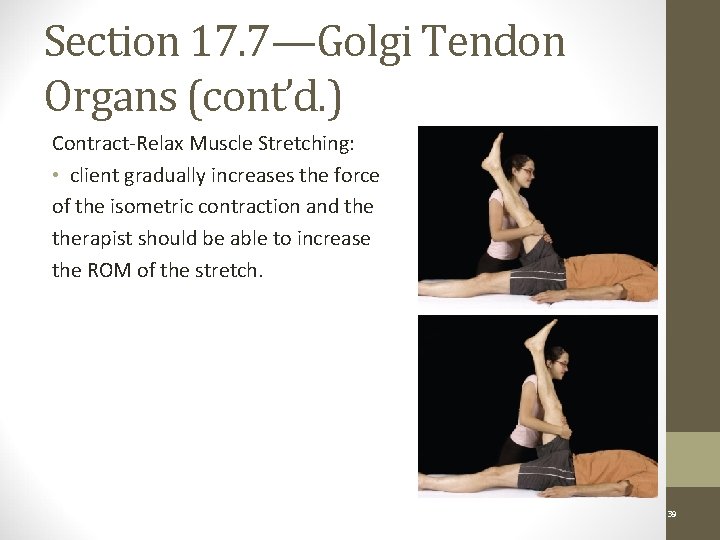
Section 17. 7—Golgi Tendon Organs (cont’d. ) Contract-Relax Muscle Stretching: • client gradually increases the force of the isometric contraction and therapist should be able to increase the ROM of the stretch. Courtesy Joseph E. Muscolino Copyright © 2011, 2007 by Mosby, Inc. , an affiliate of Elsevier Inc. All rights reserved. 39
Section 17. 7—Golgi Tendon Organs (cont’d. ) Muscle Proprioceptor Reflexes: • Muscle spindle reflex • Results in contraction of muscle • Protects muscle • Golgi tendon organ reflex • Results in relaxation of muscle • Protects tendon Copyright © 2011, 2007 by Mosby, Inc. , an affiliate of Elsevier Inc. All rights reserved. 40
Lesson 17. 3 Objectives • Describe the mechanisms and functions of inner ear proprioceptors. • Describe the relationship between inner ear proprioceptors and neck proprioceptors and the implications for bodywork and/or exercise. • Describe the mechanism and purpose of the flexor withdrawal, crossed extensor, tonic neck, righting, and cutaneous reflexes. Copyright © 2011, 2007 by Mosby, Inc. , an affiliate of Elsevier Inc. All rights reserved. 41
Lesson 17. 3 Objectives (cont’d. ) • Discuss the mechanism and importance of bodywork and exercise to the pain-spasm-pain cycle. • Describe the function of muscle splinting and body armoring. • Describe the mechanism of the gate theory, including the implications for bodywork and exercise. Copyright © 2011, 2007 by Mosby, Inc. , an affiliate of Elsevier Inc. All rights reserved. 42
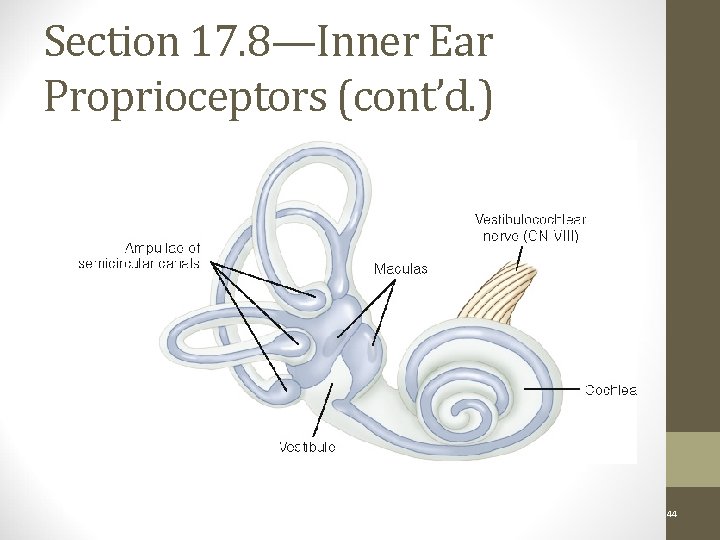
Section 17. 8—Inner Ear Proprioceptors • Provide information on static position and dynamic movement of head • Two types of inner ear proprioceptive organs: • Maculae (static) • Crista ampullaris structures (dynamic) Copyright © 2011, 2007 by Mosby, Inc. , an affiliate of Elsevier Inc. All rights reserved. 43
Section 17. 8—Inner Ear Proprioceptors (cont’d. ) Figure 17 -10 Copyright © 2011, 2007 by Mosby, Inc. , an affiliate of Elsevier Inc. All rights reserved. 44
Section 17. 8—Inner Ear Proprioceptors (cont’d. ) Static Proprioception: Figure 17 -11 Copyright © 2011, 2007 by Mosby, Inc. , an affiliate of Elsevier Inc. All rights reserved. 45
Section 17. 8—Inner Ear Proprioceptors (cont’d. ) Dynamic Proprioception: Figure 17 -12 Copyright © 2011, 2007 by Mosby, Inc. , an affiliate of Elsevier Inc. All rights reserved. 46
Section 17. 8—Inner Ear Proprioceptors (cont’d. ) • Righting reflex keeps head level • Dizziness results when disagreement exists between reports from different proprioceptors Copyright © 2011, 2007 by Mosby, Inc. , an affiliate of Elsevier Inc. All rights reserved. 47
Section 17. 8—Inner Ear Proprioceptors (cont’d. ) Neck Proprioceptors: • Report the posture of the neck • Can be damaged and cause dizziness Copyright © 2011, 2007 by Mosby, Inc. , an affiliate of Elsevier Inc. All rights reserved. 48
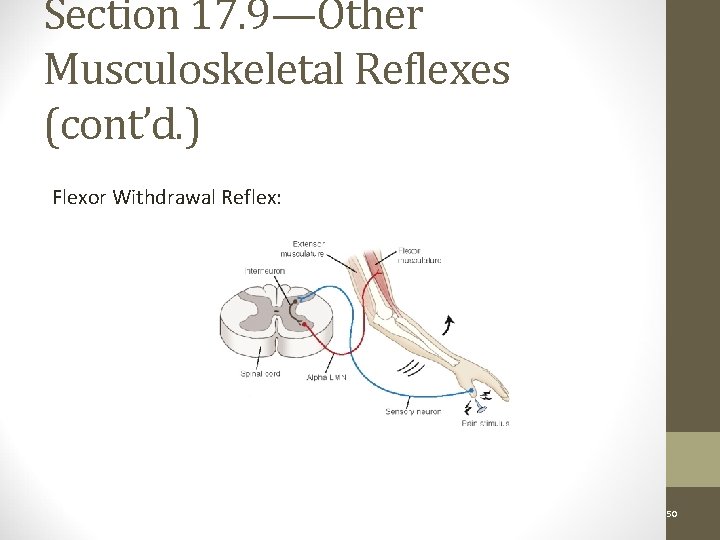
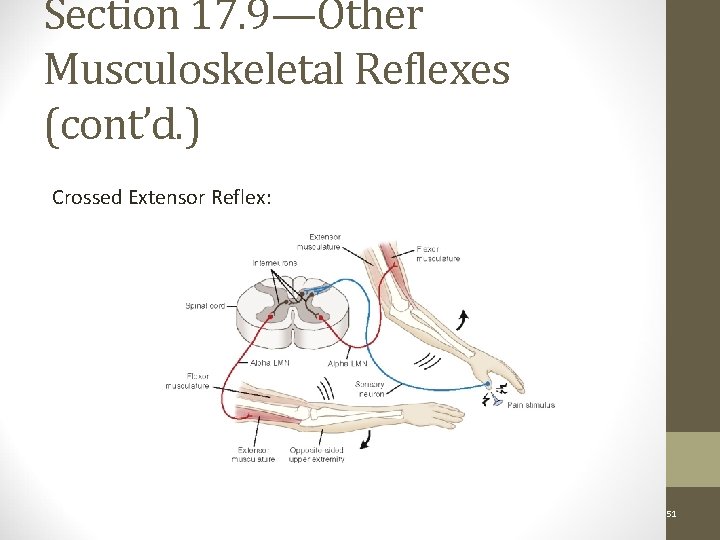
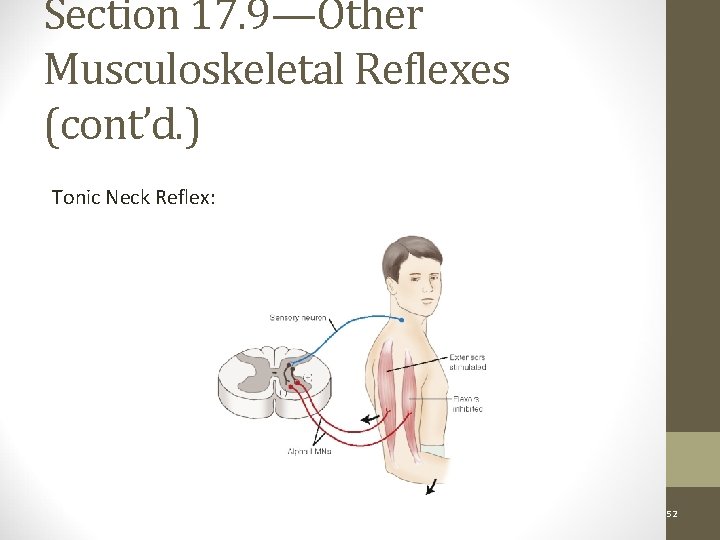
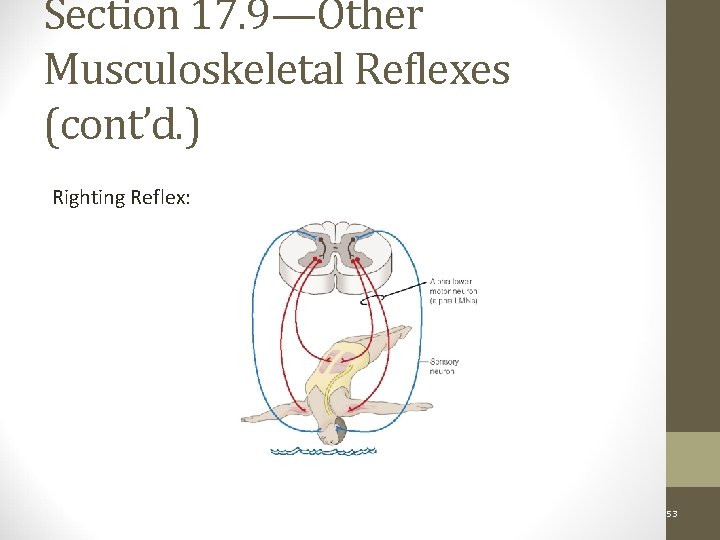
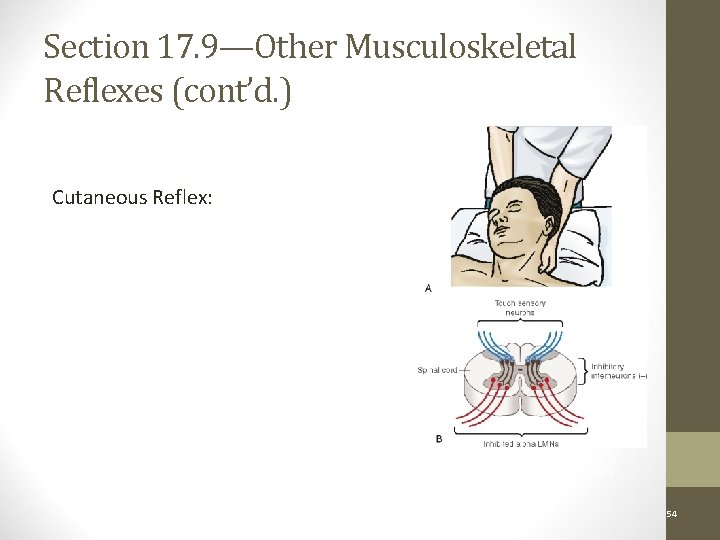
Section 17. 9—Other Musculoskeletal Reflexes • Flexor withdrawal reflex- prevents injury by removing the body part from possible injury • Crossed extensor reflex • Tonic neck reflex • Righting reflex • Cutaneous reflex Copyright © 2011, 2007 by Mosby, Inc. , an affiliate of Elsevier Inc. All rights reserved. 49
Section 17. 9—Other Musculoskeletal Reflexes (cont’d. ) Flexor Withdrawal Reflex: Figure 17 -13 Copyright © 2011, 2007 by Mosby, Inc. , an affiliate of Elsevier Inc. All rights reserved. 50
Section 17. 9—Other Musculoskeletal Reflexes (cont’d. ) Crossed Extensor Reflex: Figure 17 -14 Copyright © 2011, 2007 by Mosby, Inc. , an affiliate of Elsevier Inc. All rights reserved. 51
Section 17. 9—Other Musculoskeletal Reflexes (cont’d. ) Tonic Neck Reflex: Figure 17 -15 Copyright © 2011, 2007 by Mosby, Inc. , an affiliate of Elsevier Inc. All rights reserved. 52
Section 17. 9—Other Musculoskeletal Reflexes (cont’d. ) Righting Reflex: Figure 17 -16 Copyright © 2011, 2007 by Mosby, Inc. , an affiliate of Elsevier Inc. All rights reserved. 53
Section 17. 9—Other Musculoskeletal Reflexes (cont’d. ) Cutaneous Reflex: Figure 17 -17 A , From Fritz S: Mosby ’ s fundamentals of therapeutic massage, ed 4, St Louis, 2009, Mosby Copyright © 2011, 2007 by Mosby, Inc. , an affiliate of Elsevier Inc. All rights reserved. 54
Section 17. 10—Pain-Spasm. Pain Cycle How the Body Copes with Trauma: • Muscle splinting • Body armoring Copyright © 2011, 2007 by Mosby, Inc. , an affiliate of Elsevier Inc. All rights reserved. 55
Section 17. 10—Pain-Spasm. Pain Cycle (cont’d. ) • • Pain causes spasm Spasm does not go away Continued spasm causes further pain Can be broken by eliminating either factor Copyright © 2011, 2007 by Mosby, Inc. , an affiliate of Elsevier Inc. All rights reserved. 56
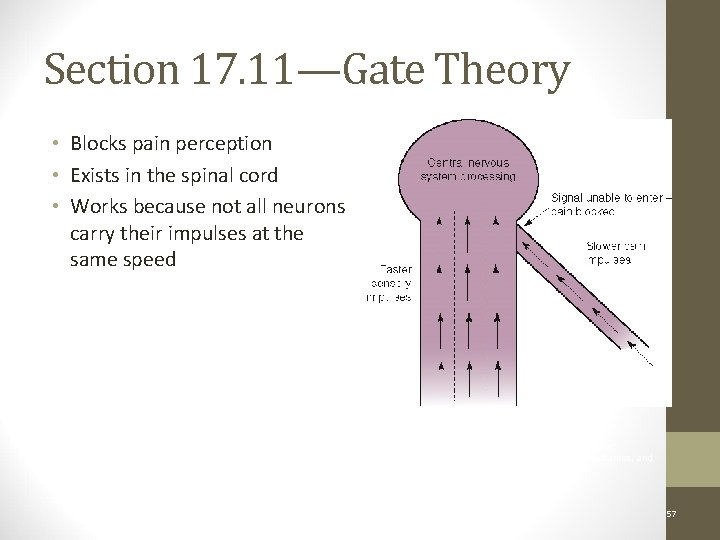
Section 17. 11—Gate Theory • Blocks pain perception • Exists in the spinal cord • Works because not all neurons carry their impulses at the same speed Figure 17 -18 Modified from Fritz S: Mosby ’ s essential sciences for therapeutic massage: anatomy, physiology, biomechanics, and pathology, ed 3, St Louis, 2009, Mosby Copyright © 2011, 2007 by Mosby, Inc. , an affiliate of Elsevier Inc. All rights reserved. 57
Section 17. 11—Gate Theory (cont’d. ) • Physical damage from exercise might not manifest until hours later. • Any touch that does not injure the client will tend to block the client’s pain. Copyright © 2011, 2007 by Mosby, Inc. , an affiliate of Elsevier Inc. All rights reserved. 58