
Chapter 17 The Nervous System The Autonomic Nervous
- Slides: 55
Chapter 17 The Nervous System The Autonomic Nervous System Lecture Presentation by Steven Bassett Southeast Community College © 2015 Pearson Education, Inc.
Introduction • The autonomic nervous system functions outside of our conscious awareness • The autonomic nervous system makes routine adjustments in our body’s systems • The autonomic nervous system: • Regulates body temperature • Coordinates cardiovascular, respiratory, digestive, excretory, and reproductive functions © 2015 Pearson Education, Inc.
A Comparison of the Somatic and Autonomic Nervous Systems • Autonomic Nervous System • Axons innervate the visceral organs • Has afferent and efferent neurons • Afferent pathways originate in the visceral receptors • Somatic nervous system • Axons innervate the skeletal muscles • Has afferent and efferent neurons • Afferent pathways originate in the skeletal muscles © 2015 Pearson Education, Inc.
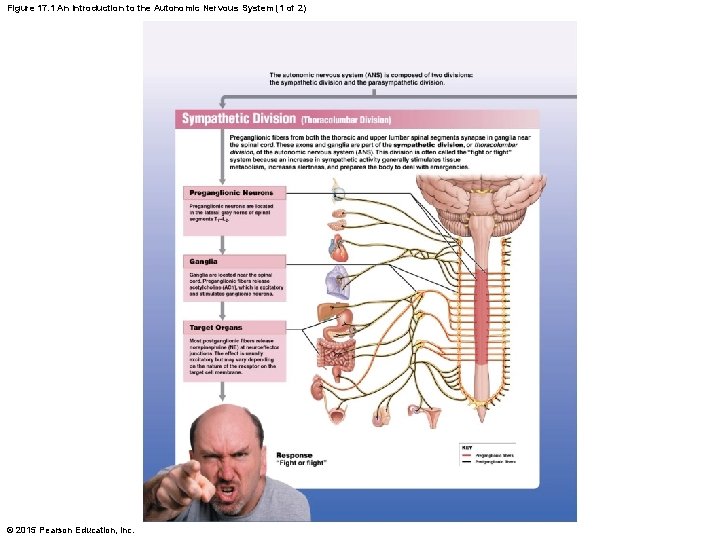
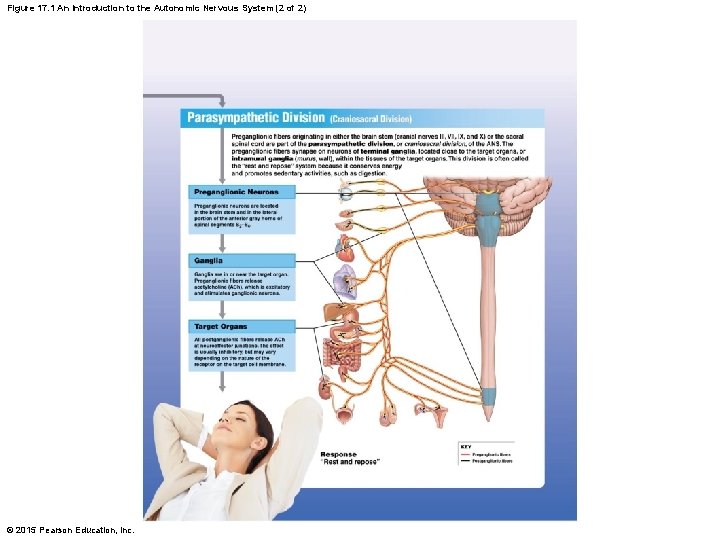
Sympathetic and Parasympathetic Subdivisions of the ANS • The autonomic nervous system consists of two major subdivisions • Sympathetic division • Also called the thoracolumbar division • Most active during times of stress, exertion, or emergency • Parasympathetic division • Also called the craniosacral division • Most active during resting conditions © 2015 Pearson Education, Inc.
Figure 17. 1 An Introduction to the Autonomic Nervous System (1 of 2) © 2015 Pearson Education, Inc.
Figure 17. 1 An Introduction to the Autonomic Nervous System (2 of 2) © 2015 Pearson Education, Inc.
Sympathetic and Parasympathetic Subdivisions of the ANS • The autonomic nervous system consists of a third division (not commonly discussed) • Enteric Nervous System • Neurons located in the walls of the digestive tract • Many visceral reflexes are initiated by the ENS © 2015 Pearson Education, Inc.
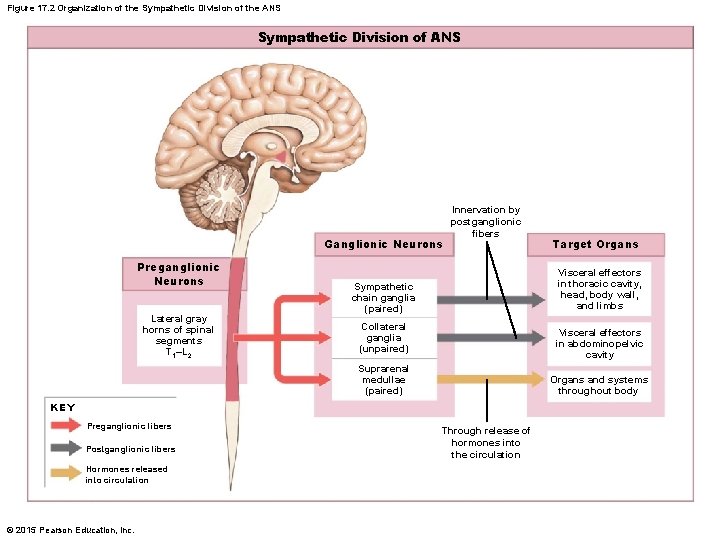
The Sympathetic Division • Sympathetic division consists of: • Preganglionic neurons between T 1 and L 2 • Neuronal cell bodies in ganglia near the vertebral column • Sympathetic chain ganglia • Collateral ganglia • Specialized neurons in the interior of the suprarenal gland © 2015 Pearson Education, Inc.
Figure 17. 2 Organization of the Sympathetic Division of the ANS Sympathetic Division of ANS Ganglionic Neurons Preganglionic Neurons Lateral gray horns of spinal segments T 1–L 2 Innervation by postganglionic fibers Visceral effectors in thoracic cavity, head, body wall, and limbs Sympathetic chain ganglia (paired) Collateral ganglia (unpaired) Visceral effectors in abdominopelvic cavity Suprarenal medullae (paired) Organs and systems throughout body KEY Preganglionic fibers Postganglionic fibers Hormones released into circulation © 2015 Pearson Education, Inc. Target Organs Through release of hormones into the circulation
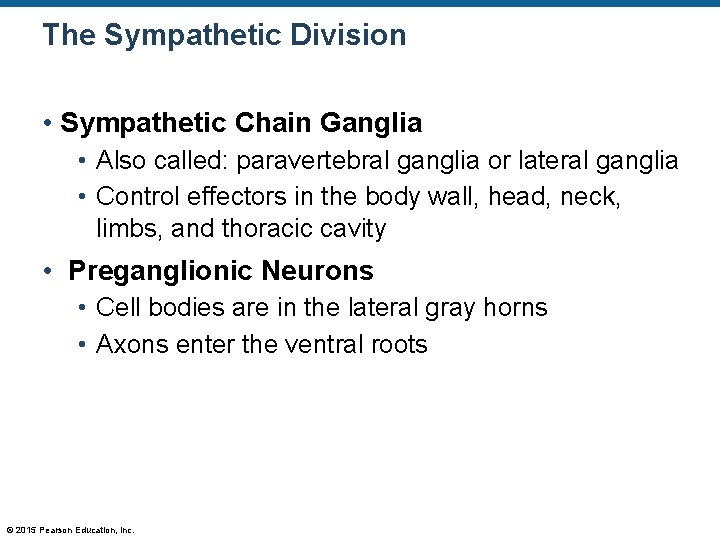
The Sympathetic Division • Sympathetic Chain Ganglia • Also called: paravertebral ganglia or lateral ganglia • Control effectors in the body wall, head, neck, limbs, and thoracic cavity • Preganglionic Neurons • Cell bodies are in the lateral gray horns • Axons enter the ventral roots © 2015 Pearson Education, Inc.
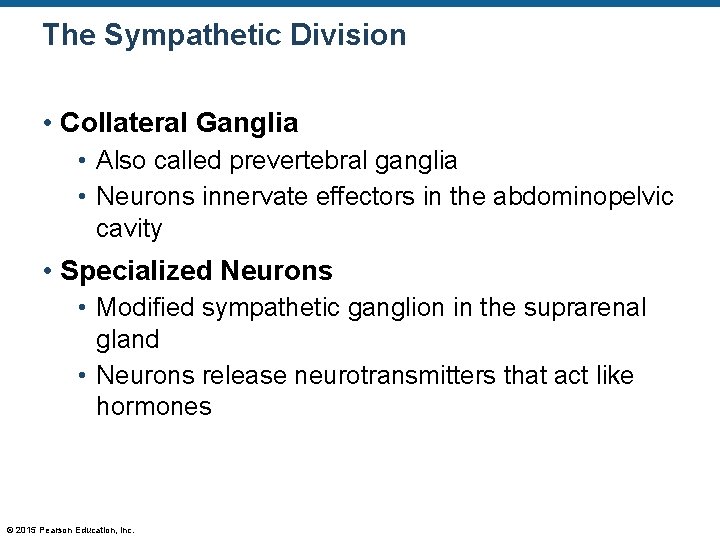
The Sympathetic Division • Collateral Ganglia • Also called prevertebral ganglia • Neurons innervate effectors in the abdominopelvic cavity • Specialized Neurons • Modified sympathetic ganglion in the suprarenal gland • Neurons release neurotransmitters that act like hormones © 2015 Pearson Education, Inc.
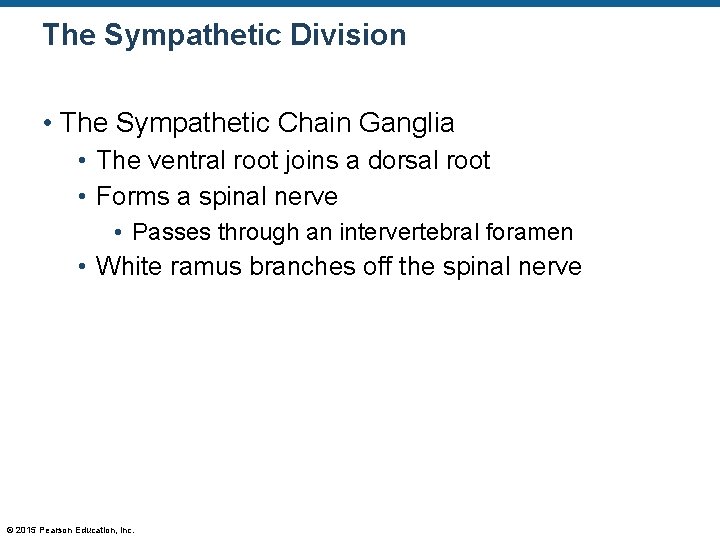
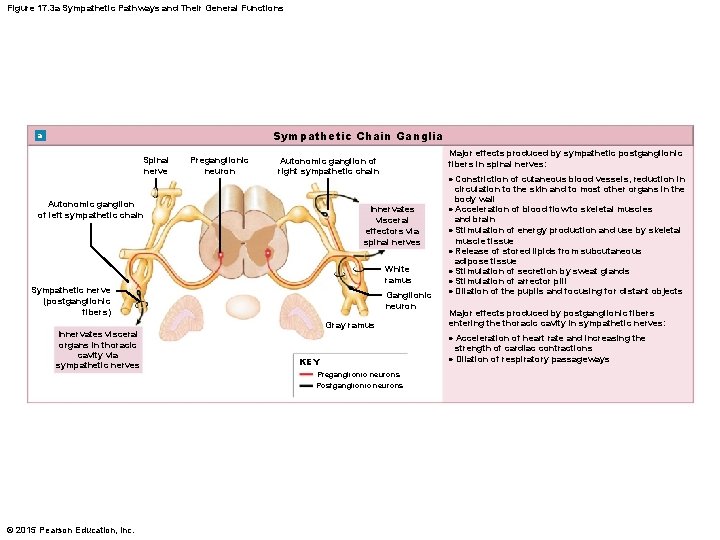
The Sympathetic Division • The Sympathetic Chain Ganglia • The ventral root joins a dorsal root • Forms a spinal nerve • Passes through an intervertebral foramen • White ramus branches off the spinal nerve © 2015 Pearson Education, Inc.
Figure 17. 3 a Sympathetic Pathways and Their General Functions Sympathetic Chain Ganglia a Spinal nerve Preganglionic neuron Autonomic ganglion of left sympathetic chain Innervates visceral effectors via spinal nerves White ramus Sympathetic nerve (postganglionic fibers) Innervates visceral organs in thoracic cavity via sympathetic nerves © 2015 Pearson Education, Inc. Major effects produced by sympathetic postganglionic fibers in spinal nerves: Autonomic ganglion of right sympathetic chain Ganglionic neuron Gray ramus KEY Preganglionic neurons Postganglionic neurons ● Constriction of cutaneous blood vessels, reduction in circulation to the skin and to most other organs in the body wall ● Acceleration of blood flow to skeletal muscles and brain ● Stimulation of energy production and use by skeletal muscle tissue ● Release of stored lipids from subcutaneous adipose tissue ● Stimulation of secretion by sweat glands ● Stimulation of arrector pili ● Dilation of the pupils and focusing for distant objects Major effects produced by postganglionic fibers entering the thoracic cavity in sympathetic nerves: ● Acceleration of heart rate and increasing the strength of cardiac contractions ● Dilation of respiratory passageways
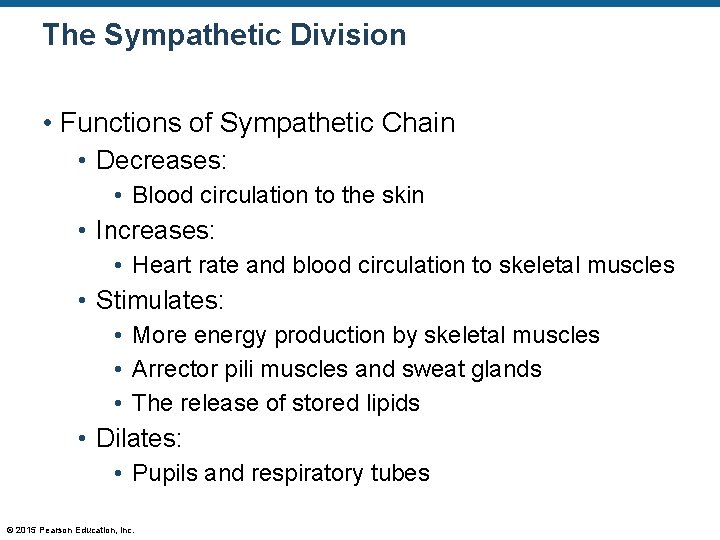
The Sympathetic Division • Functions of Sympathetic Chain • Decreases: • Blood circulation to the skin • Increases: • Heart rate and blood circulation to skeletal muscles • Stimulates: • More energy production by skeletal muscles • Arrector pili muscles and sweat glands • The release of stored lipids • Dilates: • Pupils and respiratory tubes © 2015 Pearson Education, Inc.
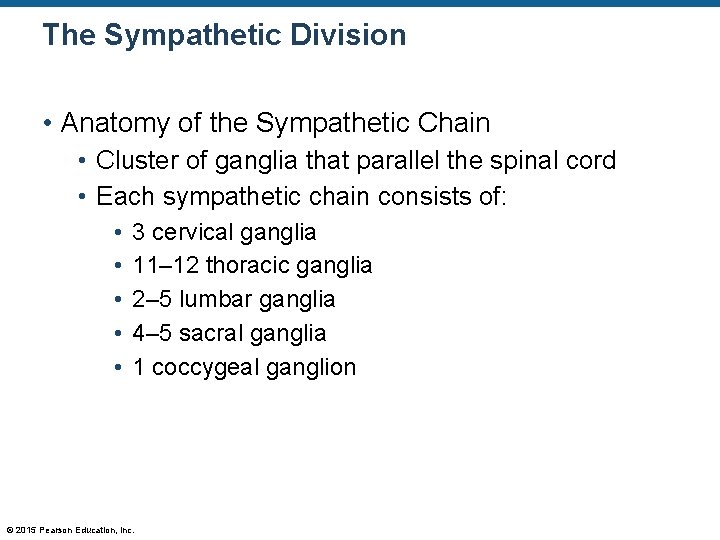
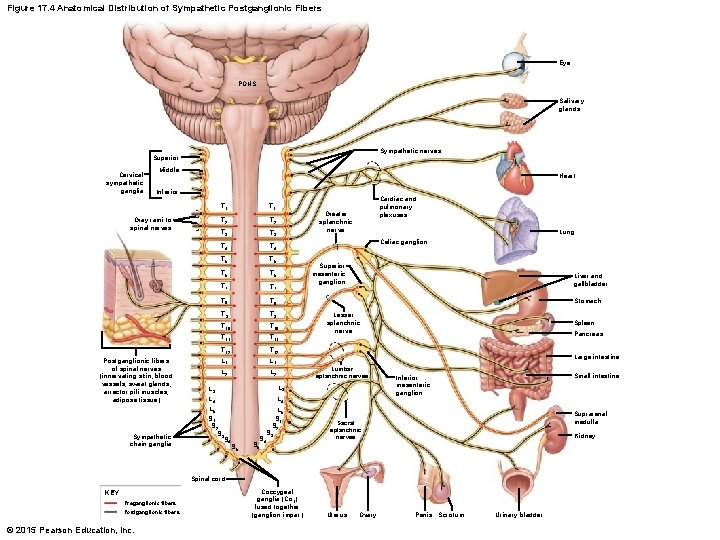
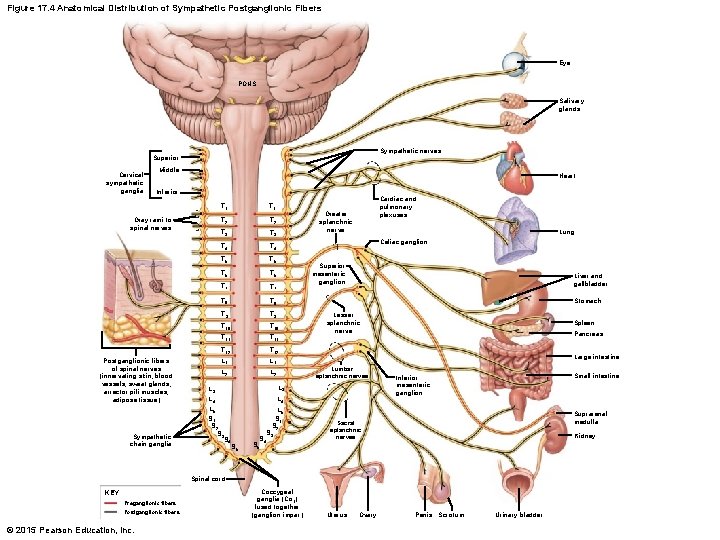
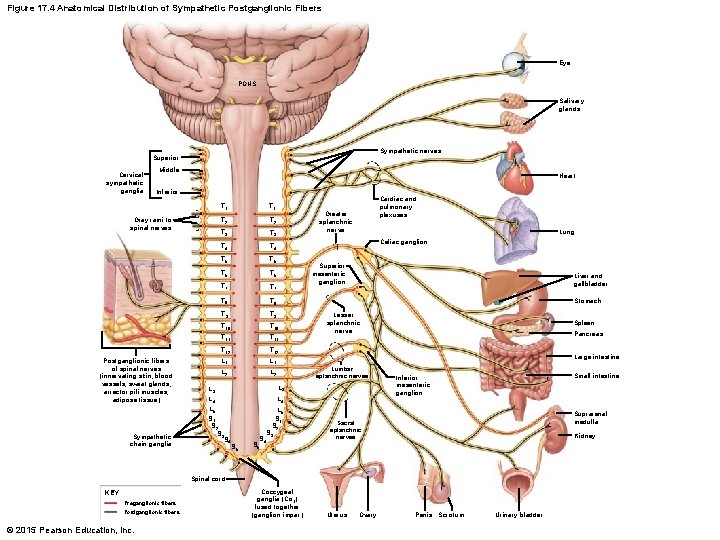
The Sympathetic Division • Anatomy of the Sympathetic Chain • Cluster of ganglia that parallel the spinal cord • Each sympathetic chain consists of: • • • 3 cervical ganglia 11– 12 thoracic ganglia 2– 5 lumbar ganglia 4– 5 sacral ganglia 1 coccygeal ganglion © 2015 Pearson Education, Inc.
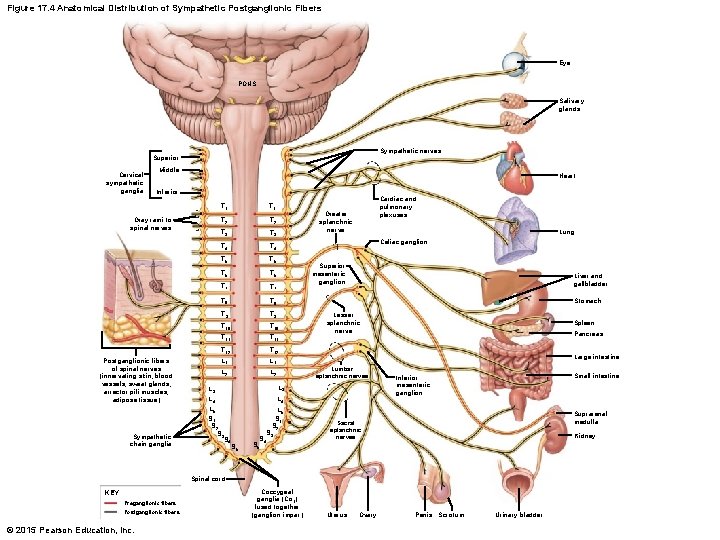
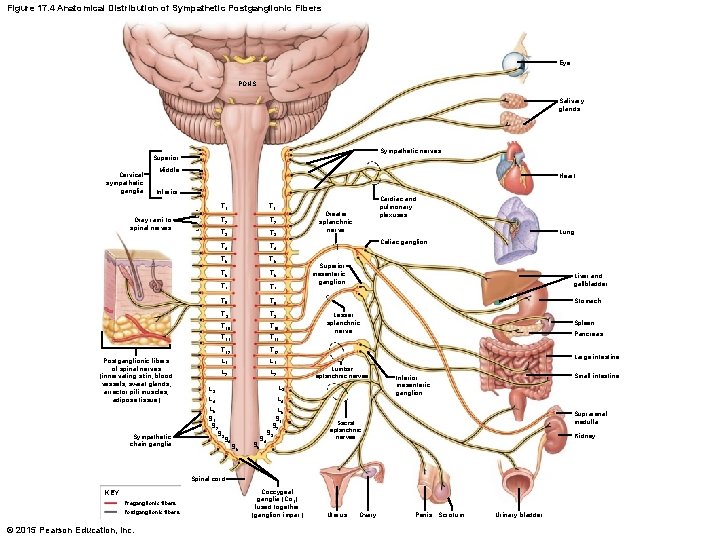
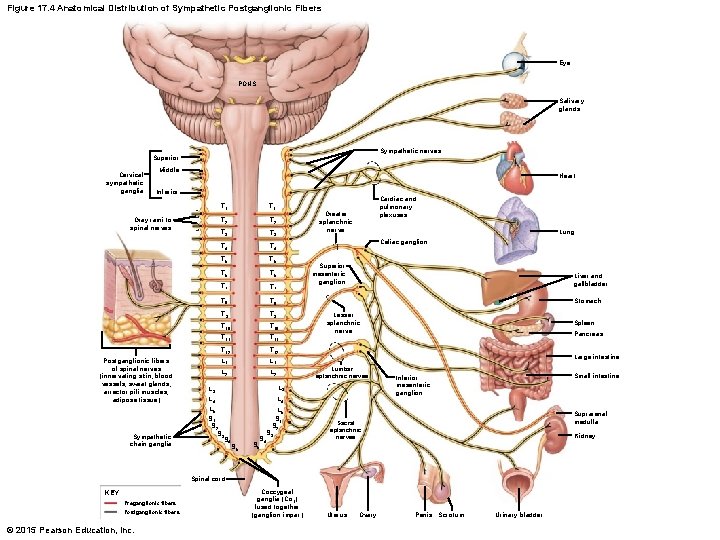
Figure 17. 4 Anatomical Distribution of Sympathetic Postganglionic Fibers Eye PONS Salivary glands Sympathetic nerves Superior Cervical sympathetic ganglia Middle Heart Inferior T 1 Gray rami to spinal nerves Postganglionic fibers of spinal nerves (innervating skin, blood vessels, sweat glands, arrector pili muscles, adipose tissue) Sympathetic chain ganglia T 1 T 2 T 3 T 4 T 5 T 6 T 7 T 8 Superior mesenteric ganglion Liver and gallbladder Stomach T 9 T 10 T 11 T 12 L 1 Lesser splanchnic nerve L 3 L 4 L 5 S 1 S 2 S 5 S 3 S 4 S 5 Spleen Pancreas Large intestine Lumbar splanchnic nerves L 2 L 3 L 4 L 5 S 1 S 2 S 3 S 4 Lung Celiac ganglion T 9 L 2 Cardiac and pulmonary plexuses Greater splanchnic nerve Small intestine Inferior mesenteric ganglion Suprarenal medulla Sacral splanchnic nerves Kidney Spinal cord KEY Preganglionic fibers Postganglionic fibers © 2015 Pearson Education, Inc. Coccygeal ganglia (Co 1) fused together (ganglion impar) Uterus Ovary Penis Scrotum Urinary bladder
The Sympathetic Division • Anatomy of the Sympathetic Chain • Preganglionic and postganglionic neurons • Cervical chain • Only has postganglionic neurons • Thoracic chain • Has both preganglionic and postganglionic neurons • Lumbar chain • Only has postganglionic neurons • Sacral chain • Only has postganglionic neurons • Coccygeal chain • Has only postganglionic neurons © 2015 Pearson Education, Inc.
Figure 17. 4 Anatomical Distribution of Sympathetic Postganglionic Fibers Eye PONS Salivary glands Sympathetic nerves Superior Cervical sympathetic ganglia Middle Heart Inferior T 1 Gray rami to spinal nerves Postganglionic fibers of spinal nerves (innervating skin, blood vessels, sweat glands, arrector pili muscles, adipose tissue) Sympathetic chain ganglia T 1 T 2 T 3 T 4 T 5 T 6 T 7 T 8 Superior mesenteric ganglion Liver and gallbladder Stomach T 9 T 10 T 11 T 12 L 1 Lesser splanchnic nerve L 3 L 4 L 5 S 1 S 2 S 5 S 3 S 4 S 5 Spleen Pancreas Large intestine Lumbar splanchnic nerves L 2 L 3 L 4 L 5 S 1 S 2 S 3 S 4 Lung Celiac ganglion T 9 L 2 Cardiac and pulmonary plexuses Greater splanchnic nerve Small intestine Inferior mesenteric ganglion Suprarenal medulla Sacral splanchnic nerves Kidney Spinal cord KEY Preganglionic fibers Postganglionic fibers © 2015 Pearson Education, Inc. Coccygeal ganglia (Co 1) fused together (ganglion impar) Uterus Ovary Penis Scrotum Urinary bladder
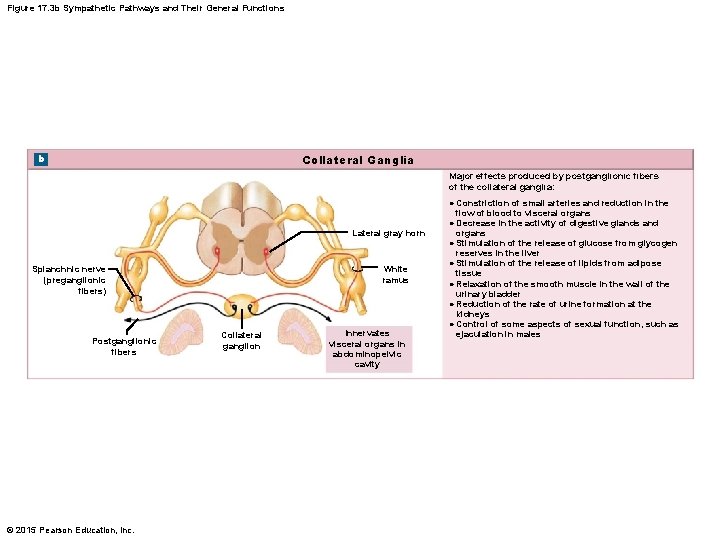
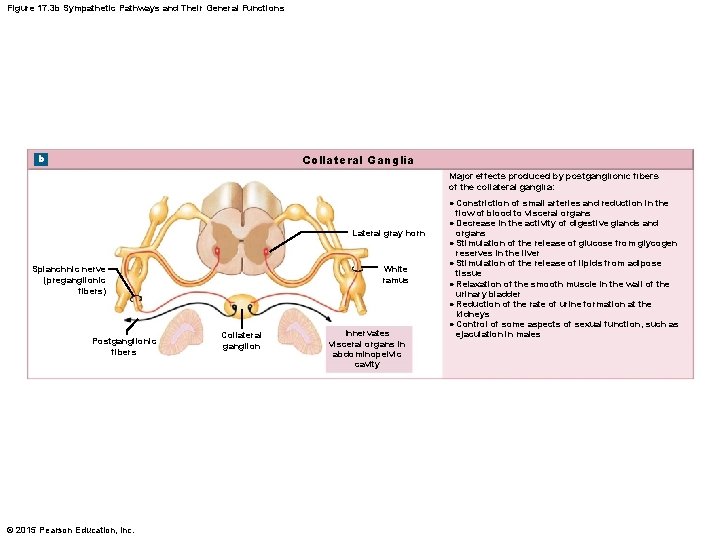
The Sympathetic Division • Splanchnic Nerves and Collateral Ganglia • Splanchnic nerves are bundles of preganglionic fibers • Converge on collateral ganglia • Innervates visceral tissue and organs © 2015 Pearson Education, Inc.
Figure 17. 4 Anatomical Distribution of Sympathetic Postganglionic Fibers Eye PONS Salivary glands Sympathetic nerves Superior Cervical sympathetic ganglia Middle Heart Inferior T 1 Gray rami to spinal nerves Postganglionic fibers of spinal nerves (innervating skin, blood vessels, sweat glands, arrector pili muscles, adipose tissue) Sympathetic chain ganglia T 1 T 2 T 3 T 4 T 5 T 6 T 7 T 8 Superior mesenteric ganglion Liver and gallbladder Stomach T 9 T 10 T 11 T 12 L 1 Lesser splanchnic nerve L 3 L 4 L 5 S 1 S 2 S 5 S 3 S 4 S 5 Spleen Pancreas Large intestine Lumbar splanchnic nerves L 2 L 3 L 4 L 5 S 1 S 2 S 3 S 4 Lung Celiac ganglion T 9 L 2 Cardiac and pulmonary plexuses Greater splanchnic nerve Small intestine Inferior mesenteric ganglion Suprarenal medulla Sacral splanchnic nerves Kidney Spinal cord KEY Preganglionic fibers Postganglionic fibers © 2015 Pearson Education, Inc. Coccygeal ganglia (Co 1) fused together (ganglion impar) Uterus Ovary Penis Scrotum Urinary bladder
Figure 17. 3 b Sympathetic Pathways and Their General Functions b Collateral Ganglia Major effects produced by postganglionic fibers of the collateral ganglia: Lateral gray horn White ramus Splanchnic nerve (preganglionic fibers) Postganglionic fibers © 2015 Pearson Education, Inc. Collateral ganglion Innervates visceral organs in abdominopelvic cavity ● Constriction of small arteries and reduction in the flow of blood to visceral organs ● Decrease in the activity of digestive glands and organs ● Stimulation of the release of glucose from glycogen reserves in the liver ● Stimulation of the release of lipids from adipose tissue ● Relaxation of the smooth muscle in the wall of the urinary bladder ● Reduction of the rate of urine formation at the kidneys ● Control of some aspects of sexual function, such as ejaculation in males
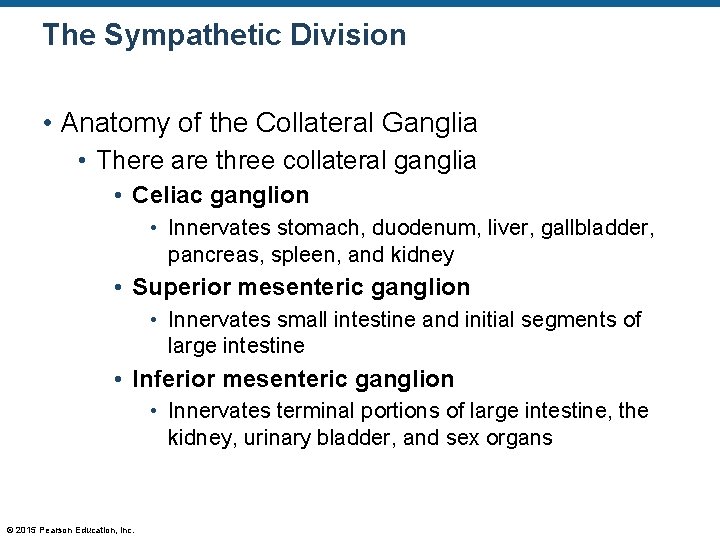
The Sympathetic Division • Anatomy of the Collateral Ganglia • There are three collateral ganglia • Celiac ganglion • Innervates stomach, duodenum, liver, gallbladder, pancreas, spleen, and kidney • Superior mesenteric ganglion • Innervates small intestine and initial segments of large intestine • Inferior mesenteric ganglion • Innervates terminal portions of large intestine, the kidney, urinary bladder, and sex organs © 2015 Pearson Education, Inc.
Figure 17. 4 Anatomical Distribution of Sympathetic Postganglionic Fibers Eye PONS Salivary glands Sympathetic nerves Superior Cervical sympathetic ganglia Middle Heart Inferior T 1 Gray rami to spinal nerves Postganglionic fibers of spinal nerves (innervating skin, blood vessels, sweat glands, arrector pili muscles, adipose tissue) Sympathetic chain ganglia T 1 T 2 T 3 T 4 T 5 T 6 T 7 T 8 Superior mesenteric ganglion Liver and gallbladder Stomach T 9 T 10 T 11 T 12 L 1 Lesser splanchnic nerve L 3 L 4 L 5 S 1 S 2 S 5 S 3 S 4 S 5 Spleen Pancreas Large intestine Lumbar splanchnic nerves L 2 L 3 L 4 L 5 S 1 S 2 S 3 S 4 Lung Celiac ganglion T 9 L 2 Cardiac and pulmonary plexuses Greater splanchnic nerve Small intestine Inferior mesenteric ganglion Suprarenal medulla Sacral splanchnic nerves Kidney Spinal cord KEY Preganglionic fibers Postganglionic fibers © 2015 Pearson Education, Inc. Coccygeal ganglia (Co 1) fused together (ganglion impar) Uterus Ovary Penis Scrotum Urinary bladder
Figure 17. 3 b Sympathetic Pathways and Their General Functions b Collateral Ganglia Major effects produced by postganglionic fibers of the collateral ganglia: Lateral gray horn White ramus Splanchnic nerve (preganglionic fibers) Postganglionic fibers © 2015 Pearson Education, Inc. Collateral ganglion Innervates visceral organs in abdominopelvic cavity ● Constriction of small arteries and reduction in the flow of blood to visceral organs ● Decrease in the activity of digestive glands and organs ● Stimulation of the release of glucose from glycogen reserves in the liver ● Stimulation of the release of lipids from adipose tissue ● Relaxation of the smooth muscle in the wall of the urinary bladder ● Reduction of the rate of urine formation at the kidneys ● Control of some aspects of sexual function, such as ejaculation in males
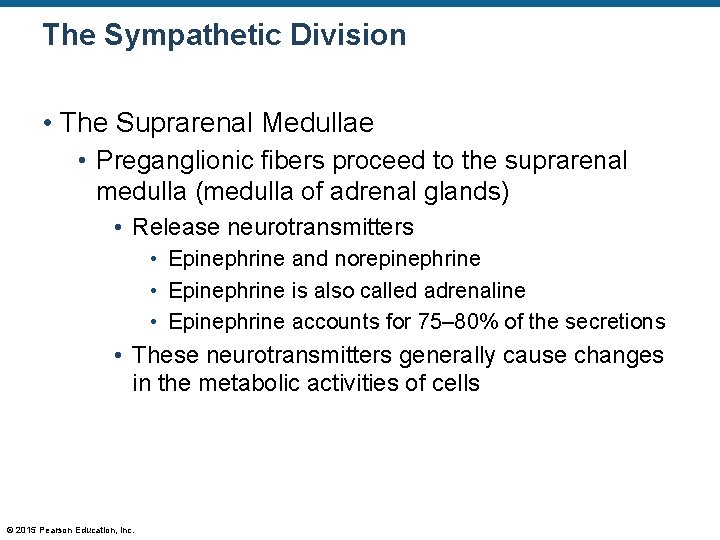
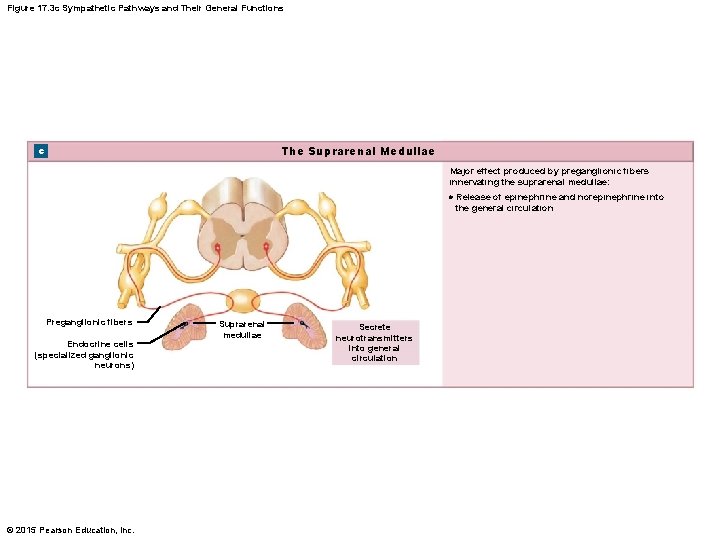
The Sympathetic Division • The Suprarenal Medullae • Preganglionic fibers proceed to the suprarenal medulla (medulla of adrenal glands) • Release neurotransmitters • Epinephrine and norepinephrine • Epinephrine is also called adrenaline • Epinephrine accounts for 75– 80% of the secretions • These neurotransmitters generally cause changes in the metabolic activities of cells © 2015 Pearson Education, Inc.
Figure 17. 4 Anatomical Distribution of Sympathetic Postganglionic Fibers Eye PONS Salivary glands Sympathetic nerves Superior Cervical sympathetic ganglia Middle Heart Inferior T 1 Gray rami to spinal nerves Postganglionic fibers of spinal nerves (innervating skin, blood vessels, sweat glands, arrector pili muscles, adipose tissue) Sympathetic chain ganglia T 1 T 2 T 3 T 4 T 5 T 6 T 7 T 8 Superior mesenteric ganglion Liver and gallbladder Stomach T 9 T 10 T 11 T 12 L 1 Lesser splanchnic nerve L 3 L 4 L 5 S 1 S 2 S 5 S 3 S 4 S 5 Spleen Pancreas Large intestine Lumbar splanchnic nerves L 2 L 3 L 4 L 5 S 1 S 2 S 3 S 4 Lung Celiac ganglion T 9 L 2 Cardiac and pulmonary plexuses Greater splanchnic nerve Small intestine Inferior mesenteric ganglion Suprarenal medulla Sacral splanchnic nerves Kidney Spinal cord KEY Preganglionic fibers Postganglionic fibers © 2015 Pearson Education, Inc. Coccygeal ganglia (Co 1) fused together (ganglion impar) Uterus Ovary Penis Scrotum Urinary bladder
Figure 17. 3 c Sympathetic Pathways and Their General Functions c The Suprarenal Medullae Major effect produced by preganglionic fibers innervating the suprarenal medullae: ● Release of epinephrine and norepinephrine into the general circulation Preganglionic fibers Endocrine cells (specialized ganglionic neurons) © 2015 Pearson Education, Inc. Suprarenal medullae Secrete neurotransmitters into general circulation
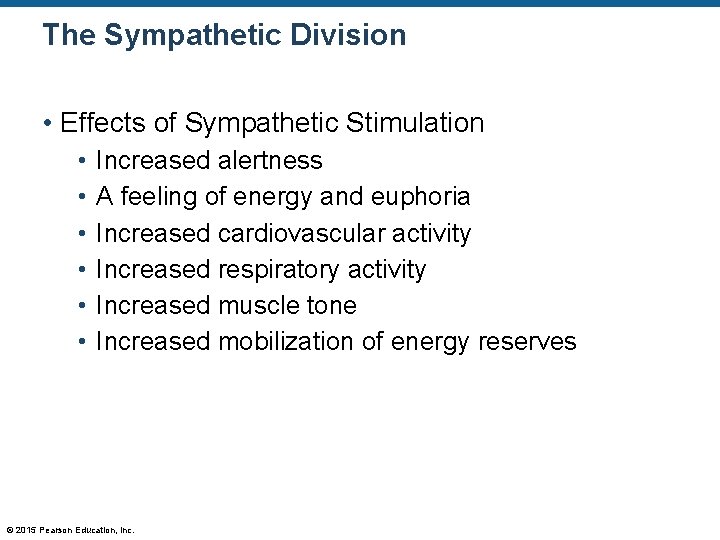
The Sympathetic Division • Effects of Sympathetic Stimulation • • • Increased alertness A feeling of energy and euphoria Increased cardiovascular activity Increased respiratory activity Increased muscle tone Increased mobilization of energy reserves © 2015 Pearson Education, Inc.
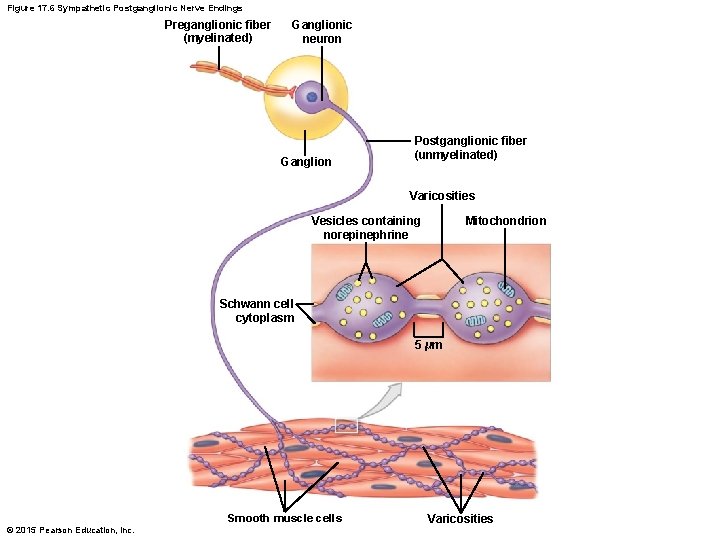
The Sympathetic Division • Sympathetic Activation and Neurotransmitter Release • Sympathetic ganglion fibers release acetylcholine at the synapse with ganglionic neurons • These are cholinergic synapses • The stimulation of ganglionic neurons causes the release of norepinephrine at the neuroeffector junction • These terminals are adrenergic © 2015 Pearson Education, Inc.
The Sympathetic Division • Sympathetic Activation and Neurotransmitter Release • Some ganglionic neurons release acetylcholine • Especially at the neuroeffector junctions of skeletal muscles © 2015 Pearson Education, Inc.
Figure 17. 6 Sympathetic Postganglionic Nerve Endings Preganglionic fiber (myelinated) Ganglionic neuron Ganglion Postganglionic fiber (unmyelinated) Varicosities Vesicles containing norepinephrine Mitochondrion Schwann cell cytoplasm 5 μm © 2015 Pearson Education, Inc. Smooth muscle cells Varicosities
The Sympathetic Division • Plasmalemma Receptors and Sympathetic Function • There are two classes of plasmalemma receptors • Alpha receptors • Stimulated by epinephrine • Stimulated by norepinephrine • Beta receptors • Stimulated by epinephrine © 2015 Pearson Education, Inc.
The Sympathetic Division • A Summary of the Sympathetic Division • Consists of parallel chains on either side of the spinal cord • Preganglionic fibers are short and extend from the spinal cord to the sympathetic chain • Postganglionic fibers are long and extend from the spinal cord to the body organs © 2015 Pearson Education, Inc.
The Sympathetic Division • A Summary of the Sympathetic Division • The sympathetic division shows considerable divergence • All preganglionic neurons release ACh / most postganglionic neurons release norepinephrine • The effector response depends on the presence of either alpha receptors or beta receptors © 2015 Pearson Education, Inc.
Figure 17. 4 Anatomical Distribution of Sympathetic Postganglionic Fibers Eye PONS Salivary glands Sympathetic nerves Superior Cervical sympathetic ganglia Middle Heart Inferior T 1 Gray rami to spinal nerves Postganglionic fibers of spinal nerves (innervating skin, blood vessels, sweat glands, arrector pili muscles, adipose tissue) Sympathetic chain ganglia T 1 T 2 T 3 T 4 T 5 T 6 T 7 T 8 Superior mesenteric ganglion Liver and gallbladder Stomach T 9 T 10 T 11 T 12 L 1 Lesser splanchnic nerve L 3 L 4 L 5 S 1 S 2 S 5 S 3 S 4 S 5 Spleen Pancreas Large intestine Lumbar splanchnic nerves L 2 L 3 L 4 L 5 S 1 S 2 S 3 S 4 Lung Celiac ganglion T 9 L 2 Cardiac and pulmonary plexuses Greater splanchnic nerve Small intestine Inferior mesenteric ganglion Suprarenal medulla Sacral splanchnic nerves Kidney Spinal cord KEY Preganglionic fibers Postganglionic fibers © 2015 Pearson Education, Inc. Coccygeal ganglia (Co 1) fused together (ganglion impar) Uterus Ovary Penis Scrotum Urinary bladder
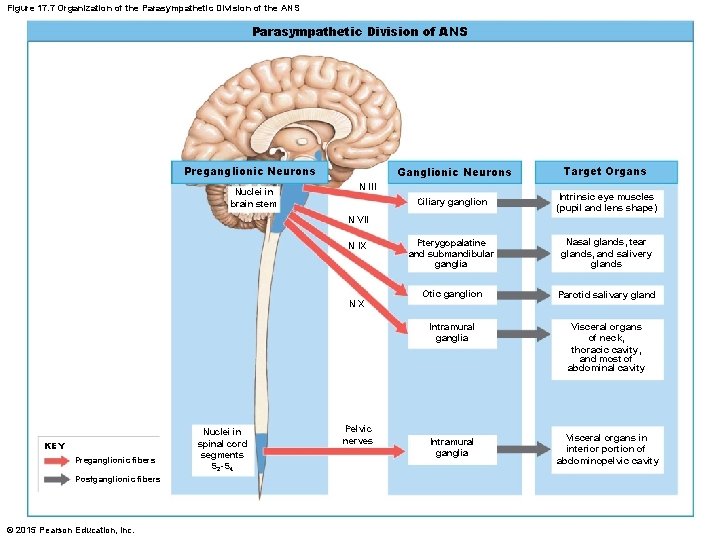
The Parasympathetic Division • Preganglionic neurons are in the brain stem and sacral segments • Preganglionic neurons do not diverge as much as the sympathetic division • Therefore, the parasympathetic division is more localized and specific as compared to the sympathetic division • Postganglionic neurons are near (terminal) the target organ or within (intramural) the target organ © 2015 Pearson Education, Inc.
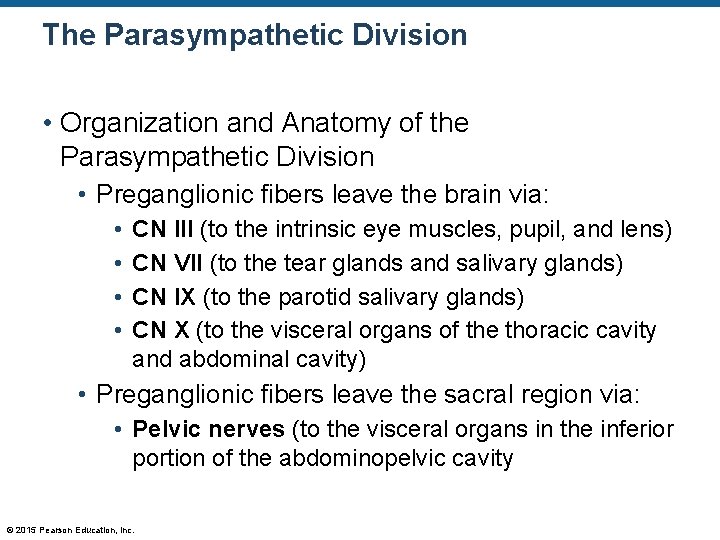
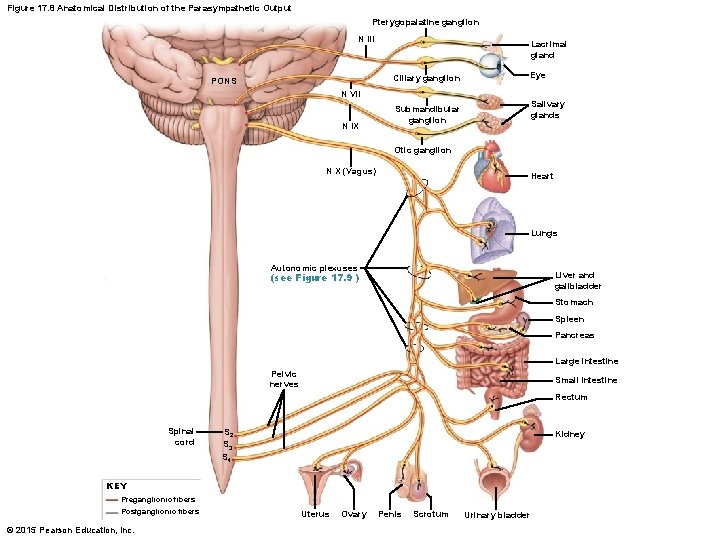
The Parasympathetic Division • Organization and Anatomy of the Parasympathetic Division • Preganglionic fibers leave the brain via: • • CN III (to the intrinsic eye muscles, pupil, and lens) CN VII (to the tear glands and salivary glands) CN IX (to the parotid salivary glands) CN X (to the visceral organs of the thoracic cavity and abdominal cavity) • Preganglionic fibers leave the sacral region via: • Pelvic nerves (to the visceral organs in the inferior portion of the abdominopelvic cavity © 2015 Pearson Education, Inc.
Figure 17. 7 Organization of the Parasympathetic Division of the ANS Parasympathetic Division of ANS Preganglionic Neurons Nuclei in brain stem Ganglionic Neurons Target Organs Ciliary ganglion Intrinsic eye muscles (pupil and lens shape) Pterygopalatine and submandibular ganglia Nasal glands, tear glands, and salivery glands Otic ganglion Parotid salivary gland Intramural ganglia Visceral organs of neck, thoracic cavity, and most of abdominal cavity Intramural ganglia Visceral organs in interior portion of abdominopelvic cavity N III N VII N IX NX KEY Preganglionic fibers Postganglionic fibers © 2015 Pearson Education, Inc. Nuclei in spinal cord segments S 2 -S 4 Pelvic nerves
Figure 17. 8 Anatomical Distribution of the Parasympathetic Output Pterygopalatine ganglion N III Lacrimal gland Ciliary ganglion PONS Eye N VII N IX Salivary glands Submandibular ganglion Otic ganglion N X (Vagus) Heart Lungs Autonomic plexuses Liver and gallbladder (see Figure 17. 9 ) Stomach Spleen Pancreas Large intestine Pelvic nerves Small intestine Rectum Spinal cord S 2 S 3 S 4 Kidney KEY Preganglionic fibers Postganglionic fibers © 2015 Pearson Education, Inc. Uterus Ovary Penis Scrotum Urinary bladder
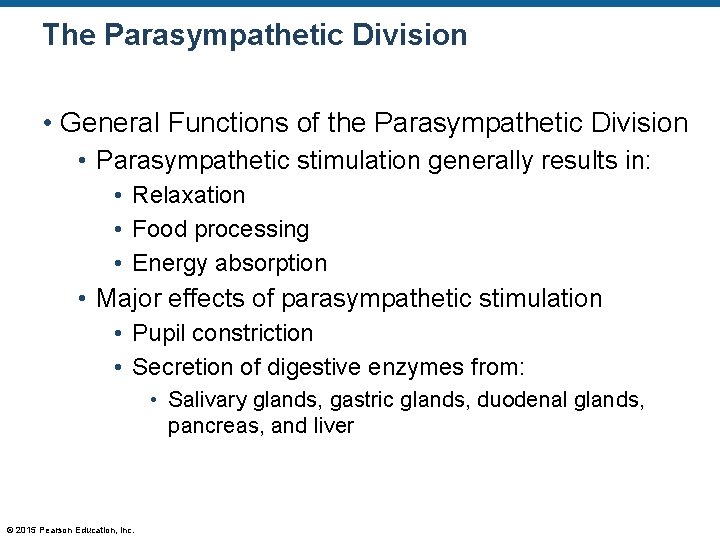
The Parasympathetic Division • General Functions of the Parasympathetic Division • Parasympathetic stimulation generally results in: • Relaxation • Food processing • Energy absorption • Major effects of parasympathetic stimulation • Pupil constriction • Secretion of digestive enzymes from: • Salivary glands, gastric glands, duodenal glands, pancreas, and liver © 2015 Pearson Education, Inc.
The Parasympathetic Division • General Functions of the Parasympathetic Division • Major effects of parasympathetic stimulation (continued) • Secretion of hormones that promote nutrient absorption • Increased smooth muscle activity of the digestive system • Stimulation and coordination of defecation • Contraction of the urinary bladder • Constriction of respiratory passages • Reduced heart rate • Sexual arousal © 2015 Pearson Education, Inc.
The Parasympathetic Division • Parasympathetic Activation and Neurotransmitter Release • All preganglionic and postganglionic fibers release ACh at their synapses and neuroeffector junctions • Most parasympathetic stimulations are short lived • This is due to the immediate breakdown of ACh by acetylcholinesterase • Any diffused ACh will be deactivated by cholinesterase • Thus, parasympathetic stimulations are very localized © 2015 Pearson Education, Inc.
The Parasympathetic Division • Plasmalemma Receptors and Responses • Two types of ACh receptors are found on the postsynaptic plasmalemmae: • Nicotinic receptors • Respond to nicotine • Found on surfaces of parasympathetic and sympathetic ganglionic neurons • Muscarinic receptors • Respond to muscarine • Found on surfaces of parasympathetic cholinergic neuroeffector junctions © 2015 Pearson Education, Inc.
The Parasympathetic Division • A Summary of the Parasympathetic Division • Involves CN III, CN VII, CN IX, and CN X • Involves sacral segments S 2 to S 4 • All parasympathetic neurons are cholinergic • Release of ACh stimulates nicotinic receptors on ganglionic neurons • Effect is always excitatory • Release of ACh on neuroeffector junctions stimulates muscarinic receptors • Effect can be excitatory or inhibitory © 2015 Pearson Education, Inc.
The Parasympathetic Division • A Summary of the Parasympathetic Division (continued) • Parasympathetic stimulation are usually brief • Parasympathetic stimulation is localized • Parasympathetic nerves innervate • Head, thoracic, abdominal, and pelvic organs © 2015 Pearson Education, Inc.
Relationships between the Sympathetic and Parasympathetic Divisions • Sympathetic • Widespread effect on visceral organs • Parasympathetic • Modifies the activity of structures innervated by specific cranial nerves and pelvic nerves • Most vital organs are innervated by both the sympathetic and parasympathetic nerves • This is known as dual innervation • The two often oppose (antagonistic) each other © 2015 Pearson Education, Inc.
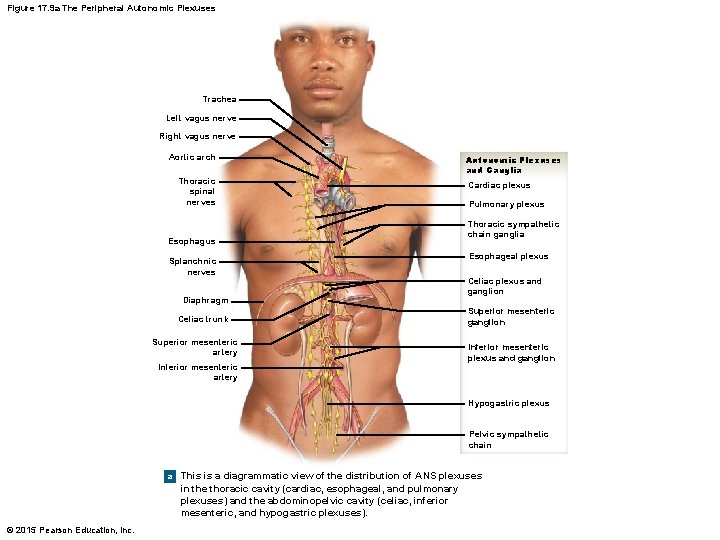
Relationships between the Sympathetic and Parasympathetic Divisions • Anatomy of Dual Innervation • Head region • The parasympathetic fibers accompany the sympathetic fibers to the target organ • Thoracic and abdominopelvic regions • The parasympathetic and sympathetic fibers mingle together forming plexuses • Cardiac, pulmonary, esophageal, celiac, inferior mesenteric, and hypogastric plexus © 2015 Pearson Education, Inc.
Figure 17. 9 a The Peripheral Autonomic Plexuses Trachea Left vagus nerve Right vagus nerve Aortic arch Thoracic spinal nerves Esophagus Splanchnic nerves Diaphragm Celiac trunk Superior mesenteric artery Inferior mesenteric artery Autonomic Plexuses and Ganglia Cardiac plexus Pulmonary plexus Thoracic sympathetic chain ganglia Esophageal plexus Celiac plexus and ganglion Superior mesenteric ganglion Inferior mesenteric plexus and ganglion Hypogastric plexus Pelvic sympathetic chain a This is a diagrammatic view of the distribution of ANS plexuses in the thoracic cavity (cardiac, esophageal, and pulmonary plexuses) and the abdominopelvic cavity (celiac, inferior mesenteric, and hypogastric plexuses). © 2015 Pearson Education, Inc.
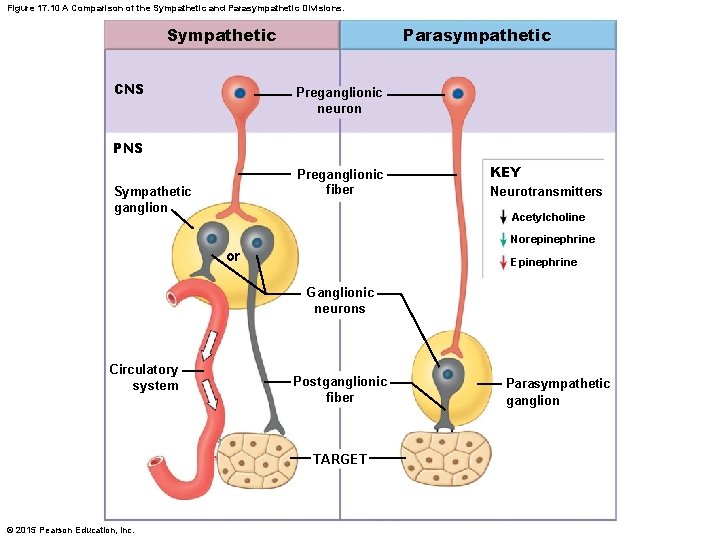
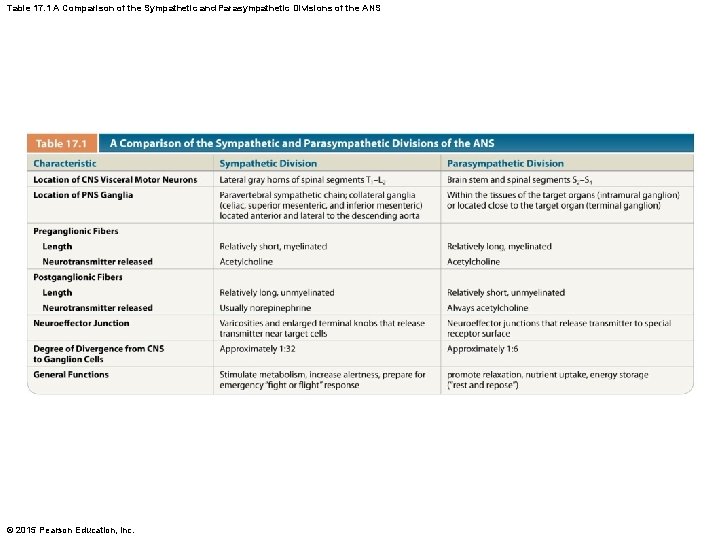
Relationships between the Sympathetic and Parasympathetic Divisions • A Comparison of the Sympathetic and Parasympathetic Divisions • • • Compare the length of the preganglionic fibers Compare the length of the postganglionic fibers Compare the location of the ganglia Compare the neurotransmitter released Compare the degree of divergence © 2015 Pearson Education, Inc.
Figure 17. 10 A Comparison of the Sympathetic and Parasympathetic Divisions. Sympathetic CNS Parasympathetic Preganglionic neuron PNS Preganglionic fiber Sympathetic ganglion KEY Neurotransmitters Acetylcholine Norepinephrine or Epinephrine Ganglionic neurons Circulatory system Postganglionic fiber TARGET © 2015 Pearson Education, Inc. Parasympathetic ganglion
Table 17. 1 A Comparison of the Sympathetic and Parasympathetic Divisions of the ANS © 2015 Pearson Education, Inc.
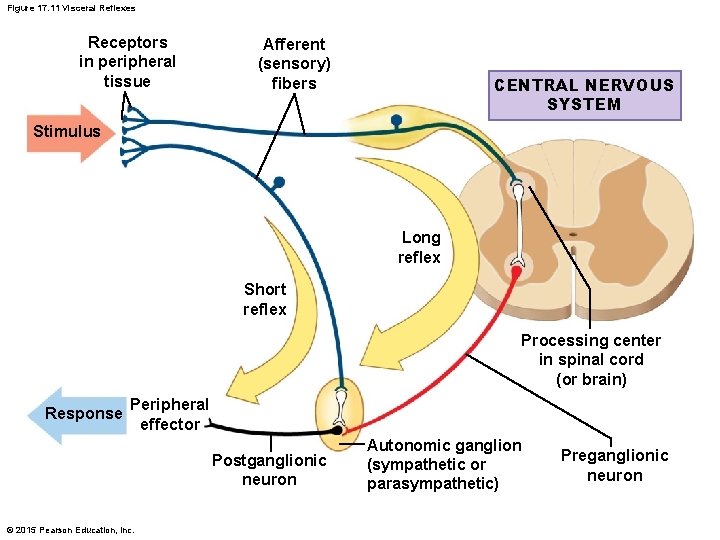
Visceral Reflexes • Provide autonomic motor responses to: • Modify or facilitate higher centers • All visceral reflexes are polysynaptic • Reflexes can be: • Long reflexes • Short reflexes © 2015 Pearson Education, Inc.
Visceral Reflexes • Long Reflexes • Visceral sensory neurons go to the CNS via the dorsal roots • There are interneurons within the CNS • Information is “interpreted” in the spinal cord or brain • ANS sends motor commands to the visceral organs © 2015 Pearson Education, Inc.
Visceral Reflexes • Short Reflexes • Sensory nerve impulses go to the ganglionic neurons • Motor commands are distributed by the postganglionic fibers • Impulses bypass the CNS © 2015 Pearson Education, Inc.
Figure 17. 11 Visceral Reflexes Receptors in peripheral tissue Afferent (sensory) fibers CENTRAL NERVOUS SYSTEM Stimulus Long reflex Short reflex Processing center in spinal cord (or brain) Response Peripheral effector Postganglionic neuron © 2015 Pearson Education, Inc. Autonomic ganglion (sympathetic or parasympathetic) Preganglionic neuron