
CHAPTER 17 STATEMENT OF CASH FLOWS Accounting Principles


- Slides: 44
CHAPTER 17 STATEMENT OF CASH FLOWS Accounting Principles, Eighth Edition Chapter 17 -1
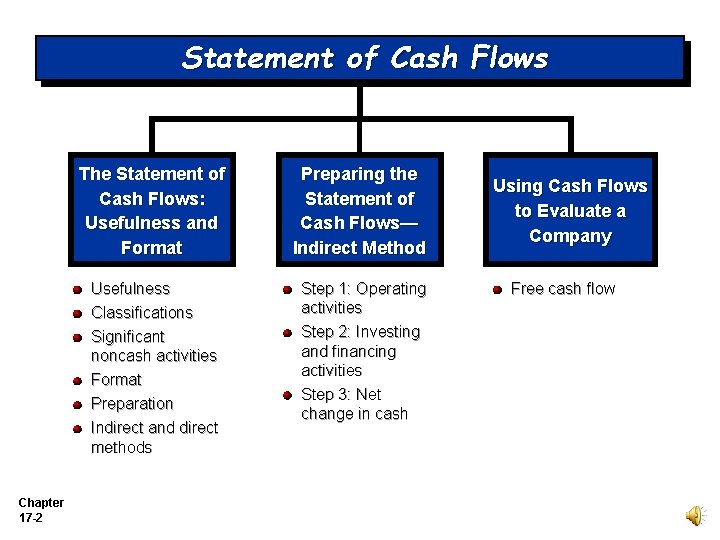
Statement of Cash Flows The Statement of Cash Flows: Usefulness and Format Preparing the Statement of Cash Flows— Indirect Method Usefulness Classifications Significant noncash activities Format Step 1: Operating activities Step 2: Investing and financing activities Step 3: Net change in cash Preparation Indirect and direct methods Chapter 17 -2 Using Cash Flows to Evaluate a Company Free cash flow
In our business, what do we use “cash” for? Chapter 17 -3
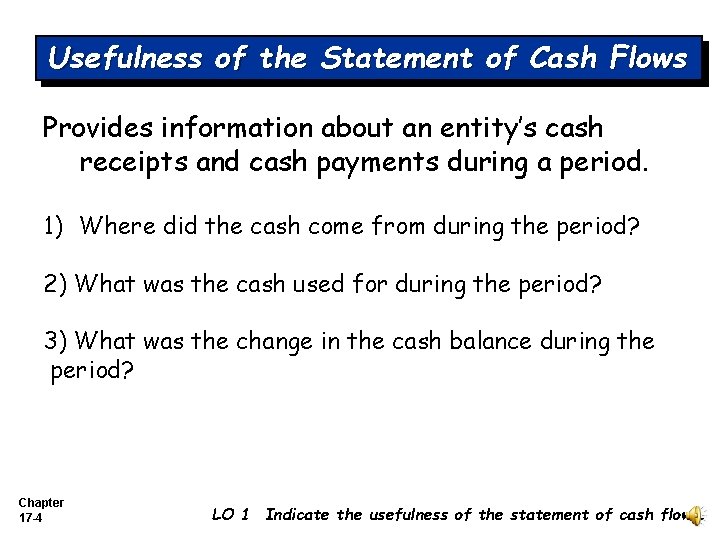
Usefulness of the Statement of Cash Flows Provides information about an entity’s cash receipts and cash payments during a period. 1) Where did the cash come from during the period? 2) What was the cash used for during the period? 3) What was the change in the cash balance during the period? Chapter 17 -4 LO 1 Indicate the usefulness of the statement of cash flows.
Classification of Cash Flows Operating Activities Income Statement Items Chapter 17 -5 Investing Activities Generally Long. Term Asset Items Financing Activities Generally Long. Term Liability and Equity Items LO 2 Distinguish among operating, investing, and financing activities.
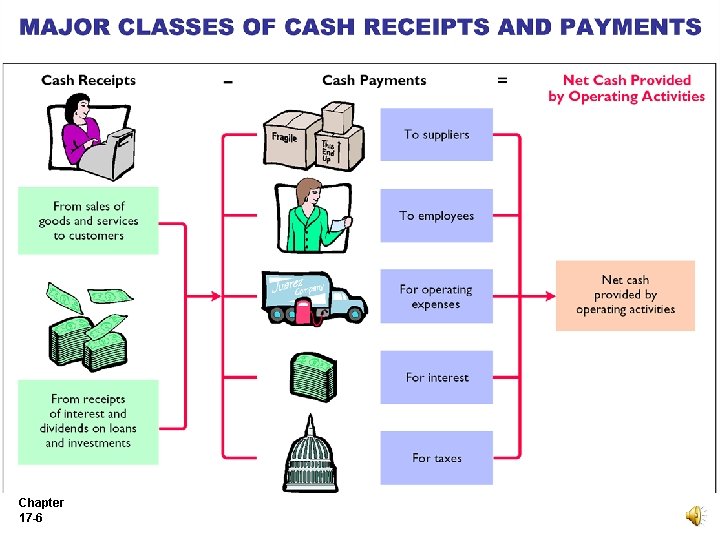
Chapter 17 -6
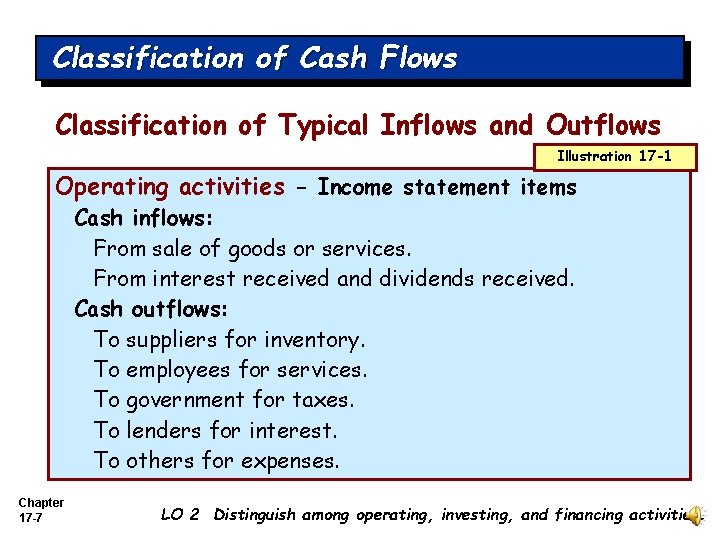
Classification of Cash Flows Classification of Typical Inflows and Outflows Illustration 17 -1 Operating activities - Income statement items Cash inflows: From sale of goods or services. From interest received and dividends received. Cash outflows: To suppliers for inventory. To employees for services. To government for taxes. To lenders for interest. To others for expenses. Chapter 17 -7 LO 2 Distinguish among operating, investing, and financing activities.
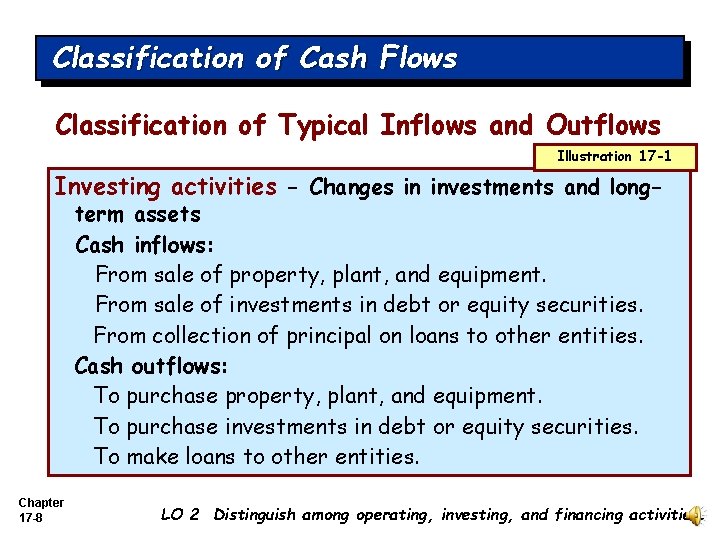
Classification of Cash Flows Classification of Typical Inflows and Outflows Illustration 17 -1 Investing activities - Changes in investments and longterm assets Cash inflows: From sale of property, plant, and equipment. From sale of investments in debt or equity securities. From collection of principal on loans to other entities. Cash outflows: To purchase property, plant, and equipment. To purchase investments in debt or equity securities. To make loans to other entities. Chapter 17 -8 LO 2 Distinguish among operating, investing, and financing activities.
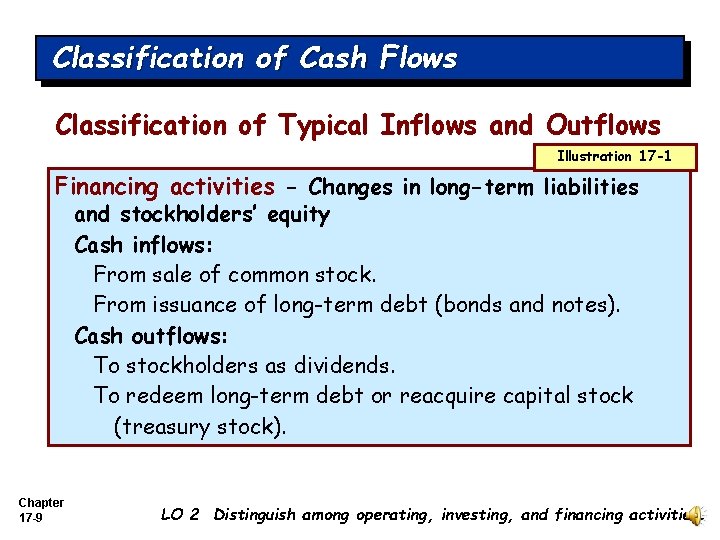
Classification of Cash Flows Classification of Typical Inflows and Outflows Illustration 17 -1 Financing activities - Changes in long-term liabilities and stockholders’ equity Cash inflows: From sale of common stock. From issuance of long-term debt (bonds and notes). Cash outflows: To stockholders as dividends. To redeem long-term debt or reacquire capital stock (treasury stock). Chapter 17 -9 LO 2 Distinguish among operating, investing, and financing activities.
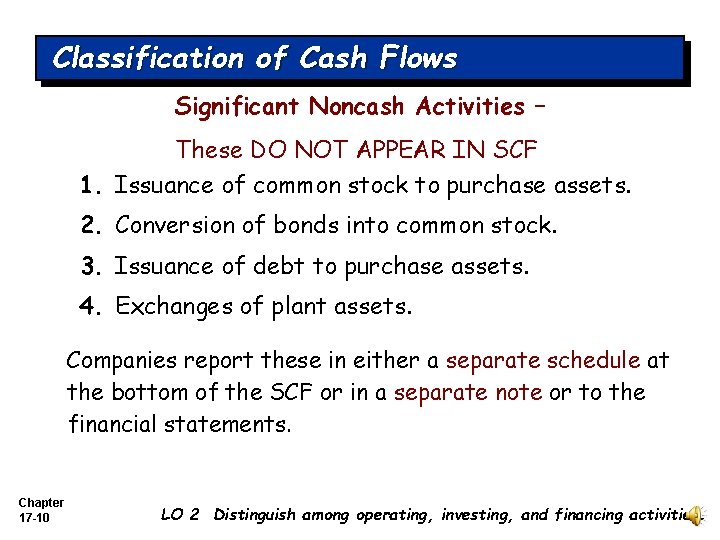
Classification of Cash Flows Significant Noncash Activities – These DO NOT APPEAR IN SCF 1. Issuance of common stock to purchase assets. 2. Conversion of bonds into common stock. 3. Issuance of debt to purchase assets. 4. Exchanges of plant assets. Companies report these in either a separate schedule at the bottom of the SCF or in a separate note or to the financial statements. Chapter 17 -10 LO 2 Distinguish among operating, investing, and financing activities.
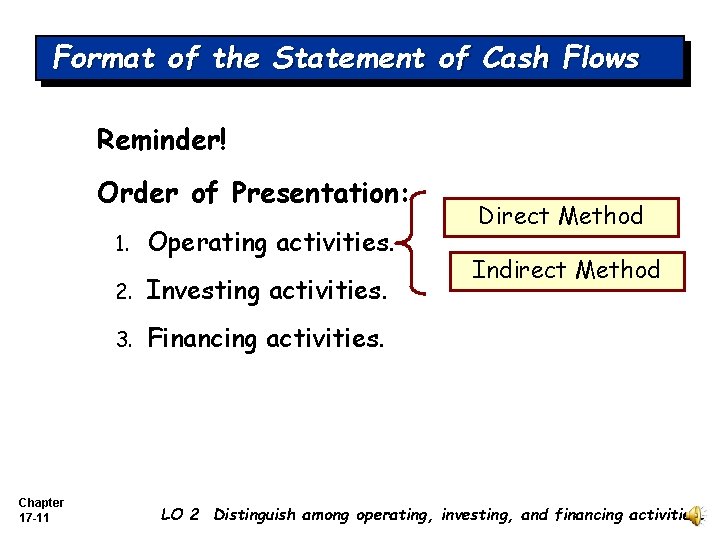
Format of the Statement of Cash Flows Reminder! Order of Presentation: Chapter 17 -11 1. Operating activities. 2. Investing activities. 3. Financing activities. Direct Method Indirect Method LO 2 Distinguish among operating, investing, and financing activities.
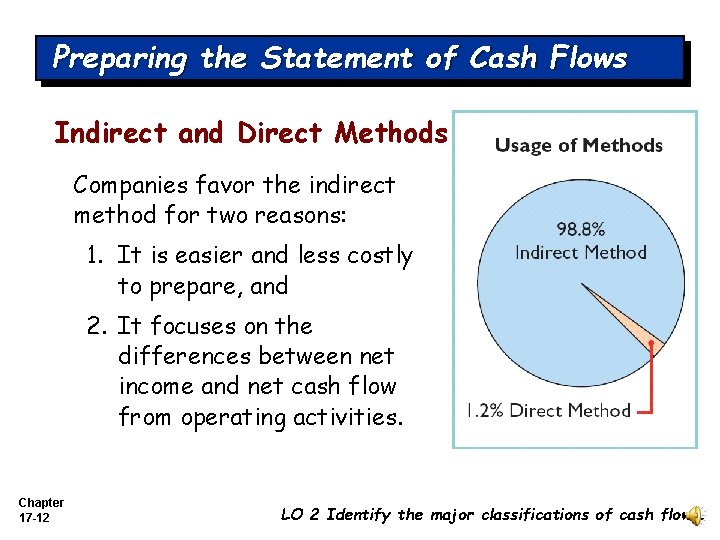
Preparing the Statement of Cash Flows Indirect and Direct Methods Companies favor the indirect method for two reasons: 1. It is easier and less costly to prepare, and 2. It focuses on the differences between net income and net cash flow from operating activities. Chapter 17 -12 LO 2 Identify the major classifications of cash flows.
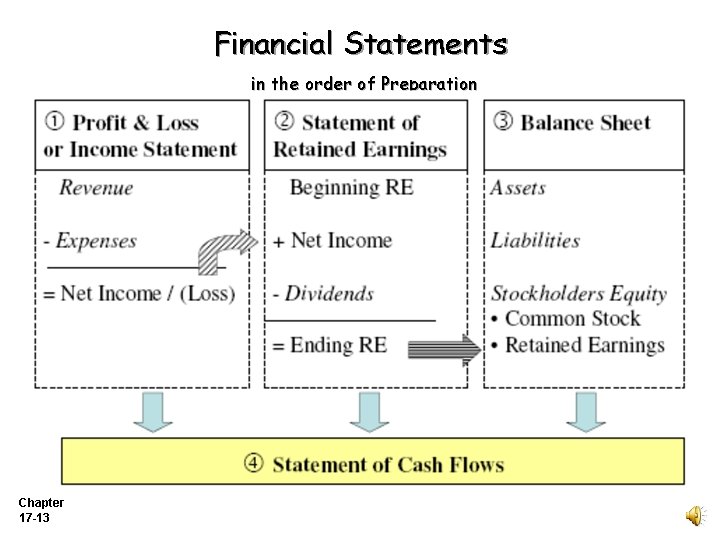
Financial Statements in the order of Preparation Chapter 17 -13
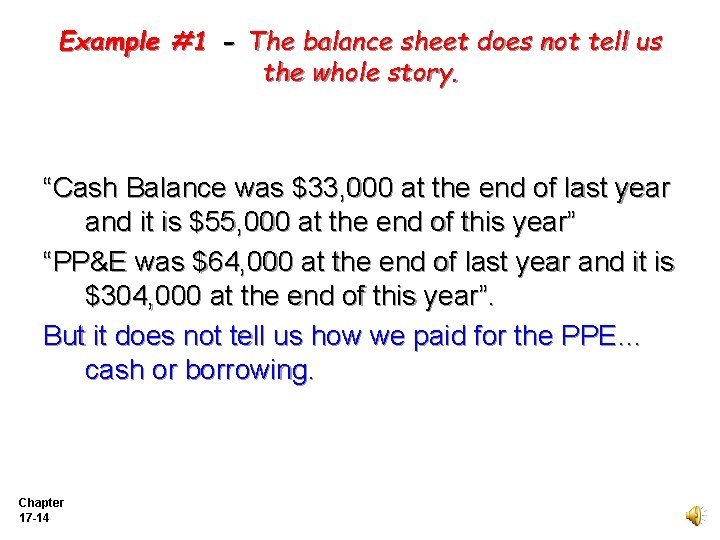
Example #1 - The balance sheet does not tell us the whole story. “Cash Balance was $33, 000 at the end of last year and it is $55, 000 at the end of this year” “PP&E was $64, 000 at the end of last year and it is $304, 000 at the end of this year”. But it does not tell us how we paid for the PPE… cash or borrowing. Chapter 17 -14
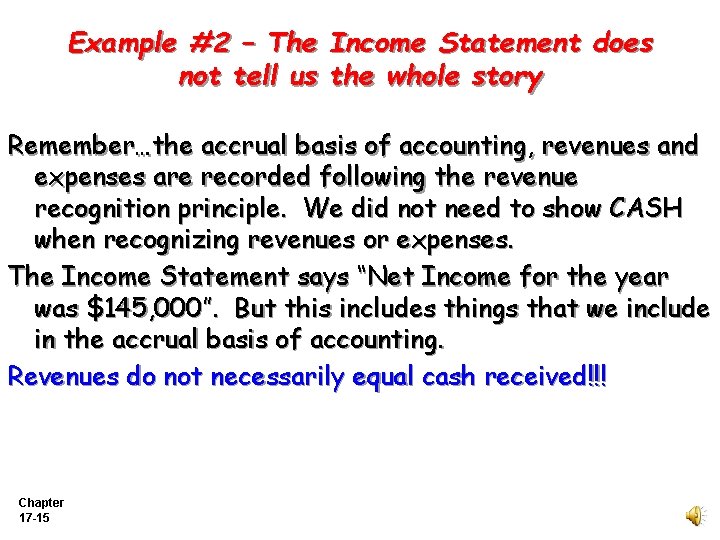
Example #2 – The Income Statement does not tell us the whole story Remember…the accrual basis of accounting, revenues and expenses are recorded following the revenue recognition principle. We did not need to show CASH when recognizing revenues or expenses. The Income Statement says “Net Income for the year was $145, 000”. But this includes things that we include in the accrual basis of accounting. Revenues do not necessarily equal cash received!!! Chapter 17 -15
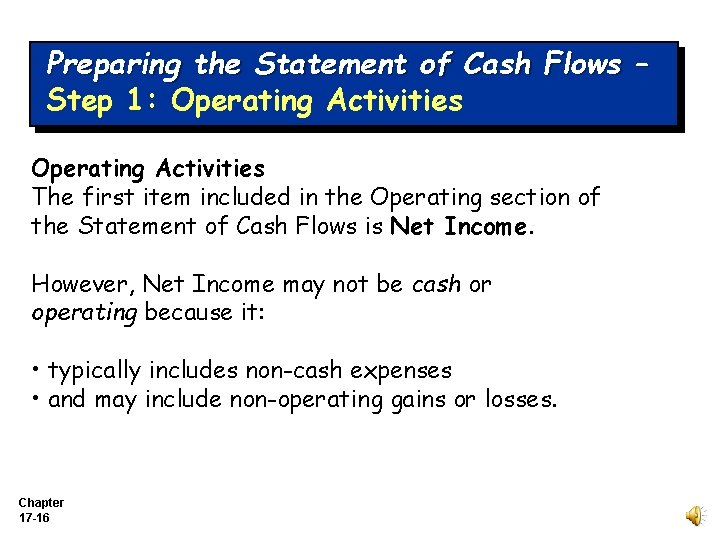
Preparing the Statement of Cash Flows – Step 1: Operating Activities The first item included in the Operating section of the Statement of Cash Flows is Net Income. However, Net Income may not be cash or operating because it: • typically includes non-cash expenses • and may include non-operating gains or losses. Chapter 17 -16
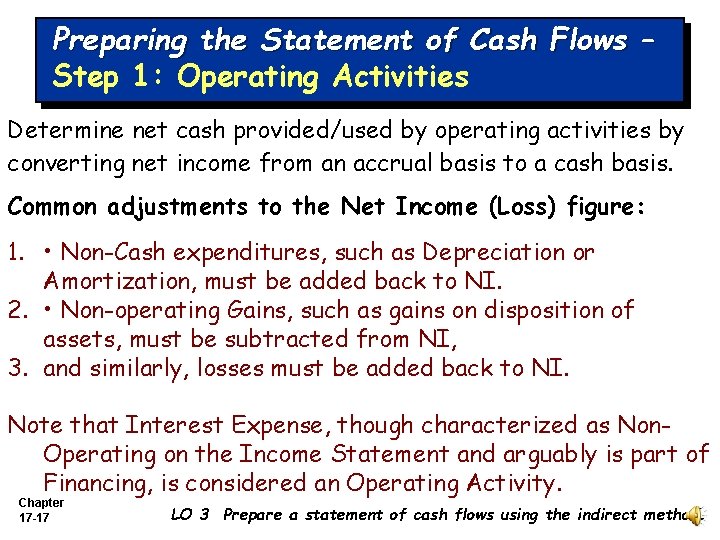
Preparing the Statement of Cash Flows – Step 1: Operating Activities Determine net cash provided/used by operating activities by converting net income from an accrual basis to a cash basis. Common adjustments to the Net Income (Loss) figure: 1. • Non-Cash expenditures, such as Depreciation or Amortization, must be added back to NI. 2. • Non-operating Gains, such as gains on disposition of assets, must be subtracted from NI, 3. and similarly, losses must be added back to NI. Note that Interest Expense, though characterized as Non. Operating on the Income Statement and arguably is part of Financing, is considered an Operating Activity. Chapter 17 -17 LO 3 Prepare a statement of cash flows using the indirect method.
SCF Indirect Method Step 1: Operating Activities Non-cash Items – Depreciation Gains and Losses Chapter 17 -18
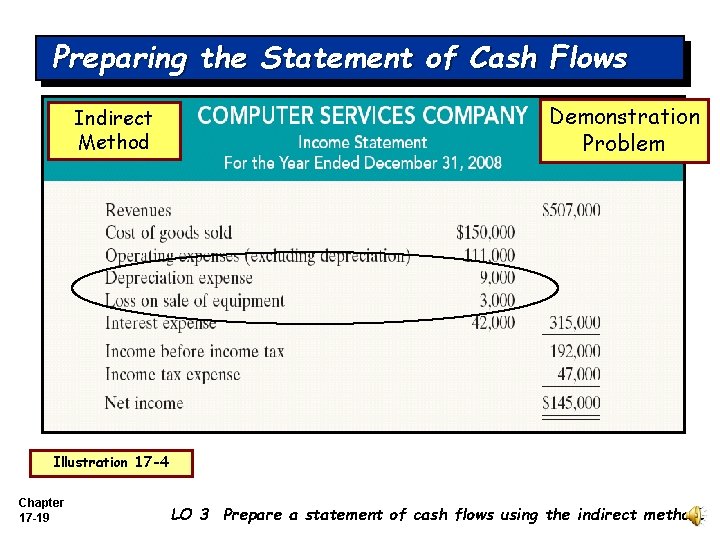
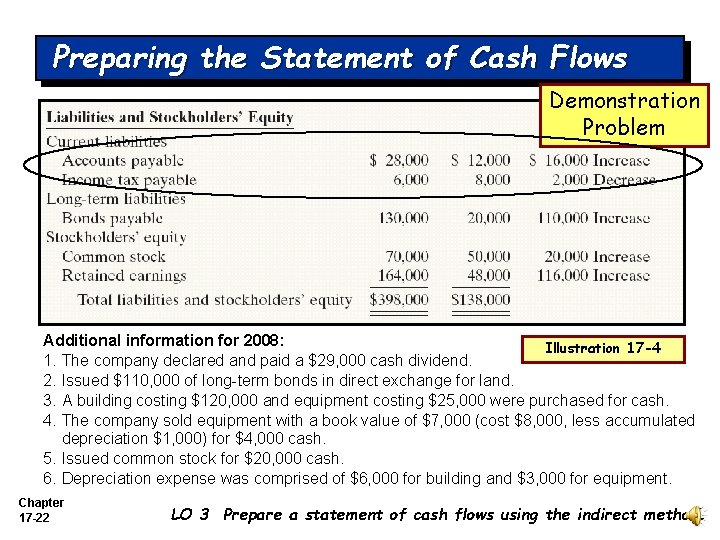
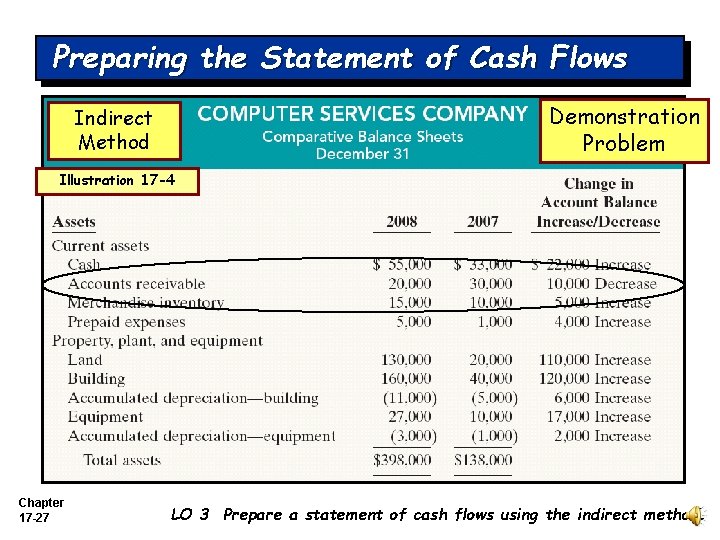
Preparing the Statement of Cash Flows Indirect Method Demonstration Problem Illustration 17 -4 Chapter 17 -19 LO 3 Prepare a statement of cash flows using the indirect method.
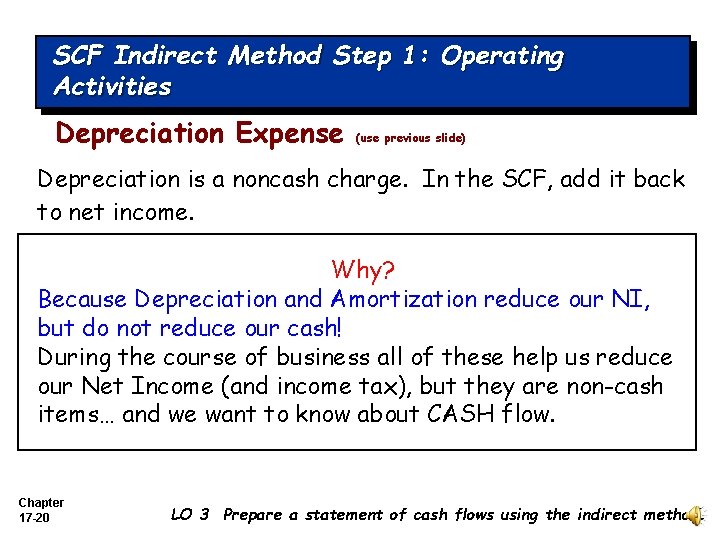
SCF Indirect Method Activities Step 1: Operating Activities Depreciation Expense (use previous slide) Depreciation is a noncash charge. In the SCF, add it back to net income. Why? Because Depreciation and Amortization reduce our NI, but do not reduce our cash! During the course of business all of these help us reduce our Net Income (and income tax), but they are non-cash items… and we want to know about CASH flow. Chapter 17 -20 LO 3 Prepare a statement of cash flows using the indirect method.
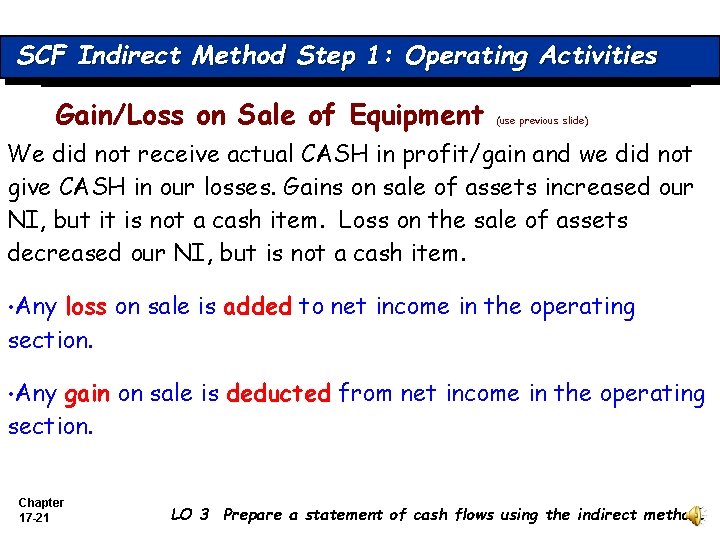
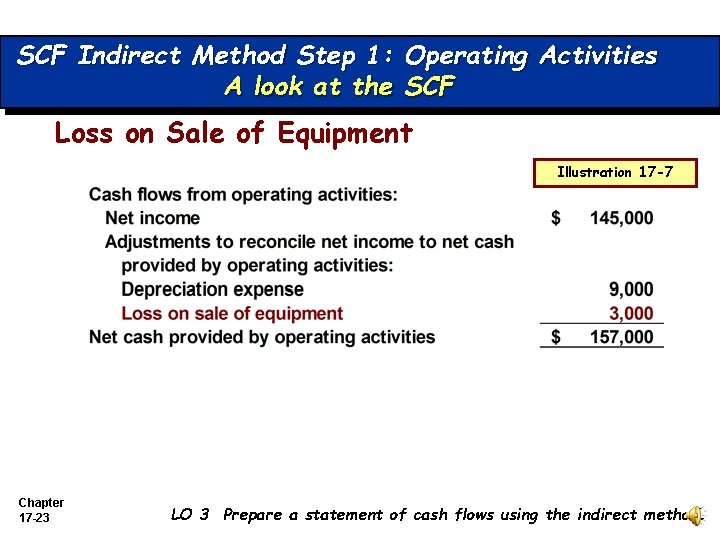
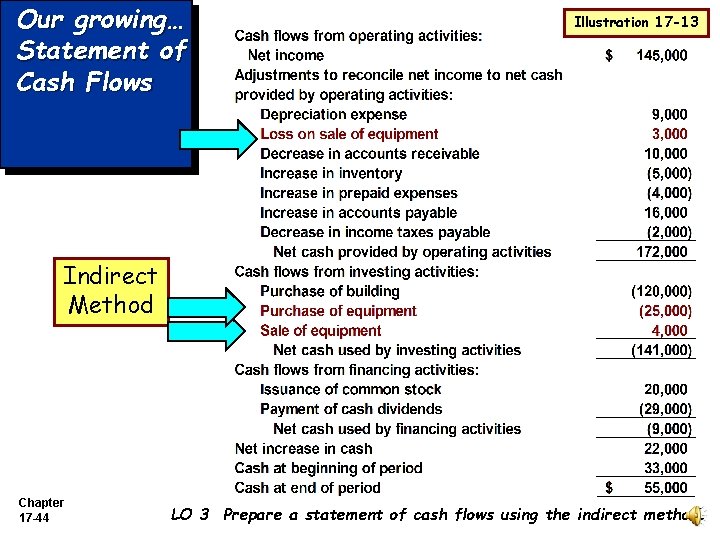
SCF Indirect Method Step 1: Operating Activities Gain/Loss on Sale of Equipment (use previous slide) We did not receive actual CASH in profit/gain and we did not give CASH in our losses. Gains on sale of assets increased our NI, but it is not a cash item. Loss on the sale of assets decreased our NI, but is not a cash item. • Any loss on sale is added to net income in the operating section. • Any gain on sale is deducted from net income in the operating section. Chapter 17 -21 LO 3 Prepare a statement of cash flows using the indirect method.
Preparing the Statement of Cash Flows Demonstration Problem Additional information for 2008: Illustration 17 -4 1. The company declared and paid a $29, 000 cash dividend. 2. Issued $110, 000 of long-term bonds in direct exchange for land. 3. A building costing $120, 000 and equipment costing $25, 000 were purchased for cash. 4. The company sold equipment with a book value of $7, 000 (cost $8, 000, less accumulated depreciation $1, 000) for $4, 000 cash. 5. Issued common stock for $20, 000 cash. 6. Depreciation expense was comprised of $6, 000 for building and $3, 000 for equipment. Chapter 17 -22 LO 3 Prepare a statement of cash flows using the indirect method.
SCF Indirect Method Step 1: Operating Activities A look at the SCF Loss on Sale of Equipment Illustration 17 -7 Chapter 17 -23 LO 3 Prepare a statement of cash flows using the indirect method.
SCF Indirect Method Step 1: Operating Activities Non-cash Items Chapter 17 -24
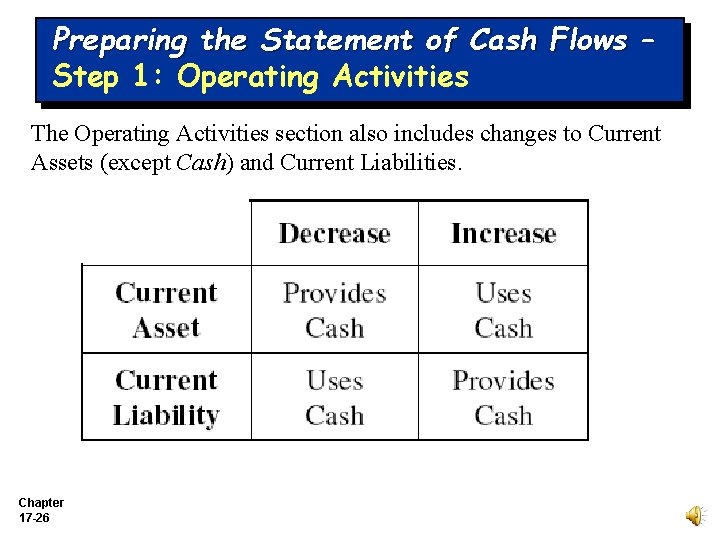
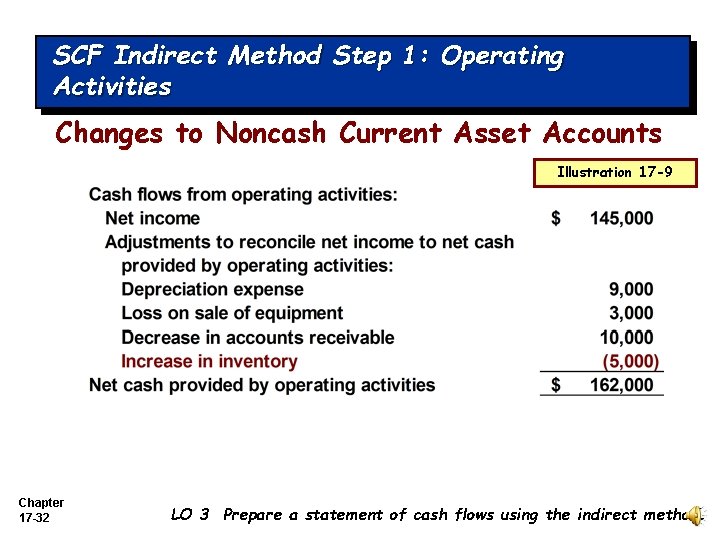
SCF Indirect Method Step 1: Operating Activities Changes to Noncash Current Asset Accounts General Rule: Changes to non-cash asset and liability accounts need to be adjusted. • Increases in current asset accounts need to be deducted from NI on SCF • Decreases in current asset accounts need to be added to NI on SCF Chapter 17 -25 LO 3 Prepare a statement of cash flows using the indirect method.
Preparing the Statement of Cash Flows – Step 1: Operating Activities The Operating Activities section also includes changes to Current Assets (except Cash) and Current Liabilities. Chapter 17 -26
Preparing the Statement of Cash Flows Demonstration Problem Indirect Method Illustration 17 -4 Chapter 17 -27 LO 3 Prepare a statement of cash flows using the indirect method.
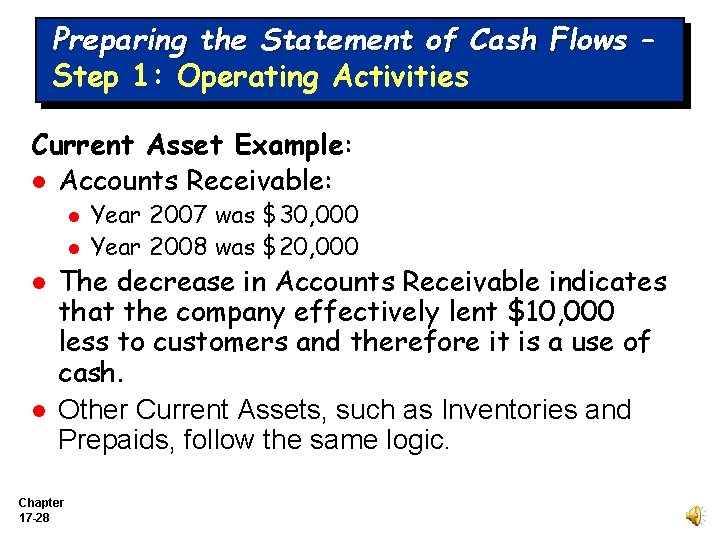
Preparing the Statement of Cash Flows – Step 1: Operating Activities Current Asset Example: l Accounts Receivable: l l Year 2007 was $30, 000 Year 2008 was $20, 000 The decrease in Accounts Receivable indicates that the company effectively lent $10, 000 less to customers and therefore it is a use of cash. Other Current Assets, such as Inventories and Prepaids, follow the same logic. Chapter 17 -28
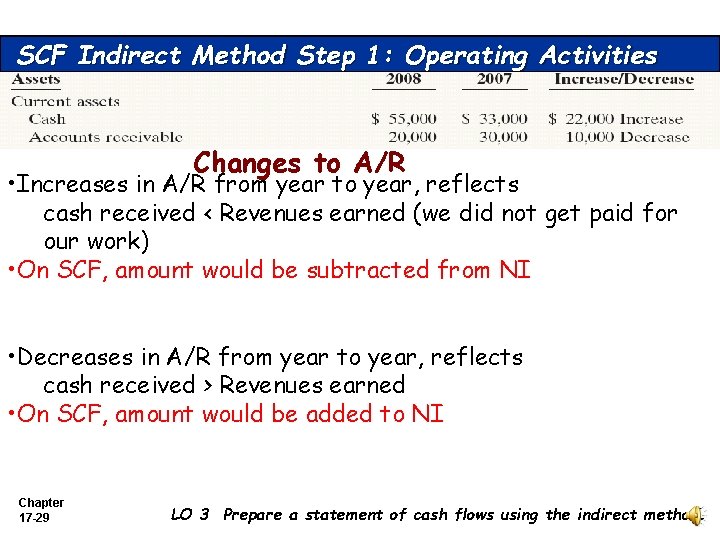
SCF Indirect Method Step 1: Operating Activities Changes to A/R • Increases in A/R from year to year, reflects cash received < Revenues earned (we did not get paid for our work) • On SCF, amount would be subtracted from NI • Decreases in A/R from year to year, reflects cash received > Revenues earned • On SCF, amount would be added to NI Chapter 17 -29 LO 3 Prepare a statement of cash flows using the indirect method.
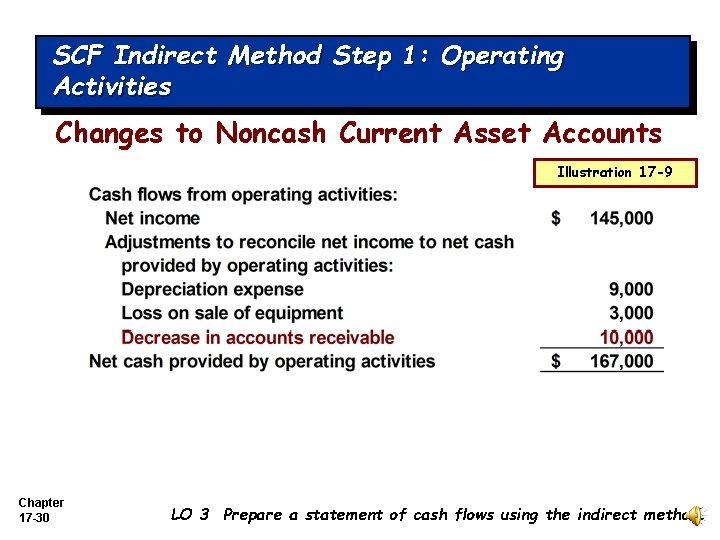
SCF Indirect. Activities Method Step 1: Operating Activities Changes to Noncash Current Asset Accounts Illustration 17 -9 Chapter 17 -30 LO 3 Prepare a statement of cash flows using the indirect method.
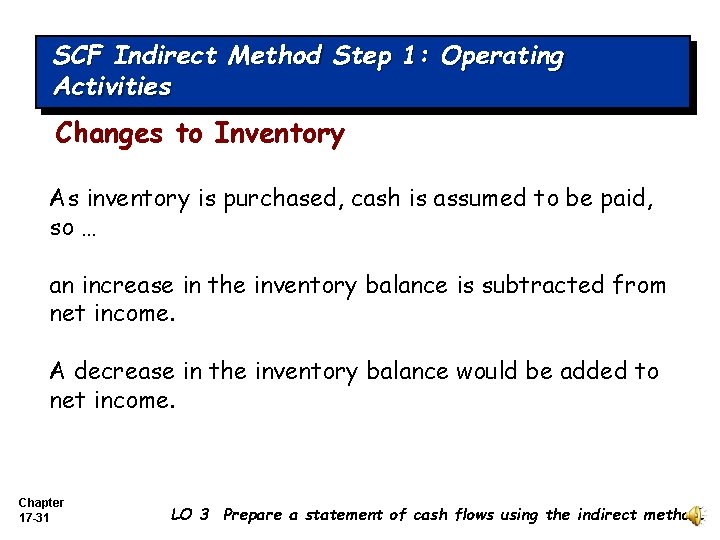
SCF Indirect. Activities Method Step 1: Operating Activities Changes to Inventory As inventory is purchased, cash is assumed to be paid, so … an increase in the inventory balance is subtracted from net income. A decrease in the inventory balance would be added to net income. Chapter 17 -31 LO 3 Prepare a statement of cash flows using the indirect method.
SCF Indirect. Activities Method Step 1: Operating Activities Changes to Noncash Current Asset Accounts Illustration 17 -9 Chapter 17 -32 LO 3 Prepare a statement of cash flows using the indirect method.
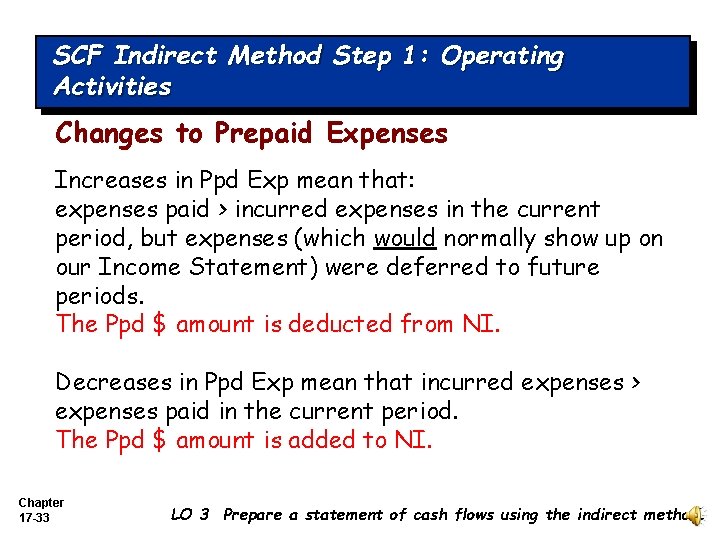
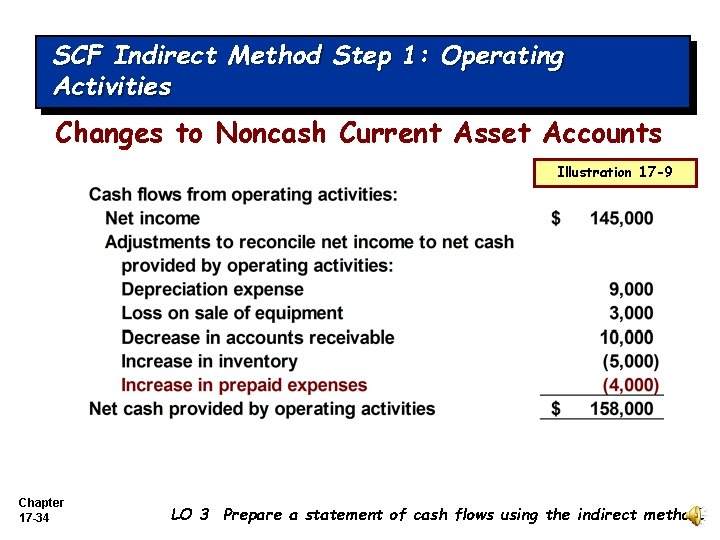
SCF Indirect. Activities Method Step 1: Operating Activities Changes to Prepaid Expenses Increases in Ppd Exp mean that: expenses paid > incurred expenses in the current period, but expenses (which would normally show up on our Income Statement) were deferred to future periods. The Ppd $ amount is deducted from NI. Decreases in Ppd Exp mean that incurred expenses > expenses paid in the current period. The Ppd $ amount is added to NI. Chapter 17 -33 LO 3 Prepare a statement of cash flows using the indirect method.
SCF Indirect. Activities Method Step 1: Operating Activities Changes to Noncash Current Asset Accounts Illustration 17 -9 Chapter 17 -34 LO 3 Prepare a statement of cash flows using the indirect method.
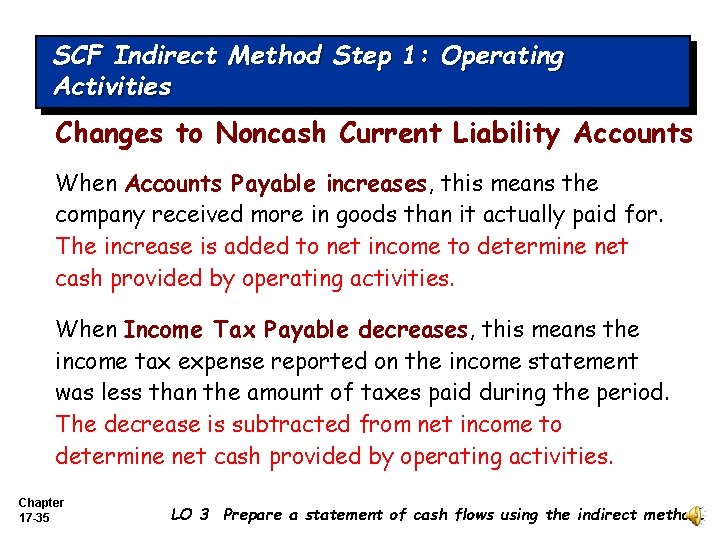
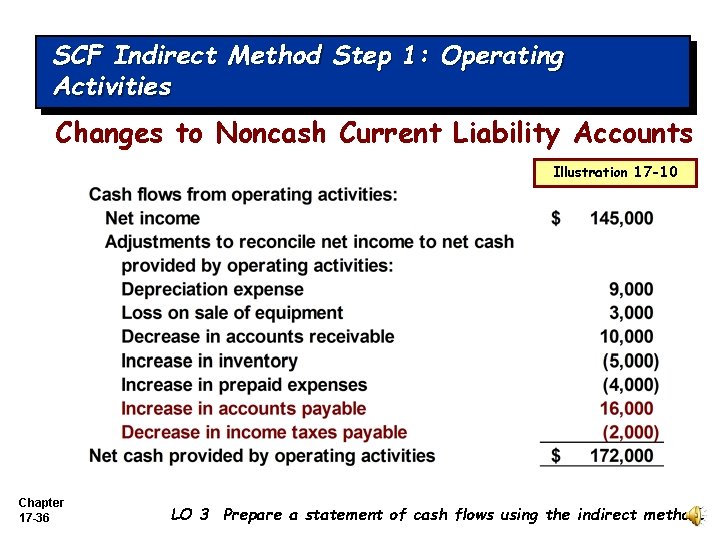
SCF Indirect. Activities Method Step 1: Operating Activities Changes to Noncash Current Liability Accounts When Accounts Payable increases, this means the company received more in goods than it actually paid for. The increase is added to net income to determine net cash provided by operating activities. When Income Tax Payable decreases, this means the income tax expense reported on the income statement was less than the amount of taxes paid during the period. The decrease is subtracted from net income to determine net cash provided by operating activities. Chapter 17 -35 LO 3 Prepare a statement of cash flows using the indirect method.
SCF Indirect. Activities Method Step 1: Operating Activities Changes to Noncash Current Liability Accounts Illustration 17 -10 Chapter 17 -36 LO 3 Prepare a statement of cash flows using the indirect method.
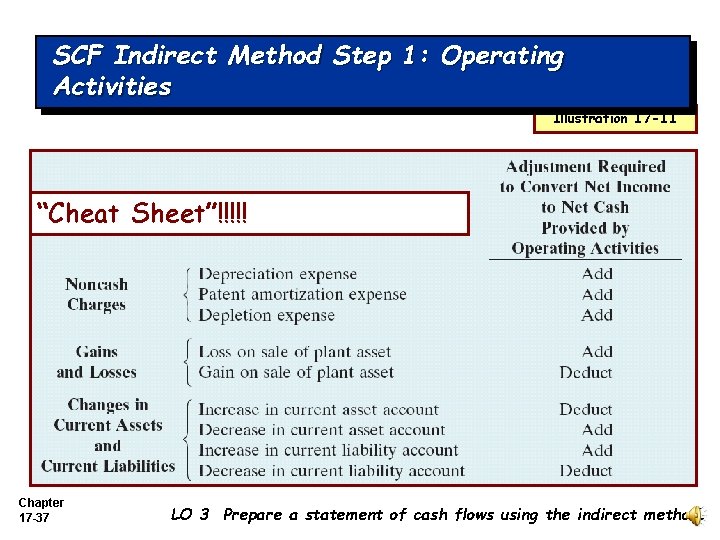
SCF Indirect. Activities Method Step 1: Operating Activities Illustration 17 -11 “Cheat Sheet”!!!!! Chapter 17 -37 LO 3 Prepare a statement of cash flows using the indirect method.
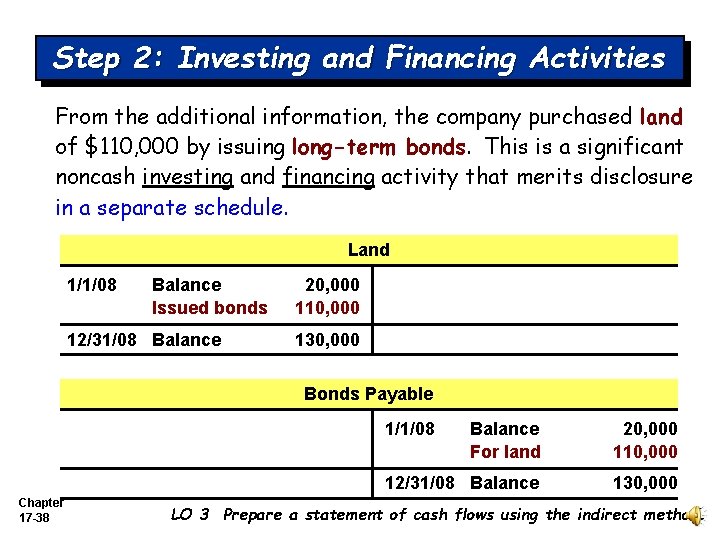
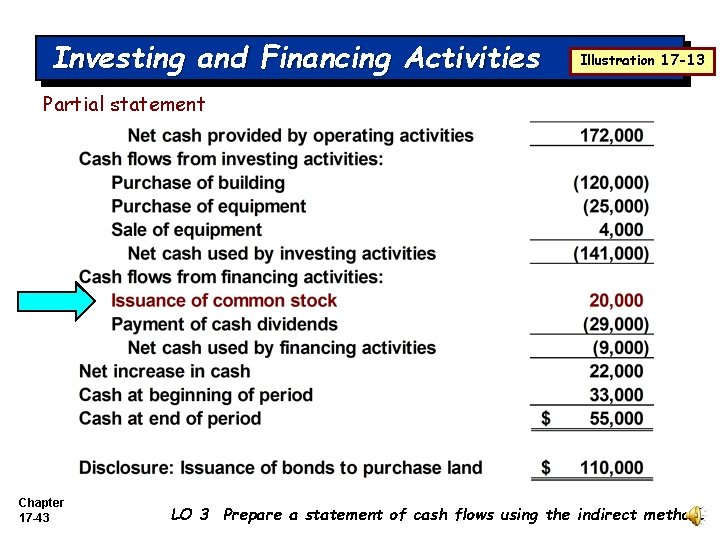
Step 2: Investing and Financing Activities From the additional information, the company purchased land of $110, 000 by issuing long-term bonds. This is a significant noncash investing and financing activity that merits disclosure in a separate schedule. Land 1/1/08 Balance Issued bonds 12/31/08 Balance 20, 000 110, 000 130, 000 Bonds Payable 1/1/08 Chapter 17 -38 Balance For land 20, 000 110, 000 12/31/08 Balance 130, 000 LO 3 Prepare a statement of cash flows using the indirect method.
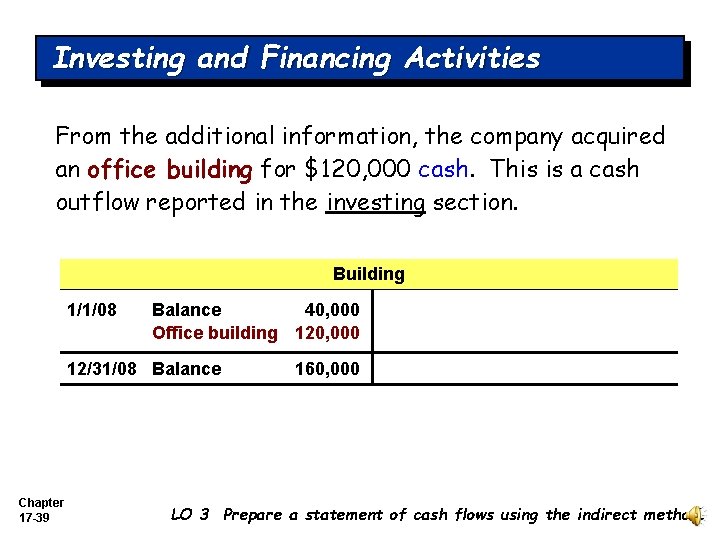
Investing and Financing Activities From the additional information, the company acquired an office building for $120, 000 cash. This is a cash outflow reported in the investing section. Building 1/1/08 Balance 40, 000 Office building 120, 000 12/31/08 Balance Chapter 17 -39 160, 000 LO 3 Prepare a statement of cash flows using the indirect method.
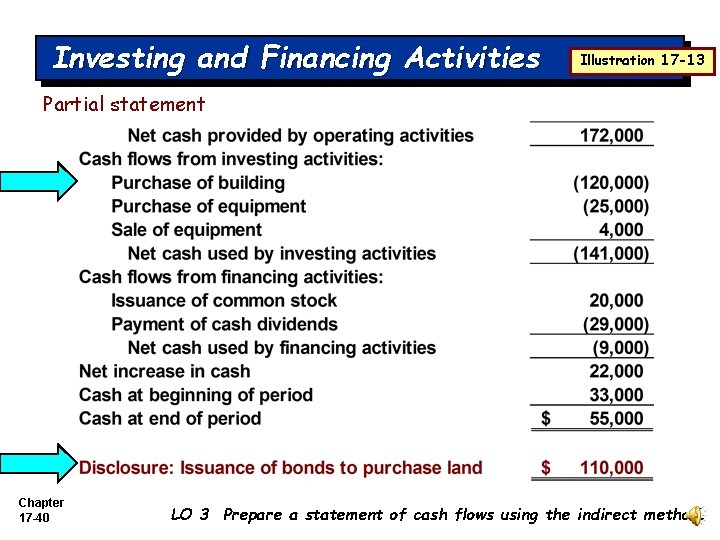
Investing and Financing Activities Illustration 17 -13 Partial statement Chapter 17 -40 LO 3 Prepare a statement of cash flows using the indirect method.
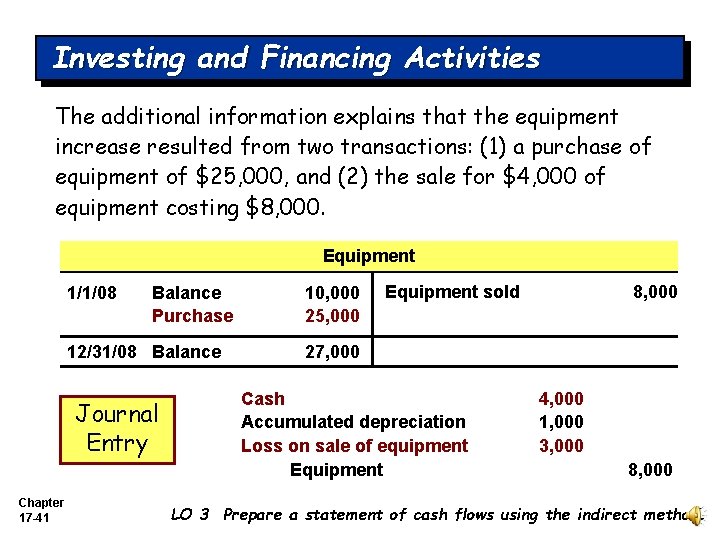
Investing and Financing Activities The additional information explains that the equipment increase resulted from two transactions: (1) a purchase of equipment of $25, 000, and (2) the sale for $4, 000 of equipment costing $8, 000. Equipment 1/1/08 Balance Purchase 12/31/08 Balance Journal Entry Chapter 17 -41 10, 000 25, 000 Equipment sold 8, 000 27, 000 Cash Accumulated depreciation Loss on sale of equipment Equipment 4, 000 1, 000 3, 000 8, 000 LO 3 Prepare a statement of cash flows using the indirect method.
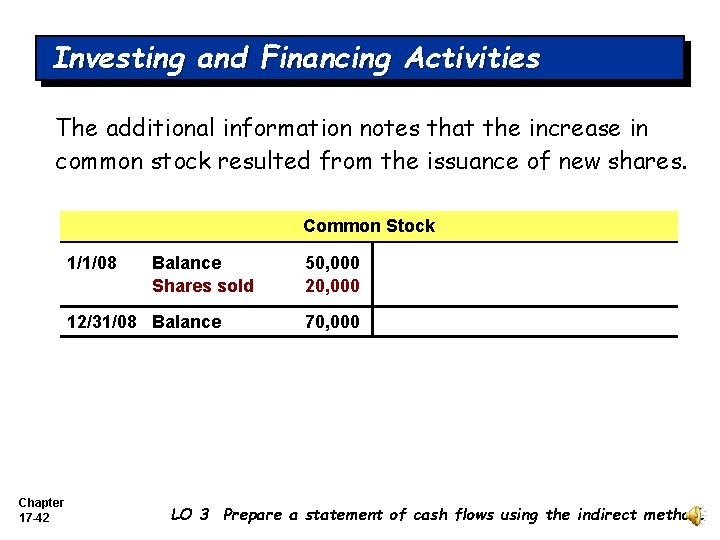
Investing and Financing Activities The additional information notes that the increase in common stock resulted from the issuance of new shares. Common Stock 1/1/08 Balance Shares sold 12/31/08 Balance Chapter 17 -42 50, 000 20, 000 70, 000 LO 3 Prepare a statement of cash flows using the indirect method.
Investing and Financing Activities Illustration 17 -13 Partial statement Chapter 17 -43 LO 3 Prepare a statement of cash flows using the indirect method.
Our growing… Statement of Cash Flows Illustration 17 -13 Indirect Method Chapter 17 -44 LO 3 Prepare a statement of cash flows using the indirect method.